
Journalist

Lee Hugh
=
-
 KB Securities Q1 Operating Profit Jumps 101.7% to 453.1 Billion Won KB Securities said Wednesday that its first-quarter operating profit rose 101.7% from a year earlier to 453.1 billion won, based on preliminary results. Revenue climbed 179.5% to 8.3509 trillion won, and net profit increased 92.8% to 350.2 billion won. The company said market volatility has persisted as domestic and overseas uncertainties have increased, but it has continued to lead the market on the back of steady performance centered on investment banking. It said its competitiveness in the global debt capital markets has continued to expand, citing lead management of foreign exchange stabilization fund bonds and “Kimchi bonds.” It also said it strengthened its position through four domestic refinancing deals for high-quality acquisition financing. KB Securities added that its wealth management business also grew, saying individual clients’ assets under management increased as it provided timely products and content in response to gains in the domestic stock market.* This article has been translated by AI. 2026-04-23 18:12:17
 -
 Friday Forecast: Highs Near 77 Degrees, Big Day-Night Temperature Swings Friday the 24th is expected to be mostly sunny nationwide, with daytime temperatures rising to around 25 degrees Celsius, bringing a taste of early summer. The Korea Meteorological Administration said Thursday that morning lows will range from 4 to 11 degrees Celsius, with daytime highs of 15 to 25 degrees. That is similar to, or slightly higher than, seasonal averages of 5 to 11 degrees for lows and 18 to 22 degrees for highs. Forecast morning lows by major city are: Seoul 8C, Incheon 10C, Chuncheon 5C, Gangneung 7C, Daejeon 8C, Daegu 6C, Jeonju 8C, Gwangju 8C, Busan 11C and Jeju 12C. Forecast highs are: Seoul 24C, Incheon 22C, Chuncheon 24C, Gangneung 17C, Daejeon 24C, Daegu 22C, Jeonju 24C, Gwangju 23C, Busan 20C and Jeju 18C. A KMA official said the clear weather will be driven by a high-pressure system moving from near China’s Shandong Peninsula toward the East Sea. The official warned that inland areas could see day-night temperature differences of around 20 degrees, urging people to dress accordingly. Fine dust levels are expected to range from “good” to “moderate” across the country due to smooth atmospheric circulation.* This article has been translated by AI. 2026-04-23 18:11:32
 -
 Celltrion Starts Patient Dosing for Three ADC Cancer Drug Candidates Celltrion begins patient dosing for all three ADC cancer drug candidates Celltrion said April 23 that all three of its antibody-drug conjugate (ADC)-based cancer drug candidates have entered the patient-dosing stage. The candidates now being dosed are CT‑P70, CT‑P71 and CT‑P73. All three received U.S. Food and Drug Administration approval last year for investigational new drug (IND) applications for Phase 1 trials, the company said. Patient dosing for CT‑P70 and CT‑P71 began in the second half of last year, and CT‑P73 dosing began in the first quarter of this year. Celltrion said preclinical studies confirmed the candidates’ mechanisms of action and safety. In Phase 1, it plans to evaluate dose-by-dose safety and pharmacokinetic characteristics. The company is also developing a multispecific antibody candidate, CT‑P72. It is currently recruiting patients and could begin dosing the first patient as early as next month. Korea Pharmaceutical and Bio-Pharma Association adds hands-on training on U.S. life sciences patents The Korea Pharmaceutical and Bio-Pharma Association said April 23 it will launch a practical training course on responding to U.S. life sciences patent issues on June 12 at the association’s fourth-floor auditorium. The association said the program is designed to strengthen companies’ ability to manage U.S. patent risks that can arise during global expansion, including technology licensing, partnering and overseas clinical trials. It cited cases in which negotiations collapsed after businesses moved forward without freedom-to-operate (FTO) analysis, or deals were delayed during due diligence because of intellectual property issues. The course will have three sessions: the reality of U.S. life sciences patent disputes and core FTO concepts and practical considerations; U.S. patent avoidance strategies and global dispute trends; and global IP strategy and commercialization preparation at the research and development stage. The lecture will be led by attorney Nam In-young, a New York and California-licensed lawyer and U.S. patent litigation specialist, the association said. The program is aimed at R&D and IP staff, business development and corporate planning personnel, and executives and decision-makers at life sciences companies considering or pursuing entry into the U.S. market. Enrollment will be capped at 50 participants. Handok holds plogging cleanup campaign in Busan with employees Handok said April 23 that it held an environmental cleanup “plogging” volunteer event with employees on April 22 around Busan Citizens Park. The company said the campaign, titled “Pick up for me, pick up for Earth,” was organized with the Busan Volunteer Center to mark Earth Day on April 22. It also aimed to spruce up the area ahead of the 20th National Para Student Sports Games and the 55th National Youth Sports Games. About 30 Handok employees, including sales staff working in Busan, took part, the company said. It plans to continue individual plogging through May 24 using the Busan Volunteer Bank application. Chong Kun Dang Gochon Foundation names three artists for 2026 program, expands support The Chong Kun Dang Gochon Foundation said April 23 it selected three artists — Kim Myeong-chan, Park Geurim and Yeom Ji-hee — as this year’s artists and held a certificate presentation ceremony April 22 at Chong Kun Dang’s headquarters in Chungjeong-ro, Seoul. The foundation said the artists were recognized for experimentation and growth potential within contemporary painting. The selections were made through a closed review by a panel of art experts. Each artist will receive 10 million won a year in creation grants for three years, and in the final year will be given an opportunity to present results through a curated exhibition, the foundation said. The “Chong Kun Dang Gochon Art Award” is a cultural and arts social contribution program launched at the suggestion of Chairman Lee Jang-han to support emerging artists with growth potential. Since 2012, it has been run with Chong Kun Dang Holdings, the Korea Mecenat Association and Art Space Huga, and has discovered and supported a total of 45 artists, the foundation said.* This article has been translated by AI. 2026-04-23 18:10:18
 -
 South Korea Requests Police Probe Into Illegal Vehicle Software Changes South Korea’s Ministry of Land, Infrastructure and Transport has asked police to investigate cases in which vehicle software was altered without authorization. In a press note released on the 23rd, the ministry said unauthorized software changes have continued to occur and it has requested a probe by the National Police Agency. The police agency plans to begin an investigation after receiving related materials from automakers, the ministry said. The ministry said it had already warned last month that illegally modifying software that affects safe vehicle operation is prohibited, and it has been monitoring for violations. Automakers are also responding under the vehicle cybersecurity certification system, known as CSMS, and are taking steps to immediately disable vehicles remotely if users alter software without authorization, the ministry said. As vehicles shift to connected cars and software-defined vehicles, safety oversight of automotive software is being strengthened internationally, the ministry said. It added that under Article 35 of the Automobile Management Act, unauthorized changes to software that affects safe operation are strictly restricted. * This article has been translated by AI. 2026-04-23 18:09:19
 -
 Retail Trading in Single-Stock Futures and Options in South Korea Triples Amid Rally As South Korea’s stock market rally continues, retail investors are increasing high-risk leveraged bets, with trading in derivatives tied to individual stocks surging more than threefold from a year earlier. The rise in debt-funded investing has also accelerated, prompting warnings that household investor risk is approaching dangerous levels. According to the Korea Exchange, retail investors traded 276.605 trillion won ($276,605,000,000,000) in domestic single-stock futures from January through April 21. That was about 3.44 times the 80.3073 trillion won ($80,307,300,000,000) recorded in the same period last year. Retail trading in stock options totaled 230 billion won ($230,000,000,000), up 5.85 times from 39.3 billion won ($39,300,000,000) a year earlier. Derivatives linked to individual stocks are generally considered riskier than index-based products because they tend to be more volatile. The jump reflects both expectations for further gains and increased volatility, analysts said. Derivatives allow investors to bet on either rising or falling prices and can be used for hedging, but they also attract money seeking profits when price swings widen. With relatively small margin requirements, investors can take large positions. Margin rates vary, but current conditions allow leverage of roughly three to 10 times, a range that can expand or shrink with market conditions. The concern is that heavier use of leverage can amplify losses. With 10-times leverage in futures, a 10% drop in the underlying asset can wipe out the entire investment. Options positions can also generate rapidly growing losses if the trade moves the wrong way, and some structures can produce losses exceeding the initial principal. Leverage is also rising through margin borrowing. The Korea Financial Investment Association said outstanding margin loans stood at about 34.4694 trillion won ($34,469,400,000,000) as of April 21, repeatedly setting record highs as more individuals borrow to invest amid the market’s climb. Such debt-backed investing can support prices in a rising market, but it can deepen shocks when sentiment turns. If share prices fall, collateral values drop, and positions can be forced into liquidation, including broker-initiated sell-offs, potentially accelerating declines. Retail investors, the report said, posted losses every year over the five-year period from 2020 to 2024. Experts urged individuals to focus less on short-term gains and better understand the risks embedded in leveraged products. “If leveraged investing surges during a period of rising volatility, losses can spread quickly even from a small shock,” a financial investment industry official said. “In a rising market, repeated profit-taking can make it easy to underestimate risk. When the market’s direction changes, losses can expand sharply, so investors should be cautious about excessive leverage.”* This article has been translated by AI. 2026-04-23 18:07:12
 -
 Samsung heiress' ex-husband serving jail term in bizarre case involving shaman girlfriend SEOUL, April 23 (AJP) - Im Woo-jae, the ex-husband of Samsung heiress Lee Boo-jin and former adviser at the conglomerate's minor subsidiary Samsung Electro-Mechanics, has been serving a one-year prison sentence, it was belatedly revealed on Thursday. Lee was found guilty of obstruction of official duties after getting caught up in a bizarre case involving his girlfriend, who is a shaman, according legal sources. He apparently deceived officials while attempting to shield his girlfriend who was involved in the confinement and assault of a woman in her 80s last year. The shaman, who had a dispute with the elderly woman's son, allegedly arranged for the victim to be kidnapped and beaten by her own grandson on the outskirts of Seoul. But the elderly woman managed to escape and went to the police, and Im's girlfriend allegedly staged a fake suicide attempt to conceal her crime, only for the truth to be revealed later. The shaman was sentenced to six years in prison. Although Im did not carry out the violence himself, a judge ruled that he knew about the assault and convicted him of obstructing justice for helping to cover up his girlfriend's crime. Im, who was previously married to Lee, the eldest daughter of the late Samsung chairman Lee Kun-hee, divorced in 2020 after a lengthy legal battle over substantial alimony and custody of their son. 2026-04-23 18:06:59
 -
 Hyundai Motor posts record first-quarter revenue as profit drops on tariffs, higher costs Hyundai Motor Co. said geopolitical uncertainty and rising costs weighed on its first-quarter results, even as sales in its biggest export market, the United States, held up. The automaker pointed to tariffs, higher raw material prices and currency moves as key drags, and said it plans to lean more on hybrids and other eco-friendly models to regain momentum. In a preliminary earnings filing on Wednesday, Hyundai said first-quarter operating profit on a consolidated basis fell 30.8% from a year earlier to 2.5147 trillion won. Revenue rose 3.4% to 45.9389 trillion won, the highest ever for a first quarter. While sales grew, profitability weakened. Hyundai said the continued burden of a 15% tariff, along with a weaker exchange rate tied to geopolitical risks and higher raw material prices, hit operating profit. With multiple cost pressures at once, operating profit fell by more than 1 trillion won from a year earlier. Lee Seung-jo, head of Hyundai’s planning and finance division, said raw material prices have surged since late last year, creating about a 200 billion won burden on first-quarter results. He said similar cost pressure could continue in the second quarter and that the company is preparing cost-cutting measures. Hyundai sold 976,219 vehicles worldwide in the first quarter, down 2.5% from a year earlier. The company attributed the decline to heightened geopolitical uncertainty that it said drove global auto demand down 7.2%. In the United States, Hyundai sold 243,572 vehicles, up 0.3% from a year earlier. Total overseas sales fell 2.1% to 817,153 vehicles. Domestic sales dropped 4.4% to 159,066 vehicles, which Hyundai said reflected demand tied to waiting lists for new models and production disruptions after a fire at its parts plant in Daejeon affected some lines. Hyundai said sales of electric and hybrid models were strong. The share of eco-friendly vehicles and hybrids in global sales rose to quarterly highs of 24.9% and 17.8%, respectively, as consumer demand shifted toward hybrids amid a slowdown in electric-vehicle growth. Looking ahead, Hyundai said it will continue to improve its product mix by focusing on higher value-added models such as hybrids. It plans to expand its lineup, including a refreshed Grandeur, and to diversify sales channels by strengthening its push in China and other emerging markets. Hyundai also said it will keep expanding its electrified lineup, including new Ioniq models, range-extended electric vehicles and sedans. It plans to deploy its software-defined vehicle (SDV) “face car,” a test vehicle, on some roads starting in the second half of this year.* This article has been translated by AI. 2026-04-23 18:06:05
 -
 SK hynix Profit Surge Fuels Bonus Pressure as Big Chip Investments Loom SK hynix has posted a record first-quarter operating profit of more than 37 trillion won, prompting talk that it could climb into the world’s No. 4 spot on an annual basis. But as earnings surge, management faces rising pressure from the labor union over performance bonuses, adding to the company’s burden. According to securities-industry consensus estimates released on April 23, SK hynix is projected to post 358.037 trillion won in revenue this year, with operating profit as high as 277.7 trillion won. If those forecasts are realized, SK hynix would rank around fourth globally, ahead of Microsoft (245 trillion won) and Alphabet (240 trillion won). Even with record results, executives are increasingly concerned as bonuses of “hundreds of millions of won per employee” come into view, potentially squeezing management flexibility. Under a labor-management agreement to allocate 10% of operating profit to profit-sharing bonuses, the company would already need to set aside about 3.76 trillion won based on first-quarter operating profit of 37.6103 trillion won. Divided among about 35,000 employees, that works out to an average bonus of about 100 million won per person based on first-quarter results alone. If annual operating profit exceeds 270 trillion won, the average payout would be about 650 million won per employee. That level would surpass the cost of building a single advanced production base. SK hynix on the previous day officially broke ground on its advanced packaging plant, P&T7, in Cheongju, North Chungcheong Province, with a total budget of 19 trillion won. The projected annual bonus pool would exceed the cost of constructing a next-generation flagship production site. The gap is also large compared with spending meant to secure the company’s future. SK hynix’s R&D investment last year totaled 6.7325 trillion won. The projected bonus pool would also exceed by more than 10 times the company’s total dividends of 2.1 trillion won for more than 1.19 million shareholders. SK hynix has major projects awaiting funding, including its new M15X fab in Cheongju and the Yongin semiconductor cluster, both requiring investments in the trillions of won. The company also needs sustained funding to develop and mass-produce next-generation high-bandwidth memory, or HBM, to meet demands from global customers including Nvidia. Industry experts say the semiconductor sector’s volatility means the company should focus on capital allocation for long-term survival rather than becoming complacent amid record earnings, prioritizing preparation for future downturns and investment in next-generation processes. Ahn Ki-hyeon, executive director of the Korea Semiconductor Industry Association, said, “Since semiconductors are a national security asset, the union also needs cooperation at a broader level for the company’s sustainable growth, rather than focusing on short-term gains in performance bonuses.”* This article has been translated by AI. 2026-04-23 18:05:12
 -
 SK hynix posts record Q1 operating profit as Hyundai Motor margin slides SK hynix posted its best quarterly results on record on surging demand for artificial intelligence chips, while Hyundai Motor saw profitability weaken despite higher sales, raising fresh concerns about Korea’s growing reliance on semiconductors. On the 23rd, SK hynix said first-quarter revenue rose to 52.5763 trillion won and operating profit to 37.6103 trillion won. That was up 198.1% and 405.5% from a year earlier, respectively, and marked a record for any quarter. Its operating margin reached 72%, the company said. The results were unusual for a seasonally slow period, helped by expanding AI infrastructure investment and a shift toward higher-value products. The boom could continue as AI demand broadens from training to real-time inference, strengthening the base for memory demand. Some in the securities industry have forecast SK hynix’s annual operating profit could exceed 200 trillion won, which would place it fourth globally. Hyundai Motor and Kia, however, showed weaker profitability even as sales grew. Hyundai Motor’s first-quarter revenue rose 3.4% from a year earlier to 45.9389 trillion won, but operating profit fell 30.8% to 2.5147 trillion won. Kia, which is set to report on the 24th, is expected to post operating profit of 2.2986 trillion won, down about 24%, according to the consensus estimate cited in the report. The two automakers posted record sales in the U.S. market, but tariff costs weighed heavily on earnings, the report said. Hyundai Motor said it spent 860 billion won on tariff costs in the first quarter. Kia’s tariff costs are estimated at 500 billion to 700 billion won. Other headwinds included higher oil prices tied to the Middle East war, rising raw material prices and a weaker currency. The report said a fire at a parts supplier in Daejeon caused production disruptions of about 30,000 vehicles, while Middle East risks added pressure to both logistics costs and the sales environment. With autos, a key export industry, also hit by worsening external conditions, the profit structure of Korean industry is becoming more concentrated in semiconductors, the report said. In an AI-driven industrial reshuffle, semiconductors have moved into an outsized-profit phase, while autos remain highly exposed to policy and cost variables, it added. Kim Pil-su, a professor in the Department of Future Automotive Engineering at Daelim University, said reliance on Samsung Electronics and SK hynix for AI semiconductors such as high-bandwidth memory, or HBM, means the semiconductor tilt is likely to persist for now. He added that uncertainty over auto tariffs continues and geopolitical risks in the Middle East are growing. 2026-04-23 18:04:17
 -
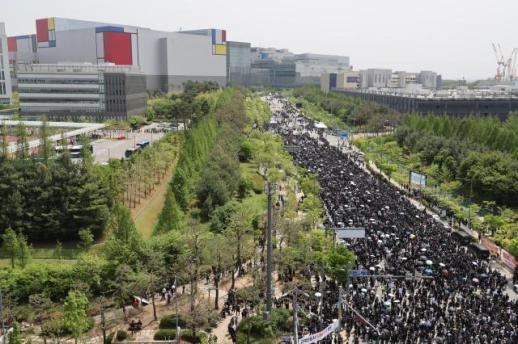 Samsung Elec's Pyeongtaek campus - protest instead of celebration of chip boom PYEONGTAEK, April 23 (AJP) -The usual soundtrack of the Samsung Electronics Pyeongtaek Campus—the low, constant hum of fabrication lines—was drowned out Thursday by a different cadence: tens of thousands of workers chanting in lockstep, their placards snapping in the wind as a bonus fight spilled into the open. At 2 p.m., the newly ascendant Samsung Electronics Enterprise Union—now the company’s first majority union—filled the forecourt with an estimated 40,000 members, a sea of dark jackets punctuated by white placards: “Change it transparently” and “Abolish the cap.” The slogans rose and fell in waves, each chant snapping into unison under the emcee’s cadence. From atop a crane, union chairman Choi Seung-ho delivered a speech overlooking the tightly packed crowd, underscoring the union’s sharpened leverage after securing legal worker representative status on April 15 with around 74,000 members. The union warned it would launch a general strike from May 21 to June 7 if negotiations fail. Earlier in the day, a small counter-protest by the Korea Shareholder Movement Headquarters drew just four participants, who argued that shareholders oppose what they called excessive bonus demands and potential risks to the semiconductor operation. 2026-04-23 18:03:37