
Journalist

Yuna Ryu
Julia37@ajupress.com
-
 As romance revives from recession in Korea, dating mimics reality TV SEOUL, April 30 (AJP) - For Jason Park, a corporate analyst in his mid-30s, the math of modern romance simply wasn’t adding up. Buried in work under lingering post-pandemic social atrophy, the prospect of a chance encounter felt less like a possibility and more like a statistical anomaly. "If I hadn't been there that day two years ago, I would still be wrapped up in work," Park says, glancing shyly at his girlfriend, Choi, a freelance announcer in her 30s. The pair met not through a serendipitous coffee spill or a mutual friend, but in the polished confines of a premium lounge bar—a curated "rotation dating" event designed for Seoul’s high-achieving singles. "That day, I didn’t just meet my life companion; I found a community." In South Korea, where the "dating desert" has become a matter of national discourse, romance is staging a comeback—not through traditional slow-burn courtships, but through high-end, highly structured social engineering. The statistics tell a story of romantic recession. As of 2024, nearly 75% of South Korean men aged 30 to 34 remain unmarried; for women in the same bracket, the figure sits at 58%. Yet, despite the narrative of a "non-marriage generation," the desire for partnership is rebounding. Recent data from the Planned Parenthood Federation of Korea shows that over 60% of single men and nearly half of single women express a desire to wed—a figure that has climbed for two consecutive years. This gap between desire and reality has birthed a burgeoning industry of "curated" dating. These are not the sterile, interview-like sessions of traditional matchmaking agencies. Instead, they are immersive experiences that feel, by design, like a localized episode of Heart Signal. From Screen to Script At a private lounge in Gangnam on a recent April afternoon, the air is thick with the "syntax of curated romance." Here, 40 participants in coordinated black-and-white attire mingle over wine. The atmosphere is less "blind date" and more "reality TV set." "The traditional setup invests an entire evening in a single proposition that may immediately fail," explains Helen Shin, a professor of Media and Communications at Korea University. "The rotation format diversifies that investment across many short exposures." Shin calls this "emotional portfolio logic." By meeting 20 people in one evening, the psychological sting of rejection is diluted, dispersed across a dozen micro-interactions rather than concentrated in one failed dinner. For Lee, a 36-year-old participant, the appeal is the escape from the "credential-checking" fatigue of apps and agencies. "Traditional agencies felt like interviews," she says. "You evaluate people as resumes. Here, you begin to realize what kind of person you’re genuinely drawn to naturally." At elite clubs like The Grace Club, the "natural" feel is underpinned by rigorous gatekeeping. Entry requires mandatory identity verification, employment screening, and a pre-screening of photographs. Most participants are professionals from "top-tier" backgrounds—lawyers, doctors, and engineers from conglomerates like Samsung and Hyundai. While critics might view this as cold calculation, Professor Shin suggests it is a form of "defensive realism." "Verification functions as a technology of trust in a moment when the social institutions that once underwrote courtship—family introductions, workplace circles, neighborhood networks—have substantially eroded," Shin says. In this new ecology, the dating app, the reality show, and the premium event have merged into a single, recursive loop. Participants arrive already fluent in the observational habits of the screen, viewing their own lives through the "evaluative gaze" of an invisible camera. Despite the rise of AI-driven matching and the efficiency of digital filters, the participants in Yeongdeungpo date night remain firm on one point: chemistry cannot be coded. Even during the height of Covid-19, when "online rotation" sessions were held via group chats, the goal was always the eventual physical meeting. As 10 p.m. nears on a rooftop in western Seoul, the clinking of glasses signals the end of the "event" and the beginning of something more traditional. Phone numbers are exchanged; future dinners are planned. Whether this represents a permanent shift in Korean courtship or a temporary adaptation to economic strain remains to be seen. But for a generation navigating scarcity and uncertainty, the most rational response to a chaotic world appears to be a perfectly curated evening. 2026-05-01 09:00:00
 -
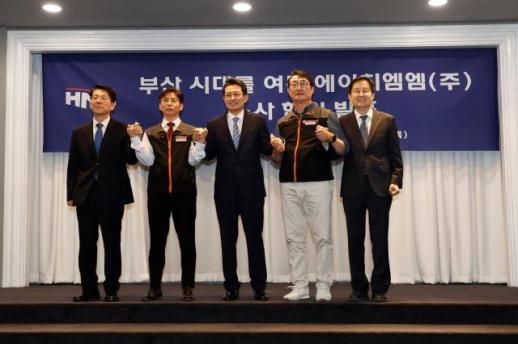 HMM reaches labor-management deal to move HQ to Busan SEOUL, April 30 (AJP) - South Korea’s HMM, the world’s eighth-largest shipping company, said Friday that its labor and management have reached an agreement to relocate the company’s headquarters to the southern port city of Busan, the country’s main maritime gateway, resolving a long-standing dispute that had raised concerns over labor strikes and disruptions to global logistics. Busan, home to South Korea’s largest port, has been positioning itself as a maritime and logistics hub, with the government pushing to cluster shipping, finance, and related industries in the city. While the government expects the relocation to strengthen operational efficiency and create synergies with port infrastructure and maritime institutions in the city, concerned voices erupted from workers from government offices and companies, including HMM, who were worried about their families leaving their hometown to move to Busan. The shipbuilder said that the agreement reflects a shared commitment to national priorities such as regional development and decentralization. HMM added that with the prolonged Middle East conflict continuing to strain global supply chains, the deal was reached to avoid a potential labor strike stemming from labor-management differences, which could have disrupted both domestic and international logistics and led to broader social and economic impacts. Under the deal, HMM will complete legal procedures to change its registered headquarters following an extraordinary shareholders’ meeting scheduled for May 8. Afterward, the company will first relocate the CEO’s office, after which labor and management will begin detailed talks on the relocation, with a focus on business efficiency and potential synergies. The company said the two sides had held multiple rounds of talks since the second half of last year but failed to reach an agreement, with tensions escalating recently as the union filed for mediation, pursued legal action against the CEO and warned of a possible strike. The company also plans to push ahead with the construction of a landmark office building in Busan’s North Port area to support the local economy. Meanwhile, the company reported revenue of 10.89 trillion won ($7.9 billion) and an operating profit of 1.46 trillion won last year. An official of HMM said the deal reflects national priorities and the company’s role as a national flag carrier, adding that with uncertainties now eased, it will focus on addressing external risks and strengthening its global competitiveness. Founded in 1976, HMM operates a global network connecting more than 60 trade routes and over 100 ports across the Americas, Europe, the Middle East and Latin America. The company has secured container capacity exceeding 1 million twenty-foot equivalent units (TEUs) and aims to expand this to 1.55 million TEUs by 2030, alongside investments in eco-friendly vessels and digital transformation. 2026-04-30 15:59:52
 -
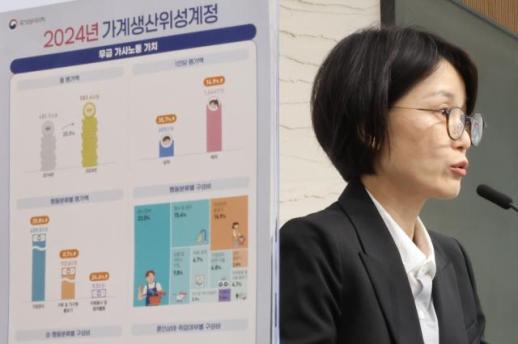 Korean women still do 3 times more unpaid housework, men on faster rise SEOUL, April 29 (AJP) - South Korean women would effectively be 2.7 times richer than men — if unpaid household work were properly compensated — though the gap has eased from 3.2 times five years ago as single life forces more men to take on domestic responsibility, data showed Wednesday. The value of home management in South Korea — encompassing childcare, cooking, cleaning and elder care — was estimated at 582.4 trillion won ($420 billion) in 2024, equivalent to 22.8 percent of nominal gross domestic product, according to the 2024 Household Production Satellite Account released by Ministry of Data and Statistics. The account measures the economic value of unpaid work not captured in GDP. The estimate marked a 20 percent increase over the past five years, though its share of GDP edged down by 1 percentage point. The value of unpaid household work per person was estimated at 11.25 million won annually, up 20 percent over the same period. Housework remains primarily women’s responsibility, with their unpaid labor valued at 16.46 million won per person, compared with 6.05 million won for men — about 2.7 times higher. The shift, however, has been sharper among men. Among unmarried men, the value of unpaid household labor surged 68.7 percent over five years, outpacing the 47.2 percent increase among unmarried women. Married men also recorded a faster rise at 28.9 percent. By category, household management work rose 25.8 percent, while care for pets and plants jumped 60.4 percent. Adult care, including eldercare, increased 20.8 percent as the population aged. By contrast, the value of childcare fell 1.8 percent, reflecting a decline in the school-age population. Single-person households recorded the sharpest increase in unpaid household labor value, rising 66.2 percent over five years, followed by two-person households at 40.9 percent and three-person households at 22.2 percent. Households with five or more members saw an 11.3 percent decline. Three-person households accounted for the largest share at 166 trillion won, followed by four-person households at 147.4 trillion won and two-person households at 136.7 trillion won. By employment status, unpaid household work was valued at 297.4 trillion won for those outside the workforce, slightly exceeding the 284.9 trillion won for those with jobs. Regionally, Sejong posted the steepest increase at 42.3 percent, driven by growth in the child population and rising caregiving time. First introduced in 2018, the household production satellite account is compiled every five years to estimate the value of unpaid work excluded from GDP. 2026-04-29 15:07:53
 -
 KOSPI takes breath amid growing uncertainty over AI-fueled rally SEOUL, April 29 (AJP) - South Korea's benchmark KOSPI fluctuated on Wednesday after opening lower, as investors weighed an overnight Wall Street selloff amid uncertainty over the sustainability of the recent artificial intelligence (AI)-fueled rally. Investors also appeared cautious ahead of earnings reports from five major tech companies, collectively dubbed the "magnificent seven," including Alphabet, Amazon, Apple, Meta, and Microsoft this week. The main index fell 0.43 percent to 6,612.20 shortly after trading began. Foreign investors sold a net 436.4 billion won, outweighing buying by retail and institutional investors. Heavyweight semiconductor shares such as Samsung Electronics and SK Hynix came under pressure, tracking weakness in U.S. technology stocks. Samsung Electronics fell 0.90 percent to 220,000 won, while SK Hynix slipped 0.31 percent to 1,296,000 won. Sentiment had initially been dampened after U.S. equities retreated overnight, with technology shares leading losses amid renewed concerns over elevated valuations tied to the AI boom. The S&P 500 fell 0.49 percent to 7,138.80 and the Nasdaq Composite dropped 0.90 percent to 24,663.80. Among other large caps, Samsung Biologics slipped 1.20 percent to 1,486,000 won, and Hyundai Motor fell 1.08 percent to 549,000 won. LG Energy Solution also declined 1.06 percent to 467,000 won. Gains were led by defense and industrial shares, with Hanwha Aerospace rising 1.79 percent to 1,420,000 won and HD Hyundai Heavy Industries jumping 3.15 percent to 688,000 won. Samsung SDI climbed 2.50 percent to 697,000 won, while SK Square edged up 0.37 percent to 814,000 won. Power equipment shares also remained firm, with Hyosung Heavy Industries adding 0.20 percent to 3,984,000 won. The junior KOSDAQ stocks were also mostly lower, led by Juseong Engineering, which tumbled 7.13 percent to 121,200 won, and LigaChem Biosciences, down 3.83 percent to 195,700 won. Ecopro fell 2.79 percent to 157,000 won, and Alteogen slipped 1.33 percent to 381,500 won. Rainbow Robotics dropped 1.65 percent to 657,000 won, and Ecopro BM lost 1.41 percent to 210,500 won. Among others, Leeno Industrial fell 1.97 percent to 109,200 won, EO Technics dropped 1.95 percent to 503,000 won, Wonik IPS shed 2.06 percent to 118,600 won, and Caregen slipped 1.31 percent to 105,600 won. Gainers were limited, with Alteogen rising 1.33 percent to 381,500 won and ABL Bio edging up 0.14 percent to 139,600 won. The South Korean won strengthened slightly to 1,472.50 per dollar from 1,473.60 previously. Elsewhere in Asia, Hong Kong's Hang Seng Index rose 0.63 percent to 25,842.63, while China's Shanghai Composite fell 0.41 percent to 4,061.82. Japan's Nikkei 225 was closed on Wednesday for Showa Day, a Japanese public holiday honoring former Emperor Hirohito, while markets in South Korea, China, Hong Kong, and Taiwan will be closed on Friday for Labor Day. 2026-04-29 11:21:20
 -
 Inside Korea’s Curated Singles Parties: Dating as Risk Management “Even in a crowd, there’s one person who stands out. Here, that feeling can even lead to marriage.” “I hesitated at first, but now it feels like I’ve walked onto a TV set. I’ve already sent a ‘signal’ to two people.” Lines that sound like they belong on a hit dating show were heard one April afternoon at a lounge party in Seoul’s Samseong-dong. In a room where dozens of men and women circulated, one couple said a few words were enough to set the direction of their relationship. A mid-30s professional identified by the surname Lim and a late-30s senior researcher at a major company identified by the surname Kim said they had avoided dating apps and casual meetups because of busy schedules. Over a glass of wine, they talked about everyday life and were drawn to each other’s approach to living. Without going to a second venue, they set a dinner date for the next day. The relationship has continued for a year. “We realized how efficient it is to meet someone who’s been vetted,” the couple said. As “natural” encounters become harder to come by, many young South Koreans are shifting their search for partners from screens to curated, in-person events. Nearly 3 in 4 men in their early 30s are unmarried The push toward “designed” meetings is backed by stark numbers. According to the National Data Portal’s population and housing census, as of 2024 the unmarried rate for ages 30-34 was 74.7% for men and 58% for women. For ages 35-39, it was 46.8% for men and 29.9% for women. The unmarried rate for men ages 40-44 was 30.1%. Participants said the challenge has moved beyond simply marrying later to the difficulty of forming relationships at all. Several told reporters that in ordinary daily life, the odds of meeting a partner feel as remote as winning the lottery, making it a waste of time to wait for chance. Introverts said they are not exempt. A man surnamed Park, who described himself as extremely introverted and works at a state-run company, said organizers introduced him to a freelance announcer surnamed Choi and they became a couple. “If I hadn’t come here, I would never have met the person next to me in my lifetime,” he said. A 36-year-old participant identified by the surname Lee said she came for “trust” and “naturalness,” contrasting the experience with a marriage matchmaking company. “At those companies, you sit for an hour introducing yourself. It felt like an interview,” she said. “You end up evaluating conditions, and you think, ‘I might meet someone with better conditions tomorrow,’ so your expectations rise and it’s hard to focus on the relationship.” Lee said she once had as many as seven blind dates scheduled in a week, a structure she said turns people into “comparisons” rather than partners. At curated parties, she said, basic qualifications are checked but what matters is the feel of meeting in person. “If you dress up once and meet 20 people, you realize who you’re actually drawn to,” she said. “When you meet people who’ve built results, you feel, in the intellectual depth of conversation, ‘This person is different.’” She said the rotation format also lowers pressure. “On a one-on-one date, if you’re asked questions you have to keep answering, which is stressful. Here, if an uncomfortable question comes up, you can naturally move on,” she said. “If matchmaking felt like homework, this feels like getting to know people more naturally, so you can see a more genuine side.” From TV ‘signals’ to real life A similar scene played out on a rooftop in Yeongdeungpo, where about 40 men and women in a black-and-white dress code talked with wine glasses in hand. A participant identified as LDJ, 35, called it a “real-life Heart Signal.” “It’s highly satisfying because people with great jobs who are hard to meet privately gather here,” he said, giving it a perfect 10. Shin Hye-rin, a professor of media studies at Korea University, said the comparison is more than a metaphor. “The structure of observing multiple candidates at once, comparing chemistry and strategically exchanging interest looks a lot like the program format,” she said. She added that as dating shows present romance as something to be interpreted, participants can internalize that evaluative gaze and try to read and judge others. Shin said dating reality shows can also function as a kind of script. “For today’s generation, the awareness that ‘someone is always watching, or I am posting and showing myself’ is deeply internalized,” she said, adding that the process of signaling among multiple potential partners can take on aspects of performance. Shin described the trend as “defensive realism”: In an uncertain environment, weighing practical factors such as education, job and finances becomes an adaptation strategy to reduce the chance of failure. “It’s not that young people don’t know the contradictions of these standards,” she said. “They feel society still operates on traditional criteria, so they choose to maximize usefulness within that system.” She also framed the appeal of rotation-style dating as an “emotional portfolio” approach: reducing the risk of placing all expectations on one person by spreading emotional investment across multiple possibilities, lowering the psychological blow of rejection or failure. The premium social club that runs the events, The Grace Club, says it relies on strict verification and screening. A government ID and proof of employment are required, and applicants must pass a pre-screening of photos for appearance described as “above average.” About 65% of attendees were born in the 1990s, and many work in professional fields such as medicine and law or at major companies including Samsung Electronics, Hyundai Motor and Kakao. Organizers said the rules are meant to reduce the chance of disappointment and prevent wasted time. They said word-of-mouth has spread to the point that about six cast members from the dating show “I Am Solo” have passed through, making it a perceived must-stop in the marriage market. A man in his 30s using the nickname “Chic” said, “People who focused on studying or work have fewer chances to build connections, and gatherings like this help break through blocked social networks.” The club also kept operating during the pandemic through remote formats. It used KakaoTalk group chats in an “online rotation” system in which identities were revealed only when a match was made. Organizers said online tools could not fully convey atmosphere or emotional exchange. They added that as the AI era advances, the value of meeting in person and feeling another person’s presence is growing. After distancing rules eased, they said, offline applications surged, with a noticeable increase among women in their 30s seeking serious relationships. Shin said the trend reflects fatigue with dating apps combined with a desire for face-to-face contact. “The form is offline, but the operating logic still carries the platform optimization mindset,” she said. Instead of an app algorithm, organizers’ screening and verification act as the filter, while participants still compare multiple candidates and make choices. By 10 p.m. in Yeongdeungpo, as wine glasses clinked, some attendees were already setting their next plans. 2026-04-29 11:14:44
 -
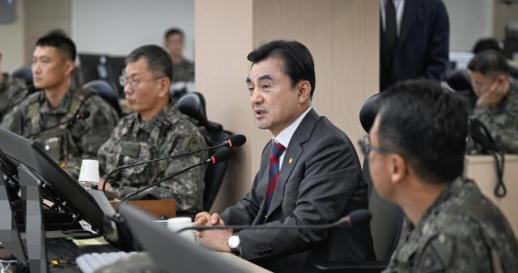 Robots to take over GOPs in Korea but computing power poses setback SEOUL, April 28 (AJP) - Robots will take over general outposts (GOPs) along the heavily fortified border with North Korea as South Korea grapples with shrinking troop numbers due to depopulation. But maintaining a robotic fleet comes with a catch — massive computing power. The Ministry of National Defense said Tuesday it is reviewing a plan to gradually reduce troops stationed at front-line GOPs and transition to an AI-enabled surveillance system. “The ministry is reviewing a plan to transform GOPs into an AI-based border security system combining manned and unmanned operations, and to pursue related force restructuring,” a ministry spokesperson said. Troop levels at GOPs could be reduced from about 22,000 to around 6,000. The ministry emphasized that the move is not simply about cutting troop numbers, but part of a broader restructuring driven by long-term demographic pressures. “GOP guard forces would be shifted to the Forward Edge of the Battle Area (FEBA), allowing troops to focus on training and preparing for combat while maintaining rapid response capabilities in emergencies,” the spokesperson said. The military is refining a roadmap for phased mid- to long-term pilot programs and complementary measures to ensure readiness during the transition. The plan, however, faces a significant infrastructure shortfall. The military estimates it will need about 50,000 graphics processing units (GPUs) to implement AI systems, but currently operates only around 500 across major defense data facilities, including the Defense Integrated Data Center, battlefield data centers and the Agency for Defense Development. The challenge extends beyond equipment shortages. Even if additional GPUs are secured, constraints in power supply, cooling systems and rack space could limit further expansion. The Agency for Defense Development, which holds roughly 480 GPUs, had planned to add another 320 last year but scrapped the plan due to insufficient installation space. Outsourcing GPU management to commercial cloud providers such as Naver Cloud and Kakao is not an option under National Intelligence Service security guidelines, which restrict such use in defense. Without new data centers, additional GPUs would be difficult to deploy, risking delays to broader military AI adoption. Given national security requirements, any new military data center would likely need to be built underground and hardened against chemical, biological and electromagnetic pulse (EMP) threats, with costs expected to exceed 2 trillion won ($1.4 billion). There are growing calls to build a facility capable of housing large volumes of GPUs, similar to one planned by the Ministry of Science and ICT. The ministry aims to invest 2 trillion won by 2028 to establish a National AI Computing Center with 50,000 GPUs. Separately, the ministry signed a memorandum of understanding Monday with Demis Hassabis, co-founder and chief executive of Google DeepMind, to cooperate on joint research in science, technology and AI, as well as talent development and the responsible use of AI. 2026-04-28 17:56:42
 -
 KOSPI extends record-setting rally as chip halo trickles down SEOUL, April 28 (AJP) — The KOSPI extended record-setting rally Tuesday with eyes on the 7,000 milestone, shrugging off the stalemate in U.S.-Iran talks even as the conflict nears the 60-day mark this week. As of 11:00 a.m., the benchmark index rose 0.65 percent to 6,658.25, as foreign and institutional investors continued buying despite retail profit-taking. Market breadth remained tight, with gainers narrowly outpacing losers 424 to 409. Investor sentiment was buoyed by expectations that strong earnings from U.S. technology heavyweights would reinforce momentum in Korea’s semiconductor- and IT-led market. With a substantial share of S&P 500 firms already reporting solid first-quarter results, attention has shifted to earnings from five “Magnificent Seven” companies. Microsoft, Alphabet, Amazon and Meta are due Wednesday, followed by Apple a day later. In U.S. trading, Nvidia surged 4 percent to a fresh intraday high on earnings optimism, while Alphabet gained 1.72 percent. Microsoft added 0.05 percent and Meta rose 0.53 percent, with Tesla up 0.63 percent. Apple slipped 1.27 percent. The strength spilled over into Korean chipmakers. SK hynix climbed 2.55 percent to 1,325,000 won, hitting a 52-week high, while Samsung Electronics edged up 0.22 percent to 225,000 won. South Korea’s broader rally has also lifted its global standing. Total market capitalization has surged more than 45 percent this year to about $4.04 trillion, overtaking the U.K. to rank as the world’s eighth-largest equity market, supported by global inflows into AI and semiconductor stocks. Cyclicals joined the advance. Hyundai Motor jumped 7.06 percent to 561,000 won, while Kia rose 3.41 percent to 157,800 won. Battery makers were also firm, with Samsung SDI gaining 4.72 percent and LG Energy Solution up 0.97 percent. Power equipment shares also remained firm, with Hyosung Heavy Industries up 0.96 percent at 3,979,000 won, extending gains since April 22 and continuing a run of successive record highs on expectations tied to AI infrastructure expansion and North American grid replacement demand. Financial and industrial shares edged higher, with KB Financial Group and Samsung C&T both up 0.64 percent. Losses were limited, though defense and shipbuilding stocks came under pressure. Hanwha Aerospace fell 1.10 percent, while HD Hyundai Heavy Industries slipped 0.74 percent. On the KOSDAQ, the index dropped 0.84 percent to 1,215.87 as foreigners and institutions sold a combined 458.6 billion won, offsetting net buying of 461.3 billion won by retail investors. Biotech stocks led declines, with AblBio plunging 19.86 percent, while Samchundang Pharm and LigaChem Biosciences also fell. Battery-related shares bucked the trend, with EcoPro rising 3.07 percent and EcoPro BM gaining 2.17 percent. In currency markets, the Korean won weakened slightly to 1,474.50 per dollar from 1,472.50 previously. Elsewhere, Japan’s Nikkei 225 fell 0.54 percent to 60,211.50, retreating from a record high as investors positioned ahead of the Bank of Japan’s policy decision. Chip-related stocks led declines, with Advantest down 4.51 percent and SoftBank Group tumbling 7.14 percent. Hong Kong’s Hang Seng Index slipped 0.52 percent, while China’s Shanghai Composite edged down 0.22 percent. Regional markets face a shortened trading week, with Japan closed Wednesday and South Korea, China, Hong Kong and Taiwan shut Friday for Labor Day. 2026-04-28 11:30:59
 -
 Korea moves to lock in tourism windfall as regional travel shifts boost arrivals SEOUL, April 27 (AJP) - South Korea is moving to lock in a tourism windfall as shifting regional travel patterns and stronger visitor spending drive a surge in foreign arrivals ahead of a holiday-packed May. The country welcomed a record 4.76 million foreign visitors in the first quarter, up 23 percent from a year earlier, with 2.06 million arriving in March alone, according to the Ministry of Culture, Sports and Tourism. The March spike was partly driven by the full-member comeback performance of BTS in Gwanghwamun, which drew global fans and boosted visits to nearby cultural sites such as Gyeongbokgung Palace. Beyond headline numbers, officials say the recovery is becoming more structural. Arrivals through regional airports rose nearly 50 percent in the first quarter, while 34.5 percent of visitors traveled outside Seoul — signaling a broader geographic spread in tourism demand. Visitors are also staying longer and spending more. Overnight stays in non-capital regions rose 36.2 percent, while foreign card spending increased 23 percent to 3.21 trillion won. Overall visitor satisfaction reached 90.8 points. Booking data reinforces the trend. Trip.com ranked Seoul as the world’s top destination for spring flight bookings, with reservations up 83 percent from a year earlier, outpacing Tokyo and Osaka. The spillover is increasingly visible beyond the capital. Cheongju, about 120 kilometers south of Seoul, recorded a 962 percent jump in visitors, followed by Busan with 131 percent and Jeju with 129 percent. Local governments are moving quickly to extend the momentum. Busan has launched a rail-linked tourism campaign with Korail, offering discounts of up to 50 percent on high-speed KTX fares through September. The promotion bundles transport with major events such as the Haeundae Sand Festival in May, the Busan Port Festival in June, and large-scale exhibitions including G-STAR 2026. Officials say the goal is to spread demand beyond peak seasons and encourage longer stays. Growth has been broad-based across major markets. China remained the largest source of visitors, with arrivals rising 29 percent to 1.45 million, followed by Japan at 940,915 visitors, up 20.2 percent. Taiwan posted the fastest growth at 37.7 percent, while arrivals from the Americas and Europe rose 17.1 percent. Cruise traffic also rebounded, with calls at ports including Jeju, Busan and Incheon reaching 338, up 52.9 percent from a year earlier. Momentum is expected to continue into the second quarter. Japan’s Golden Week and China’s May Day holiday are likely to bring another wave of visitors, with H.I.S. ranking Seoul as the top overseas destination for the period. Data from Airbnb showed South Korea ranked first in global destination searches for the May Day holiday, with interest rising fivefold from a year earlier. Part of the surge may reflect shifting regional travel dynamics. China’s Global Times reported that about 45 percent of scheduled flights from mainland China to Japan during the five-day holiday period had been canceled. Data from the Japan National Tourism Organization showed Chinese arrivals to Japan fell 55.9 percent in March, marking a fourth straight monthly decline. The shift is increasingly redirecting demand toward Korea, reinforcing its position as a key alternative destination in Northeast Asia. 2026-04-27 17:04:01
 -
 Seoul and Tokyo benchmarks touch new highs as tech rally overrides Gulf jitters SEOUL, April 27 (AJP) - Seoul's main KOSPI touched a new ceiling at 6,600 on institutional buying early Monday, brushing aside weekend incidents — the stalemated U.S.-Iran peace talks and a shooting incident during the White House Correspondents’ Dinner attended by U.S. President Donald Trump. Both the KOSPI and junior KOSDAQ gained nearly 2 percent, pushing their combined market capitalization above 6,000 trillion won, up nearly 40 percent from the beginning of the year. As of 11:00 a.m., the KOSPI was up 1.96 percent at 6,602.44, while the KOSDAQ rose 1.76 percent to 1,222.90. Semiconductor shares led the advance, with SK hynix hitting another 52-week high Monday, extending gains on expectations of a semiconductor supercycle. Shares rose 4.83 percent to 1,281,000 won. Support also came from expectations that the current memory upcycle may be stronger than in previous cycles, with investors watching this week’s results from global NAND suppliers for guidance that could lift consensus forecasts for SK hynix’s NAND business. Gains spread across the broader semiconductor sector, with Samsung Electronics rising 1.59 percent to 223,000 won. Autos were mostly firmer, with Hyundai Motor Company surging 3.12 percent to 529,000 won and affiliate Kia edging up 0.13 percent to 153,600 won. Industrial and defense shares were mixed, with HD Hyundai Heavy Industries up 1.04 percent at 678,000 won and Doosan Enerbility adding 0.87 percent to 128,200 won, while Hanwha Aerospace slipped 0.68 percent to 1,453,000 won. Battery names came under pressure, with LG Energy Solution down 3.17 percent to 465,750 won and Samsung SDI dropping 1.72 percent to 630,000 won. The KOSDAQ was lifted by strength in biotech and robotics shares, with nearly all of the top components trading higher. Rainbow Robotics jumped 11.44 percent to 682,000 won, while ABL Bio climbed 8.97 percent to 171,300 won and Samchundang Pharm rose 8.38 percent to 446,000 won. Alteogen added 4.20 percent to 384,500 won, while HLB gained 4.15 percent to 62,700 won. Leeno Industrial — a semiconductor testing equipment maker — was the only decliner among major components, falling 14.63 percent to 106,200 won. The dollar sharply eased on renewed foreign buying, trading at 1,474.30 won compared with the previous close of 1,484.50 won. Japan’s Nikkei 225 rose 1.23 percent to a fresh intraday high of 60,351.95 in morning trade, led by semiconductor-related shares. Advantest climbed 1.24 percent and SoftBank Group added 0.89 percent, as investors positioned ahead of the Bank of Japan’s policy decision due Tuesday. Hong Kong’s Hang Seng Index slipped 0.08 percent to 25,957.25, while China’s Shanghai Composite Index eased 0.02 percent to 4,079.00. Japan’s markets are set to close Wednesday, while South Korea, China, Hong Kong and Taiwan will be shut Friday for Labor Day. Meanwhile, market focus will turn to how earnings from megacap technology firms shape volatility this week, with Microsoft, Alphabet, Amazon and Meta due to report first-quarter results on Wednesday, followed by Apple on Thursday. 2026-04-27 11:15:28
 -
 Big-tech layoffs: a prelude to AI replacement? SEOUL, April 24 (AJP) - What has long been feared is beginning to take shape. From May 20, Meta plans to cut about 8,000 jobs — roughly 10 percent of its workforce — while leaving 6,000 roles unfilled, even as it raises capital spending to as much as $135 billion this year for AI data centers and infrastructure. “We’re starting to see projects that used to require big teams now be accomplished by a single very talented person,” Mark Zuckerberg said during an earnings call, outlining plans to develop a so-called CEO agent. Microsoft has also offered voluntary buyouts to about 8,750 U.S. employees, even as it accelerates investment in artificial intelligence. Its chief executive, Satya Nadella, has repeatedly highlighted internal AI adoption, saying it has driven significant productivity gains. In April 2025, he said AI was already handling as much as 30 percent of the company’s coding work. In short, the very companies that once led a hiring boom to secure programming talent are now making room for AI. Kim Jin-young, a professor of economics at Korea University, describes the shift as deeply ironic. “Some programmers are rewarded in proportion to how much they use AI tools,” he said. “It creates a system where people work harder to build the weapon that could replace them.” Still, he cautions against overestimating the speed of disruption. “There is an assumption that AI can quickly replace labor, but in reality there are many hurdles to overcome, and that transition is likely to take considerable time,” he said. The scale of the shift is already visible. According to Crunchbase News, about 127,000 jobs were cut at U.S.-based technology companies in 2025, following 95,667 in 2024 and more than 191,000 in 2023. Among individual firms, Intel recorded the largest cuts in 2025 with more than 27,000 job losses, followed by Microsoft, Verizon and Amazon. The clearest signs of strain are emerging at the entry level. A 2023 study by GitHub and Microsoft found developers using GitHub Copilot completed coding tasks 55.8 percent faster on average, raising concerns that generative AI is absorbing routine work — coding, debugging, testing and documentation — traditionally assigned to junior engineers. The so-called “entry-level squeeze” is already evident in the United States. According to reporting by The Washington Post, computer programming jobs fell 27.5 percent over two years, while software developer employment remained largely flat. By 2025 and into 2026, major tech firms including Google and Meta have scaled back aggressive new-graduate hiring, shifting focus toward experienced engineers who can leverage AI tools more effectively. South Korea is showing similar signs. According to the Ministry of Data and Statistics, employment in professional, scientific and technical services fell by 105,000 on year to 1.373 million last month — the sharpest decline since the industrial classification system was revised in 2017. Employment in information and communications also dropped by 42,000, marking a second straight monthly decline. The impact is particularly acute among younger workers. Employment among people in their 20s fell by 163,000 to 3.262 million, the lowest level since records began in 1982 — the only age group to post a decline. Job placement data for computer science graduates tell a similar story. Placement rates have dropped across major universities, including Seoul National University, KAIST and Hanyang University. The shift is also reflected in hiring demand. According to the Korea Labor Institute, the share of entry-level openings in software developer job postings fell to 37.4 percent in 2024 from 53.5 percent in 2022. This coincides with the rapid adoption of generative AI. A survey by McKinsey & Company found the share of companies using generative AI in at least one business function jumped to 65 percent in 2024 from 33 percent a year earlier. As AI becomes standard in the workplace, companies are increasingly favoring experienced workers who can deploy these tools effectively, rather than hiring juniors for repetitive tasks. That does not mean software development is disappearing. The U.S. Bureau of Labor Statistics projects employment for software developers will grow 15 percent from 2024 to 2034. Rather, the nature of the work is shifting. Demand is weakening for routine coding, while rising for higher-skilled developers who can design systems, validate models and integrate AI into products. International institutions point in the same direction. The International Monetary Fund estimates about 40 percent of global employment — and up to 60 percent in advanced economies — is exposed to AI, while the World Economic Forum projects the technology could create 11 million jobs by 2030 while displacing 9 million. The implication is less about wholesale job destruction than a reconfiguration of work — unbundling tasks, automating some, and raising the value of others. Kim Geun-tae, a professor of public sociology at Korea University, says education must adapt accordingly. “Computer science students should also be taking humanities and social science courses,” he said, noting that future competitiveness will hinge on combining technical skills with human judgment. He pointed to renewed interest in philosophy departments at top universities as employers place greater value on reasoning, ethics and interpretive skills that are harder to automate. Even hiring practices are evolving. Companies such as KT Corporation are incorporating AI-assisted problem-solving into recruitment, asking applicants to use AI tools during interviews. Yet the two professors agree the current correction does not signal the end of human labor. “The essential things are not easily replaced,” Kim said. 2026-04-24 17:52:45