
Journalist

Abraham Kwak
candicekim1121@ajupress.com
-
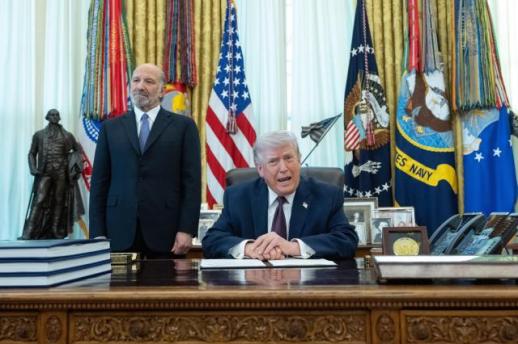 S.Korea to announce major US investment project within weeks, US official says SEOUL, April 04 (AJP) - South Korea is finalizing a major investment plan for the United States, a senior Trump administration official said, as Washington rolls out a new wave of tariffs on metals and pharmaceuticals. During a telephone briefing on Thursday, the senior U.S. official stated that Seoul is expected to unveil a significant investment project in the U.S. within the coming weeks. The official's remarks came after highlighting recent investment commitments from Japan, which include natural gas facilities in Ohio, artificial diamond production, and small modular reactors (SMRs) in Tennessee and Alabama. Seoul and Washington are currently in the final stages of coordinating the details of the investment. While the U.S. has reportedly requested investments in a liquefied natural gas (LNG) export terminal in Louisiana, the South Korean government is leaning toward sectors such as artificial intelligence (AI) data centers and nuclear power plant construction, citing stronger business viability and existing expertise. The upcoming investment announcement coincides with President Donald Trump signing an executive order that revises the imposition of tariffs under Section 232 of the Trade Expansion Act. Under the new rules taking effect on April 6, a blanket 25 percent tariff will be applied to derivative products containing more than 15 percent of steel, aluminum, or copper. The administration maintains a 50 percent tariff on the raw materials themselves. The official explained that this streamlined process will make it easier for companies to handle administrative work, noting that the previous system failed to generate the expected tariff revenue. Additionally, the executive order introduces a new 100 percent tariff on pharmaceutical products. However, South Korea, Japan, the European Union, and Switzerland will be subject to a reduced rate of 15 percent, while the U.K. will face a 10 percent rate. The U.S. official noted that these allied nations are granted lower rates because they have broader trade agreements with Washington, allowing them to maintain their domestic production facilities. 2026-04-04 13:42:10
 -
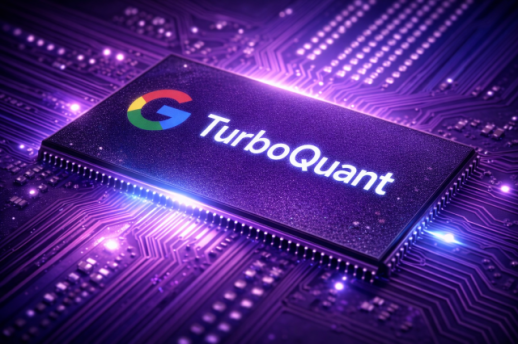 Investors are jittery, but analysts are buoyant behind Korean memory makers vs TurboQuant SEOUL, April 01 (AJP) - A new artificial intelligence data-compression technology from Google has hit Seoul’s main stock market as hard as Strait of Hormuz-related news, as it involves South Korea’s top memory chipmakers responsible for around 40 percent of not just the KOSPI but also the country’s exports. Since the unveiling of Google’s TurboQuant, a next-generation quantization algorithm, Samsung Electronics and SK hynix saw their shares tumble 4.7 percent and 6.2 percent, respectively, over a two-day period late last month. They staged a strong comeback Wednesday — Samsung Electronics up 12.5 percent and SK hynix up 10.4 percent. But Wednesday’s gains hinged on hopes for a war endgame, and any shifts in Washington or Tehran could quickly reverse sentiment. For the chipmakers, the drag came from a research paper published by Google on March 24 detailing the debut of a technology called TurboQuant. TurboQuant acts as a highly efficient “packing” mechanism for AI. Large language models (LLMs) like ChatGPT require vast amounts of temporary memory, known as the KV cache, to retain the context of long conversations. TurboQuant compresses this data without losing its core meaning, reducing the memory footprint to as little as one-sixth of conventional levels. Fearing this level of efficiency would drastically reduce the need for dynamic random-access memory (DRAM) and high-bandwidth memory (HBM) chips, investors aggressively dumped tech shares. “The impact will be massive,” said Kim Deok-kee, a professor of electronic engineering at Sejong University in Seoul. “If memory requirements are reduced to one-sixth, revenue will drop drastically. With Samsung, SK hynix, Micron and emerging Chinese players in the mix, this could quickly lead to a memory oversupply.” Kim warned that the current rush to expand capacity could backfire. “Companies are building multiple fabs based on current high demand, but in two to three years, this could result in massive oversupply and severe financial deficits,” he said. However, local brokerages strongly argue that this efficiency will actually lower the cost of running AI, thereby expanding overall usage, and are maintaining a robust outlook for South Korean chipmakers. “The technology simultaneously improves memory and computational efficiency, lowering AI utilization costs,” Jang Moon-young, an analyst at Hyundai Motor Securities, wrote in a recent note. “In the mid-to-long term, it is highly likely to lead to an expansion in memory demand through broader AI adoption and increased usage.” Kim Dong-won, head of research at KB Securities, said low-cost AI technologies like TurboQuant will “lower entry barriers and explosively expand overall AI demand.” “Despite geopolitical anxieties stemming from rising tensions in the Middle East, second-quarter memory chip orders are strengthening, exceeding previous estimates,” he said. Analysts also highlight the coming era of “physical AI,” such as robotics and autonomous driving, which will require massive data processing. In a report released Wednesday, Daol Investment & Securities analysts Koh Young-min and Kim Yeon-mi said the sell-off over TurboQuant was excessive. “The best thing this KV cache compression technology does is bring unrealistic demand down to a more realistic level,” they wrote. “The potential for future HBM demand growth remains ample.” 2026-04-01 17:13:40
 -
 Samsung Elec union crying foul over wage talks to press ahead with strikes SEOUL, March 31 (AJP) - Samsung Electronics claims it has put forward a compensation package more attractive than that of rival SK hynix, but its largest labor union is calling it a deception — and is pressing ahead with plans for a general strike in May. “The company lied to us,” Kim Jae-won, head of policy planning at the National Samsung Electronics Union (NSEU), told AJP on Tuesday. “There is no other way to describe what happened at that table.” Wage negotiations have collapsed, pushing South Korea’s largest tech firm toward what could become its most significant strike yet — at a time when chip prices are surging amid supply shortages, compounded by raw material and shipping disruptions tied to the widening conflict in the Middle East. The Samsung Electronics Labor Union (SELU), which represents more than 70,000 employees — over half of Samsung Electronics’ workforce — suspended talks on Friday. The union accuses management of presenting a proposal to institutionalize bonuses, only to later deny that such an offer was ever made. The union has warned it will proceed with a general strike in May unless executives issue a formal apology for what it calls a “deceptive approach to bargaining” and replace the current negotiation team. At the heart of the dispute is what transpired in the latest round of talks. According to Kim, management offered two options: a one-time bonus or the permanent institutionalization of the Overachievement Performance Incentive (OPI) system. “They told us they would persuade top management based on our choice,” Kim said. “We chose institutionalization. But later we were told it had been rejected — and now they claim it was never proposed at all.” Kim suggested either the negotiating team acted without senior approval or top management reversed course afterward. “Either way, they stabbed us in the back. This is something we cannot accept,” he said. Union leader Choi Seung-ho said the alternative proposal was equally unacceptable. “The company tried to push a one-time payout using treasury stock, which we rejected,” Choi said. “We are demanding a transparent, cash-based system. Management appears reluctant because it wants to preserve its corporate governance structure.” Samsung acknowledged the breakdown in talks but offered a different interpretation. “We sought a method to allocate additional resources more clearly to high-performing business units, while the union insisted on maintaining a uniform distribution approach,” a company official said. On the key issue of the OPI cap — currently set at 50 percent of annual salary — the company said it had not ruled out adjustments. “It’s not that we refused to lift the cap,” the official said. “Our proposal included similar conditions, but our focus was on how to distribute additional resources, whereas the union prioritized securing a fixed share of operating profit.” What is clear is that the standoff is deepening. Samsung’s attempt to offer a one-time payout — reportedly exceeding SK hynix’s package — while preserving the existing compensation structure appears to have backfired. The union has escalated its demands, calling for 15 percent of operating profit to be allocated as a bonus pool, above the 10 percent benchmark at domestic peers. It also proposes a “7-to-3” distribution split — 70 percent at the division level and 30 percent at the business unit level — aimed at narrowing pay gaps across divisions. “The company only justified our actions,” Kim said. “Members are angrier than ever and uniting faster. They’re spending money but still getting blamed because of their own actions.” As of Tuesday, SELU membership stood at 70,375, accounting for 54.5 percent of Samsung Electronics’ workforce. Unionization in the core chipmaking Device Solutions (DS) division has climbed to 72.2 percent. The union plans a mass rally of around 30,000 workers at the Pyeongtaek semiconductor complex on April 23, with 22,000 already committed to attend. A full-scale strike will proceed in May unless management changes course. Samsung said it will continue efforts to resolve the dispute and avoid a strike that could surpass the scale of its first walkout two years ago. “We don’t yet know how it will impact operations, but the best-case scenario is to resolve this before a strike,” an official said, requesting anonymity. 2026-03-31 15:33:25
 -
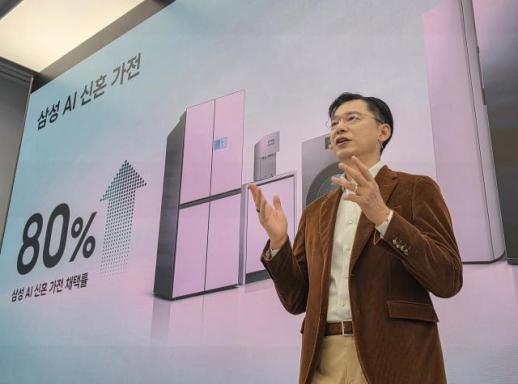 Samsung targets rebounding marriage boom to drive AI home appliance sales SEOUL, March 26 (AJP) - Samsung Electronics is betting on a revival in South Korea’s marriage market to accelerate adoption of artificial intelligence-powered home appliances, positioning its latest all-in-one washer-dryer as a centerpiece for newlyweds building automated homes. At a media briefing in Gangnam on Thursday, the company unveiled the 2026 Bespoke AI Combo, integrating upgraded hardware with generative AI features as part of its push to dominate the premium “hon-su” — or wedding essentials — segment. The strategy comes as marriage rates show a meaningful rebound. Marriages rose about 6.9 percent in 2025 to roughly 207,000, marking the first notable recovery after years of decline. The momentum has carried into 2026, with January marriages climbing 12.4 percent on-year. The demographic shift is being driven in part by the so-called “second echo boom,” as those born between 1991 and 1995 — children of Korea’s second baby boom generation — enter peak marriage and childbearing years. Samsung said internal data shows more than 80 percent of newlyweds opted for AI-enabled appliances last year, underscoring the segment’s strategic importance. Its Bespoke AI Combo already accounts for about 25 percent of the domestic drum washer-dryer market, with the company aiming to lift the share of combo models to 60 percent within the year. The 2026 model offers a record domestic capacity of 25 kilograms for washing and 20 kilograms for drying. Equipped with a “Booster Heat Exchanger” and “Pre-heat” system, it completes a full wash-and-dry cycle in 69 minutes — about 30 minutes faster than the previous generation. Samsung acknowledged challenges in replicating the “hon-su” effect overseas, where bundled appliance purchases tied to marriage are less common and where non-Galaxy users may face ecosystem barriers. “Consumers in foreign markets may not be familiar with Korea’s ‘hon-su’ culture, where newlyweds purchase a full suite of appliances,” said Lim Seong-taek, executive vice president and head of Samsung Electronics Korea. “But as adoption of AI appliances grows and the SmartThings ecosystem expands, we believe the value proposition will scale globally.” To lower entry barriers, Samsung is expanding its “AI Subscription Club” and “Wedding Professional Stores,” offering services such as relocation support and reinstallation tailored to younger renters with more mobile lifestyles. “This is often the first appliance consumers choose for themselves,” Lim said. “It is a critical moment to demonstrate how AI can meaningfully reduce the burden of household labor.” 2026-03-26 13:13:20
 -
 SK hynix's AI windfall tests investor trust as ADR plan sparks backlash ICHEON, March 25 (AJP) - SK hynix’s meteoric rise on the back of the AI boom is now colliding with a growing backlash from retail investors, as its aggressive capital strategy exposes a widening gap between global ambition and shareholder returns. At its annual general meeting in Icheon on Wednesday, the chipmaker — now a critical supplier of High Bandwidth Memory (HBM) chips to Nvidia — faced unusually sharp criticism despite its record-breaking market performance. Shares have surged roughly fivefold in recent years, recently breaching the symbolic 1 million won ($740) level and lifting the company’s market capitalization beyond 700 trillion won. Yet the mood inside the meeting hall was far from celebratory. Instead, tensions flared over SK hynix’s plan to pursue a U.S. listing through American Depositary Receipts (ADRs), a move seen by management as essential to securing the financial firepower needed to compete in the capital-intensive AI race. The company confirmed it had confidentially filed a Form F-1 with the U.S. Securities and Exchange Commission on March 24, targeting a listing in the second half of the year. The controversy, however, lies less in the listing itself than in how it will be funded. Just weeks after canceling roughly 14 trillion won worth of treasury shares — a move typically aimed at boosting shareholder value — SK hynix now plans to issue new shares to raise an estimated 10 trillion to 15 trillion won. Investors argue the sequence effectively dilutes existing shareholders after temporarily inflating share value. “What you call a 100 trillion won war chest — where is the return for shareholders?” one investor protested during the meeting. “It feels like minority shareholders are being asked to fund the company’s expansion without any reward.” Another shareholder pointed to the mismatch between soaring share prices and stagnant dividends, calling for a stock split to improve accessibility as the stock hovers near the 1 million won mark — nearly six times its level at the start of 2025. Investor frustration has also spilled beyond the meeting floor. “If the goal is proper valuation in the U.S., why raise only 2 percent of market cap?” one investor told AJP. “It raises the question of whether this is truly about global positioning — or simply raising cash at shareholders’ expense.” Chief Executive Kwak Noh-jung pushed back, framing the capital raise as a strategic necessity rather than a choice. “To ensure stable execution of future investments, we aim to secure more than 100 trillion won in net cash,” Kwak said, noting that SK hynix still trails global peers in financial capacity despite improving fundamentals. The cash buffer, he added, is essential in an industry defined by extreme cyclicality and surging capital demands, particularly as companies race to build advanced cleanrooms and infrastructure for next-generation AI memory. On operations, management remained firmly confident. Kwak said HBM3E remains the company’s core product for now, with HBM4 set to gain share in the second half of the year. He also confirmed that samples of next-generation HBM4E chips will be delivered on schedule within the year. Still, the dispute underscores a deeper dilemma facing SK hynix. The company has rapidly ascended to the top tier of global semiconductor players, propelled by the AI boom and its near-monopoly position in advanced memory. But sustaining that trajectory now requires massive upfront investment — increasingly financed in ways that test investor patience. Wednesday’s meeting made clear that while SK hynix has secured its place at the center of the AI supply chain, keeping shareholders aligned with that vision may prove just as critical as maintaining its technological edge. 2026-03-25 16:37:58
 -
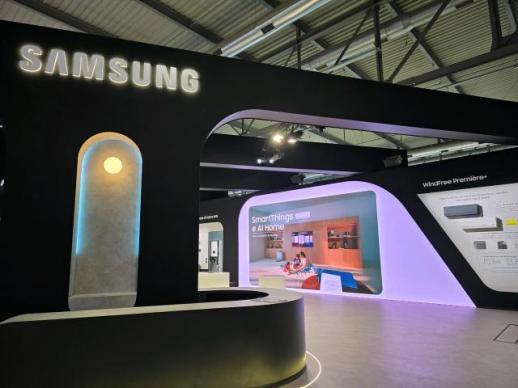 Samsung Electronics showcases joint HVAC solutions with newly acquired FläktGroup at MCE 2026 SEOUL, March 24 (AJP) - Samsung Electronics unveiled its latest heating, ventilation, and air conditioning (HVAC) solutions jointly with FläktGroup at the MCE 2026 exhibition in Milan, Italy, on Tuesday. The event marks the first joint showcase since Samsung's acquisition of the climate control firm in November. Samsung is displaying a centralized HVAC system that connects FläktGroup's five indoor units with its own outdoor units, such as the DVM S2+, managed through a Building Management Solution (BMS) platform. The companies are targeting high-value industrial sectors, including data centers and clean rooms. Commercial products on display include FläktGroup's 'CAIRplus' Air Handling Unit (AHU) and the compact 'Geko' Fan Coil Unit (FCU). For the residential market, Samsung introduced the 2026 'AI Wind-Free Combo Pro' wall-mounted air conditioner and the 'EHS All-in-One' system. Targeting European regulations and demand for energy efficiency, the EHS and DVM S2+ lineups utilize R32 refrigerant, which features a 68 percent lower Global Warming Potential compared to conventional R410A. The systems also incorporate AI-driven energy-saving modes and waste heat recycling technologies. The biennial MCE exhibition, which features around 1,900 participating companies this year, runs from March 24 to 27. 2026-03-24 15:19:54
 -
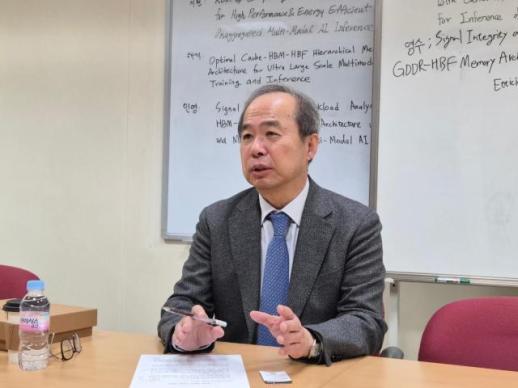 Beyond HBM: The next AI memory race is already underway DAEJEON, March 24 (AJP) - High bandwidth memory (HBM) is what enabled the current artificial intelligence boom, giving chips the speed needed to train large-scale models. But as AI shifts from training to real-world deployment, the industry is running into a different constraint — not speed, but scale. That shift is beginning to redefine the competitive landscape. The next phase of the AI chip race may hinge not on HBM itself, but on what comes after it: high bandwidth flash (HBF). Joung-ho Kim, a professor at the Korea Advanced Institute of Science and Technology (KAIST) and dubbed as the “father of HBM,” argues that this shift is not incremental but structural. In an interview with AJP, he argued the future of AI competitiveness will hinge on how quickly companies adapt their memory architecture to this new reality. “The memory architecture must be fundamentally restructured,” Kim said. “HBM defined the last decade, but HBF will likely determine the next.” The urgency stems from the rapid expansion of AI workloads, particularly in inference — the stage where trained models generate responses in real time. Unlike training, inference relies heavily on key-value (KV) caches, which store intermediate data and grow rapidly as models process longer context windows. What was once a manageable memory demand is now pushing into the terabyte range per system, exposing the limits of existing HBM-based designs. HBM, built on stacked DRAM, has served as an ultra-fast layer closely attached to GPUs, effectively acting as the system’s “working memory.” But its strengths — speed and bandwidth — are increasingly offset by limitations in scalability and cost. As models expand, simply adding more HBM becomes inefficient and prohibitively expensive. HBF addresses this bottleneck by introducing NAND flash into the memory hierarchy. While slower than DRAM, NAND offers significantly greater capacity at a fraction of the cost, enabling a new layered approach in which high-speed HBM handles immediate computation while HBF stores the massive datasets required for sustained inference. This shift marks a subtle but critical change in how AI performance is defined. “Once decoding begins, throughput becomes memory-bound,” Kim noted. “At that stage, capacity matters as much as bandwidth.” The implications are already shaping corporate strategies. SK hynix, which secured an early lead in HBM through aggressive investment in the 2010s, is once again moving ahead of the curve. In February, the company launched a high bandwidth flash standardization consortium with U.S.-based SanDisk, aiming to establish global specifications under the Open Compute Project. The move signals an attempt not just to develop technology, but to shape the broader ecosystem before the market fully materializes. The timeline remains long, with engineering samples expected around 2027 and commercialization closer to 2030. Yet the strategic positioning is taking place now, as companies seek to avoid repeating past missteps. Samsung Electronics, which was slower to commit to HBM in its early stages, is approaching the transition with greater caution. While focusing its immediate resources on next-generation HBM products such as HBM4E and HBM5, it is also investing in NAND-based architectures aligned with the HBF concept. The goal is clear: to ensure it does not lose its footing in another architectural shift. At its core, the emerging competition is less about a single product than about control over the entire memory system. The question is no longer who can produce faster chips, but who can design the most efficient hierarchy of compute and storage for an AI-driven world. The parallels with the past are difficult to ignore. SK hynix’s early bet on HBM reshaped the competitive landscape, while hesitation from rivals proved costly. Kim suggests that the same dynamic could play out again. “If companies fail to invest in HBF now, they could face the same risks we saw before,” he said. HBF may still be years away from commercial deployment, but the direction of the industry is already becoming clear. If HBM enabled the rise of large-scale AI training, HBF is positioning itself as the foundation for scalable, real-time AI services. In that sense, the next phase of the AI race may not be decided by raw processing power alone, but by something less visible — the architecture of memory itself. 2026-03-24 14:41:12
 -
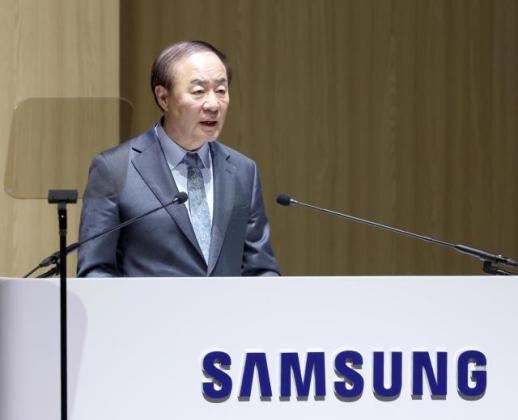 Samsung Electronics and union reopen talks, strike risk lingers SEOUL, March 23 (AJP)-Management at Samsung Electronics and its labor union held an unexpected executive-level meeting Monday, signaling a possible thaw in tensions after the union abruptly canceled a planned rally outside Chairman Lee Jae-yong’s residence. Vice Chairman Jun Young-hyun, who leads the critical Device Solutions (DS) division, met a four-member delegation from a joint protest committee that includes representatives of the National Samsung Electronics Union (NSEU). During the 90-minute meeting, Jun acknowledged employee grievances and proposed resuming formal negotiations, according to a union statement. “I am aware of the employees’ complaints, and we have arranged this meeting with the labor union to resolve them,” Jun said, adding the company is prepared to discuss key demands at the bargaining table. The union reiterated its preconditions for talks: scrapping the 50 percent cap on the Overall Performance Incentive (OPI) and overhauling the bonus system to improve transparency. It has strongly opposed the current use of Economic Value Added (EVA) as a benchmark, calling instead for metrics tied to operating profit. Jun signaled openness to reviewing the demands but cautioned that bonus allocation across semiconductor business units requires careful consideration. He also proposed a follow-up meeting in the near term. The dialogue came just hours after the union called off a press conference and rally planned outside Lee’s home in Seoul, citing “internal reasons,” in a move widely seen as lowering immediate tensions. Still, the risk of industrial action remains. The union recently secured legal strike rights after 73.5 percent of its roughly 90,000 members backed a walkout. It has threatened an 18-day general strike from May 21 to June 7 if negotiations fail. A mass rally involving about 9,300 members is scheduled for April 23 in Pyeongtaek, home to Samsung’s flagship chip plants. A strike would mark only the second in the company’s history, following a walkout in July 2024. Industry observers warn that any prolonged disruption could weigh on semiconductor output at a pivotal moment, as Samsung races to capture surging global demand for AI memory chips. 2026-03-23 18:10:00
 -
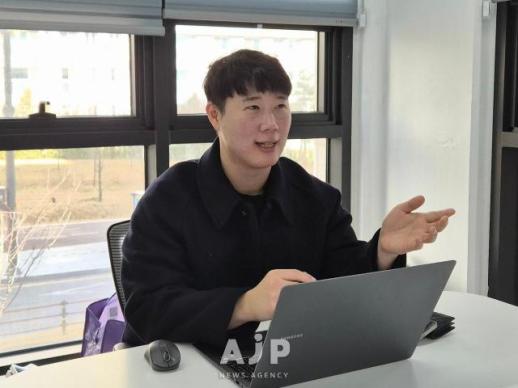 Samsung union chief: 'No. 1 means nothing without first-class treatment' PYEONGTAEK, March 20 (AJP) - Riding a two-year windfall from the global AI boom, Samsung Electronics is ramping up investment and shareholder returns at an unprecedented scale — but one stakeholder feels left out of the bounty: its employees. The company is pouring more than 110 trillion won ($74.6 billion) into semiconductors and has pledged to return 50 percent of its free cash flow to shareholders. Yet workers say the rewards of the AI-driven surge are not being shared on the ground. “We aren’t asking for the impossible,” said Choi Seung-ho, chairman of the Samsung Electronics Union Joint Action Committee, in an interview with AJP near the company’s Pyeongtaek fabs. “We are asking the company to act like the world-class leader it claims to be.” “Profit-hoarding days must end.” The rhetoric marks a shift from wage negotiations to a broader challenge of Samsung’s corporate identity, as the union escalates pressure following a 93.1 percent vote in favor of industrial action. Plans are now underway for a mass rally in April and a potential general strike in May. At the core of the dispute is compensation — and a widening gap with rival SK hynix that the union warns is fueling a “talent exodus.” While Samsung employees are widely perceived as elite earners, Choi pointed to a different reality for mid-level staff. A manager earning a base salary of around 76 million won ($57,000) often struggles to reach 100 million won in total compensation after taxes and relatively modest bonuses — a level increasingly out of step with the industry’s AI-driven gains. The contrast with SK hynix is stark. In 2025, its employees received average performance bonuses of 120 million to 130 million won under a transparent profit-sharing model. Comparable roles at Samsung, the union says, received roughly 37 million won — less than a third. “That gap creates a profound sense of deprivation,” Choi said. The union is demanding the removal of Samsung’s “Economic Value Added” (EVA) bonus cap, which limits payouts to 50 percent of salary and is based on a complex internal formula widely criticized by employees as a “black box.” By contrast, SK hynix shares 10 percent of operating profit directly with employees and removed its bonus cap last year. Tensions have been further aggravated by what the union calls a “divide-and-conquer” approach. Management recently proposed conditional bonuses tied to 100 trillion won in operating profit — but only for the Memory division, excluding Foundry and System LSI workers. “We were hired on the promise of equal treatment across the semiconductor pillar,” Choi said. “Excluding certain divisions now is nothing short of employment fraud.” The internal conflict comes as Samsung accelerates investment to maintain its lead in AI chips and high-bandwidth memory. Under its latest value-up plan, the company will boost facility and R&D spending to 110 trillion won this year, including a 37.7 trillion won R&D budget. At the same time, it reaffirmed its shareholder return policy, maintaining a payout ratio of 50 percent of free cash flow and planning to distribute 9.8 trillion won in dividends this year. For the union, the contrast is stark. “The company says it cannot afford to improve compensation, yet it commits over 100 trillion won to capital and generous shareholder returns,” Choi said. “There is no equivalent concept of ‘employee return.’” The stakes are rising quickly. Samsung’s Pyeongtaek production lines are estimated to generate up to 10 billion won per hour, meaning an extended strike could inflict losses exceeding 5 trillion won. “We are preparing,” Choi said, noting plans for large-scale mobilization ahead of April’s rally. He dismissed criticism that the dispute reflects excessive demands from high-paid engineers, framing it instead as a structural issue behind the so-called “Korea discount.” “If Samsung wants to maintain leadership in the HBM race, it must choose coexistence over disruption,” he said. “Without fair rewards, we cannot stop the outflow of talent.” Choi added that feedback from engineers who have already moved to SK hynix has been telling. “They report extremely high satisfaction,” he said. “When a company provides what employees feel they deserve, the result is obvious.” His final warning was blunt. “If this continues, the union may end up helping people leave,” Choi said. “We will support each other in finding opportunities elsewhere. 2026-03-20 16:36:44
 -
 Samsung Electronics adds AMD on HMB4 client list after Nvidia SEOUL, March 18 (AJP) - Samsung Electronics added AMD after Nvidia on its burgeoning client list for next-generation high bandwidth memory dubbed HBM4, gaining traction in the crucial in HBM race move to inference AI stage. A memorandum of understanding (MOU) with U.S. chip designer AMD to expand strategic partnership in next-generation AI memory and computing technologies was signed at Samsung’s Pyeongtaek campus. Under the terms of the agreement, Samsung will supply its advanced HBM4 solutions for AMD’s next-generation "Instinct MI455X" GPUs. The collaboration also extends to providing next-generation DDR5 memory for AMD’s EPYC server processors and its "Helios" data center platform. This move is seen as a strategic effort by both companies to diversify the AI semiconductor supply chain, which is currently seeing intense competition for high-capacity memory. "Powering the next generation of AI infrastructure requires deep collaboration across the industry," said Lisa Su, Chair and CEO of AMD. "We are thrilled to expand our work with Samsung, bringing together their leadership in advanced memory with our Instinct GPUs, EPYC CPUs and rack-scale platforms. Integration across the full computing stack, from silicon to system to rack, is essential to accelerating AI innovation that translates into real-world impact at scale.” Samsung Vice Chairman Jun Young-hyun emphasized the company’s "turnkey" capabilities, which integrate memory, foundry, and advanced packaging services under one roof. The two companies also discussed potential cooperation in semiconductor foundry services, leveraging Samsung’s advanced process technology to manufacture future AMD products. This deal marks a significant expansion of a 20-year partnership that began with graphics memory in 2007. On Tuesday, Samsung showed off its sixth-generation HBM4 being mass produced at Pyeongtaek at Nvidia's GTC 2026 as it a provider of a comprehensive memory and storage solution the U.S. top GPU maker's next-generation Vera Rubin platform. 2026-03-18 17:32:05