
Journalist
Arthur I. Cyr
davekim0807@ajupress.com
-
 HD Korea Shipbuilding issues $1.57 bn in exchangeable bonds, sparking valuation re-rating hopes SEOUL, April 03 (AJP) - HD Korea Shipbuilding & Offshore Engineering has launched a 2.37 trillion won ($1.57 billion) exchangeable bond issuance targeting shares of its flagship subsidiary HD Hyundai Heavy Industries, a move analysts say could dismantle the holding company discount that has long weighed on its stock. The company disclosed the EB issuance on March 31, later revising the total from an initially announced 3.03 trillion won. The bonds are exchangeable into a 4.3 percent stake in HD Hyundai Heavy Industries at a conversion price of 523,125 won per share, with exchange requests eligible from June 14. The offering crystallizes a plan first floated at a January management briefing, where executives acknowledged that HD Hyundai Heavy Industries' thin free float had become a bottleneck for unlocking shareholder value. "The company had announced it had no plans to sell its stake, but by issuing exchangeable bonds, it has effectively liquidated its HD Hyundai Heavy Industries holdings in a way that minimizes market shock," said Kim Yong-min, an analyst at Yuanta Securities. By opting for exchangeable bonds rather than a block deal, the shipbuilder chose to cushion the market from a sudden supply shock. Instead of offloading a large tranche of shares in one sweep, the structure allows a gradual expansion of circulating stock as bondholders exercise their conversion rights over time. For HD Korea Shipbuilding, monetizing a long-dormant subsidiary stake could serve as a springboard for valuation re-rating, with the parent's standalone net cash position projected to swell to nearly 5 trillion won. HD Hyundai Heavy Industries, by contrast, faces near-term headwinds on the supply side. EB investors are widely expected to engage in hedge trading — shorting the underlying shares to manage risk — which could exert downward pressure on the stock in the coming weeks. Market attention has now turned squarely to how the war chest will be deployed. Given that both companies already sit on ample liquidity, analysts view the fundraising as a preemptive move to finance large-scale strategic investments rather than a routine cash buffer. Potential targets include establishing a naval defense foothold in the United States and pursuing mergers and acquisitions in next-generation green maritime technology, particularly as Washington has signaled its desire to deepen cooperation with South Korean shipbuilders. No concrete spending plans have been finalized, however, leaving a degree of uncertainty. "This fundraising will give HD Korea Shipbuilding's overseas expansion and M&A pursuits significant momentum. It could serve as a catalyst for narrowing the valuation gap with rival shipbuilders," said Jeong Dong-ik, an analyst at KB Securities. As of 11:20 a.m. Friday, KOSPI-listed HD Korea Shipbuilding traded 7.42 percent up at 376,500 won per stock. 2026-04-03 11:22:44
 -
 Nexon opens 'Maple Island' permanent theme zone at Lotte World Adventure SEOUL, April 03 (AJP) - South Korean gaming giant Nexon has officially opened "Maple Island," a permanent story-themed attraction at Lotte World Adventure in Seoul's Jamsil district, bringing the beloved "MapleStory" franchise off the screen and into the real world. The roughly 2,000-square-metre zone, built within the outdoor section of the park, immerses visitors in the iconic landscapes of the MapleStory universe — including fan-favourite regions Henesys, Ludibrium and Arcana — and challenges them to solve hidden quests alongside the game's signature cast of monsters. The attraction features four rides, three of which are entirely new. Stone Express, a roller coaster, sends riders on a high-speed hunt for stone spirits, while Arcana Ride guides guests through a story of restoring life to an enchanted tree. Eos Tower propels visitors up and down at full speed toward the fan-favorite character Pink Bean, and the existing Gyro Spin attraction has been refitted with full Maple Island theming. Beyond the rides, visitors can shop for branded merchandise at Maple Store and stop at Maple Sweets for in-universe food and beverages such as "Red Potion" and "Blue Potion" drinks modelled on in-game items. The opening is part of a broader three-month seasonal collaboration, "MapleStory in Lotte World," launched on March 14 and running through June 14. The wider event spans the entire park and includes character interaction zones, Magic Castle projection mapping and themed parades. 2026-04-03 09:18:36
 -
 Seoul forced to swallow Trump's call, increase US share in energy SEOUL, April 02 (AJP) - South Korea is scrambling to shore up dwindling energy supplies and diversify away from the Middle East after U.S. President Donald Trump ruled out an immediate end to the Iran war, vowing instead to hit Iran "extremely hard over the next two to three weeks." In a primetime address from the White House on Thursday, Trump made clear the operation would last through April, destabilizing not just Iran's military infrastructure but also the core Middle East shipping pipeline — and, by extension, the global energy market. For South Korea — Asia's fourth-largest economy, which imports over 90 percent of its energy from abroad — the message was blunt. Rather than pledging to reopen the chokepoint through which about 20 percent of the world's oil and liquefied natural gas flows, Trump offered fuel-starved nations two options: buy American oil or secure the strait themselves. The remarks are reinforcing a structural shift already underway in Seoul's energy sourcing, with U.S. crude emerging as a key alternative. A senior trade official said domestic refiners are "scouring global markets" to secure replacement cargoes, adding that U.S. oil is taking up a growing share of substitute supply. The United States has rapidly gained ground in Korea's import mix, rising from just 0.2 percent in 2016 to over 16 percent last year, as Seoul has pushed to diversify away from Middle Eastern dependence. Industry sources say refiners including GS Caltex, HD Hyundai Oilbank and SK Energy are actively expanding U.S. procurement. Trump has been blunt in his message to allies that failed to support the U.S. war effort and are now grappling with supply disruptions. "So to those countries that can't get fuel, many of which refused to get involved in the decapitation of Iran, I have a suggestion," Trump said. "Number one, buy oil from the United States of America. We have plenty. And number two, build up some delayed courage. Go to the Strait and just take it, protect it, use it for yourselves." Seoul sources roughly 70 percent of its crude oil and 20 percent of its LNG from the Middle East, with virtually all of it transiting the now-blocked strait. Brent crude surged back above $105 a barrel after the speech, up from about $70 before the conflict erupted on Feb. 28. The Korean won hovered near 1,510 per dollar on Thursday, close to its weakest since 2009. The cascading damage to South Korea's industrial base is already severe. Naphtha, the petrochemical feedstock used in everything from plastics to automotive parts, has surged about 60 percent since February, while ethylene costs have doubled. Several naphtha crackers have gone into shutdown, requiring weeks to restart. Following shortages, Seoul has imposed a temporary ban on naphtha exports and designated the material as an "economic security" item. "Supply itself has been cut off, halting production entirely," said Jung Jun-hwan, a senior researcher at the Korea Energy Economics Institute. "Shutdowns could cascade across manufacturing sectors where raw material costs account for a large share of total expenses." The government has responded with a 26.2 trillion won ($17.2 billion) supplementary budget targeting fuel price caps, expanded subsidies, cash handouts for about 70 percent of the population and industrial support. Seoul has also lifted the 80-percent operating cap on coal-fired power plants, raised nuclear utilization rates above 80 percent and pledged to release 22.46 million barrels from its strategic petroleum reserve in coordination with the International Energy Agency. Officials said alternative supply is being secured at a pace that could cushion the immediate shock, albeit below normal levels. "Alternative supply for April is estimated at around 50 million barrels, and a significant volume for May is also being secured," Yang Ki-wook, deputy minister for energy security at the Ministry of Trade, Industry and Energy, said at a briefing on Thursday. That compares with a typical monthly import level of around 80 million barrels, but Yang stressed that the gap is manageable under current demand conditions. "The 80 million barrels is a normal benchmark, not an absolute requirement," he said, noting that lower refinery utilization and demand management measures limit the immediate impact. He added that remaining shortfalls can be bridged through stockpile swaps, allowing refiners to draw on government reserves before incoming cargoes arrive. With Russian crude emerging as a stopgap — made possible by a U.S. sanctions waiver issued in mid-March — Seoul is exploring supply routes it had abandoned after the invasion of Ukraine. However, industry experts say most Russian crude already has committed destinations and imports carry various restrictions, dimming the option. Even if the Strait of Hormuz were to be reopened tomorrow, experts say industry recoveries would come slowly. "Fully loaded tankers must first pass through, and empty vessels must then enter and drain the stockpiles before oil-producing states can resume output," said Yoon Jae-sung, an analyst at Hana Securities. "Given that a voyage to Asia takes four weeks and that 30 to 40 percent of Gulf refining capacity has been damaged — with normalization expected to take at least three months — restoring the supply chain will require considerable time. Crude oil and gas would take priority, pushing petrochemical products and naphtha further down the queue." 2026-04-02 16:25:57
 -
 Hyundai Motor bets on EV re-pivot after Gulf crisis SEOUL, April 02 (AJP) -South Korea's Hyundai Motor Group is stepping harder on the pedal in battery development and factory upgrades, after a period of stalled investment amid weak demand, as it bets on a structural shift toward non-fuel vehicles triggered by the global energy crisis. Its affiliate Kia said Wednesday that domestic sales of eco-friendly vehicles — including hybrids, electric vehicles and hydrogen-powered cars — jumped 51.9 percent on-year in March to 35,480 units. Electric vehicle sales alone surged 122.5 percent to 14,488 units, marking the first time Kia’s monthly domestic EV sales topped the 10,000 mark. Pricing has emerged as a key lever. With government subsidies, models such as the PV5 and EV3 are priced in the 20 million won ($13,216) range, allowing Kia to reach a broader pool of cost-conscious consumers. Hybrid demand also remained solid, with sales rising 14.5 percent to 19,293 units, underscoring a transitional shift as consumers hedge between fuel efficiency and full electrification. “Sales in the Middle East and sub-Saharan Africa dipped due to geopolitical risks, but robust eco-friendly vehicle demand elsewhere drove us to our best-ever first-quarter performance,” a Kia spokesperson said. “We will continue to build sales momentum by leading with EVs and hybrid SUVs.” The rally comes as soaring crude oil prices — triggered by the blockade of the Strait of Hormuz — have laid bare Asia's dependence on fossil fuels and sharpened the economic case for electrification. "The most viable escape from a world where geopolitical instability dictates energy prices is clean energy," said Kim Do-hyun, a senior analyst at Samsung Securities. Beyond sales, Hyundai Motor Group is deepening its push into battery technology. The group has begun developing ultra-high-nickel batteries — with nickel content exceeding 90 percent — in partnership with cathode material suppliers L&F, POSCO Future M and Ecopro. The next-generation cells are designed to deliver a range of 500 to 700 kilometers on a single charge, about 10 percent more than current high-nickel batteries. No battery maker or automaker has yet succeeded in mass-producing such cells, which demand advanced engineering to manage heightened fire risks and shorter lifespans tied to extreme energy density. Industry sources say the batteries are expected to be fitted in Hyundai's premium EV lineup, including its N performance series and the Genesis Magma brand. The group plans to continue development at its upcoming Future Mobility Battery Campus in Anseong, south of Seoul, scheduled for completion later this year. The facility will serve as a hub for battery research across EVs and robotics. Hyundai has also signaled that even as it builds in-house battery capabilities, it will not reduce procurement from external cell makers such as SK On. Its solid-state battery technology — widely considered the next frontier for safer, higher-density energy storage — is reportedly on par with that of South Korea's three major battery manufacturers. Meanwhile, the group is overhauling its flagship Ulsan complex — the world's largest single automotive plant, spanning 5 million square meters with an annual capacity of up to 1.52 million vehicles. Two aging production lines at Plant 1 and Plant 4, where Hyundai's first assembled car, the Cortina, rolled off the line in 1968 and its first indigenous model, the Pony, was built starting in 1975, are slated for reconstruction. Industry sources estimate Hyundai will invest about 4 trillion won to transform the two lines into advanced EV production facilities. A separate new EV plant within the Ulsan complex is set to begin operations in the second half of this year — the company's first new domestic assembly plant in 29 years, since the Asan facility opened in 1996. The green vehicle push coincides with the group's broader physical AI ambitions, which include deploying Boston Dynamics' Atlas humanoid robots at its U.S. plants by 2028 and mass-producing on-device AI chips for autonomous robotics. With electrification gaining ground at the showroom and intelligent automation reshaping the factory floor, Hyundai is betting both fronts will define its next chapter. 2026-04-02 11:41:27
 -
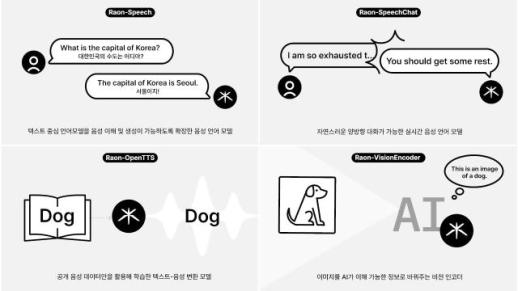 Krafton launches 'Raon' AI brand, releases four open-source models SEOUL, April 02 (AJP) - South Korean game developer Krafton unveiled a new artificial intelligence model brand called "Raon", releasing four open-source models on global AI platform Hugging Face as the company moves to establish itself as a serious AI contender beyond gaming. The four models — Raon-Speech, Raon-SpeechChat, Raon-OpenTTS and Raon-VisionEncoder — span speech, voice and visual processing, reflecting Krafton's push into multimodal AI. The brand name draws from the native Korean word "라온," meaning joy, and is designed to capture what the company calls the essential pleasure of gaming through AI. Raon-Speech, a 9-billion-parameter voice language model, claimed the top global ranking among open speech-language models under 10 billion parameters in both English and Korean, assessed across seven core tasks and 40 benchmarks. Raon-SpeechChat, meanwhile, is the first real-time, full-duplex voice conversation model developed in South Korea, capable of interrupting and being interrupted mid-conversation. Raon-OpenTTS, trained entirely on publicly available voice data, ranked among the world's best in blind listening tests against research-grade text-to-speech systems built on proprietary datasets. Raon-VisionEncoder, the fourth model, outperformed Google's SigLIP2 in select visual recognition tasks and will be integrated into Krafton's broader independent AI foundation model project. "The release of the Raon model series marks an important milestone in building our AI capabilities," Chief AI Officer Lee Kang-wook said. "By open-sourcing large-scale training data and core models, we hope to contribute to the advancement of multimodal technology and the growth of South Korea's AI ecosystem." 2026-04-02 10:41:01
 -
 Samsung Biologics completes $353 mln Maryland, US plant acquisition SEOUL, April 01 (AJP) -Samsung Biologics, South Korea’s leading contract drug manufacturer, has completed its acquisition of a biopharmaceutical manufacturing facility in Rockville, Maryland, marking its first production base in the United States to better access the world’s largest drug market and mitigate tariff risks. The company said in a press release on Wednesday its wholly owned unit Samsung Biologics America acquired Human Genome Sciences from GSK for $353.1 million, including $280 million for the facility and equity and $73.1 million for inventories and raw materials. The Rockville site comprises two manufacturing plants with a combined 60,000-liter drug substance capacity, supporting both clinical and commercial biologics production. The addition lifts Samsung Biologics’ total global capacity to 845,000 liters. The deal comes as the company seeks to mitigate supply chain risks and expand its contract manufacturing presence beyond Korea, where all of its production facilities had previously been concentrated. Samsung Biologics said it will continue supplying products previously manufactured at the site to GSK while expanding contract manufacturing services. It also plans further investments to increase capacity and upgrade technologies at the facility. The acquisition secures more than 500 jobs at the site and strengthens the company’s ability to offer multi-site manufacturing options to global clients, particularly in North America. “This represents a meaningful step in expanding our U.S. manufacturing footprint,” CEO John Rim said, highlighting the role of the new facility in building a geographically diversified production network. “Today’s ribbon cutting is the realization of that meeting and our state’s momentum,” Maryland Gov. Wes Moore said. “South Korea’s largest biotech company is opening its first U.S. manufacturing facility here in Maryland.” The deal’s closure came three months after Samsung Biologics announced the acquisition on Dec. 22 last year, as part of efforts to mitigate risks stemming from U.S. tariff policies on biopharmaceuticals. As of 2:00 p.m. Wednesday, KOSPI-listed Samsung Biologics were 5 percent up at 1,580,000 won ($1,047). 2026-04-01 14:13:58
 -
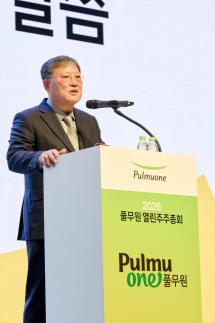 Pulmuone vows AI-driven growth push at annual shareholder meeting SEOUL, March 31 (AJP) - South Korean food company Pulmuone held its annual general meeting, pledging to accelerate its artificial intelligence transformation strategy and expand into new business segments as it eyes a deeper footprint in global markets. The meeting, held at the Korea Science and Technology Convention Center in Seoul's Gangnam district on Tuesday, drew shareholders and company executives under the theme "ONE" — a reference to the firm's corporate philosophy, its track record, and its strategic roadmap. General CEO Lee Woo-bong reported that Pulmuone posted consolidated revenue of 3.38 trillion won (about $2.2 billion) and operating profit of 93.2 billion won in fiscal 2025, calling the results a reaffirmation of the company's competitive resilience amid global economic headwinds. "We will leap forward to the next level as the global no.1 wholesome food and sustainable lifestyle company leading the K-food industry by creating sustainable growth momentum toward a new future through an organizational culture based on AX innovation and an entrepreneurial mindset," Lee said. Shareholders approved six agenda items, including the fiscal 2025 financial statements, amendments to the company's articles of incorporation, and the appointment of new directors. Under the charter revision, the mandatory ratio of independent outside directors was raised from one-quarter to one-third of the total board. Chun Young-hoon, CEO of Pulmuone Foods, was appointed as an inside director alongside two newly elected outside directors. On the growth front, the company said it is scaling up nascent businesses — including living care, pet products, food technology, and corporate food service — while pressing ahead with a company-wide AI transformation drive centered on a new future business division established earlier this year. Pulmuone said it plans to pursue both top-line growth and margin improvement across its domestic and overseas operations in 2026, with a particular focus on turning around its U.S., China, and Japan units and expanding into Europe and Canada. 2026-03-31 13:59:16
 -
 Ottogi joins hands with Gen.G Esports to chase global gaming audience SEOUL, March 31 (AJP) - South Korean food company Ottogi has signed a strategic partnership with global esports organization Gen.G Esports, targeting millennial and Gen Z gamers across key international markets, the company said Tuesday. The two companies plan to weave gaming culture into everyday consumer experiences by building an integrated marketing model spanning content, physical spaces, and commerce. Brand exposure will be carried through player uniforms and digital content centered on titles including League of Legends and Valorant. Joint campaigns tied to marquee global tournaments — including the League of Legends Mid-Season Invitational and World Championship — are also in the works, giving Ottogi visibility at some of esports' most-watched events. The two sides will also pursue co-branded content drawing on each company's intellectual property, with expansion plans targeting North America, Southeast Asia, and the Chinese-speaking market as part of a broader K-food and esports crossover strategy. "This partnership lays the groundwork for deepening our connection with the global younger generation and delivering a fresh brand experience," an Ottogi spokesperson said, adding the company would continue to expand its presence in international markets. 2026-03-31 09:17:02
 -
 HMM pushes ahead with move to Busan despite union protest SEOUL, March 30 (AJP) - South Korea's largest container shipping line HMM reportedly said its board of directors approved a charter amendment to relocate the company's headquarters from Seoul to the southeastern port city of Busan, setting the stage for a shareholder vote on May 8 that is all but certain to pass. The board convened an extraordinary session to endorse the revision to Article 3 of HMM's articles of incorporation, which currently designates Seoul as the registered seat. An extraordinary general meeting of shareholders will follow on May 8, where approval requires a special resolution backed by two-thirds of attending shareholders. With state-affiliated entities holding more than 70 percent of HMM shares — Korea Development Bank at 35.42 percent, Korea Ocean Business Corporation at 35.08 percent and the National Pension Service at 5.62 percent — passage is widely considered a foregone conclusion. The move is a centerpiece of President Lee Jae Myung's drive to transform Busan into a maritime capital, consolidating shipping administration, judicial functions and corporate headquarters in a city that already hosts the world's second-largest container transshipment port. Industry officials expect HMM to begin scouting office sites near Busan New Port in the second half of the year and to unveil relocation support packages for Seoul-based staff shortly after the vote. HMM's onshore labor union, however, struck a defiant tone. The union declared bargaining with management collapsed after the board acted without prior consultation and said it would move to secure the right to stage industrial action, raising the specter of a general strike before the May meeting. The union has argued the transfer could hollow out operational efficiency and trigger an exodus of seasoned employees whose work is embedded in Seoul's financial and logistics networks. Analysts say the Busan relocation could also accelerate the long-delayed privatization of HMM, as KDB seeks to shore up its capital adequacy by divesting its stake in the carrier. The headquarters shift follows the Ministry of Oceans and Fisheries' own relocation from the administrative capital of Sejong to Busan in December 2025, a move that prompted mid-sized bulk carriers SK Shipping and H-Line Shipping — both controlled by private equity firm Hahn & Company — to begin relocating to the port city earlier this year. 2026-03-30 17:08:02
 -
 Union-proof Samsung faces twin labor flare-ups as Biologics joins chip unit unrest SEOUL, March 30 (AJP) -Samsung Group, long seen as union-proof, is facing back-to-back labor unrest as its biopharmaceutical arm Samsung Biologics moved toward its first-ever strike, joining a parallel standoff at Samsung Electronics. The union at Samsung Biologics secured strike authorization with overwhelming support, marking the first such move since the company’s founding in 2011. About 95.5 percent of 3,678 eligible voters backed industrial action after months of stalled wage negotiations, the union said Sunday. The union represents roughly 3,689 workers, or about 75 percent of the company’s workforce. Labor and management have held 13 rounds of talks without narrowing differences. The union is demanding an average 14 percent wage increase, a 30 million won ($19,846) one-time incentive per employee, performance bonuses equivalent to 20 percent of operating profit, and stock grants over three years. Management has offered a 6.2 percent pay raise, citing alignment with compensation standards across major Samsung affiliates, including Samsung Electronics. “We are willing to talk at any time if management brings an improved proposal — there is clearly room for compromise at a reasonable level,” union chairman Park Jae-sung said. The standoff has raised concerns among industry observers, who warn that prolonged disruption could derail Samsung Biologics’ 15 trillion won ($10.8 billion) capacity expansion plan through 2034 and delay plant commissioning, at a time when global rivals Lonza and Fujifilm Diosynth are aggressively courting clients. The union plans to begin informal talks once CEO John Rim returns from an overseas trip. Failing progress, workers are set to launch a full-scale general strike on May 1. Samsung Electronics’ semiconductor workforce is locked in a parallel dispute. Its union — representing about 90,000 members — secured legal strike rights last month after 73.5 percent backed a walkout, and has warned of an 18-day general strike from May 21 to June 7 if negotiations over bonus reforms break down. The prospect of simultaneous industrial action across two of Samsung’s most critical units is raising concerns over operational disruptions at a time when the group is navigating intensifying global competition and supply chain uncertainty. At 1:30 p.m. Shares of Samsung Biologics were trading 4.05 percent down at 1,540,000 won ($1,018). 2026-03-30 13:30:57