
Journalist

Kim Yeon-jae
duswogmlwo77@ajupress.com
-
 FSS probes Bithumb following "ghost coin" scandal SEOUL, Feb 10 (AJP) -The Bithumb mispayment case is emerging as a major test for South Korea’s virtual asset regulatory system, as financial authorities move to use the findings to shape tougher oversight and future legislation. The Financial Supervisory Service (FSS) said Tuesday that it is focusing on whether Bithumb’s internal control systems complied with the Act on the Protection of Virtual Asset Users, particularly rules requiring exchanges to hold virtual assets in amounts equivalent to customer deposits. Regulators are also examining how a single employee’s input was able to trigger large-scale ledger distortions and whether real-time monitoring systems were operating properly. Authorities are reviewing Bithumb’s reconciliation procedures, including how frequently the exchange compared its internal accounting records with actual wallet balances. Bithumb has confirmed that it conducted reconciliation once a day, completing checks on the afternoon of the following trading day. This contrasts with rival Upbit, which operates an automated system that verifies reserves and ledger balances at five-minute intervals. Officials are also investigating how quickly the mispayment was detected. According to industry sources, the error was identified within about 20 minutes after a staff member reviewed a test account that had been included among event recipients. The FSS said the inspection results would be reflected in discussions on the second phase of virtual asset legislation, with a focus on preventing the recurrence of so-called “ghost coin” incidents. FSS Governor Lee Chan-jin has said that resolving such issues is essential for the virtual asset market to gain institutional credibility. Lawmakers and regulators are also reviewing governance standards at crypto exchanges. Some officials said the case has added momentum to proposals to cap major shareholders’ ownership stakes at 15 to 20 percent to strengthen internal oversight. The FSS is expected to continue intensive inspections this week and may extend the probe if necessary. Depending on the outcome, Bithumb could face administrative sanctions, including fines and possible disadvantages in future business license renewals. Bithumb responded that it is strengthening internal controls and reviewing its operating systems, regardless of the investigation outcome. The exchange said it has launched an internal audit to identify the root cause of the error and assess weaknesses in its accounting and approval processes. It is also conducting a comprehensive review of its ledger management and reconciliation systems. Bithumb said it is reinforcing safeguards to prevent a recurrence, including tightening access controls, strengthening multi-step verification procedures for asset transfers, and expanding automated monitoring systems that compare internal records with actual wallet balances. The company said it is also reviewing its reconciliation schedule, which currently involves comparing ledger entries and on-chain balances once a day. Officials indicated that the frequency and scope of these checks may be expanded, following criticism that the system was insufficient to detect abnormal transactions in real time. Regarding customer protection, Bithumb said it has taken steps to secure affected assets and prevent unauthorized withdrawals linked to the mispayment. The company said it is reviewing compensation and recovery measures in line with regulatory guidance. The incident occurred during a routine event payout at Bithumb last Friday, when an intended reward of 2,000 won ($1.20) per user was mistakenly entered as 2,000 bitcoins. As a result, about 620,000 bitcoins were credited to 249 customer accounts. Bithumb said it intervened within minutes after detecting the error. However, during the brief window before the system was frozen, about 1,788 bitcoins were sold on the market, triggering sharp volatility and pushing prices down by as much as 17 percent at one point. Prices have since stabilized, but the exchange said it has recovered only 99.7 percent of the misallocated assets, with about 125 bitcoins still unretrieved. The episode bared a yawning discrepancy between Bithumb’s internal accounting records and its actual asset holdings. The exchange did not possess the 620,000 bitcoins that were credited to customer accounts. According to its disclosures, Bithumb’s total bitcoin reserves are estimated at around 43,000 coins, with only about 175 bitcoins owned directly by the company, excluding customer deposits. This means the platform temporarily recorded balances far exceeding its actual holdings, creating so-called “ghost coins” within its internal ledger. 2026-02-10 13:16:04
 -
 Bithumb scandal sparks deep skepticism over Korea's crypto exchange systems SEOUL, Feb 09 (AJP) - A “fat finger” blunder at Bithumb, South Korea’s second-largest cryptocurrency exchange, has become a windfall for a few and a nightmare for many, involving more than $40 billion in erroneous transactions and raising fresh concerns over the safety of crypto trading in Korea. At around 7 p.m. KST last Friday, a staff member attempted to distribute 620,000 won in prize money but mistakenly transferred 620,000 won worth of Bitcoin instead—each unit valued at about 100 million won at the time. At the time of the incident, Bithumb reportedly held about 40,000 Bitcoins. Yet the erroneous payout amounted to nearly 15 times that figure. The exchange said it had recovered more than 99 percent of the wrongly distributed assets, but about 125 Bitcoins—worth roughly 13 billion won—remain unreturned. As volumes several dozen times larger than actual market capitalization were deposited into accounts, some investors panicked. This triggered a flash crash, sending Bitcoin prices plunging from around 100 million won to 80 million won and causing significant losses for many traders. Korean investors are familiar with such “fat finger” incidents. In 2018, Samsung Securities mistakenly issued “ghost stocks” worth 112 trillion won after entering share quantities instead of cash dividends. The Bithumb case has revived memories of that episode. Weak safeguards despite massive volumes The scandal has reignited criticism over the lack of preventive mechanisms in South Korea’s crypto market, which ranks among the world’s largest by trading volume. Although the Act on the Protection of Virtual Asset Users has been in force since July 2024, its provisions are seen as falling short of safeguards in major overseas markets. The incident stemmed from the absence of internal systems to block abnormal transactions at the platform level. Once the erroneous data was entered, it translated directly into actual transfers. In Japan, a 2025 amendment to the Payment Services Act allows withdrawals to be immediately blocked when irregular activity is detected, supported by approval processes using cold wallets. While Korean rules require at least 80 percent of assets to be stored in cold wallets, they impose few concrete restrictions on withdrawal procedures, complicating recovery efforts. In the European Union, detailed ledger and disclosure requirements allow regulators to access full records of balances, transaction purposes and histories, making it difficult for exchanges to record volumes far exceeding their holdings. Fears of manipulation mount Some experts view the incident as evidence that the risks of “naked short selling” in crypto markets have been underestimated. “During the Samsung Securities fat finger incident, there were overwhelming suspicions that the firm traded non-existent shares to intentionally manipulate stock prices,” said Seok Byoung-hoon, an economics professor at Ewha Womans University. “I believe this case will be remembered as a representative example showing that naked short selling is indeed possible in the crypto world.” Korean investors are particularly sensitive to such practices. In May 2024, the Financial Supervisory Service identified about 150 billion won in illegal short selling by seven investment banks, including HSBC Hong Kong and BNP Paribas. The findings led to a temporary ban on short selling, which was lifted in March 2025. FSS Governor Lee Chan-jin said Monday that authorities would respond sternly, without specifying details. “The essence of this issue is that erroneous virtual data actually led to real-world transactions,” he said. 2026-02-09 17:59:38
 -
 Seoul sells $3 bn in USD bonds, largest sovereign offering since global financial crisis SEOUL, February 06 (AJP) - South Korea on Thursday sold $3 billion in U.S. dollar-denominated bonds in its largest single sovereign offering since the aftermath of global financial crisis, building up the ammunition to defend the local currency while the debt environment remains favorable. According to the Ministry of Economy and Finance on Friday, the government issued $3 billion in foreign exchange stabilization bonds in two tranches: $1 billion in three-year notes and $2 billion in five-year bonds. The three-year papers were priced at 3.683 percent, or nine basis points above comparable U.S. Treasuries, while the five-year notes carried a yield of 3.915 percent, or 12 basis points over benchmark Treasuries. The deal marks the largest sovereign dollar bond issuance since April 2009, when Seoul raised $3 billion in the aftermath of the global financial crisis. Foreign exchange stabilization bond issuance has historically increased during periods of won weakness. The latest offering reflects the government’s increasingly firm stance on defending the currency. As of Friday, the won closed at 1,469.5 per dollar, surpassing its monthly average, under pressure from a strong greenback and persistent foreign capital outflows. The issuance is also aimed at replenishing foreign currency reserves. South Korea spent a total of $4.75 billion between December 2025 and January 2026 to stabilize the won, an unusually aggressive intervention by global standards. Most major economies typically build reserves toward year-end to meet capital adequacy requirements under the Bank for International Settlements framework. Korea, however, was the only major economy to substantially draw down dollar reserves in December. Reserves Decline Despite Record Surplus The reserve trend has raised concerns among policymakers. The Bank of Korea said Friday that despite recording its largest-ever current account surplus in 2025, foreign exchange reserves fell by $4.44 billion over the year. The central bank also confirmed this week that it had renewed its foreign exchange swap arrangement with the National Pension Service, highlighting ongoing efforts to secure dollar liquidity. Officials said the bond sale was driven in part by growing risks from external shocks, particularly amid prolonged trade tensions with the United States. On Jan. 27, U.S. President Donald Trump announced a 25 percent tariff hike on South Korean automobiles, citing delays in related legislation. The measure took effect this week. The finance ministry said it had “preemptively expanded foreign exchange reserves, which serve as an external safety valve, amid heightened uncertainties such as tariffs,” signaling that trade risks were a key factor behind the issuance. Geopolitical uncertainties were also considered, including instability in Venezuela and Iran and the prolonged war in Ukraine, all of which continue to weigh on global markets. The narrow spreads achieved in the latest sale point to Korea’s improved credit standing. During the 2009 financial crisis, spreads on 10-year Korean sovereign bonds surged to more than 430 basis points. After the 1998 IMF bailout, they exceeded 350 basis points. By contrast, the current spread of around 10 basis points over U.S. Treasuries is comparable to that of top-rated advanced economies and major international institutions. “This demonstrates that the so-called ‘Korea discount’ is steadily disappearing in the global sovereign bond market,” the ministry said. Foreign investor demand for Korean debt has strengthened further ahead of Korea’s scheduled inclusion in the World Government Bond Index between April and November. 2026-02-06 17:27:46
 -
 Korea's record C/A surplus pales by near-tripling capital outflows SEOUL, Feb. 06 (AJP) -The black figure in South Korea’s current account stretched to a monthly high in December and an annual high for 2025 thanks to red-hot chip sales, but the bulk of the gains went to defending the Korean currency against rapid depreciation and funding outbound investments, data showed. According to data released by the Bank of Korea on Friday, the current account in December recorded a surplus of $18.7 billion, an increase of more than $6 billion from the previous month. This marked the largest monthly surplus on record. For the full year, the surplus reached $123.05 billion, also rewriting the all-time high. Much of the glow fades when the data is set against the financial account, which measures capital flows. The financial account posted net asset increases of $23.77 billion in December, more than doubled from a year earlier, and $119.76 billion for full-year 2025, compared with $96.87 billion in 2024, implying that much more Korean money flowed out than in. The current-account surplus was driven largely by exports, which rose more than 13 percent to $69.54 billion. Chips were the primary earner, with exports expanding 43.1 percent to about $20.92 billion. Information and communication technology devices, including mobile phones, also performed strongly, rising 24 percent to $4.77 billion. Petroleum product exports reached $4.24 billion, up 6 percent from a year earlier, following a four-week improvement in refining margins through late December and a year-end surge in demand. Ships, once a pillar of export growth through October, fell 3 percent to $2.89 billion, marking a second consecutive month of decline. Automobile exports, which exceeded $6 billion in November, slipped back to $5.59 billion. Major automakers such as Hyundai and Kia have entered “contingency plans” as inventories subject to a potential 25 percent tariff under U.S.-Korea trade negotiations hit the market. Steel products also remained sluggish. Although the decline narrowed from November’s 6.3 percent drop, exports still fell 1.7 percent to $4.02 billion. Home appliance exports slid 8.1 percent to $560 million amid competition from cheaper Chinese products. Imports totaled $57.37 billion, up 4.6 percent from a year earlier. The decline in raw material import prices, which hovered around 8 percent in November, slowed sharply to just 1 percent. This reflected the won’s weakness, which averaged 1,467.3 per dollar in December, and rising prices for selected items. While crude oil imports fell 14.4 percent to $5.59 billion and gas dropped 33.4 percent to $2.03 billion, mining imports surged. Mineral imports rose 22.3 percent to $2.55 billion, while other metals, including rare earths, climbed 11.8 percent to $1.55 billion. The largest increase was seen in consumer goods, which jumped 17.9 percent to $9.72 billion. Durable goods, in particular, surged 30.8 percent to $4.37 billion, reflecting soaring prices for smartphones and computers as general-purpose chips were diverted to the AI business-to-business market, along with rising imported car sales. The problem is that much of the money earned has failed to build wealth at home. Investment income reached a record $30.17 billion in 2025, up $1.47 billion from a year earlier. Dividend income accounted for more than two-thirds of the total, at $20.19 billion. But the devil is in the details. In December, outward securities investment by residents rose 17.2 percent to $14.37 billion, with equities accounting for $11.83 billion. In contrast, inward investment by foreigners fell to $5.68 billion from $5.81 billion in November, with just $410 million flowing into stocks and the remainder into bonds. For full-year 2025, outbound securities investment reached $140.3 billion, nearly triple the $52.54 billion invested in local securities by foreigners. Direct investment showed a similar trend. Outward investment rose $6.49 billion, while inward foreign investment increased by only $5.17 billion. The gap, however, narrowed sharply from October, when outbound investment was nearly ten times larger than inbound. For 2025, outbound direct investment reached $41.23 billion, nearly tripling the $15.8 billion invested in Korea by foreign entities. It is little wonder that Korea’s pledge of up to $350 billion — including about $200 billion in cash — to the United States has weighed on the won, despite strong exports and a buoyant stock market. Reserve assets fell $4.44 billion in December, compared with a $1.69 billion increase in November. The country’s foreign exchange reserves fell $2 billion in December and $2.15 billion in January as authorities intervened to support the won and curb import-driven inflation through currency swap arrangements with the National Pension Service. As of 10:15 a.m. Friday, the won was trading at 1,470.2 per dollar, down 1.2 won from the previous close. After stabilizing briefly near the 1,420 level earlier this month, the currency is again facing renewed weakness. 2026-02-06 12:10:58
 -
 Freefall may be looming in Seoul as short selling mounts SEOUL, Feb. 05 (AJP) - “What goes up must come down,” the saying goes — and after a prolonged roller-coaster ride, Korean stocks plunged Thursday as heavy institutional selling triggered a sharp reversal. The immediate cue came from a retreat in U.S. technology shares. But the pullback was hardly unexpected, given the rapid buildup in short-selling positions and growing signs of speculative excess. Both the KOSPI and the secondary KOSDAQ tumbled nearly 4 percent Thursday from their previous day’s peaks, underscoring how quickly sentiment had shifted. The reversal had been foreshadowed by institutional investors’ readiness to lock in profits at the first sign of weakness. As of Tuesday, the balance of stock lending — widely seen as a precursor to short selling — climbed to a record 140.8 trillion won ($96 billion), up 24.5 percent from six months earlier, according to market data. In stock lending transactions, institutional players such as pension funds and insurers lend shares to traders, who sell them in anticipation of repurchasing them later at lower prices. The expanding lending balance suggests a growing number of investors have been positioning for a correction or seeking protection against heightened downside risks. Market volatility in early February has been unusually intense. On Monday, concerns over a potential hawkish shift in U.S. monetary policy triggered a 5.3 percent plunge in the KOSPI, briefly pushing it below the psychologically important 5,000 mark. The index rebounded sharply the following day, surging 6.84 percent to a record close, before extending gains on Wednesday — only to reverse course again. By comparison, Japan’s Nikkei 225 posted far more moderate fluctuations over the same period, highlighting the exceptional turbulence in Korean equities. Reflecting elevated investor anxiety, the VKOSPI volatility index climbed above 50 on Feb. 5, more than 50 percent higher than a month earlier. “As volatility widens and the market appears increasingly disconnected from economic fundamentals, investors are actively seeking hedging tools,” a market official said, speaking on condition of anonymity. Yet products designed to profit from falling markets have struggled as the rally continues. Samsung Asset Management’s KODEX 200 Futures Inverse 2X ETF — the most actively traded inverse product — closed at 345 won on Feb. 4, down 38 percent over the past month and more than 90 percent below its 2016 listing price, leaving it trading at levels comparable to penny stocks. Other inverse products have also weakened. Mirae Asset’s TIGER Inverse ETF has fallen about 22 percent since the start of the year. Inverse ETFs move opposite to the underlying index, meaning their performance deteriorates when markets rise. When the KOSPI fell 3.86 percent in the following session, the KODEX leveraged inverse fund briefly jumped nearly 9 percent, underscoring the products’ sensitivity to market swings. Analysts say structural factors also weigh on returns, including frequent trading and retail investors’ tendency to react quickly to market headlines. Average daily ETF trading value this year has nearly doubled from last year to more than 11 trillion won, according to the Korea Exchange, reflecting heavier speculative activity. The Bank of Korea has also noted rising trading volumes in leveraged and inverse ETFs. “Participants in leveraged and inverse ETF markets, especially double-inverse products, tend to focus on short-term trades and are highly sensitive to external news,” said an official at a capital markets research institute. 2026-02-05 17:25:32
 -
 Seoul's FX battle costs $4 bn over the last two months SEOUL, February 04 (AJP) - South Korea has deployed nearly every tool in its policy playbook to defend the won, which authorities say has weakened “excessively” beyond its fundamentals — a view shared even by the U.S. Treasury secretary. Measures have ranged from pressuring public and private institutions to sell dollar holdings to offering tax incentives aimed at drawing capital back home. Yet despite these efforts, the national coffers have paid a heavy price. As of the end of January 2026, foreign exchange reserves stood at $425.91 billion, down $2.15 billion from the previous month, following a decline of more than $2 billion in December, according to the Bank of Korea (BOK) on Wednesday. Nearly $4.2 billion has been depleted in just two months. The central bank attributed the decline primarily to its FX swap arrangement with the National Pension Service (NPS). Under the program, the BOK supplies dollars to the NPS for overseas equity purchases, temporarily limiting capital outflows that typically weaken the won. The BOK has said the swap would temporarily dent reserves but be reversed once the dollars are returned. However, whether the strategy is producing meaningful results remains uncertain. The average exchange rate rose to 1,467.35 won per dollar in December, up from 1,461 in November. Despite continued intervention, the rate remained weak at around 1,451 won as of Feb. 4. In late January, the won posted the sharpest decline among major currencies, briefly approaching the 1,470 level. Private dollar hoarding offsets intervention A broader look at the private sector highlights a structural challenge. According to BOK data released on Jan. 26, resident foreign currency deposits reached a record $119.43 billion in December, up $15.88 billion from November. Both the balance and the monthly increase marked all-time highs. The central bank is well aware of the trend. At a press conference following the January Monetary Policy Board meeting, BOK Governor Rhee Chang-yong noted that individuals and corporations already hold ample dollar liquidity. Rhee explained that many market participants, betting on continued dollar strength, prefer lending their dollars in financial markets rather than selling them in the spot market. “The issue lies in circulation structure, not in total supply,” he said. Meanwhile, growing preference for overseas assets reflects persistent skepticism over corporate earnings growth and long-term prospects for “Korea Inc.” Data from the Korea Securities Depository show that Korean investors’ holdings of U.S. stocks reached a record $171.8 billion, rising 5 percent between Dec. 31 and Jan. 16. The BOK also reported that outward securities investment surged by $12.26 billion in November, led by equities, while foreign inflows remained below $6 billion and were concentrated largely in bonds. Policy efforts face structural limits Authorities are rolling out measures to attract capital back home, including Reshoring Investment Accounts and the National Growth Fund. The Financial Supervisory Service is also considering incentives such as higher interest rates for converting dollars into won. South Korea’s gradual inclusion in the World Government Bond Index through November is also raising hopes for stronger foreign inflows. Still, analysts stress that sustained currency stability ultimately depends on economic fundamentals. Shinhan Securities expects the exchange rate to remain around 1,400 won per dollar, citing weak growth and slowing potential output. South Korea’s economy contracted 0.3 percent in the fourth quarter of 2025, while full-year growth barely reached 1 percent. “The reason many people are investing in ‘Gobbuss’ (KODEX 200 Futures Inverse 2X) even as the KOSPI hits record highs is anxiety over the real economy,” said an investment banking official, speaking on condition of anonymity. “The psychology behind refusing to sell dollars is essentially the same.” Stocks surge despite currency weakness Despite the won’s fragility, equity markets continued to rally. The KOSPI closed Wednesday at a record 5,371.10, up 1.57 percent. Institutional investors posted net purchases of 1.4 trillion won ($964.2 million), while retail investors sold a net 1 trillion won. In January, institutions were net buyers of 34 trillion won, while retail and foreign investors were net sellers of 2.7 trillion won and 3.7 trillion won, respectively. Meanwhile, the dollar rose 1.30 won to close at 1,452.30. 2026-02-04 17:42:43
 -
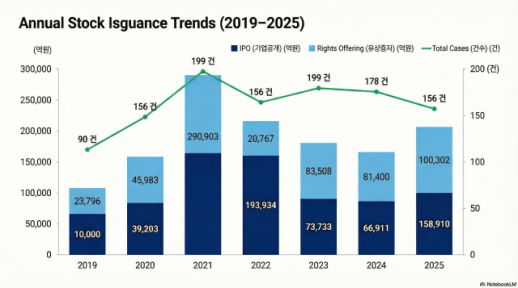 Greater rights offerings and fewer IPOs amid big-cap-led Korean stock boom SEOUL, Feb. 04 (AJP) - South Korea’s equity issuance saw a significant jump of approximately 55 percent last year, fueled by large-scale rights offerings. In contrast, new shares issued through initial public offerings (IPOs) contracted, underscoring a deepening funding freeze for small- and medium-sized enterprises (SMEs) and venture firms. According to the Financial Supervisory Service (FSS) on Wednesday, public equity issuance last year totaled 13.71 trillion won ($9.4 billion), an increase of 55.4 percent from the previous year. Rights offerings accounted for 10.30 trillion won of the total, skyrocketing 113.3 percent compared to 2024. The surge was primarily driven by major conglomerates, with the total value of rights offerings by large corporations alone increasing by nearly 220 percent on year. The number of rights offerings reached 72, an increase of 28.6 percent from the 56 cases recorded in 2024. Reflecting a growth trend skewed toward conglomerates, the push in rights offerings was led by major players. While rights offerings by large firms surged 220 percent versus the previous year, those by SMEs decreased 22.6 percent during the same period. IPO market chills amid tightened regulations Equity issuance through IPOs amounted to 3.68 trillion won, down 10.7 percent from a year ago. The number of IPOs fell 14 percent to 98 cases. By market, 6 cases were listed on the benchmark KOSPI, while 92 cases were on the tech-heavy KOSDAQ. The divergence is attributed to continued strong performances by existing listed giants, while SMEs and venture firms struggled. Furthermore, the government's aggressive moves to exit "zombie companies" and block "split-off listings" have raised the bar for initial public offerings. Corporate bond issuance totaled 276.25 trillion won, a slight decrease of 0.7 percent against the previous year. Compared to 2024, general corporate bonds and ABS increased 6.5 percent and 20.0 percent, respectively, while financial bonds fell 4.0 percent. For general corporate bonds, refinancing accounted for the largest share at 79.6 percent, followed by operating capital (16.4 percent) and facility investment (4.0 percent). By credit rating, high-grade bonds (AA or higher) rose to 70.7 percent, while lower-rated bonds (A or lower) fell to 29.3 percent relative to the year before. By maturity, mid-term bonds continued to dominate at 95.0 percent, with long-term and short-term bonds accounting for 3.4 percent and 1.6 percent, respectively. Among financial bonds, bank bonds and other financial bonds decreased 12.2 percent and 2.4 percent, while bonds issued by financial holding companies jumped 31.3 percent from a year earlier. As of the end of last year, the total outstanding balance of corporate bonds stood at 756.88 trillion won, up 9.3 percent from the prior year. Meanwhile, issuance of commercial paper (CP) and short-term bonds reached 1,663.32 trillion won, marking a 27.6 percent increase over 2024. 2026-02-04 10:28:27
 -
 KOSPI, Nikkei rebound from 'Warsh Shock,' hit fresh record highs SEOUL, Feb 03 (AJP) - Asian equity markets staged a decisive rebound Tuesday, shaking off jitters dubbed the “Warsh Shock,” as South Korea’s benchmark KOSPI surged nearly 7 percent to a fresh all-time high and fueling a regionwide rally. The sharp recovery followed gains on Wall Street after U.S. purchasing managers’ index data returned to expansion for the first time in a year, easing concerns about an economic slowdown. Market sentiment also improved as investors reassessed initial fears that Federal Reserve chair nominee Kevin Warsh would take an aggressively hawkish stance, increasingly viewing them as overblown. The Korean won strengthened alongside equities, with the dollar falling as much as 10.5 won to 1,443 won from the previous close. Meanwhile, a rapid rotation into risk assets pushed the yield on the 10-year Korean government bond up 5.8 basis points to 3.661 percent. The KOSPI soared 6.84 percent to close at 5,228.08, recouping the previous session’s losses and setting a new intraday and closing record. Hopes that Warsh could emerge as a “hawkish dove” rather than a hardliner helped reignite appetite for equities. Institutional investors led the rally with a net purchase of 2.17 trillion won ($1.5 billion), while foreign investors added 705 billion won. Retail investors, who had fueled buying the previous day, took profits, unloading 2.94 trillion won. Chip behemoths roared on. Samsung Electronics jumped 11.37 percent to a record 167,500 won, while SK hynix climbed 9.28 percent to 907,000 won, both marking fresh 52-week highs. Hyundai Motor, the third-largest company by market capitalization, rose 2.82 percent to 491,500 won. LG Energy Solution, which has struggled with sluggish earnings, gained 2.9 percent to close at 391,000 won. Naver, however, lagged the broader rally, edging up just 0.37 percent to 269,000 won as investors stayed on the sidelines ahead of its earnings release expected around Feb. 5. The tech-heavy KOSDAQ advanced 4.19 percent to 1,144.33, erasing the previous session’s sharp losses, though it fell short of a new record. Mirae Asset Venture Investment was the day’s standout performer, hitting the daily 30 percent upper limit to close at 22,100 won. The surge followed news that Elon Musk’s SpaceX had acquired xAI, benefiting Mirae Asset Venture, a major investor in SpaceX. In Japan, the Nikkei 225 snapped its losing streak, jumping 3.92 percent to close at 54,720.66, also a new all-time high. A rebound in U.S. technology stocks lifted Japanese semiconductor shares. Advantest rose 7.1 percent, Disco gained 7.4 percent, Tokyo Electron climbed 4.8 percent, and Ibiden surged 8.6 percent, capping a strong day for the chip sector. Toyota Motor advanced a more modest 1.67 percent to 3,594 yen, as much of its strength as the world’s top auto seller in 2025 was already priced in. Elsewhere in the region, Taiwan’s TAIEX rose 1.81 percent to 32,195.36. MediaTek surged 5.28 percent after reporting better-than-expected earnings, while TSMC gained 2.0 percent. Chinese markets also rebounded broadly, with the Shanghai Composite up 1.3 percent and the Shenzhen Composite climbing 2.2 percent. Hong Kong’s Hang Seng Index, however, lagged peers, inching up just 0.13 percent to close at 26,810, weighed down by dollar strength and turbulence in cryptocurrency markets. 2026-02-03 17:07:55
 -
 UPDATE: Korea's inflation cools to 2% in January on soft fuel prices, weak demand *Updated with additional information SEOUL, February 03 (AJP) - South Korea’s inflation eased back to the central bank’s target level in January, as softer fuel prices and subdued domestic demand outweighed lingering pressures from a weak currency. According to the Ministry of Data and Statistics, the consumer price index (CPI) rose 2.0 percent in January from a year earlier, slowing from 2.3 percent in December and 2.4 percent in both October and November. The moderation partly reflected seasonal factors. The Lunar New Year holiday falls in February this year, unlike last year when it came in January and pushed up food prices due to family gatherings and ceremonial demand. Energy prices also helped contain inflation despite the won’s prolonged weakness against the U.S. dollar. Gasoline and diesel prices fell 2.4 percent and 3.5 percent, respectively, easing pressure on utility costs during the winter peak season. The data suggest that sluggish domestic demand has so far offset inflationary pass-through effects from currency depreciation and global price volatility. The exchange rate remained a key inflationary factor, though pressures softened slightly. The won averaged 1,458.19 per dollar in January, strengthening modestly from 1,467.35 in December. The stabilization was supported by government intervention in the foreign exchange market and a broader softening of the U.S. dollar through January, allowing the won to recover part of its recent losses. The easing helped reduce energy import costs. Dubai crude oil traded in a narrow range of $58 to $62 per barrel in January, broadly unchanged from December. Fuel prices, however, reversed the sharp increases seen late last year, when gasoline and diesel surged 5.7 percent and 10.8 percent, respectively. Reflecting the fuel decline, transportation costs fell 0.9 percent month-on-month. Month-on-month price movements underscore restrained consumption behavior amid still-elevated price levels. Food and beverages rose 0.6 percent from December, household goods increased 0.5 percent, and recreation and culture climbed 0.6 percent. Prices for “miscellaneous goods and services” rose 2.8 percent on the month and 5.0 percent year-on-year, largely due to annual price adjustments at the start of the year. Insurance service fees surged 15.3 percent from a year earlier, the steepest increase among all CPI items. Household goods and domestic services also rose 2.9 percent year-on-year, outpacing most other categories. A breakdown by item type confirms the subdued demand trend. Dining-out prices rose just 0.3 percent, while non-dining personal services increased 1.0 percent. In contrast, price growth for agricultural and industrial products either slowed or shifted toward contraction. Prices of agricultural, livestock and fishery products rose 0.7 percent year-on-year, easing from 1.0 percent in December. Overall goods inflation narrowed sharply from 0.4 percent to 0.1 percent. Notably, manufactured goods prices fell 0.1 percent month-on-month, helped by the won’s relative stabilization. The Ministry of Economy and Finance assessed in a press release that inflation remained relatively stable in January but warned of potential upward pressure during the Lunar New Year holiday in mid-February. “Given lingering uncertainties such as international oil price volatility and winter weather conditions, the government plans to devote all its resources to stabilizing perceived inflation for the public,” the ministry said. 2026-02-03 08:29:52
 -
 Trump's Warsh pick triggers panic in Korean markets for strong USD bias SEOUL, February 02 (AJP) - Korean markets saw panicky selling on Monday following Donald Trump’s nomination of Kevin Warsh as the next chair of the U.S. Federal Reserve, with equities and the won sliding sharply on concerns that his policy framework could reinforce dollar strength and drain global liquidity. Whether Warsh would ultimately comply with Trump’s long-standing calls for lower borrowing costs remains uncertain. Investors, however, moved quickly to price in a scenario in which rate cuts coexist with tighter underlying liquidity — a mix widely viewed as unfavorable for emerging-market currencies such as the Korean won. Trump announced Warsh’s nomination last Friday. He is set to succeed Jerome Powell, whose term expires on May 15 after a tenure frequently marked by public friction with the White House. The selloff was broad-based. The KOSPI closed down 5.26 percent at 4,949.67, falling below the psychologically important 5,000 level. Intraday volatility triggered a sell-side “sidecar” trading halt, underscoring the disorderly nature of the move. The won weakened to 1,464.3 per dollar, down 24.8 won by late afternoon. Commodity markets echoed the risk-off mood. Gold futures fell 11.4 percent to $4,745.10 per troy ounce, while silver futures plunged 31.4 percent to $78.531, marking their steepest single-day declines since January 1980, when former Fed chair Paul Volcker unleashed aggressive rate hikes to rein in inflation. Hawkish by structure, not by label Warsh is not generally regarded as a traditional monetary hawk. Paradoxically, that nuance has unsettled markets. Investors point to his record as a Fed governor, particularly his clashes with Ben Bernanke over the second round of quantitative easing (QE2). At the time, Warsh openly opposed large-scale asset purchases, warning Bernanke, “If I were in your chair, I would not be leading the Fed in this direction.” That history has reinforced expectations that Warsh, even if willing to lower policy rates, would prioritize balance-sheet discipline — keeping the dollar scarce and underpinning its value. Warsh’s more recent thinking suggests a hybrid approach: cutting rates to support investment while continuing quantitative tightening (QT) through Treasury sales. The goal is to stimulate corporate activity without undermining the dollar. Under such a framework, rate cuts would not necessarily weaken the greenback. Instead, reduced global dollar liquidity could persist, weighing on currencies like the won and making Korean assets less attractive on a currency-adjusted basis. Warsh has defended the apparent contradiction by arguing that productivity gains from artificial intelligence can offset inflationary pressures. In a July interview, he said the AI revolution would be a “significant disinflationary force,” allowing looser policy without destabilizing prices. He has also cited Alan Greenspan as a reference point, praising Greenspan’s decision to refrain from preemptive rate hikes during the 1990s technology boom as productivity gains kept inflation in check. For South Korea, that historical parallel is unsettling. Greenspan’s accommodative stance ultimately preceded the 2000 dot-com collapse, when the Nasdaq plunged 78 percent and the U.S. dollar index weakened sharply. Korea was hit harder still: the KOSDAQ fell nearly 80 percent, while the won depreciated from the 1,100 range to around 1,360 per dollar. Analysts warn that a similar combination of equity volatility and currency weakness could re-emerge if global liquidity tightens more aggressively than markets expect under a Warsh-led Fed. Liquidity stress back on the radar Concerns are also resurfacing over potential liquidity stress as QT drains bank reserves. In September 2019, heavy Treasury issuance combined with corporate tax payments pushed the U.S. repo rate from 2 percent to 10 percent, forcing emergency Fed intervention. Some market participants fear that under Warsh, such stress might be tolerated — or allowed to run longer — as part of balance-sheet normalization. “Unlike in 2019, there is now a broader consensus that normalizing the balance sheet itself is a core policy objective,” a KB Securities official said on condition of anonymity. NH Investment & Securities similarly cautioned that a rapid policy pivot should not be assumed. A tougher outlook for the won Optimism earlier this year that the won could stabilize near 1,400 per dollar, as suggested by Lee Jae Myung, is now being reassessed. For Korean markets, the concern is less about Warsh’s personal ideology than about whether the next Fed chair institutionalizes a framework that favors a strong dollar by design. If that proves to be the case, Monday’s panicky selling may mark the start of a longer adjustment rather than a one-off reaction. 2026-02-02 17:15:04