
Journalist

Kim Yeon-je
duswogmlwo77@ajupress.com
-
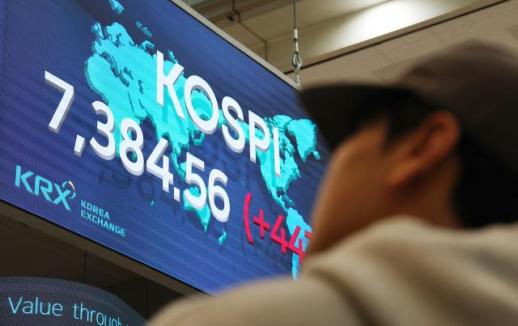 Stocks on unfettered rally, bonds dip as Seoul markets bet on inflation-driven rate hike SEOUL, May 6 (AJP) — The rationale for higher interest rates gained ground in South Korea as inflation, long subdued by lethargic demand, accelerated at the fastest pace in 21 months in April after the blockade of the Strait of Hormuz triggered a surge in imported prices, while the benchmark stock index nearly tripled from a year earlier to touch a new four-digit milestone. According to data released by the Ministry of Data and Statistics (MDAS) on Wednesday, consumer prices rose 2.6 percent year-on-year in April, breaking out of the months-long range around 2 percent. Fuel was the primary driver, as South Korea relies heavily on Middle Eastern crude and gas for energy and manufacturing. Petroleum prices alone soared 21.9 percent from a year earlier and 7.9 percent from the previous month, contributing nearly 1 percentage point to headline inflation. Gasoline prices jumped 21.1 percent year-on-year, while diesel prices surged 30.8 percent. Kerosene prices also climbed 18.7 percent. As fuel prices rose, transportation costs followed suit. International airfares climbed 15.9 percent from a year earlier. The Baltic Dry Index (BDI), a benchmark for global shipping rates, surged more than 27 percent from 2,140 on Feb. 27 — before the conflict escalated — to 2,730 as of May 1. Economic authorities say the impact of the blockade reached the domestic market with a time lag. While vessels that cleared the Strait of Hormuz in February arrived at Korean ports by late March, supply chains began rupturing in April as shipments were cut off. And the pain may only be beginning. “The squeeze from the blockade will be reflected in second-quarter data,” Lee Dong-won, director general of economic statistics at the Bank of Korea (BOK), said during a press briefing on first-quarter GDP growth on April 23. At the time, Lee said the modest 2.2 percent rise in March inflation was temporary. “The impact remained minimal through the first quarter as vessels that passed through the strait before the closure arrived in Korea by late March,” he warned. That warning has now become reality. International oil prices have continued to climb steadily. As of Wednesday afternoon, the three major oil benchmarks — West Texas Intermediate (WTI), Brent and Dubai crude — were all trading above $100 per barrel. Dubai crude, which accounts for about 70 percent of South Korea’s crude imports, has maintained its upward trend even after the United Arab Emirates (UAE) withdrew from OPEC and other members announced production increases. Given the tense tug-of-war between the United States and Iran over control of the strategic chokepoint, oil prices are unlikely to normalize anytime soon. The National Assembly Budget Office (NABO) estimated that South Korea’s economic growth could slow to 1.2 percent from its initial estimate of 2 percent if international oil prices remain above an annual average of $100 per barrel. It also projected inflation to average 2.9 percent, well above the central bank’s 2 percent target. Following stronger-than-expected 1.7 percent GDP growth in the first quarter and a red-hot streak in chip earnings and stocks, major investment banks have sharply raised their forecasts for Korea this year. JPMorgan Chase lifted its growth estimate to 3.0 percent from 2.2 percent, BNP Paribas raised its forecast to 2.7 percent from 2.0 percent and Citigroup increased its projection to 2.9 percent from 2.2 percent. Higher growth and inflation forecasts could further fuel inflation expectations at a time when price pressures are already becoming entrenched. Bond prices hit fresh annual lows on expectations that rates may move higher. The yield on the three-year government bonds retreated to 3.595 percent after hitting annual high of 3.641 percent in the morning while the ten-year yield ended at 3.932 percent after flirting close at 4.00 percent in earlier session, building pressure around the benchmark interest rate, which has stayed unchanged at 2.5 percent since May last year. Pessimists warn that the chip and stock frenzy may be overheating, particularly as leveraged investment accelerates. The KOSPI continued to stun markets, ending Wednesday up 6.45 percent at 7,384.56, outpacing the S&P 500 index’s Tuesday close of 7,259.22. “The prolonged Middle East war could lower South Korea’s economic growth rate by 0.9 percentage point,” Albert Park, chief economist of the Asian Development Bank (ADB), said during a press conference at the ADB annual meeting in Samarkand, Uzbekistan. The ADB nevertheless raised its growth forecast for South Korea to 1.9 percent from 1.7 percent earlier in April. 2026-05-06 16:45:00
 -
 UPDATE: Korea's inflation hits 21-month high, markets rally on *Updated with additional information and market response SEOUL, May 6 (AJP) — South Korea’s inflation accelerated to a 21-month high in April as a monthlong blockade of the Strait of Hormuz drove up imported fuel costs and price pressure from gas pumps to dining tables. According to data released by the Ministry of Data and Statistics (MDAS) on Wednesday, the consumer price index (CPI) rose 0.5 percent from March and 2.6 percent from a year earlier, up from 2.2 percent in March. It was the fastest annual gain since July 2024, when inflation stood at 2.7 percent. The latest data reinforced concerns at the Bank of Korea that inflation could drift toward the 3 percent range if Middle East tensions persist and supply disruptions continue to pressure energy imports. The surge was led largely by petroleum-linked industrial goods. Industrial product prices rose 3.8 percent from a year earlier, accelerating from 2.7 percent in March. Petroleum prices alone soared 21.9 percent on year and 7.9 percent from the previous month, contributing 0.84 percentage point to headline inflation. The increase reflected both the impact of the Middle East war and a low base from last year. Dubai crude averaged $105.7 per barrel in April, compared with $67.7 a year earlier. Domestic gasoline prices rose to 1,986 won per liter from 1,647 won a year earlier, while diesel prices climbed to 1,979 won from 1,513 won. Among individual items, gasoline prices jumped 21.1 percent from a year earlier, while diesel prices surged 30.8 percent. Kerosene prices climbed 18.7 percent. Transportation recorded the steepest increase among major spending categories, rising 9.7 percent from a year earlier and 3.4 percent from March, contributing nearly one percentage point to overall inflation. Rising energy costs also spilled over into travel-related services. International airfare prices climbed 15.9 percent from a year earlier, while overseas package tour prices rose 11.5 percent, reflecting higher transportation and fuel-related costs amid prolonged instability in Middle Eastern shipping routes. Service-sector inflation remained elevated. Personal services prices rose 3.2 percent from a year earlier, with dining-out prices up 2.6 percent and other personal services up 3.5 percent. Agricultural prices continued to stabilize after last year’s weather-driven spikes. Agricultural, livestock and fisheries products fell 0.5 percent from a year earlier, while fresh food prices dropped 6.1 percent. Vegetable prices plunged 12.7 percent, led by declines in onions, radishes and napa cabbage. Still, some food items continued to rise sharply. Rice prices surged 14.4 percent from a year earlier, while pork, eggs and imported beef also posted gains. The Living Necessities Price Index, which tracks frequently purchased goods and services, climbed 2.9 percent on year in April, up from 2.3 percent in March. Excluding food, the index jumped 3.9 percent, underscoring the growing burden of energy-related costs on households. Core inflation remained relatively stable. Both the index excluding food and energy and the index excluding agricultural products and petroleum rose 2.2 percent from a year earlier, unchanged from March, highlighting how heavily the headline figure was driven by oil prices. “With uncertainty remaining due to the Middle East war and increased volatility in global oil prices, the government will make all-out efforts to stabilize prices felt by consumers,” the Ministry of Finance and Economy said in a statement. “We will prioritize petroleum products while closely managing items closely tied to people’s livelihoods through the price task force.” Markets largely shrugged off the ominous inflation data. As of 10:10 a.m. Wednesday, the benchmark KOSPI was up 5.6 percent to break the unchartered 7,300 mark, while the Korean won recovered to pre-war levels around 1,450 against the U.S. dollar. Government bond yields, in contrast, continued to weaken, with the three-year Treasury yield rising 2.6 basis points to 3.641 percent and the 10-year yield climbing 2.3 basis points to 3.955 percent during the morning session - amid Wednesday’s sharp rise in consumer prices, combined with earlier signals from Bank of Korea (BOK) Deputy Governor Ryoo Sang dai regarding a potential interest rate hike. 2026-05-06 09:06:21
 -
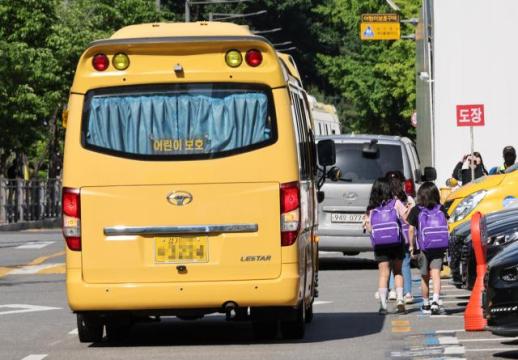 Playgrounds stay empty as Korean children simply have no time to play SEOUL, May 04 (AJP) - As South Korea observes the 104th anniversary of Children’s Day this Tuesday, the festive banners and gift-wrapped toys mask a sobering reality. The holiday, envisioned by pioneer Bang Jeong-hwan as a day to prioritize the "happiness and well-being" of the nation’s youth, has become a poignant reminder of a childhood increasingly spent in the shadows of high-stakes testing and digital screens. Data suggests that for the average South Korean child, the "right to play" is less a lived reality and more a luxury they simply cannot afford. The most striking finding from the National Center for the Rights of the Child’s “2025 Key Statistics for Children” isn't just that children are busy—it’s the profound disconnect between their aspirations and their daily lives. Four out of 10 desired to spend time and play with friends after school, but only two were able to do so as most were carried off to after-school academies and private tutoring. More than half of surveyed students identified after-school academies (hagwons) and tutoring as the main barriers to free play. The pressure begins early in South Korea’s highly competitive education system, where preparation for elite university admissions increasingly starts in elementary school. A 2024 survey by ChildFund Korea found that older elementary students aged 9 to 12 spent an average of 2 hours and 47 minutes a day studying outside school, while younger children aged 6 to 9 studied an additional 2 hours and 17 minutes daily. Although school hours in South Korea are shorter than the OECD average, total study time including private education reaches nearly six hours a day, exceeding the OECD average of five hours. The consequences are increasingly visible. In its report “Child Well-Being in an Unpredictable World,” the Organization for Economic Co-operation and Development ranked South Korea 28th out of 40 countries in children’s physical health and 34th out of 36 countries in mental health. Despite significantly longer study hours than Japan, South Korean students also posted lower scores in reading, mathematics and science in the 2022 PISA assessment. “When private education hours become excessively long, marginal utility inevitably decreases,” said Kim Hyun-chul, a professor at Seoul National University. “It is crucial to maintain proper balance in everything.” Where physical play and social interaction vanish, digital dependence fills the void. In a world where safe play spaces are scarce and time is tighter than ever, smartphones have become the default "playground." A recent survey by the Korean Teachers and Education Workers Union reveals that 70% of upper elementary students are already engaging with generative AI like ChatGPT and Gemini and half of them spending more than two hours on smartphones after school. While technological literacy is vital, researchers warn that this shift is often a survival mechanism. When children are too tired or too busy for the park, they turn to the screen for a quick, low-effort dopamine hit. Globally, however, attitudes toward play are shifting in the opposite direction. The United Nations Children's Fund and the LEGO Group last year established June 11 as the International Day of Play, emphasizing play as essential to healthy child development. The World Health Organization has also stressed that regular physical activity and active play are critical for children’s physical and mental well-being. “Allow them to sleep and exercise sufficiently,” Korean children’s rights pioneer Bang Jeong-hwan wrote in the original Children’s Day proclamation more than a century ago. “Let them go on walks or picnics occasionally.” The words now sound less like celebration and more like a reminder of what many Korean children increasingly lack. 2026-05-04 16:53:07
 -
 BOK deputy governor flags rate hike possibility, bond yields tick up SEOUL, May 4 (AJP) — Bank of Korea Deputy Governor Ryoo Sang-dai on Sunday signaled that South Korea’s monetary policy may be shifting toward tightening rather than easing, becoming the first monetary board member to publicly lean toward a rate hike amid mounting inflationary pressure tied to Middle East tensions. “Given the external shock and broader economic conditions, my personal view is that monetary policy is moving closer to a hiking cycle than a rate-cut cycle,” Ryoo told reporters during a press conference on the sidelines of the Asian Development Bank annual meeting in Samarkand, Uzbekistan. Ryoo said economic growth is likely to remain broadly in line with this year’s official target of 2.0 percent, while inflation could exceed the central bank’s forecast of 2.2 percent. “Based on these factors, we should move away from easing and begin deliberating tightening,” he said. The deputy governor pointed to the blockade of the Strait of Hormuz as a key inflationary driver, with all three major crude benchmarks — West Texas Intermediate, Brent and Dubai — remaining above $100 per barrel as of Monday. Regarding the Bank of Korea’s so-called “six-month dot plot,” which reflects monetary board members’ policy-rate outlooks over the coming half year, Ryoo said more members may shift toward supporting hikes at the upcoming May 28 policy meeting. In the February dot plot, only one of the three dots allocated to each board member pointed to a quarter-percentage-point hike toward 2.75 percent. “If the current situation is confirmed, there is ample room for the interest-rate path to rise compared to the February dot plot,” Ryoo said. “Probabilistically, the possibility of a rate hike is open.” Inflationary pressure has yet to undermine economic growth. Korea’s economy expanded 1.7 percent in the first quarter, nearly doubled from estimated 0.9 percent, buoyed by strong semiconductor exports and robust artificial intelligence-related investment. Still, Ryoo stressed that uncertainty surrounding the duration and scope of the Middle East conflict makes policy decisions difficult. “We cannot finalize policy when it remains unclear how long the war will continue or how far it may spread,” he said, adding that the central bank would continue monitoring developments ahead of the May meeting. Ryoo disagreed with the Organization for Economic Co-operation and Development's downgrade of Korea’s potential growth rate estimate from 1.7 percent to 1.57 percent next year. “Potential growth does not suddenly fall unless there is a major economic crisis,” he said, adding that the Bank of Korea still estimates the economy’s potential growth rate at slightly below 2.0 percent. On the foreign exchange market, Ryoo acknowledged that the won’s recent trading range around 1,470 to 1,480 per dollar remains historically weak, though he avoided explicitly characterizing current levels as excessive. “The exchange rate is determined by market supply and demand,” he said, adding that authorities would intervene only in cases of excessive volatility or herd behavior. The Korean won opened at 1,472.9 per dollar on Monday, strengthening 10.4 won from the previous session, supported by Ryoo’s remarks and a softer dollar after the Bank of Japan intervened last week to support the yen. Government bonds weakened following the deputy governor’s hawkish comments. The three-year Treasury yield rose 1.3 basis points to 3.608 percent by midday, while the 10-year yield held steady at 3.923 percent. 2026-05-04 14:29:50
 -
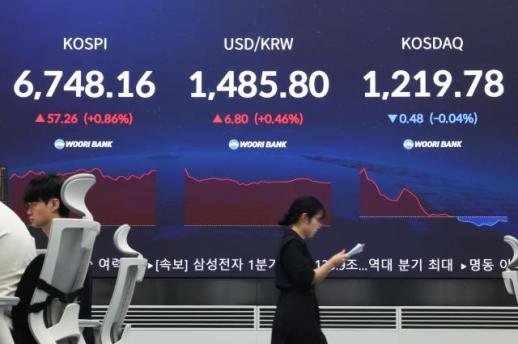 At War 60 Days: Decoupling deepens in Korean markets as stocks rally alone SEOUL, April 30 (AJP) — Decoupling across South Korean asset markets has intensified over the past two months of war in the Middle East, with equities extending a solo rally while the currency and bond markets remain under pressure. With few safe havens in a wartime environment, equities have emerged as the primary risk asset. In contrast, the won and government bonds — more exposed to macroeconomic stress — have been weighed down by disruptions to the Strait of Hormuz and now, the uncertainty over the Federal Reserve’s policy path. On Wednesday, the benchmark KOSPI closed at a record 6,690.90, supported by stronger-than-expected 1.7 percent first-quarter growth and blockbuster earnings from Samsung Electronics and SK hynix, whose combined operating profit exceeded 95 trillion won ($63.9 billion). The earnings surge has fed directly into share prices. Samsung Electronics rose above 220,000 won on Wednesday, while SK hynix hit a record high above 1.3 million won on Thursday. Market volatility has eased from March’s shock levels. After swinging more than 10 percent following the de facto blockade of the Strait of Hormuz on March 4, the KOSPI has trended steadily higher since mid-April. The last “buy sidecar” was triggered on April 9, when the index jumped 6.9 percent. The KOSPI Volatility Index (VKOSPI), which spiked to a record 80 on March 4, eased to around 54 on Thursday, suggesting investors are increasingly treating the conflict as a persistent backdrop rather than an acute shock. “Geopolitical threats are episodic; over time, markets revert to corporate fundamentals,” said Lee Kyung-min, a researcher at Daishin Securities. The mood in foreign exchange and bond markets, however, remains fragile. The Korean won has shown elevated volatility, with daily swings averaging 0.55 percent between April 11 and Thursday — higher than those of the South African rand (0.47 percent) and the Turkish lira (0.50 percent). Although the won has recovered from its March 31 low of 1,530 per dollar, it averaged 1,487 in April, weakening about 2 percent from January’s 1,458. The currency remains vulnerable to energy shocks, as South Korea imports roughly 70 percent of its crude oil via the Strait of Hormuz. Fuel prices are already reflecting the strain. Gasoline in Seoul has climbed above 2,000 won per liter, while the Consumer Sentiment Index fell below 100 in April for the first time in a year. Industrial activity is also showing signs of stress. Mining and manufacturing output rose just 0.3 percent in March, sharply slowing from 5.3 percent growth in February. Policy uncertainty in the United States has added another layer of pressure. The Federal Reserve on Wednesday left its benchmark rate unchanged, with the upper bound at 3.75 percent. Chair Jerome Powell, in his final meeting, signaled the possibility of rate cuts, even as incoming leadership under Kevin Warsh is expected to lean more hawkish. The decision exposed divisions within the 12-member committee, drawing four dissenting votes. Governor Steven Myron called for immediate cuts, while three regional presidents pushed back against what they viewed as overly dovish guidance. Reflecting the uncertainty, the won opened at 1,486.5 per dollar on Thursday, weakening by 7.5 won. Government bonds have also come under pressure. The three-year Treasury yield rose 4.3 basis points to 3.568 percent in Thursday morning trade, the highest since November 2023, while the five-year yield climbed 4.1 basis points to 3.888 percent. Gains from South Korea’s inclusion in the World Government Bond Index (WGBI) on April 1 have effectively been erased by geopolitical risk. “If markets scale back expectations for U.S. rate cuts, bond prices will fall further, adding pressure on the currency,” said Ahn Jae-kyun, a researcher at Shinhan Securities. “This trend is likely to persist until the bottleneck in the Strait of Hormuz is resolved.” 2026-04-30 16:04:39
 -
 Korean Economy/Business Calendar SEOUL, April 30 (AJP) - May 6 (Wed) Apr. 2026 Consumer Price Index (Preliminary) - Ministry of Data and Statistics May 8 (Fri) Mar. 2026 Balance of Payments (Preliminary) - Bank of Korea May 13 (Wed) Apr. 2026 Employment Trends - Ministry of Data and Statistics Mar. 2026 Money and Liquidity - Bank of Korea May 15 (Fri) Apr. 2026 Export/Import Prices + Trade Indices (Preliminary) - Bank of Korea May 19 (Tue) Q1 2026 Household Credit (Preliminary) - Bank of Korea May 21 (Thu) Apr. 2026 Producer Price Index (PPI) (Preliminary) - Bank of Korea May 22 (Fri) May 2026 Consumer Survey Index (CCSI) - Bank of Korea May 27 (Wed) Q1 2026 International Investment Position (Preliminary) - Bank of Korea May 2026 Business Survey Index (BSI) & Economic Sentiment Index (ESI) - Bank of Korea May 29 (Fri) Apr. 2026 Industrial Activity Trends - Ministry of Data and Statistics *1Q 2026 Tentative Earnings Release Schedule May 7 (Thu) Kakao LG Uplus Hyundai Department Store May 8 (Fri) Korean Air KT May 11 (Mon) Lotte Shopping May 12 (Tue) CJ CheilJedang SK Telecom May 13 (Wed) NCSoft 2026-04-30 13:13:31
 -
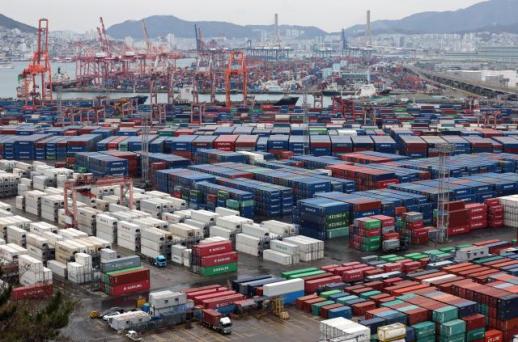 (UPDATE) March factory output sharply eases in Korea as Hormuz shock ripples *Updated with additional information and market response. SEOUL, April 30 (AJP) — South Korea’s manufacturing and investment activity slowed sharply in March as supply disruptions from the Middle East’s key energy waterway began to weigh on the import-dependent economy in the first month of the war, data showed Thursday. According to March industrial activity data from the Ministry of Data and Statistics, mining and manufacturing output eked out a 0.3 percent gain from the previous month, sharply slowing from a 5.3 percent increase in February. Overall industrial output also slowed to 0.3 percent in March from 2.1 percent in February, although service-sector output accelerated to 1.4 percent, partially offsetting the slowdown. Retail sales, a barometer of consumption, rose 1.8 percent, reversing a 0.3 percent drop a month earlier, as higher energy and chip prices spurred preemptive fuel purchases and lifted demand for finished IT products. Investment momentum weakened markedly. Facility investment rose 1.5 percent, compared with a 14.6 percent jump in February, while construction investment plunged 7.3 percent after surging 13 percent the previous month. Supply disruption began to take toll on factory activities. Chipmaking fell 8.1 percent and refining 6.3 percent as producers adjusted output as imports of Middle East raw materials remained uncertain from the blockade of the Strait of Hormuz. Against a year-ago period, industrial output remained resilient on an annual basis, rising 3.5 percent year-on-year on strong chip demand. Consumer spending rebound was largely driven by 9.8-percent spike in computer and IT products on chip-flation worries. The coincident index added 0.5 point and the leading index climbed 0.7 point, suggesting underlying economic conditions have yet to fully reflect the external shock. Amid growing uncertainties, the KOSPI fell a tad, 0.43 percent, to 6,663.94 after testing new intraday high while the Korean won slipped to 1,485.9 against the U.S. dollar amid spike in oil prices. 2026-04-30 09:09:47
 -
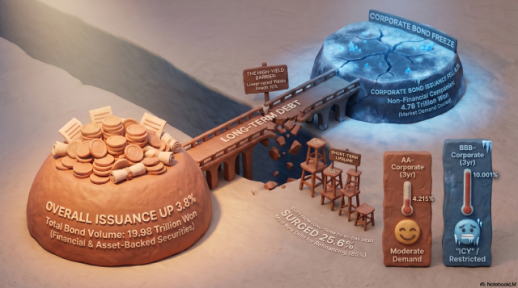 Korean Inc. turns to 91-day financing as corporate debt market remains icy SEOUL, April 29 (AJP) — South Korean companies are turning to three-month financing to meet debt obligation, as new bond issues become increasingly difficult with lower-rated yields hovering above 10 percent amid icy demand. Bond issuance by non-financial companies fell 6.5 percent from a month earlier to 4.78 trillion won in March, even as overall bond issuance rose 3.8 percent to 19.98 trillion won ($13.56 billion), according to data released Wednesday by the Financial Supervisory Service (FSS). The increase was driven largely by financial issuers and asset-backed securities (ABS), while corporate bond issuance was mostly limited to refinancing existing debt. “Excluding the first quarter, April is a period with a heavy repayment burden, with 10.7 trillion won in corporate bonds reaching maturity,” said Kim Eun-ki, a researcher at Samsung Securities. “The overall atmosphere for issuers is to wait out the storm as bond yields are rising fast.” Corporate bonds recorded a net repayment of 449 billion won in March, following a 3.41 trillion won net repayment in February, marking two consecutive months of net outflows. About 85.6 percent of general corporate bonds issued in March were used to repay existing debt, while 98.5 percent of issuance came from A-rated or higher investment-grade companies, underscoring risk aversion on both the demand and supply sides. Companies are cancelling or downsizing debt offerings as bookbuilding demand weakens and yields rise rapidly. Recent deals also point to growing market bifurcation. Mid-tier issuers such as Lotte Hi-Mart and LG HelloVision were forced to price bonds at around 20 to 40 basis points above fair value, with order books barely covering the deal size. By contrast, top-tier borrowers continued to draw demand several times the amount offered. Maturities are also getting shorter. Long-term bonds with maturities of more than five years amounted to just 120 billion won, or 2.5 percent of total issuance. Medium-term bonds of one to five years accounted for 97.5 percent, showing that companies are avoiding long-term financing amid persistent rate pressure. Issuers are raising only the minimum needed to meet debt obligations. An estimated 10.7 trillion won in general corporate bonds comes due this month, adding pressure to refinance in an unfavorable rate environment. As of Wednesday morning, the three-year government bond yield stood at 3.525 percent, while the three-year AA- corporate bond yield was 4.185 percent. The resulting credit spread of about 65 basis points has widened from around 50 basis points in the second half of last year, indicating that the credit premium paid by companies is rising again. The gap is far wider in the lower-rated market. The three-year BBB- corporate bond yield reached 10.001 percent, pushing the spread against AA- bonds to about 580 basis points. That is approaching levels seen during the 2022 Legoland crisis, when the credit market tightened sharply and the AA- to BBB- spread widened to around 600 basis points. Market watchers say access to bond financing is again becoming effectively restricted for lower-rated companies. Their lifeline are 91-day commercial papers whose rate stood at 3.06 percent, about 115 basis points lower than the AA- corporate bond yield. That makes short-term borrowing a much cheaper option for companies trying to bridge near-term maturities. Total issuance of commercial paper and short-term bonds reached 200.47 trillion won in March, up 25.6 percent from the previous month. The surge suggests that corporate funding strategies are shifting from long-term debt to short-term financing, rather than merely reflecting a temporary rise in liquidity demand. 2026-04-29 16:44:11
 -
 Minsky moment looming for Korea's financial sector SEOUL, April 28 (AJP) — Loose liquidity binges tend to end in a Minsky moment — the payback for easy gains. For South Korea’s financial sector, that moment may be inching closer, as a domestic slowdown, supply-side inflation and accumulated leverage begin to converge. Delinquency rates are rising with unusual speed. The country’s five largest commercial banks reported an average delinquency rate of 0.4 percent for the first quarter of 2026, up from 0.34 percent in the previous quarter. As of April 7, the figure had already climbed to 0.46 percent — the highest level in about a decade, since the 2015 collapse of STX Group. The first cracks appeared in loans to small and medium-sized enterprises (SMEs). At Hana Bank, SME delinquency rose to 0.61 percent from 0.47 percent a quarter earlier, the highest since its 2015 relaunch. Woori Bank reported a similar jump to 0.61 percent, the highest since the creation of Woori Financial Group in 2019. Large corporates remain relatively insulated, though pockets of risk persist. KB Kookmin Bank stands out for its exposure to troubled real estate project financing. The deterioration is no longer just marginal — it is accumulating in size. Non-performing loans (NPLs) at four major banks, excluding NH, surged 11.6 percent in the first quarter to 5.77 trillion won ($3.92 billion), crossing the 5 trillion won mark for the first time in nearly eight years, since the fallout from the Hanjin Shipping bankruptcy. While industry insiders say most loans are unlikely to be written off, the worsening economic outlook is casting doubt on that view. "Internally, we acknowledge the growing risks and are working to diversify our exposure," said an official from one of the four major banks, speaking on condition of anonymity. Banks plan to secure maximum loan-loss provisions while tightening lending regulations for distressed borrowers. The average NPL coverage ratio fell to 153.8 percent from 172.0 percent at end-2025, even as banks posted robust earnings of nearly 4 trillion won in the first quarter, including a record 1.16 trillion won at Shinhan Bank. Households are showing similar fault lines. Total household debt, already above 1,850 trillion won, expanded by another 3.5 trillion won last month. Mortgage rates — tied to more than 1,000 trillion won of that debt — continue to rise. According to the Bank of Korea, the average rate on new household loans climbed to 4.34 percent in March, the highest in nearly two and a half years. More concerning is the shift in debt quality. High-interest card loans, typically exceeding 10 percent, have ballooned to a record 43 trillion won. Long-term delinquencies of more than six months reached 470 billion won, surpassing 1 percent of total credit — the highest level in 11 years. The macro backdrop offers little relief. Stronger-than-expected first-quarter growth of 1.7 percent has reinforced the central bank’s hawkish stance, keeping the possibility of a rate hike alive. Under Governor Shin Hyun-song, price stability remains the priority — even at the risk of further squeezing already vulnerable borrowers. “Higher rates are boosting bank earnings, but at the cost of rising systemic risk,” said Park Hye-jin, a researcher at Daishin Securities. “It is a paradox where profitability and instability rise together.” While Korean equities remain among the best performers this year, other asset classes are weakening. The won traded at 1,473.6 per dollar on Tuesday, down more than 2 percent from the start of the year. Bond yields have surged, with the three-year Treasury at 3.529 percent and the 10-year at 3.861 percent — both up more than 60 basis points year to date. The signals are not yet a crisis. But the pattern is familiar: leverage builds quietly, stress emerges at the edges, and buffers erode faster than expected. That is typically how a Minsky cycle turns. 2026-04-28 16:43:26
 -
 Korea business sentiment rises on illusion of recovery as inventories shrink SEOUL, April 28 (AJP) — Pessimism among South Korean businesses eased to a 21-month low in April, but the improvement largely reflected inventory drawdowns driven by Middle East supply disruptions rather than a genuine recovery in demand, data showed Tuesday. The Composite Business Sentiment Index (CBSI) for all industries rose 0.8 point from a month earlier to 94.9, the highest since July 2024, according to the Bank of Korea. Despite the gain, the index remained below the 100 mark, indicating that negative sentiment still outweighs optimism. Strip out the inventory effect, and the picture weakens. The central bank estimated that overall sentiment would have slipped by 0.1 point across industries and by 0.4 point in manufacturing. “While manufacturing conditions improved on sustained exports and higher sales prices, the drop in inventories partly reflects firms running down existing stock to cope with disruptions in raw material supplies,” said Lee Heung-hoo, head of the BOK’s economic sentiment survey team. Manufacturing sentiment rose 2.0 points to 99.1, its highest level this year and just shy of the neutral threshold. The outlook for next month also improved, climbing 2.1 points to 98.0. By firm size, large corporations reached the 100 benchmark, while small and medium-sized enterprises (SMEs) lagged at 96.8. Export-oriented firms continued to outperform, posting a CBSI of 103.4 for a fourth consecutive month, compared with 96.4 for domestically focused companies. The improvement in manufacturing was overwhelmingly driven by inventories. Falling stock levels contributed 2.3 points to the CBSI, compared with a 0.7-point gain from better business conditions. As a countercyclical component, lower inventories mechanically lift the index even when underlying demand remains weak. Outside manufacturing, momentum was far weaker. The non-manufacturing CBSI edged up just 0.1 point to 92.1, while the outlook for next month remained unchanged at 91.2. In services, sentiment deteriorated, slipping to 92.9 from 93.4, as rising oil prices tied to the Middle East conflict pushed up sea and air freight costs, particularly weighing on wholesale and retail sectors. Cost pressures have emerged as the dominant concern across industries. In manufacturing, the share of firms citing rising raw material prices as a key difficulty surged 13.2 percentage points to 34.2 percent. In non-manufacturing, the figure rose to 19.4 percent, also the top concern, reflecting elevated energy prices, logistics disruptions around the Strait of Hormuz, and a weakening Korean won, which has depreciated by more than 2 percent from 1,458 per dollar in January to around 1,488 this month. Detailed indicators point to a widening margin squeeze. The manufacturing business conditions index rose 3 points to 74, with gains in sales and new orders, but profitability fell 5 points to 68 and financial conditions worsened by 3 points to 76. The raw material purchase price index jumped 12 points to 149, the highest since October, far outpacing the rise in product sales prices, which climbed to 110 — insufficient to offset rising input costs. The broader Economic Sentiment Index (ESI), which combines business and consumer confidence, fell 2.3 points to 91.7, marking a second straight monthly decline and the lowest level in six months. Its cyclical component also edged down 0.3 point to 94.4, signaling a slowdown in underlying economic momentum. The survey was conducted from April 9 to 16, covering 3,205 companies, including 1,781 manufacturers and 1,424 non-manufacturers. 2026-04-28 11:31:11