
Journalist

Kim Yeon-je
duswogmlwo77@ajupress.com
-
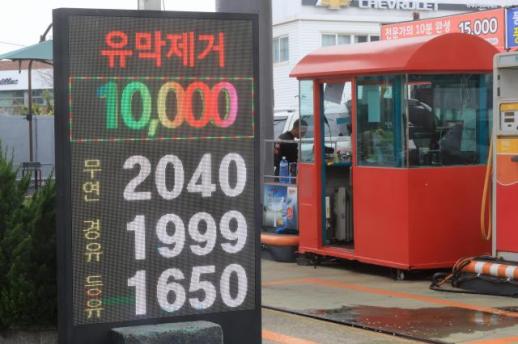 KDI warns of downside risks to economy as Gulf crisis clouds recovery SEOUL, April 7 (AJP) - South Korea's governmental Korea Development Institute think tank warned on Tuesday that the nascent economic recovery is facing increased downside risks as the conflict in the Middle East disrupts global supply chains and triggers a spike in energy prices. In the April edition of its "KDI Monthly Economic Trends," the institute said that while domestic demand and exports had been showing signs of gradual improvement, the "volatility stemming from the Middle East war, combined with surging international oil prices, is expanding downward pressure on the economy." ICT-led export boom hampered by soaring oil prices Economic indicators through February remained generally positive, KDI reported. On the production side, the service sector maintained steady growth, and the manufacturing sector expanded its gains, bolstered by a surge in semiconductor output. Exports continued a robust upward trajectory, particularly in ICT items such as semiconductors (140.5 percent) and computers (176.6 percent), driven by strong demand related to artificial intelligence (AI). Consumption also showed a moderate recovery, with average retail sales for January and February rising 2.7 percent year-on-year, excluding the seasonal distortion of the Lunar New Year holiday. Facility investment also performed well, increasing by an average of 9.3 percent in the first two months, centered on the semiconductor industry. The landscape, however, shifted abruptly in March following the outbreak of the conflict. The price of Dubai crude, South Korea’s benchmark, skyrocketed from $68.4 per barrel in February to $128.5 in March. Consequently, consumer prices in March rose 2.2 percent year-on-year – up from 2.0 percent in February – with petroleum product prices jumping 9.9 percent. Sinking sentiment and financial market volatility These escalating uncertainties are weighing heavily on economic sentiment, KDI said. The Composite Consumer Sentiment Index (CCSI) plummeted to 107.0 in March from 112.1 in February, while the Business Survey Index (BSI) also retreated across the manufacturing and non-manufacturing sectors. Financial market volatility has intensified as well. Driven by safe-haven demand and concern over the country’s reliance on Middle Eastern oil, the won-dollar exchange rate climbed into the 1,500 won range. Meanwhile, the benchmark KOSPI index dived from 6,244.1 at the end of February to 5,052.5 by the end of March. While the labor market showed some relief as the number of employed persons increased by 234,000 in February following the resumption of government job programs, employment among people in their 20s remained sluggish. "The inflationary pressure and global economic instability caused by the Middle East war could worsen export conditions and constrain investment," the report said. The think tank warned that increased costs for building materials are emerging as a significant headwind, likely delaying new projects, and hindering a rebound in construction investment. 2026-04-07 15:58:42
 -
 BOK, BdF address central bank role in tokenized environment SEOUL, April 07 (AJP) -South Korea and France’s central banks discussed stablecoins and the evolving role of banks in a tokenized financial system during a joint session in Seoul, the Bank of Korea said Tuesday. The Bank of Korea (BOK) and the Banque de France (BdF) are holding a two-day meeting from Tuesday through Wednesday as part of a regular academic exchange launched in 2024 to address shifts in the global economic landscape. This year’s session coincided with French President Emmanuel Macron’s state visit and a summit with President Lee Jae Myung, where the two leaders agreed to deepen cooperation in economic and security sectors last Friday. Talks focused on the implications of stablecoins and central bank digital currencies (CBDCs) for the international monetary system, as well as the changing roles of central and commercial banks in a tokenized environment. The Banque de France has been among Europe’s most active advocates of CBDCs, leading pilot programs on wholesale CBDCs (wCBDCs) to enhance cross-border payments and test their use as settlement assets for tokenized securities. These efforts are seen as helping shape the European Central Bank’s digital euro project. The BOK has also been advancing its own CBDC framework under “Project Han River,” launched in 2023, with real-transaction testing now entering a second phase last month. The latest discussions are expected to deepen policy coordination between the two sides. The session also examined how climate change is feeding into inflation dynamics and posing broader macroeconomic challenges for financial institutions. Participants include BOK Deputy Governor and Chief Economist Lee Jae-won and Na Seung-ho, deputy director general at its Economic Research Institute. The French delegation is led by Deputy Governor Agnès Bénassy-Quéré and Stéphane Latouche, the bank’s Asia-Pacific chief representative. 2026-04-07 14:40:21
 -
 BOK to stay on hold this week, but faces looming inflation test SEOUL, April 6 (AJP) — There is little doubt the Bank of Korea will hold its base rate at 2.5 percent at Thursday’s rate-setting meeting, but how long the pause lasts will be closely watched as Gulf-driven import inflation builds the case for at least one hike down the line. The post-meeting narrative is also unlikely to surprise, as this will be the last meeting under Governor Rhee Chang-yong before his four-year term ends on April 20. Markets are instead looking ahead to the May 28 meeting, to be chaired by incoming governor Shin Hyun-song, a U.K.-educated former Bank for International Settlements economist, when the central bank is expected to update its growth and inflation outlook to reflect the war’s impact. Government bond yields, which have risen 60 to 70 basis points this year, have eased from recent highs on expectations that Gulf tensions may stabilize. The three-year government bond yield on Monday fell 1.6 basis points to 3.451 percent, retreating from a recent peak of 3.617 percent. The 10-year yield dropped 2.2 basis points to 3.725 percent, also down from 3.915 percent. “The BOK is expected to keep the base rate unchanged at the April meeting,” said Baek Yoon-min, a senior research fellow at Kyobo Securities. “We expect the blockade of the Strait of Hormuz to ease or conclude within the second quarter.” Baek pointed to elevated U.S. inflation ahead of the November midterm elections as a key variable. Average gasoline prices have risen above $4 per gallon, the highest since August 2022. According to the Federal Reserve Bank of Cleveland, headline inflation in early April accelerated to 3.7 percent from 3.25 percent in March. Baek said U.S. inflation may paradoxically ease pressure on South Korea to tighten policy. Yoon Yeo-sam, a researcher at Meritz Securities, also expects the BOK to remain on hold for now, citing weak domestic conditions. “In 2022, core domestic indicators were robust. Now, the situation is different,” Yoon said. Economists expect rate hikes later in the year as import price pressures feed through. Consumer prices in Korea rose 2.2 percent in March from a year earlier, accelerating from 2.0 percent in the previous two months. While still within the BOK’s target range, the composition signals rising pressure. Energy has re-emerged as the dominant driver, compounded by a structurally weaker won, with the full impact only beginning to filter through. The won has extended its slide, weakening a further 6 percent this year amid capital outflows. The dollar has also sharply eased from recent peak of 1,530 won to 1,500 won Monday, but still remains at the levels of March 2009 during the global financial crisis, Petroleum prices surged 9.9 percent, contributing 0.39 percentage point to headline inflation. Diesel jumped 17 percent and gasoline 8 percent, marking the strongest energy impulse since the early phase of the Ukraine war. March likely captures only the initial shock. The key transmission channels — oil, the dollar and the exchange rate — have yet to fully feed into domestic prices. Despite his near-term hold view, Baek warned the impact of oil on inflation could be “longer and stickier” than expected, with spillovers into petrochemicals such as plastics and asphalt. He added that Shin’s appointment raises the likelihood of a shift toward tighter policy, noting the incoming governor’s preference for preemptive rate hikes. Cho Yong-gu, a research fellow at Shinyoung Securities, expects consumer inflation to approach 3 percent between May and August, with gradual tightening potentially beginning as early as July. "The central bank lacks the tools to stabilize prices quickly without a rate hike," Cho added. Some academics argue that tightening may be needed to address broader imbalances. “Given the quadruple high phenomenon of exchange rates, prices, housing costs, and interest rates, a modest rate hike is advisable,” said Kim Jung-sik, a professor emeritus at Yonsei University. “The benefits of absorbing excess liquidity to stabilize these four factors outweigh the costs.” As of Monday, the upper bound for mixed-rate mortgage loans at major banks has exceeded 7 percent. The M2 money supply rose 5.8 percent year-on-year in January, continuing to outpace the OECD average of 3 to 4 percent. 2026-04-06 17:46:38
 -
 Korea's fiscal deficit tops 100 trln won for second year despite ratio easing SEOUL, April 6 (AJP) - South Korea's managed fiscal deficit ratio to gross domestic product eased slightly to below 4 percent last year on improved tax revenue, while the deficit still exceeded 100 trillion won ($66.3 billion) for a second consecutive year, according to a government settlement report for fiscal 2025. The Ministry of Economy and Finance confirmed the managed fiscal balance at a deficit of 104.2 trillion won last year, slightly narrowing from 104.8 trillion won in 2024. The figure marks the fourth-largest deficit on record, following 117 trillion won in 2022, 112 trillion won in 2020 and 104.8 trillion won in 2024. As a share of GDP, the deficit stood at 3.9 percent, down from the 4.2 percent projected at the time of the budget, but widening from 3.7 percent a year earlier. The ratio has remained above 3 percent for six consecutive years, underscoring a prolonged period of expansionary fiscal policy. South Korea's "managed fiscal balance" - a metric that excludes social security funds such as the National Pension, private school pensions and employment insurance - is designed to better reflect the government's discretionary fiscal position. The country is the only OECD member to present its fiscal balance in such adjusted terms. Total revenue stood at 637.4 trillion won against total expenditures of 684.1 trillion won, resulting in a consolidated fiscal deficit of 46.7 trillion won. Tax revenue rebounded, rising 62 trillion won on year to 597.5 trillion won, while total expenditure increased by 61.6 trillion won to 591 trillion won. However, compared with the original budget, revenue fell short by 2.1 trillion won while spending exceeded the plan by 13.7 trillion won, pointing to looser-than-expected fiscal execution. Corporate tax revenue surged 22.1 trillion won from a year earlier, supported by strong earnings at major firms such as Samsung Electronics and SK hynix. Income tax rose 13 trillion won amid buoyant stock markets. Including 2.2 trillion won in special rural development taxes, total national tax revenue reached 373.9 trillion won, up 37.4 trillion won from the previous year. The fiscal "world surplus" - calculated by subtracting expenditures and 3.7 trillion won in carried-over budget from total revenue - stood at 3.2 trillion won, an increase of 1.1 trillion won from a year earlier. Concerns over fiscal sustainability persist. According to the Bank for International Settlements, South Korea's government debt rose 9.8 percent as of the third quarter of last year, nearly three times faster than corporate debt growth of 3.6 percent and household debt growth of 3 percent. The government defended its fiscal stance, citing overlapping domestic and external shocks. "Last year was a period when domestic and external shocks hit simultaneously, including weakened consumption following the Dec. 3 martial law incident and a rapidly changing trade environment triggered by the United States," said Hwang Soon-kwan, director general for treasury at the finance ministry. Officials said the government adopted an active fiscal approach, including two supplementary budgets, to support strategic industries such as artificial intelligence and semiconductors while stabilizing livelihoods and boosting domestic demand. Hwang also pushed back against claims that nominal GDP was overstated due to an 8 percent depreciation of the won in the second half of the year, saying underlying growth also contributed. On repeated calls from the International Monetary Fund to introduce fiscal rules, the government maintained a cautious stance. "We will actively review it once a consensus is reached in the National Assembly," Hwang said. 2026-04-06 15:42:07
 -
 Korea's credit market shows crunch signs as demand dries up SEOUL, April 3 (AJP) — Spring has arrived, but South Korea’s debt market remains stuck in a winter chill, especially for sub-investment-grade issuers, as surging bond yields, weak demand and a cheapened won erode the appeal of Korean assets. Government bond yields have climbed back to levels last seen in November 2023, when the benchmark rate stood at 3.50 percent during the post-pandemic tightening cycle — even as the current policy rate has been held at 2.50 percent for nearly a year. The three-year government bond yield on Friday approached 3.5 percent, up more than 50 basis points this year, while the 10-year yield rose to around 3.8 percent, gaining over 60 basis points. The increase is roughly twice that of Japanese government bonds and more than triple the rise in U.S. 10-year Treasury yields, which have climbed about 15 basis points. Some relief came as South Korean sovereign bonds began their inclusion in the World Government Bond Index (WGBI) on April 1, but yields quickly resumed their upward march as initial optimism faded. The strain is more acute further down the credit curve. Corporate bond issuance totaled 21 trillion won ($14.2 billion) in the first quarter, down 30 percent from a year earlier, according to the Korea Financial Investment Association. Yields on lower-rated debt have risen even faster. The three-year AA- yield has jumped more than 70 basis points to above 4 percent, while BBB- yields are nearing 10 percent. Demand has narrowed sharply to top-tier borrowers. The share of demand for AA-rated corporate bonds rose to 93 percent in January 2026 from 81 percent a year earlier, underscoring an increasingly selective market. Hanwha Aerospace, rated AA, drew 3.23 trillion won in bids for its Jan. 14 offering — nearly 13 times its initial 250 billion won target — prompting the company to double issuance to 500 billion won. Similarly, AA- rated E-Mart attracted 1.94 trillion won in orders against a 300 billion won target. The retailer’s improved earnings outlook, including a 585 percent surge in operating profit in 2025, helped offset concerns over intensifying competition with Coupang. The flight to quality is deepening refinancing pressure for lower-rated firms. Lotte Engineering & Construction (A) and CJ CGV (A-) have repeatedly withdrawn bond sales due to weak demand. Geopolitical risks are compounding the stress. The ongoing disruption of the Strait of Hormuz — a critical artery for global energy flows — has driven up oil prices and dampened investor appetite for riskier credit. At the same time, financial institutions are ramping up issuance to shore up balance sheets against rising delinquencies. Financial bond issuance surged 17.5 percent on-year to 76.4 trillion won in the first quarter. Liquidity remains ample but is adding to market distortions. Broad money (M2) reached 4,560.6 trillion won as of January, up 8.5 percent from a year earlier. Even under a narrower classification, it rose 5.8 percent to 4,108.9 trillion won — still outpacing major economies. With excess liquidity weighing on the won and energy-driven inflation risks mounting, the Bank of Korea has already shifted its stance. It removed references to rate cuts from its January policy statement, even before the Middle East conflict escalated. “As uncertainty grows, demand concentrates in top-rated bonds, including financial debt,” said Daeil Ahn, head of Korea debt capital markets at Citi. Ultimately, both the surge in financial issuance and the concentration of demand reflect deepening market anxiety. “The strengthening preference for safe assets is pushing flows into high-grade bonds,” said Kim Ki-myung, an analyst at Korea Investment & Securities, noting that the tilt toward AA-rated paper reflects heightened risk aversion. Lee Jae-hyung, a researcher at Yuanta Securities, added: “The widening of credit spreads is a direct reflection of investors’ increasing risk-avoidance.” 2026-04-03 17:24:35
 -
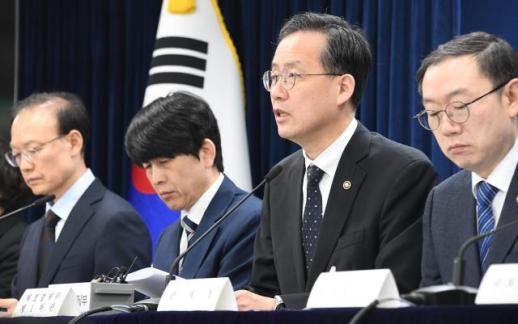 Seoul waives duties on freight surge to curb inflation spillover SEOUL, April 3 (AJP) — South Korea will waive customs duties on extraordinary freight cost increases for imports from the Middle East, as the crippling of the Strait of Hormuz threatens to spill into domestic prices and broader inflation. The emergency measure, announced Friday by the Ministry of Economy and Finance, allows companies to exclude surging shipping costs incurred from longer alternative routes when calculating import duties. The move comes as tanker freight rates on Middle East–China routes have soared 608 percent from a year earlier, with the chokepoint effectively sealed by Iranian forces. Customs duties are typically levied on the total value of imports, including freight. By excluding the recent spike in shipping costs, the government aims to ease the burden on importers and contain pass-through inflation. “U-turn cargo” — shipments originally destined for the Middle East but forced to return — will face minimal inspections, while key imports such as energy and raw materials will be granted pre-arrival clearance to ensure immediate domestic supply upon arrival. Administrative procedures for supply-sensitive items will also be streamlined. For raw materials used in paint and polyethylene (PE) resin, firms will be allowed to submit testing plans in place of full toxicity data, cutting approval timelines from more than three months to a fraction of that period. In the pharmaceutical and medical device sectors, a fast-track review system will prioritize essential items such as IV solutions, sanitary pads and injection needles. On-site Good Manufacturing Practice (GMP) inspections required for facility changes will be replaced with document-based reviews. To preempt shortages in daily necessities, quality inspections for items such as municipal trash bags will be reduced from 10 days to one. The 100 million won ($66,000) cap on direct purchases by local governments will also be temporarily lifted. For asphalt, where prices have climbed alongside crude oil, authorities will advise local governments to delay non-urgent road maintenance projects. In the case of automotive urea, the government will facilitate inter-company trading and may release public stockpiles if needed. Fertilizer-grade urea supply will be stabilized through the National Agricultural Cooperative Federation (Nonghyup). “Eight of the 13 measures will take effect immediately, with the remaining regulatory revisions to be completed within two weeks,” First Vice Finance Minister Lee Hyung-il said. “We will maintain these temporary exemptions until the emergency subsides, while closely monitoring for potential side effects.” 2026-04-03 13:29:28
 -
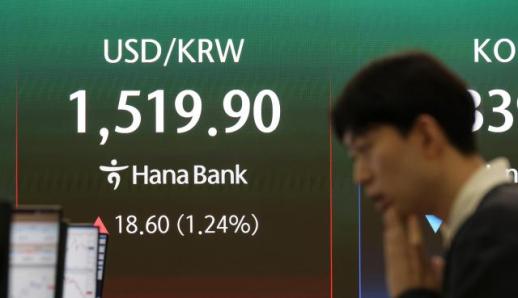 Korea's FX reserves slip $4 bn as won defense cost soars SEOUL, April 3 (AJP) — South Korea’s foreign exchange reserves fell by nearly $4 billion in March, underscoring the growing strain on the country’s external buffers as authorities continue to defend the won against crisis-era pressure. The Bank of Korea said Friday that reserves stood at $423.66 billion at end-March, down $3.97 billion from $427.62 billion a month earlier. That marked the steepest monthly decline since April 2024, when reserves fell by $5.99 billion as the won also plunged amid global market turmoil following the U.S. Federal Reserve’s decision to keep interest rates at a two-decade high. The drop came even after the government issued foreign exchange stabilization bonds in February, suggesting that the temporary boost from those proceeds was not enough to offset persistent intervention demand and valuation losses. The BOK said the March decline reflected a lower dollar value of non-dollar assets as well as market-stabilization operations, including foreign exchange swaps with the National Pension Service. The latest figures also highlighted how heavily authorities have leaned on liquid reserves. Securities, which accounted for 89.2 percent of total holdings, fell by $2.26 billion. Deposits — the most readily deployable portion of reserves — dropped by $1.44 billion, or 6.4 percent, to $21.05 billion from $22.49 billion a month earlier. Special Drawing Rights fell by $200 million to $15.57 billion, while the IMF reserve position stood at $4.55 billion. The reserve decline comes as the won remains under intense pressure. South Korean authorities sold a net $22.467 billion in the fourth quarter of 2025 for market stabilization, the largest quarterly intervention on record, according to the BOK’s latest disclosure. That compared with net dollar sales of $1.75 billion in the third quarter, $797 million in the second and $2.96 billion in the first. The broader market backdrop remains hostile. The won this week slid past 1,520 per dollar, levels not seen since 2009, as South Korean markets reeled from the prolonged Middle East war and heavy foreign selling. South Korea also slipped out of the global top 10 in reserve holdings. As of end-February, the country ranked 12th in the world, down from 10th a month earlier, according to the BOK. The central bank said some peers benefited from marking gold holdings to market as bullion prices rose. The latest data suggest Seoul is still willing to spend reserves to smooth volatility, but they also show the cost of that defense is mounting as dollar demand stays elevated and the external shock drags on. 2026-04-03 08:26:17
 -
 Stock, FX, and debt in triple win in Seoul, but lasting strength hinges on Gulf SEOUL, April 1 (AJP) — South Korea's war-beleaguered capital markets roared back with all three assets — stocks, the won and bond prices — strengthening sharply Wednesday, helped by talk of a Gulf war endgame and a rush of foreign capital into the debt market on the first day of Korea’s inclusion in the World Government Bond Index. But since much of the rally hinges on Gulf developments, the sustainability of the gains remains in question. The dollar tumbled below 1,500 won Wednesday, a stunning retreat from above 1,530 in the previous session. Bond yields also retreated, showing a rare moment of strength, with the three-year government bond yield falling 17.7 basis points to around 3.38 percent and the 10-year yield dropping 19.1 basis points to 3.691 percent. The KOSPI ended 8.4 percent higher. While expectations of a war exit in the Gulf fueled equities, the primary boost to the currency and debt markets came from WGBI inclusion, while the passage of the "Exchange Rate Stability Act" played only a small supporting role. After a year’s delay, FTSE Russell, a subsidiary of the London Stock Exchange, finalized South Korea’s inclusion in the WGBI, with phased purchases of Korean government bonds set from April 1 to Nov. 8, 2026. Inclusion in the WGBI is often likened to a "blue-chip" certification for a country’s sovereign debt. At least 2 percent of the $2.5 trillion index — equivalent to roughly $50 billion — is expected to be allocated to Korean government bonds, triggering an influx of foreign capital. Unlike typical emerging market debt flows, WGBI-related funds are primarily "passive" capital aimed at long-term investment. While emerging market debt is often traded within months, WGBI funds tend to be held for several years, providing a stabilizing effect on the currency market. "Foreign financial institutions and primary dealers forecast an inflow of $50 billion to $60 billion following the WGBI inclusion, and we have confirmed capital inflows starting this week," wrote Goo Yun-cheol, Deputy Prime Minister and Minister of Economy and Finance, on his X account, echoing the optimistic outlook. Traders are not as optimistic. "While we saw strength today, it is still insufficient considering that bond yields have surged by 40 to 60 basis points this year alone," said a bond trader at a commercial bank on condition of anonymity. "Since the blockade of the Strait of Hormuz remains the dominant issue, we are treating the WGBI news as a short-term factor." Yoon Yeo-sam, a researcher at Meritz Securities, also noted that "macro uncertainties, such as delayed U.S. rate cuts and the exchange rate breaching the 1,500 level, are overshadowing the positive impact of the index inclusion." The so-called reshoring incentive as part of the FX Stability Act drew even more cynicism. Brokerages have been selling Reshoring Investment Accounts since March 23, offering various tax incentives for those who reinvest dollar-based assets into Korean ones. The accounts sold by 10 brokerages have so far drawn 400 billion won ($265 million), about 0.2 percent of the roughly $150 billion in U.S. stocks held by South Koreans. Investors scoffed at the limited incentives, with tax benefits capped at 50 million won. "After investing in U.S. stocks for over a decade, my balance is well into the hundreds of millions of won," said one investor. "Unless the tax benefits are significantly expanded for larger and longer-term investments, I have no reason to return." For others, there is little reason to cash out of U.S. dollar assets, as no tax benefit is enough to offset exchange losses. "I entered the U.S. market a year ago when the rate was around 1,300 won," said another investor. "With the rate now near 1,500, returning to the domestic market and then trying to re-enter U.S. stocks later would cost me more than 10 percent of my principal." Experts agree that RIAs will struggle to attract investors without addressing fundamental issues. "Asking investors to liquidate overseas assets and bring them back in won when the currency is undervalued essentially damages their expected returns," said Kang Hyun-joo, a senior research fellow at the Korea Capital Market Institute. "Unless currency stabilization comes first, the RIA will remain little more than a nominal policy." 2026-04-01 17:13:11
 -
 South Korea's March exports hit $80b mark SEOUL, April 1 (AJP) — South Korea raised the bar on exports again, achieving fresh monthly high of over $80 billion in March as an unprecedented boom in the semiconductor sector more than offset supply disruptions from the outbreak of a war in the Middle East. According to data released by the Ministry of Trade, Industry and Energy on Wednesday, exports for March reached all-time monthly high of $86.13 billion, up 48.3 percent on year. The previous monthly record was $69.5 billion set in December last year. Monthly exports have extended record-setting winning streak for 10 consecutive months, largely hinged on chip demand. Chip shipments in March skyrocketed 151.4 percent to record $32.83 billion and responsible for nearly 40 percent of March exports. This is the first time monthly semiconductor exports have exceeded the $30 billion mark, eclipsing the previous high of $24.2 billion set in March 2022 during a period of surging DRAM prices. Imports rose 13.2 percent to $60.4 billion. Consequently, the trade balance recorded a surplus of $25.74 billion, marking 14 consecutive months of surplus since February last year. 2026-04-01 10:10:38
 -
 Korea burned $22.5 bln defending won Q4, USD-KRW nears 1,530 SEOUL, March 31 (AJP) -South Korea spent a staggering $22.5 billion in the final quarter of 2025 to stabilize the won, as the currency hovered near crisis-era lows amid intensifying capital outflows and dollar demand, central bank data showed. Net dollar sales for “market stability” surged to $22.47 billion in the fourth quarter, the Bank of Korea said in its disclosure of its intervention balance sheet — a sharp escalation from $1.75 billion in the third quarter, $797 million in the second and $2.96 billion in the first. The October-December interventionist spending is the largest three-month record since disclosure started in 2019. The intervention brought total spending for the year to roughly $28 billion, the largest since 2022 when authorities struggled to tame the won amid Legoland debt crisis from rapid tightening in the U.S. The won averaged 1,450.71 per dollar in the first quarter, strengthening modestly to 1,399.13 in the second and 1,386.77 in the third, before weakening sharply to 1,448.87 in the fourth — when intervention intensified. “Supply-demand conditions were extremely skewed in the fourth quarter. Outflows by residents far exceeded the current account surplus,” Yoon Kyung-soo, director of the BOK's international department said in a briefing. “In October alone, overseas securities investment by residents was roughly three times the size of the current account surplus," he added. The won lifted partly by dollar retreat and intervention gave ground after the war in the Middle East broke out. The dollar briefly touched 1,530 won, revisiting the level of March 2009 amid global financial crisis in Tuesday trading. The won has lost more than 6 percent of its value against the dollar, double the gain in the dollar index over the same period. Authorities said they were "closely monitoring" if one-sided bias deepens and the won's depreciation is deemed too steep versus other currency movements. 2026-03-31 16:16:13