

Journalist

Seo Hye Seung, Kim Yeon-jae
duswogmlwo77@ajupress.com
-
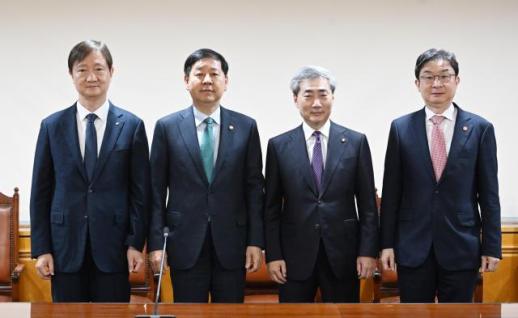 Financial chiefs monitor market volatility, Samsung strike risks SEOUL, May 14 (AJP) -The so-called 'financial four (F4)' - chiefs responsible for fiscal, monetary, and financial policies - gathered Thursday to monitor recent volatility in the financial and foreign exchange markets, assess risks stemming from the war in the Middle East, and discuss market stabilization measures. Notably, the meeting also addressed the potential impact of a general strike at Samsung Electronics, the nation's largest company, on the financial market and the real economy. Koo Yun-cheol, Deputy Prime Minister and Minister of Economy and Finance, presided over the joint market monitoring meeting at the Korea Federation of Banks in Seoul. The meeting was attended by Bank of Korea (BOK) Governor Shin Hyun-song, Financial Services Commission Chairman Lee Eog-won, and Financial Supervisory Service Governor Lee Chan-jin. The policy chiefs evaluated that the Korean economy continues to show higher-than-expected growth driven by robust semiconductors, with the fundamentals of the macroeconomy and financial markets remaining solid. Still, the volatility in the won-dollar exchange rate has expanded recently due to the prolonged Middle East conflict, rising international oil prices, and uncertainty regarding the monetary policies of major economies. Korea's gross domestic product (GDP) grew 1.7 percent in the first quarter, doubling the previous consensus of 0.9 percent. However, during the same period, the average exchange rate reached 1,469 won per dollar, weakening by more than 1 percent from 1,453.5 won in the previous quarter. Government bond yields also rose by an average of 35.4 bps for the three-year bond and 41.1 bps for the 10-year bond. KOSPI has grown into a globally top-tier market based on the competitiveness and earnings of key industries like semiconductors. However, they shared the consensus that efforts to improve the structure of the capital market must continue for it to solidify its position as a world-class market. As of Thursday's close, Samsung Electronics and SK hynix accounted for 48.1 percent of the total KOSPI market capitalization, raising concerns about a "K-shaped" polarization in the securities market. Regarding the weakness in the bond market, officials explained that the recent rise in treasury bond yields resulted from global inflation concerns, shifts in expectations for major countries' monetary policies, and strong first-quarter GDP growth. The government evaluated that the structural demand base for the bond market is improving, supported by healthy fiscal soundness and capital inflows following the inclusion in the World Government Bond Index (WGBI). They agreed the recent weakness of the won is excessive relative to the country's economic fundamentals. The government diagnosed that recent net selling of domestic stocks by foreign investors and an increase in offshore speculative trading have increased exchange rate volatility. They pointed out foreign exchange liquidity remains at a good level, and institutional improvements such as the WGBI inclusion, the National Pension Service’s new framework, and the Return-to-Korea Investment Account (RIA) are contributing to the stabilization of supply and demand. They projected that the exchange market would stabilize quickly if external uncertainties, such as the Middle East war, ease, supported by a record-high current account surplus. The meeting also touched upon the labor conflict at Samsung Electronics. Participants expressed concern that a general strike could pose significant risks to growth, exports, and the overall financial market, emphasizing the need for a swift resolution through principled negotiations. The management and labor union of Samsung Electronics have held negotiations since their first 2026 wage talk meeting on December 11 last year, but failed to bridge differences over the restructuring of the performance-based bonus system and the removal of the salary cap. The union secured the right to strike with a 93.1 percent approval rate in a March 18 vote and has intensified its struggle through rallies. Following mediation by the Ministry of Employment and Labor and the National Labor Relations Commission, post-adjustment procedures were held from May 11 to 13 but failed to reach a final agreement. Immediately after the breakdown of talks, the union announced it would go on a full-scale strike for 18 days, from May 21 to June 7. 2026-05-14 17:36:56
 -
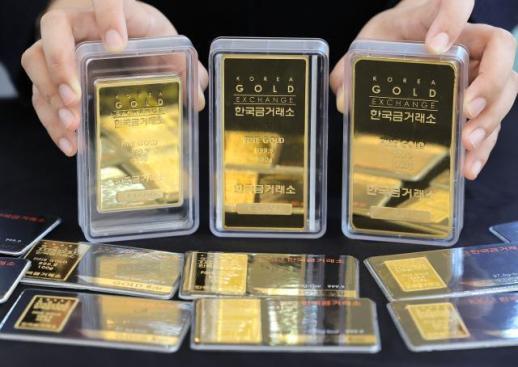 Korea's gold restraint pays off amid Gulf crisis SEOUL, May 14 (AJP) - Restraint from joining the global gold rush may have worked in the favor of the Bank of Korea, as the country’s relatively low gold exposure helped shield South Korea from sharper foreign reserve losses during market turmoil triggered by the Iran war earlier this year. As oil prices surged following the outbreak of the conflict in late February, governments around the world drew down reserves in March to stabilize currencies and protect their economies. South Korea’s foreign reserves fell by $4 billion as authorities intervened to defend the won after it weakened beyond 1,490 per dollar, according to the BOK. Despite the intervention, the decline was among the smallest recorded among major reserve-holding countries. China’s reserves fell by $85.7 billion in March, while India’s dropped by $37.4 billion. Russia posted a $60 billion decline and Germany recorded a $69.2 billion decrease. Among the world’s 12 largest reserve holders, only Saudi Arabia outperformed South Korea, posting a $20 billion increase as Dubai crude prices averaged more than $120 per barrel during the month. Analysts say South Korea’s comparatively low exposure to gold helped cushion reserve volatility as the precious metal — traditionally regarded as a safe-haven asset — turned unexpectedly volatile during the crisis. Although the U.S. dollar index rose above 100 following the blockade of the Strait of Hormuz and a broader flight toward safe assets, international gold prices fell sharply in March. Prices dropped 3.3 percent to $4,867.7 per troy ounce from $5,034.4 in February. The decline erased roughly half of February’s gains, when gold prices had climbed nearly 6 percent from the previous month. Gold prices continued to weaken through April and May even as the dollar index remained near 98. The April average slipped below $4,800 per troy ounce, and by Thursday prices had fallen further to $4,688. Analysts attributed the downturn partly to the scale of gold’s earlier rally. Prices, which stood near $2,700 per ounce in January last year, had surged to more than $5,100 by January this year — an increase of roughly 80 percent in just 12 months. Expectations that U.S. interest rates had peaked also contributed to the rally. When U.S. consumer inflation remained stable at 2.4 percent year-on-year in January, markets increasingly expected the Federal Reserve to cut rates and resume quantitative easing in line with the policy stance of President Donald Trump. The yield on the 10-year U.S. Treasury bond remained near 4.1 percent at the time. The outbreak of war quickly altered those expectations. Average March prices for the world’s three major oil benchmarks — West Texas Intermediate (WTI), Brent and Dubai crude — all exceeded $100 per barrel, fueling renewed inflationary pressure. The U.S. Consumer Price Index rose 3.3 percent in March and 3.8 percent in April, while 10-year Treasury yields climbed above 4.4 percent by Thursday. The shift prompted policymakers to adopt a more hawkish tone. Kevin Warsh, considered a leading contender to become the next Federal Reserve chair, stressed the need to contain inflation during a late-April hearing and rejected expectations of automatic quantitative easing. Central bank officials across Asia have echoed similar concerns. Major Asian central bank officials including Reserve Bank of India (RBI) Governor Sanjay Malhotra and Bank of Korea (BOK) Senior Deputy Governor Ryoo Sang-dai have both indicated that additional rate hikes may need to be considered if inflationary pressure intensifies. With gold retreating from record highs and the prospect of higher interest rates reemerging, investors have increasingly shifted funds back toward currency and bond markets. “During wars tied directly to energy supply disruptions, gains in gold prices have historically been more limited than during broader financial crises,” a foreign exchange dealing room official said on condition of anonymity. “Because gold prices had already surged to unprecedented levels before the Strait of Hormuz blockade, the base effect is becoming increasingly pronounced,” the official added. 2026-05-14 17:29:48
 -
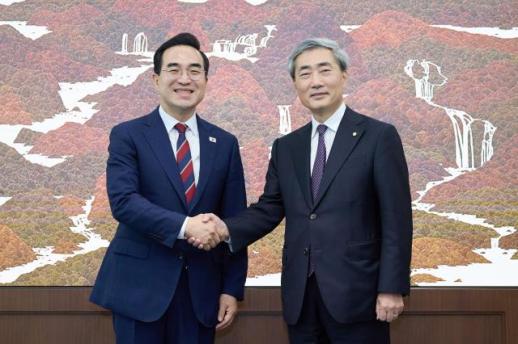 Chief of newly-launched budget ministry meets BOK governor SEOUL, May 14 (AJP) - Park Hong-geun, the chief of the newly-launched Ministry of Planning and Budget, met with Bank of Korea (BOK) governor Shin Hyun-song in Seoul on Thursday. They discussed ways to strengthen cooperation in fiscal and monetary policy, as well as in establishing future strategies. During their talks at the Bank of Korea headquarters in central Seoul, both sides expressed concerns that, while exports remain robust, inflationary pressures are rising due to the prolonged war in the Middle East and sustained high oil prices. They also agreed on the need to focus on stabilizing livelihoods by ensuring price stability and increasing support for the underprivileged. Their first such meeting comes as the government pushes for fiscal expansion and structural reforms. As an icebreaker at the start of the meeting, Park presented a pine bonsai to Shin, saying, "Just as the roots and trunk of a pine tree depend on each other, let us continue to cooperate." "Close coordination between the ministry and the central bank has never been more important," Park said. "No single institution can tackle these economic challenges alone," Shin replied. The two sides also stressed the need for cooperation in addressing major challenges such as the transition into the artificial intelligence (AI) era, demographic shifts, climate change, growing wealth inequality, and regional economic imbalances. Park outlined plans to establish mid- to long-term strategies in close collaboration with the Bank of Korea. Shin pledged that the BOK would actively cooperate. Shin said the central bank would expand its role beyond its traditional focus on price and financial stability, actively researching and offering policy proposals on growth and structural reform, an approach in line with that of his predecessor, Rhee Chang-yong. The two also agreed to meet more frequently to share key issues and to continue close cooperation. 2026-05-14 15:34:54
 -
 Fiscal deficit narrows on stronger tax revenue, debt burden persists SEOUL, May 14 (AJP) — South Korea’s fiscal balance improved significantly in the first quarter of this year as tax revenues continued to recover, feeding the government rationale for more aggressive policy to counter import inflationary risks amid protracted Middle East conflicts. According to the Ministry of Planning and Budget on Thursday, total revenue from January to March reached 188.8 trillion ($128.5 billion) won, an increase of 28.9 trillion won from a year earlier. The surge in tax revenue is attributed to the recovery of the semiconductor industry and active stock market trading. Analysts evaluate that the stock market rally centered on AI semiconductors and improved corporate earnings led to increased tax revenue from securities transactions and corporate taxes. Despite the market plunge in March caused by the war involving the United States and Iran, the benchmark KOSPI rose 20 percent during the first quarter. During the same period, Samsung Electronics and SK hynix recorded a combined operating profit of 94 trillion won, once again hitting record highs. National tax revenue rose by 15.5 trillion won to 108.8 trillion won, while total expenditure stood at 211.6 trillion won - up only 1.7 trillion won from a year ago. Consequently, the managed fiscal balance—a key gauge of fiscal health that excludes social security funds—recorded a deficit of 39.6 trillion won. The deficit narrowed by 21.7 trillion won compared to the same period last year. The government evaluated the fiscal conditions as gradually stabilizing, noting that the managed fiscal deficit as of March is at its lowest level since 2020. However, some in the market remain cautious about whether this improvement will lead to a structural recovery of fiscal soundness. A major burden is the central government debt, which remained at a high level in the 1,300 trillion won range. Concerns are also being raised that the growth of national debt could accelerate again, given the potential for additional fiscal spending to counter an economic slowdown, mitigate high oil price shocks, and support youth employment. The budget ministry explained that "the March results are based on figures before the passage of the supplementary budget." President Lee Jae Myung supported an expansionary stance during a Cabinet meeting on Tuesday, stating that "more money needs to be released." The government closed the first round of applications for high oil price damage relief funds from April 27 to May 8 and plans to begin the second round of applications next Monday. Total spending for the relief is expected to exceed 6 trillion won. 2026-05-14 13:30:44
 -
 KOSPI hits fresh high, fully recovering from previous losses as most Asian markets rally SEOUL, May 13 (AJP) - Asian stock markets largely shrugged off the overnight slump in Wall Street triggered by higher-than-expected U.S. consumer inflation. However, Taiwan's benchmark index, which is heavily reliant on the semiconductor industry, was the sole decliner among major Asian markets amid weaker U.S. market sentiment. The South Korean won ended at 1,494.5 per dollar, sharply down 15.5 won from the previous session. The global dollar strength was reignited as the U.S. Consumer Price Index (CPI) for April rose 3.7 percent on year, surpassing market expectations and dampening hopes for an early interest rate cut by the Federal Reserve. Government bond yields retreated across both short- and long-term maturities - signaling a rise in bond prices - reversing the previous day's sharp ascent. Investor sentiment was bolstered as Cheong Wa Dae directly addressed policy uncertainties surrounding the "AI dividend," easing relevant concerns. The three-year treasury bond yield fell 4.2 bps to 3.520 percent, while the 10-year yield dropped 3.8 bps to 3.615 percent. The benchmark KOSPI surged 2.63 percent on Wednesday to close at 7,844.01, fully recovering from the previous day's 2 percent loss and setting a new record high. Retail and institutional investors led the rally, net buying 1.89 trillion won (US$1.26 billion) and 1.69 trillion won, respectively. In contrast, foreign investors extended their selling streak, offloading 3.73 trillion won. The index had initially opened lower following a more than 2 percent drop the previous day, after Kim Yong-beom, the senior presidential secretary for policy, abruptly raised the idea of a dividend from brokerage profits. However, the mood shifted as government officials distanced themselves from Kim's remarks. Expectations also grew for semiconductor stocks ahead of the summit between U.S. President Donald Trump and Chinese President Xi Jinping. Market heavyweights SK hynix and Samsung Electronics saw divergent fortunes. SK hynix soared 7.7 percent to close at 1,976,000 won ($1,322.25). Meanwhile, Samsung Electronics edged up 1.8 percent to 284,000 won, as its gains were capped by an ongoing general strike despite hopes for the U.S.-China summit. Hyundai Motor, which held its ground during Tuesday's sell-off, jumped 9.9 percent to end at 710,000 won. The gain reflected delayed positive sentiment following the release of a demonstration video for the "Atlas" humanoid robot by its subsidiary, Boston Dynamics. Conversely, secondary battery stocks struggled or saw limited gains as the higher-than-expected U.S. CPI pushed back rate cut expectations. LG Energy Solution fell 2.93 percent to 430,000 won, while Samsung SDI edged up 0.8 percent to 634,000 won. The tech-heavy KOSDAQ slipped 0.2 percent, weighed down by a 4 percent drop in secondary battery leader EcoPro BM, which closed at 197,100 won. In Japan, the Nikkei 225 gained 0.84 percent to close at 63,272.11. Market leader Toyota Motor led the rise, jumping 3.4 percent to 2,940 yen ($18.85). Honda Motor, which recently scaled back operations and exited some overseas markets like South Korea due to poor performance, also rose 1.3 percent to 1,272 yen. Having said that, semiconductor equipment makers struggled as the U.S. accelerated the "MATCH Act," which broadly bans exports of semiconductor equipment to China. Advantest fell 1.45 percent to 28,290 yen, and Tokyo Electron dropped 1.57 percent to 51,340 yen. The TAIEX was the only major regional index to fall, declining 1.25 percent to 41,374.50. The index was hit hard by news that Apple decided to outsource some chip orders to Intel. TSMC fell 1.6 percent to 2,220 Taiwan dollars ($68.41), and MediaTek slumped 5.54 percent to 3,495 Taiwan dollars. Mainland Chinese shares rallied on expectations for the U.S.-China summit. The Shanghai Composite rose 0.67 percent to 4,242.57, while the Shenzhen Composite climbed 1.67 percent to 16,089.75. 2026-05-13 17:29:27
 -
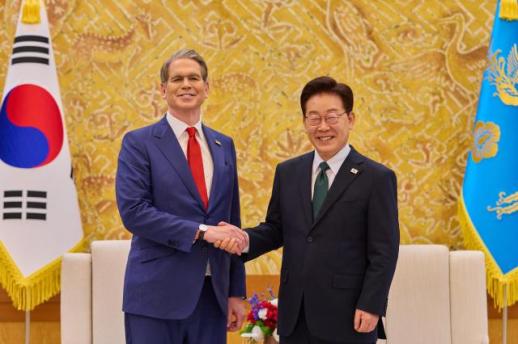 Lee hosts U.S., Chinese economic chiefs ahead of Trump-Xi summit SEOUL, May 13 (AJP) - President Lee Jae Myung on Wednesday had back-to-back meetings with U.S. Treasury Secretary Scott Bessent and Chinese Vice Premier He Lifeng, who visited South Korea just a day before the scheduled U.S.-China summit in Beijing. According to the presidential office, Lee met He and Bessent separately on Wednesday morning. Following their meetings with the president, the two officials united at Incheon International Airport for last-minute fine-tuning ahead of the summit between the United States and China, set to take place in Beijing from Thursday. During the meeting with Bessent, Lee reportedly explained the South Korean government's commitment to implementing investments in the United States, including the MASGA project. It is also speculated that Lee requested cooperation on security and economic issues, such as the introduction of nuclear-powered submarines, which was previously discussed between the leaders of South Korea and the U.S. In the meeting with He - accompanied by Li Chenggang, China's international trade representative and vice minister of commerce - discussions reportedly centered on South Korea-China relations and economic cooperation measures. Lee referred to China as a key strategic cooperative partner for South Korea and emphasized the necessity of horizontal and mutually beneficial cooperation between the two nations. Bessent and He began a private meeting in the VIP lounge of Incheon International Airport around 12:30 p.m. Bessent arrived at Incheon Airport earlier in the morning, traveled to the Blue House to meet Lee, and then returned to the airport for the consultation. The two sides are expected to coordinate economic and trade issues, including tariffs and global supply chain stability, ahead of the summit. Both parties entered the meeting without making any public remarks. Bessent is flying to Japan to meet Finance Minister Satsuki Katayama before joining Trump in Beijing. 2026-05-13 15:04:57
 -
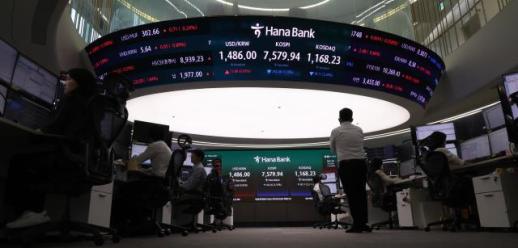 KDI bumps up 2026 growth estimate to 2.5%, chips drive half of upgrade SEOUL, May 13 (AJP) -State think tank Korea Development Institute on Wednesday projected South Korea’s economy to grow at its fastest pace in three years at 2.5 percent this year, while inflation is expected to accelerate to 2.7 percent — a combination suggesting the economy may sidestep stagflation fears for now even as growth momentum is likely to cool next year alongside moderating chip demand. At the same time, the institute warned inflation risks were intensifying from both demand and supply pressures and called for flexible monetary policy, including the possibility of interest rate hikes should inflation expectations become unstable. “Should the possibility of persistently high inflation increase, rates would need to rise,” KDI said in its revised economic outlook, while adding that uncertainty remains too high to determine the timing of any potential move. Its latest outlook marks a sharp 0.6 percentage-point upgrade from the institute’s February forecast issued before the outbreak of the Middle East conflict and reflects stronger-than-expected first-quarter growth, when the economy expanded 1.7 percent from the previous quarter. The state-run think tank raised its inflation forecast for this year by 0.6 percentage point, warning that rising global oil prices and recovering domestic demand were adding upward pressure on consumer prices. “The Korean economy has continued its recovery trend as growth expanded at a relatively strong pace, driven by the semiconductor boom and expanding domestic demand,” the KDI said. The KDI expects the economy to grow 1.7 percent in 2027, while describing both this year and next year as an expansionary phase because growth is projected to exceed the country’s estimated potential growth rate. Still, the recovery remains heavily skewed toward semiconductors. According to the KDI, semiconductor exports accounted for more than half of the upward revision in this year’s growth outlook. “Compared with the negative impact from the Middle East war, the positive effect from semiconductor exports was larger,” Jung Kyu-chul, head of KDI’s macroeconomic and financial policy division, said during a briefing in Sejong. “Out of the 0.6 percentage-point upward revision, semiconductors contributed more than 0.3 percentage point.” Jung estimated the Middle East war shaved roughly 0.5 percentage point off growth, while supplementary budget spending added about 0.2 percentage point. He added that surging semiconductor demand and supply shortages had sharply lifted chip prices, suggesting growth could improve further if production capacity expands more quickly. The KDI, however, warned that prolonged high oil prices could derail the outlook. The institute assumes Dubai crude will average $91 per barrel this year before easing to $82 next year, compared with $69 last year, while the won-dollar exchange rate is assumed to remain near the current 1,475 won level. The think tank projected exports would rise 4.6 percent this year on robust semiconductor demand before moderating to 2.2 percent next year, while the current account surplus is expected to reach a record $239 billion this year. Private consumption is forecast to increase 2.2 percent this year and 1.5 percent next year despite inflationary pressures from the Middle East conflict, supported by improving income conditions and government stimulus measures. Jung added that rising stock prices were also likely to support consumption through wealth effects. The KDI also projected employment would continue improving moderately, with the number of employed persons increasing by 170,000 in both this year and next year despite demographic changes. The institute additionally urged the government to focus fiscal spending on boosting potential growth and supporting vulnerable households while improving spending efficiency. It specifically called for reforms to basic pensions and local education subsidies, which are projected to exceed 100 trillion won next year. 2026-05-13 14:30:52
 -
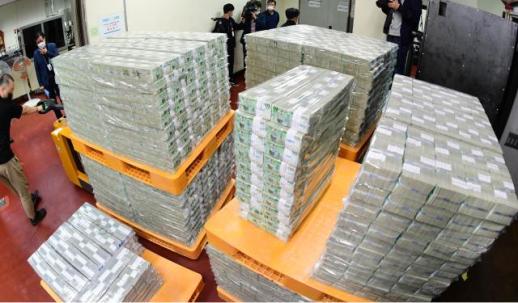 Korea's M2 growth runs twice Japan's, deepening inflation and FX dilemma SEOUL, May 13 (AJP) - South Korea’s liquidity expanded sharply in March, with much of the abundance funneling toward the red-hot asset market rather than helping to bolster weakening economic fundamentals and creating a headache for monetary authorities battling looming imported energy-triggered inflation and a stubbornly weak currency. The M2 money supply reached 4,132.1 trillion won ($2.76 trillion) in March, up 5.6 percent from a year earlier, according to the Bank of Korea on Wednesday. M2 includes cash, demand deposits and other highly liquid financial instruments. Under the BOK’s previous calculation standard, the figure would have stood at 4,625.1 trillion won, marking a 9.3 percent on-year increase. By either measure, liquidity growth is accelerating noticeably. The last time M2 growth exceeded 9 percent under the old standard was in April 2022, when it reached 9.4 percent, at a time when markets were still awash with liquidity injected during the Covid-19 pandemic. That period later prompted aggressive interest rate hikes by the U.S. Federal Reserve and other major central banks to absorb excess liquidity. Even under the revised standard introduced late last year — after criticism that the central bank’s loose policy stance had contributed to the won’s weakness against major currencies — Korea’s liquidity growth still more than doubled Japan’s roughly 2 percent pace and outpaced the eurozone’s 3.2 percent expansion during the same period. The surge comes amid growing rationale for monetary tightening. New Bank of Korea Governor Shin Hyun-song, Senior Deputy Governor Ryoo Sang-dai and recently retired monetary board member Shin Sung-hwan have all recently mentioned the possibility of an interest rate hike. The won on Wednesday hovered close to the psychologically sensitive 1,500-per-dollar mark, a level previously seen mainly during periods of financial crisis. Consumer prices rose 2.6 percent in April even as the impact of disruptions around the Strait of Hormuz has yet to fully reach Korean shores through higher energy costs. The government, meanwhile, continues to lean toward fiscal stimulus despite mounting concerns over debt and excess liquidity in an effort to pre-empt stagnationary risks. During a Cabinet meeting Tuesday, President Lee Jae Myung criticized calls for tightening as “populist” and signaled fiscal expansion in the second half and next year’s budget planning. Lee argued that the livelihood recovery support payments distributed last year generated roughly 430,000 won in additional consumption for every 1 million won provided. The government is currently preparing another round of high oil-price relief payments ranging from 100,000 won to 600,000 won per person depending on income level and region. The total package is expected to amount to 6.1 trillion won. The real question lies in the effectiveness of the stimulus measures. The money multiplier — calculated by dividing the new M2 measure by the monetary base — stood at 13.43 in March, continuing a steady decline from its peak of 14.5 in November 2023. The indicator measures how actively liquidity is being used across consumption, investment, lending and asset purchases. A lower multiplier suggests money is not circulating efficiently despite the growing supply. “The increase in money supply only becomes meaningful when consumption and investment expand, but currently only stocks and real estate are rising,” said Ahn Dong-hyun, an economics professor at Seoul National University. 2026-05-13 13:55:09
 -
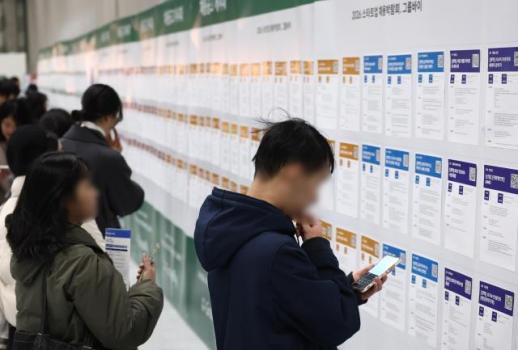 UPDATE: Job growth hits 16-month low in Korea in April, youth employment dips *Updated with additional information SEOUL, May 13 (AJP) — South Korea’s job growth slowed in April to its weakest pace since December 2024, when the country was grappling with the aftermath of the martial law episode, as the war in the Middle East dragged into a third month. The number of employed people aged 15 and older rose by 74,000 from a year earlier to 28.96 million in April, the Ministry of Data and Statistics said Wednesday. It marked the smallest gain in one year and four months, since December 2024, when the number of employed people fell by 52,000. The employment rate for the working-age population, aged 15 to 64, stood at 70 percent, up 0.1 percentage point from a year earlier. But youth employment continued to weaken. The employment rate for people aged 15 to 29 fell by 1.6 percentage points to 43.7 percent, extending its decline for a second straight year since May 2024. Concerns are growing because the weakness in youth employment cannot be explained simply by demographic decline. According to the statistics agency, the number of employed people in their 20s fell by 195,000 from a year earlier, while the youth employment rate has been declining for 24 consecutive months since May last year. The April drop was also sharper than in previous months, widening from declines of 0.7 percentage point in February and 0.9 percentage point in March. The youth unemployment rate stood at 7.1 percent, down 0.2 percentage point from a year earlier, but the figure does not necessarily point to an improvement. The number of people preparing for employment plunged by 43,000, or 6.4 percent, from a year earlier to 626,000, while the number of discouraged workers rose by 15,000. Polarization between experienced workers and newcomers also deepened. The number of unemployed people with prior work experience fell by 1.7 percent on year to 785,000, while the number of unemployed people with no prior work experience surged 21 percent to 68,000. Amid the continued bifurcation of the labor market, more people are staying in education or training. The number of economically inactive people enrolled in education or training rose by 96,000, or 3 percent, over the past 12 months — an unusual increase for April, when the figure typically declines or remains flat. This suggests that young people are delaying their entry into the labor market rather than exiting it altogether, waiting for job conditions to improve. The number of people in their 20s who said they were “taking a break” came to 376,000, down 16,000 from a year earlier, marking a second consecutive monthly decline. The overall increase in those taking a break was driven by people aged 60 and older, whose number jumped 8.4 percent on year to 1.18 million. By industry, employment increased in health and social welfare services by 261,000 and in arts, sports and recreation-related services by 54,000. But job losses continued in professional, scientific and technical services, down 115,000; manufacturing, down 55,000; and agriculture, forestry and fisheries, down 92,000. The decline in professional, scientific and technical services — sectors favored by younger workers and increasingly exposed to artificial intelligence — points to a shortage of quality entry-level jobs and a structural shift in the labor market that is worsening youth employment conditions. The Ministry of Economy and Finance and the Ministry of Employment and Labor on Wednesday unveiled the "Youth New Deal" to address the sluggish job market caused by the Middle East conflict and the shift toward AI. A central component is the "K-New Deal Academy," a vocational training program involving 70 companies, including the top 10 conglomerates, which aims to train 12,000 individuals to align skills with corporate demand. The "Youth Leap Boot Camp," a joint university-industry initiative, will also launch in July following university selections in June. Public and private internship programs are also set to begin recruitment this month. 2026-05-13 09:02:17
 -
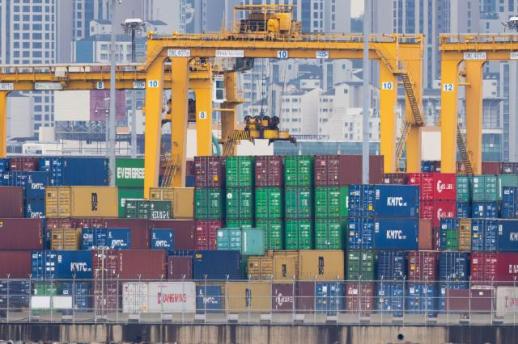 South Korea outpaces peers in Q1 growth; structural risks persist SEOUL, May 12 (AJP) — The South Korean economy was the best performer among major economies in the first quarter of this year, benefiting from a base effect from a contraction in the fourth quarter of last year and chip boom. South Korea's real gross domestic product (GDP) increased by 1.7 percent in the first quarter from the previous quarter - the highest growth rate among the 22 countries that have released first-quarter flash estimates as of Monday. This outperforms countries that have historically recorded higher growth, such as Indonesia (1.37 percent) and China (1.3 percent) - the only countries that saw growth exceeding 1 percent in the first quarter other than South Korea so far. Most other major advanced economies remained in the 0 percent range. The United States grew 0.5 percent while Japan expanded 0.1 percent. Major European economies including Portugal, the Netherlands and Italy also recorded zero or marginal growth of around 0.1 percent. The primary driver of the growth was a surge in semiconductor exports. Rapidly increasing production and exports of memory chips, fueled by expanding AI investment and demand for High Bandwidth Memory (HBM), led to a 5.1 percent increase in total exports compared to the previous quarter. The semiconductor boom also translated into facility investment and production normalization. As investments in semiconductor equipment and electronic devices increased to meet the expansion of AI servers and data centers, facility investment grew in the high 4 percent range compared to the previous quarter. The rapid growth in the first quarter, however, may be a "base effect" from the previous quarter's contraction. South Korea’s growth rate in the fourth quarter of last year was minus 0.2 percent, ranking as the second lowest among G20 member nations after Mexico (-0.8 percent). When growth in the previous quarter is negative, the following quarter's growth rate can appear significantly high simply through the normalization of production, exports, and investment. South Korea saw a 2.1 percent rebound in the third quarter of 2020, followed by a -3.0 percent contraction in the second quarter of that year due to the COVID-19 pandemic. The risk that growth could slow again depending on the semiconductor cycle also remains a concern. According to the central bank, semiconductors accounted for more than half of the manufacturing sector's contribution to growth, at approximately 55 percent. Without the semiconductor manufacturing sector, the first-quarter growth rate of 1.7 percent could have been cut by more than half. Above all, forecasts are emerging that the prolonged blockade of the Strait of Hormuz due to the conflict between the U.S. and Iran could significantly slow South Korea's economic growth. French investment bank Natixis recently slashed its real GDP growth forecast for South Korea from 1.8 percent to 1.0 percent, while British research firm Capital Economics lowered its outlook from 2.0 percent to 1.6 percent. 2026-05-12 17:04:51