
Journalist

Cho Jae Hyung
grind@ajunews.com
-
 APR posts record Q1 operating profit as overseas sales near 90% Beauty company APR posted its strongest quarterly results on record in the first quarter, driven by a surge in overseas business as K-beauty demand lifted its performance in the U.S. market, including a No. 1 ranking in Amazon’s U.S. beauty category. APR said in a preliminary earnings filing on Wednesday that 2026 first-quarter consolidated revenue rose 123.0% from a year earlier to 593.4 billion won, while operating profit jumped 173.7% to 152.3 billion won. Both were the highest quarterly figures since the company’s founding. Overseas sales led the gains. First-quarter international revenue climbed 179.9% to 528.1 billion won, topping 500 billion won for the first time. Overseas sales accounted for 89.0% of total revenue, up 18.1 percentage points from a year earlier. The U.S. market posted the sharpest growth. U.S. first-quarter revenue surged 250.8% to 248.5 billion won, representing 41.9% of total sales. U.S. market research firm Navigo Marketing said APR ranked first in Amazon’s U.S. beauty category in the first quarter with a 14.1% share. APR’s flagship brand, Medicube, is set to expand beyond Ulta Beauty, with placements planned at multiple major U.S. offline retail channels in stages within the year starting in the second quarter. Outside the U.S., Japan revenue rose 100.8% to 58.9 billion won. Sales in other regions increased 216.1% to 190.0 billion won from 60.1 billion won a year earlier. By business segment, cosmetics and beauty revenue climbed 174.3% to 452.6 billion won. Medicube’s PDRN product line surpassed 50 million units in cumulative global sales in February, and its toner pads sold more than 20 million units on a first-quarter basis. During Amazon’s Big Spring Sale in March, 10 Medicube products entered the beauty category’s top 100 best-seller list, the company said. Beauty device revenue rose 46.0% to 132.7 billion won, also a record quarterly result. APR said it plans to use its online momentum to accelerate offline distribution, aiming to reinforce a self-sustaining growth cycle. In the U.S., it expects additional major offline channel rollouts beyond Ulta Beauty beginning in the second quarter. The company is also expanding in other markets. In March, it launched Medicube through Sephora’s online and offline channels across 17 European countries, including France and Germany, and signed a partnership with Nykaa, India’s largest beauty and lifestyle platform. APR recently was named to Time magazine’s list of the “100 Most Influential Companies” in the world, the company said, calling it the only South Korean company on the list this year and the first K-beauty company to be included. Time’s website shows APR was selected in the “Titans” category, alongside companies including Nvidia, Google, SpaceX, Meta and Saudi Aramco. “While pursuing sustained growth through entry into new markets and diversification of distribution channels, we will also actively launch new products that reflect customer and market trends to continue a quantum jump,” an APR official said.* This article has been translated by AI. 2026-05-07 13:43:26
 -
 Sulwhasoo Targets Japan With Pop-Up Experience at @cosme Tokyo Amorepacific’s luxury cosmetics brand Sulwhasoo is stepping up its push into Japan, setting up a brand experience space at the country’s largest beauty platform to go beyond sales and introduce its K-luxury skincare philosophy and heritage. According to the beauty industry on the 7th, Sulwhasoo will run a large-scale brand experience event through the 12th at @cosme Tokyo in Tokyo. @cosme Tokyo is a leading Japanese beauty platform where brand trust is built on consumer reviews and in-person testing, and it is considered a key retail channel that strongly influences purchasing decisions. Sulwhasoo said it is prioritizing building trust to appeal to Japanese consumers known for demanding standards in basic skincare. Rather than focusing on immediate results or sales volume, the brand plans to emphasize its long-standing story of blending Eastern aesthetics with modern science. Pop-up visitors can try Sulwhasoo’s signature lineup and experience the brand firsthand. The move is also drawing attention as part of Amorepacific’s broader expansion strategy in Japan. In 2022, the company placed Laneige officially on @cosme, marking a major step in its Japan entry. More recently, it has reported notable growth in Japan led by function-focused derma cosmetic brands such as Aestura and COSRX. By widening customer touchpoints for Sulwhasoo, the group’s flagship high-end brand, Amorepacific aims to strengthen its position in Japan’s beauty market as a leading K-beauty company. “Using this brand experience event as a starting point, Sulwhasoo plans to gradually expand brand awareness in Japan and continue strengthening points of contact with local consumers,” an Amorepacific official said. 2026-05-07 10:52:11
 -
 K-Culture Boosts Korea’s Cross-Border E-Commerce as Platforms Expand Overseas Sales As the market for selling South Korean products directly to overseas consumers grows, e-commerce companies are rapidly adjusting strategy. The focus is shifting away from serving Korean shoppers’ overseas direct purchases toward targeting foreign buyers with competitive K-beauty, fashion and other content-driven products. According to the National Data Center on Tuesday, online overseas direct sales totaled 3.02 trillion won last year, up 16.4% from a year earlier. In the first quarter of this year, such sales by domestic businesses rose 24.4% from the same period a year earlier to 1.06 trillion won, returning to the 1 trillion won range for the first time in 4 1/2 years since the third quarter of 2021 (1.0428 trillion won). By country, China led with 376.3 billion won, followed by Japan with 255.2 billion won and the United States with 252.1 billion won. By product category, cosmetics ranked first at 633.6 billion won, followed by records, videos and musical instruments at 108.3 billion won, and clothing and fashion-related goods at 93.8 billion won. Overseas direct purchases by Korean consumers, however, totaled 1.9789 trillion won over the same period, up just 1.2%. China accounted for the largest share at 1.2276 trillion won. Clothing and fashion led at 787.2 billion won, followed by food and beverages at 415.7 billion won, and household and auto supplies at 197.1 billion won. The trend is being read as a sign that global demand for Korean products is rebounding quickly alongside the spread of K-culture. E-commerce companies are moving to expand overseas direct sales. 11st will end operations of its existing “Amazon Global Store” on June 30 and reorganize its business around overseas direct sales. Starting in mid-June, it will open a dedicated 11st section on JD.com’s cross-border platform, “JD Worldwide.” When an order is placed, sellers will deliver products to 11st’s logistics center, while 11st will support the rest of the operations. Gmarket is targeting the market through Lazada, Alibaba Group’s Southeast Asia platform. After initially linking more than 7,000 sellers and 1.2 million products, sales through Lazada in March rose about 150% from two months earlier. Gmarket plans to increase the number of Lazada-linked products to 2.5 times the early-year level within this year and expand beyond Southeast Asia into West Asia and Europe. Cooperation between logistics companies and platforms is also increasing. Hanjin has partnered with live commerce platform Grip to target Japan’s overseas direct sales market. The strategy centers on combining its logistics infrastructure with local influencers to build a content-based sales model, aiming to strengthen the path from “content to purchase.” Fashion and beauty platforms are also joining the competition. Musinsa introduced a “global review” feature on its global store so overseas customers can post reviews directly, addressing information gaps seen as a limitation in overseas direct sales. KakaoStyle began a pilot operation in France of “Piona,” a separate K-beauty-focused overseas direct sales platform, in a renewed push into Europe about two years after withdrawing its “Zigzag Global” service. “In the past, overseas direct purchases were centered on price competitiveness, but overseas direct sales hinge on brand and content competitiveness,” an industry official said. “As global demand based on K-culture expands structurally, competition among platforms for leadership in overseas direct sales will intensify.”* This article has been translated by AI. 2026-05-06 17:54:46
 -
 Kurly to Sell 33 Billion Won in New Shares to Naver, Raising Stake to 6.2% Retail tech company Kurly is moving to deepen its partnership with Naver. Kurly said in a regulatory filing on the 6th that it will carry out a third-party allotment paid-in capital increase for Naver. Kurly will issue 498,882 new common shares at 66,148 won per share. Naver will subscribe to all of the newly issued shares, Kurly said. The issue price was set by mutual agreement based on Kurly’s most recent fundraising round, the company said. Based on that, Kurly’s overall valuation is estimated at about 2.8 trillion won. After the capital increase is completed, Naver’s stake in Kurly will rise to 6.2%. Kurly said it plans to use the 33 billion won raised to support mid- to long-term growth, including expanding logistics infrastructure, a key to delivery competitiveness, and funding new businesses. Kurly and Naver signed a strategic partnership in April last year and have expanded cooperation, including opening the “KurlyN Mart” grocery section on the Naver Plus Store in September of the same year. Kurly Nextmile, Kurly’s logistics subsidiary, handles dawn delivery for products sold through Naver Smart Store and Brand Store, the company said. Kurly CEO Kim Seul-a said, “With this investment as a turning point, the two companies plan to further strengthen cooperation as strategic partners and achieve meaningful synergy and rapid growth.” Kurly said its consolidated revenue last year rose 7.8% from a year earlier to 2.3671 trillion won. Operating profit came to 13.1 billion won, swinging to a profit from an 18.3 billion won operating loss a year earlier. Gross merchandise value increased 13.5% to 3.5340 trillion won. The company attributed improved profitability to balanced growth in its core fresh food business and its Beauty Kurly cosmetics unit, as well as results from KurlyN Mart. Samsung Securities said KurlyN Mart’s monthly transaction volume has increased by more than 50% each month since launch. * This article has been translated by AI. 2026-05-06 16:39:16
 -
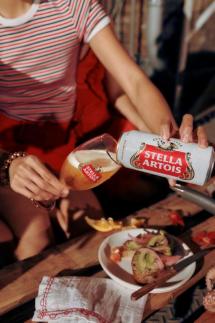 Stella Artois Launches 'Taste Worth More' Campaign Highlighting Perfect Serve Belgian beer brand Stella Artois is rolling out a marketing push that puts taste and quality front and center. OB Beer, which distributes Stella Artois in South Korea, said Tuesday the brand has launched a new campaign, “Taste Worth More,” aimed at highlighting a top-tier beer-drinking experience. The campaign expands the brand experience to the full process of completing a single pour. The ads focus on the brand’s signature “chalice” glass and visually lay out a “five-step serving ritual,” including how the beer is poured, the height of the foam and the order in which the glass is handled. Stella Artois is also expanding on-site quality control. It plans to increase the number of locations using “Perfect Serve,” its global draft-beer quality management program, from about 1,500 to about 2,500 this year. The company will also hold the “Stella Artois Perfect Serve Awards Korea” competition for venues that complete the training program. Using an AI-powered “Perfect Serve Scanner” app, the brand will select the top 20 venues based on scores submitted by consumers. Those venues will then compete on the accuracy and consistency of the five-step serving ritual. The brand is also updating packaging and running a limited-time promotion. It has changed the logo on its cans from a horizontal to a vertical layout, a design intended to keep the logo upright when the can is tilted to pour into the chalice. For May, it will also sell a limited-edition package that includes a temperature-sensitive chalice through major supermarkets nationwide and convenience-store smart orders online. When cold beer at the optimal temperature touches the glass, the logo on the outside turns red, allowing drinkers to confirm the beer is chilled. “S Stella Artois believes the brand should be responsible not only for how the beer is made, but also for the moment consumers experience it,” said Park Sang-young, an OB Beer marketing executive director. “We will continue to set standards for delivering the best possible beer experience.” Stella Artois also participated as the official beer partner at the Michelin Guide Seoul & Busan 2026 publication event held in March at Signiel Busan. The brand has partnered with the Michelin Guide Seoul & Busan for a second consecutive year.* This article has been translated by AI. 2026-05-06 09:45:26
 -
 Rising Exchange Rate and Oil Prices Push Up Meat and Egg Costs in South Korea Rising exchange rates and higher global oil prices are pushing up livestock product prices across the board in South Korea, hitting both domestic and imported meat. Analysts say the usual role of imported meat as a buffer against food inflation is weakening, adding pressure on household grocery bills. According to the Korea Institute for Animal Products Quality Evaluation, as of May 4, Grade 1 hanwoo tenderloin averaged 14,663 won per 100 grams, up 19.3% from the seasonal norm of 12,294 won. Grade 1 hanwoo sirloin averaged 10,443 won per 100 grams, a 13.5% increase from normal levels. Pork belly, a staple for dining out, averaged 2,828 won per 100 grams, up 12.4% from the typical 2,516 won. On a monthly basis, the price rose from 2,601 won in March to 2,644 won in April, and averaged about 2,812 won in May. Pork shoulder averaged 2,637 won per 100 grams, up 13.1% from the norm of 2,331 won. Broiler chicken averaged 6,566 won per kilogram, up 11.0% from the typical 5,914 won. Egg prices also climbed: a 30-egg tray of extra-large eggs averaged 7,273 won, up 6.3% from the norm of 6,843 won. Imported meat, long seen as a cheaper alternative, also rose. U.S. chilled chuck eye roll averaged 4,091 won per 100 grams, up 31.4% from the typical 3,114 won. U.S. chilled rib finger meat averaged 4,804 won, up 14.8% from 4,185 won, and U.S. frozen beef short ribs averaged 4,452 won, up 10.7% from 4,020 won. Imported pork averaged 1,522 won, above the typical 1,448 won. The broad rise is being attributed to overlapping global headwinds, including higher international oil prices amid instability in the Middle East, greater exchange-rate volatility, and rising feed and logistics costs. Higher energy and raw-material prices are being reflected in production and distribution costs with a lag, adding to upward pressure on retail prices. In response, the government plans to provide 10 billion won in discount support for agricultural and livestock products in May and June. It will offer discounts of up to 40% on items including rice, eggs and chicken, and will expand the list to include onions, napa cabbage, cabbage, tomatoes, Korean melons, zucchini and bell peppers. It also plans to support discounts of up to 50% for hanwoo and pork in cooperation with industry-funded promotion groups. Major supermarket chains also plan to continue special promotions this month to ease the burden on shoppers. Earlier, leading retailers including E-Mart and Lotte Mart ran large discount events on key agricultural and livestock products through May 6. E-Mart is also reported to be planning an additional discount event around May 9-11 in cooperation with the Korean Pork Producers Association. 2026-05-05 14:45:15
 -
 Hyundai Department Store’s Mokdong Branch Revamps Living Floor in Biggest Renovation Since 2002 Hyundai Department Store’s Mokdong branch has overhauled its living floor, targeting strong local demand for premium home goods. It is the store’s largest renovation since it opened in 2002. Hyundai Department Store said Tuesday it has reopened the living floor on the B1 level after a full renovation of about 500 pyeong (1,652 square meters), redesigning it as a curated space tailored to customers’ lifestyles. The most prominent addition is a sleep-focused experience zone called the “sleep fitting room.” Customers can lie down in a cozy, private room with dimmed lighting to try high-end mattresses from brands including Simmons and Tempur. The merchandise mix was also adjusted for shoppers seeking both premium products and practicality. The store strengthened its lineup of Nordic-style living brands, a trend that has taken hold in the interior market, adding brands including Fritz Hansen, &Tradition, Stay H, BD and Radof. The branch will also run pop-up stores aimed at consumers in their 30s and 40s, a key customer group. Participants include sink specialist Baekjo Sink, custom chair brand Size of, and lifestyle furniture brand Ceres Home, the company said. A Hyundai Department Store official said the company will continue to build “distinctive content and a premium shopping experience” to position the Mokdong branch as a leading living destination in western Seoul. Department stores have been accelerating renovations at major locations as they seek to offer experiences that differ from online shopping. Shinsegae Department Store’s Hanam branch recently renovated 10 young fashion brands and 18 children’s brands on the first floor, opening new stores including young fashion labels Rave and Duelring and children’s brand Apricot Studio, the first in the Hanam area. The branch reduced the number of brands while expanding individual store size and walkways by about 1.5 times to create a more comfortable shopping environment. Lotte Department Store’s Incheon branch completed a reorganization of its first-floor luxury section, reopening it on the first of this month with hands-on content.* This article has been translated by AI. 2026-05-05 13:47:59
 -
 Coupang to Donate Up to 180,000 New Fashion Items to Vulnerable Children, Families Coupang is launching a large-scale giving campaign to support vulnerable groups, including underserved children, by donating new fashion items in proportion to what customers buy. According to the industry on the 5th, Coupang will run a promotion through the end of this month titled “One Piece of My Clothing That Becomes a Donation,” and plans to donate up to 180,000 fashion items to Good Neighbors, a global NGO specializing in children’s rights. The campaign is the company’s second relay-style giving effort this year, following a book-donation drive for children in underserved households held in March. It is designed as a “matching donation” program, linking everyday shopping directly to giving. Under the program, when customers purchase items in Coupang’s fashion category — including men’s and women’s apparel such as T-shirts, pants and dresses, as well as children’s clothing, underwear, shoes and bags — donation items are accumulated in the same quantity. To bolster transparency, real-time progress will be posted on the promotion page. Coupang said all donated items, up to 180,000, will be new products currently sold on its platform. More than 50,000 pieces are set aside for infants’ and children’s clothing, which the company said could provide practical help to low-income families where children quickly outgrow clothes. All accumulated items will be delivered through Good Neighbors to underserved children and local residents in South Korea and abroad immediately after the campaign ends. A Coupang official said the campaign was planned so customers can “naturally take part in giving through everyday shopping,” adding that the company will continue expanding social-contribution efforts that provide “practical help” to marginalized neighbors. Coupang has also been running other initiatives for vulnerable communities. On April 7, marking Health Day, it began operating “Coupang Ondongne Care,” a health screening project that visits residents in depopulating areas with limited medical infrastructure. The program was launched with the aim of building a health safety net by minimizing underserved areas in medical services, similar to Coupang’s logistics network, the company said. Coupang plans to visit township-level areas nationwide at least once a month, including regions in Jeolla, Gyeongsang, Gangwon and Chungcheong, focusing on communities with poor access to hospitals. The company said it will continue expanding Ondongne Care by touring medically underserved areas nationwide, starting with Jangsu County and holding the next program this month in Danyang, North Chungcheong Province.* This article has been translated by AI. 2026-05-05 11:13:15
 -
 Domino’s Korea Raises Prices on Six Drinks, Including Coca-Cola and Sprite Domino’s Pizza has raised prices by up to 8.7% for major beverages sold in its stores, including Coca-Cola and Sprite. Industry officials said on May 5 that Domino’s increased prices on six drink items by 100 to 200 won. The company said it raised the prices starting May 4 due to higher costs. Coca-Cola and Coca-Cola Zero in 1.25-liter bottles rose 8.7% to 2,500 won. Sprite in a 1.5-liter bottle increased 8.3% to 2,600 won. Three 500-milliliter drinks also went up 100 won each. Coca-Cola and Coca-Cola Zero in 500-milliliter bottles rose 5.9% to 1,800 won, and Sprite in 500 milliliters was also set at 1,800 won. Domino’s said it asks for customers’ understanding and will “do our best to repay your support and interest with the best service and menu.” Domino’s is No. 1 in South Korea’s pizza franchise market by sales. According to the Financial Supervisory Service’s electronic disclosure system, Cheong O DPK, Domino’s local operator, posted 210.9 billion won in revenue last year, up 4.8% from 201.2 billion won a year earlier. The increase comes as raw material and logistics costs continue to rise, and is seen as a move to protect profitability. An industry official said companies sometimes adjust prices for drinks or side items first because raising pizza prices can trigger stronger consumer pushback, adding that further increases cannot be ruled out if cost pressures persist. * This article has been translated by AI. 2026-05-05 08:19:27
 -
 High Exchange Rates Cut Korean Duty-Free Sales as Retailers Target Foreign Tourists A sustained run of high exchange rates has weakened the price appeal of duty-free shopping, and the number of Korean customers has fallen for three straight months, industry data show. Major duty-free operators are trying to offset the drop by expanding K-content and experience-focused spaces aimed at foreign visitors. According to the Korea Duty Free Shops Association, the number of Korean duty-free shoppers declined to 1.63 million in January, 1.45 million in February and 1.36 million in March. Sales to Korean customers also fell month by month, from 284.2 billion won in January to 257.6 billion won in February and 231.2 billion won in March. Foreign customer traffic moved the other way. The number of foreign duty-free shoppers was 940,000 in January and 910,000 in February, then rose to 1.09 million in March, topping 1 million. Foreign-customer sales slipped from 786.6 billion won in January to 704.7 billion won in February, then jumped to 851.3 billion won in March. With high exchange rates eroding the attractiveness of duty-free prices, Korean demand has cooled, while rising inbound tourism has partly offset the decline, the association said. Foreign visits are expected to increase further as Japan's Golden Week (April 29-May 6) overlaps with China's Labor Day holiday (May 1-5). Duty-free retailers are responding by rolling out specialized spaces that emphasize experiences tied to K-content. Shinsegae Duty Free expanded its K-food and wellness curation zone, "Taste of Shinsegae," from its Myeongdong store to its Incheon Airport store on April 24. After launching the zone in Myeongdong, the company said that within six months the number of food buyers quadrupled and sales rose 30-fold, and it expects similar results at the airport, where last-minute purchases are common before departure. Its 11th-floor K-wave zone in Myeongdong is also growing: March sales rose 90% from the previous month, and sales of BTS goods surged 200% over the same period. Lotte Duty Free has launched a new campaign, "Trip Lotte Duty Free," featuring the girl group aespa. The campaign positions duty-free stores as "a travel destination" rather than just a shopping venue. Aespa members appear as category-by-category shopping guides, and offline stores have added concept "episode" zones and life-size standees to deepen fan engagement. Hyundai Duty Free recently opened an "AI Beauty Trip" space at its Trade Center store, where artificial intelligence diagnoses customers' skin condition and personal color and recommends cosmetics. The company also signed a memorandum of understanding with Hwaseong Special City to develop travel products using West Coast tourism resources, part of a strategy linked to tourism infrastructure. Shilla Duty Free is running a Jeju local dessert showcase, "Sweet Jeju," at its Jeju store, bringing together signature items from well-known bakeries and cafes across the island. "With exchange rates weakening price competitiveness, content and experiences have emerged as the key differentiators," an industry official said. "Going forward, complex, experience-based spaces that combine K-content, traditional culture and AI technology will be an important factor in drawing foreign demand."* This article has been translated by AI. 2026-05-03 16:51:16