

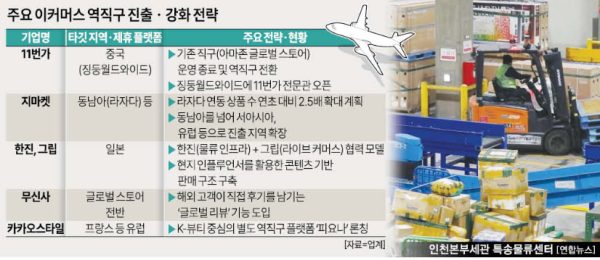
Major e-commerce companies’ strategies to expand overseas direct sales. [Graphic=Ajou Economy]
As the market for selling South Korean products directly to overseas consumers grows, e-commerce companies are rapidly adjusting strategy. The focus is shifting away from serving Korean shoppers’ overseas direct purchases toward targeting foreign buyers with competitive K-beauty, fashion and other content-driven products.
According to the National Data Center on Tuesday, online overseas direct sales totaled 3.02 trillion won last year, up 16.4% from a year earlier. In the first quarter of this year, such sales by domestic businesses rose 24.4% from the same period a year earlier to 1.06 trillion won, returning to the 1 trillion won range for the first time in 4 1/2 years since the third quarter of 2021 (1.0428 trillion won). By country, China led with 376.3 billion won, followed by Japan with 255.2 billion won and the United States with 252.1 billion won. By product category, cosmetics ranked first at 633.6 billion won, followed by records, videos and musical instruments at 108.3 billion won, and clothing and fashion-related goods at 93.8 billion won.
Overseas direct purchases by Korean consumers, however, totaled 1.9789 trillion won over the same period, up just 1.2%. China accounted for the largest share at 1.2276 trillion won. Clothing and fashion led at 787.2 billion won, followed by food and beverages at 415.7 billion won, and household and auto supplies at 197.1 billion won. The trend is being read as a sign that global demand for Korean products is rebounding quickly alongside the spread of K-culture.
E-commerce companies are moving to expand overseas direct sales. 11st will end operations of its existing “Amazon Global Store” on June 30 and reorganize its business around overseas direct sales. Starting in mid-June, it will open a dedicated 11st section on JD.com’s cross-border platform, “JD Worldwide.” When an order is placed, sellers will deliver products to 11st’s logistics center, while 11st will support the rest of the operations.
Gmarket is targeting the market through Lazada, Alibaba Group’s Southeast Asia platform. After initially linking more than 7,000 sellers and 1.2 million products, sales through Lazada in March rose about 150% from two months earlier. Gmarket plans to increase the number of Lazada-linked products to 2.5 times the early-year level within this year and expand beyond Southeast Asia into West Asia and Europe.
Cooperation between logistics companies and platforms is also increasing. Hanjin has partnered with live commerce platform Grip to target Japan’s overseas direct sales market. The strategy centers on combining its logistics infrastructure with local influencers to build a content-based sales model, aiming to strengthen the path from “content to purchase.”
Fashion and beauty platforms are also joining the competition. Musinsa introduced a “global review” feature on its global store so overseas customers can post reviews directly, addressing information gaps seen as a limitation in overseas direct sales. KakaoStyle began a pilot operation in France of “Piona,” a separate K-beauty-focused overseas direct sales platform, in a renewed push into Europe about two years after withdrawing its “Zigzag Global” service.
“In the past, overseas direct purchases were centered on price competitiveness, but overseas direct sales hinge on brand and content competitiveness,” an industry official said. “As global demand based on K-culture expands structurally, competition among platforms for leadership in overseas direct sales will intensify.”
* This article has been translated by AI.
Copyright ⓒ Aju Press All rights reserved.