
Journalist

Kim Hyun-ah
haha@ajunews.com
-
 Rep. Han Ji-a Calls for Institutional Support to Boost K-Bio's Global Competitiveness Rep. Han Ji-a, a member of the National Assembly's Health and Welfare Committee, emphasized the need for institutional support to enhance the global competitiveness of the K-Bio sector as the pharmaceutical and biotech industries undergo rapid restructuring due to the spread of artificial intelligence (AI) technology. Speaking at the 16th Global Healthcare Forum hosted by Aju Economy at the Korea Press Center in Jung-gu, Seoul, on May 14, Han stated, "AI is bringing revolutionary changes across various industrial structures beyond daily life. The pharmaceutical and biotech industries are also experiencing unprecedented changes in their structures, from research and development (R&D) to clinical trials, production, and distribution, through the integration of AI technology." He noted, "The global pharmaceutical and biotech market is growing at a pace that significantly exceeds that of the global semiconductor market. Following the COVID-19 pandemic, the importance of stabilizing the pharmaceutical supply chain has increased, making technological competitiveness and supply chain leadership critical issues that determine national competitiveness." Han added, "The market is rapidly shifting from simple technological competition to a race to establish stable production capabilities and supply chains. In this context, I find it very meaningful that the forum is being held under the theme 'AI Revolution: Global Value Chain Strategy for K-Bio.'" He particularly highlighted the growth potential of the Contract Development and Manufacturing Organization (CDMO) industry, forecasting that the global CDMO market size will expand from approximately 25 trillion won in 2024 to about 60 trillion won by 2029. He assessed that South Korea possesses sufficient potential based on its world-class manufacturing capabilities and excellent R&D competitiveness. As a member of the Health and Welfare Committee, Han expressed a deep awareness of the importance of the pharmaceutical and biotech industries, stating, "I have introduced a special law to support CDMO to strengthen the competitiveness of domestic biopharmaceutical production, which has successfully passed through the plenary session." In conclusion, he stated, "I will continue to do my best to provide institutional support, such as R&D assistance and regulatory easing, so that our companies can secure competitiveness in a more stable and market-friendly environment amid intensifying global competition."* This article has been translated by AI. 2026-05-14 19:05:54
 -
 Nongshim's Shin Ramyeon Surpasses $15 Billion in Sales as It Celebrates 40th Anniversary Nongshim's Shin Ramyeon has made history in the South Korean food industry by surpassing 20 trillion won ($15 billion) in cumulative sales since its launch 40 years ago. This achievement marks a rare milestone for a single food brand, not only in the ramen sector but across the entire food industry. The company aims to increase its overseas sales share to 60% and achieve group sales of over 7.3 trillion won ($6 billion) by 2030. On May 13, Nongshim held a media briefing at the Lotte Hotel in Seoul to discuss the achievements of Shin Ramyeon over the past four decades and its global vision. Launched in October 1986 with the tagline "Spicy flavor that moves men," Shin Ramyeon became the top-selling ramen in South Korea in 1991 and has maintained its leading position for 35 years. The cumulative sales have reached approximately 42.5 billion units. Jo Yong-cheol, CEO of Nongshim, stated during the briefing, "The cumulative sales of 20 trillion won is not just a financial achievement; it is evidence that we have been part of consumers' daily lives worldwide for 40 years. What Shin Ramyeon has created are countless moments, memories, and slices of life for many people." He quoted the late founder of Nongshim, Shin Chun-ho, saying, "Korean flavors will become the most global flavors," highlighting the brand's heritage. Nongshim has outlined its 'Vision 2030' plan, aiming to increase total group sales to 7.3 trillion won and achieve over 60% in overseas sales by 2030. Jo described the goals as "challenging but entirely achievable," citing the completion of a second export-only factory in Busan, entry into the U.S. snack market, and diversification into new business areas as key factors. In terms of global marketing, the integration with K-culture has yielded visible results. Shim Kyu-cheol, head of global marketing, noted that the first advertising campaign featuring the K-pop girl group aespa as global ambassadors garnered over 500 million views worldwide, stating, "Shin Ramyeon has established itself as a cultural product representing K-culture beyond just a food item." Indeed, Shin Ramyeon participated in three major winter festivals worldwide, including the Quebec Winter Carnival in Canada, the Sapporo Snow Festival in Japan, and the Harbin Ice Festival in China. The brand also launched large outdoor advertising campaigns in key locations such as Times Square in New York and Piccadilly Circus in London. A new product celebrating the 40th anniversary was also unveiled. Nongshim plans to launch 'Shin Ramyeon Rose' simultaneously in Korea and Japan on May 18, with a global rollout starting in June. Inspired by the modi-shumer trend, this product combines gochujang with tomato and cream sauce, under the 'K-Rose' concept, taking about four years to develop. Additionally, in June, Nongshim will open a brand experience space called 'Shin Ramyeon Bunsik' in Seongsu-dong, Seoul, to engage with younger consumers and foreign tourists. Shin Ramyeon is currently exported to over 100 countries and has established itself as a top-five brand in the global ramen market. Nongshim aims to expand beyond its fried noodle portfolio into all areas of noodle dishes, including dry noodles, stir-fried noodles, and pasta, positioning itself as a 'global noodle solution provider.' Jo emphasized, "Today's consumers are looking for more than just a tasty product; they demand health, convenience, and the experiences and culture that come with it. As we move into an era where individual solutions are needed rather than a one-size-fits-all answer, Nongshim aims to be the company that can meet all tastes through the medium of 'noodles.'"* This article has been translated by AI. 2026-05-13 19:24:00
 -
 Ildong Foodis Launches High-Myun Products at Musinsa Megastore in Seongsu Ildong Foodis announced on May 13 that it has begun selling its High-Myun products at the Musinsa Megastore in Seongsu, targeting the 2030 demographic and foreign tourists as part of its strategy to expand its offline presence. The Musinsa Megastore in Seongsu is a multi-level shopping space spanning approximately 2,000 square meters, featuring fashion and beauty brands alongside experiential content areas and food and beverage facilities. Ildong Foodis is showcasing a total of 11 products, including eight varieties of High-Myun Protein Balance Active and three types of energy gel products called High-Myun Amino Poten, located in the 'Musinsa Beauty' section on the second floor of the megastore. High-Myun Active is a high-protein beverage containing 20 to 22 grams of protein per pack, featuring essential amino acids BCAA (leucine, isoleucine, valine) at 4,500 mg and L-carnitine. The accompanying High-Myun Amino Poten is a high-amino acid energy gel product designed for immediate energy replenishment, available in three lines tailored for specific energy needs. It was noted in a survey by the Korea Consumer Agency last year as the only product designed primarily with amino acids as the main ingredient. Ildong Foodis plans to enhance product experience opportunities for consumers visiting the Seongsu area and increase brand awareness through this launch. An Ildong Foodis representative stated, "We hope that consumers will have the opportunity to experience High-Myun products directly at the Musinsa Megastore in Seongsu. We also plan to continue expanding our offline sales channels to increase consumer touchpoints." According to Musinsa, the megastore, which opened in April, recorded 42,000 visitors during its first weekend from April 24 to 26, with sales totaling 900 million won during that period.* This article has been translated by AI. 2026-05-13 18:48:00
 -
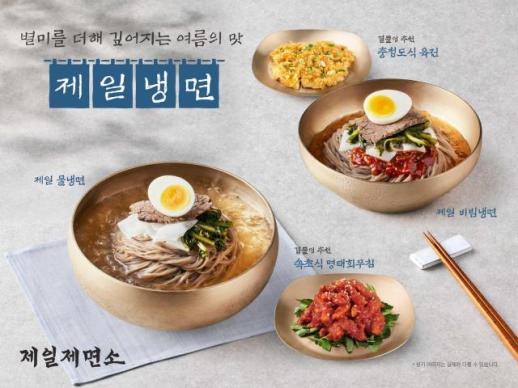 CJ Foodville Launches Cold Noodle Menu with Regional Delicacies CJ Foodville's Jeil Jemyunso is kicking off the summer season by launching its cold noodle menu. This year, the restaurant has expanded its offerings to include regional delicacies as side dishes. On May 13, Jeil Jemyunso announced that it will begin selling its summer-exclusive 'Jeil Mul Naengmyeon' (cold noodles in broth) and 'Jeil Bibim Naengmyeon' (spicy cold noodles) starting May 14. 'Jeil Mul Naengmyeon' features chewy noodles served in a chilled broth with ice flakes, while 'Jeil Bibim Naengmyeon' is designed to stimulate the palate with a sweet and tangy special sauce. This year, the restaurant has also introduced regionally inspired side dishes to complement the cold noodles. The 'Chungcheong-style Yukjeon' is a pork dish enhanced with a special sauce, which has received positive feedback since its initial launch at the Yeouido IFC Mall. It will now be available at all locations this season. Additionally, 'Sokcho-style Myungtae Hoe-muchim' will be offered, featuring pollock mixed with a spicy and tangy seasoning, enhancing the flavors of the cold noodles. Jeil Jemyunso has also created set options for customers to enjoy the cold noodles along with the side dishes. When ordering cold noodles, customers can add Chungcheong-style Yukjeon for 4,000 won or Sokcho-style Myungtae Hoe-muchim for 5,000 won to create a set meal. Moreover, the restaurant has combined these new offerings with existing Korean dishes such as Yangji Suyuk (brisket) and Hangjeong Suyuk (pork jowl) to provide a complete summer dining experience. A CJ Foodville representative stated, "We planned this year's cold noodle menu with a focus on regional characteristics, which are consistently popular every summer. Customers will be able to enjoy a variety of combinations to savor summer delicacies according to their preferences."* This article has been translated by AI. 2026-05-13 18:43:57
 -
 Samyang Foods Reports Record Q1 Operating Profit of 177.1 Billion Won Driven by Global Demand for Buldak Samyang Foods has once again achieved record quarterly results, fueled by strong overseas sales. The demand for the Buldak brand continues to thrive in global markets, supported by increased production capacity and favorable exchange rates, leading to improvements in both revenue and profitability. On May 13, Samyang Foods announced that its consolidated revenue for the first quarter reached 714.4 billion won, with an operating profit of 177.1 billion won. This marks a 35% increase in revenue and a 32% rise in operating profit compared to the same period last year. The overall performance was driven by international business. First-quarter overseas sales amounted to 585 billion won, a 38% increase from the previous year, accounting for over 80% of total revenue. Notably, the European market saw significant growth. All overseas subsidiaries recorded double-digit growth rates, with European sales reaching 77 billion won, up 215% year-on-year. This surge is attributed to the expansion of local distribution networks following the establishment of a subsidiary in the UK and increased presence in mainstream channels in major Western European countries such as Germany and the Netherlands. Growth trends also continued in the company’s largest export markets, the United States and China. Revenue from the U.S. subsidiary rose by 37% to 185 billion won, while the Chinese subsidiary reported a 36% increase, reaching 171 billion won. Samyang Foods attributed its improved performance to increased supply capacity due to higher operational rates at its Miryang Plant 2. The increased production has helped meet the rising demand for Buldak products, particularly in the U.S. and Europe, contributing to overseas sales growth. Profitability remained stable, with the operating profit margin for the first quarter at 24.8%, maintaining over 20% for five consecutive quarters. A company representative stated, "Despite external uncertainties, this performance reaffirms the competitiveness and growth sustainability of the Buldak brand. We plan to focus on strengthening our global management system and expanding our production and sales infrastructure this year." Meanwhile, to meet the growing global demand, Samyang Foods is establishing its first overseas production facility in Jiaxing, Zhejiang Province, China. The plant, with a total investment of 207.2 billion won, is expected to be completed by January 2027. It will feature eight production lines, capable of producing an additional 1.13 billion units of Buldak Bokkeummyeon annually once operational.* This article has been translated by AI. 2026-05-13 18:42:23
 -
Nongshim's Shin Ramyun marks 40 years with 20 trillion won in cumulative sales SEOUL, May 13 (AJP) - Instant noodle maker Nongshim has achieved a milestone of more than 20 trillion won (about US$13.8 billion) in cumulative sales of its flagship Shin Ramyun since it first went on sale about 40 years ago, the company said on Wednesday. First hitting store shelves in October 1986, Shin Ramyun became the top-selling instant noodle brand in South Korea in 1991 and has held the top spot ever since, with cumulative sales volume reaching about 42.5 billion packs. "It is proof that we have been part of consumers' daily lives in South Korea as well as around the world for 40 years," said CEO Jo Yong-chul at an event in Seoul, touting it as a "rare milestone for a single food brand" in the country. "What Shin Ramyun has built is ultimately time, memories, and moments in people's lives," he added. He then recalled the late Shin Choon-ho, the company's founder, citing him as saying, "Korean flavors will become the most global flavors." Cho also unveiled ambitious plans to raise sales to 7.3 trillion won by 2030 while increasing the share of overseas revenue to more than 60 percent. He pointed to the upcoming completion of an export-dedicated factory in Busan, the company's expanding confectionery business in the U.S. market, and diversification into new business areas as reasons for optimism. The company has also been boosting its global marketing and promotional activities. "Shin Ramyun has become a product representing Korean culture beyond just food," a Nongshim executive said, citing its first advertisement featuring K-pop girl group aespa, which drew more than 500 million views worldwide shortly after its release. To mark the 40th anniversary, a new product called "Shin Ramyun Rose" is set to go on sale next week in South Korea and Japan, with plans to expand into global markets starting in June. Nongshim said it spent about four years planning and developing the new variant, which blends tomato and cream sauces for a milder taste compared with the signature spicy original, in a bid to broaden its appeal to overseas consumers. The company also plans to open space in Seoul's hip, trendy neighborhood of Seongsu next month, where young people and foreign visitors can sample its products. "Today's consumers are not just looking for one tasty product," Cho said, stressing a multi-faceted approach to meet their diverse needs, whether health-conscious, convenience-seeking, or culturally driven. "Nongshim will become a company that can satisfy any consumer taste through noodles, no matter what flavors they want," he vowed, reminding that its achievement of exporting to about 100 countries and becoming a top-five brand in the global instant noodle market did not come easily. 2026-05-13 15:42:31
-
 Fake K-ramen Spreads to Nepal with Korean Branding "Feels like a Korean store"... Counterfeit Korean ramen floods Nepali resort On May 8, at a supermarket in Pokhara, Nepal, a popular tourist destination just a 10-minute walk from Phewa Lake, the ramen aisle was the first thing to catch the eye. Most of the products on the shelves featured Korean writing, creating a familiar atmosphere reminiscent of a Korean grocery store. Upon closer inspection, however, a strange sense of unease emerged. While the products appeared to be Korean, they were actually from local and overseas brands. The most notable was a stir-fried noodle product branded as 'HANKOOK.' Its design, featuring a black background with a chicken character breathing fire, strongly evoked Samyang Foods' Buldak Bokkeummyeon. The English label 'BULDAK' and the product name 'Buldak Bokkeummyeon' were nearly identical, and the phrase 'Taste of Korea' was placed where a 'Made in Korea' mark would typically appear, adding to the confusion. The original product, along with its pink-packaged counterpart, was being sold under the same guise. As I continued to browse the aisle, more similar products caught my attention. The use of Korean writing varied widely. The Nepali ramen brand 'Current' prominently displayed the word '현재' (meaning 'current') on its packaging, while 'Jackpot' included the phrase '공동자금' (meaning 'joint fund'), which was completely unrelated to ramen. Many products emphasized spiciness by incorporating Korean words. Phrases like '악마의' (meaning 'devil's') and '라라 매콤한' (meaning 'spicy') were scattered throughout the shelves. A local store employee remarked, "The important thing is that it has Korean writing; it creates a perception that it’s a Korean ramen, which increases its popularity." Consumer reactions were similar. Robin, a 28-year-old from India, selecting products in front of the shelf, said, "I didn’t know the HANKOOK product was a knockoff. I just assumed it was Korean ramen because it had Korean writing on it." He added, "I chose it because it was cheaper than the original." From Southeast Asia to Japan... The resurgence of 'K-style' products without clear nationality This phenomenon is not limited to Nepal. As the popularity of K-food rises, local products across Asia are increasingly adopting Korean-style packaging and Korean writing. This trend goes beyond merely importing and selling Korean products; local companies are actively mimicking the design and naming conventions of Korean ramen. A prominent example is in the Indian market. The large food company ITC is selling 'Daebak Ramen' under its instant noodle brand 'Yippee.' The product prominently features the Korean word '대박' (meaning 'big hit') on the front, using a striking black and red color scheme to emphasize the image of spicy Korean ramen. The word 'Korean' is also included to highlight the concept of Korean ramen. Indonesia is witnessing a similar trend. The local ramen brand Mie Sedaap has introduced a product concept called 'Korean Seasoned Dak Galbi Ramen,' featuring the Korean phrase '양념 닭갈비' (meaning 'seasoned chicken galbi') on its packaging and emphasizing flavors of smokiness and spiciness with a red color design. Japan, known as the birthplace of instant ramen, is also not exempt. Local brands in Japanese convenience stores and supermarkets prominently display products labeled 'Korean Jjamppong' and 'Korean-style ramen.' Many products feature Korean writing more prominently than Japanese, or use red and black designs to emphasize the image of spicy Korean ramen. Nissin Foods, Japan's largest ramen company, has previously faced controversy. Its 2023 product 'Nissin Yakisoba U.F.O. Stir-fried Noodles Korean-style Sweet and Spicy Carbonara' received criticism for its pink packaging and product concept being similar to Samyang Foods' 'Carbonara Buldak Bokkeummyeon.' The use of the Korean term '볶음면' (meaning 'stir-fried noodles') in the product name also drew attention. Industry experts attribute this trend to the success of K-ramen, particularly centered around Shin Ramyeon and Buldak Bokkeummyeon. According to the Ministry of Agriculture, Food and Rural Affairs, K-food exports reached a record high of $13.62 billion last year, a 5.1% increase from the previous year. Notably, ramen exports surged by 21.9% to exceed $1.52 billion, marking the first time a single item surpassed the $1 billion mark. The growth trend continues this year, with ramen exports in the first quarter reaching $435 million, a 26.4% increase from the previous year. “Image theft while evading legal frameworks”... Food industry faces brand erosion The food industry views the recent trend of 'borrowing Korean writing' abroad as a significant change rather than a mere fad. In the past, packaging typically featured English and local languages, but now Korean writing and the label 'KOREA' itself are becoming key elements that enhance product competitiveness. However, with this increased prominence comes growing concern about brand erosion. According to Samyang Foods, the popularity of Buldak Bokkeummyeon has led to a rapid increase in imitation products. While past imitations often involved direct copying of logos or characters, recent trends show a clever evasion of legal regulations. A representative from Samyang Foods stated, "Recently, there are many cases where the unique color combinations or packaging designs of our brand are closely mimicked to confuse consumers. They may slightly alter the details of mascot characters or insert phrases like 'Korean-style spiciness' to make them appear authentic." A representative from Nongshim noted, "In the past, many cases involved directly copying product names, but now we see more instances of cleverly imitating designs, colors, and overall ambiance. Since they don't directly replicate trademarks, legal responses are becoming more complicated." The industry is monitoring similar products through local distribution networks and consumer reports, taking legal action such as sending warning letters and administrative measures. Registration of trademark rights and packaging design copyrights is also expanding in key countries. One industry insider remarked, "While the rising status of K-food is encouraging, the malicious imitation that confuses consumers with Korean products is a serious issue that undermines brand value in the long term." 2026-05-11 17:06:57
 -
 BBQ Opens First Store in Almaty, Kazakhstan, Expanding into Central Asia Genesis BBQ has opened its first store in Almaty, Kazakhstan, marking its entry into the Central Asian market. This is the first time BBQ has expanded into this region. On May 11, BBQ announced the opening of its Mega Almaty location in the southern part of Almaty, the largest city in Kazakhstan, within the MEGA Alma-Ata shopping mall. The store covers approximately 78 square meters and is located on the second floor food court of the mall. It offers a variety of menu items, including Golden Fried Chicken, the seasoned "Secret Sauce Chicken," chicken burgers, tteokbokki, and set menus. The menu also features "UFO Chicken," which includes chicken served with cheddar cheese fondue, targeting local consumers. Almaty is recognized as Kazakhstan's largest city and a key economic hub in Central Asia. The city has a well-developed dining, franchise, and retail industry, making it a prime location for global brands entering Kazakhstan. With a concentration of finance, trade, and tourism industries, the demand for dining out in the evenings is high, and the presence of major universities contributes to a strong market of young people and international students. The Mega Alma-Ata shopping mall, where BBQ has opened, is one of the largest shopping centers in Central Asia, with a total area of about 180,000 square meters. It attracts around 10 million visitors annually and is considered a central business district that draws university students, professionals, and tourists. BBQ plans to accelerate its expansion across Kazakhstan, starting with Almaty. The company aims to open an additional 20 stores in key commercial areas by the end of the first half of the year and intends to enter the capital city of Astana in the third quarter. Based on this strategy, BBQ aims to have 100 local stores open by the end of the year. A BBQ representative stated, "This entry into Kazakhstan is a result of public-private collaboration achieved through cooperation with the Korea Trade-Investment Promotion Agency (KOTRA). We plan to strengthen our presence in the Central Asian market by expanding our business to major cities like Astana, starting from Almaty."* This article has been translated by AI. 2026-05-11 14:48:32
 -
 Bibigo Booth Draws Attention at KCON Japan 2026 with Dumplings and Photo Ops CJ CheilJedang announced on May 11 that it participated in KCON JAPAN 2026, held from May 8 to 10 at Makuhari Messe in Chiba, Japan, showcasing an interactive booth featuring its global K-food brand, Bibigo. The booth was themed around "Happy Bibigo Day" in collaboration with the K-pop group Zero Base One. It combined the group's signature blue color with the Bibigo brand image and featured a large cake installation that created a festive birthday party atmosphere, attracting the attention of attendees. At the Bibigo food truck zone, visitors could enjoy a set menu featuring the popular Japanese products, dumplings and Micho. Long lines formed in front of the food truck, with approximately 20,000 products sold during the event. CJ CheilJedang views Japan as a key strategic market for the global expansion of K-food and is intensifying its local efforts. In September of last year, the company invested about 100 billion won to complete a dumpling production facility in Kisarazu, Chiba. This marked the first time a domestic food company established a production facility in Japan. The new product, "Bibigo Dumpling Gyoza," produced at the Chiba factory, generated approximately 700 million won in sales in its first month of March and quickly entered over 6,000 major retail channels in the region. As a result, Bibigo dumplings surpassed a 10% market share in Japan's dumpling market for the first time as of March this year. Currently, CJ CheilJedang products, including Bibigo dumplings, are sold through about 40,000 retail channels and online platforms in Japan, including Aeon, Don Quijote, and Costco. A CJ CheilJedang representative stated, "We felt a strong interest in Bibigo and K-food at this KCON event. We will continue to strengthen our position as a global representative K-food brand through various marketing activities."* This article has been translated by AI. 2026-05-11 14:45:32
 -
 Chinese Hot Pot, Malatang and Milk Tea Chains Rush Into South Korea Chinese-language food and beverage franchises are rapidly expanding their presence in South Korea’s dining market, with once-budget Chinese fare increasingly repositioned as trendy, premium spending through malatang, hot pot and milk tea. According to industry officials on April 29, Chinese milk tea brand Chagee plans to open stores simultaneously on April 30 in Gangnam, Sinchon and Yongsan. Chagee, which reinterprets traditional tea in a modern style, opened its first store in China’s Yunnan province in 2017 and has expanded quickly. It now operates about 7,000 stores across Greater China and in Malaysia, Thailand, Singapore, Indonesia, the Philippines, Vietnam and the United States. Other tea brands have already entered South Korea. Chinese milk tea brand Chabaidao entered in 2024 and is preparing to open its 28th store. Heytea, which arrived around the same time, has expanded from Apgujeong to major retail districts including Hongdae, Myeongdong and Garosu-gil. Milk tea brand Misher, which entered in 2022, operates 16 stores centered on university areas in Seoul. Meal-focused brands are also growing. Hot pot chain Haidilao, which entered South Korea in 2014 with its first store in Myeongdong, has expanded to locations including Jeju and Daegu and now directly operates 11 stores nationwide. Despite a per-person check of about 40,000 to 60,000 won, it has drawn strong interest among younger consumers, with waits of more than three hours reported. Its sales rose 50.9% to 117.7 billion won last year from 78.1 billion won a year earlier, topping 100 billion won. Operating profit nearly doubled to 20.2 billion won from 11.0 billion won. Malatang franchise Tanghua Kungfu, which arrived in 2013, had 560 stores as of March, becoming the first malatang brand in South Korea to surpass 500 outlets. Sales rose 14.6% last year to 25.4 billion won, and operating profit increased to 11.0 billion won from 10.5 billion won. Its operating margin was 43.5%. Analysts link the overseas push to slowing growth at home. China’s National Bureau of Statistics said 2024 restaurant revenue rose 5.3% from a year earlier to 5.5718 trillion yuan, a sharp slowdown from growth above 20% in 2023. With competition intensifying in the domestic market, brands that already run thousands of stores are increasingly looking abroad. South Korea is seen as an attractive target because of strong consumer purchasing power and the speed at which trends spread on social media, helping new brands gain traction. Industry officials also point to the deep penetration of Chinese e-commerce platforms such as AliExpress, Temu and Shein, which they say makes it easier to gauge Korean consumer preferences and data. “South Korea is a market with strong cultural influence,” a representative of a Chinese-language dining brand said. “Success in Korea is seen as a signal that a brand can work in global markets, so it is viewed as an important test bed.” Some warn the trend could add pressure to South Korea’s dining industry as competition intensifies amid weak domestic demand. The number of franchised food-service outlets in South Korea rose 1.5% last year to 183,714, while the franchise closure rate hit a record 15.8%. “Chinese franchises enter the Korean market with experience operating large-scale stores and strong cost competitiveness,” a South Korean dining franchise official said. “For domestic brands and self-employed owners, the competitive environment is bound to become even tougher.”* This article has been translated by AI. 2026-04-29 17:35:17