
Journalist

Abraham Kwak
khs@ajunews.com
-
 U.S. makes clear Taiwan chip tariff deal will not apply to South Korea SEOUL, January 17 (AJP) - Washington has made clear that semiconductor tariffs and related exemptions will be set through country‑by‑country negotiations, meaning the criteria agreed with Taiwan will not be copied and applied automatically to South Korea. An administration official said on Friday that the U.S. would pursue "separate agreements for separate countries" when asked whether the semiconductor tariff waiver terms offered to Taiwan would also be granted to South Korea. This suggests that Washington intends to define specific tariff and exemption conditions bilaterally with each major chip‑exporting partner, rather than adopting a single unified standard. President Donald Trump has argued that semiconductor imports have reached a level that threatens U.S. national security and has instructed his administration to negotiate with relevant countries to address this perceived risk through tariffs. Under this approach, Washington plans to negotiate first with countries that export semiconductors to the U.S. and only then impose tariffs, while offering "tariff offset programs" to companies that invest in strengthening the U.S. semiconductor supply chain. Within this framework, the U.S. announced a trade agreement with Taiwan on Thursday that sets out the tariff waiver rules for Taiwanese semiconductor exports. In return for a commitment by Taiwanese firms to undertake $250 billion of direct investment in the U.S., Washington agreed to cut the reciprocal tariff rate on Taiwanese products from 20 percent to 15 percent, aligning it with the rate applied to South Korea and Japan. Previously, South Korea had agreed to $350 billion in U.S. investment and Japan to $550 billion, in exchange for reductions in their respective reciprocal tariffs. The Trump administration also decided that Taiwanese companies establishing new semiconductor production capacity in the U.S. will receive substantial tariff relief. While a new facility is under construction, imports of up to 2.5 times its production capacity can enter the U.S. market without paying the new semiconductor tariffs. After the facility is completed, imports of up to 1.5 times the new capacity can continue to enter tariff‑free. South Korea finalized its trade negotiations with the U.S. at the end of October last year, ahead of Taiwan, and secured assurances that it would not be placed at a disadvantage compared with countries whose semiconductor trade volumes with the U.S. exceed South Korea's. This implies that South Korea is expected to receive conditions at least equivalent to those applied to Taiwan, one of its key competitors, although how this principle will be implemented remains uncertain and is expected to be clarified through further negotiations with Washington. 2026-01-17 11:11:50
 -
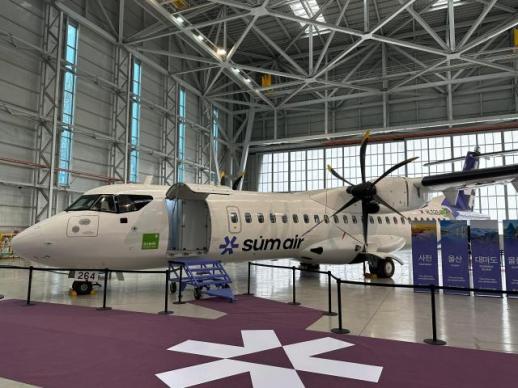 Korea's new regional airline targets islands and emergency medical transport SEOUL, January 15 (AJP) - South Korea's new regional airline SUM Air, which aims to become a major transport link between regional areas and islands, unveiled its first brand-new aircraft at Gimpo International Airport on Thursday. The carrier plans to connect underserved islands and provide essential medical transport services, positioning itself as the only airline capable of serving various island airports. As a Regional Air Mobility (RAM) operator led by CEO Choi Yong-duck, SUM Air will initially deploy its first brand-new ATR 72-600 aircraft on flights from Sacheon in South Gyeongsang Province between March and April, and will sequentially expand routes to Ulsan and islands such as Tsushima, Ulleung, Heuksan and Baengnyeong, Choi said. At the delivery ceremony, attendees included CEO Choi, ATR (Avions de Transport Régional) Chief Commercial Officer (COO) Alexis Vidal, ATR Sales Director Jean-Daniel, as well as airport officials, government representatives and investors. "I'm very happy to be with you. I think your presence today, your engagement, shows how important regional aviation and regional mobility are for Korea," said Alexis Vidal, CCO of ATR. SUM Air's latest ATR 72-600 series aircraft, equipped with turboprop engines, is optimized for short runways of around 1,200 meters and for airfields exposed to environmental constraints such as frequent bird strikes, making it well-suited to many of Korea's island airports and small regional airfields. Highlighting short runways at future island airports such as Ulleung and Heuksan, as well as at foreign regional airports like Japan's Tsushima Island where narrow runways prevent larger jets from operating, Choi stressed that SUM Air will avoid direct competition with major low-cost carriers (LCCs) and instead concentrate on niche regional markets where smaller aircraft have a clear advantage. Ulleung Island has long been considered a transport-isolated region, and the burden of that isolation has fallen squarely on its roughly 9,000 residents. With no branch of a major commercial bank on the island, residents must commit to at least an overnight stay on the mainland just to complete basic banking tasks, and even two nights are often not enough when combining multiple errands. Each trip to the mainland entails several days of accommodation costs and lost time. To address these challenges, the Korean government is investing about 600 billion won ($408 million) to build a new airport on Ulleung Island. Construction began in July 2020 and, as of October 2025, the project had passed 70 percent completion, with foundational work largely finished. The airport, slated to open in 2027, will feature a 1,200-meter runway—too short for typical narrow-body jets like the Airbus A320 or Boeing 737, which generally require around 1,800 meters for safe operations. SUM Air is then currently the only airline in Korea able to operate at Ulleung Airport once it opens. Before Ulleung Airport opens, SUM Air plans to operate regular flights between Sacheon and Gimpo, with the flight time between the two cities expected to be just over one hour. Choi revealed plans to operate up to eight round-trip flights per day, including peak morning and evening commuter timings. Starting with Sacheon, the airline intends to gradually increase scheduled services to small regional airports across the country, thereby knitting together a dense network that reduces transport blind spots. Most inhabited Korean islands have at least a public health subcenter, while smaller islands often have a simple public health post. At these facilities, public health doctors and nurses, or in some cases only nurses, handle basic care such as monitoring blood pressure and blood sugar, administering vaccinations and issuing simple prescriptions. However, when residents require specialized or emergency treatment, they must still travel to urban hospitals on the mainland—a journey that can be particularly difficult in remote islands where ferries operate only once or twice a day. In urgent cases, air ambulances such as doctor helicopters may be deployed, but operations are limited by weather conditions and high costs, leaving many islanders exposed to delays in receiving critical care. To help fill this gap, SUM Air has formed a shareholder partnership with Seoul Bumin Hospital, enabling the airline to support regional medical transport services for island residents who need specialized treatment. "We are equipping our new ATR aircraft from the manufacturer with an option that allows us to fold the third row of seats and install a stretcher," Choi explained. He added that when SUM Air begins serving destinations like Baengnyeong, the airline expects significant demand for emergency transport of Marine Corps personnel, with similar needs anticipated for Ulleung and Heuksan. Noting that Ulleung effectively has no full-service hospital, Choi underscored the airline's commitment to providing regional medical transport services to island communities. 2026-01-15 17:29:44
 -
 Contrary to long-held belief, kimchi and traditional Korean diets may not be as healthy as assumed SEOUL, January 14 (AJP) - Kimchi, South Korea's fermented staple, has been included in U.S. government dietary guidelines for its potential benefits to gut health. Yet a new Korean study suggests that high salt intake from kimchi and other traditional foods may contribute to cancer risk — challenging the widely held view that the Korean diet is inherently healthy. The study, led by researchers from Seoul National University and published in the government-funded journal Epidemiology and Health, estimates that 6.08 percent of cancer cases and 5.70 percent of cancer deaths in Korea are attributable to dietary factors. The findings, indexed in PubMed at the U.S. National Library of Medicine, raise fresh questions about the long-term health impact of salt-heavy eating patterns. Using national health and nutrition survey data and large Korean cohort studies, the research team calculated population-attributable fractions (PAFs) for diet-related cancers between 2015 and 2030. Korea's diet-attributable cancer incidence exceeds that of the United States (5.2 percent) and France (5.4 percent), though it remains lower than that of the United Kingdom (9.2 percent) and Germany (7.8 percent). Among dietary factors, salted vegetables — including kimchi, salted cabbage, radish and cucumber — emerged as the single largest contributor to cancer burden. In 2020, salted vegetables accounted for an estimated 2.12 percent of all cancer cases and 1.78 percent of cancer deaths, with a particularly strong association with stomach cancer. More than 44 percent of diet-related cancer cases were stomach cancers, which also made up over 37 percent of diet-related cancer deaths. The PAFs for diet-related stomach cancer reached 24.61 percent for incidence and 24.27 percent for mortality, suggesting that roughly one in four stomach cancer cases in Korea may be linked to dietary factors. "The findings quantify how a salt-heavy diet structurally drives the burden of stomach cancer in Korea," the authors wrote. The dietary impact was notably higher among men than women. For men, 8.43 percent of cancer cases and 7.93 percent of cancer deaths were linked to diet, compared with 3.45 percent and 2.08 percent, respectively, for women. The researchers attributed the gap to higher consumption of salted vegetables, red and processed meat, and lower intake of vegetables and fruit among men. Salted vegetable consumption has been gradually declining, driven by sodium-reduction policies and changing eating habits. Even so, the study projects that salted vegetables will remain Korea's largest dietary cancer risk factor through 2030, underscoring the need to reduce both portion size and salt content. The researchers also warned that cutting back on salty foods alone will have limited impact unless accompanied by broader dietary changes. Low intake of non-starchy vegetables and fruit was identified as another major driver of cancer risk. Koreans consume an average of 340.5 grams of vegetables and fruit per day — well below the internationally recommended range of 490 to 730 grams. The shortfall increases the risk of stomach and colorectal cancers, as well as certain respiratory and digestive cancers. The cancer burden linked to insufficient produce intake is expected to remain largely unchanged through 2030. Red and processed meat showed relatively low PAFs in Korea — accounting in 2020 for just 0.10 percent and 0.02 percent of cancer cases, respectively — largely because consumption remains lower than in many Western countries. However, the study warned that steadily rising intake since the mid-2000s could raise the PAF for processed meat to 0.08 percent by 2030, amplifying its impact over time. "Diet-based cancer prevention in Korea must go beyond reducing salted vegetables," the authors wrote. "It is essential to increase the consumption of fresh vegetables, fruit and dietary fiber at the same time." For Koreans, kimchi is more than a side dish. It anchors daily meals and symbolizes warmth and hospitality at the table. Sharing kimchi is often a way of sharing affection — whether passed to a neighbor or sent to family living far away. Each winter, families and communities gather for gimjang, the traditional kimchi-making season, salting and seasoning cabbage in large batches to last through the cold months. Even as Korean kimchi gains global popularity, domestic consumption has been gradually declining, reflecting rising incomes and the steady westernization of diets. 2026-01-14 16:08:56
 -
 Korean classrooms are thinning fast and remain isolated from AI transition SEOUL, January 13 (AJP) - Fewer than 300,000 children will enter first grade across South Korea when the school year begins in March — the smallest cohort on record. The number is set to fall further as the country's ultra-low birthrate continues to hollow out the school-age population. These eight-year-olds are starting school at a moment when artificial intelligence (AI) is rapidly reshaping work, production and decision-making across society. Yet serious doubts remain over whether South Korea's education system is prepared to equip them for an AI-driven future — amid a shortage of trained teachers, weak curriculum guidance and limited classroom exposure to AI-related learning. Dropping below 300,000 first-graders is rare among OECD countries. The demographic shock is already reshaping schools: classes are being merged, and campuses are closing, particularly in rural areas where student numbers have collapsed. South Korea's total fertility rate rebounded slightly last year to around 0.8 — its first increase in four years — but remains the lowest in the OECD, far below the group's 2023 average of 1.43. According to the Ministry of Education's latest projections for 2026–2031, the number of first-graders nationwide will fall to 298,178. The milestone was originally forecast for 2027, but updated population registry and enrollment data pushed it forward by a year. In Seoul, education guidelines flag schools with fewer than three classes per grade or fewer than 18 students per class for potential teacher reductions. Daecheong Elementary School in Ilwon-dong, Gangnam — which has just 75 students in total — proposed a merger with nearby Yeonghee Elementary last November, but shelved the plan after parent opposition. In 2025, Daecheong had a single first-grade class with just eight students. AI fills labor gaps — but where do children go? As robots and AI systems increasingly replace younger workers, artificial intelligence is no longer viewed in South Korea merely as a technology, but as a structural response to demographic decline. Education, however, is lagging far behind that shift. Efforts to raise AI literacy and close skills gaps remain rudimentary. While AI capabilities are advancing at breakneck speed, school textbooks still reflect the 2022 curriculum revision, instructional hours devoted to information and AI education remain limited, and trained teachers are in short supply. Under the revised national curriculum in 2022, instructional time for information subjects in primary and secondary schools was roughly doubled. Even so, it remains low by international standards. In elementary schools, information education totals just 34 hours — 0.58 percent of the 5,892 hours taught over six years — and is embedded within practical arts classes rather than taught as a standalone subject. Middle school students receive 68 hours over three years, about 2 percent of total instruction time. In high school, AI-related courses are electives, meaning many students may graduate without ever taking one. By comparison, students in the UK receive about 374 hours of information-related instruction, compared with 405 hours in Japan and 212 hours in Beijing. Reflecting this gap, a survey by the Korea Youth Policy Institute found that teenagers rated their experience with AI education at just over 2 out of 4, indicating limited exposure. "South Korea is trying to build its own AI ecosystem right now, but when it comes to education, I see almost no strategic approach," said An Sun-hoi, a professor at the Graduate School of Education at Joongbu University. "Education is the area where democracy functions the least," An said. "Policies tend to favor educators as a group, while the demands of industry, parents and national strategy are barely reflected." As birth cohorts shrink, the stakes are rising, he warned. "We now have to raise a very small pool of human resources into the core talent that will lead the country." He added that greater authority in student evaluation has not translated into clear improvements in learning outcomes. Teaching fewer children — more deeply Global institutions are calling for a fundamental shift in how societies prepare workers for AI. The World Economic Forum has outlined four possible futures for AI and labor, arguing that a "copilot economy" — where humans and AI work together — is more likely than mass job displacement. McKinsey has likewise emphasized that AI and robotics will increase the value of uniquely human skills such as judgment, communication, coordination and creativity. Both stress that the future will depend not on a small elite of AI developers, but on a broad workforce capable of understanding and collaborating with AI systems. "If South Korea continues with its current education system, we risk creating a society where people are subordinated to AI rather than empowered by it," An said. "Critical and creative thinking cannot exist without a solid foundation in knowledge and concepts." Dr. Nancy Le Nezet, a high school principal at Seoul Foreign School, also emphasized education over restriction. "Adults need to keep pace with technological developments so they can understand how their children use AI and social media," she said. "Taking an interest in their world is the best way to protect them — and also a way for adults to keep learning." Experts increasingly argue that instead of shrinking classrooms and cutting staff in line with falling student numbers, South Korea should seize this moment to redesign public education — allocating more teachers, time and resources to each child. The imbalance is already visible. In Gyeonggi Province, average class sizes in 2025 stood at 21.7 students in elementary schools and 25 in middle schools, both above the national average. Nearly a quarter of classes are overcrowded, forcing schools to rely heavily on temporary teachers. Meanwhile, rural regions are seeing a rapid rise in schools with fewer than 100 students, where staffing shortages make it difficult to offer a full curriculum. 2026-01-13 17:56:02
 -
 Korean Air–Asiana union nears; what does it mean for Asiana passengers? SEOUL, January 12 (AJP) - The long-awaited merger between Korean Air and Asiana Airlines is finally approaching completion. But for millions of Asiana passengers, one question matters more than regulatory approvals or aircraft numbers: What happens to my miles, status and benefits? As Asiana is absorbed into Korea's larger flag carrier, its brand, loyalty program and global alliance will all disappear. While the combined airline promises greater scale and efficiency, many frequent flyers fear they may lose hard-earned advantages along the way. Miles: the biggest unresolved issue The most sensitive issue remains mileage integration, now widely seen as the final hurdle to full merger approval. In September last year, Korean Air proposed converting flight-earned miles at a 1:1 ratio, while credit-card miles would be converted at 1:0.82. Consumer groups objected immediately, arguing that the two airlines' mileage programs are not equal in value. Industry estimates put the value of a Korean Air mile at about 21–23 won ($0.02), compared with 17–19 won for an Asiana mile. The gap reflects stricter qualification rules at Korean Air, where elite status requires far more flying. Asiana flyers currently reach Gold status at 20,000 miles, while Korean Air's entry-level elite tier, Morning Calm, requires 50,000 miles. That difference has allowed many travelers to earn a higher status more easily on Asiana. Why elite flyers are worried Under the merger, the two loyalty systems will eventually be combined. That raises fears on both sides: Asiana customers worry their miles and status will be downgraded, while Korean Air elites fear their hard-earned privileges will be diluted if the elite pool suddenly expands. One frequent flyer summed it up online: "If lounge access and upgrades don't expand with the number of elite members, benefits will lose their meaning." To address criticism, Korean Air revised its plan, proposing to keep the two mileage programs separate for 10 years, with no conversion during that period. After a decade, all miles would move under Korean Air's Skypass program. The Fair Trade Commission (FTC) rejected that proposal in December, asking for stronger guarantees on award-seat availability and mileage upgrades — a decision that has pushed final integration further into the future. Alliance change: fewer global perks Another major change is Asiana's exit from Star Alliance in October. The airline will move to SkyTeam, Korean Air's alliance, because airlines cannot belong to two alliances at once. For many Asiana frequent flyers, this is a clear loss. Star Alliance has 25 member airlines, compared with SkyTeam's 19, and offers broader global coverage and lounge access. Korean Air says SkyTeam is sufficient for major routes and that customers will gain better access to its direct flights. Business travelers, however, say the shift reduces flexibility rather than improving it. One brand survives — and it's not Asiana The merger also ends Asiana Airlines as a standalone brand. Korean Air has made clear it will operate the combined carrier under its own name. Last year, it unveiled a refreshed logo and aircraft design, replacing "KOREAN AIR" with a simplified "KOREAN." For Asiana customers, the message is clear: this is not a merger of equals. The physical transition will also take time. Korean Air must repaint 238 aircraft, including 68 from Asiana, by 2027. Each repaint can take up to 15 days and cost nearly 1 billion won, raising questions about cost and disruption during the transition. Bigger airline, lingering doubts Legally, the deal is almost done. Korean Air completed the acquisition on Dec. 11, 2024, after securing approvals in 14 jurisdictions. Once fully integrated, the airline will rank among the world's top ten, with more than 230 aircraft, service to 120 cities and annual revenue exceeding 23 trillion won. At Incheon Airport, it will control about 37 percent of slots, with Asiana moving to Terminal 2 in mid-January 2026 for smoother transfers. Yet analysts say scale alone won't determine success. "If customers feel their loyalty was simply erased, the merger's long-term value will suffer," one industry official said. The question is no longer whether the merger will happen — but whether Korean Air can keep the trust of Asiana’s passengers once it does. 2026-01-12 16:26:34
 -
 S. Korea's airline passengers hit record high last year on strong short-haul demand SEOUL, January 09 (AJP) - The number of airline passengers traveling through South Korea's airports reached an all-time high last year, boosted by a surge in short-haul international routes, particularly to Japan and China. According to aviation statistics released Friday by the Ministry of Land, Infrastructure and Transport and the Korea Civil Aviation Association, the combined number of domestic and international air passengers totaled 124.79 million last year, up 3.9 percent from 120.06 million a year earlier. The figure surpassed the previous record set in 2019, before the COVID-19 pandemic, when passenger traffic stood at 122.36 million, by about 1.2 percent. Domestic air travel declined 2.8 percent on the year to 30.25 million passengers, while international traffic rose 6.3 percent to a record 94.55 million, offsetting the domestic downturn. By region, Japan-bound routes carried 27.31 million passengers, an 8.6 percent increase from the previous year and a sharp 44.8 percent jump compared with 2019 levels. Analysts attribute the rise to the prolonged weak yen and an expansion of routes, including services to smaller regional cities. Passenger numbers on China routes climbed 22 percent to 16.8 million, recovering to 91.2 percent of pre-pandemic levels. The rebound was supported by China's visa-free entry policy for South Korean travelers, the resumption of visa-free entry for Chinese group tourists to South Korea from late September, and aggressive low-fare strategies by Chinese airlines. As traffic concentrated on Japan and China, routes to other Asian destinations, including Southeast Asia, edged down 0.5 percent year on year to 34.82 million passengers, or 95.6 percent of 2019 levels. Transpacific routes to the Americas recorded 6.82 million passengers, up 4.7 percent, while European routes carried 4.85 million, a 5.5 percent increase. International passenger numbers rose overall across the industry, but airline performance varied widely. Among low-cost carriers, Jeju Air saw the steepest decline, with passenger numbers falling 9 percent to 7.78 million. Air Busan carried 4.16 million passengers, down 7.4 percent, while Air Seoul posted an 8.4 percent drop to 1.68 million. In contrast, airlines that expanded seat capacity recorded sharp gains. Aero K saw passenger numbers surge 75.4 percent to 1.5 million, while Eastar Jet carried 3.07 million passengers, up 59.7 percent. Air Premia also posted strong growth, with 1.08 million passengers, a 42.3 percent increase. T’way Air transported 7.06 million passengers, up 7.3 percent, while Jin Air carried 6.67 million, a 2.2 percent rise. Parata Air, a new entrant that launched international services in November, recorded about 71,000 passengers. Among full-service carriers (FSC), Korean Air carried 19.14 million international passengers, an 8.2 percent increase, while Asiana Airlines transported 12.15 million, up 1.3 percent. Industry officials said safety concerns following recent aviation incidents prompted some passengers to shift demand toward full-service carriers from early last year. 2026-01-09 16:40:19
 -
 Growing strawberries year-round, even in desert with Korea's smart farming SEOUL, January 08 (AJP) - Strawberries are no longer a spring fruit in Korea. They have become seasonless — and in fact, their peak arrives in icy-cold winter. From strawberry cakes to lattes, the fruit dominates winter menus. "Orders are pouring in because it's winter strawberry season. We go through 10 kilograms of strawberries a day," said the owner of a café in downtown Seoul. Winter strawberries grown in greenhouses are known to be especially sweet. From winter staple to export powerhouse Korea-grown strawberries have also gained global popularity. Strawberry exports surpassed the 100-billion-won ($70 million) mark in 2023, becoming the country's top agricultural export item by value. Their appeal lies in freshness and sweetness — the result of advanced breeding technology. Only Korea, Japan and China possess premium strawberry varieties with high sugar content that are widely recognized in global markets. Among them, Korea has secured a competitive edge by developing proprietary varieties such as Seolhyang, Maehyang and Geumsil, establishing what industry officials describe as "sovereignty" in strawberry farming. Since Seolhyang — a low-acid, juicy variety developed by the Nonsan Strawberry Research Institute under the Chungcheongnam-do Agricultural Research and Extension Services — entered the market, Korea's domestic strawberry variety adoption rate has reached 96.3 percent. Between 2005 and 2020, the country saved an estimated 35 billion won in royalty payments by replacing foreign varieties. The strawberry "family" has continued to expand, with Maehyang introduced in 2010, Kingsberry in 2012, Sunnyberry in 2016, Vitaberry in 2017 and Geumsil in 2019. Currently, 18 Korean strawberry varieties are registered with the Rural Development Administration. More than half of Korea's strawberry exports are shipped to Southeast Asian markets such as Hong Kong and Singapore. To maintain freshness, shipments rely on air freight and short-haul routes — a limitation that has capped further export growth. "If they can't go far, why not grow them overseas?" That question has led Korea's strawberry industry toward smart-farm experiments in the Middle East. Smart farms take strawberries to the desert Smart farming offers solutions to those logistical constraints. Water usage is reduced to roughly one-tenth of traditional agriculture, farms can be built in deserts or city centers, and production is shielded from climate volatility. These advantages have drawn strong interest from Middle Eastern countries pursuing food self-sufficiency. Heating is the key challenge for winter farming in temperate climates — while cooling is the main hurdle in desert regions. Artificial intelligence (AI) has reshaped both. "Everything is automated based on environmental conditions that replicate natural growing environments through sensors," said Lee Sang-hun, CEO of Agro Solution Korea. Lee has been running a vertical farm in Abu Dhabi's Al Khatm South district since January 2025. Sensors collect real-time data on temperature, humidity and soil moisture, which AI systems analyze to automatically maintain optimal growing conditions. Early signs of pests and diseases are detected, while LED light spectra are adjusted according to growth stages to boost energy efficiency. Manual monitoring is largely replaced by data. Smart farms precisely control temperature, humidity, CO₂ levels and lighting. Vertical farms, in particular, achieve high productivity in confined spaces using multi-tier shelf structures. In conventional setups, fixed growing beds waste 30 to 40 percent of floor space on permanent walkways. The "Moving Bed" system addresses that inefficiency. Beds glide left and right on floor-mounted rails, remaining tightly packed during normal operation. When workers need access, pathways open only where necessary. "Vertical farms require more than 5 million won per pyeong in upfront investment for a four-tier structure," Lee said. "That's heavy capital, but the Middle East has the financial capacity." Lee added that while talks are underway with the Philippines, Vietnam, Indonesia and Malaysia, large-scale expansion in Southeast Asia is challenging due to high humidity, unstable electricity and limited corporate investment. "The Middle East is more attractive," he said. Growing strawberries in Abu Dhabi Lee's smart farm in Abu Dhabi uses a "Double Bed" system. Unlike conventional single-row planting, two beds are connected to increase planting density and maximize yield per square meter. With this setup, 12,000 strawberry plants can be grown in a 75-pyeong (248-square-meter) facility, producing about one ton of strawberries per month. The potential is significant in a region where food self-sufficiency rates hover around 10 percent. Locally grown strawberries are virtually nonexistent, with imports arriving mainly from Europe and the United States. Long-haul logistics push prices into luxury territory. "In desert climates where temperatures exceed 40 degrees Celsius and annual rainfall falls below 100 millimeters, traditional agriculture is nearly impossible," Lee said. Strawberries reach optimal flavor at sugar levels above 10 Brix, he explained, requiring temperature swings between a maximum of 24 degrees Celsius and a minimum of 10 degrees. "Strawberries are cold-climate plants, so heating isn't necessary," Lee said. "In vertical farms, we mainly focus on cooling. Even in winter, indoor temperatures remain stable — winter is actually ideal." Although desert heat suggests heavy cooling costs, Lee said insulation makes the difference. "We use double-layer sandwich panels to block external heat and maintain internal temperatures. There's minimal heat loss." Electricity costs also favor the Middle East. In the UAE, power for data centers costs about 73 won per kilowatt-hour — less than half Korea's average commercial rate of 172.99 won. Lee's company is also working with the Korea Institute of Energy Research on a proof-of-concept project to capture waste heat from LEDs. Since LEDs emit only 20 percent light and 80 percent heat, recovering that heat could significantly cut cooling demand. Automation and the road ahead Automation is also reducing labor costs. While strawberry harvesting still requires human hands, Lee said progress is being made. "Starting this January at our Iksan farm, robots patrol the facility to identify pest and disease outbreaks and apply treatments only where needed," he said. Full automation of harvesting is expected to take several more years. K-strawberry exports, which approached 100 billion won again in 2024, are projected to expand further. The Ministry of Agriculture, Food and Rural Affairs has set a target of $21 billion in K-food exports by 2030 and identified the Middle East as a key growth market for fresh fruit. The Middle Eastern fruit and vegetable market is expected to grow from $17.9 billion in 2025 to $25.8 billion by 2032 — and Korea's smart-farm technology may offer the blueprint for growing strawberries where none could grow before. 2026-01-08 17:55:42
 -
 Overseas fugitives top 1,000 for first time as cross-border scams surge in Korea SEOUL, January 07 (AJP) - The number of criminal suspects who fled overseas after committing crimes in South Korea has surged past 1,000 for the first time on record, raising concerns that the country is increasingly exposed to transnational crime networks operating across Asia and Russia. According to the Korean National Police Agency (KNPA), 1,249 new overseas fugitives were recorded last year, up 31 percent from 951 a year earlier. It marked the first time the annual figure exceeded 1,000 since police began compiling the data. Police attribute the sharp rise to the growing internationalization and organization of crime, particularly scam- and fraud-related offenses structured to operate across borders. In the past, overseas flight was largely associated with suspects attempting to evade punishment after committing violent crimes such as murder or robbery. In recent years, however, many criminal operations have been designed from the outset to run from abroad, with perpetrators establishing overseas bases while targeting victims in South Korea. That shift has drawn renewed attention to Cambodia, which has emerged as a major hub for global online scam operations. Last August, a South Korean college student who traveled to Cambodia after being promised a high-paying job was found dead near a crime compound in the Bokor Mountain area of Kampot province. A joint investigation and autopsy conducted with local authorities found extensive signs of assault and torture. Cambodia has long been identified as a center for online scam activity involving the abduction and trafficking of foreign nationals. KNPA data show that Cambodia ranked first among destinations linked to overseas fugitives last year, with 399 suspects, or 31.8 percent of the total — overtaking China, which recorded 254 cases. The Cambodia-linked figure more than tripled from 123 a year earlier. Police believe hundreds of scam compounds operated by Chinese criminal organizations are scattered across Cambodia, drawing in criminal groups from South Korea, Japan, Vietnam and elsewhere to form an extensive transnational network. Experts trace the roots of this structure to the mid-2000s, when Cambodia and China jointly developed the Sihanoukville Special Economic Zone. After China intensified its anti-corruption campaign under President Xi Jinping in 2018, casino capital and criminal groups relocated to Cambodia. When the COVID-19 pandemic undermined the casino economy, these groups pivoted to online scams, repurposing existing infrastructure and manpower into what police describe as corporate-style fraud operations. Fraud accounted for the largest share of offenses among overseas fugitives last year, with 757 cases, or 60.6 percent of the total, followed by online gambling at 141 cases, or 11.3 percent. Most involved cyber-enabled financial crimes, including voice phishing, investment scams, romance scams and schemes using deepfake technology, the KNPA said. "In the past, suspects could simply flee overseas and wait out the statute of limitations," said Shin Yi-chul, chair of the Department of Police Science at Wonkwang Digital University. "But the law has since been revised so that the statute of limitations is suspended when a suspect flees abroad. Overseas flight no longer offers a real escape — at best, it buys time." Law enforcement authorities have stepped up cooperation with foreign counterparts through permanent joint investigation teams, enabling faster arrests on the ground. A key example is the Korea Task Force jointly operated by South Korean and Cambodian police. Established in November, the unit arrested 92 South Korean suspects within its first month. In early December, authorities detained the ringleader and 15 members of a romance-scam organization responsible for 26 billion won ($1.8 million) in losses in Poipet. Later that month, joint raids near the Cambodia–Vietnam border led to the arrest of 26 additional suspects. Extraditions have also risen. Police repatriated 828 fugitives last year, up nearly 20 percent from the previous year, marking the fourth consecutive annual record since 2022. In total, 263 South Korean suspects were arrested in Cambodia alone. "Crimes committed domestically have become much harder to carry out," an official at the KNPA's International Cooperation Bureau said. "International cooperation — through channels such as Interpol and bilateral partnerships — is now far more active and effective than in the past." 2026-01-07 17:22:04
 -
 Stray Kids, Jennie to headline major US music festival 'The Governors Ball' SEOUL, January 07 (AJP) - K-pop girl group BLACKPINK's Jennie and K-pop boy band Stray Kids will headline The Governors Ball Music Festival, one of the largest music festivals in the U.S. Organizers of The Governors Ball Music Festival announced on Tuesday the lineup for this year's event, scheduled to take place from June 5 to 7 at Flushing Meadows Corona Park in New York. HYBE's Korean-American joint girl group KATSEYE, which has been nominated for Best New Artist at the 2026 Grammy Awards set to be held in February, will open the festival on June 5. Stray Kids will headline the June 6 show, while Jennie will take the stage as a headliner on June 7. Jennie is expected to perform tracks from her first full-length solo album, "Ruby," during her set. The festival is a large-scale outdoor music event held annually in New York during the summer. Past headliners include Eminem, Travis Scott, Kendrick Lamar and Lizzo. Meanwhile, Stray Kids have set a record by topping the U.S. Billboard 200 with eight consecutive releases. According to the latest chart released on Tuesday, the group's fourth full-length album, "KARMA," ranked No. 117, marking its 19th consecutive week on the chart and extending the group's longest charting record. Jennie recorded the highest first-week sales ever for a female solo artist in Korea last year, selling around 660,000 copies, according to the Korea-based music sales tracking system Hanteo Chart. She also logged the highest cumulative views at the Melon Music Awards, organized by Korea's largest music streaming platform, with a total of 1.7 billion streams to date. 2026-01-07 16:37:05
 -
 K-content gets a permanent address in Incheon — now comes the harder part: keeping it interesting SEOUL, January 06 (AJP) - Imagine never having to fight ticket scalpers again for a G-Dragon concert. No frantic refreshing. No VIP seats resold at 6.8 million won. Just… a year-round GD performance you can drop in on, any weekend you like. That, at least, is the fantasy behind Incheon's ambitious bet on what officials are calling "K-Con Land" — a sprawling cultural complex designed to give K-pop, K-drama and digital content something they've never really had before: a permanent home. At the heart of the plan is a concert hall where holograms of past and present stars perform on a rotating basis. Die-hard fans won't have to wait for comeback tours or overseas dates. The show, in theory, is always on. But K-Con Land is not just about concerts. The larger vision, unfolding across the Cheongna and Yeongjong districts, is to stitch together production studios, performance venues, hotels and tourism infrastructure into a single ecosystem — one that turns K-content from a series of one-off events into something closer to a standing attraction. Think less "festival weekend," more "content district." From airport stopover to content destination Incheon's pitch starts with geography. The city sits next to Korea's main international gateway, and with the opening of the Third Sea Bridge this week, Cheongna and Yeongjong are now directly linked. The goal is to turn airport proximity — long a logistics advantage — into a cultural one. At the center of the plan is I-Con City, a massive complex slated for Cheongna International City, just west of Yeongjong Island. The project covers 260,000 square meters — roughly the size of Yeouido Park — with total floor space exceeding that of COEX. Rising up to 49 floors, the complex will house an arena, VFX studios, a content tower, museums, hotels and resort facilities, all wrapped around a central public space dubbed "Durumi Park." The idea is frictionless circulation: artists arrive, shoot, perform and stay in one place; visitors watch, tour, sleep and move on — or stick around longer. Transportation is meant to do the rest. Subway Line 7's extension to Cheongna, scheduled for 2027, will cut travel time to Gangnam to about 68 minutes without transfers. A KTX connection from Incheon via Songdo would link the area to Busan in just over two hours. For a city long seen as peripheral to Seoul’s cultural core, those minutes matter. Competing with Seoul — by not being Seoul Cheongna's biggest selling point may be what it lacks: density. Unlike Seoul's Sangam Digital Media City, where land is tight and costs are high, Cheongna offers room to build large-scale studios and move bulky equipment — and to house international crews without scattering them across the capital. Production, performance and accommodation in one zone is not just convenient; developers argue it cuts costs and time. "With the Third Land Bridge, Cheongna is now directly connected to Yeouido in 30 minutes and to Yeongjong," said Eum Jae-sang, CIO at DAOL Asset Management. "With Starfield Cheongna and a university hospital also coming in, this won't be a bedroom town. It's becoming a district with its own purpose." The lineup of partners reflects that long-game thinking. U.S.-based boutique hotel franchise The Kessler Collection will oversee overall development and hospitality operations. DAOL manages the funds. POSCO E&C is handling construction. Galaxy Corporation — which represents G-Dragon — is in charge of content operations. Financial structuring is being led by SK Securities. Hotel Shilla will operate serviced residences, while a U.S. senior-living operator is joining the residential side. "This isn't a build-and-sell project," Eum said. "We're talking about operating this for 20 to 30 years after completion." The real test: content, not concrete Construction is slated to begin in the second half of 2027, with completion targeted for 2031. By then, the buildings will likely be impressive. What's less guaranteed is what happens inside them. Industry officials say tax incentives for foreign content producers could make or break the project's appeal. Incheon's Free Economic Zone authority has been calling for stronger breaks, arguing that global competition for film and content production is intensifying. "If production costs one unit, the regional economic impact can be seven to ten times that," said Commissioner Yun Won-sok early last year, noting that many advanced economies now offer aggressive incentives to attract studios. For a project estimated at 1.9 trillion won, the stakes are high. K-content has proven it can draw global attention — but turning that attention into a permanent tourist habit is another matter entirely. A hologram concert may draw crowds once. The challenge will be making them come back. 2026-01-06 17:05:20