

Journalist

Park Sae-jin
swatchsjp@ajupress.com
-
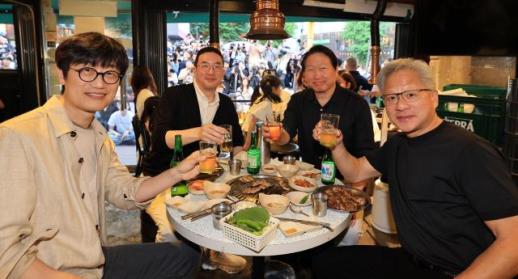 From PC cafés to pork belly: Inside Jensen Huang's unconventional Seoul summit SEOUL, June 05 (AJP) - Neon lights, the rapid clatter of keyboards in a bustling Hongdae PC café, and the unmistakable sizzle of meat hitting a hot grill—these are hardly the traditional backdrops for high-stakes tech diplomacy. Yet, on the evening of June 5, NVIDIA CEO Jensen Huang traded the polished boardrooms of Silicon Valley for the vibrant, everyday rhythms of Seoul. Immersing himself first in South Korea's grassroots digital culture, Huang eventually made his way to "Hyungnim Jeoyo," a local pork belly restaurant, setting a distinctly grounded and intimate visual tone for the night ahead. By 7 p.m., the casual outing transformed into an unprecedented gathering of industry titans. Sharing the table and bonding over a traditional "samso"—pork belly paired with soju—were SK Group Chairman Chey Tae-won, LG Group Chairman Koo Kwang-mo, and Naver founder Lee Hae-jin. This smoky, grill-side meeting echoed a similarly historic summit Huang held just seven months prior with Samsung and Hyundai leadership over fried chicken. The images that follow capture the candid, unbuttoned moments of this extraordinary evening, offering a rare glimpse into the personal, cross-cultural connections that are quietly shaping the future of global technology. 2026-06-05 22:54:20
 -
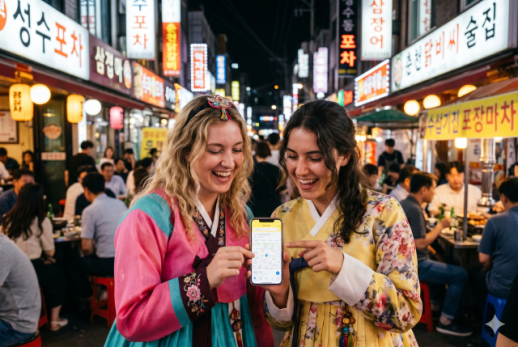 Tourism agency partners with Catch Table to simplify restaurant reservations for foreign tourists SEOUL, June 05 (AJP) - The Korea Tourism Organization has forged a partnership with WAD, the operator of the dining platform Catch Table, to improve restaurant reservations and information access for international visitors, , the state-operated tourism agency said Friday. The partnership focuses on promoting K-Local Gourmet Travels 33, a list of regional food destinations selected by KTO. Through the Catch Table global application, the organizations will create a digital service that combines restaurant information, reservations, and payment processing into a single system. The initiative is designed to eliminate language barriers that foreign travelers experience when dining at local restaurants. By integrating regional eateries into a global platform, the project seeks to distribute tourist traffic beyond major cities and generate revenue for small businesses across South Korea. "With K-food establishing itself as a global cultural trend, this agreement is an important milestone for the qualitative growth of food tourism in South Korea," said Min Byung-sun, head of the tourism industry division at KTO. "We will help foreign tourists conveniently enjoy hidden culinary gems across South Korea, bringing new vitality to the regional economy and the overall tourism industry." 2026-06-05 14:50:05
 -
 South Korean researchers win best paper award for humanoid pilot robot SEOUL, June 05 (AJP) - A research team has won the 2026 Best Paper Award from the IEEE Robotics and Automation Magazine for developing an artificial intelligence-based framework that allows a humanoid robot to autonomously fly an aircraft, the Korea Advanced Institute of Science and Technology (KAIST) said Friday. The award recognizes a 2025 study detailing PIBOT, a humanoid designed to operate standard aircraft controls without requiring cockpit modifications. The award ceremony took place on June 4, 2026, during the International Conference on Robotics and Automation in Vienna, Austria. The research, based in South Korea, is led by Professor Shim Hyun-chul of the electrical and electronic engineering department at KAIST. The IEEE Robotics and Automation Magazine is a peer-reviewed publication that highlights applied robotics research, recording an impact factor of 7.1 in 2025. The recognized study demonstrated a physical artificial intelligence system capable of acquiring specialized aviation knowledge, recognizing flight situations in real time, and responding adaptively. This differentiates the system from humanoid robots focused primarily on basic movement and cargo transport. The development of PIBOT began in 2021 with an estimated 5.7 billion won in funding over five years from the Agency for Defense Development (ADD). Having completed the initial phase of research, the team has been working since 2024 on a second-phase robot with a human-like physique and joint structure optimized for piloting. Researchers are also collaborating with related organizations to adapt the technology for ground vehicles and ships. "It is very meaningful that the pilot robot technology proposed for the first time in the world by a domestic research team has been recognized as a world-class research achievement thanks to the support of large-scale domestic projects," Professor Shim said. "We will further develop the research so that humanoid robots can help people in real environments and safely operate complex systems." Doctoral students Min Sung-jae, Kang Gyu-ri, and Kim Hyung-joo participated as co-first authors of the study. (Reference Information) Journal/Source: IEEE Robotics and Automation Magazine Title: Toward Fully Autonomous Aviation: PIBOT, a Humanoid Robot Pilot for Human-Centric Aircraft Cockpits Link/DOI: https://doi.org/10.1109/MRA.2024.3505774 2026-06-05 14:36:44
 -
 Turkey's Foreign Minister Calls for Cooperation with South Korea to Stabilize Global Order Hakan Fidan, Turkey's Foreign Minister, urged South Korea and Turkey to actively collaborate to restore the collapsing international cooperation framework and stabilize the fragmented global order. In a keynote address at the 143rd International Policy Forum at Korea University in Seoul on June 4, Fidan diagnosed that the outdated international order centered around major powers has shown its limitations. He emphasized that capable middle powers like South Korea and Turkey, with diverse backgrounds, must step forward to lead new diplomatic agreements to untangle the complex knots of current global issues. Fidan pointed out the structural contradictions facing the international community today. Over the past 80 years, numerous international organizations and treaties have been established, yet in the face of significant crises, the world remains deeply divided and has lost a sense of common purpose. He cautioned against narrowly interpreting the current situation as merely a security crisis. Relying on outdated tactics of military deployment or deterrence cannot resolve fundamental issues; rather, the essence of the crisis lies in the collapse of the international cooperation system itself. A recent example is the armed conflicts spreading in the Gulf region, centered around Iran, which pose significant threats to global economic and strategic stability. Turkey is actively engaging in diplomatic channels with countries like Pakistan and Indonesia to mediate between the United States and Iran to prevent further escalation. The ongoing war in Ukraine, now in its fifth year, starkly illustrates the ineffectiveness of the international community. Fidan criticized recent medium-range missile strikes near the borders of the European Union and NATO as an unacceptable escalation, warning of the risk of the conflict spreading throughout Europe. Ukrainian forces continue to target Russian ground communications, disrupting enemy logistics. As the war shows no signs of ending, European leaders face intense pressure to expedite Ukraine's accession to the European Union as a foundation for future peace agreements. The situation in Gaza starkly reveals the failures of the collapsed international order. The Foreign Minister characterized the international community's inability to prevent the ongoing tragedy as a severe legitimacy crisis. He explained that a system that cannot uphold universal human principles is destined to fail, and even countries that have benefited from the existing order now confront crises at their own doorsteps. In a multipolar world, no single country can bear the burden of global crises alone. Fidan analyzed that the roles of middle powers like South Korea and Turkey have become increasingly important in this dynamic. When two countries with different social and geographical backgrounds transcend the narrow interests of a single power bloc, they can forge solid agreements. To achieve tangible diplomatic outcomes, Fidan argued that regions must take the initiative to reform outdated systems. He also criticized the veto power system of the United Nations Security Council as an outdated monopoly of power by major countries, reiterating that the world is larger than just five nations. Hakan Fidan, who served as the head of Turkey's National Intelligence Organization for 13 years, was appointed Foreign Minister in 2023. In closing, he noted that when the concept of collective security was tested in the Korean Peninsula in the past, South Korea and Turkey stood shoulder to shoulder militarily.* This article has been translated by AI. 2026-06-04 23:51:00
 -
 Turkish foreign minister urges S. Korea partnership to stabilize global governance SEOUL, June 04 (AJP) - South Korea and Türkiye must leverage their diplomatic influence to address a deepening crisis in global governance and stabilize a fragmented international order, Turkish Foreign Minister Hakan Fidan said Thursday. Speaking at the 143rd International Policy Forum at Korea University in Seoul, Hakan Fidan warned that the current international system is unsustainable and requires coordinated intervention by capable middle powers. The diplomat highlighted a profound paradox in modern global cooperation. He noted that while the international community has established an unprecedented number of institutions and treaties over the past 80 years, the sense of shared global purpose has never been more severely fractured. He cautioned against viewing contemporary instability purely as a security crisis. Relying on familiar tactics like military deployments, deterrence, and containment fails to address the root issue, which he described as a fundamental breakdown requiring a visionary response. The escalating conflict involving Iran in the Gulf serves as a prime example of this instability, carrying severe consequences for global economic and strategic stability. Ankara is currently utilizing its diplomatic channels to halt the active conflict and prevent secondary regional spillover. Working alongside Indonesia, the Turkish government is closely coordinating with Pakistan, which is performing the primary mediating role in ongoing negotiations between the United States and Iran. A similar systemic failure is evident in Ukraine, now a grinding war of attrition in its fifth year where a ceasefire remains elusive due to incompatible territorial claims. The threat of the conflict expanding into a broader war between Russia and Europe remains high following a recent intermediate-range missile strike near the borders of the European Union and NATO, an act described as an unacceptable escalation. Ukrainian forces have maintained a mid-range strike campaign against Russian ground lines of communication, successfully disrupting logistics across the theater. As the war continues indefinitely, European leaders face immense pressure to provide Kyiv with a credible and speedy path to European Union membership to help secure a future peace deal. The situation in Gaza represents the absolute peak of this systemic breakdown, with the top Turkish envoy characterizing the international community's failure to intervene in the ongoing genocide as an acute crisis of legitimacy. He warned that a system unable to prevent atrocities or uphold its founding principles is bound to fail. Nations that long benefited from the current framework are now facing crises at their own borders, he added. As power shifts fluidly across a growing number of theaters, no single actor can manage these global challenges alone. This dynamic elevates the role of capable middle powers like South Korea and Türkiye. Their distinct societies and backgrounds allow them to construct a resilient consensus beyond the narrow interests of singular power blocs. Achieving concrete diplomatic outcomes relies on regional ownership and global institutional reform. Regions must manage their own risks to prevent exporting instability to the rest of the world, as peace cannot be imposed from the outside. The minister also criticized the United Nations Security Council, arguing its veto architecture reflects a long-receded distribution of power that fails to represent current realities. Reaffirming the statement that the world is bigger than five, he demanded structural changes to establish fairness, inclusiveness, and shared responsibility. The foreign minister assumed his current Cabinet position in 2023 following a 13-year tenure as director of Türkiye's National Intelligence Organization. His extensive administrative and academic background includes serving on the Board of Governors of the International Atomic Energy Agency and holding a doctorate in international relations from Bilkent University. Addressing the historical ties between Seoul and Ankara, he grounded his call for reform in the military cooperation seen during the war. He noted that when the concept of collective security was put to the ultimate test on the Korean Peninsula, South Korea and Türkiye stood shoulder to shoulder. 2026-06-04 18:51:33
 -
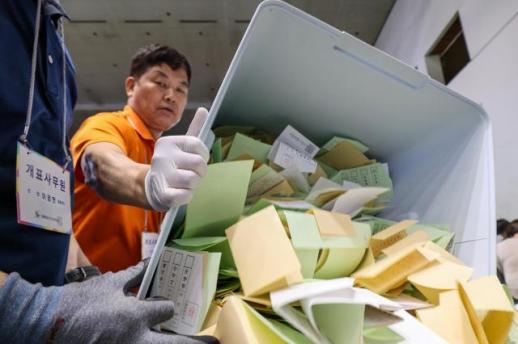 Ruling Democratic Party dominates early vote counting in S. Korea's local elections SEOUL, June 03 (AJP) - Early vote counting for the June 3 local elections shows the ruling Democratic Party taking the lead in 14 of 16 metropolitan and provincial races, including the Seoul mayoral election. The conservative People Power Party is leading in only one region, North Gyeongsang Province. If the current trend continues, the elections will end in a sweeping victory for the Democratic Party. The early results suggest that voters in the first nationwide elections since President Lee Jae Myung took office a year ago are heavily backing the ruling party. The Democratic Party framed the election as a judgment on the 2024 insurrection and a vote for government stability, countering the opposition's calls to hold the current administration accountable. According to the National Election Commission, 14.0 percent of all votes had been counted as of 10 p.m. Wednesday. In the highly contested Seoul mayoral race, where 5.46 percent of votes have been counted, Democratic Party candidate Jung Won-oh is leading with 65.72 percent against People Power Party incumbent Oh Se-hoon, who has 31.88 percent. The counting rate remains below average in Seocho and Songpa districts, which are traditional conservative strongholds in the capital. The Seoul mayoral race was marred by logistical issues earlier in the day when polling stations in Songpa, Gangnam, and Gwangjin districts ran out of ballot papers, leaving voters waiting in line. The People Power Party is demanding a halt to the vote counting and calling for a revote in the city. In Gyeonggi Province, Democratic Party candidate Choo Mi-ae leads with 51.07 percent over the People Power Party's Yang Hyang-ja, who has 43.16 percent. In Incheon, Democratic Party candidate Park Chan-dae is ahead with 60.04 percent against the People Power Party's Yoo Jeong-bok at 39.04 percent. The Democratic Party also took early leads in four regions that exit polls conducted by three major broadcasters had projected as tight races: Busan, Daegu, North Jeolla Province, and Gangwon Province. In Busan, the Democratic Party's Jeon Jae-soo leads with 53.60 percent against the People Power Party's Park Hyung-jun. In Daegu, Kim Boo-kyum of the Democratic Party has 53.48 percent, leading the People Power Party's Choo Kyung-ho. In Gangwon Province, the Democratic Party's Woo Sang-ho is ahead of the People Power Party's Kim Jin-tae with 54.00 percent. In North Jeolla Province, Democratic Party candidate Lee Won-taek is leading independent Kim Kwan-young with 52.52 percent to 41.37 percent. Democratic Party candidates Min Hyung-bae in Jeonnam-Gwangju Special City and Wi Seong-gon in Jeju Province are certain to win, securing 81.62 percent and 61.35 percent, respectively. For the People Power Party, Lee Cheol-woo is the likely winner in North Gyeongsang Province with 64.64 percent. The race for South Gyeongsang Province governor remains a dead heat with 14.98 percent of the votes counted. Democratic Party candidate Kim Kyoung-soo has 49.71 percent, narrowly trailing the People Power Party's Park Wan-soo at 50.28 percent. The Democratic Party is also dominating the 14 parliamentary by-elections held alongside the local elections. In the Busan Buk-gap district, with 8.7 percent of votes counted, Democratic Party candidate Ha Jung-woo is leading with 53.37 percent. He is comfortably ahead of independent Han Dong-hoon at 38.55 percent and the People Power Party's Park Min-shik at 8.06 percent. In Gyeonggi Province's Pyeongtaek-eul district, where 6.1 percent of the vote has been counted, Rebuilding Korea Party candidate Cho Kuk is leading a three-way race with 38.12 percent. He is followed by the Democratic Party's Kim Yong-nam at 32.80 percent and the People Power Party's Yu Eui-dong at 23.76 percent. In the Gongju-Buyeo-Cheongyang district of South Chungcheong Province, Democratic Party candidate Kim Young-bin leads with 55.06 percent against the People Power Party's Yoon Yong-geun at 39.26 percent, with 10.48 percent of votes counted. In Ulsan's Nam-gap district, traditionally considered a conservative stronghold, Democratic Party candidate Jeon Tae-jin is leading with 57.41 percent against the People Power Party's Kim Tae-gyu at 37.40 percent, based on a counting rate of 8.7 percent. In Gyeonggi Province's Hanam-gap district, which saw a razor-thin margin in the previous general election, Democratic Party candidate Lee Kwang-jae is leading with 66.42 percent against the People Power Party's Lee Yong at 31.66 percent, with 14.0 percent of the vote counted. The People Power Party is securing a significant lead in Daegu's Dalseong-gun district, where Lee Jin-sook has 64.54 percent compared to the Democratic Party's Park Hyung-ryong at 35.45 percent, with 32.3 percent of the vote counted. Of the 14 seats contested in the by-elections, 13 were previously held by the Democratic Party and one by the People Power Party. 2026-06-03 23:59:28
 -
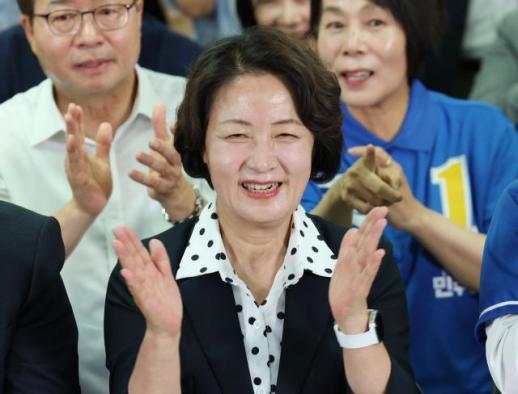 Former justice minister Choo Mi-ae to become first female provincial governor in South Korea SEOUL, June 03 (AJP) - The Ruling Democratic Party candidate and former justice minister Choo Mi-ae is certain to win the Gyeonggi Province gubernatorial race, making her the first woman to head a metropolitan or provincial government in South Korean history. According to the National Election Commission on Wednesday, Choo is projected to defeat People Power Party candidate Yang Hyang-ja in the June 3 local elections. The six-term lawmaker maintained a wide lead over Yang throughout the campaign, cementing her victory early on. Her win breaks a long-standing glass ceiling in South Korean politics. Since the country introduced nationwide local elections in 1995, women have consistently run for top regional posts but have never won. The closest attempts occurred in 2022 and 2010. In the 2022 Gyeonggi governor race, conservative candidate Kim Eun-hye lost to Democratic Party candidate Kim Dong-yeon by a margin of 0.15 percentage points after a tight race that stretched into the morning after election day. In 2010, Democratic Party candidate Han Myeong-sook lost the Seoul mayoral election to Oh Se-hoon by 0.2 percentage points. During the 2021 Seoul mayoral by-election, former Minister of SMEs and Startups Park Young-sun, running for the Democratic Party, lost to Oh by 18.3 percentage points, securing 39.2 percent of the vote. Female representation among candidates for top regional posts declined this year. Only five women, or 9.8 percent of 51 candidates, ran for metropolitan mayoral or gubernatorial seats, roughly half of 18.2 percent seen in the 2022 elections. Choo is the only woman to win such a post this year. In 2022, all 10 female candidates running for these positions lost. A former judge from Daegu, Choo entered politics in 1995 after being recruited by former President Kim Dae-jung, who was then leading the National Congress for New Politics. She earned the nickname "Choo d'Arc" -- combining her surname with Joan of Arc -- after leading a campaign group in the conservative stronghold of Daegu that helped secure Kim's 1997 presidential win. Choo was first elected to the National Assembly in 1996 for Seoul's Gwangjin-eul district. She went on to represent the district for five terms in the 15th, 16th, 18th, 19th, and 20th parliaments. She was elected party leader at the Democratic Party convention in 2020 and served as justice minister during the Moon Jae-in administration. In the recent 22nd general election, she secured her sixth term after receiving a strategic nomination for Gyeonggi Province's Hanam District. Although considered a strong contender for National Assembly speaker in the first half of the 22nd parliament, she lost the internal party primary to Woo Won-shik. She then took the helm of the Legislation and Judiciary Committee, spearheading efforts to pass prosecution reform bills. Choo is widely regarded as a prominent hardliner within her party, known for her strong drive and clear political stances. Because her term as Gyeonggi governor will end in 2030, a timeline that aligns with the next South Korean presidential election, political watchers view her as a potential presidential contender. 2026-06-03 23:49:32
 -
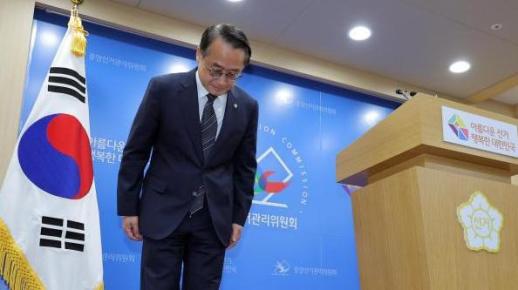 National Election Commission apologizes for ballot shortage SEOUL, June 3 (AJP) - Heo Chul-hoon, secretary-general of South Korea's National Election Commission, issued a public apology on Wednesday evening after several polling stations ran out of ballot papers during local elections. Speaking at the commission headquarters in Gwacheon, Gyeonggi Province, Heo said he takes full responsibility for the oversight. He said the commission deeply apologizes for causing great confusion and concern, acknowledging that the incident inconvenienced voters and damaged public trust. "We will accurately identify the causes and problems of the ballot shortages at some polling stations as soon as the counting is over and prepare measures to prevent a recurrence," Heo said. The commission transported extra ballots to affected sites immediately after noticing the shortage. Officials also instructed staff to ensure citizens who were already waiting in line could cast their votes normally even after the scheduled closing time. The supply issues occurred earlier in the afternoon at polling stations in major Seoul districts, including Gangnam, Gwangjin, and Songpa, forcing voters to wait for extended periods. Meanwhile, National Election Commission Chairperson Roh Tae-ak has not issued any statement yet. 2026-06-03 21:48:50
 -
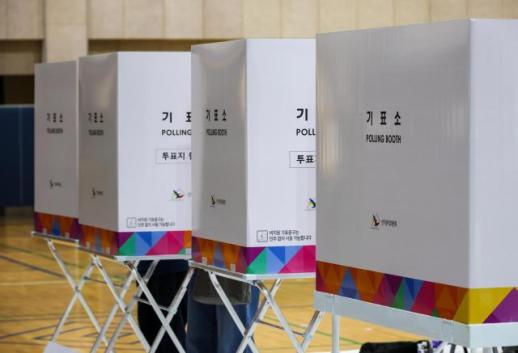 ASIA DEEP INSIGHT: Architecture of South Korean reconciliation At exactly 8:30 p.m. on Wednesday, the abstract statistics of South Korea’s ninth nationwide local elections collided with physical reality. Across 258 counting centers, the seals on the first ballot boxes were broken. As millions of paper slips began feeding into automated sorting machines—the initial step before a grueling, newly mandated manual verification process—the republic stood at a critical institutional juncture. Joint exit polls released at the close of voting projected the ruling Democratic Party of Korea claiming widespread administrative control, leading in 11 of 16 metropolitan mayoral and gubernatorial races. Yet, reading this moment as a simple partisan triumph fundamentally misunderstands the structural mechanics of the current political era. As the count begins, this election is not a standard referendum on municipal budgets; it is a live-fire test of whether a political architecture profoundly fractured by recent constitutional shocks can successfully contain a divided nation. The administration of President Lee Jae Myung reached its one-year milestone against the backdrop of deep institutional trauma. This midterm vote operates in the immediate wake of the December 2024 martial law decree and the subsequent impeachment of the former executive, events that fundamentally rewrote the boundaries of South Korean political conflict. The fallout left the conservative bloc fighting an explicit war for baseline political survival. Following a devastating defeat in the general elections two years ago, the conservative People Power Party arrived at this local cycle on the verge of territorial extinction. Stripped of executive authority and severely marginalized in the National Assembly, municipal and provincial governance represented their final remaining foothold on the domestic political map. Because the conservative establishment was backed into an existential corner, their electoral resistance was total. This desperation materialized not in civic apathy, but in a relentless mobilization of the base. By the time polls closed at 6:00 p.m., the National Election Commission verified a definitive national turnout of 60.9 percent. This figure represents the physical footprint of a cornered demographic. The electorate did not flood the polling stations out of a shared desire for national harmony; they mobilized because both factions viewed the alternative as political erasure. It is precisely within this climate of existential anxiety that the true mechanism of South Korean reconciliation reveals itself. True political stabilization in a deeply polarized society does not emerge from sentimental appeals to unity or emotional healing. It is forged when competing factions, driven by the sheer terror of eradication, are forced to channel their conflict entirely through the rigid infrastructure of the democratic state. The shared act of submitting to the ballot box institutionalizes the hostility, proving that even a highly traumatized political class prefers the grueling mechanics of the vote count to extra-parliamentary chaos. The material realities driving this mobilization were split along clear ideological lines. The opposition People Power Party successfully anchored its campaign to acute macroeconomic anxiety, focusing public attention on the 3.1 percent consumer inflation spike recorded in May—the largest inflationary surge in 26 months. While regional economic analysts correctly identify this strain as a byproduct of external pressures, including the depreciation of the Japanese yen and shifting Chinese export strategies, the domestic electorate processed it as an immediate failure of state management. The opposition framed the vote purely as a material defense of personal property and wages. Conversely, the ruling Democratic Party of Korea counter-mobilized by framing the election as a literal defense of the constitutional order, labeling the opposition as the remnants of an insurrectionist faction that sought to subvert the republic two winters ago. As the ballot boxes open under the glare of counting-room lights, the razor-thin margins projected by the exit polls guarantee an intensely volatile night. In the metropolitan city of Daegu, the traditional heartland of South Korean conservatism, exit polls place opposition candidate Choo Kyung-ho at a razor-thin 49.9 percent against the ruling party’s Kim Boo-kyum at 49.1 percent. In the southern port city of Busan, a critical economic hub and outward-facing logistics anchor, the ruling party's Jeon Jae-su holds a narrow edge of 50.2 percent over the opposition's Park Hyung-jun at 48.3 percent. In the capital city of Seoul, the primary national barometer, the ruling party's Jung Won-oh leads opposition incumbent Oh Se-hoon by a projected 51.4 percent to 46.0 percent. In an environment poisoned by the memory of martial law, these sub-one-percent margins will not instantly breed political harmony. In the immediate hours ahead, they will inevitably cause intense friction, legal challenges, and partisan paranoia. A margin of less than one percent is an operational invitation to contest every single ballot box. Yet, over the long arc of the administration, these microscopic margins function as the ultimate structural safeguard against ideological cleansing. A majority faction cannot govern as an absolute conqueror when its mandate rests on fractions of a single percentage point. The projected numbers indicate that the conservative establishment has managed to preserve its core geographic fortresses, denying the ruling party total hegemonic control over the state. Simultaneously, the ruling party’s deep penetration into traditionally hostile territory proves that old geographic dogmas no longer offer absolute insulation. This is the definition of mutually assured political survival. When neither side possesses the numerical superiority required to completely liquidate the other, both are structurally compelled to accept a cautious, administrative coexistence. To guarantee that this volatile equilibrium holds, the state has deployed its final institutional defense. Tonight, 314,000 management personnel across 258 counting centers are executing a completely manual, ballot-by-ballot review process after the automated sorting is complete. In a political climate saturated with institutional distrust, this logistical gauntlet is a deliberate decelerator. The agonizingly slow physical verification of millions of paper slips introduces an immediate surface area for human exhaustion and localized disputes over individual tables. Yet, this manual count is the only process capable of establishing an irrefutable boundary. South Korea's divided factions are not united by a shared vision of the future, and they still view each other's motives with profound suspicion. But by forcing this existential combat into the slow, indisputable, and manually verified reality of the 8:30 p.m. unsealing, the state is successfully engineering a cold, structural equilibrium. The divided hearts of the electorate are not being mended by mutual affection; they are being bound by an ironclad architecture where political survival depends entirely on submitting to the rule of the institution. 2026-06-03 20:51:44
 -
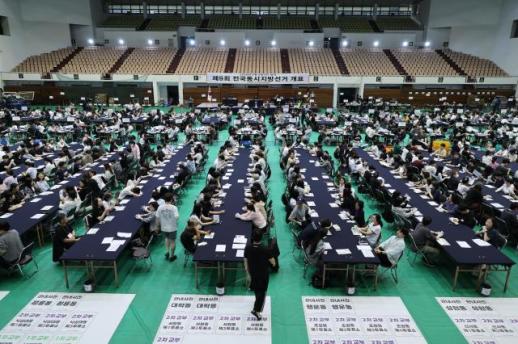 Ruling party leads in South Korean local election exit polls SEOUL, June 03 (AJP) -South Korea's ruling Democratic Party of Korea holds a strong lead in 11 out of 16 metropolitan mayoral and gubernatorial races, according to joint election-day exit polls released Wednesday. The projected outcomes position the party to expand its local administrative power as President Lee Jae-myung enters the second year of his term. The nationwide vote serves as the first major electoral test for the Lee Jae Myung administration, a critical midterm referendum on his first year in office. A decisive victory would grant the ruling party a unified mandate across administrative, legislative, and local levels, while a defeat for the opposition People Power Party could trigger immediate leadership restructuring. In the high-profile race for mayor of Seoul, the country's capital and primary political barometer, ruling party candidate Jung Won-oh leads opposition incumbent Oh Se-hoon by 51.4 percent to 46.0 percent. Control of the capital is historically viewed as a critical prize in South Korean elections due to the city's massive population and economic influence. Broadcasters classified several major regions as tight contests, including the southern port city of Busan and the metropolitan city of Daegu, which is traditionally regarded as the heart of South Korean conservatism. In the Daegu mayoral race, opposition candidate Choo Kyung-ho holds a razor-thin lead over ruling party candidate Kim Boo-kyum by 49.9 percent to 49.1 percent. In Busan, the ruling party's Jeon Jae-su maintains a narrow edge with 50.2 percent over the opposition's Park Hyung-jun at 48.3 percent. Meanwhile, the North Jeolla gubernatorial race shows the ruling party's Lee Won-taek leading independent candidate Kim Kwan-young by 48.5 percent to 46.3 percent. A separate prediction survey released by cable network JTBC projected the ruling Democratic Party of Korea to win 10 seats and the conservative opposition to win one seat. The network classified five regions as battlegrounds, listing Daegu, Chungnam, Chungbuk, Jeonbuk, and Gyeongnam as too close to call. The joint exit polls, conducted by major terrestrial broadcasters KBS, MBC, and SBS, were released simultaneously at 6 p.m. as polling stations closed across South Korea. 2026-06-03 19:00:17