

Journalist

Yujin Kim and Seo Hye Seung
ujeans@ajunews.com
-
 Finance Ministry Meets with Duty-Free Industry to Discuss Support Measures As the domestic duty-free industry shows signs of recovery this year, risks such as competition with local retail channels and high exchange rates remain prevalent. In response, the Ministry of Finance has convened a meeting with industry representatives to address their concerns. On June 4, the Ministry of Finance held a meeting at Incheon Airport with the Korea Duty-Free Shops Association to assess the current market situation and explore revitalization strategies. The ministry listened to feedback from stakeholders in the industry. Attendees included major duty-free operators such as Lotte, Shilla, Shinsegae, and Gyeongbokgung, along with representatives from the Korea Duty-Free Shops Association. According to the association, total sales at domestic duty-free shops reached 1.08 trillion won in March, a 12.5% increase from the previous month, driven by a rise in foreign tourist numbers. Both the number of foreign buyers and sales figures rose by approximately 20% compared to the previous month. While major duty-free shops have returned to profitability, challenges persist due to ongoing high exchange rates and intensified competition with local retail channels. Industry representatives have called for support measures, including a reduction in duty-free license fees, an increase in tax-free purchase limits for travelers, and a relaxation of regulations governing duty-free operations. They also emphasized the need for tailored marketing strategies targeting foreign tourists and the introduction of experiential products utilizing K-content. A Ministry of Finance official stated, "We will actively review the issues raised during today’s meeting and will continue to maintain communication with the duty-free industry."* This article has been translated by AI. 2026-06-04 16:06:00
 -
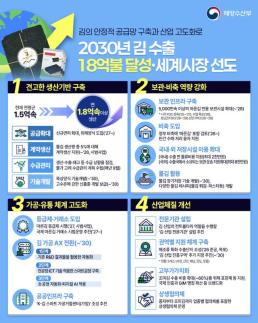 South Korea Aims for $1.8 Billion in Seaweed Exports by 2030 The South Korean government is taking steps to expand the export of seaweed, often referred to as "black semiconductor" due to its rising popularity. To meet surging global demand, the government plans to increase production and enhance efficiency by integrating artificial intelligence (AI) into the production, distribution, and supply processes. On June 4, the Ministry of Oceans and Fisheries unveiled its "Seaweed Export Supply Chain Innovation Plan" during a meeting of the Task Force on Living Costs, chaired by Deputy Prime Minister and Minister of Economy and Finance Koo Yun-cheol. Seaweed, a key export item in the K-seafood sector, achieved $11.3 billion in exports last year, with demand projected to reach 210 million packs (one pack equals 100 sheets) by 2030. Currently, domestic production of dried seaweed stands at an average of 15 million packs annually. If production does not increase, the country may face shortages and rising export prices. In response, the Ministry established a "Seaweed Export Supply Chain Innovation Task Force" in January, led by Fisheries Policy Director Choi Hyun-ho, to devise strategies. To stabilize production, the government plans to expand seaweed farming areas. It will explore phased expansion of offshore farming in waters deeper than 35 meters after conducting trials, and it aims to establish land-based farming systems to produce seaweed outside of the ocean. A ministry official stated, "We will develop new varieties that are resilient to high temperatures and land-based farming technologies by 2030 to secure stable production amid climate change. We will also include dried seaweed in our stockpiling efforts and provide low-interest loans to the private sector to minimize supply instability and price volatility." In addition to increasing production, the government will also revamp processing and distribution systems. AI will be introduced into the seaweed processing stages to promote automation. In the first phase, the government will distribute equipment for foreign matter inspection and automatic packaging, and it plans to increase the number of smart seaweed factories in collaboration with the Ministry of SMEs and Startups by 2030. Ultimately, it aims to achieve full automation for companies building smart factories through the development of physical AI technology. Furthermore, a "K-Seaweed Smart Processing Hub" will be established to consolidate research, industry, technology, and facilities in one location. The government will also enhance storage capabilities for dried seaweed, aiming to increase storage facilities to hold about 30% of annual production by 2028. Given that 77% of domestic dried seaweed is produced in Jeollanam-do, the government plans to expand the Naju Distribution Center and construct new distribution centers in Jeollanam-do and the central region. Finally, the government is pursuing the establishment of a specialized agency to oversee the seaweed industry. Since April, the Ministry has been conducting a feasibility study for this agency, which will last for one year. To increase the export share of seasoned seaweed to 60%, the government will also enhance tailored support for export companies and accelerate branding efforts for the English name of Korean seaweed, "GIM." Through this innovation plan, the Ministry expects to produce over 18 million packs of seaweed annually by 2030. Additionally, it aims to achieve $4.2 billion in seafood exports and $1.8 billion in seaweed exports by 2028. Minister Hwang Jong-woo stated, "Through the Seaweed Export Supply Chain Innovation Plan, we will ensure stable seaweed supply and demand management while advancing the industry. We aim to stabilize seaweed prices so that consumers can enjoy it without burden and further solidify the status of our seaweed in the global market."* This article has been translated by AI. 2026-06-04 14:06:00
 -
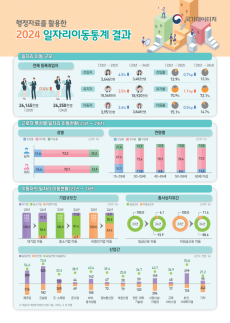 Job Market Sees Two Consecutive Weeks of Decline in New Entrants and Job Changers The number of registered job seekers entering the labor market or changing jobs has declined for two consecutive years. Additionally, the number of young people aged 15 to 29 entering the job market has also decreased. According to the "2024 Job Mobility Statistics" released by the National Data Agency on June 4, the total number of registered job seekers increased by 105,000 (0.4%) from the previous year to 26.25 million. Registered job seekers are defined as wage and non-wage workers reported to public institutions based on administrative data related to the four major social insurances. While the number of workers maintaining their jobs has increased, the population entering the job market or changing jobs has decreased. In 2024, the number of new entrants was 3.482 million, down 164,000 (-4.5%) from the previous year, with an entry rate of 13.3%, a drop of 0.7 percentage points. During the same period, the number of job changers decreased by 103,000 (-2.6%) to 3.838 million, resulting in a mobility rate of only 14.7%, down 0.5 percentage points. The number of non-registered workers was 3.377 million, a decrease of 181,000 (-5.1%) from the previous year. Conversely, the number of workers who maintained their jobs increased by 373,000 (2.0%) to 18.9 million, with a retention rate rising by 1.1 percentage points to 72.1%. By age group, the entry and mobility rates were highest among those under 29, but the number of young entrants has been declining each year. The number of new entrants aged 15 to 29 fell from 1.309 million in 2022 to 1.203 million in 2023, and further to 1.13 million in 2024. The proportion of this age group also decreased from 33.2% in 2022 to 31.6% in 2023, and 31.1% in 2024. When analyzing the retention rates by age group for 2023, those in their 40s had the highest rate at 78.9%, followed by those in their 50s at 78.4%, 30s at 73.4%, and those aged 60 and over at 73.0%. In contrast, the retention rate for young workers was only 47.6%. Examining mobility rates by company size, small businesses had a mobility rate of 16.8% and an entry rate of 14.9%, surpassing large enterprises. The proportion of workers moving from large to large enterprises was 37.0%, while 56.6% of workers transitioned from large to small businesses. Conversely, only 11.8% moved from small businesses to large enterprises. By organizational type, the entry rate was highest for individual enterprises, recorded at 16.0%. The retention rate for jobs that continued a year later was 80.7% for government and non-profit organizations, meaning eight out of ten workers remained in the same job. The mobility rate was highest for corporate entities at 18.8%. Additionally, 57.8% of workers who changed jobs did so for positions with increased wages, while 41.3% moved to jobs with decreased wages. Over the past five years since 2019, while the number of job holders and retention rates have gradually decreased, the number of job changers and new entrants has shown an upward trend.* This article has been translated by AI. 2026-06-04 13:18:00
 -
 Team Korea Wins $2.8 Billion Louisiana FLNG Project, Accelerating U.S. Energy Market Entry Team Korea has successfully secured a contract for the construction of the first floating liquefied natural gas (FLNG) offshore plant in Louisiana, valued at $2.8 billion (4 trillion won). This achievement is expected to boost Team Korea's entry into the U.S. energy market. On June 1, Team Korea was selected as the contractor for the Louisiana FLNG project, according to the Ministry of Oceans and Fisheries, the Ministry of Land, Infrastructure and Transport, and the Ministry of Climate, Energy and Environment. The FLNG facility is a floating offshore plant equipped with liquefaction equipment for natural gas. It will be constructed in South Korea and installed locally, serving to liquefy, store, and offload natural gas produced from gas fields. The Delfin FLNG project, which Team Korea has won, is a collaboration between private developers and shipbuilders. Samsung Heavy Industries, along with three ministries and two public institutions, is involved in the project. The Korea Overseas Infrastructure and Urban Development Corporation (KIND) and the Korea Maritime Promotion Corporation, along with the Green Fund, have invested in the BlackRock fund leading the project. They also participated as financial investors to support financial structuring and assist in securing engineering, procurement, and construction (EPC) contracts for Korean companies. The project will incorporate eco-friendly design technologies from Korean companies. Notable technologies include selective catalytic reduction, which extracts nitrogen oxides from exhaust gases produced by burned fuel and reduces them to nitrogen and water, and waste heat recovery boilers that generate steam and electricity from recovered waste heat. The government views this project as a pivotal opportunity to transition overseas construction from a traditional contracting industry to a high-value-added complex industry. It also sees significant value in establishing a foothold in the U.S. energy infrastructure market. Moreover, since the FLNG will be manufactured domestically, it is expected to stimulate the local economy through a chain of contracts for small and medium-sized enterprises. This case demonstrates that participation in major overseas infrastructure projects contributes to strengthening supply chain stability. The government plans to accelerate efforts to enhance transportation networks and diversify import sources through future overseas infrastructure acquisitions. A government official stated, "We will strengthen our capabilities to respond to global supply chain issues by expanding investments in overseas energy and port infrastructure. Based on the partnerships established through this negotiation with global developers, we will actively seek out future collaborative projects."* This article has been translated by AI. 2026-06-04 10:39:00
 -
 Korean Economy Relying on Semiconductors Faces Growth Illusions Major domestic and international economic institutions have raised their forecasts for South Korea's economic growth rate. However, a significant gap remains between macroeconomic indicators and the real economy as experienced by ordinary citizens. Most sectors, except for semiconductors, continue to struggle, raising concerns about economic polarization. This phenomenon is attributed to what is termed the "semiconductor illusion effect." While the semiconductor export boom has boosted exports and growth rates, the real economy continues to lag due to high inflation and exchange rates. According to the Ministry of Economy and Finance, the Organization for Economic Cooperation and Development (OECD) has revised its forecast for South Korea's economic growth rate upward by 0.9 percentage points to 2.6% for this year. Growth is expected to continue in the second half of the year, primarily driven by semiconductors, although the polarization between semiconductor and non-semiconductor manufacturing is expected to deepen. A recent report from the National Assembly Budget Office indicates that the production capacity index for the semiconductor sector has surged by 80 percentage points over the past five years. This increase is attributed to the AI boom and the recovery of global information technology demand, leading to significant investments and production increases. In contrast, the production capacity index for non-semiconductor manufacturing has declined by 14 percentage points during the same period. This decline reflects the weakening fundamentals of traditional manufacturing sectors, such as steel, petrochemicals, and automotive parts, which have been the backbone of the South Korean economy. A representative from the Budget Office stated, "Due to global supply excess, the operating rates for steel and petrochemical sectors have been declining for several years. High inflation is also constraining consumption, leading to negative growth in the domestic service sector." The inability of the semiconductor boom to spread to other industries and the overall economy is attributed to external uncertainties. The prolonged conflict in the Middle East, coupled with geopolitical risks, has kept international oil prices elevated. Given South Korea's high dependence on energy imports and its export-oriented economic structure, high oil prices contribute to rising production costs and inflationary pressures. The high exchange rate, hovering around 1,500 won per dollar, also poses challenges. In the past, a rising exchange rate was seen as enhancing the price competitiveness of export companies. However, current analyses suggest that it primarily exacerbates the costs of imported raw materials, negatively impacting the profitability of domestic firms. Rising international oil prices and exchange rates lead to increased import prices and production costs. This, in turn, triggers price hikes for products and raises living costs. The increase in living costs results in a decline in real household income, ultimately leading to a vicious cycle of reduced consumption. This trend is evident in various indicators. According to the National Data Agency's industrial activity trends for April, the retail sales index, which reflects consumption, fell by 3.6% compared to the previous month, marking the largest decline since February 2024. Equipment investment also decreased by 3.6%, and the construction performance index, which indicates domestic construction activity, dropped by 1.4%. Some experts warn that excessive reliance on semiconductors for national economic growth could lower South Korea's potential growth rate. If the global AI boom ends or the semiconductor market enters a downturn, there may not be sufficient industrial foundations to replace or supplement it. A representative from the Budget Office emphasized, "The semiconductor industry has limited spillover effects, so if semiconductor demand slows, it could exert significant downward pressure on the overall manufacturing sector. Policies are needed to diversify away from semiconductor dependence and strengthen the resilience of other manufacturing and domestic-based industries."* This article has been translated by AI. 2026-06-03 18:00:00
 -
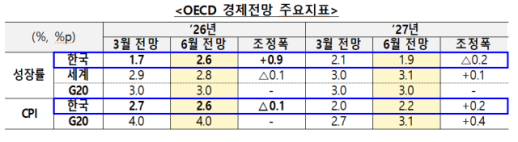 OECD Raises South Korea's Growth Forecast to 2.6% Amid Semiconductor Boom The OECD has projected that South Korea's economy will grow by 2.6% this year, driven by a surge in semiconductor exports. According to the Ministry of Finance and Economy on June 3, the OECD raised its growth forecast for South Korea by 0.9 percentage points in its World Economic Outlook report. This marks the largest increase among the G20 nations. However, the forecast for next year has been lowered by 0.2 percentage points to 1.9%. Previously, the South Korean government, the Bank of Korea, and the Korea Development Institute (KDI) had also revised their growth forecasts for this year to the mid-2% range. Reflecting the economic boom, the KOSPI index has surpassed 8,000, and the current account surplus for the first quarter reached a record $73.3 billion. The OECD noted that the expansion in exports, particularly in semiconductors, has propelled overall economic growth and private investment in South Korea. It also projected that consumer spending will gradually recover, with both prices and volumes of exports increasing since the beginning of the year. Private investment has significantly benefited from the semiconductor sector. The OECD stated, "Private investment in South Korea is increasing, particularly in semiconductors," and added that by the end of this year, investment growth is expected to spread to other sectors, maintaining a strong performance. It also forecasted a gradual recovery in consumer spending from this year into next year, influenced by supplementary budget measures. The nominal economic growth rate for this year, adjusted for the GDP deflator, is expected to be 10.4%, while the general government debt-to-GDP ratio has been revised down by 4.8 percentage points to 50.2% compared to projections made last December. Consumer prices are anticipated to average 2.6% this year, influenced by the ongoing conflict in the Middle East. However, inflation rates are expected to return to target levels starting next year. The OECD believes that measures such as the maximum price cap on oil products and reductions in fuel taxes will help alleviate inflationary pressures caused by energy supply shocks. Nonetheless, an OECD official cautioned that these measures could increase the persistence of inflationary pressures and recommended a gradual phase-out. In contrast, the global economic outlook remains bleak. The OECD has lowered its global growth forecast for this year to 2.8%, down 0.1 percentage points from its March estimate. It attributed this downgrade to soaring energy prices and trade disruptions caused by the blockade of the Strait of Hormuz. Major economies, including the United States (2.0%), the Eurozone (0.8%), and Japan (0.6%), are expected to experience slower growth due to the impact of the conflict in the Middle East. Inflation rates for G20 countries are projected at 4.0% this year and 3.1% next year. The prolonged conflict in the Middle East is identified as the biggest downside risk to global economic growth. Should the war continue, global growth could decline by as much as 0.7 percentage points, while inflation could rise by 0.4 percentage points. Conversely, an early resolution to the conflict and increased global demand for artificial intelligence (AI) are expected to positively influence global economic recovery. An OECD official emphasized the need for monetary policy to address inflationary pressures and called for measures to expand the tax base to alleviate long-term fiscal burdens. He also highlighted the necessity for structural reforms across society, including diversifying energy supply chains.* This article has been translated by AI. 2026-06-03 16:03:00
 -
 Ministry of Economy Launches AX Jiphyeonjeon 2.0 to Integrate AI into Operations The Ministry of Economy and Finance is enhancing its operations by integrating artificial intelligence (AI) across various functions, from establishing an AI learning club to training senior officials and appointing private expert advisors. On June 1, the ministry launched "AX Jiphyeonjeon 2.0" to create a learning organization within government departments in response to the AI transformation era. This club aims not only to study AI theory but also to explore ways to apply AI in policymaking. Members of the club will engage in tasks such as identifying automation projects, developing tools, researching data utilization within the ministry, visiting leading AI companies, and supporting government innovation competitions. During a meeting held that day, Deputy Prime Minister Koo emphasized, "The Ministry of Economy and Finance is recognized as a leader in AI innovation among government departments," and pledged to provide active support to ensure the smooth operation of the initial phase of the club. AI training for senior officials is also underway. Koo noted the need for high-level officials' interest to strengthen the ministry's capabilities and introduced demonstrations of training outcomes during three expanded executive meetings. At the morning meeting, three major projects from employees who completed the second AI intensive training program were showcased. One project demonstrated how to automatically generate revised tax law provisions and related documents in a Word file by inputting key changes. To incorporate external perspectives, the ministry plans to appoint and operate an AI advisory group consisting of six private experts. The advisors will serve a one-year term and will be responsible for providing AI training programs, mentoring and judging hackathon competitions, and accompanying visits to innovative companies by the learning club. Additionally, the ministry is pursuing initiatives like the "Korean-style AI package project" to integrate AI into policies such as official development assistance (ODA).* This article has been translated by AI. 2026-06-01 17:12:00
 -
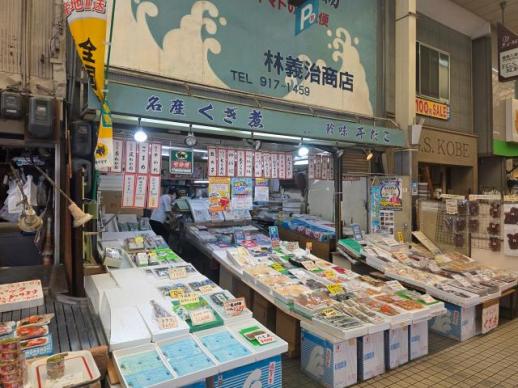 K-Food Gains Popularity in Japan's Hyogo Prefecture Last year, K-Food achieved record-high exports, and the response in the Japanese market has been enthusiastic. To confirm the popularity of high-quality Korean seafood, a visit was made to the Uonotana Fish Market in Hyogo Prefecture on May 29. Upon entering the market, neatly packaged seafood caught the eye. A brief thought about whether Japanese consumers might prefer domestic products was quickly dispelled during an interview with a vendor, which highlighted the popularity of K-Food. Toshimichi Ohigashi, the owner of the "Ori Shop" at the market, stated, "In recent years, Japan's abalone production has decreased, leading to an increase in imports of Korean abalone." The presence of Korean seafood, including abalone and flounder, was evident throughout the market. When asked about Japanese consumers' reactions to Korean abalone, Ohigashi noted, "It tastes good and is popular. Compared to Japanese abalone, it is also more affordable, attracting many buyers." Japanese fishermen are also aware of the growing popularity of Korean seafood. On the same day, Hiroyuki Nishimoto, head of business development at the Hyogo Prefecture Fisheries Cooperative, confirmed that the demand for Korean seafood is increasing. Factors contributing to the rise in imports of foreign seafood in Japan include environmental changes and a decline in domestic fishing. In Hyogo, the nearby sea has become excessively clean, resulting in a decrease in plankton, which is a food source for seafood. Consequently, the catch has diminished. Additionally, an aging population has led to a reduction in labor within the fishing industry and a decline in seafood consumption, further impacting the market. These environmental changes have created an opportunity for Korean seafood to gain a stronger foothold in Japan. While cheaper Chinese seafood is often used as restaurant ingredients, Korean exports are utilized in higher-end dishes. Nishimoto noted, "I understand that mackerel and anago (conger eel) are popular. The younger generation, particularly those in their 20s and 30s, seems to consume a lot of Korean seaweed due to their interest in Korean culture." Regarding competition with Chinese seafood, he remarked, "Upper-class consumers prefer quality products even if they are more expensive, so securing high quality is essential." 2026-06-01 15:48:00
 -
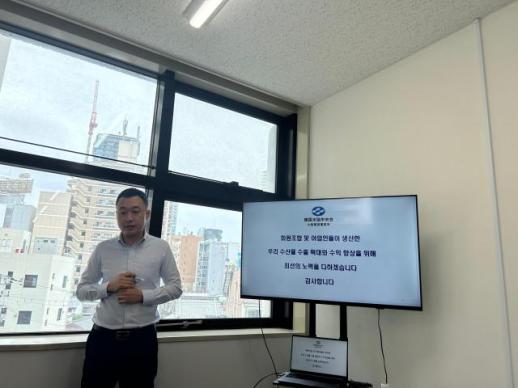 Surge in Abalone and Flounder Exports Boosts Fisheries in Japan "We aim to enhance the income of Korean fishermen by expanding the export of seafood products. Since our opening last March, we have achieved export results totaling 5.5 billion won," said Kim Dong-hee, head of the Korea Fisheries Association's Osaka office, during a meeting in Osaka on May 28. The Osaka office represents more than just a foreign branch; it serves as a 'local direct distribution platform.' Moving away from a reliance on private exporters, the association has established its own distribution network in Japan. Osaka is a major hub for seafood consumption in Japan, conveniently located near large cities like Kyoto, Kobe, and Nara, making it advantageous for securing significant consumer markets. The association has chosen Osaka as its first overseas office to develop a supply base for K-seafood in western Japan. Since its opening on March 18 of last year, the Osaka office has focused on exporting live abalone and flounder. Previously, Korean seafood had to go through intermediaries or local wholesalers before reaching the market. Now, the association manages the entire process—from production to export to local distribution—ensuring the freshness of the seafood. The office is collaborating with York Benimaru, a prominent Japanese distribution market, to supply seafood products and has confirmed exports of frozen abalone and salt. Additionally, efforts are underway to develop new products tailored to buyer demands, such as flower crabs. From March to December last year, the office exported 3.8 billion won (180 tons) of live abalone and 1.3 billion won (60 tons) of live flounder, totaling 5.5 billion won in exports, while also diversifying its key products to include frozen abalone and live octopus. These achievements were not easily attained. The Japanese market has high barriers for new entrants due to its established relationships. Kim shared, "I approached buyers as if I were hitting the ground running, making calls and visits to find potential partners." The sales efforts involved sending emails to import buyers and arranging meetings with those who responded. Kim noted, "Once we meet, I feel confident. When I introduce our organization as similar to the National Federation of Fisheries Cooperatives in Japan, trust begins to build with buyers. Once mutual understanding is established, we can start transactions." There is a growing interest among Japanese consumers in Korean abalone. Kim stated, "Farmed abalone from Korea is regarded as top quality and is a must-have in high-end restaurants for dishes like teppanyaki and butter-grilled abalone." The Korea Fisheries Association is also accelerating the process of incorporating the Osaka office as a local entity. The association believes that formal incorporation will further contribute to diversifying exports. Kim explained, "Once we are incorporated, we hope to expand our network to include small-scale businesses that want to import Korean seafood but are currently unable due to their size. This will enhance the diversification of Korean seafood exports. We are also considering storage facilities like tanks." However, the increasing competition in the abalone market poses a challenge. In 2017, Japan imported between 1,600 and 1,700 tons of abalone, but this figure surged to 2,500 tons last year. This influx has led to a decline in abalone prices. Kim remarked, "Intense internal competition within the Korean aquaculture industry has resulted in overproduction, which is driving down export prices. I understand that some regions are even beginning to reduce their aquaculture operations as a means of addressing this issue." 2026-06-01 12:03:00
 -
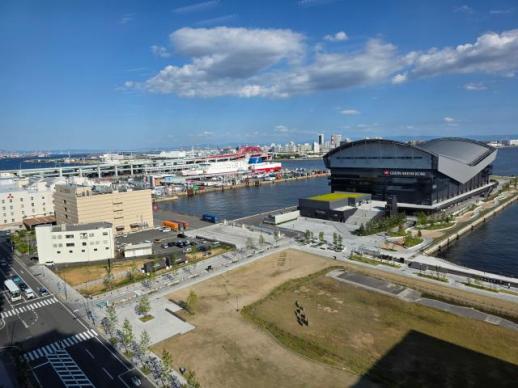 Kobe Port Combines Logistics and Entertainment, Showcasing the Future of Harbors Kobe Port, located in Hyogo Prefecture, Japan, is challenging the perception of harbors as merely functional spaces for container and cargo ships. On May 29, the port was revealed as a waterfront area inviting visitors to explore. Opened in 1868, Kobe Port is one of Japan's three major trading ports, handling an average of over 2.1 million TEUs annually. The modern port began to take shape in the early 1900s, with significant developments in the new and central wharves by 1940. Kensuke Kitagawa, an official from the Kobe Port Authority, explained, "From 1965 to 2005, we expanded the port's logistics capabilities by reclaiming land from the sea." The period from the 1960s to the 1980s was marked by a focus on containerization in port logistics. Until 1963, smaller vessels were used for transportation, but the introduction of container ships transformed maritime logistics. Consequently, the existing port areas began to transition into urban spaces. Since 1970, the development of Meriken Park Harborland has added entertainment features, attracting tourists. The redevelopment of a former container terminal into Harborland has integrated dining, shopping, and recreational activities in one location. However, the port's redevelopment faced a setback due to the Great Hanshin-Awaji Earthquake in 1995. Although port facilities were restored within two years, the recovery process incurred significant debt, straining Kobe's finances and delaying redevelopment projects. The repayment of this debt was completed in 2011, allowing redevelopment efforts to accelerate. Kitagawa noted, "You are currently at the G-Lion Hours building, which houses a museum, aquarium, food court, and residential units." He added, "Across from you is the G-Lion Arena Kobe, a next-generation arena with a capacity of 10,000, operated through private investment on Kobe's land." Kobe Port Tower, established in 1964, is another key tourist attraction. Following renovations to enhance earthquake resilience in 2024, the tower opened some outdoor observation decks. Visitor numbers, which had previously plateaued at around 300,000 annually, doubled to 600,000 after the reopening. Kobe City plans to continue its port redevelopment efforts with a focus on "creating new value that connects history and the future" by 2040. Naoki Sekiguchi, an official from the Kobe Port Authority, stated, "We will operate the port primarily for logistics while enhancing tourism and entertainment features. Given that the port has a history of over 100 years, we aim to preserve as many of the historical buildings as possible during redevelopment." 2026-06-01 12:03:00