
Journalist

AJP
-
 Arko Art Center Unveils 2026 Lineup of Five Exhibitions Focused on Discovery and Experiment The Arts Council Korea, known as Arko, announced Arko Art Center’s 2026 exhibition program on the 23rd. The museum will present five exhibitions built around experimentation and diversity. While linking the lineup to Arko support programs, Arko Art Center said it will further develop its identity of “discovery and experimentation,” shaped over more than 50 years. The first show is the homecoming exhibition for the Korean Pavilion at the 19th Venice Biennale International Architecture Exhibition, “Dukkobah Dukkobah: The Time of the House” (2.6~4.5). Marking the pavilion’s 30th anniversary, it examines the building and reconsiders the meaning of a pavilion through the lens of a “house.” The second exhibition, “Uncalibrated Time” (working title, 5.21~7.19), is a two-person show tied to Arko’s Visual Arts Creative Subject Support program. It aims to dismantle hierarchies of time and the senses and to consider attitudes of coexistence. Participants include O Min, selected for multiyear support, and Camille Norment, known for multimedia experimentation on the international stage. Arko said Norment will be introduced at an Asian art museum for the first time through this exhibition. The thematic exhibition “Art School” (working title, 8.7~9.27) looks at the role of Insa Art Space (2000~2025), which has served an educational function in discovering and nurturing emerging artists. Framed as “art as education,” it reflects on education systems and institutions and highlights the activities and practices of art-world participants beyond exhibitions. A “Collection Special Exhibition” (working title, 10.16~11.29) will use Arko Art Center’s holdings to examine the museum’s exhibition history within the context of Korean art history, aiming to provide a meaningful opportunity for research into the history of contemporary Korean art. The final show, “Arko Art Center × Regional Arts Leap Support Collaborative Exhibition” (working title, 12.18~27.2.14), will be linked to Arko’s regional support program. It will back the production of new works by promising regional artists and serve as a platform to broaden the results of discovering and supporting local artists. * This article has been translated by AI. 2026-02-23 09:18:42
 -
 KB Kookmin Bank, LG Uplus to Showcase AI Voice Phishing Response Model at MWC26 KB Kookmin Bank said it will present a strategic cooperation model with LG Uplus at MWC26, the world’s largest mobile exhibition, set to open March 2 (local time) in Barcelona, Spain. The model outlines an “AI-based finance-telecom real-time response collaboration system” to combat voice phishing. The partnership goes beyond a technology tie-up, the bank said, and is aimed at putting into practice its strategy to upgrade its voice phishing monitoring system and strengthen real-time response capabilities. In a demonstration, KB Kookmin Bank’s enhanced monitoring system will link in real time with LG Uplus’ AI calling app, ixi-O, and its voice phishing prevention service. If suspicious signs are detected during a call, related information will be sent immediately to the bank’s monitoring system. The bank can then take rapid steps such as freezing the account or shifting it to intensive monitoring. The bank said its future security model focuses on prevention rather than after-the-fact action, with the carrier and bank operating like a single system at the moment criminals try to induce a transfer to block potential financial losses. “Based on cooperation between the two companies, we expect to speed up the response needed to block voice phishing,” a KB Kookmin Bank official said. “We will continue to build innovative security infrastructure to protect financial consumers.”* This article has been translated by AI. 2026-02-23 09:18:00
 -
 Auto Repair Franchise Partners With Poen to Launch EV Total Repair Service The auto repair franchise Everything About Cars said Monday it has partnered with Poen, a company specializing in remanufacturing EV batteries, to launch an “EV Total Repair Service” that allows partial repairs up to the high-voltage battery. High-voltage EV batteries have typically been treated as a single finished component, leaving replacement with a new unit as the main option when failures occur — and the cost can be steep. As of February, Hyundai Mobis lists the new battery system assembly for the Hyundai Ioniq 5 and Kia EV6 at about 25 million won, while the Kia EV9 exceeds 30 million won. Under the new service, the companies said costs can be reduced by repairing modules and internal parts based on the battery’s condition, with some repairs possible for about 3 million won. Customers can receive light EV maintenance and battery diagnostics at Everything About Cars locations nationwide, while Poen handles the battery repair work under a two-track system the companies said is designed to ensure quality, safety and access. Kim Seon-woo, CEO of Everything About Cars, said, “We wanted to offer a realistic alternative for customers who feel stuck when facing EV battery problems,” adding, “Through this collaboration, we will set a new standard for EV maintenance.”* This article has been translated by AI. 2026-02-23 09:04:53
 -
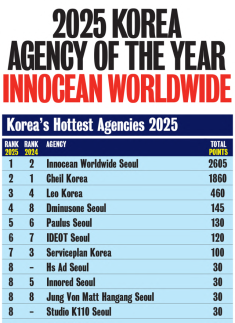 Innocean Tops South Korea in Campaign Brief Asia 2025 Creative Rankings, No. 6 in Asia Hyundai Motor Group affiliate Innocean said it has again demonstrated top-tier advertising production capabilities on the global stage. Innocean said Monday it was ranked No. 1 in South Korea and No. 6 in Asia in Campaign Brief Asia’s “2025 Creative Rankings.” The rankings compile major international advertising award results earned by agencies across Asia over the past two years, covering the period from Jan. 1, 2024, through Dec. 31, 2025. Campaign Brief Asia weighted wins across 12 major global awards, including Cannes Lions, the New York Festivals and the Clio Awards, based on each competition’s standing. Innocean placed first among South Korean agencies and finished sixth overall in Asia. Campaign Brief Asia said Innocean posted the strongest award performance over the two-year period, citing a run of top prizes at leading global competitions. In individual rankings, Innocean CEO and chief creative officer Kim Jeong-a ranked first among South Korean creative directors based on award results. Copywriter Yang Do-yu, art director Oh Eun-ha and creative director Moon Na-ri tied for first in South Korea in the creative category for the most awards won. Kim also ranked sixth across Asia. The individual creative rankings covered 2,885 people, including copywriters, art directors and creative directors. The “Night Fishing” campaign with Hyundai Motor Co. was among works that received high marks, Innocean said. Innocean previously ranked first in the “Indonesia Creative Rankings,” giving the company top spots in both its South Korean headquarters and an overseas unit. In Indonesia, it held the No. 1 position for a second straight year, it said. “From late last year to early this year, we were named ‘Agency of the Year’ three times in a row by leading overseas organizations, which is very meaningful and gratifying,” Kim said. “This achievement goes beyond awards, serving as an important opportunity to raise the standing of Korean creativity in the global market while also helping drive client growth,” she said. * This article has been translated by AI. 2026-02-23 09:04:04
 -
 Air Premia Marks Washington, D.C., Launch With Up to 30% Fare Discounts Air Premia said Sunday it will run a promotion offering up to 30% off to mark its planned launch of service to Washington, D.C., in April. From Sunday through Feb. 26, the airline will release a first-come, first-served discount code each day for 30% off fares on its Washington route. The 30% code will be posted daily at 10 a.m. and will end once the allotment is gone. Customers can find the code on the event page of the airline’s website and mobile app, and the code will change each day. Customers who miss the 30% offer can still get 20% off fares by entering the code “IADNEW20” from Feb. 27 through March 2. Air Premia will begin scheduled service between Incheon and Washington Dulles International Airport (IAD) on April 24, operating four times a week. The airline said the launch is a strategic move to diversify its U.S. route portfolio and expand its demand base. Washington, D.C., is an administrative and diplomatic hub where demand for business travel remains steady, including visits to public agencies, defense-related organizations and research institutions. Northern Virginia nearby is home to clusters of defense and technology industries and research facilities, which the airline said supports stable corporate and institutional demand. The airline also cited Washington’s cultural and historical attractions — including the Smithsonian museums, the National Mall and the Lincoln Memorial — as drivers of steady leisure travel demand, noting that free admission at major museums can help keep travel costs relatively low. Dulles is a key gateway for the Washington metropolitan area, with strong access to government agencies and a transfer network to major U.S. cities, the airline said, adding that it expects convenient connections within the Eastern U.S. “Washington is a market shaped by both demand for visits to public, diplomatic and research institutions and demand for cultural tourism,” an Air Premia official said. “As this launch is a strategic expansion to diversify our U.S. route portfolio and stabilize our revenue base, we will focus on securing early demand and establishing the route in the market.”* This article has been translated by AI. 2026-02-23 09:03:16
 -
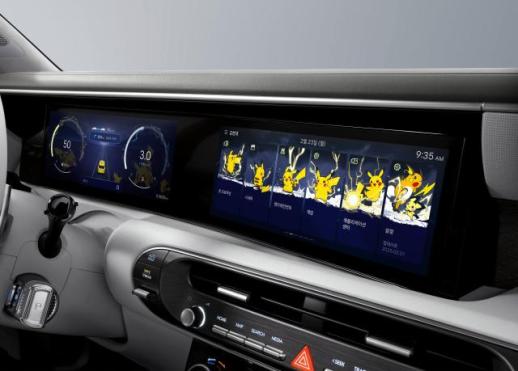 Hyundai Launches Pokemon Display Themes for In-Car Screens Hyundai Motor is bringing Pokemon characters to in-car displays, offering drivers a new way to personalize the cabin experience. The automaker said Sunday it is releasing two new display themes developed with Pokemon Korea: the “Pokemon Pikachu Thunderbolt Theme” and the “Pokemon Ditto World Theme.” Drivers can apply Pokemon-inspired colors and graphics to the infotainment and cluster displays, along with navigation driving information and startup and shutdown animations. Hyundai said the Pokemon-themed displays are expected to create an emotional connection and shared interest between parents and children. The themes can be purchased through Hyundai’s Bluelink Store after registering a primary vehicle in the MyHyundai app. Eligible models are the All-New Palisade, Ioniq 9, All-New Nexo, The New Ioniq 6, 2026 Sonata The Edge and The New Staria. Hyundai said it plans to expand compatibility through OTA (over-the-air) software updates. “This collaboration with Pokemon Korea reflects customer demand to decorate and express their own style through their vehicle,” a Hyundai official said. “In step with the connected-car era, we will continue to raise the value of the experience customers can have in their vehicles.” 2026-02-23 08:57:19
 -
 Nexen Tire Opens Winter Tire Test Center in Finland to Boost R&D Nexen Tire said it has begun full operations of its new winter and all-weather tire test center in Ivalo, Finland, after holding an opening ceremony for the “Purple Snow Ivalo Center.” The event was attended by Kim Jong-myeong, head of Nexen Tire’s research institute, and representatives of European automotive media outlets. To strengthen winter performance development, the company built its own research facilities, including a lab focused on winter road-surface characteristics. It also secured a newly designed proving ground through a long-term lease, featuring a snow handling track with varied slopes and curves and a large snow flat track. The center was established within a UTAC (Union Technique de l'Automobile, du moto cycle et du Cycle) driving test site in Ivalo, near the Arctic Circle in northern Finland. UTAC is Europe’s largest automotive testing specialist and has indoor and outdoor infrastructure capable of reproducing extreme winter road conditions. Nexen Tire said the Finland center is expected to strengthen competitiveness in Europe, a key market that accounts for more than 40% of its revenue. The company cited requirements in major countries such as Germany that mandate the use of 3PMSF-certified products in winter, increasing the importance of technical readiness for winter tires. Nexen Tire also said it has secured a durability evaluation track for studded winter tires designed for icy roads in extremely cold regions such as Northern Europe, aiming to respond strategically to rising local demand for winter tires. The company said the center will also link virtual development with real-vehicle testing. It will allow immediate cross-checking of performance predicted by a high dynamic driving simulator introduced last year — the first in the domestic industry — through on-snow driving tests. Nexen Tire said it plans to use AI-linked virtual development to expand opportunities to participate in original equipment tire projects and strengthen its foundation for high-performance tire development. Alongside the new center, Nexen Tire said it is pursuing the winter tire market on multiple fronts. It launched the winter tire “WINGUARD Sport 3” in Europe last year and is continuing to expand available sizes for the all-weather “N'BLUE 4Season 2,” which meets winter tire standards while supporting year-round driving. The company said it is also strengthening its sales infrastructure by expanding shop-branded stores through local distributors in key markets including Germany, Italy, France and the U.K., and by establishing a new branch in Romania. It said it is also pursuing strategic expansion into major non-European markets such as Australia and Japan. A Nexen Tire official said the center will serve as a key base to elevate R&D for winter and all-weather tires by combining a far-northern location with Europe’s longest winter season and the operating know-how of a top specialist. The official said the company will continue to strengthen testing and research capabilities to meet demand in Europe and global markets and improve competitiveness. * This article has been translated by AI. 2026-02-23 08:51:43
 -
 Hanwha Eagles Lock Up Noh Si-hwan in Record 11-Year Deal, Build Corner Infield Core 497 billion won combined. The Hanwha Eagles said Sunday they signed infielder Noh Si-hwan to a non-free-agent, multi-year contract a day earlier. The 11-year deal is worth 30.7 billion won ($307 million) including incentives, the longest and richest contract in KBO League history across both free-agent and non-free-agent agreements. The club also included a clause allowing Noh to pursue a move to Major League Baseball via the posting system after the 2026 season, as an added motivator. While a long-term deal for Noh had been widely expected, the size exceeded projections, effectively tying him to Hanwha for the long haul. Hanwha cited Noh’s value as a rare young right-handed power hitter. General manager Son Hyuk said, “Noh Si-hwan is an exemplary player who aims to play all 144 games, and he has grown into a right-handed power hitter who represents not only our team but the league,” explaining the rationale for the deal. Noh’s production has ranked among the league’s best. Last season he played all 144 games and hit 32 home runs, anchoring Hanwha’s power-heavy lineup. Hanwha moved quickly to secure him before he could reach free agency. Hanwha also strengthened its lineup by signing Kang Baek-ho in free agency to a four-year, 10 billion won deal. Pairing the right-handed slugger Noh with left-handed power from Kang gives Hanwha more punch. Kang’s defense has raised questions about his best position, but Hanwha emphasized his bat and plans to use him at designated hitter and first base. If Kang is used at DH, Chae Eun-seong can play first base. Chae is another key bat, having signed with Hanwha after the 2022 season on a six-year, 9 billion won contract. With Noh at third and Kang and Chae sharing first base, Hanwha now has what it believes is one of the KBO’s top corner-infield groups. The club expects the arrangement to maximize offense while leaning on Noh’s proven defense and durability. Attention now turns to whether Hanwha can rebound from last season’s runner-up finish and win its first title in 27 years with this corner-infield core leading the lineup. 2026-02-23 08:51:00
 -
 Hanwha Eagles’ Noh Si-hwan signs record 11-year, 30.7 billion won non-FA deal Hanwha Eagles infielder Noh Si-hwan has agreed to a record-setting long-term deal with the club. Hanwha said on Feb. 23 that it signed Noh to a non-free agent, multi-year contract on Feb. 22. The deal runs 11 years and is worth 30.7 billion won, including incentives. The club said it is the longest and largest contract in KBO League history, including both free-agent and non-free agent multi-year deals. The agreement also includes a clause allowing Noh to pursue a move to Major League Baseball via posting after the 2026 season, when he becomes eligible for free agency. General manager Son Hyuk said Noh is a model player who aims to appear in all 144 games and has developed into a right-handed power hitter representing both the team and the league. Son said the club considered multiple options to respect the player’s goals and treat him as a franchise star, leading to the agreement. He added that he hopes Noh will follow in the footsteps of Jang Jong-hoon and Kim Tae-kyun as a hitter who symbolizes Hanwha. Noh thanked the club for what he called a historic contract, saying it valued him highly. He also credited fans for their support, saying it played a major role in the deal and in his career so far. He said he will take on greater responsibility as a franchise player and do his best to help Hanwha establish itself as a top club. Looking ahead to 2026, he said he will work with the manager, coaches and teammates toward the goal of winning the Korean Series. 2026-02-23 08:15:00
 -
 WHIB Sets First Concert Tour Starting in March, Visiting 13 Cities in Japan and North America WHIB will launch its first concert tour of 2026 in March, starting in Seoul and continuing through 13 cities in Japan and North America. The tour, titled 'GO UP : Our era,' is scheduled for March 14-15 in Seoul; April 18 in Osaka, April 25 in Yokohama and April 29 in New York; and May 5 in Atlanta, May 7 in Nashville, May 10 in Chicago, May 12 in Kansas City, May 14 in Dallas, May 16 in Denver, May 19 in Salt Lake City, May 21 in Tempe and May 23 in Los Angeles. Now in its third year since debut, WHIB said it will use the tour to showcase a polished stage and the group's strong chemistry. The group recently released its first comeback as a complete seven-member lineup with the first mini album 'ROCK THE NATION,' setting a personal record for first-week sales. From November through January, WHIB also wrapped up its 2025 fan concert, 'AnD : New Chapter,' across five Asian cities. The Seoul shows that open the 2026 tour will be held at Blue Square's Woori WON Banking Hall at 5 p.m. on March 14 and 4 p.m. on March 15. Tickets are on sale through the online seller NOL Ticket.* This article has been translated by AI. 2026-02-23 08:09:15