
Journalist

AJP
-
 Hyundai, Kia Near 1 Million EV Sales in Europe as Market Rebounds Hyundai Motor and Kia are expected to reach 1 million cumulative electric-vehicle sales in Europe in the first half of this year. Hyundai Motor Group said on Feb. 15 that the two automakers sold a combined 915,996 EVs in Europe from the start of Soul EV sales in 2014 through last year. In 2021, they sold 135,408 EVs in Europe, topping 100,000 annual sales there for the first time. Sales continued to rise in 2022 and 2023, reaching 143,460 and 147,457 vehicles, respectively. In 2024, sales fell to 121,705 amid reduced EV subsidies in major European countries including Germany and concerns about an economic slowdown. Last year, sales rebounded to 183,912 on the strength of new models such as the Ioniq 9, EV4 and EV5. That was more than a 50% increase from a year earlier and the highest annual total on record. Given that Hyundai and Kia averaged more than 15,000 EV sales a month in Europe last year, the group said it is likely the companies will surpass 1 million cumulative sales in the European EV market in the first half of this year. Europe’s EV market has also regained momentum since last year. The European Automobile Manufacturers’ Association, or ACEA, said annual EV sales totaled 2,585,187 last year, accounting for 19.5% of the market, and in December EV sales surpassed gasoline vehicles for the first time.* This article has been translated by AI. 2026-02-15 14:06:32
 -
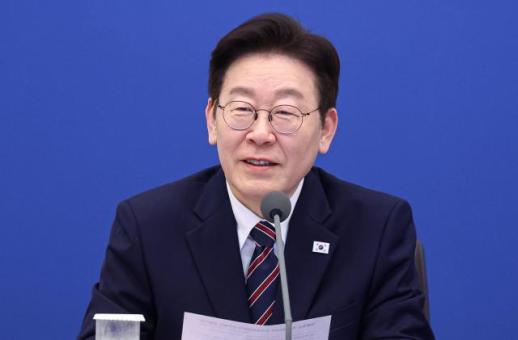 President Lee Jae-myung congratulates Hwang Dae-heon on Olympic 1500m silver President Lee Jae-myung on Saturday congratulated short-track speed skater Hwang Dae-heon after he won a silver medal in the men’s 1,500 meters at the 2026 Milan-Cortina Winter Olympics. In a Facebook post titled, “A calm race by a true ice competitor — congratulations on Korea’s short-track silver,” Lee said, “I sincerely congratulate him,” adding that he applauded Hwang for a “hard-earned silver medal.” Hwang finished second in the men’s 1,500-meter final held Saturday (local time), crossing in 2:12.304 behind Jens van’t Wout of the Netherlands. Hwang, who won silver in the 500 meters at the 2018 PyeongChang Winter Olympics and gold in the 1,500 meters plus silver in the 5,000-meter relay at the 2022 Beijing Winter Olympics, has now medaled at three consecutive Games. Lee said Hwang “proved once again he is among the world’s best” by adding silver to his 2022 Olympic gold, and noted he also set a record as the first in South Korean men’s short track to win medals at three straight Olympics. “Even in a fierce race, he stayed calm to the end and kept his pace,” Lee wrote, calling Hwang a true “ice competitor” and adding, “It’s incredible, and I’m proud.” Lee also voiced support for Hwang’s pledge to become “an athlete remembered for a long time, not a star who shines briefly,” saying he hoped Hwang’s hard work and passion would lead to more strong results. Lee again congratulated Hwang on the silver and offered encouragement to fellow South Korean competitors Shin Dong-min and Lim Jong-eon. * This article has been translated by AI. 2026-02-15 13:24:00
 -
 National Gugak Center to Stage Lunar New Year Show 'Seol Majung Gase' on Feb. 17 The National Gugak Center said Sunday it will present a Lunar New Year family program, “Seol Ma(馬)jung Gase,” at 3 p.m. on Feb. 17 at its Yeakdang Theater. The show was planned for 2026, the Byeongo Year (丙午年), described as the “Year of the Red Horse.” It will pair traditional and newly created Korean music and dance to welcome New Year’s blessings and deliver a message of hope about moving forward. The program opens with the center’s Court Music Orchestra performing “Sujecheon.” It continues with the Folk Music Orchestra’s “Binari” and a medley of folk songs, offering wishes for peace and good fortune. The center’s Dance Company and Folk Music Orchestra then join for a fan dance, followed by “Pangut” and a janggu drum dance. A one-act changgeuk excerpt from “Simcheongga,” titled “The Road to Hwangseong,” will feature National Changgeuk Company members Seo Jeong-geum and Choi Yong-seok, among others. In the second half, the center’s Creative Music Orchestra will perform “Sound of Hoofbeats,” filling the stage with driving rhythms. The orchestra will also team with Ssinggeut Arariga for a traditional Korean children’s song set aimed at young audience members. On the day of the performance, the center will run a Lunar New Year hands-on program, “Umyun Land Returns,” from 1 p.m. to 5 p.m. on its lawn. Activities include traditional folk games, clay dumpling-making and crafting lucky pouches. A center official said the Lunar New Year program “brings together tradition and new works, music and dance,” and will serve as “a place to welcome New Year’s blessings and start the year with hope.” The performance will be held at the Yeakdang Theater, with folk and craft activities for attendees on the lawn beginning two hours before curtain. Tickets are available through the National Gugak Center website or by phone. All seats cost 20,000 won* This article has been translated by AI. 2026-02-15 13:06:00
 -
 National Museums in South Korea Offer Lunar New Year Events, Free Exhibits National museums across South Korea are marking the Lunar New Year holiday with cultural programs designed for families nationwide. The National Museum of Korea said Sunday the events were planned to celebrate Seollal, the country’s traditional New Year, and to offer visitors more hands-on opportunities to experience traditional culture. At the National Museum of Korea, the spring plum blossom exhibit "Ipchun Maehyang" is being held during the holiday period. The exhibit began Feb. 3 and runs through Feb. 18, featuring plum blossoms in full bloom. From mid-March, the museum will continue the seasonal theme with a spring flower festival, "Geoulmot Plum Blossom Fragrance," timed to the blooming of plum trees around the Mirror Pond on the museum grounds. The museum is also running a Seollal-themed, visitor-participation SNS event tied to the plum exhibit: visitors who post a verification photo after viewing and register it with the event post will be entered in a drawing for small souvenirs. During the Lunar New Year holiday, visitors can also see the "Our Yi Sun-sin" exhibition free of charge. The museum will be closed on Seollal itself. The National Museum of Korea is also displaying the full 22-panel set of "Daedongyeojido" by cartographer Kim Jeong-ho (1804?~1866?) starting Feb. 12 on the first floor of the permanent exhibition hall along "The Road of History." The display offers a rare chance to view the complete "Daedongyeojido," produced by Kim in 1861 (Cheoljong 12), at a glance. The National Folk Museum of Korea will hold its 2026 Seollal festival, "Bok-it-Seol," on the 16th. In the main building lobby, visitors can use a yut-stick fortune-telling kiosk for a New Year’s fortune experience titled "Byeongo Year Seen Through Yut." The museum will also run a "Well-Wishes Archive" where families and neighbors can leave New Year messages. Other offerings include a special Seollal performance, the family pansori-style theater piece "Finding the Sound of Princess Bari"; a "Sodam Play Yard" featuring traditional games such as jegi, ttakji and spinning tops; and videos exploring the meaning of Seollal. At the museum’s Paju branch, the Seollal seasonal program "Seolma-jung — A Soft-and-Lively Seasonal Playground" will be offered. In a storage-linked activity based on the tradition of exchanging well-wishes on Seollal, "New Year’s Greetings Completed With Horse-Related Words," visitors will find horse-related artifacts and use their meanings to complete a New Year greeting. Those who finish the activity sheet will receive a Seollal souvenir inspired by tteokguk. Regional national museums are also hosting Seollal events reflecting local themes. The Gwangju National Museum will offer a multi-stamp bookmark-making activity at its ceramics culture center and a workshop to make a horse-insignia plaster air freshener. At the Buyeo National Museum, visitors can try folk games including yutnori, tuho and jegichagi. The Daegu National Museum will host hands-on sessions where visitors can make items such as a card-holder-style horse insignia and a gat key ring. Other national museums around the country have prepared additional programs, including traditional games such as jegichagi, rolling hoops and spinning tops, Seollal lucky pouches, and gonggi. Visitors can join on site without reservations, and participation is free. Yoo Hong-jun, director of the National Museum of Korea, said the museum "carefully prepared" a range of events so people can spend the holiday enjoying traditional culture with their families. He added that the museum will continue developing programs so it can serve not only as a place to view artifacts but also as a cultural hub connecting generations and local communities. * This article has been translated by AI. 2026-02-15 11:27:00
 -
 OPINION: What Bangladesh's democratic transition means for Asia SEOUL, February 15 (AJP) - Asia is no longer on the margins of the global order. Population, production, technology, and culture are increasingly shifting east, with major trade and logistics networks centered on Asian ports. Digital innovation and cultural industries are also expanding rapidly across Asian cities. Yet political developments are still often judged through a Western lens, with democracy and market economies assessed by how closely they align with Western standards. The key question is whether Asia should continue defining itself in comparison with the West or develop its own framework based on its history and experience. This series, part of "Asia Insight," begins with the idea that Asia should develop its own language to explain itself and reinterpret democracy and market economics in an Asian context. Its first case study is Bangladesh's recent change of government. Since gaining independence in 1971, Bangladesh has experienced military coups, authoritarian rule, dynastic politics, and street protests. Democracy in Bangladesh has repeatedly been challenged, and elections have at times sparked conflict and division. The two major parties, the Awami League and the Bangladesh Nationalist Party (BNP), have competed for power for decades, reflecting not only political rivalry but also competing visions of national identity. The 2026 general election last Friday marked a major turning point in Bangladesh's political trajectory. A BNP-led coalition secured widespread voter support through a nationwide campaign and strong party organization, winning well over a majority of seats amid high turnout on election day. Voting and counting proceeded relatively smoothly under the oversight of international monitors and domestic election authorities, and despite some objections, the results were accepted without large-scale clashes. The outcome was significant beyond a simple win or loss, demonstrating that power could change hands through ballots rather than force. The process, in which Tarique Rahman returned home after 17 years in exile and emerged as the leading candidate for prime minister, was presented as a transfer of power through constitutional procedures rather than military intervention or emergency rule. During the post-election transition, efforts were made to avoid sharp confrontation, and the new leadership pledged to prioritize national stability and the restoration of normal governance. The implications extend beyond Bangladesh, as Asia confronts overlapping pressures from U.S.-China rivalry, rising protectionism, energy-security uncertainties, and rivalry over technological dominance. Global supply chains are being reshaped, and middle powers are pursuing balanced diplomacy to avoid overdependence on any single major power. Bangladesh, too, signaled its intention to guard against excessive reliance on one country and diversify its diplomatic and economic strategy, a concern shared by many nations in Southeast Asia. The question of whether states become arenas for great-power competition or achieve strategic autonomy is not unique to Bangladesh. Still, an election victory is only a starting point. Democracy is not built on votes alone; it also requires judicial independence, press freedom, a political culture that respects the opposition, and transparent governance. Post-election restraint and limits on the use of power are seen as central tests for the new government. If the rule of law weakens, markets can become instruments of privilege; if institutional trust collapses, sustainable economic growth is undermined. Whether Bangladesh’s political shift leads to durable democratic institutions will depend on the decisions made in the coming period. South Korea offers valuable lessons. It emerged from colonialism and war, democratized through grassroots struggle against authoritarianism, and became an economic success story through strategic industrialization, educational investment, and technological prowess. South Korea's development was shaped by a combination of public checks on power, a strong rule of law, peaceful democratic transfers of government, and a market economy governed by transparent rules. While the system was not perfect, it was continually refined and improved, demonstrating that democracy is an evolving process rather than a fixed condition. Bangladesh and South Korea already share extensive people-to-people exchanges. Many Bangladeshi workers are employed in South Korean businesses, gaining valuable experience with industrial technologies and skills. This goes beyond labor migration, serving as a channel for social learning. Exposure to contract reliability, compliance with safety regulations, production management systems, e-government, and digital administration provides an unseen foundation for growth. Such experience could help set new standards in Bangladesh’s industry and public sector when these workers return their home. Across Asia, political progress has been shaped by long periods of colonial rule, military dictatorships, and single-party dominance. The path has not been smooth, marked by setbacks and turmoil, but civic awareness steadily accumulates, and greater access to education and information makes it increasingly difficult to maintain monopolies on power. Market economies require transparency and predictability, which can drive institutional reform. An Asian perspective does not reject freedom but seeks to integrate it within each country's history and culture, balancing communal values with individual rights while pursuing both growth and fairness. This is where "Asia Insight" begins. The goal is not to deny Western perspectives but to build an indigenous Asian language for understanding Asia itself. Bangladesh's change of government is presented as more than a single country's political event, a case that shows both the possibilities and limits of democracy in Asia. The underlying principle is that sustainable prosperity becomes possible when power derives from the people, law stands above authority, and markets operate under fair rules and that these principles belong to no single civilization. Truth, justice, and freedom are universal values, and Asia plays a role in upholding them. No longer peripheral, Asia becomes central when it defines itself on its own terms and interprets the world in its own voice. Bangladesh's transition is one chapter in that story, and "Asia Insight" turns the first page. *The author is an AJP columnist. 2026-02-15 11:21:47
 -
 3.0-magnitude earthquake strikes Gyeonggi Province SEOUL, February 15 (AJP) - A 3.0-magnitude earthquake struck Yeoncheon in Gyeonggi Province early Sunday morning. According to the Korea Meteorological Administration, the quake occurred at around 4:13 a.m. Residents in nearby areas such as Gimpo, Paju, and Pocheon in the province, as well as Cheorwon in Gangwon Province, felt weak tremors. So far, there have been no reports of damage or injuries. It was the strongest earthquake recorded on the Korean Peninsula this year. Of the eight earthquakes of magnitude 2.0 or higher in 2026, this was the first to reach magnitude 3.0, while the rest ranged between 2.0 and 2.9. 2026-02-15 10:12:11
 -
 Short-track speed skater Hwang Dae-heon wins silver at Winter Olympics in Italy SEOUL, February 15 (AJP) - Short-track speed skater Hwang Dae-heon on Saturday won silver in the men's 1,500 meters at the Winter Olympics underway in Milan and Cortina d'Ampezzo. Hwang finished with a time of 2:12.30 to take silver, just behind Jens van't Wout of the Netherlands, who clocked 2:12.22. Latvia's Roberts Krūzbergs, who clocked 2:12.37, took bronze. In a chaotic final in Assago, northern Italy, nine skaters battled from the opening lap, but Hwang hung back, biding his time. With just five laps remaining, three skaters fell. Hwang seized the moment, moving into second place. On the final lap, he made his move for the lead but came up just short, crossing the line in second. It was his second consecutive medal in the 1,500 meters, after winning gold at the 2022 Beijing Olympics, securing his fourth Olympic medal overall. "I'm very grateful to those who believed in me and supported me," said Hwang after the race. "I also want to say thank you to my family." Among his fellow skaters, Shin Dong-min finished fourth in his Olympic debut, just missing the podium, while strong favorite Rim Jong-un was eliminated in the quarterfinals. Lin Xiaojun, who was naturalized to compete for China in 2020, failed to advance to the semifinals. With Hwang's silver-medal finish, South Korea now has five medals overall, following snowboarders Kim Sang-gyeom, who won silver in the men's parallel giant slalom; Yoo Seung-eun, who took bronze in the women's big air; Choi Ga-on, who claimed gold in the women's halfpipe; and skater Rim Jong-un, who earned bronze in the men's 1,000 meters in short-track speed skating. 2026-02-15 09:16:15
 -
 Seollal Holiday: Seoul’s Royal Palaces Free Admission Ahead of BTS Gwanghwamun Show The ceremonial “royal route” that BTS is expected to walk during its upcoming Gwanghwamun performance will be open to the public for free during the Lunar New Year holiday, offering visitors a chance to see the area ahead of what officials expect could be massive crowds on the concert day. The Korea Heritage Service said it will offer free admission to palaces and royal tombs during the holiday period. From Feb. 14 to 18, Gyeongbokgung, Changdeokgung, Deoksugung and Changgyeonggung will be open free of charge, along with Jongmyo Shrine and the Joseon royal tombs, with no closure days during the five-day period. Jongmyo, which normally operates on timed entry, will allow self-guided visits during the holiday. Changdeokgung’s rear garden is excluded. All four palaces, Jongmyo and the royal tombs will be closed Feb. 19, the day after the free-admission period ends. BTS is scheduled to hold a concert Feb. 21 in and around Gwanghwamun Square and Gyeongbokgung to mark the release of its fifth full-length album, “Arirang.” Organizers have applied to use areas inside Gyeongbokgung, including Geunjeongmun and Heungnyemun gates and the stone platform in front of Gwanghwamun. Observers expect the group to pass along the “eodo,” the path reserved for the king, from Geunjeongmun to Gwanghwamun before the main performance begins at Gwanghwamun Square. The agency also said it will hold a traditional New Year’s folk-painting giveaway at Heungnyemun Square in Gyeongbokgung from Feb. 16 to 18. This year’s “sehwa” was produced in collaboration with Jeong Gwi-ja, a holder of Seoul’s intangible cultural heritage designation for minhwa, or folk painting, under the theme “Twelve Zodiac Guardians: Red Horse Gate Guard.” Sehwa are meant to ward off illness and disasters and to wish for good fortune in the year ahead, a custom that traces back to the Joseon era, when the king presented paintings to officials and the practice later spread among the public. The giveaway will be held twice a day, at 10:20 a.m. and 2:20 p.m., after the palace guard changing-of-the-guard reenactment ends at 10 a.m. and 2 p.m. Organizers will distribute 1,000 copies per session, for a total of 6,000, on a first-come, first-served basis. Digital versions can be downloaded via QR codes posted on-site and on the National Heritage Promotion Agency website. More details are available on the Korea Heritage Service’s Palace and Royal Tombs Headquarters website, the National Heritage Promotion Agency website and the agency’s Instagram account. The Korea Heritage Service said it will raise its national heritage disaster alert during the holiday period by one level, from “attention” to “caution.” An agency official said, “We will do our best so that national heritage can be preserved and managed safely and systematically even during the holiday.” The article said BTS will be the first singer to hold a solo concert at Gyeongbokgung and Gwanghwamun Square. With BTS described as a global artist, some expect crowds could reach hundreds of thousands on the day. The Seoul Metropolitan Government said it will strengthen crowd monitoring and safety management, using real-time city data and CCTV through its disaster and safety control center. The city also plans traffic measures, including possible subway pass-through at nearby stations without stopping and bus detours due to road controls. It also plans to secure additional restrooms, suspend rentals of public bikes and shared personal mobility devices in the area to improve pedestrian safety, and crack down on illegal street vending and illegal parking.* This article has been translated by AI. 2026-02-15 08:15:00
 -
Hwang Dae-heon wins silver in men’s 1,500 at Milan-Cortina Olympics Hwang Dae-heon of Gangwon Provincial Office won silver in the men’s 1,500 meters in short track at the 2026 Milan-Cortina d’Ampezzo Winter Olympics, bringing his Olympic total to four medals (one gold, three silvers). Hwang finished second in 2:12.304 in the final at the Milan Ice Skating Arena on Saturday in Milan, Italy, in Korean time, in a nine-man race. After winning gold at the 2022 Beijing Olympics, Hwang added silver in Milan. He has now medaled at three straight Olympics: silver in the men’s 500 meters at the 2018 Pyeongchang Games, gold in the men’s 1,500 and silver in the men’s 5,000 relay at Beijing, and silver in the 1,500 in Milan. It was South Korea’s fifth medal of these Games. Kim Sang-gyeom won silver in men’s parallel giant slalom snowboarding on Feb. 8, Yoo Seung-eun took bronze in women’s big air snowboarding on Feb. 10, Choi Ga-on won gold in women’s halfpipe snowboarding on Feb. 13, and Lim Jong-eon earned bronze in the men’s 1,000 meters in short track. In the final, Hwang stayed near the back early as the nine skaters battled for position, then joined the fight at the front from the 11th lap. With five laps left, three skaters fell, and Hwang moved up to second. He tried to challenge on the last lap but crossed the line second. “There were a lot of hardships and trials to get here. Personally, it was very difficult,” Hwang said in a broadcaster interview. “I’m so happy to be back here. I’m very grateful to those who trusted me and supported me strongly. I also want to tell my family thank you.” “I’m thankful and it’s meaningful to take home this valuable silver,” he said. “This medal carries a lot of my story. I want to tell myself here that I’m truly grateful.” Jens Vantwout of the Netherlands won gold in 2:12.219 to become a double champion at these Games. Latvia’s Roberts Krūzbergs took bronze in 2:12.376. Shin Dong-min of Hwaseong City Hall, competing in his first Olympics, finished fourth. Lim Jong-eon, considered a top contender and the men’s team ace, failed to reach the semifinals after falling during his quarterfinal race in heat 5. Lin Xiaojun, who competed for South Korea before switching nationality to China in 2020, also missed the semifinals in his main event, the 1,500, after placing fourth in the mixed 2,000 relay and being eliminated in the 1,000 quarterfinals.* This article has been translated by AI. 2026-02-15 07:54:00
-
 South Korea Women’s Curling Team Falls to Denmark, Drops to 2-2 in Round Robin South Korea’s women’s curling team, Gyeonggi Province, ranked No. 3 in the world, saw its round-robin momentum halted at the 2026 Milan·Cortina Winter Olympics. The team — skip Kim Eun-ji, third Kim Min-ji, second Kim Su-ji, lead Seol Ye-eun and fifth Seol Ye-ji — lost 6-3 to Denmark in its fourth round-robin game at the Cortina Curling Olympic Stadium in Cortina d’Ampezzo, Italy, on Feb. 15 (Korean time). After opening with a loss to the United States, South Korea beat host Italy in its second game and then cruised past Great Britain, the 2022 Beijing champion. The setback to Denmark left South Korea at 2-2. In women’s curling, 10 teams play nine round-robin games, with the top four advancing to the semifinals. South Korea got off to a difficult start, giving up a steal of one in the second end while holding the hammer. Kim Min-ji scored one in the fifth end to make it 2-2 at the break, but South Korea surrendered one in the sixth to fall behind. Another steal in the seventh stretched the deficit to 4-2. South Korea pulled one back in the eighth with the hammer, but dropped one point in each of the ninth and 10th ends. South Korea plays Japan at 10:15 p.m. in its fifth round-robin game.* This article has been translated by AI. 2026-02-15 07:18:00