
Journalist

AJP
-
 Korean large firms turn confident about business prospects for the first time in nearly 4 yrs SEOUL, January 27 (AJP) -South Korea’s large manufacturers — most of them export-oriented — turned optimistic about business conditions on strong orders in semiconductors and shipbuilding, even as overall business sentiment softened at the start of 2026, a Bank of Korea survey showed Tuesday. The business sentiment index for large manufacturing firms rose to 101.8 in January, up from 97.7 a month earlier, marking the first time the reading topped the neutral 100 threshold in three years and seven months, according to the central bank’s January business survey and economic sentiment index. A reading above 100 signals optimism, while a figure below that level indicates pessimism. The rebound was led by shipbuilders, whose business conditions index climbed to 107, reflecting strong order books, while sentiment among electronic equipment makers stood at 97, supported by robust semiconductor exports. By contrast, sentiment among small manufacturers remained subdued. Their index rose 1.7 points month on month but stayed at 91.8, underscoring a widening confidence gap between large and small firms. The gap between the two expanded to 10.0 points, the widest since September 2023. “Sentiment improved among large firms led by primary metals, other machinery and equipment, and electronic, video and communications equipment,” said Lee Hye-young, head of the Bank of Korea’s economic sentiment survey team. Industry-level data showed sharp divergence. In terms of current business conditions, shipbuilding and other transportation equipment posted a reading of 112, the only manufacturing sector above 100, buoyed by expectations of increased exports linked to cooperation with the United States. Electronic, video and communications equipment recorded a relatively high reading of 87, reflecting sustained semiconductor demand. Across all industries, however, the composite business sentiment index edged down 0.2 points to 94.0, slipping after three consecutive monthly gains. Manufacturing and nonmanufacturing sectors moved in opposite directions. The manufacturing CBSI rose 2.8 points to 97.5, supported by improvements in production and new orders. The nonmanufacturing CBSI fell 2.1 points to 91.7, weighed down by weaker funding conditions and profitability. Looking ahead, the outlook index for February improved modestly, rising to 95.0 for manufacturing and 88.4 for nonmanufacturing, while the all-industry outlook stood at 91.0. Lee said sentiment in nonmanufacturing sectors often peaks at year-end due to seasonal order concentration, with a slowdown typically emerging early in the year. She added that signs of improvement are emerging for February, led by wholesale and retail trade and arts, sports and leisure-related services, reflecting the Lunar New Year holiday effect. The economic sentiment index, which combines corporate and consumer sentiment, rose 0.5 points to 94.0 in January, while the seasonally adjusted cyclical indicator increased 0.6 points to 95.8. The survey was conducted between Jan. 12 and 19 among 3,524 companies nationwide, with 3,255 firms responding, including 1,815 manufacturers and 1,440 nonmanufacturers. 2026-01-27 08:09:00
 -
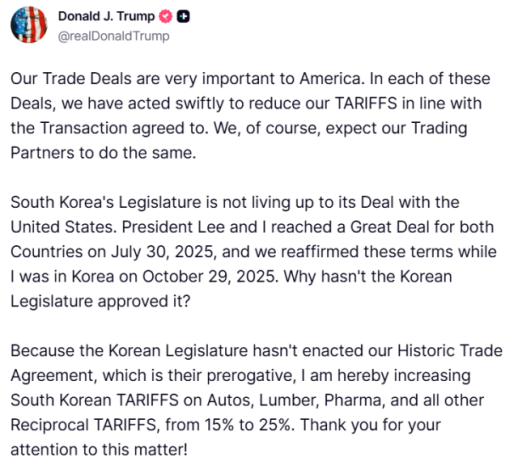 Trump threatens to raise tariffs back to 25%, blaming Seoul for delaying tariff deal SEOUL, January 27 (AJP) -U.S. President Donald Trump said Monday he is raising tariffs on a wide range of South Korean goods from 15 percent to 25 percent, citing delays in South Korea’s National Assembly approving a bilateral trade agreement reached last year. “Because the Korean Legislature hasn’t enacted our Historic Trade Agreement, which is their prerogative, I am hereby increasing South Korean TARIFFS on Autos, Lumber, Pharma, and all other Reciprocal TARIFFS, from 15% to 25%,” Trump wrote in a post on Truth Social. It was not immediately clear when the higher tariffs would take effect. Trump said the decision followed South Korea’s failure to ratify a trade package he described as a “Great Deal” reached with President Lee Jae Myung on July 30, 2025, and reaffirmed during his visit to Korea late October. The White House has yet to confirm Trump's remark. Seoul also has not responded. The October understanding was billed by the White House at the time as a sweeping $350 billion trade and investment framework, aimed at expanding U.S. exports and investment flows while easing tariff and non-tariff barriers between the two allies. The package reportedly covered market access in autos, pharmaceuticals and industrial materials, alongside commitments related to supply chains, energy cooperation and long-term Korean investment in the United States. “South Korea’s Legislature is not living up to its Deal with the United States,” Trump wrote, questioning why the agreement had yet to be enacted despite what he called repeated reaffirmations at the leadership level. The tariff hike directly affects key Korean export sectors. Autos are expected to be among the hardest hit, with Hyundai Motor Group the largest importer of South Korean-made vehicles into the U.S. market. Pharmaceuticals and industrial materials such as lumber were also singled out in Trump’s post. A senior-level U.S. delegation is expected to visit Seoul to negotiate the details to the factsheet released in November that differs in some areas with Seoul's separate announcement on the deal. 2026-01-27 07:34:29
 -
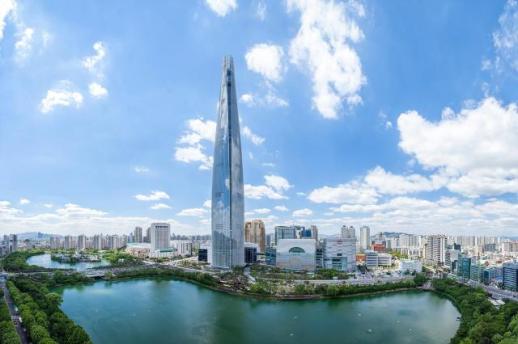 Regulator blocks merger plan for Korea's leading car rental firms, citing monopoly risks SEOUL, January 26 (AJP) - South Korea’s Fair Trade Commission (FTC) has blocked a proposed merger between Lotte Rental and SK Rent-a-Car, the country’s largest and second-largest rental-car operators, citing concerns that the deal would weaken competition and lead to higher prices. The commission said on Monday it had issued such an order on a filing by private equity firm Affinity Equity Partners to acquire a 63.5 percent stake in Lotte Rental. Affinity acquired SK Rent-a-Car in August 2024 and in March last year agreed to buy Lotte Rental shares held by Hotel Lotte and other shareholders for 1.8 trillion won, subsequently submitting a merger notification to regulators. “The transaction would place the two leading competitors in the rental-car market under the control of a single private equity firm,” the FTC said in a press release. It added concerns were “very large” that competition would be restricted, including through price increases. The FTC said the combined entity would command a 38.3 percent share of the long-term rental-car market and would also become the dominant player in short-term rentals. By contrast, the third-largest short-term rental operator holds just over a 3 percent share, raising the risk of a market structure characterized by “one giant firm versus many small operators,” it said. The commission also said its decision was based strictly on concerns that a private equity firm could dominate the top two operators, expand market power and later seek a high-priced resale, potentially distorting the market. The FTC decision is expected to complicate Lotte Group’s efforts to raise cash. The conglomerate has been seeking to sell the noncore Lotte Rental unit amid weak performance and liquidity strains at key affiliates, including Lotte Chemical and Lotte Engineering & Construction. With the 1.8 trillion won inflow no longer expected, the group will need to revise its broader financial restructuring plans. The decision also undermines Affinity’s exit strategy. The firm had planned to merge SK Rent-a-Car and Lotte Rental to strengthen market dominance, boost corporate value and eventually sell the combined business. It must now pursue a standalone strategy to enhance SK Rent-a-Car’s competitiveness or explore alternative structures to acquire Lotte Rental. * This article, published by Aju Business Daily, was translated by AI and edited by AJP. 2026-01-26 17:34:23
 -
 A star rising quietly from the K-pop margins with soothing voice -Hanroro SEOUL, January 26 (AJP) – While the global spotlight is fixed on BTS’s long-awaited comeback and K-pop’s high-profile Grammy ambitions, a very different ascent is unfolding on Korea’s domestic charts — quieter, slower, but no less decisive. Hanroro, an indie singer-songwriter once known mainly through word of mouth, has emerged as one of the most talked-about new voices of the year. Often described as a “Gen Z rock star,” she has climbed steadily rather than explosively, edging her way toward the top of the charts on the strength of songs that linger rather than shout. Her track “Landing in Love,” first released last year, entered Melon’s weekly Top 100 in October and continued its slow burn into the new year, reaching No. 2 for the January 12–18 tracking period. In an industry accustomed to instant virality, the song’s rise feels almost old-fashioned — built on repeat listens, shared clips and emotional recognition. The turning point came last July, when Hanroro appeared on Mnet’s live performance program Live Wire as a featured artist chosen by JANNABI. Her restrained delivery of “Landing in Love” — understated, controlled, and quietly raw — struck a chord. A clip of the performance later surpassed 4.5 million views on YouTube, fueling organic discovery and pushing streaming numbers higher. The pattern was familiar to those who had followed her earlier. Her debut track, “Let Me Love My Youth,” gained early traction after BTS leader RM shared the song on social media — a brief endorsement that introduced her music to a far wider audience. Since then, a combination of celebrity mentions, broadcast exposure and online circulation has continued to widen her reach, without diluting the intimacy of her sound. At the heart of Hanroro’s appeal is songwriting that speaks plainly about youth — its tenderness, its bruises, and its quiet resilience. Drawing on her background in Korean literature, she writes her own lyrics, translating the anxieties of growing up, the ache of relationships and the uncertainty of becoming into language that feels both simple and carefully chosen. Listeners quote her lines, replay her songs, and describe them in personal terms. “Your music always feels familiar, warm and touching,” one fan wrote online. “Let Me Love My Youth,” which uses spring as a metaphor for emotional uncertainty, and “Landing in Love,” a reflection on life after a breakup, have resonated deeply with teens and young adults navigating similar terrain. The Korean Music Awards has taken note as well, praising her poetic lyrics and restrained rock arrangements for capturing a subdued nostalgia that defines much of contemporary youth culture. Hanroro’s storytelling now extends beyond music. Her debut novel, JAMONG SALGU CLUB, has drawn renewed attention amid the success of “Landing in Love,” ranking No. 4 on Kyobo Bookstore’s overall bestseller list in the second week of January. An EP of the same title has also gained traction, with the track “0+0” breaking into Melon’s daily Top 10 — evidence that her audience is consuming her work not as isolated songs or books, but as a connected emotional universe. One reader described the novel as a book that made them cry — and then think about how people comfort one another. “You may not know it yet. But the more you cry out that you want to live, the more you will begin to want to live,” Hanroro writes in Jamong Salgu Club. A similar gentleness runs through her song “0+0,” which repeats the line, “I won’t abandon you — you won’t either, right?” These are not dramatic statements, but quiet words that stay with the listener. For many young adults in South Korea, where youth suicide rates remain among the highest in developed countries, such lines have resonated as small but meaningful forms of comfort, offering presence rather than answers. Her rise also reflects a broader shift in Korea’s music industry, where indie artists are increasingly developed with K-pop-style systems. Hanroro’s agency, Authentic, applied structured training and branding strategies more commonly associated with idol acts, while allowing her creative voice to remain intact. Critics note that her gentle sound, coupled with her work across music and literature, has made her especially appealing to young listeners searching for alternatives to the mainstream. That growing engagement is visible beyond charts and reviews. Merchandise tied to Hanroro sold out across all items through A0, a production brand celebrating its second anniversary this year — a sign that casual listeners are becoming committed fans, invested not just in songs but in the world surrounding them. On social media platform X, listeners share lyric excerpts, personal reflections and late-night listening rituals tied to tracks like “0+0” and “Landing in Love,” reinforcing the sense of a shared emotional language. Hanroro will take another symbolic step on March 21, when she holds a solo concert at Kintex in Goyang — on the same day BTS stages its long-awaited comeback show at Gwanghwamun. It is an almost poetic coincidence: the industry’s biggest name reclaiming the center, while a quieter voice continues to rise just offstage, on her own terms. 2026-01-26 17:23:59
 -
 Lunar New Year's preparation slightly eases from last year SEOUL, January 26 (AJP) - The cost of preparing an ancestral table at traditional markets ahead of the Lunar New Year holiday has been surveyed at 296,500 won(about 205 dollars), slightly lower than last year. According to a survey conducted by Korea Price Information (KPI), a specialized price research agency, on Jan. 25, the cost for a four-person family declined 1.98% year-on-year at traditional markets. Large discount stores also saw a 0.64% drop to 406,880 won(about 282 dollars) compared to the previous year. Prices for fruits and vegetables including pears, jujubes, radishes, and cabbage decreased. This year's Seollal falls on Feb. 17, marking the first day of the first lunar month and the beginning of the new year. It is one of Korea's major holidays, during which families typically perform ancestral rites. 2026-01-26 17:22:12
 -
 KOSDAQ steals the day in subdued Asian markets SEOUL, January 26 (AJP) - Korea’s secondary KOSDAQ stole the spotlight Monday, surging more than 7 percent as most Asian equities retreated, in a striking display of risk appetite concentrated in higher-beta names. The tech-heavy index jumped 7.09 percent — its biggest daily gain in more than two years — to close at 1,064.4 and return to 1,000-mark in four years. The sharp advance triggered a temporary trading halt under the sidecar mechanism at 9:59 a.m., as program buying accelerated early in the session. Institutions led the charge, snapping up a net 2.6 trillion won worth of shares, while foreign investors added 431.4 billion won. Retail investors were net sellers of 2.91 trillion won, underscoring a rapid rotation of capital out of large-cap defensives and into growth-oriented names. In contrast, the main KOSPI fell 0.8 percent, or 40.5 points, to 4,949.6. The benchmark briefly touched an intraday record high of 5,023.8 before selling pressure intensified in the afternoon, dragging the index below its session low. The pullback followed a short-lived rally that had carried the market higher over the previous week. The KOSPI 200 slid 1.0 percent to 720.04, weighed down by heavy losses in automakers and semiconductor stocks. On the main board, foreign investors sold 158.7 billion won ($110 million), while institutions offloaded 1.54 trillion won. Retail investors absorbed the selling, buying 1.72 trillion won. Currency markets added another layer of volatility. The dollar fell sharply against the won, sliding 14.1 won to 1,441.2, tracking gains in the Japanese yen amid reports that Washington is increasingly tolerant of stronger currencies among key East Asian allies, including South Korea, Japan and Taiwan. Sector performance reflected the risk-on tilt. Non-ferrous metal stocks led gains, rising 11.9 percent. Korea Zinc surged 14.4 percent to 1,807,000 won on rising global silver prices and expectations of stronger earnings, while Sam-A Aluminum climbed 12.8 percent and Hyundai BNG Steel advanced 11.0 percent. Battery and platform stocks also posted strong gains. EcoPro soared 23.0 percent to 130,200 won, while Naver rose 2.4 percent to 272,500 won. Samsung SDI added 3.8 percent to 387,000 won. By contrast, logistics and transport-related shares lagged, with the sector falling 3.2 percent. CJ Logistics dropped 3.5 percent, and Hyundai Glovis slipped 3.4 percent. Among large-cap losers, Hyundai Motor fell 3.4 percent, while SK hynix declined 4.0 percent. Elsewhere in the region, markets were broadly weaker. Japan’s Nikkei 225 slid 1.8 percent, while China’s Shanghai Composite edged down 0.09 percent, reinforcing the contrast between Korea’s speculative surge and a cautious regional backdrop. 2026-01-26 17:19:10
 -
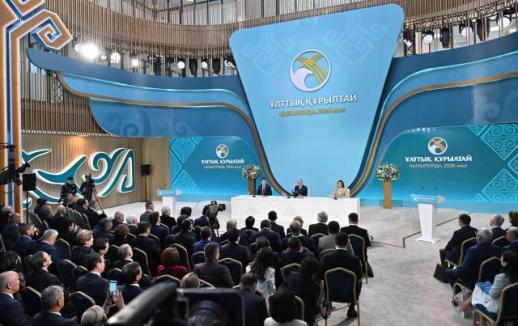 Kazakhstan president proposes vice presidency and unicameral parliament in major reform push SEOUL, January 26 (AJP) - President Kassym-Jomart Tokayev announced a major overhaul of the national government on January 20, proposing the creation of a vice presidency and a transition to a single-chamber legislature. Speaking at the National Kurultai in Kyzylorda, the president outlined a series of constitutional amendments intended to modernize the state system. The proposal includes the establishment of a Vice President who would represent South Korea's neighbor on the international stage and handle coordination with the parliament. President Kassym-Jomart Tokayev stated that while the reform introduces new leadership roles, the country will remain a presidential republic. The plan calls for the current two-house system to be replaced by a unicameral parliament known as the Kurultai. Under this model, the legislature would consist of 145 deputies elected for five-year terms through a proportional representation system. The reform would also grant the parliament the authority to approve judges for the Supreme Court and members of the Central Election Commission. Regarding political stability, the president proposed strict rules for succession. If a president leaves office early, a national election must be held within two months to ensure the next head of state is chosen through a public vote. On foreign policy, President Kassym-Jomart Tokayev advocated for a pragmatic approach focused on national interests. He noted that diplomacy should serve as a tool for compromise rather than confrontation. He also announced the creation of the Khalyk Kenesi, or People's Council, an advisory body that will have the right to suggest new laws. Economic priorities mentioned in the address included the expansion of artificial intelligence and the development of high-capacity data centers. The president also discussed Kazakhstan's goal of becoming a primary transport hub for the Middle Corridor, which links trade routes between the East and the West. According to a report from the Astana Times on January 24, 2026, a Constitutional Commission has already been formed to draft these amendments for a planned national referendum. 2026-01-26 16:54:34
 -
 Team Korea in Canada under watch as Korea's defense manufacturing moves to global center SEOUL, January 26 (AJP) -As countries accelerate rearmament amid a more inward-looking U.S. security posture, South Korea’s defense manufacturing capacity has moved to the center of global procurement — a shift underscored by Seoul’s decision to dispatch a high-level delegation to Canada to back a $44 billion submarine bid. Presidential Chief of Staff Kang Hoon-sik departed for Canada on Monday, leading a delegation that includes Industry Minister Kim Jung-kwan and Defense Acquisition Program Administration head Lee Yong-cheol. The visit is aimed at supporting Seoul’s bid for the Canadian Patrol Submarine Project (CPSP), estimated at around 60 trillion won ($44 billion). Joining the delegation are Hyundai Motor Group Chairman Chung Eui-sun and Hanwha Group Vice Chairman Kim Dong-kwan — a lineup that underscores how seriously Seoul views the opportunity and highlights the growing role of state-industry coordination in major defense contracts. Before boarding his flight at Incheon International Airport, Kang told reporters the competition has narrowed to two contenders — South Korea and Germany. “Germany is a global manufacturing powerhouse in automation and advanced chemical engineering,” Kang said, adding that “given how South Korea inherited core submarine technologies from Germany in our early development stages, the situation will not be easy.” Germany, which recently lost Poland’s submarine tender, is said to be approaching the Canadian competition with exceptional intensity. Nevertheless, Kang emphasized the scale of the project and its implications for South Korea’s industrial base. “This is the largest defense procurement project currently underway internationally,” he said. “If we win, the domestic production ripple effect alone would exceed 40 trillion won, creating more than 20,000 jobs and securing work for over 300 partner companies.” Manufacturing capacity meets strategic demand The CPSP has emerged as a test case for how defense procurement is evolving globally. Canada is seeking up to 12 diesel-electric submarines of roughly 3,000 tons, along with decades of maintenance, repair and overhaul (MRO). Ottawa is also reportedly requiring part of the project to be carried out at a new local shipyard, while allowing initial units to be built in the contractor’s home country. Such conditions favor suppliers with large-scale manufacturing capacity and the ability to integrate local production and long-term sustainment — areas where Korea has increasingly differentiated itself. Global demand for weapons has surged as allies face pressure to rebuild inventories as the United States urges partners to shoulder more of their own defense burden under an America-First security policy. In Europe, rearmament has accelerated, but fragmented industrial structures and capacity bottlenecks have limited supply. Korea’s ability to produce and deliver complex systems at scale has elevated its standing from a fast-growing exporter to a core manufacturing hub in the global defense market. Historical ties and diplomatic signaling On Sunday, the eve of his departure, Kang paid tribute to Canadian soldiers who fought in the Korean War at the War Memorial of Korea in Seoul. He laid a wreath at the monument honoring Canada’s fallen and observed a moment of silence. Though Korea and Canada are not formal military allies, the two countries have expanded security cooperation under their “Comprehensive Strategic Partnership.” Last October, Seoul hosted Canadian Prime Minister Mark Carney, and the two governments signed a Military Information Security Agreement, laying the groundwork for deeper defense industrial collaboration. A bid shaped by geopolitics Experts say the CPSP has become more than a procurement contest, reflecting broader shifts in the global security architecture. “Canada–South Korea relations have long been strong,” said Daniel Béland, professor of political science at McGill University. “More than 500 Canadians died during the Korean War defending the South against the North’s aggression, and since then, Canada has played a direct role in the UN Command.” Béland said ties have deepened since formal diplomatic relations were established in 1960. “Economic and strategic ties have increased since the advent of the CKFTA trade agreement a decade ago,” he said. “Given the current geopolitical and trade uncertainties created by the second Trump administration, we’re likely to see even stronger security and economic ties between our two countries — in line with the multilateral collaborative strategy outlined by Prime Minister Carney in his recent Davos speech.” He added that “the very fact that a South Korean company was shortlisted for the CPSP has already brought the two countries closer together,” and that a win by the KSS-III design would deepen cooperation across both economic and security fields. Canada’s recalibration and Europe’s signal Patrick Lennox, a Canadian politician from the ruling Liberal Party, described the submarine project as central to Ottawa’s push to strengthen maritime capabilities and diversify partnerships. “Canada’s participation in the Korean conflict hearkens back to a time when our foreign policy could leverage multilateral institutions like the UN to attempt to constrain and moderate American decisions,” Lennox said. “With those days squarely behind us, we are seeking to diversify and strengthen our global partnerships and rebuild our military capability.” He called the CPSP “a key feature of this generational investment,” linking it to Canada’s Indo-Pacific strategy. “Canada is looking to open new opportunities for security cooperation and to strengthen stability on the Korean Peninsula,” Lennox said. “At a strategic level, geopolitical imperatives are pushing our two democratic nations closer together as we work towards enhancing middle power alliances and strategic partnerships in the face of unconstrained great power politics.” Beyond submarines Trade officials say Canada has asked both South Korea and Germany for broader industrial commitments as part of offset negotiations, with Ottawa favoring local investments and supply-chain integration. Kang’s entourage is therefore expected to pursue parallel discussions on industrial cooperation. Hyundai’s Chung and Hanwha’s Kim are reportedly exploring local partnerships aligned with Canada’s manufacturing and climate priorities. Public diplomacy is also part of the visit. Seoul plans cultural and commemorative events highlighting historic ties, including a memorial marking 70 years since the death of Oliver R. Avison, a Canadian medical missionary and founder of Severance Hospital. A musical dramatizing the work of early Canadian missionaries in Korea is scheduled to coincide with the delegation’s stay. 2026-01-26 16:13:20
 -
 Hongcheon ice fishing festival ends with a splash SEOUL, January 26 (AJP) -The arctic cold snap did not spoil the fun at the 2026 Hongcheon Kkongkkong Ice Fishing Festival, which drew about 270,000 visitors to the Hongcheon River area and injected fresh vitality into the local economy. Despite the severe weather, food stalls and sales of local agricultural products reached record highs. The festival earned positive reviews for enhancing its quality as Hongcheon’s signature winter tourism attraction by combining a wide range of experiential programs centered on the locally renowned “Hongcheon Ginseng Trout.” Highlights included ice fishing, pontoon fishing, indoor fishing and bare-hand ginseng trout catching. 2026-01-26 16:11:52
 -
 In icy Seoul, the Han River slows to a hush SEOUL, January 26 (AJP) -Under the grip of Arctic air, sections of Seoul’s great waterway have begun to harden — ice floes drifting in silence, icicles clinging to embankments where the river meets the city. What is usually a moving ribbon of steel-gray water now carries the weight of winter, visible and unmistakable. A severe cold wave continues to blanket South Korea as northerly winds sweep down the peninsula, driving temperatures sharply lower and pushing wind chills well below what thermometers suggest. Cold wave advisories remain in effect for the Seoul metropolitan area, as well as parts of central and inland southeastern regions. The cold is expected to linger through Monday. Morning lows are forecast to fall as far as minus 15 degrees Celsius, with daytime highs struggling between minus 3 and 8 degrees. Even under clear skies, the air bites. Along the Han, the transformation is stark. Ice forms where currents slow. Frost traces railings and reeds. The river does not freeze all at once — it stiffens in fragments, mirroring the way winter settles over the city: gradually, insistently. Authorities have urged the elderly and young children to limit outdoor activities as subzero mornings near minus 10 degrees Celsius persist in central regions. Elsewhere, dry air and strong winds have raised wildfire concerns, particularly in the mountains of Gangwon Province and in coastal and southern areas. Light snow or rain is expected in parts of the west coast and Jeju Island, but across the country, winds will remain strong — sharpening the cold, carrying it deeper into streets, bridges and riverbanks. For now, the Han flows on, slowed but not stilled — a frozen reminder that winter, at its peak, reshapes even the most familiar landscapes. 2026-01-26 16:02:43