
Journalist

AJP
-
 CES 2026: Inside how China has leapfrogged in AI robots — self-sufficiency LAS VEGAS, January 09 (AJP) - From synchronized dancing and kung-fu demonstrations to boxing, deliveries and cleaning, Chinese robots were ubiquitous at the world's largest consumer electronics show in Las Vegas this week. China, which has already begun rolling humanoid robots off assembly lines and into retail stores and homes in various forms and scales, used CES 2026 to show the United States and the wider world just how far it has moved ahead in physical AI. Of the 38 companies participating in CES's humanoid robotics category, 21 were Chinese — ranging from established players such as Unitree Robotics to newer entrants including AgiBot and Noetix Robotics. The self-sufficiency drive comes as Chinese firms accounted for the vast majority of the roughly 13,000 humanoid robots shipped globally in 2025, according to research firm Omdia. Shanghai-based AgiBot topped the list with an estimated 5,168 units, followed by Unitree Robotics and UBTech Robotics. Except for Nvidia chips, everything else is homemade Despite the push for deep vertical integration, one component remains a near-universal import: the processor. An AgiBot employee told AJP that the company uses Nvidia chips as the computing brain for its robots — an irreplaceable component for every machine standing, spinning or twirling on the show floor. The company trains its robots at a data center in Shanghai, combining synthetic and real-world data to develop the artificial-intelligence models that power its humanoids. Beyond the processor, however, AgiBot manufactures nearly all components in-house, excluding only small standardized parts such as bolts and nuts. The reliance on Nvidia extends across China's robotics landscape. Unitree, Galbot, Engine AI and UBTech have all adopted Nvidia’s Jetson platform, with many becoming early users of the Jetson AGX Thor modules launched in August 2025. From joints to guards At UniX AI's booth, the vertical-integration story ran even deeper. Jerry Wu, the company's chief financial officer, said the Suzhou-based firm manufactures everything from joint mechanisms to the internal components of its robotic hands. The only exceptions are standardized parts, including optical sensors. "We developed everything by ourselves," Wu said. "Even the very inside of the joints." For processors, UniX AI also relies on Nvidia chips. The company has developed a two-layer AI model architecture: one layer functions as the "brain," interpreting situations and making decisions, while the other controls physical movement. Its Wanda series models are already generating revenue in China. Hotels have deployed the robots for housekeeping tasks such as bed-making and cleaning, while security applications use the machines to patrol buildings. "These are general models," Wu said. "They can even make alcoholic drinks as well." Cost pressure drives self-sufficiency Galaxea Dynamics, a Beijing-based company whom also has a office in San Jose, follows a similar playbook. Lei Yu, the company's chief business officer, said manufacturing is done entirely in-house — down to the motors — with Nvidia processors used for computing. "We build our own robots in-house," Yu said. "We design and control the body and manufacture everything ourselves." The rationale is as much economic as it is strategic. Training robots for manipulation tasks requires enormous volumes of real-world data, which in turn demands large fleets of robots to collect it. "To have a lot of data, you have to walk on it. So we need to have a lot of robots," Yu said. "And to have a lot of robots, it can be extremely expensive. That's why we use our own motors — to reduce costs at the data-collection stage." Galaxea Dynamics plans to bring its latest model to market between March and September this year, with educational discounts available. The company has partnered with research institutions to deploy about 200 robots. Synthetic data, real deployment Founded in May 2023, Galbot has positioned itself as one of the most valuable embodied-AI companies in the humanoid robotics sector. Yvonne Yuan, head of overseas marketing, said the company produces most components — from arms to wheels — using proprietary technology. Galbot was among the first globally to adopt Nvidia's Jetson Thor chipset. "It's all our own proprietary technology, including the hardware," Yuan said. Galbot's training strategy reflects a broader industry shift toward efficiency. About 90 percent of its training data is synthetic, generated in simulators, with only about 10 percent derived from real-world environments. "We do not rely so much on real-world data," Yuan said. "We train them in a simulator, then fine-tune using real-world data." Its G1 robots are already deployed in factories and warehouses across China, sorting vehicle parts and assisting production-line workers. The machines can operate for up to eight hours on a single charge and automatically return to charging stations when battery levels drop. A heavier model is in development. The current G1 can lift between 10 and 50 kilograms using both hands. The upcoming version will be able to lift at least 32 kilograms and feature a redesigned appearance, Yuan said. The bigger picture The push for vertical integration aligns with Beijing's broader industrial policy. China's Ministry of Industry and Information Technology has set a goal of achieving global leadership in humanoid robotics by 2027. The strategy appears to be gaining traction. ABI Research forecasts the global humanoid robot market will reach $6.5 billion by 2030, with China's state funding and regulatory environment positioning domestic firms for outsized growth. Yet the reliance on Nvidia processors highlights a persistent vulnerability. Washington restricts Nvidia from exporting its most advanced chips to China, though the modules currently used in robotics applications remain available. For now, China's robotics industry is betting that controlling everything else — from the hands that grasp to the motors that move — will be enough to win the race. 2026-01-09 12:56:54
 -
 Asian stocks mostly in the positive on chip and robotics expectations SEOUL, Jan. 9 (AJP) —Asian stocks kept to the positive despite profit-taking offensive Friday on halo effect from regional chip and robotics strengths. The KOSPI swung back and forth the positive and negative as foreigners took profits. As of11;30, the KOSPI was 0.4 percent higher at 4,571.36 and the KOSDAQ nearly flat at 944.75. Retail investors were net buyers of about 615.1 billion won ($458 million), while institutions bought roughly 277.5 billion won. Foreign investors, however, sold around 928.4 billion won, weighing on the broader market. Among major stocks, Samsung Electronics fell 1.1 percent to 137,200 won, while SK hynix slid 1.0 percent to 739,000 won, reflecting profit-taking after their recent rally. LG Electronics sank 4 percent after it reported its first quarterly operating loss in the fourth quarter of 2025. By contrast, defense shares extended gains. Hanwha Aerospace jumped 6.7 percent to 1,163,000 won ($870) on sustained buying tied to expectations of increased global defense outlays. Hyundai Motor rose 0.6 percent to 348,000 won, bucking the broader market weakness. Hanwha Ocean gained 0.7 percent to 130,900 won, while Doosan Enerbility climbed 0.4 percent to 84,300 won. In internet and industrial names, NAVER added 0.2 percent to 254,500 won, and Samsung Heavy Industries rose 0.4 percent to 27,900 won. Entertainment stocks moved lower as investors reassessed near-term expectations following recent volatility linked to China-related policy signals. HYBE fell 1.5 percent to 330,500 won, while JYP Entertainment slid 2.5 percent to 69,600 won. SM Entertainment dropped 1.7 percent to 115,900 won, and YG Entertainment declined 0.4 percent to 67,900 won. Elsewhere in Asia, Japan’s Nikkei 225 rose 0.7 percent in morning trade, rebounding from the previous session as buying interest returned to large-cap exporters. China’s Shanghai Composite was marginally higher, while Hong Kong shares also traded firmer in early dealings. 2026-01-09 11:45:57
 -
 Lee to travel to Japanese PM's hometown for summit next week SEOUL, January 9 (AJP) - President Lee Jae Myung will visit to Japan's historic city of Nara next week for a summit with Japanese Prime Minister Sanae Takaichi, Cheong Wa Dae said on Friday. Lee is scheduled to leave for Nara, Takaichi's hometown and Japan's ancient capital during its early imperial era, for a summit with her, followed by a dinner next Tuesday. During his two-day trip to the island country, Lee is expected to discuss various regional and global issues with her as well as ways to expand practical cooperation, as part of shuttle diplomacy aimed at strengthening bilateral ties. Lee will then hold a meeting the following day with South Korean expats there before returning home. 2026-01-09 11:12:19
 -
 UPDATE: Korea's LG Electronics slips into first Q4 loss in a decade despite record 2025 sales * Updated with additional information SEOUL, January 09 (AJP) - LG Electronics posted record annual revenue in 2025 but swung to an operating loss in the fourth quarter for the first time in a decade, weighed down by weaker display demand and rising costs tied to higher memory prices and its transition toward AI-driven products. In earnings guidance released Friday, the South Korean home-appliance and consumer electronics maker said consolidated revenue for the full year reached 89.2 trillion won ($66 billion), up 1.7 percent from a year earlier and the highest level on record. Operating profit for the year totaled 2.48 trillion won, down 27.5 percent from 2024. For the October–December period, revenue came to 23.85 trillion won, but the company reported an operating loss of 109.4 billion won, marking its first fourth-quarter loss since 2015. LG said the quarterly loss was mainly due to a slower-than-expected recovery in demand for its display products and higher marketing spending amid intensifying competition. The company also cited one-off costs related to a voluntary retirement program in the second half, saying the measures are expected to help ease fixed-cost burdens over the medium to long term. Shares of LG Electronics closed down 3.5 percent at 89,000 won on Friday. LG Electronics said it will release finalized earnings, including net profit and a detailed breakdown by business division, later this month. 2026-01-09 11:09:42
 -
 Final hearing underway for impeached president's insurrection charge SEOUL, January 9 (AJP) - The final hearing in disgraced former President Yoon Suk Yeol's trial over charges of insurrection and abuse of power is underway in southern Seoul on Thursday, with attention focused on the sentence prosecutors are expected to seek. The hearing for Yoon's botched Dec. 3 declaration of martial law last year began at the Seoul Central District Court around 9:20 a.m. It is set to be followed by related cases involving seven other officials, including former Defense Minister Kim Yong-hyun and former chief of National Police Agency Cho Ji-ho. When it comes to the insurrection charge, one of Yoon's multiple charges related to the debacle, there are only two possible penalties: death or life imprisonment, with or without forced labor. With the country having not carried out the death penalty since 1997, many anticipate prosecutors will request a life sentence. After hearing final statements from all parties including prosecutors and defendants throughout the day, the court is expected to deliver its verdict in early February. 2026-01-09 10:54:04
 -
 OPINION: Religion is not sanctuary For centuries, religion has served as a moral compass, illuminating the inner lives of individuals and offering communities a shared ethical horizon. Through faith, people have asked the most enduring human questions—about meaning, suffering, and responsibility to one another. At its best, religion has nurtured solidarity and restrained power. But something changes when religion begins to orbit power and capital. Faith loses its sacred gravity, and institutions begin to mistake themselves for sanctuaries beyond scrutiny. Recent allegations of church–state entanglement in South Korea are not merely about one group or another. They raise a deeper and more uncomfortable question: how has society allowed religion to drift from conscience into privilege? One point must be stated plainly. Religion is not a sanctuary. Religious institutions are human institutions. They operate in society, influence politics, shape public opinion, and mobilize resources. As such, they cannot be exempt from the basic principles that govern any public actor—transparency, accountability, and equality before the law. Freedom of religion is a constitutional right, but it exists to protect the inner freedom of belief, not to shield opaque governance, financial secrecy, or political leverage. The moment a religious organization steps into the public sphere, it must also submit to public standards. This is not hostility toward faith. It is the foundation of a democratic order. The controversies surrounding certain religious movements—often criticized for doctrinal exclusivity, organizational opacity, and social conflict—bring this tension into sharp relief. Not every accusation is necessarily true, and vigilance against prejudice or moral panic is essential. Yet it is equally unconvincing to dismiss sustained and credible concerns as mere persecution. The answer lies neither in witch hunts nor in blind deference, but in calm fact-finding and the rule of law. If religion is to reclaim moral authority, it must first apply to itself three basic principles. The first is truth. Truth withers in secrecy. Beliefs may contain mystery, but governance, finances, and public engagement must be open to scrutiny. The second is freedom. Faith must be chosen, not coerced. Any religion that suppresses questions or disciplines doubt has already departed from the essence of belief. The third is justice. Religion must stand closer to the vulnerable than to power. The moment faith begins to bargain with political authority, it forfeits its moral credibility. These principles are not aimed at one denomination or tradition. They are questions every religious community must ask of itself. Whether church, temple, cathedral, or shrine, the path to restored trust is not complicated: openness, self-examination, and humility. Looking ahead, this challenge becomes even more urgent. In an age of artificial intelligence—where machines increasingly replace human labor and even cognitive tasks—the role of religion may grow, not shrink. Technology delivers efficiency, but it cannot explain meaning or purpose. Here, religion could once again become a refuge for human dignity. But only if it is open rather than authoritarian, spiritual rather than institutional. Korea, in this respect, holds a distinctive cultural asset. The ancient ideals of Hongik Ingan—to benefit humanity—and Jaesei Ihwa—to harmonize the world—express a universal ethic rooted in Korean tradition. They do not belong to any single faith. When combined with Christian love, Buddhist compassion, Confucian benevolence, and Taoist respect for nature, they suggest the possibility of a shared moral language—a Korean model of spirituality oriented toward maturity rather than expansion. Such spirituality would measure success not by numbers, but by depth. Not by conversion, but by healing. Not by institutional size, but by the quality of human life it helps sustain. Religion is not a sanctuary. But the values religion exists to protect—truth, freedom, and justice—remain sacred. A faith rebuilt on transparency and responsibility, one that bridges humanity, nature, technology, and meaning, is not only a task for Korean religion. It is an invitation to the world. *The author is the President of Global Economic and Financial Research Institute (GEFRI) 2026-01-09 09:48:44
 -
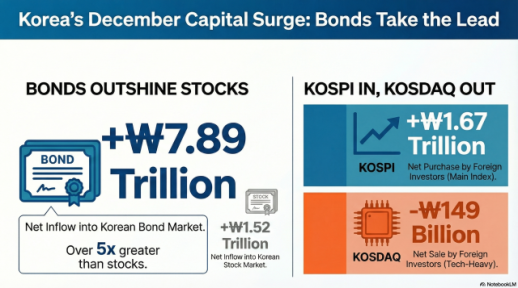 Foreign investors' appetite for South Korean stocks recovers SEOUL, Jan. 9 (AJP) - Foreign investors returned to the South Korean stock market, net purchasing over 9 trillion won in December alone, according to data released by the Financial Supervisory Service (FSS) on Friday. Foreigners snapped up 1.52 trillion Korean won (US$1 billion) in stocks and 7.89 trillion won in bonds, marking a decisive return after a brief retreat in November last year. The appetite was concentrated on the KOSPI, with net purchases totaling 1.67 trillion won, even as the tech-heavy KOSDAQ saw a modest net outflow of 149 billion won. The renewed interest lifted the total value of foreign-held stocks to 1,326.8 trillion won by the end of the year, up 134 trillion won from the previous month. Foreign holdings now account for 30.8 percent of the total market capitalization of the South Korean stock market. European investors led the buying spree with a net 1.6 trillion won, followed by North American and Asian investors at 400 billion won and 300 billion won, respectively. By country, France and the U.K. were the most aggressive buyers, with net purchases of 1 trillion won and 800 billion won. Conversely, Singapore and the Cayman Islands offloaded 900 billion won and 600 billion won. The U.S. remains the largest stakeholder, holding 546 trillion won worth of stocks or 41.2 percent of all foreign-owned shares. European investors follow with 417 trillion won, while Asian and Middle Eastern holdings stand at 182.4 trillion won and 22.9 trillion won. The bond market also saw a robust influx of capital with foreign investors purchasing a net 17.53 trillion won. Even after 9.64 trillion won in matured holdings, net investment amounted to 7.89 trillion won. This pushed total foreign bond holdings to 328.5 trillion won, up 6.9 trillion won from November, accounting for 11.9 percent of all outstanding listed debt. European investors led foreign bond inflows with 2.5 trillion won, followed by the Americas at 1.7 trillion won and Asia at 1.1 trillion won. In terms of total holdings, Asian investors maintain the largest share at 135.9 trillion won, followed by European holders at 120.6 trillion won. Most of the investment went into government bonds and Monetary Stabilization Bonds (MSBs), which saw net purchases of 3.7 trillion won and 1.9 trillion won, respectively. As of the end of last year, foreign investors held 297.1 trillion won in government bonds and 31.4 trillion won in other bonds. 2026-01-09 09:38:15
 -
 CES 2026: Hyundai Motor Group unveils in-house AI chips for robotics LAS VEGAS, January 09 (AJP) -South Korea’s Hyundai Motor Group has developed an in-house artificial intelligence chip for its mobility platform, extending its ambitions in robotics and so-called “physical AI.” Hyundai Motor and Kia said they have completed development of an on-device AI chip for robots and are preparing for mass production, marking a strategic shift toward greater vertical integration in next-generation mobility technologies. The automakers’ Robotics Lab said Thursday, local time, that the chip was co-developed with Korea-based AI semiconductor startup DeepX and unveiled at CES 2026 Foundry in Las Vegas. CES Foundry is a newly introduced program at this year’s CES, designed to foster broader discussion around artificial intelligence, blockchain and quantum technologies. According to the lab, the on-device AI chip consumes less than 5 watts of power and is capable of real-time data processing for recognition and decision-making. Unlike cloud-based AI systems, it operates independently of network connectivity, allowing robots to function reliably in environments where connections are unstable or unavailable, such as underground parking garages and logistics centers. The architecture also enables faster response times and offers security advantages. Hyundai Motor–Kia said the chip supports the development of robots optimized for specific services, rather than a one-size-fits-all design. By embedding intelligence directly on the device, the companies aim to improve reliability while reducing dependence on external infrastructure. Hyun Dong-jin, managing director and head of the Hyundai Motor–Kia Robotics Lab, said the lab is pursuing a vision of “robotizing space” to realize physical AI — intelligent machines that can perceive, reason and act autonomously in real-world environments. An internally developed AI controller has already been applied since June 2024 to facial-recognition systems and the DAL-e delivery robot at the Factorial Seongsu complex in Seoul to validate performance and quality. The automakers said the partnership combines the Robotics Lab’s AI and software capabilities with DeepX’s semiconductor expertise, allowing them to balance cost efficiency, performance and supply-chain stability. Securing an optimized chip solution early is expected to support large-scale robot production and reduce exposure to external supply risks. Hyundai Motor–Kia emphasized that robots must ultimately operate in everyday settings to address structural challenges such as population aging, industrial safety risks and labor shortages. The new on-device AI chip is expected to serve as a core building block for a stable physical AI infrastructure. The group is seeking to leverage the automotive value chain it has built over decades to enable mass production of robots, while deepening cooperation with South Korea’s battery industry. Pilot projects are also under way in environments such as airports and hospitals, as part of efforts to expand applications and strengthen the country’s robotics ecosystem. “Hyundai Motor–Kia Robotics Lab is not simply making robots; we are building a sustainable robotics ecosystem,” Hyun said. The aim, he added, is to deliver efficient, low-power robots that create tangible value for users at the final stage of the physical AI pipeline. 2026-01-09 07:45:23
 -
 OPINION: Why FX stability is a must for South Korea South Korea is one of the world’s most open economies, with trade accounting for roughly 75% of GDP, and it depends entirely on imports for energy. In this structure, exchange-rate stability is not merely an economic policy issue but a matter of national resilience. When the won weakens, import prices rise, energy and raw-material costs surge, and pressure mounts on both corporate competitiveness and household finances. The won–dollar exchange rate has recently steadied around 1,440 won, but volatility remains elevated. When the rate surged to 1,480 won not long ago, fears of a renewed foreign-exchange crisis spread quickly among policymakers and the public alike. The government responded by adjusting the pace of the National Pension Service’s overseas investment, managing capital flows and taking steps to stabilize dollar supply and demand. These measures helped restore short-term calm, but they were closer to stopgap interventions than lasting solutions. Over the long term, South Korea’s exchange rate has followed a structurally upward path. The won traded around 200 to the dollar in the 1970s, approached 2,000 during the 1997 foreign-exchange crisis, and climbed to roughly 1,600 during the 2008 global financial crisis. The recent return toward the 1,480 level has revived public anxiety that another crisis could emerge, a reminder that without structural reform, external shocks have a tendency to repeat. Foreign-exchange crises are not unique to South Korea. Argentina is now facing its 10th such crisis, and as of January around 10 countries — including Pakistan, Sri Lanka and Argentina — were receiving bailout support from the International Monetary Fund. Currency instability remains a recurring vulnerability for open economies that lack sufficient buffers. South Korea’s risk of a foreign-exchange crisis can be placed at roughly 30%, which means both the government and the National Assembly must pursue structural measures to stabilize the currency. Foreign-exchange reserves — the country’s last line of defense — should be expanded to at least $930 billion. South Korea currently holds about $430 billion, equivalent to roughly 22% of GDP. Taiwan, by contrast, holds around $600 billion, or about 77% of GDP. Ample reserves were a key reason Taiwan weathered the 1997 Asian financial crisis with relative stability. Currency swap lines with Japan and the United States should also be expanded, as they provide a critical financial backstop that allows rapid access to foreign currency during periods of stress. During the 2008 global financial crisis, the South Korea–U.S. swap line was expanded to $60 billion and the South Korea–Japan swap line to $70 billion, playing a decisive role in stabilizing the exchange rate. International financial markets reward preparation and punish complacency. Fiscal discipline is equally essential. South Korea’s official national debt ratio stands at 52%, but when military and civil-service pensions and public-enterprise debt are included, the effective burden is estimated at around 130%. Even on a central-government bond basis, the ratio is projected to approach 60% by 2029. The International Monetary Fund classifies non-reserve-currency countries as risky once debt exceeds 60% of GDP, underscoring that fiscal soundness is a core condition for exchange-rate stability. Exchange-rate stability is not solely the government’s responsibility. Individuals must also prepare by holding dollar-denominated assets. A portfolio weighted toward high-quality U.S. equities, complemented by exposure to leading South Korean companies, can help hedge against a weaker won and the risk of a foreign-exchange crisis. Exchange-rate stability underpins confidence in South Korea’s economy and its long-term sustainability. Structural preparation, not crisis management, is the only durable defense. * The author is a business administration professor at Sejong University. * This article, published by Aju Business Daily, was translated by AI and edited by AJP. 2026-01-09 07:35:27
 -
 OPINION: The won's slide is about confidence, not crisis The won traded around 1,360 per U.S. dollar when the Lee Jae Myung government took office in early June 2025. It weakened into the 1,470s in November and the 1,480s in December. Although it has since eased back to the 1,440s, the exchange rate — along with real estate — has emerged as one of the most visible risk factors confronting the new administration. A high exchange rate itself is not new. The won remained weak throughout the Yoon Suk Yeol government. What requires explanation is why, under the Lee government, the depreciation has been framed as a sudden surge — and why it has reignited fears of a foreign-exchange crisis. Several explanations have been offered: the widening U.S.–South Korea interest-rate gap, money-supply growth linked to expansionary fiscal policy, prolonged export weakness and domestic political instability. Yet most of these factors predate the current administration. The Bank of Korea’s rate cuts and the resulting rate gap began under Yoon, and export weakness has been a persistent issue. Blaming money-supply growth on a government barely six months into office is also a stretch. Some have singled out so-called “Seohak ants” — South Korean retail investors buying overseas stocks — as a culprit. But the KOSPI has surged under the Lee government, weakening the claim that capital flight by retail investors is driving the won lower. That leaves political and economic uncertainty — and declining confidence in policy direction — as the more persuasive explanation. Context matters. South Korea holds net dollar assets of roughly $1.3 trillion, including more than $400 billion in foreign-exchange reserves and over $900 billion in net external dollar assets. These figures include overseas stock holdings by retail investors. This is nowhere near the 1997–98 situation, when dollars were scarce. A foreign-exchange crisis driven by liquidity shortages is, for now, effectively off the table. Nor is there evidence of a fundamental rupture in the won–dollar relationship. The dollar had been strengthening even before the U.S.–South Korea rate gap widened, and it has remained strong against major currencies such as the euro and the yen. Still, the late-2025 jump from the low-to-mid 1,400s into the high 1,400s — flirting with 1,500 — was problematic. It reflected an episode of “overshooting,” in which small changes triggered outsized market reactions. That points to shortcomings in short-term management rather than a structural collapse. Three factors stand out. First are political and economic tensions surrounding the change of government. Some market participants appear to view the new policy direction as weakening fundamentals and have positioned for a softer won. Uneven media coverage of the exchange rate and a rise in domestic dollar-deposit balances suggest a shift in sentiment toward defensive positioning. Second is perceived instability among economic authorities, particularly the so-called F4 — the deputy prime minister and finance minister, the Bank of Korea governor, the Financial Services Commission chairman and the Financial Supervisory Service chief. Doubts persist about both expertise and coordination. Bank of Korea Gov. Rhee Chang-yong is nearing the end of his term, while the other three face criticism for limited experience in international finance. As a result, short-term measures have had limited impact. Controversies over retail investors, the National Pension Service’s hedging practices and pressure on major exporters to sell dollars have done little to stabilize expectations. In currency markets, credibility matters more than reserves: when authorities’ words carry weight, they rarely need to deploy “ammunition.” Third are longer-term structural issues, which call for a broader perspective — including lessons from Japan. Japan once had its own version of retail investors, the so-called “Mrs. Watanabe.” On April 1, 1998, it overhauled its foreign-exchange regime through the Foreign Exchange and Foreign Trade Control Law, sharply liberalizing capital transactions and easing restrictions on overseas investment. Those “Mrs. Watanabe” yen-carry trades did contribute to yen weakness. But Japan also gained something else: as the yen became more internationalized and trading deepened, volatility declined. With yen bonds, spot and futures trading occurring in real time in markets such as New York and London, exchange-rate swings moderated. When carry-trade returns rose, they often helped stabilize the currency rather than destabilize it. In an era of financial globalization, there is no realistic way to block retail investors’ overseas investment. The more constructive approach is to sharply ease — or even abolish — foreign-exchange regulations so retail flows help deepen the market and potentially exert stabilizing effects. That would be a step toward internationalizing the won. South Korea has yet to join the group of 28 countries with fully convertible currencies. Aside from limited liberalization imposed by the International Monetary Fund after the 1998 crisis, its foreign-exchange market has remained largely closed for nearly three decades. The result is a distorted structure, exemplified by the outsized role of the offshore non-deliverable forward market. This also helps explain why South Korea remains excluded from the MSCI developed-market index — a constraint that ultimately undermines ambitions such as “KOSPI 5000.” *The author is a columnist for the Aju Business Daily. About the author: ▷International economics, Seoul National University College of Social Sciences and graduate school ▷Ph.D. in economics, University of Missouri ▷CEO of MaeKyung TV and MaeKyung Publishing; Washington correspondent and editorial writer at Maeil Business Newspaper ▷Visiting professor, Seoul National University Department of Economics ▷CEO, Yeonwoo Consulting * This article, published by Aju Business Daily, was translated by AI and edited by AJP. 2026-01-09 07:27:54