

Journalist

CGTN
-
 Prosecutors seek 15-year prison term for ex-first lady in appeals trial SEOUL, April 8 (AJP) - Prosecutors requested a 15-year prison term for Kim Keon Hee, the wife of disgraced former President Yoon Suk Yeol over multiple charges during an appeals trial in Seoul on Wednesday. The 15-year sentence requested by prosecutors at the Seoul High Court is the same as what they sought in the first trial. In the first ruling, delivered in January, the former first lady was sentenced to just 20 months in prison for accepting bribes including a luxury handbag and high-end jewelry worth about 80 million Korean won (US$60,000) from a dubious religious leader and shaman as well as secretive religious sect Unification Church, better known as the Moonies. But the court dismissed other charges that she was allegedly involved in a stock manipulation scheme and in interfering with candidate nominations during the 2022 by-elections. Prosecutors argued that the initial sentence was too light, given the severity of her misconduct, which caused "grave social shock." They also pointed out that Kim "undermined the securities market for personal gain" and warned that leniency could threaten the integrity of the financial system and harm ordinary investors. During the final hearing before sentencing at the court in southern Seoul, Kim opted to remain silent and declined to answer any questions from prosecutors. 2026-04-08 15:52:32
 -
 Lawyers in Korea clash over bar pass rates amid glut and AI threat SEOUL, April 08 (AJP) - Lawyers usually fight for others, but in South Korea these days, they are fighting for themselves. The Korean Law School Student Association on Wednesday issued a statement signed by 1,024 students from 25 law schools, calling on the government to ease entry barriers by raising the bar exam pass rate to 75 percent from the current median of around 50 percent. Just days earlier, on Monday, an unseasonably chilly spring drizzle did not deter about 200 lawyers from staging a sit-in outside the Gwacheon Government Complex — home to the Ministry of Justice — demanding the exact opposite: a reduction in new entrants. They cited intensifying competition, a growing glut in the legal market, and the rise of AI and digital tools threatening to replace paralegals and assistants. With roughly 1,700 new lawyers entering the market each year, tensions are rising ahead of the April 24 bar exam results, as debate intensifies over whether to curb new entrants or raise the pass rate. The conflict echoes a long-running dispute. In December 2010, students from 25 law schools staged a protest by piling up withdrawal letters, reflecting a deep divide over quotas. The Korean Bar Association called for the number of new lawyers to be capped at around 1,000, while law schools insisted on guaranteeing at least 2,000. According to the Korean Bar Association, the number of lawyers in South Korea is expected to more than triple from around 10,000 in 2009 to an estimated 38,000 this year. The increase has been driven by the steady addition of 1,500 to 1,700 new lawyers annually, including 1,744 newly licensed in 2025. At this pace, the total could approach 40,000 — roughly one lawyer for every 1,350 people. The ratio remains a far cry when compared to 1 per 249 in the United States and the OECD average of 1 per 555, but the expansion has intensified competition and eroded incomes in Korea where legal services are less common than developed economies. The Korean Bar Association said the average number of cases handled per lawyer has fallen from 6.97 in 2008 to fewer than one today. Median annual income has dropped to around 30 million won, below that of average wage workers. For many, the profession has lost its status as a high-income elite career. Timothy Kim, 35, who became a lawyer last year, said that even after completing mandatory training, employment is not guaranteed. “Offices in Seocho — Seoul’s legal district housing courts up to the Supreme Court — pay trainees with law school degrees less than 3 million won per month,” he said. “Graduates are required to complete a training program provided by the Korean Bar Association, but the cost alone exceeds 1 million won,” he added. Many in the field trace the oversupply to the adoption of a U.S.-style law school system. Introduced in 2009, the system replaced the state judicial exam — once known for its extreme selectivity — with a model designed to produce about 1,500 new lawyers annually. Under the current system, candidates who complete a three-year law school program are eligible to sit for the bar exam. The reform aimed to diversify the legal profession, expand access to legal services and reduce the social and economic costs of prolonged exam preparation. Less than two decades later, however, many graduates say the system has recreated intense competition — likening it to high school seniors competing for select top universities and in this case, top law firm positions and public-sector roles. Too many students, too few places Competition begins at entry. A total of 19,057 applicants sat for the Legal Education Eligibility Test (LEET) last year, more than double the 8,246 recorded in 2016. With law school admissions capped at around 2,100 annually, entry has become increasingly competitive. Amid shrinking job opportunities at major corporations, many university graduates are turning to law school to buy time and enhance credentials — contributing to persistently low pass rates, with roughly half of candidates failing each year. The number of bar exam candidates has nearly doubled from 1,663 in 2012 to 3,336 last year, with 3,757 applicants this year. Despite the surge, the Ministry of Justice has maintained an annual quota of around 1,500 to 1,700 successful candidates. Under current rules, graduates are allowed up to five attempts within five years to pass the exam. Those who fail lose eligibility permanently, even if they re-enroll in law school. As a result, the number of so-called “bar exam dropouts” reached 1,918 last year and is expected to exceed 2,000 this year. The debate over lawyer supply has sharpened, with starkly opposing views on whether the pass rate should remain near 50 percent or rise toward 80 percent. Supporters of an increase argue that maintaining a 50 percent pass rate undermines the original intent of the law school system — to provide broader and fairer access to the profession. They also point to potential growth in legal demand, particularly in corporate advisory work, cross-border transactions and AI-related services. “A system that excludes qualified candidates due to a fixed pass rate cannot be right,” said Lee Hwang, a professor at Korea University School of Law. He added that the current structure distorts legal education, as students focus solely on passing the bar exam rather than developing practical skills. He warned that this limits the competencies required of legal professionals and argued that raising the pass rate is essential. Lee also noted that low pass rates have intensified stratification among law schools. “Schools are effectively ranked by pass rates, and both students and faculty face significant pressure — particularly at institutions with lower rates,” he said. The Korean Bar Association disputes this view. Jung Hyuk-joo, a spokesperson for the association, said the probability of passing within five attempts already exceeds 80 percent. “A more fundamental solution is to reduce law school enrollment rather than raise the pass rate,” he said. Lee also argued that reinstating the old state-administered judicial exam would not resolve the issue and could instead distort the market. Maintaining both systems, as in Japan, would also risk oversupply, he added. Jung, however, pointed to Japan as a counterexample, noting that despite having a population roughly 2.5 times larger than South Korea, it produces about 1,500 new lawyers annually. He also cautioned against comparisons with the United States, where lawyers cover a broader scope of work due to the absence of parallel professions such as patent attorneys, tax accountants and administrative agents. “The scale of the legal market in the U.S. is fundamentally different,” he said, adding that any discussion on raising the pass rate must first clarify whether the benchmark is Japan or the United States. Discussions are nevertheless underway at the presidential office on a proposal to select an additional 50 to 150 legal professionals annually through a separate judicial exam track. 2026-04-08 15:21:37
 -
 Viet Nam readies financial hub pivot as Hanoi targets high-income status SEOUL, April 08 (AJP) - Viet Nam has secured 10 billion dollars in initial investment commitments as it formally launched a dual-hub international finance center, marking a decisive shift from its decades-long reliance on low-cost manufacturing. The project, which anchors operations in Ho Chi Minh City and Da Nang, signals the most significant economic restructuring since the Doi Moi reforms of the 1980s. This pivot toward the Viet Nam International Finance Center (VIFC) represents a strategic gambit to escape the middle-income trap that has historically stifled developing economies. By establishing specialized zones, Hanoi aims to modernize its economic architecture and position itself as a sophisticated, technology-driven alternative to established regional nodes. The strategy operates on a one-center, two-hub model designed to leverage the distinct geographic and economic strengths of the nation. Ho Chi Minh City, the commercial engine of the south, is designated as the primary gateway for international capital. Development is concentrated in the Thu Thiem district, which will house investment banks, private equity firms, and venture capital outfits to facilitate cross-border transactions and initial public offerings. In contrast, Da Nang is positioned as a center for green finance and technological innovation. The coastal city will host regulatory sandboxes for fintech, blockchain, and financial artificial intelligence. This division of labor allows Hanoi to target emerging sectors such as renewable energy projects and environmental, social, and governance funds, carving out a niche in the global market. Rather than attempting to replicate the traditional models of Singapore or Hong Kong, officials are pursuing a leapfrog strategy centered on digital assets and the data economy. To attract global institutional players, the government has introduced Decree 323 and Decree 324, which grant the VIFC unprecedented levels of autonomy. These frameworks mandate the adoption of International Financial Reporting Standards and Basel-compliant risk supervision to ensure institutional stability and transparency. Fiscal incentives for the project are among the most aggressive in Southeast Asia. Priority ventures in fintech, semiconductor technology, and green finance are eligible for a 10 percent corporate income tax rate for 30 years. Other qualifying projects will receive a 15 percent rate for 15 years. To address the need for specialized labor, the state has introduced a golden visa program providing up to 10 years of residency and personal income tax exemptions for international experts. The initiative arrives as global investors seek to diversify portfolios amid shifting supply chains in Asia. South Korean conglomerates and financial institutions in Seoul, which have historically treated the country as a manufacturing base, are now evaluating expanded roles in the burgeoning services sector. The 10 billion dollars in early investment pledges are primarily directed toward aviation finance and digital data infrastructure. The Ministry of Planning and Investment continues to finalize the technical implementation of the regulatory sandbox for digital asset trading. For global investors, participating in the VIFC represents more than just simple market expansion; it signifies entering the early stages of a mid-to-long-term growth cycle. At this current juncture, as the institutional framework, infrastructure, and financial ecosystem are taking shape in earnest, institutions that establish a preemptive presence will secure a strategic advantage. This early entry will allow them not only to secure prime locations and forge key partnerships but also to lead in establishing market standards. The core message from Viet Nam's senior leadership is clear. Rather than relying on the outdated approach of competing directly with established, traditional financial hubs, the goal is to build a "smart, digital, and green" financial center rooted in Vietnam's unique strengths. This mindset demonstrates both confidence and a pragmatic perspective. Instead of simply replicating the models of Singapore or Hong Kong, Viet Nam has chosen a strategy that integrates digital technology, green finance, fintech, artificial intelligence (AI), and the data economy right from the initial stages. This is a highly differentiated approach, characteristic of a "next-generation financial hub" that responds flexibly, openly, and swiftly to global shifts. 2026-04-08 15:17:10
 -
 LAFC's Son Heung-min scores season's second goal, ending months-long drought SEOUL, April 8 (AJP) - Son Heung-min of the Los Angles FC (LAFC) scored a goal, helping his club cruise to a 3-0 win over Mexico's Cruz Azul in the first leg of the CONCACAF Champions Cup quarterfinals on Tuesday. In a match at BMO Stadium in Los Angeles, the striker scored in the 30th minute, converting a cross from Canadian midfielder Mathieu Choinière on the right with a left-footed finish into the net. The goal was his second of the season, ending a drought after going scoreless in nine consecutive matches since his last goal in mid-February. LAFC added two more goals from Venezuelan forward David Martínez who scored in the 39th and 58th minutes to secure the win and put the club in a favorable position to reach the semifinals. Son was substituted by American Nathan Ordaz just minutes before injury time. The LAFC's second leg match will be played in Puebla, Mexico next Tuesday. 2026-04-08 15:11:46
 -
 Netflix Film 'Humint' Tops Global Top 10 Movies List The film 'Humint' has surged to No. 1 on Netflix’s Global Top 10 list for non-English movies soon after its release, extending its strong run. According to Netflix’s Tudum Top 10 website on Tuesday, 'Humint' logged 11 million views for the week measured, ranking first in the non-English film category. The result came within five days of its April 1 release. It also outperformed the No. 1 title in Netflix’s English-language film category over the same period, making it the top-performing movie overall on the platform’s weekly chart. The film ranked No. 1 in 14 countries, including South Korea, Taiwan, Romania, Morocco, Vietnam, Saudi Arabia, Singapore, Qatar, Kenya, Kuwait, the Philippines and Hong Kong, and appeared in the Top 10 lists in 67 countries worldwide. International reviews have followed. The South China Morning Post said the film delivers “nonstop action without a break,” highlighting the genre payoff in the latter part. Users on IMDb and Rotten Tomatoes also praised its balance of action and emotion and the tension typical of spy thrillers. The performance suggests the film’s genre appeal has resonated with viewers beyond South Korea’s theaters, where it was released before arriving on Netflix. Set in Vladivostok, portrayed as a place where secrets and truths are buried in an icy sea, 'Humint' follows characters with different aims as they collide. The film is directed by Ryoo Seung-wan and stars Jo In-sung, Park Jeong-min, Park Hae-joon and Shin Se-kyung.* This article has been translated by AI. 2026-04-08 15:03:07
 -
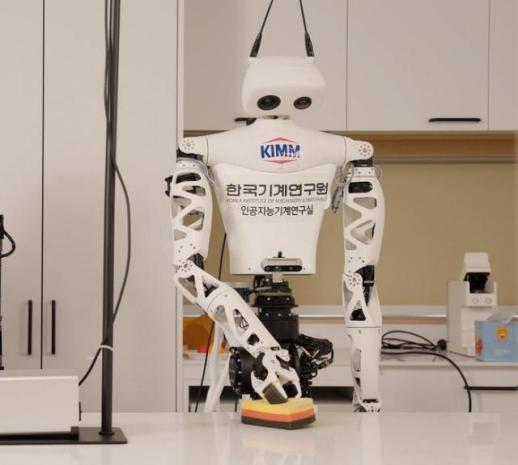 S. Korea's KIMM urges rapid pivot as humanoid era dawns SEOUL, April 08 (AJP) - South Korea's Korea Institute of Machinery & Materials (KIMM) said that 2026 marks the year humanoid robots cross into commercial viability, urging the nation to exploit its manufacturing prowess within a five-year window before the global pecking order hardens. In its 122nd policy report uploaded Wednesday, KIMM said the industry has entered a "commercial tipping point" — the moment where humanoids shed their laboratory origins and begin generating revenue on factory floors and in service settings. The pivot is underpinned by a sharp decline in manufacturing costs. Per-unit expenses currently hover at about $35,000 but are expected to fall to between $13,000 and $17,000 within five years as mass production scales up and component designs mature. China's Unitree Robotics has led the price collapse, driving its flagship model from $90,000 for the H1 in 2024 down to $5,900 for the R1 in 2025 — a trajectory KIMM attributes to Wright's Law, under which unit costs drop 15 to 20 percent each time cumulative output doubles. Shipment volumes are poised to follow a similar exponential curve. Bank of America projects global humanoid deliveries will surge from a cumulative 18,000 units in 2025 to about one million annually by 2030 to 2035. Goldman Sachs forecasts sales climbing from roughly 8,000 units in 2025 to 136,000 in 2030 and 2.1 million in 2035, entering what the bank calls a J-shaped acceleration phase. The United States leads the race with big-tech-driven AI foundation models and semiconductor design advantages spearheaded by Tesla, Nvidia and Figure AI. China, meanwhile, has mobilized more than 140 companies into mass-production competition, with Chinese firms accounting for about 70 percent of newly unveiled humanoid models in 2025 and rapidly consolidating market share through vertically integrated supply chains and state subsidies. South Korea possesses world-class semiconductor, battery and telecommunications infrastructure but remains hobbled by a shortage of indigenous AI foundation models and a fragile supply chain for humanoid-specific components such as actuators and reducers, the report said. To close the gap, KIMM prescribed a "two-track" strategy: the first track calls for localizing core hardware — precision actuators, control systems and dedicated batteries — by leveraging the country's existing manufacturing base. The second track urges swift partnerships with global AI leaders such as OpenAI and Google to bridge the foundation-model deficit rather than attempting to build one from scratch. KIMM itself is spearheading a 220.8 billion won ($149.8 million) national project to develop a mass-production-ready humanoid platform, a self-learning AI brain and an open data factory where industry and academia can jointly train robot models. The institute plans to unveil the first version of its own humanoid, KAIROS, by April 2027. "The era of flashy tech demos is over — what matters now is how quickly a robot can earn its keep on a real factory floor," said Kim Hee-tae, a senior researcher at KIMM's center of R&D policy. "The window through 2030 is the golden time that will determine who commands this market, and Korea must convert its manufacturing edge into robotics leadership before that door closes." 2026-04-08 15:02:09
 -
 Son Heung-min scores first non-penalty goal of 2026 as LAFC routs Cruz Azul in Champions Cup quarterfinal 미국 메이저리그사커(MLS) 로스앤젤레스FC(LAFC)의 손흥민이 마침내 올해 첫 필드골을 터뜨렸다. 손흥민은 8일(한국시간) 미국 캘리포니아주 로스앤젤레스의 BMO 스타디움에서 열린 크루스 아술(멕시코)과 2026 북중미카리브축구연맹(CONCACAF) 챔피언스컵 8강 1차전에서 전반 30분 선제골을 기록하며 팀의 3대 0 완승을 이끌었다. LAFC는 1차전에서 3-0으로 이기며 4강 진출에 유리한 고지를 점했다. 2차전 원정 경기는 15일 열린다. 4-2-3-1 전형의 최전방 공격수로 선발 출전한 손흥민은 전반 30분 마티외 슈아니에르(캐나다)가 오른쪽에서 올린 크로스를 페널티 박스 정면으로 쇄도해 왼발로 마무리했다. 이 골로 손흥민의 이번 시즌 공격 포인트는 2골 11도움이 됐다. 손흥민의 올 시즌 첫 득점은 지난 2월 18일 CONCACAF 챔피언스컵 에스파냐(온두라스)전(6-1 승)에서 기록한 페널티킥이었다. 이후 9경기 동안 득점이 없던 그는 이날 시즌 2호골이자 첫 필드골을 터뜨렸다. LAFC는 전반 39분과 후반 13분 다비드 마르티네스(베네수엘라)의 연속 골로 격차를 벌리며 3-0 완승을 거뒀다. 손흥민은 승리가 굳어진 후반 추가시간 2분 네이선 오르다스(미국)와 교체돼 벤치로 물러났다.* This article has been translated by AI. 2026-04-08 14:21:00
 -
 Pitcher Ryu Hyun-jin hits 1,500-strikeout milestone SEOUL, April 8 (AJP) - Pitcher Ryu Hyun-jin of the Hanwha Eagles added another milestone in his baseball career with his 1,500th strikeout. Ryu, who started an away game against the SSG Landers in Incheon on Tuesday, struck out 10 batters to become the oldest pitcher in Korean Baseball Organization (KBO) history to reach 1,500 strikeouts at 39 years and 13 days, as well as the fastest to reach the milestone by games played with 246 outings. It was also his first double-digit strikeout game in about 14 years since October 2012. After the game ended with the Eagles' 6–2 victory, the left-hander, who pitched through the sixth inning, said he was aware he was approaching the milestone. "I thought I might be able to get at least one strikeout. I got it in the first inning, so I was able to pitch comfortably." Earlier Ryu amassed 934 strikeouts over 10 seasons in the U.S. Major League Baseball. Since making his professional baseball debut in 2006 in South Korea, Ryu has posted at least 100 strikeouts in nine consecutive seasons and is aiming to extend the streak this year. 2026-04-08 14:18:22
 -
 New Books: Why You Keep Tuning In to Romance ‘Frequencies’ Problematic Love That Unknowingly Ruins You and Helps You Grow=By Kim Ji-yong, Dplot. If you find yourself searching YouTube for tarot readings like “Does that person still think about me?” or listening to romance “frequencies” promising “They’ll text in eight minutes,” this book argues it may be time to look inward instead. For readers who avoid dating out of fear of heartbreak — or who cannot leave relationships that repeat the same wounds — the author urges them to stop blaming fate, a fixed destiny or past love and to examine their own unconscious patterns. Kim, a psychiatrist, draws on cases from his clinic involving people struggling with love and dating. He describes the counseling process as using a “T-hammer” to bring up what lies beneath the surface, analyzing patterns ranging from people who cannot start relationships to those who cannot deepen them, those who cycle through frequent breakups, and those who repeatedly end up in unequal power dynamics. Citing Sigmund Freud’s line that “in a married couple’s bedroom there are six people,” Kim writes that early attachment to parents can shape adult romance. One example is a woman in her early 30s — with striking looks and a stable job — who has never dated; raised by a tyrannical father, she unconsciously built a wall around herself with the rule that any man “like Dad” was unacceptable. Other cases include L, who cannot stand loneliness; W, who wants to be loved exclusively; and G, who is “too nice,” inviting readers to recognize themselves in past or current relationships. Kim also warns readers to break free from the “gaslighting” of the idea that “your true other half is out there.” He argues that warmth in love comes not from destiny but from reasoned self-reflection, honest conversation with a partner and growth that expands each person’s sense of self. If that kind of love feels unfamiliar, he writes, start now. He recommends the book to prospective parents and those raising young children, saying the attachment types described can help readers assess their own tendencies and consider whether they may be passing on insecure attachment. “‘Life is not something you explore and then live; it is something you live while exploring.’ Yang Gui-ja, , Sseuda, 2013, p. 296. Life is not time spent searching for a fixed answer. There is no correct answer to begin with. It is unpredictably complex, and every moment is contradictory. By living through those contradictions and paradoxes, we gain unexpected insight and grow. That was true for me, and for everyone I have met. (Omitted) Near the end of , I found a line that confirmed my changed thinking. ‘What do you think the completion of love is?’ ‘Marriage?’ ‘Love is complete in itself. If you loved unbelievably well, that’s enough.’” (pp. 244-245) Mind Study With Mencius=By Jang Hyun-geun, Hangilsa. Jang, a professor in the Department of Chinese Studies at Yongin University and an adjunct professor at Jilin University in China, explains that Mencius’ concept of “budongsim” — an unshakable mind — is not about suppressing emotion. He describes it as internalizing principles that do not collapse under pressure, arguing that people waver because of outside influences despite an inherently good nature. Based on Mencius’ answer to how to remain steady, Jang lays out 22 everyday principles. They include holding to one’s intent and center without meddling in small matters; not lingering too long at the door of someone who has closed off conversation; keeping principles while judging what is most important and urgent; and setting rules to rely on when judgment blurs or emotions take over. For readers who feel shaken day after day, the book offers a standard for self-review. “Mencius was different. Rather than simply following fate, he opened the possibility of ‘seeing’ fate differently through self-cultivation and effort. He accepts that some fate cannot be helped, but also recognizes that some things are not fixed, and he sought ways to find happiness and joy on that side. He offered the path of seeking the nature within people — benevolence, righteousness, propriety and wisdom — as a ‘useful’ solution. What is useful in life is not money or power but cultivation of the mind. Happiness gained through character cultivation is more important in life than a fate that brings fortune.” (p. 273) 2026-04-08 14:12:23
 -
 Review: ‘Salmokji’ turns a reservoir into the engine of fear "It feels romantic. The lighting, the temperature, the humidity ..." a guest on a variety show once said. The point was that place, weather and even how you feel can combine to create an atmosphere. Movies work the same way: your mood and experience can become part of how you judge what you see. In that spirit, "Choi’s Review" introduces films through the writer’s perspective, in a more relaxed, everyday voice. <Editor’s note> In some films, a location does not stay in the background. It changes the characters’ rhythm and becomes a force that drives the story. That is the case in “Salmokji,” where the reservoir that gives the film its title functions less as a setting than as the narrative’s anchor. On a weekend morning, producers at the road-view service company Onroad Media are urgently called in after an unidentified figure appears on a road-view image of the rumor-filled reservoir known as Salmokji. PD Han Su-in (Kim Hye-yoon) is ordered to reshoot the footage that day and quickly assembles a team to head to the site. At the reservoir, junior PD Seong-bin (Yoon Jae-chan), PD Se-jeong (Jang Da-a), who runs a “horror exploration” channel, and filming-company head Gyeong-tae (Kim Young-sung) and his younger brother Gyeong-jun (Oh Dong-min) step into an uneasy tension created by the place itself. Once filming begins, their missing senior, Gyo-sik (Kim Jun-han), emerges from the fog, and a series of hard-to-explain events follows. Su-in’s ex-boyfriend, Gi-tae (Lee Jong-won), heads to Salmokji to try to save them, but the situation spirals into confusion and fear. The film builds the reservoir into an active presence, not a mere backdrop. Salmokji steadily unsettles the characters’ senses and even redirects their gaze, making the fear feel physical. Rather than simply recycling familiar ghost-story imagery, the movie reshapes it into the sensation of being pulled under water. Designed elements — a grove of large willows, oddly stacked stone towers and tangled aquatic plants — heighten the reservoir’s texture. The mise-en-scene works to draw viewers downward, as if the space itself is pushing the characters forward. Director Lee Sang-min also translates that space into a contemporary experience. Equipment such as a 360-degree panorama camera, motion detectors and a ghost box is used not as decoration but as a way to make an unseen presence feel immediate. Handheld camerawork, off-kilter framing, fog and the waterline as a boundary build pressure, while jump scares release it with precision. Sound design amplifies stillness, water and small movements, tightening the film’s grip. For that reason, “Salmokji” appears best suited to premium formats rather than standard screenings. The staging suggests an eye toward ScreenX and 4DX, where expanded visuals and physical vibration can turn the audience from observers into participants. The ensemble is a strength. Kim holds the film’s center with a sharp, restrained presence. Lee, introduced in earnest after the midpoint, blends naturally into the story and raises tension. Kim deepens the mystery and chill, while Jang and Yoon help keep the pacing alive. Kim Young-sung and Oh, as the Gyeong-tae brothers, stand out by giving potentially functional roles a sense of everyday realism that reinforces the reservoir’s grounded feel. “Salmokji” aims for more than startle effects, pushing viewers to feel what it means to be held by a place. By layering fiction onto a real reservoir and placing the source of fear in the location itself, it blends classic horror mood with contemporary technique. The film opens in theaters April 8. It runs 95 minutes and is rated for ages 15 and older.* This article has been translated by AI. 2026-04-08 14:09:26