

Journalist

CGTN
-
 National Museum sound of Silla-era bell used in BTS album track, merch The National Museum of Korea said March 20 that the sound recording and decorative motifs of the “King Seongdeok Bell,” a cultural heritage item held by the Gyeongju National Museum, were used in a BTS full-length album and related collaboration merchandise. The museum said the project stems from a memorandum of understanding signed in October last year by the National Museum of Korea, the National Museum Foundation of Korea and HYBE to help expand Korean cultural heritage and K-culture. At HYBE’s request after the agreement, the museum provided a high-quality bell-sound recording of the King Seongdeok Bell that is available as a public-use work. The recording was used in the BTS track “No.29” on the group’s new album, “ARIRANG.” After the MOU was signed, museum director Yu Hong-jun guided HYBE Chairman Bang Si-hyuk through the museum’s third-floor sensory exhibition gallery, where they listened to and discussed the bell’s resonance, the museum said. The King Seongdeok Bell is a major Korean bronze bell made in 771 during the Unified Silla period. It stands 3.6 meters tall and weighs 18.9 tons, and is known for its imposing sound and design. The museum said the collaboration offers a new way to experience the bell’s distinctive “beating” effect, in which the sound swells and fades repeatedly and lingers softly. The bell is displayed outdoors at the Gyeongju National Museum. Visitors can experience its sound and vibrations at the National Museum of Korea’s third-floor sensory gallery, “Space_Between,” and hear the original recording at the Gyeongju National Museum’s digital video hall, the museum said. Separately, the National Museum Foundation of Korea and HYBE developed graphics based on the bell’s donor figure and surrounding cloud patterns for a five-item “2026 BTS X MU:DS Collaboration Merch.” line: a shoulder bag, card holder, hair clip, hairpin and layered skirt. The National Museum of Korea said it will continue interpreting and expanding the historical value and appeal of Korean cultural heritage in modern ways, and strengthen its role as a cultural platform linking tradition and the present, museums and popular culture.* This article has been translated by AI. 2026-03-20 17:12:20
 -
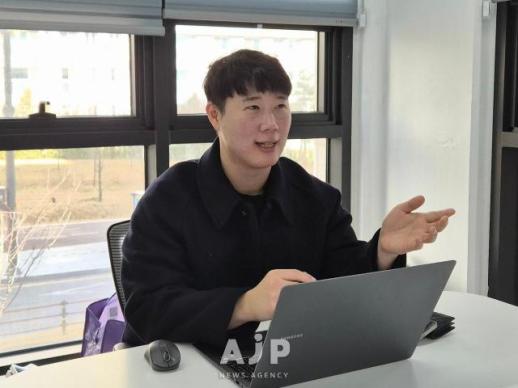 Samsung union chief: 'No. 1 means nothing without first-class treatment' PYEONGTAEK, March 20 (AJP) - Riding a two-year windfall from the global AI boom, Samsung Electronics is ramping up investment and shareholder returns at an unprecedented scale — but one stakeholder feels left out of the bounty: its employees. The company is pouring more than 110 trillion won ($74.6 billion) into semiconductors and has pledged to return 50 percent of its free cash flow to shareholders. Yet workers say the rewards of the AI-driven surge are not being shared on the ground. “We aren’t asking for the impossible,” said Choi Seung-ho, chairman of the Samsung Electronics Union Joint Action Committee, in an interview with AJP near the company’s Pyeongtaek fabs. “We are asking the company to act like the world-class leader it claims to be.” “Profit-hoarding days must end.” The rhetoric marks a shift from wage negotiations to a broader challenge of Samsung’s corporate identity, as the union escalates pressure following a 93.1 percent vote in favor of industrial action. Plans are now underway for a mass rally in April and a potential general strike in May. At the core of the dispute is compensation — and a widening gap with rival SK hynix that the union warns is fueling a “talent exodus.” While Samsung employees are widely perceived as elite earners, Choi pointed to a different reality for mid-level staff. A manager earning a base salary of around 76 million won ($57,000) often struggles to reach 100 million won in total compensation after taxes and relatively modest bonuses — a level increasingly out of step with the industry’s AI-driven gains. The contrast with SK hynix is stark. In 2025, its employees received average performance bonuses of 120 million to 130 million won under a transparent profit-sharing model. Comparable roles at Samsung, the union says, received roughly 37 million won — less than a third. “That gap creates a profound sense of deprivation,” Choi said. The union is demanding the removal of Samsung’s “Economic Value Added” (EVA) bonus cap, which limits payouts to 50 percent of salary and is based on a complex internal formula widely criticized by employees as a “black box.” By contrast, SK hynix shares 10 percent of operating profit directly with employees and removed its bonus cap last year. Tensions have been further aggravated by what the union calls a “divide-and-conquer” approach. Management recently proposed conditional bonuses tied to 100 trillion won in operating profit — but only for the Memory division, excluding Foundry and System LSI workers. “We were hired on the promise of equal treatment across the semiconductor pillar,” Choi said. “Excluding certain divisions now is nothing short of employment fraud.” The internal conflict comes as Samsung accelerates investment to maintain its lead in AI chips and high-bandwidth memory. Under its latest value-up plan, the company will boost facility and R&D spending to 110 trillion won this year, including a 37.7 trillion won R&D budget. At the same time, it reaffirmed its shareholder return policy, maintaining a payout ratio of 50 percent of free cash flow and planning to distribute 9.8 trillion won in dividends this year. For the union, the contrast is stark. “The company says it cannot afford to improve compensation, yet it commits over 100 trillion won to capital and generous shareholder returns,” Choi said. “There is no equivalent concept of ‘employee return.’” The stakes are rising quickly. Samsung’s Pyeongtaek production lines are estimated to generate up to 10 billion won per hour, meaning an extended strike could inflict losses exceeding 5 trillion won. “We are preparing,” Choi said, noting plans for large-scale mobilization ahead of April’s rally. He dismissed criticism that the dispute reflects excessive demands from high-paid engineers, framing it instead as a structural issue behind the so-called “Korea discount.” “If Samsung wants to maintain leadership in the HBM race, it must choose coexistence over disruption,” he said. “Without fair rewards, we cannot stop the outflow of talent.” Choi added that feedback from engineers who have already moved to SK hynix has been telling. “They report extremely high satisfaction,” he said. “When a company provides what employees feel they deserve, the result is obvious.” His final warning was blunt. “If this continues, the union may end up helping people leave,” Choi said. “We will support each other in finding opportunities elsewhere. 2026-03-20 16:36:44
 -
 Kakao Mobility launches recruitment drive for end-to-end autonomous driving engineers SEOUL, March 20 (AJP) - Kakao Mobility announced it has launched a recruitment drive targeting engineers in four autonomous driving specialties as the South Korean mobility platform accelerates its push to develop in-house end-to-end self-driving technology. The company said Friday it has created a dedicated "Physical AI" tab on its hiring page and will recruit experienced engineers in autonomous driving AI, SLAM (Simultaneous Localization and Mapping), hardware, and electrical and electronic systems. Candidates are required to have at least five years of relevant experience, and the company said it has set no cap on the number of hires or the duration of recruitment, though it has designated March 29 as the end of an intensive intake period. The hiring push is part of a broader strategic pivot toward what Chief Executive Ryu Geung-sun has described as a "Physical AI-based future mobility company." Kakao Mobility said it has been refining its AI Planner — the core decision-making system of its autonomous vehicles — using complex urban driving data gathered from areas including Pangyo and Gangnam in Seoul. "Those who join now, at a moment when technological maturity, urban infrastructure and market demand converge, will directly write a new chapter in South Korean mobility," said Kim Jin-gyu, head of the Physical AI division. The four roles being recruited cover the full stack of autonomous vehicle development: AI engineers to build the integrated end-to-end neural system using Vision-Language-Action models; SLAM engineers for precision localization; hardware engineers for sensor packaging and control systems; and E/E engineers for high-speed in-vehicle data networks. Kakao Mobility said the recruitment drive is intended to further internalize core autonomous driving capabilities and accelerate its ambition to become a leading Physical AI company with global competitiveness. 2026-03-20 16:12:26
 -
 BTS Live D-1: Leader RM injured ahead of landmark Seoul comeback SEOUL, March 20 (AJP) - K-pop sensation BTS' leader and rapper RM has injured his ankle during a rehearsal for the seven-member band's comeback performance scheduled on Saturday, the agency said. The injury means fans will be unable to witness a full-scale choreography by the rapper or the group as a whole during their highly anticipated return. This setback occurred just as the ensemble concluded a nearly four-year hiatus necessitated by mandatory military service. The performance, titled "BTS THE COMEBACK LIVE | ARIRANG," was intended to be a complete demonstration of the septet's reunited power at one of the nation's most symbolic landmarks. Big Hit Music announced on Friday that the incident took place on Thursday during a practice session for the free concert at Gwanghwamun Square. Medical examinations revealed an accessory navicular sprain, a partial ligament tear, and a talus contusion. Following the diagnosis, physicians fitted the performer with a cast and mandated a minimum of two weeks of restricted physical activity to facilitate recovery. Consequently, the agency confirmed that his participation in the complex choreography will be strictly curtailed for the duration of the show. Big Hit noted that while the leader maintained a strong desire to deliver a full performance at the historic venue, the health of the artist remained the primary concern. "RM's will to create a high-quality performance in such a symbolic space as Gwanghwamun was very strong," the agency said in a statement. However, management opted to minimize his movements on stage to prevent further aggravation of the injured area. The remaining members will proceed with the original production routines while the rapper performs from a stationary position. The live event is scheduled to begin at 8 p.m. (1100 GMT) on March 21 at the central Seoul landmark. This comeback marks the first major public appearance for the group since their last collective activity nearly four years ago. The agency pledged to provide all necessary support to ensure the artist returns to full health for future activities. The performance will be broadcast live to a global audience as the group transitions back to active status. 2026-03-20 16:07:26
 -
 Korea Music Copyright Association backs BTS comeback, eyes renewed “BTSnomics” boost After a wait of three years and nine months, BTS is set to return as a full group on March 21 with a comeback live show at Seoul’s Gwanghwamun Square, with a global broadcast reaching 190 countries. The Korea Music Copyright Association, led by Chairman Lee Si-ha, said it is moving to support copyright-related work tied to the group’s return, citing the expected cultural and economic ripple effects. The association said March 20 that it has received and processed album-approval applications for 14 tracks, including the title song “SWIM,” ahead of the release of BTS’ fifth full-length album, “ARIRANG.” It said it will also proceed with settlements for performance-use fees related to the Gwanghwamun live show and plans close cooperation to help ensure the event runs smoothly. The concert is expected to draw hundreds of thousands of people and, combined with the global live broadcast, is projected to be one of the largest events of its kind. The market is already focusing on the so-called “BTSnomics” effect. Analysts expect spillover across albums, concerts, merchandise, tourism and platform spending, with a direct lift for the music copyright market. According to the association, total music copyright collections continued to rise in 2025, but the reproduction-fee category fell 2.7% from a year earlier, reflecting reduced reproduction-based use such as album purchases after the pandemic. It said the success of “ARIRANG,” which has surpassed 4 million in preorders, could help physical albums and the digital reproduction market rebound. An 82-show world tour is also seen as a key factor for expanding performance-use fees. The association said performance-use fees, including stage performances, totaled 60 billion won last year, showing steady growth. With the tour expected to draw more than 4 million people at stadium-scale venues worldwide, it said the domestic and overseas performance copyright markets could gain strong upward momentum. The association also highlighted that all BTS members are its members and write music as creators. It said the group has built extensive music copyright intellectual property, including RM’s leading role in writing lyrics for “SWIM,” underscoring that they are rights holders whose work must be protected. “BTS singing ‘Arirang,’ which carries the emotions of our people, at Gwanghwamun is a symbolic scene that shows the expansion of creation,” Lee said. He added that the association will “stand firmly” to ensure the results of the members’ creative work are fairly compensated worldwide.* This article has been translated by AI. 2026-03-20 16:03:22
 -
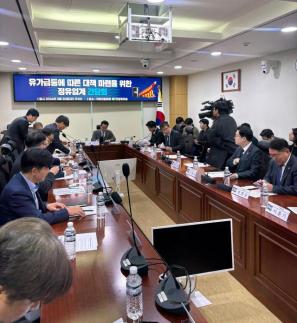 Refiners, Gas Stations Clash Over Fixes as Oil Prices Surge on U.S.-Iran War As oil prices surge amid the war between the United States and Iran, refiners and gas station operators say their business burdens are growing. Lawmakers convened an industry meeting at the National Assembly to discuss countermeasures, but the roughly hourlong session ended without agreement, underscoring the gap between the two sides. The Democratic Party’s Euljiro Committee held the meeting on March 20 at the National Assembly Members’ Office Building, citing rising household costs as international oil prices jump on Middle East risks. Attendees included the Korea Gas Station Association and representatives from SK Innovation, GS Caltex, HD Hyundai Oilbank and S-Oil. Gas station operators focused on what they called structural disadvantages in the retail market. Ahn Seung-bae, chairman of the Korea Gas Station Association, said stations do not set prices but sell at prices determined by refiners. When prices rise, he said, stations are blamed for profiteering despite lacking pricing power. Ahn urged refiners to address practices including all-volume purchasing, after-the-fact settlement, credit card fee burdens and what he described as prices being reflected in advance. He said many stations are effectively tied to buying nearly 100% of their fuel from a single refiner, and that paying before supply prices are finalized — followed by later settlement — increases financing pressure. Refiners said they shared the need to stabilize supply and ease consumer burdens but were cautious about offering specific solutions on distribution structure, citing limits on what companies can do as crude supply risks intensify. Lee Sang-yoon, a vice president at SK Innovation, said a blockade of the Strait of Hormuz has become the biggest variable for crude supply, and that any disruption would inevitably have a major impact on the domestic market. Ahn Young-mo, a managing director at GS Caltex, said the company is using all private inventories to supply petroleum but described the situation as severe. If the Strait of Hormuz blockade is not lifted, he said, “there could be a situation where even naphtha cannot be helped.” Refiners’ stockpiled volumes could be depleted as early as April, the article said. Additional supplies secured from outside the Middle East and through diplomatic efforts would not be enough to replace existing volumes. The refining industry is asking the government to release strategic reserves. However, even in a closed-door discussion after opening remarks, participants did not meaningfully address crude supply plans, which refiners consider the top issue. The meeting was seen as confirming the reality of supply uncertainty and the perception gap between refiners and gas stations, rather than producing detailed steps to respond to the price surge. The Democratic Party’s Euljiro Committee said it plans to form a social dialogue body as early as next week to begin fuller discussions.* This article has been translated by AI. 2026-03-20 15:55:01
 -
 Celltrion Wins Canada Approval for Stekima Auto-Injector as Pharma, Biotech Updates Roll Out Celltrion: Stekima Auto-Injector Wins Approval in Canada Celltrion said it has secured additional approval for an auto-injector version of its autoimmune disease treatment Stekima (ustekinumab). The company said March 20 that Health Canada approved Stekima in auto-injector (AI) form, adding two presentations in Canada: 45 mg/0.5 mL and 90 mg/1.0 mL. “With Stekima, we have added an AI formulation that the original product does not offer in Canada, completing a full lineup across doses and formulations and further strengthening competitiveness,” Celltrion said. Celltrion said the approval supports its strategy to accelerate its push into the North American market. A company official said demand for self-injection options has been rising in major markets, including North America. “With tailored prescribing now possible based on administration settings and patient characteristics, we plan to respond strategically to needs across diverse clinical sites,” the official said. Celltrion said it also aims to quickly raise market share by leveraging synergies with its existing portfolio built in Canada as it expands its presence in the autoimmune disease market. Protein, Vitamins Added: Koryo Eundan Launches ‘Balance Care Energy Bar’ Koryo Eundan said March 20 it has launched the “Balance Care Energy Bar.” The company said the bar uses ingredients such as peanuts, oats and lentils and is designed for convenient nutrition or as a meal replacement. It contains 7 grams of plant-based protein — about the amount in one egg — and 4 grams of dietary fiber, which the company said is comparable to 1.5 bananas. Koryo Eundan said it also includes 12 vitamins and minerals formulated with premium ingredients from global supplier DSM. The company said each bar contains about 0.19 grams of sugars, positioning it as a low-sugar product. “We planned a bar-type product so people can easily supplement nutrition as outdoor activities increase,” the company said. “It can be used in various situations, such as a meal replacement or a snack before or after exercise.” HK inno.N Partners With Seongnam Mental Health Center for Employee Program HK inno.N said March 20 it will work with the Seongnam Mental Health Welfare Center to run a workplace mental health management program for employees. The company said it held a memorandum-of-understanding ceremony with the center on March 18 to promote employee mental health and prevent job-related stress. HK inno.N said the partnership is part of its ESG efforts in safety and health management. It also cited a revision last year to the Korea Occupational Safety and Health Agency’s KOSHA GUIDE, which emphasizes preventing job stress through organization-level health promotion programs. Under the agreement, HK inno.N will recruit participants and, starting in April, run a six-week program with 12 sessions. The company said activities will include mental health checkups, meditation and horticulture, aimed at teaching effective ways to manage mental well-being. Seoul National University Hospital Reports 15-Year Benefits After Total Knee Replacement Patients who underwent total knee arthroplasty (TKA) saw major improvements in function and quality of life within six months, and those gains remained above pre-surgery levels up to 15 years later, Seoul National University Hospital said March 20. The hospital said an orthopedic surgery team led by professors Choi Byeong-seon, Noh Doo-hyun and Han Hyeok-su tracked patient-reported outcome measures (PROMs) for up to 15 years in 1,264 patients ages 50 and older who received TKA between 2005 and 2013. The average age was 68.5, and 93.7% were women. The team analyzed changes from before surgery through six months and at 1, 2, 5, 10 and 15 years. All measures improved significantly within six months. While patterns differed by indicator afterward, all measures remained higher than pre-surgery levels at 15 years, the hospital said. Disease-specific indicators were relatively stable through about five years. However, the KSFS score — reflecting daily activities such as walking and climbing stairs — showed a clinically meaningful decline between 10 and 15 years after surgery, it said. By age group, patients in their 80s and older had lower physical function scores than younger patients but higher social function scores, which remained elevated over the long term, the hospital said. The findings were published in the latest issue of The Journal of Bone and Joint Surgery (JBJS).* This article has been translated by AI. 2026-03-20 15:48:00
 -
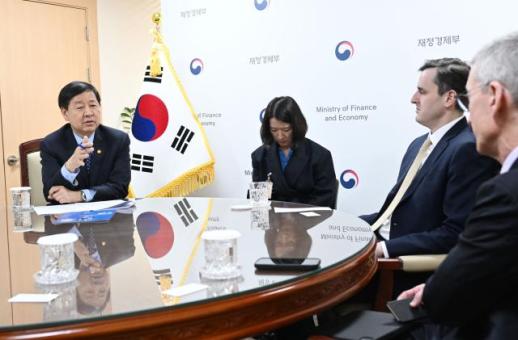 IMF to factor Middle East shock into world economic outlook in April SEOUL, March 20 (AJP) - The International Monetary Fund perceives rising downside risks in the global economy from volatility in energy prices and financial market stemming from Middle East conflict and will factor the negative impact on growth and inflation into its updated economic outlook in April, according to a senior official. Deputy Prime Minister and Minister of Economy and Finance Koo Yun-cheol met visiting Dan Katz, First Deputy Managing Director of the International Monetary Fund (IMF) in Seoul on Thursday and discussed strategic response to escalating global risks, the ministry said in a press release Friday. Katz pointed out that recent military clashes in the Middle East, the blockade of the Strait of Hormuz, and strikes on energy production facilities have significantly heightened volatility in energy prices and financial markets. He warned that these factors are increasingly likely to dampen global economic growth. The IMF official added that a prolonged conflict could severely hamper global expansion and trigger widespread inflation, noting that the IMF intends to closely monitor these projections. These assessments are expected to be reflected in the IMF’s World Economic Outlook (WEO) scheduled for release in April. Koo explained Seoul was deploying "all possible policy means" - enforcing cap on gasoline and fuel prices and fast-tracking supplementary budget - to minimize the fallout on the real economy. Katz commended the South Korean government for its "swift and decisive" response to recent market volatility and its impact on the real economy. He assessed that the South Korean economy has historically demonstrated strong resilience in the face of various domestic and international shocks. Furthermore, the IMF deputy chief expressed gratitude for South Korea’s contributions to capacity-building programs for vulnerable and low-income countries, including its recent funding to the IMF. Koo responded by reaffirming Seoul's commitment to further contributing to capacity-building initiatives in emerging fields, such as AI and digital technology. 2026-03-20 15:43:44
 -
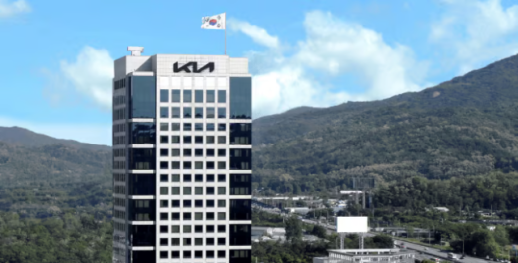 Kia targets 13 EV models by 2030, accelerates PBV and software pivot SEOUL, March 20 (AJP) - Kia outlined plans to expand its electric vehicle lineup to 13 models by 2030 and deepen its push into purpose-built vehicles and software-defined cars, as the automaker seeks to reposition itself amid a global slowdown in EV demand. President Song Ho-sung presented the strategy at the company's annual general meeting held at its headquarters in southern Seoul on Friday, identifying three priorities: EV mass-market expansion, growth of its purpose-built vehicle (PBV) business and a transition toward software-defined vehicles. The automaker said it will launch the compact EV2 this year to complete its affordable EV range, aiming to capture demand in the budget segment. The company will leverage production bases across South Korea, the United States, Europe and emerging markets to match regional demand. On the PBV front, Kia plans to roll out three models in sequence — the PV5, already unveiled last year, followed by the PV7 in 2027 and PV9 in 2029 — targeting logistics and commercial fleets. The company is building a dedicated PBV production line at its Hwaseong EVO plant and working with partners to develop specialized variants including box trucks and camper vehicles. "We will maintain our eco-friendly vehicle strategy despite uncertainties from rising protectionism and tariff variables," said Song. Shareholders also approved governance changes to comply with a revised commercial code, including the adoption of electronic shareholder meetings, mandatory cumulative voting for directors and expanded fiduciary duties for board members. In separate votes, Kim Seung-jun, head of the finance division, was elected as an inside director, and Jeon Chan-hyuk, chief executive of Cesco, was reappointed as an outside director. 2026-03-20 15:27:25
 -
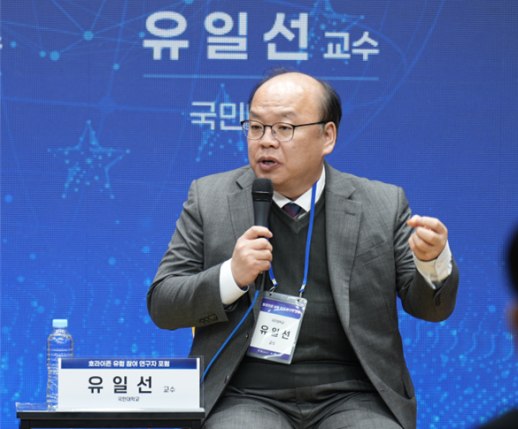 Kookmin University joins major EU research project for quantum and AI security SEOUL, March 20 (AJP) - Kookmin University Professor Yoo Il-sun has been selected to participate in Horizon Europe, the European Union’s premier research and innovation program. This partnership marks a significant milestone for South Korean academia, positioning the university at the forefront of a global effort to integrate quantum technology with digital security. The three-year project, known as the Quantum Computing European Union–South Korea Working Team (QuoUSKWe), operates with a total budget of approximately 2.7 million euros. Led by the Polytechnic University of Milan (Politecnico di Milano), the multinational consortium includes Germany’s Fraunhofer Institute and Finland’s IQM Quantum Computers. Kookmin University (KMU) is tasked with designing and verifying AI-based digital security systems that combine quantum computing with high-performance computing. The research will focus on securing quantum-safe technologies essential for 6G communication environments and the broader hyper-connected digital ecosystem. "This selection is meaningful because it recognizes our university's research competitiveness and innovation in quantum technology and digital security on an international level," Professor Yoo Il-sun said. "Based on cooperation with major European research institutes, we will take the lead in securing technological sovereignty and leading international standards in future strategic technology fields." Professor Yoo currently serves as the director of the Global ICT Convergence Security Innovation Research Center. He also holds leadership roles in international standard-setting bodies, including the IEEE 6G-IoT Quantum Security Standardization Group and the IFIP E-Business Information Systems Group. The university’s selection follows the launch of the KMU VISION 2035: EDGE initiative, which identifies quantum technology and artificial intelligence as core growth pillars. KMU established the first "Quantum Campus" in Korea on July 10, 2025, to bridge the gap between academic research and commercial application. Through this collaboration, the Global ICT Convergence Security Innovation Research Center expects to solidify its position as a global hub for quantum and AI-integrated security. The project officially commenced on March 20, 2026, and will continue to strengthen research ties between South Korea and European scientific institutions. 2026-03-20 15:15:46