
Journalist

Elizabeth Englezos
-
 Samsung Heavy Industries Signs U.S. MOUs to Enter Global Data Infrastructure Market Samsung Heavy Industries said it has laid the groundwork to enter the global data infrastructure market with a floating data center, or FDC. The company said it attended Data Center World (DCW 2026), held April 20-23 (local time) in Washington, and secured a foothold for global market entry for its in-house developed FDC. An FDC is a model that builds data centers at sea as demand surges with the spread of artificial intelligence. It is drawing attention as an alternative that can address land acquisition, power supply and cooling efficiency constraints. At the event, Samsung Heavy said it obtained approval in principle for a 50-megawatt FDC concept design from U.S. classification society ABS and U.K.-based Lloyd’s Register. The certified design is based on a standardized shipyard construction process that integrates design, fabrication and equipment installation, which the company said can shorten delivery times compared with land-based data centers. It can also be fitted with an in-house power generation system, reducing reliance on onshore electricity, it said. Samsung Heavy said it also expanded cooperation with global companies during the event. It is pursuing collaboration with electrification and automation firm ABB to develop an FDC power system, and signed a memorandum of understanding with U.S. data center developer Musterian to develop an FDC in the United States. The company said it plans to use the certifications as a starting point to push commercialization by linking power-system development with U.S. permitting and partnerships for local operations. Choi Won-young, chairman of Samsung Heavy’s workers’ council, attended the event, highlighting labor-management participation. “The council will actively take part in the growth of new businesses such as the FDC,” Choi said. Ahn, the technology development chief, called the FDC “a new business model that expands shipbuilding technology into the digital infrastructure industry.” He said it would “set a new standard in the global data market” when combined with eco-friendly energy.* This article has been translated by AI. 2026-04-24 10:00:19
 -
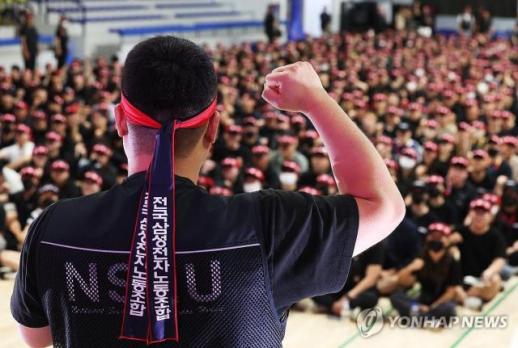 Samsung Electronics Union Vows Strike Despite Court Ruling, Raising Output Concerns South Korea’s industrial sector is again facing intensifying labor-management conflict, with concerns growing over production disruptions and weaker investment as some unions press ahead with strikes despite court action questioning the legality of the dispute. Labor disputes are an inevitable part of a democratic society, but confrontations that disregard legal judgments risk undermining industrial competitiveness. The Samsung Electronics union recently held a large rally at the company’s Pyeongtaek complex and reaffirmed plans to launch a general strike next month. The union is seeking changes to the performance-bonus system and a broader sharing of excess profits, and it has raised the possibility of halting semiconductor production lines. The company said that under Supreme Court precedent, demands to share excess profits are not a lawful basis for a strike, adding that it will continue efforts to reach an agreement through talks. Workers’ demands for fair compensation and the right to collective action are protected by the Constitution. But not every demand automatically justifies a strike. Legal standards apply, including whether the issue directly concerns wages and working conditions, whether collective bargaining procedures were properly followed, and whether social harm was minimized. If a court has ruled and imposed limits, respecting that decision is a starting point for the rule of law. The stakes are heightened by the industry involved. The expected clash centers on semiconductors and other advanced manufacturing, a core pillar of the South Korean economy. With global supply chains being reshaped and technology competition intensifying among the United States and China, and with Taiwan and Japan investing aggressively, South Korean companies face mounting pressure. Repeatedly using the prospect of production stoppages as leverage effectively gives competitors time to catch up. Semiconductor operations also differ from typical manufacturing. Restarting after a shutdown can require significant time and cost, and delivery delays can lead customers to switch suppliers. Restoring trust after disruptions can take far longer. The more both sides focus on short-term wins, the greater the long-term losses can become. Companies, however, are not free of responsibility. If performance compensation is opaque or communication is rigid, the roots of conflict lie inside the organization. If employees do not feel they share in results even during record performance, dissatisfaction is likely to build. Claims of excessive union demands do not excuse management’s lack of responsiveness. The path forward is structured negotiation, not escalation. Issues addressed by court rulings should be respected, while detailed compensation systems can be revisited at the bargaining table. Companies should disclose bonus calculation standards and future investment plans more transparently to rebuild trust. Unions should move away from tactics that hold production disruptions as leverage and instead engage as responsible partners on expertise and sustainability. The government should strengthen mediation in disputes affecting key industries and provide predictable guidelines. Protecting labor rights and maintaining industrial competitiveness are not mutually exclusive. Stable jobs ultimately depend on competitive companies, and companies that do not respect workers are not sustainable. Strikes pushed ahead despite court limits are unlikely to win broad public support, and companies should not hide behind legal arguments while allowing conflicts to fester. Global competition is driven by technology and speed, and South Korea cannot afford to be slowed by internal confrontation. 2026-04-24 09:58:28
 -
 PPP Floor Leader Song Eon-seok Slams Democrats’ Proposed Special Counsel as ‘Prejudged’ Song Eon-seok, floor leader of the People Power Party, criticized the Democratic Party on April 24 for pushing what it calls a special counsel probe into “fabricated indictments” under the Yoon Suk Yeol government, calling it “another prejudged special counsel” following what he described as a prejudged parliamentary investigation. Speaking at a party meeting at the National Assembly on Friday morning, Song said, “It looks like the next step has begun to withdraw President Lee Jae-myung’s indictments.” Song said the biggest issue was what he called a move to give the special counsel authority to withdraw indictments. He claimed it was intended to have the special counsel, not Lee and Justice Minister Jeong Seong-ho, “get blood on their hands” by carrying out the withdrawals. He also accused those who dismantled the prosecution service after warning that combining investigative and charging powers was dangerous of now seeking to give the special counsel not only both powers but also the authority to withdraw indictments. Song said the ruling party was “mobilizing all state power” to eliminate what he called Lee’s five criminal trials, and that it was also willing to nominate candidates with criminal histories. “This Democratic Party nomination is, in effect, the return of criminal old boys,” he said. He said the party again nominated Kim Kyoung-soo, who lost the governorship over the “Druking” online-comment manipulation case, as its candidate for South Gyeongsang governor. He also said Rep. Jeon Jae-soo became the party’s candidate for Busan mayor after the statute of limitations expired in a case involving alleged bribes including a Cartier watch from the Unification Church, which he blamed on what he called a lenient and delayed investigation by a special counsel and a joint probe team. Song said Song Young-gil, whom he described as having avoided punishment due to legal issues over admissibility of evidence in a party convention cash-envelope case, received a strategic nomination in Incheon’s Yeonsu A district. He also said former lawmaker Lee Kwang-jae was to receive a strategic nomination, citing a political funds law violation case in which Lee was convicted on appeal and lost the governorship about six months after taking office for receiving $95,000 from Park Yeon-cha and Jeong Dae-geun. Song said that as these figures return, Kim Yong, whom he described as having been found guilty through the second trial, was also pressing to receive a nomination. “This is not an era of popular sovereignty, but an era of criminals’ sovereignty,” he said. He added, “In the Democratic Party, are criminal records medals and criminal investigations a sin?” and asked whether the party intended to create “a paradise for crime and a hell for law-abiding citizens.” 2026-04-24 09:57:19
 -
 Korail Signs Rail Electrification Cooperation Deal With France’s SYSTRA, MESEA Korea Railroad Corp., known as Korail, said April 24 it signed a multilateral memorandum of understanding with French rail companies SYSTRA and MESEA at its headquarters in Daejeon and held a technical exchange meeting. The April 23 event drew about 20 rail officials from South Korea and France, including Korail Electricity Headquarters Director Lee Seong-hyeong, SYSTRA Vice President Sarah Madjedi and MESEA Technical Headquarters Director Olivier Gouin, Korail said. At the meeting, Korail presented operating cases of condition-based maintenance, which analyzes current asset condition data to set optimal maintenance cycles, and predictive maintenance, which forecasts warning signs before failures to enable preemptive repairs. Korail also shared its mid- to long-term plan to upgrade maintenance. Under the agreement, the three organizations will strengthen cooperation through sharing best practices and information related to maintenance of rail electrical facilities and through mutual benchmarking. They also plan to promote a “data-driven, scientific maintenance system” by actively introducing advanced technologies such as artificial intelligence to improve equipment reliability and prevent failures in advance. “By advancing an AI-based maintenance system for rail electrification, we will enhance the safety and reliability of electrical facilities and continue expanding the foundation for entering the global rail market,” Lee said. * This article has been translated by AI. 2026-04-24 09:51:15
 -
 South Korea's foreign patient arrivals top 2 million for first time SEOUL, April 24 (AJP) - South Korea welcomed more than 2 million foreign patients last year, the first time the figure has breached that threshold since record-keeping began in 2009. The Ministry of Health and Welfare said Friday 2,011,822 patients from 201 countries sought treatment in 2025, capping a three-year streak of record highs after arrivals cratered to about 110,000 during the COVID-19 pandemic. Chinese nationals accounted for 30.8 percent of the total, overtaking Japanese patients for the first time to claim the top spot, followed by Taiwan, the United States and Thailand. Dermatology drove the surge, drawing 1.31 million patients — 62.9 percent of the total — while plastic surgery trailed at 11.2 percent, underscoring a pronounced tilt toward cosmetic procedures. Clinic-level facilities handled 87.7 percent of all visits, and dental clinics, though accounting for just 1.6 percent, posted the steepest year-on-year growth at 128.9 percent. Seoul absorbed 87.2 percent of the traffic, a concentration the ministry attributed to the capital's dense cluster of transport, tourism and medical infrastructure. Some 2,555 registered medical institutions — 62.5 percent of the national total — are based in the city. The Korea Institute for Industrial Economics and Trade estimated that the 2 million patients and their companions generated about 12.5 trillion won ($8.4 billion) in medical tourism spending, producing more than 10 trillion won in added economic value. "Now that more than one million patients a year are visiting from across Asia, we will build a sustainable industrial ecosystem," said Jung Eun-young, director-general of the ministry's mental health policy bureau. "We intend to pursue qualitative growth in foreign patient recruitment." 2026-04-24 09:49:21
 -
 KEPCO Signs MOU With Petrovietnam to Review Nuclear Power Cooperation Kim Dong-cheol, president of Korea Electric Power Corp., visited Vietnam from April 21-24 to discuss cooperation with key Vietnamese government and state-run company officials as part of a push to expand into the local power market. KEPCO said April 24 that it signed a memorandum of understanding with Vietnam National Industry-Energy Group (Petrovietnam) on April 22 at the Vietnamese presidential palace, with the two countries’ leaders present, to review the feasibility of cooperation on nuclear power plant development. KEPCO also signed a four-party MOU with the Export-Import Bank of Korea and Korea Trade Insurance Corp. to review potential financial cooperation for a nuclear power project, strengthening the basis for funding. KEPCO said the agreement, along with an MOU signed in August last year on cooperation in training nuclear-sector personnel, is expected to help accelerate cooperation on new nuclear plant construction projects. On April 23, Kim attended the Korea-Vietnam Business Forum and expressed KEPCO’s intent to take an active role in Vietnam’s new nuclear power and electricity infrastructure projects. “Based on KEPCO’s capabilities in nuclear power and new energy technologies, we will be Vietnam’s most reliable partner for a 100-year journey together,” he said. At the forum, KEPCO also signed an MOU with Vietnam Electricity (EVN) on power infrastructure cooperation, aimed at expanding practical collaboration across the power grid, new energy technologies and battery energy storage systems (BESS). Kim said the agreements would be “an important milestone” as KEPCO pursues broad cooperation with Vietnam across the power industry, including nuclear energy, and pledged to strengthen partnerships with Vietnamese power companies to deliver visible results.* This article has been translated by AI. 2026-04-24 09:48:06
 -
 People Power Party Hits Record-Low Support as Leadership Feud Deepens South Korea’s People Power Party is facing a deepening crisis as its support falls to the lowest level since it adopted its current name in 2020, while internal calls for accountability and resignation spill into the open. With local elections approaching, the main opposition party is focused less on winning back voters than on internal power struggles, raising broader questions about its credibility. According to results released on the 23rd by the National Barometer Survey (NBS), the People Power Party’s support stood at 15%, its lowest since September 2020. The Democratic Party was at 48%, widening the gap to more than threefold. Even in the conservative stronghold of Daegu and North Gyeongsang Province, the People Power Party polled 25%, trailing the Democratic Party’s 34%, the survey found. Critics say the party’s response has compounded the problem. Rather than focusing on stabilizing the situation, the leadership has appeared to devote more energy to internal discipline and factional clashes. Party leader Jang Dong-hyeok warned that he would “immediately replace” any candidate who engaged in “acts that harm the party.” But some inside and outside the party criticized the remark as likely to inflame factional conflict. Some lawmakers have publicly called for him to step back or resign. The party’s slump did not emerge overnight, the article said, pointing to accumulated problems including a lack of policy direction, mixed messaging, distrust in leadership and faction-driven decision-making. While voters face issues such as economic uncertainty, security variables and regional concerns, the party’s headlines have centered on leadership disputes and internal confrontation. The article argued that a weakened conservative party is not desirable for South Korea’s broader political system, saying democracy functions best when there is a competitive alternative force. Unchecked power can become arrogant, it said, while a feeble opposition can deepen public distrust in politics. The article called for renewal rather than blame. It said the leadership should clarify responsibility, including decisions about whether to stay in office. It also urged the party to halt factional loyalty contests and rebuild transparent standards for nominations and party management. It said the party should shift from opposing for opposition’s sake to presenting policy alternatives, competing with the government on issues such as prices, housing, industrial competitiveness and balanced regional development. The article said even conservative supporters understand that blind unity will not revive the party, and that wavering support in its political base is a warning, not a temporary fluctuation. If the party continues to blame rivals and fuel internal hostility, it said, the decline will only accelerate. Politics receives warnings in numbers and is judged at the ballot box, the article said. The 15% figure may not be the end, it added, but could be the party’s last chance. If the People Power Party fails to read the signal, the crisis could expand beyond one leader to become a question of the party’s survival. Voters, it said, are waiting for an opposition that works, not one that fights.* This article has been translated by AI. 2026-04-24 09:44:53
 -
 Hoban Construction, Upstage to Build AI Platform Integrating Data Across Construction Process Hoban Construction said it is partnering with global AI company Upstage to build an AI platform that integrates data generated across the construction process. The company said it signed a memorandum of understanding with Upstage on April 23 at its headquarters in Seoul’s Seocho-gu to pursue development of an “integrated AI agent platform.” Hoban Construction said the platform will consolidate and manage data produced in design, construction, quality and safety. It plans to apply AI to areas such as document drafting and management, data analysis and reporting systems to improve efficiency. Under the agreement, Hoban Construction will oversee platform development, provide data and work processes, and run pilot projects. The company said it aims to build an intelligent workflow system based on field-centered data to deliver practical productivity gains. Upstage will develop and supply AI models based on its in-house large language model, Solar. The company said it will advance industry-tailored AI through document-processing technology, fine-tuning models for construction and real estate, and design drawing analysis. Hoban Construction said it will first validate the platform in day-to-day operations, then expand it across Hoban Group. It plans to use accumulated data operations experience and AI use cases as shared group assets to strengthen digital transformation capabilities. A Hoban Construction official said the company will “organically connect data and work processes around the integrated AI agent platform to drive real workplace innovation and productivity gains,” and will expand “a proven AI utilization system” across the group to keep strengthening its AI transition foundation.* This article has been translated by AI. 2026-04-24 09:44:07
 -
 South Korea expands cooperation with Moldova as economic pact takes effect SEOUL, April 24 (AJP) - An agreement on economic cooperation between South Korea and Moldova took effect on Friday, according to the Ministry of Foreign Affairs. The agreement aims to strengthen bilateral cooperation across various sectors, including science and technology, energy, and transportation, laying the groundwork for a more comprehensive partnership between the two countries. Under the agreement, the two countries will establish a joint committee to review and implement projects, which is also expected to promote mutual exchanges among experts, scientists, and students through international fairs and exhibitions, thereby fostering industrial collaboration and broader professional networks. Bilateral trade stood at just $118 million last year, but both sides see room for growth. South Korea exports automobiles, steel, and cosmetics, while importing wine and agricultural products from Moldova. "We will continue to seek economic cooperation with promising markets to support South Korean companies' global expansion," a ministry official said, adding that the latest agreement would help broaden the country's foothold in emerging markets in Europe. South Korea currently has similar pacts signed or implemented with over 100 countries. 2026-04-24 09:43:17
 -
 GS E&C Teams With Vietnam’s FPT to Pursue Data Center, Smart City Projects GS Engineering & Construction Corp. said it is moving to develop new businesses in Vietnam centered on data centers and smart cities. The company said it signed a memorandum of understanding on April 22 with FPT Corp. at the Vietnamese firm’s headquarters in Hanoi to cooperate on data center development and smart city construction. GS E&C CEO Heo Yun-hong and FPT CEO Nguyen Van Khoa attended the signing, along with other officials. GS E&C said the agreement is intended to support Vietnam’s digital economy growth and its national digital transformation strategy by combining the two companies’ capabilities. FPT is Vietnam’s largest private IT company and ranks No. 1 among private firms in the country’s data center market by capacity, GS E&C said. GS E&C said it has more than 20 years of experience in data centers and can provide end-to-end solutions from development through operations. Under the MOU, the companies plan to develop large-scale data centers in major Vietnamese regions, starting with an initial project in the tens of megawatts and expanding in stages. They also plan to build high-efficiency facilities using advanced technology and modular construction to meet rising demand for artificial intelligence and cloud services. The companies also agreed to cooperate on smart city development. GS E&C will lead project development and execution and provide design and construction capabilities for AI infrastructure, the company said. FPT will provide technical cooperation based on its ICT expertise, including cloud services and digital platforms, and will support demand creation and cooperation with the central government and local authorities. GS E&C said the partners aim to build citywide digital infrastructure, including intelligent transportation systems, smart energy management and integrated public safety platforms, and to improve operational efficiency through AI and Internet of Things-based solutions. Separately, GS E&C said it signed another MOU on April 23 with the Bank for Investment and Development of Vietnam, the country’s largest state-owned commercial bank, for comprehensive cooperation on financial services. The company said the deal is intended to establish a financing support framework for development projects and broader smart city initiatives being pursued by its Vietnam unit, VGSE. GS E&C said the two agreements will help it secure an integrated business structure covering data center development, smart city construction and financial support, and strengthen its competitiveness in Vietnam’s digital infrastructure market.* This article has been translated by AI. 2026-04-24 09:43:15