

Journalist

Imran Khalid
-
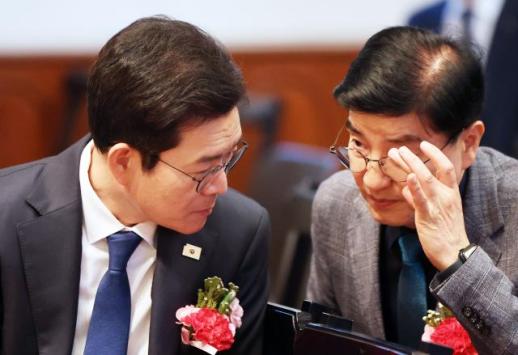 Jung Won-oh's Campaign Files Complaint Against Oh Se-hoon for Election Law Violations Jung Won-oh's campaign committee for the Democratic Party plans to file a complaint against Oh Se-hoon, the candidate from the People Power Party, for obstruction of business and violations of election law on May 29 at the Seoul Metropolitan Police Agency. During a press conference at the National Assembly, Lee Hae-sik, the head of Jung's campaign, and Chae Hyun-il, the head of the comprehensive situation headquarters, stated, "Evidence has emerged that Oh's campaign internally planned, produced, and systematically disseminated defamatory content against Jung." The campaign committee intends to file complaints against both Oh and Kim Sun-dong, the head of Oh's campaign. Chae noted, "According to reports from the previous day, Kim stated, 'I came up with the idea for the Jung Won-oh content.'" He added that card news and short videos were spread through KakaoTalk open chat rooms with hundreds of participants, and there were indications that individual dissemination performance was being monitored. He further criticized, "There is evidence that tailored defamatory content was produced and distributed targeting specific university communities, which constitutes organized online smear campaigns." Chae demanded that Oh take responsibility, stating, "He should clarify the planning and involvement of his campaign in the creation and distribution of defamatory content against Jung, the extent of organized dissemination, and the management of performance, and apologize to the citizens of Seoul." When asked about the specific reasons for including Oh in the complaint, Lee responded, "Such organized planning and dissemination raises questions about whether it could have been a unilateral decision by the campaign headquarters. Ultimately, the political responsibility lies with Oh, which is why he is included in the complaint." Regarding whether the party would consider filing a complaint, Lee said, "For now, we plan to file a complaint at the campaign level, and discussions about a party-level complaint will be held later." Meanwhile, Jung's camp filed a complaint against lawmaker Joo Jin-woo from the People Power Party for alleging that Jung's camp intended to exploit the recent fatal accident at the Seosomun Overpass for political gain. Lee dismissed Joo's claims, stating, "Joo used anonymous online messages related to the Seosomun overpass collapse to suggest that Jung's campaign was politically exploiting the incident, but this is clearly fabricated. It is merely an attempt to politically frame the campaign without any basis linking it to Jung Won-oh's campaign."* This article has been translated by AI. 2026-05-29 10:38:00
 -
 Chinese AI Startup Minimax Enters Agent Market at Fraction of U.S. Prices A Chinese large language model (LLM) with frontier-level performance is making significant inroads into the domestic AI agent market, offering prices as low as one-twentieth of comparable U.S. models. Following DeepSeek, Minimax has begun targeting the South Korean market, prompting local companies to consider switching to Chinese AI solutions due to cost concerns. According to the IT industry on the 28th, Chinese AI startup Minimax has launched its services in South Korea. The company has set the output token price for its latest model, M2.7, at $1.20 per million tokens. This is just 8% of Anthropic's Claude Sonnet 4.6 price of $15 per million tokens and 12% of GPT-4o's $10 per million tokens. Compared to Claude Opus 4.6, which costs $25 per million tokens, Minimax's price is approximately one-twentieth. Minimax, based in Shanghai, went public on the Hong Kong Stock Exchange in January. Major investors include Alibaba, Tencent, and Hillhouse Investment, with the company's valuation reaching $4 billion last year. The M2.7 model is optimized for agent coding and tool usage, and API access is available through platforms like OpenRouter. DeepSeek is also following this trend. The company has permanently reduced the API price for its flagship model, V4-Pro, by 75%, lowering the output token price to $0.87 per million tokens. This reduction brings the input token price for DeepSeek V4-Pro down to about $0.40 per million tokens, a quarter of its previous cost. The DeepSeek V4 Flash model is now priced at approximately $0.14 per million tokens, establishing itself as one of the lowest-cost high-performance models in the global market. The strategic focus on aggressive pricing by Chinese AI companies is driven by the structural characteristics of the AI agent market. A paper published by Stanford's Digital Economy Lab, titled "Token Consumption Analysis and Prediction for Agent Coding Tasks," indicates that agent tasks can consume up to 1,000 times more tokens than code inference or chat-based tasks. Agents must re-input the entire context of previous conversations at each step, leading to a phenomenon known as "context snowballing" as tasks lengthen, according to the research team. While API costs for simple chatbot usage may be in the range of a few cents, transitioning to AI agents for task automation can result in costs skyrocketing by hundreds of times. As cost pressures mount, domestic startups are also responding. Some companies developing and operating AI applications are in the process of replacing GPT or Claude-based systems with DeepSeek. An AI developer stated, "In a situation where the revenue structure is uncertain, high token prices lead to financial burdens, making the adoption of Chinese AI essential. While it may not be a complete replacement, most companies are incorporating DeepSeek and similar solutions to some extent." It is reported that large IT service companies are also testing Chinese LLMs like DeepSeek and Minimax internally to evaluate their performance and cost-effectiveness. * This article has been translated by AI. 2026-05-29 10:34:00
 -
 AMD Appoints Vinay Awasti as Vice President for Asia-Pacific Sales AMD announced on May 29 that it has appointed Vinay Awasti as Senior Vice President of Sales for the Asia-Pacific and Japan region. According to AMD, Awasti will be based in Singapore and will focus on expanding original equipment manufacturer (OEM) and channel partnerships, while enhancing customer collaboration across the Asia-Pacific region. This initiative aims to support ongoing growth in cloud, enterprise, artificial intelligence (AI), commercial, and consumer sectors. Awasti is recognized as a sales expert with over 20 years of global leadership experience in the technology industry. Before joining AMD, he served as Senior Vice President of Global Computing Sales at Qualcomm. He also spent 21 years at HP, where he held various senior leadership roles. "AMD's broad computing and AI solutions present significant opportunities across the Asia-Pacific and Japan regions," Awasti said. "I look forward to working closely with customers and partners to accelerate innovation and growth." AMD plans to actively respond to the surging demand for AI and accelerated computing in the Asia-Pacific region. The company has committed over $10 billion (approximately 15 trillion won) to invest in Taiwan's AI ecosystem, collaborating with local partners to enhance advanced packaging production capabilities. With next-generation AI accelerators like 'Helios' and other high-performance products, AMD is accelerating its efforts to secure supply contracts with major global tech companies, intensifying its competition with NVIDIA.* This article has been translated by AI. 2026-05-29 10:32:00
 -
 Blue House Calls for Public Discussion on Samsung's Excess Profits Distribution The Blue House has expressed support for public discussions regarding the distribution of excess profits by Samsung Electronics, following comments made by Minister of Employment and Labor Kim Young-hoon. On May 28, Kang Yoo-jung, the Blue House spokesperson, stated during a briefing that it would be beneficial to have opportunities for public discourse through future discussions. Kang noted, "The Minister of Labor can mention the necessity of sharing achievements from his perspective, while the Minister of Industry can provide insights from his department's viewpoint. Given the various social issues and challenges raised by the labor disputes at Samsung Electronics, it is essential for our society to engage in open dialogue." Earlier, on May 27, Minister Kim announced at a press conference held at the Government Sejong Center that social dialogue is the only solution and that an urgent discussion would be held on June 1. The discussion is titled "Exploring the Possibility of a Korean-style Social Solidarity Wage Policy." Kim emphasized the need to discuss how to socially redistribute excess profits from large corporations, citing the labor disputes at Samsung Electronics as a catalyst for addressing issues such as the growth of partner companies, community contributions, and labor market polarization. The social solidarity wage policy aims to reduce wage disparities between large and small businesses and between regular and non-regular workers. It involves adjusting wage increases for high-wage workers to allocate resources for supporting vulnerable workers and expanding welfare. The Rehn-Meidner Model from Sweden is often cited as a representative example. However, the Blue House's call for public discourse has intensified criticism online. Negative reactions have emerged from some progressive communities and female-dominated forums. Netizens expressed concerns, stating, "I thought the minister's comments would set boundaries, but it seems they are pushing forward anyway," and questioned, "Why should the government intervene in private enterprise profits?" Others remarked, "Defining a company's earnings as excess profits is itself dangerous," and expressed disappointment in the Democratic Party, saying, "If there are losses, will they not take responsibility, yet want society to share in the profits?" Some pointed out that while the disparity between large corporations and subcontractors is a valid concern, the government's public discussion of private profit distribution could conflict with market economy principles. Meanwhile, Samsung Electronics and its labor union recently reached a tentative agreement on wage and performance bonus negotiations following mediation by the Central Labor Relations Commission, averting a total strike. However, the ongoing debate surrounding the performance bonus system and excess profit redistribution is expected to continue for the foreseeable future. 2026-05-29 10:32:00
 -
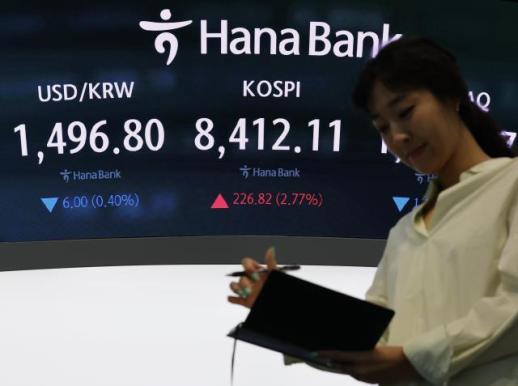 KOSPI rebounds as Middle East tensions show signs of easing SEOUL, May 29 (AJP) - South Korean stocks opened higher on Friday, recovering from a brief decline the previous day, as the benchmark KOSPI climbed back above 8,400 on hopes that the prolonged conflict in the Middle East could soon come to an end. The KOSPI rose 2.31 percent to 8,374.58 shortly after trading began, nearing its recent intraday high of 8,457.09. The junior KOSDAQ, however, fell 2.31 percent to 1,078.89 as investors shifted toward large-cap stocks. The rebound followed a volatile session the previous day, when the KOSPI closed 0.53 percent lower after briefly plunging more than 4 percent intraday, as the Bank of Korea kept its benchmark rate unchanged while hinting at future hikes. The rally was largely driven by improved investor sentiment amid signs of easing tensions in the Middle East, with reports suggesting Washington and Tehran were nearing a deal. Chipmakers led the gains, with Samsung Electronics up 4.34 percent to 312,500 won and SK Hynix up 3.23 percent to 2,363,000 won, boosting the broader market. Automakers and auto-parts makers also rallied, with Hyundai Motor climbing 6.35 percent to 720,000 won, Hyundai Mobis advancing 6.12 percent to 728,000 won and Kia adding 3.47 percent to 170,000 won. Technology and industrial shares traded higher, as Samsung Electro-Mechanics jumped 6.49 percent to 1,969,000 won, SK Square rose 1.13 percent to 1,251,000 won and HD Hyundai Heavy Industries gained 1.70 percent to 716,000 won. Financial and holding-company stocks also advanced, with Samsung Life Insurance rising 1.12 percent to 361,500 won, Samsung C&T gaining 3.38 percent to 413,000 won and Samsung Electronics preferred shares climbing 6.08 percent to 202,500 won. Defense-related shares remained firm, with Hanwha Aerospace adding 1.25 percent to 1,215,000 won. But battery, biotech and energy shares underperformed, as LG Energy Solution slipped 0.11 percent to 441,500 won, Samsung Biologics fell 0.58 percent to 1,365,000 won and Doosan Enerbility declined 2.46 percent to 103,300 won. Asian markets also opened broadly higher, with Japan's Nikkei 225 up 1.83 percent at 65,876.04, Hong Kong's Hang Seng Index rising 0.37 percent to 25,097.78 and China's Shanghai Composite adding 0.29 percent to 4,110.52. Overnight, U.S. stocks climbed to fresh record highs. The Nasdaq Composite rose 0.91 percent and the S&P 500 gained 0.58 percent, while the Philadelphia Semiconductor Index advanced about 1 percent. Investor sentiment was further boosted after Dell Technologies posted stronger-than-expected earnings and surged roughly 38 percent in after-hours trading, reinforcing optimism over AI-related spending. Lower oil prices and easing bond yields also supported risk assets. U.S. benchmark WTI crude fell to around $88 a barrel, while the yield on the 10-year U.S. Treasury note retreated to 4.44 percent. Meanwhile, the Korean won strengthened slightly against the greenback in early trading, with the dollar trading at 1,498 won, compared with the previous session's close of 1,502.80 won. 2026-05-29 10:23:59
 -
 Samsung Electronics Begins Shipping HBM4E Samples Following HBM4 Production Samsung Electronics is strengthening its technological leadership in the next-generation high-bandwidth memory (HBM) market. Following the approval for mass production of 1c DRAM in mid-2025, which laid the groundwork for HBM4 competition, the company has begun shipping HBM4 (5th generation) products and is now proactively supplying samples of HBM4E (6th generation) 12-layer memory, expanding its presence in the AI memory market. On May 29, the company announced that it has shipped HBM4E 12-layer samples to global customers. This marks a rapid transition to sample supply just months after the mass production of HBM4, indicating a shift in momentum for Samsung, which faced challenges in the HBM3E competition. The key to HBM4E lies in the combination of 1c DRAM and 4-nanometer logic die. Samsung has applied the 10-nanometer class 6th generation DRAM process, 1c DRAM, to HBM4, enhancing yield and performance stability, and has continued this foundation into HBM4E. As HBM technology relies not only on DRAM stacking but also on the competitive edge of individual DRAM die processes, securing 1c DRAM has become a crucial starting point for the competitiveness of products following HBM4. Previously, this agency reported on June 30, 2025, that Samsung had completed the approval for mass production of 1c DRAM, marking the beginning of serious competition in HBM4. At that time, industry experts viewed the development of 1c DRAM as a key variable for producing dies for HBM4, beyond just a simple transition to general-purpose DRAM processes. Indeed, Samsung has since succeeded in mass production of HBM4 and is now supplying HBM4E samples to customers, accelerating its technological roadmap. The HBM4E 12-layer product features a capacity of 48GB and operates at a stable speed of 14Gbps, with a maximum speed of up to 16Gbps. The bandwidth per single stack reaches approximately 3.6TB per second. Samsung has reported a 16% improvement in energy efficiency compared to its predecessor and has enhanced thermal resistance characteristics by over 14%. However, the shipment of samples does not immediately translate to mass production. HBM products must undergo customer certification and package-level validation before actual supply volumes can be realized. In particular, HBM for AI accelerators is evaluated not only on performance but also on long-term operational stability, heat management, energy efficiency, and packaging quality. Industry analysts believe that Samsung's experience in achieving yield targets during the HBM4 mass production process will positively influence the transition to HBM4E production. Since both HBM4 and HBM4E are based on 1c DRAM and 4-nanometer logic die, the stabilization of earlier processes and packaging expertise can carry over to subsequent products. Samsung is applying the yield management of 1c DRAM and the experience of integrating 4-nanometer base die from the HBM4 production process to the customer validation phase for HBM4E. Internally, the company is reportedly focusing on aligning the mass production schedule with customer roadmaps following the sample supply. Samsung plans to expand its lineup starting with the HBM4E 12-layer product to include 32GB 8-layer and 64GB 16-layer products. As the demand for memory bandwidth and capacity in AI servers and accelerators rapidly increases, HBM4E is poised to become a key product for next-generation AI infrastructure. Samsung's strengths lie in its integrated business structure, which encompasses memory, foundry, system LSI, and advanced packaging. In products following HBM4, it is becoming increasingly difficult to compete based solely on DRAM performance; the capabilities of base die, packaging, and customer-specific design responsiveness are also becoming crucial. Industry observers note that Samsung has significantly recovered from its relatively slow start with HBM3E during the HBM4 generation. The early stabilization of 1c DRAM leading to the mass production of HBM4 and the shipment of HBM4E samples indicates that this shipment is more than just a product announcement; it signifies that Samsung's next-generation HBM strategy is advancing to the actual supply stage. Hwang Sang-jun, Executive Vice President of Samsung Electronics' Memory Business Division, stated, "Following the successful mass production of HBM4 and the seamless supply of next-generation HBM4E samples, we have firmly established Samsung's unparalleled technological leadership in the market. We will continue to lead the growth of the global AI memory market with overwhelming technological superiority and proactive investments in production infrastructure."* This article has been translated by AI. 2026-05-29 10:22:00
 -
 NVIDIA CEO Jensen Huang's Visit Sparks 20% Surge in LG Electronics Stock LG Electronics' stock surged more than 20% during trading on May 29, fueled by speculation surrounding NVIDIA CEO Jensen Huang's visit to South Korea and a potential meeting with LG Group Chairman Koo Kwang-mo. As of 10 a.m. KST, LG Electronics shares were trading at 277,750 won, up 52,250 won (23.17%) from the previous day. The stock opened at 245,000 won and briefly soared to 283,500 won, setting a new 52-week high. LG Corp., the holding company, also saw a rise of 10.02%, trading at 127,400 won. Other major affiliates, including LG CNS (22.51%), LG Innotek (7.14%), LG Display (4.85%), and LG Uplus (3.05%), also experienced significant gains. Market attention is focused on Huang's upcoming visit to South Korea, scheduled after he attends NVIDIA's annual AI conference, GTC Taipei 2026, from June 1 to 4 in Taipei. This will be Huang's first visit to South Korea in about seven months since the APEC CEO Summit held in Gyeongju last October. There are growing expectations for collaboration between Huang and Koo during the visit, particularly in the area of physical AI, which is seen as a key growth driver for both companies. Analysts speculate that discussions may center on expanding their partnership in this emerging field. In addition to the existing collaboration between LG Electronics and NVIDIA in physical AI, there may also be discussions about group-wide initiatives involving LG AI Research's massive AI model, EXAONE, LG Innotek's semiconductor substrates and robotic sensing technologies, and LG Uplus's AI cloud business. Previously, during the APEC CEO Summit in October, Huang held a notable meeting with Samsung Electronics Chairman Lee Jae-yong and Hyundai Motor Group Chairman Chung Eui-sun, which garnered significant media attention.* This article has been translated by AI. 2026-05-29 10:22:00
 -
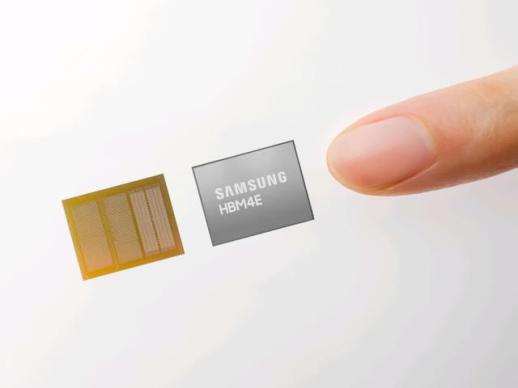 Samsung Electronics ships industry's first 12-layer HBM4E memory samples SEOUL, May 29 (AJP) - Samsung Electronics has begun shipping samples of its 12-layer HBM4E memory chips to global customers. According to the company on Friday, this is the semiconductor industry's first 12-layer HBM4E sample to be shipped. The new memory component delivers a stable pin speed of 14 gigabits-per-second (Gbps) and is capable of scaling up to 16 Gbps. This marks a performance increase of more than 20 percent compared to Samsung's previous generation of HBM4 chips. Additionally, the 12-layer HBM4E provides a memory bandwidth of up to 3.6 terabytes-per-second (TB/s) per stack. In terms of capacity, the 12-layer HBM4E offers 48 gigabytes (GB), which represents a capacity increase of over 30 percent from the previous generation. Samsung plans to further expand this lineup to include 32GB 8-layer and 64GB 16-layer configurations to meet varying customer requirements. The HBM4E utilizes Samsung's sixth-generation 10-nanometer-class (1c) DRAM process paired with a 4-nanometer logic base die manufactured by Samsung Foundry. The company reported that optimized packaging and low-power design technologies have improved the chips' energy efficiency by 16 percent. Furthermore, thermal resistance characteristics have been improved by more than 14 percent compared to the prior generation, aiding in heat dissipation for data centers running intensive workloads. The release of these samples follows Samsung's mass production and commercial shipment of HBM4 chips, which began earlier this year in February. The previous HBM4 model reached speeds of 11.7 Gbps during system in package (SiP) tests last December. "Following the successful mass production of HBM4, Samsung has once again demonstrated its distinct technological edge with HBM4E," said Sang Joon Hwang, Executive Vice President and Head of Memory Development at Samsung Electronics. "Through our advanced manufacturing capabilities and preemptive infrastructure investments, we will continue to drive the growth of the global AI memory market." 2026-05-29 10:20:50
 -
 ABC Challenges FCC's Early License Review Amid Free Press Concerns ABC Broadcasting has expressed strong opposition to the Federal Communications Commission's (FCC) request for an early review of its broadcast licenses. The network claims that the government is using license renewals as leverage to pressure critical reporting. What began as a routine license renewal process has escalated into a debate over press freedom. On May 28, Reuters and the Associated Press reported that ABC's parent company, Walt Disney, submitted license renewal applications for eight ABC-owned stations in major markets including New York, Los Angeles, and Chicago. Disney characterized this submission as a response to an FCC demand rather than a voluntary action, and included a letter of protest with the application. The key issue at hand is the timing of the review. The license renewals for these stations were not originally scheduled for consideration until before October 2028. However, the FCC requested early renewal applications from ABC stations in April. Reuters noted that this early review of major TV broadcasters is unprecedented in over 50 years. ABC has argued that this action represents an editorial pressure disguised as an administrative procedure. In its letter, Disney criticized the FCC's request as 'illegal, arbitrary, and unconstitutional,' asserting that it constitutes 'expression suppression under the guise of bureaucratic procedure.' The FCC, however, maintains that the review is necessary to fulfill public interest obligations. Brendan Carr, an FCC commissioner, stated, 'ABC has not adequately and appropriately responded to inquiries regarding diversity.' He emphasized that license holders have a duty to operate in the public interest given their use of public airwaves. Concerns about political retaliation have also emerged. President Donald Trump has repeatedly criticized ABC, its host Jimmy Kimmel, and certain news programs. Reuters reported that the FCC's request for early review came the day after Trump urged for Kimmel's dismissal.* This article has been translated by AI. 2026-05-29 10:18:00
 -
 Public Housing Crisis in Gangil-dong Sparks Debate on Welfare and Independence A public housing crisis in Gangil-dong, Seoul, has reignited the debate over welfare and self-sufficiency. Recently, an anonymous post on the workplace community platform "Blind" claimed that the Gangil-dong situation was a "massive social experiment." The author, identified as A, stated, "Providing nearly free housing for 20 years raises the question of whether it fosters independence or leads to dependency. The conclusion is that despite 20 years of affordable rent, residents have not become self-sufficient." A continued, "Instead, they seem to want to remain in public housing, becoming accustomed to relying on others (taxes) to solve their housing issues." This post quickly gained traction amid ongoing controversies surrounding the renewal and eviction of long-term public housing residents in Gangil-dong. Some residents expressed their distress, saying, "We have built a community here for over 20 years, and now we are being forced out." Critics online argued that public housing has effectively transformed into a permanent living solution. Comments from netizens included, "This experiment shows that increasing welfare can lead to dependency rather than motivation to work harder," and, "Public housing should be a stepping stone to independence, not a permanent residence." Others remarked, "Taxpayer support has only increased dependency," and, "Twenty years is ample time to prepare for independence." The debate has expanded beyond the issue of rental housing, touching on broader concerns about housing inequality and welfare policy in South Korea. There is ongoing disagreement about whether long-term public housing should focus on supporting independence or prioritizing stable housing rights. Meanwhile, the Seoul city government and the SH Corporation stated they are proceeding with legal standards and supply principles regarding contracts and resettlement related to the Gangil-dong public housing. However, as public sentiment intensifies, discussions about the role and sustainability of the public housing system are expected to continue for the foreseeable future. 2026-05-29 10:14:00