


Latest by
-
 POSCO Holdings to Launch Direct Lithium Extraction Pilot in the U.S. POSCO Holdings is set to become the first South Korean company to conduct a pilot project for Direct Lithium Extraction (DLE) technology in the United States, accelerating its efforts to enhance competitiveness in next-generation lithium extraction technologies. On June 10, POSCO Holdings signed a cooperation agreement with Australian resource development firm Anson Resources at the POSCO Center in Seoul to build and operate a DLE demonstration plant in the Green River area of Utah. DLE is a technology that allows for the economical production of lithium from low-concentration lithium brine, offering higher recovery rates and shorter production times compared to traditional evaporation methods. It is gaining attention as a key technology for the next generation of the global lithium industry. Under this agreement, POSCO Holdings will verify the commercial viability of the DLE demonstration plant's design, construction, and operation in the U.S. Anson Resources will handle site selection, infrastructure, and brine supply, as well as manage the permitting process for the plant using its local network. Since 2016, POSCO Holdings has been developing DLE technology and has conducted pilot tests on brines from various regions, including Argentina, accumulating expertise in process design and operations. This pilot project marks the first instance of POSCO Holdings validating its independently developed DLE technology in the global market, representing a significant starting point for confirming the commercial viability of next-generation lithium production technologies. POSCO Holdings aims to complete and operate the demonstration plant by 2027, with plans to finalize technology verification using actual brine by 2028, establishing a foundation for commercialization. Industry experts view this pilot as part of POSCO Holdings' broader strategy to expand its global lithium value chain, beyond mere technology verification. The company is currently securing raw materials through its lithium brine project in Argentina and investments in lithium mines in Australia. If successful in commercializing DLE technology, POSCO Holdings is expected to significantly enhance its competitiveness across the lithium supply chain, from resource development to material production. "This pilot project is a strategic investment to proactively secure next-generation technology and gain a foothold in the global lithium market," said POSCO Holdings CEO Lee Joo-tae. "We will further strengthen our competitiveness in the global lithium business, particularly in North America, based on our unique technological edge."* This article has been translated by AI. 2026-06-10 15:33:00
 -
 Shinhan Bank Launches AI Academy to Train 1,000 Specialists Shinhan Bank is accelerating its transition to artificial intelligence (AI) by developing its employees into "AI natives" and cultivating key experts to enhance the organization’s AI capabilities.On June 10, Shinhan Bank announced the official launch of its internal training organization, the AX and Web3 Academy. The academy aims to provide training for approximately 12,000 employees, with plans to develop 1,000 of them into core experts.To strengthen the academy's expertise, Shinhan Bank has recruited four external experts as full-time professors.In the AX field, Choi Kwang-sin, former head of financial strategy at Danal, and Kim Hee-sun, former data scientist at KB Kookmin Bank, have been appointed to support AI modeling, data analysis, and project coaching. In the Web3 sector, Choi Cheol, former head of SK AIX Convergence Group, and Jeong Jae-wook, former head of digital new business at Hana Bank, have been selected.Eight experts from academia and industry, including Lee Kyung-rok, CEO of BrainCrew, will join as technology partners for collaboration.A Shinhan Bank official stated, "We launched the academy to enable employees to naturally utilize AI in their work and lead technological innovations needed in the financial sector. We aim to provide differentiated financial experiences to our customers based on AI and digital technology."* This article has been translated by AI. 2026-06-10 15:33:00
 -
 AI Analyzes Job Seekers to Recommend Tailored Employment Policies Artificial intelligence (AI) has been proposed to analyze job seekers' employment potential and long-term unemployment risks, recommending tailored employment support policies. The plan aims to establish a system that goes beyond merely searching for job information, diagnosing job seekers' characteristics and needs to connect them with appropriate vocational training, employment support programs, and counseling services.On June 10, the Korea Employment Information Service presented a research report titled "Systematization Plan for Job Seeker Diagnostic Tools for Effective Online and Offline Employment Support." The report suggests creating an integrated diagnostic system that comprehensively analyzes job seekers' employment potential, willingness to work, and barriers to employment, providing customized support.In 2023, the government launched Employment24, a platform that integrates job services, including WorkNet, employment insurance, and HRD-Net. Job seekers can access a variety of services, including job listings, vocational training, unemployment benefits, and employment support programs, all in one place.The number of individual members on Employment24 has grown from 9.28 million in October 2024 to 11.19 million in May of the previous year. The platform currently offers tailored training and job information based on member characteristics. However, users often need to search for the policies and services they require, highlighting the need for a more sophisticated recommendation feature.The Korea Employment Information Service identified that diagnostic tools used in various programs, such as unemployment benefits, the National Employment Support System, and the Job Seeker Leap Package, are operated in a fragmented manner. The differing diagnostic purposes and measurement methods limit the comprehensive understanding of job seekers' characteristics and the connection between services.To analyze job seekers' characteristics more systematically and link tailored services, the establishment of an integrated diagnostic system is deemed necessary.The report also emphasizes the need for a data-driven profiling system to identify job seekers at high risk of long-term unemployment early and provide focused support.Countries like the United States, Australia, and Germany have implemented statistical profiling systems to identify and support job seekers at high risk of long-term unemployment. European countries, particularly Germany, maintain one-on-one counseling-based employment services while efficiently utilizing limited budgets and personnel through a "select and concentrate" strategy based on statistical analysis.The Korea Employment Information Service stressed the need for South Korea to shift from a simple qualification assessment-based employment service to one that identifies job seekers' characteristics and risk factors based on data, providing appropriate services accordingly.To achieve this, the report recommends using employment administrative databases and explainable artificial intelligence (XAI) to predict employment potential and allocate limited employment service resources efficiently. This approach would involve providing more intensive counseling, vocational training, and job placement services to job seekers at high risk of long-term unemployment, while quickly matching those with relatively higher employment potential to available jobs.Ultimately, the goal is to establish an "AI-collaborative employment service system" where AI analyzes job seekers' characteristics and risk factors, allowing counselors to design support strategies based on this analysis.Seohyun Joo, a senior researcher at the Korea Employment Information Service's Career Development Research Division, stated, "We need to build an AI-collaborative employment service system where AI analyzes job seekers' characteristics, and counselors design tailored services based on that analysis."* This article has been translated by AI. 2026-06-10 15:30:00
 -
 Han Yuwon Partners with Hyundai Department Store for K-Beauty Popup, Seeking Participants Until June 26 The Korea Small and Medium Business Administration announced on June 10 that it is seeking companies to participate in a popup store for small beauty businesses in collaboration with Hyundai Department Store. This popup will be operated in partnership with Hyundai Department Store's beauty concept store, Be Clean. Be Clean is a clean beauty shop directly managed by Hyundai Department Store, selling only products that contain natural ingredients, are cruelty-free, or use recyclable eco-friendly packaging. The popup, set to take place in September at the Be Clean store in Pangyo, will showcase products from a total of 50 small beauty companies. The exhibition will include cosmetics, perfumes, body and hair products, beauty devices, and inner beauty health supplements. Small businesses that achieve strong sales will be offered opportunities to enter Be Clean's online and offline platforms. Be Clean opened its first store in The Hyundai Seoul in 2021 and currently operates seven physical locations. Beauty small businesses interested in participating can apply through the 'Panpan Daero' website, with the application deadline set for June 26. Lee Tae-sik, CEO of Han Yuwon, expressed optimism, stating, "As this popup store is located in a key commercial area with a high consumer footfall, it is expected to greatly benefit small beauty companies in promoting their products." He added, "We will continue to support the growth of excellent K-beauty small businesses, leveraging the sales experience and consumer feedback gained on-site to help them take their next leap forward."* This article has been translated by AI. 2026-06-10 15:30:00
 -
 Korail Launches Railway Culture Exhibition at Seoul Station The historic Seoul Station, marking its 101st anniversary, has taken its first steps toward reclaiming its identity as a railway heritage site. Korail, the Korea Railroad Corporation, held the opening ceremony for the Railway Culture Exhibition at the old Seoul Station (Cultural Station Seoul 284) and officially declared its commitment to restoring the station's function as a national heritage site in collaboration with the Cultural Heritage Administration. Korail announced that from June 11 to August 17, it will host the exhibition titled "Seoul Station 2026: The Heart Beats Again." This will be the largest exhibition to date, featuring 13 exhibition halls, including the first and second floors and train platforms. The exhibition aims to revive memories of the old Seoul Station, which was a hub of South Korean railways, and envision its future as a functioning railway station alongside visitors. The ceremony at Cultural Station Seoul 284 was attended by key figures, including Korail President Kim Tae-seung, SR CEO Jeong Wang-guk, and Acting Chairman of the Korea Railroad Corporation Lee An-ho. In his speech, President Kim Tae-seung expressed, "This cultural exhibition was organized with the hope that the old Seoul Station will once again become the heart of South Korean railways. We will strive to ensure that railways become spaces that connect culture and history, beyond just a means of transportation." SR CEO Jeong Wang-guk emphasized, "While developing new railway technologies is important, it is equally essential to preserve and enhance our railway cultural heritage to match the status of the South Korean railway industry."Acting Chairman Lee An-ho remarked, "Railways are completed not only through technology and speed but also through the cultural value of memories and stories passed down to the next generation."The exhibition will run from June 11 to August 17. Artistic Director Kim Mi-yeon has designed it as a five-stage journey: 'Entry → Waiting → Movement → Boarding → Arrival.' Visitors will begin their journey at the entrance of the central hall by stamping the date on a replica of a ticket that was actually used in the past. In the central hall, there is an installation of over 10,000 crystal balls by artist Park Seon-ki, alongside a one-fifth scale model of the Pasi Type 1 locomotive, which was produced in 1930. This model is a vivid artifact of railway history, having been demonstrated at the 1955 Industrial Fair marking the 10th anniversary of liberation. In the third-class waiting room, a black-and-white photo archive by photographer Lee Gap-cheol showcases regions with railway stations, along with the history of the opening of 27 railway lines in South Korea. In the first and second-class waiting rooms, visitors can experience KTX-Cheongryong and hydrogen mobility technology through 3D VR. On the platform, visitors will have a special experience by descending to Seoul Station's Platform 4 and facing the tracks. In the baggage claim (RTO) area, florist Leo Kim visualized the logistics cycle using soil and plants sourced from the Honam Plain, which will be returned to its original location after the exhibition ends. On the second floor, the dining hall recreates the actual tables and silverware of 'The Grill,' Korea's first Western-style restaurant, which opened in 1925, restoring the social culture of that time. This was a space frequented by literary figures such as Lee Sang and Park Tae-won. During the exhibition period, the 'Today's Destination' program will invite local brands from regions connected by rail, including Chuncheon, Hadong, Yeongju, and Daejeon. Previously, Korail and the Cultural Heritage Administration signed a memorandum of understanding (MOU) in May of last year to enhance the value of the old Seoul Station and restore its function as a railway heritage site. The two organizations are working together on plans that include restoring and preserving the historical structure, improving the heritage environment through connections between Seoul Station, the square, and railway spaces, and expanding public access to cultural experiences. They also jointly conducted a study on management and utilization plans for the old Seoul Station. This cultural exhibition is the first visible outcome following the MOU, with further restoration timelines and plans for connecting operations with the square remaining as follow-up tasks. A Korail official stated, "Starting with this cultural exhibition, we plan to institutionalize the Railway Culture Exhibition annually to continue promoting railway culture."* This article has been translated by AI. 2026-06-10 15:27:00
 -
 Kakao Faces First Strike as Labor Dispute Escalates Kakao's labor dispute is showing signs of escalating. Following the company's first-ever strike by its labor union, an additional strike is planned for the 29th, indicating that the gap between management and labor remains wide. On June 10, the Kakao branch of the National Chemical Fiber Food Industry Workers' Union held its first strike rally in front of the Kakao office in Pangyo, Seongnam. The union conducted a four-hour strike from 10 a.m. to 3 p.m. (excluding lunch). Slogans such as "Let's secure job stability," "Irresponsible management must resign," and "Victory in the Kakao strike to achieve joint negotiations" were chanted. Over 500 participants marched from Pangyo Station Square to H Square, wearing matching black T-shirts and carrying white umbrellas. According to the union, more than 1,000 employees logged off from the company's internal system to join the strike at Kakao's headquarters alone. Including subsidiaries such as Kakao Pay, Kakao Entertainment, DK Tech, and XL Games, the total number of participants is estimated to be around 1,500. Five corporate unions with dispute rights participated in the strike. In response, Kakao has implemented emergency measures. The company, in collaboration with the Ministry of Science and ICT, reviewed its emergency response system and prepared plans focusing on essential personnel to minimize service disruptions, given that services like KakaoTalk and KakaoMap are closely tied to daily life. Despite the strike, all of Kakao's services continued to operate normally without any disruptions. This strike is significant as it marks the first labor action since Kakao's establishment. The union has been advocating for measures to alleviate job insecurity stemming from the sale of subsidiaries, spin-offs, and restructuring, as well as the establishment of a joint negotiation system. Conversely, the company maintains that it cannot fully accommodate the union's demands due to the internal and external business environment. Negotiations continue even after the second labor committee mediation failed, but the divide between the two sides remains substantial. The core issue of the labor dispute centers on compensation. The union demands a performance bonus equivalent to approximately 10 million won, which is about 13-14% of operating profit, along with an additional 5 million won in restricted stock units (RSUs). The company has not budged on its stance that these demands could impose a financial burden, and disagreements over performance compensation remain unresolved. During the rally, the union also addressed the recent departure of Chief Product Officer Hong Min-taek. The union stated, "The investigation into related matters should not cease just because the responsible party has left the company," emphasizing the need for thorough accountability. Kakao has stated that it will continue negotiations with the union. However, with the union announcing an additional strike, the labor dispute that began with the company's first strike is expected to persist for the foreseeable future. 2026-06-10 15:24:00
 -
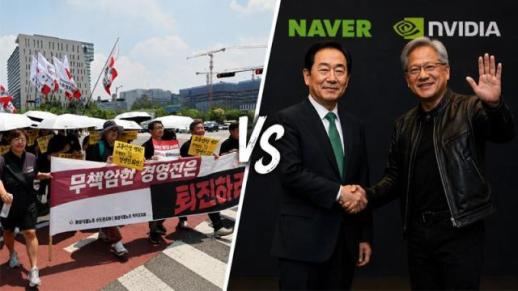 Kakao first-ever strike spares users but unnerves investors SEOUL, June 10 (AJP) - The chat platform through which most South Koreans communicate and work, along with its cab-hailing, payment and navigation services, operated normally Wednesday despite a four-hour walkout by about 600 workers, or roughly 15 percent of the workforce, near the headquarters of Kakao. The first strike in the platform operator's 20-year history left flagship services untouched but rattled investors, sending Kakao shares lower and exposing tensions that could complicate the company's push into artificial intelligence. Two days earlier, a very different scene had played out in Pangyo, often dubbed South Korea's Silicon Valley. Nvidia chief executive Jensen Huang stood inside Naver's 1784 headquarters, linking arms with founder Lee Hae-jin and pledging to build gigawatt-scale AI infrastructure together. The two scenes, unfolding in the same week and in the same technology hub south of Seoul, highlighted the diverging fortunes of South Korea's twin internet giants as the AI race reshapes the country's technology landscape. Kakao's union staged a partial strike from 10 a.m. to 3 p.m., including a one-hour lunch break, marking the first industrial action since the 2006 founding of IweLab, the predecessor to Kakao. Union members marched about 800 meters from Kakao's Pangyo office to a nearby building along Daewangpangyo-ro, condemning what they described as management failures and demanding stronger job security and a more transparent compensation system. The walkout followed the collapse of a second round of mediation at the Gyeonggi Regional Labor Relations Commission in late May, giving the union legal grounds to strike. Despite the protest, KakaoTalk, which serves about 40 million monthly users, as well as Kakao Map and Kakao Pay, continued to operate without disruption. The company said most core services are highly automated and that essential personnel remained on duty throughout the walkout. Investors nevertheless reacted cautiously. Shares of Kakao fell 3.4 percent to 38,150 won, while Kakao Games lost 1.28 percent to 8,510 won. KakaoBank ended 1.43 percent up at 24,750 won. Analysts said the lack of immediate service disruptions should not obscure longer-term risks. Automated systems can keep platforms running under normal conditions, but traffic surges, unexpected outages, major software updates and cybersecurity incidents still require rapid responses from experienced engineers. A prolonged labor dispute could also slow product development and delay new feature rollouts. The labor unrest comes at a delicate moment for Kakao as it seeks to reposition itself around AI. That challenge stands in stark contrast to the momentum enjoyed by rival Naver. During his visit Monday, Huang firmed up plans for a global AI factory centered on Naver's Gak Sejong data center. The facility is scheduled to begin operating with 55 megawatts of capacity in the first half of 2027 before expanding to 200 megawatts by 2028. "If this plan is realized, Naver will become a company 10 times bigger than it is today," Huang said, describing Naver as a cloud company with global-scale potential. Naver ranks as the 22nd-largest company on the benchmark KOSPI with a market capitalization of about 35 trillion won as of Wednesday. Kakao trails at 53rd place with a market value of around 16 trillion won. The Nvidia chief's endorsement capped a year of strong momentum for Naver. The company posted record annual revenue of roughly 12.1 trillion won ($7.9 billion) last year, driven by AI-related monetization and commerce growth. It also joined Nvidia's Nemotron alliance for open frontier AI model development. AMD chief executive Lisa Su visited Naver in March to deepen cooperation on graphics processing units. Kakao, too, enjoyed an AI-driven rally until growing employee discontent over compensation and restructuring began to overshadow the narrative. The company forged a strategic partnership with OpenAI in February last year and followed with a separate alliance with Google this year, betting that its unrivaled user base rather than infrastructure would be its pathway into the AI era. That strategy has shown early signs of traction. ChatGPT for Kakao, which integrates OpenAI's chatbot into KakaoTalk, attracted about 8 million users by the end of last year, roughly four times the level recorded a quarter earlier. Its partnership with Google, centered on the Kanana AI service within KakaoTalk, remains in the early stages. Industry observers say the differing partnerships reflect the strengths each company brings to the AI ecosystem. Naver's large-scale data center infrastructure has attracted chipmakers seeking computing capacity, while Kakao's daily interactions with much of South Korea's population appeal to AI model developers looking for distribution. Still, analysts argue Kakao's AI initiatives have yet to materially improve the metric that matters most for a platform company: user engagement. "For these services to meaningfully improve the user experience and stand apart from global rivals, agentic commerce must ultimately be realized, with the agent recommending products, taking the lead and completing transactions within the platform," said Lee Jun-ho, an analyst at Hana Securities. Chief executive Chung Shin-a, whose term was extended by two years in March, has promised to build an agentic AI ecosystem around KakaoTalk while targeting revenue growth of more than 10 percent and an operating margin of 10 percent this year. Yet Wednesday's walkout suggests her most immediate challenge may lie closer to home. Before Kakao can convince investors that its AI transformation will pay off, it must first convince the employees expected to build it. The labor dispute also appears far from over. Following Wednesday's rally in Pangyo, the union announced plans to stage a companywide "Log-off Day" on June 29, during which employees will simultaneously sign out of internal work systems as part of an escalating pressure campaign against management. While the first strike in Kakao's history left customer-facing services untouched, a prolonged standoff could increasingly affect development schedules, product launches and the company's ability to execute its AI strategy at a time when the gap with rival Naver appears to be widening. 2026-06-10 15:23:03
 -
 SK Group Chairman Chey Tae-won: Next Semiconductor Plant Must Have Infrastructure SK Hynix is exploring potential locations for its next semiconductor production facility, considering both domestic and international options following the completion of its semiconductor cluster in Yongin.Chey Tae-won, Chairman of SK Group, spoke with reporters on June 10 after attending the Nikkei Forum in Tokyo. He stated, "Demand for semiconductors continues to rise, so we cannot avoid making preparations, which are becoming a pressing task. We need to consider follow-up production bases after the completion of the Yongin Cluster Phase 4."Regarding the location of the next factory, Chey noted, "If it cannot be done in our country, we may have to look abroad. It is not necessarily the case that we will only build in Korea."He emphasized that key conditions for a semiconductor plant location include infrastructure such as power, water, land, and workforce. "We need to have power, land, people, and water all in place," he stressed.His comments indicate that the company is considering securing production bases both domestically and internationally. This comes amid recent reports that Samsung Electronics and SK Hynix are exploring new investments in semiconductor facilities in the Honam and Chungcheong regions, which has drawn attention from lawmakers.However, both Samsung Electronics and SK Hynix stated, "We are not aware of this," and clarified that there are no definitive plans regarding local investments.Chey also mentioned, "If customers or other countries believe they can provide us with significant benefits, we can make demands, and how we respond to those demands reflects our capabilities. There is a need to ensure at least minimal satisfaction for stakeholders," suggesting that the company is examining various options for the semiconductor plant location.He added, "We will make decisions based on comprehensive considerations regarding where and how to build. For now, our focus is on constructing the Yongin Cluster."Additionally, Chey expressed his agreement with Jensen Huang, CEO of NVIDIA, who recently visited Korea, on the need for increased collaboration to expand the AI ecosystem. He also emphasized that in terms of Korea-Japan economic cooperation, the two countries should enhance collaboration in semiconductors, AI, and energy sectors to become 'rule makers' in the global industrial order. 2026-06-10 15:21:00
 -
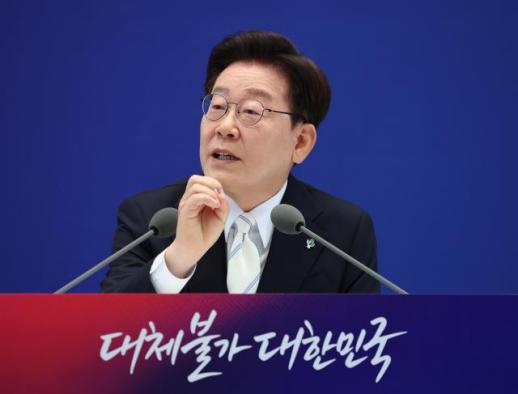 President Lee: Post-Iran War, North Korea's Denuclearization More Challenging President Lee Jae-myung discussed the growth of the artificial intelligence (AI) industry, wealth distribution, regional development, U.S.-South Korea security negotiations, and North Korea's nuclear issue in an interview with The Economist. In the interview conducted at the Blue House, President Lee stated that South Korea can move beyond the chaos following former President Yoon Suk Yeol's declaration of martial law and impeachment. The Economist noted that President Lee has maintained a high approval rating of around 60% a year into his term, bolstered by political stability, a stock market rally, and pragmatic diplomacy. However, the publication highlighted that addressing the wealth distribution issue stemming from the AI investment boom will be a significant challenge for President Lee during his remaining term. While South Korean semiconductor companies like Samsung Electronics and SK Hynix benefit from increased AI demand, how to distribute the newly created wealth could become a political issue. In response, President Lee emphasized the need for a new mechanism to distribute some of the excess profits to the general public. The Economist reported that he is considering measures such as basic income payments. Regional development was also identified as a key issue. The Economist reported that President Lee is encouraging semiconductor companies to establish supply chains in relatively underdeveloped areas. His plan to relocate some administrative functions from the Blue House to an administrative hub south of Seoul is part of this regional development strategy. In the realm of diplomacy and security, the U.S.-South Korea relationship was a focal point. The Economist assessed that while relations with former President Donald Trump could have been disastrous, President Lee's administration has managed to stabilize ties by committing to increase defense spending to 3.5% of GDP, up from 2.7% last year. Regarding defense, President Lee stated, "We must directly address our own defense issues." He also mentioned that during U.S.-South Korea tariff negotiations, South Korea secured tariff reductions in exchange for a $350 billion investment commitment to the U.S. The Economist analyzed that President Lee included security goals in this negotiation package, such as acquiring nuclear-powered submarines and capabilities for uranium enrichment and reprocessing spent nuclear fuel for nuclear power generation. However, President Lee drew a line regarding concerns over nuclear proliferation, explaining that enrichment capabilities would only be used for the low levels required for nuclear power operations. He stated that possessing nuclear weapons is neither desirable nor realistic for South Korea. On the North Korean issue, President Lee expressed a pessimistic outlook, stating that the likelihood of North Korea abandoning its nuclear weapons has decreased following the Iran war. The Economist reported that North Korea has recently labeled South Korea as an "enemy" and has strengthened ties with Russia, showing little interest in inter-Korean dialogue. Nevertheless, President Lee remains hopeful about the possibility of breakthroughs through U.S.-North Korea dialogue, noting that former President Trump's "unique personality" could be very helpful in the current situation. The article also addressed President Lee's personal legal challenges. The Economist pointed out that he took office while facing five trials related to his time as a market and provincial governor, and while these trials were paused during his presidency, they are likely to resurface after he leaves office. President Lee claims that the charges against him are politically motivated. The Economist highlighted that more than half of South Korea's presidents since democratization have faced impeachment or imprisonment, raising uncertainties about President Lee's future. In response, President Lee acknowledged that he could also become a victim of this cycle of sacrifice, stating that the likelihood is "quite high." The Economist concluded that President Lee's legacy will depend on whether he can institutionalize political stability and achieve diplomatic and economic successes, thereby breaking the so-called "curse of the Blue House."* This article has been translated by AI. 2026-06-10 15:21:00
 -
 China Criticizes US Blacklist of High-Tech Firms as Honorary Hall of Fame China's state media has ridiculed the U.S. Department of Defense's blacklist of companies linked to the Chinese military, suggesting it has become an honorary hall of fame for high-tech firms in China. This criticism follows the recent addition of 188 Chinese high-tech companies, including Alibaba and BYD, to the blacklist. In an opinion piece published on June 10, the Global Times stated, "The absurd spectacle of the U.S. military-related blacklist should come to an end." It criticized the expanding scope of the blacklist, which now includes companies in artificial intelligence (AI), e-commerce, electric vehicles, batteries, semiconductors, robotics, and biopharmaceuticals. The opinion piece highlighted that this year's list features numerous companies representing China's advanced manufacturing and emerging technology sectors, claiming it resembles a "hall of fame" showcasing China's new productive capacity. It condemned the blacklist as an unjust suppression of Chinese companies and a blatant challenge to global trade and market rules. The article pointed out that the blacklist includes e-commerce, search engine, and electric vehicle companies that have no military ties, as well as AI, cloud computing, and battery firms, which have been labeled as "linked to the Chinese military" or "threats to U.S. national security" solely due to their competitive edge in technology. It criticized the arbitrary and absurd criteria used for the blacklist. It further argued that merely being a competitive global technology company is enough for a Chinese firm to be classified as military-related, indicating that the U.S. views the entire Chinese tech industry as a strategic competitor rather than targeting specific companies. The Global Times assessed that the U.S. blacklist paradoxically reveals American anxiety about China's technological capabilities. It stated, "The blacklist implicitly acknowledges China's technological advancements and reflects U.S. fears and insecurities regarding China's core competitiveness." The expanding scope of the blacklist suggests that the U.S. strategy of pressuring specific Chinese companies has not achieved its intended effects. The opinion piece noted, "While this may exert short-term pressure on competitors, it will ultimately undermine the openness and innovative efficiency of the global supply chain." It concluded that the U.S. Department of Defense is not safeguarding security but rather disrupting normal international business cooperation, disturbing international trade order, and creating artificial risks for the global economy. The blacklist will serve as evidence of how Chinese companies have overcome technological barriers and external blockades while achieving breakthroughs in new productive capacity. On June 8, the U.S. Department of Defense added Alibaba, Baidu, and BYD to its list of companies linked to the Chinese military. Inclusion on the list does not immediately trigger sanctions or export controls, but it may disadvantage these companies in future U.S. defense procurement or contracting processes, serving as a warning to them within the U.S. government and military supply chain. The Chinese government and companies responded swiftly. On June 9, the Chinese Foreign Ministry urged the U.S. to correct its wrongful practices and cease the unjust repression of Chinese companies, indicating that necessary measures would be taken to protect the legitimate rights and interests of Chinese firms. Alibaba stated through a Hong Kong Stock Exchange announcement that there is no basis for including the company on the blacklist and that it would take all possible legal actions against attempts to damage its corporate image. The company emphasized that it is unrelated to U.S. military procurement, asserting that this action would not have a substantial impact on its global operations, including in the U.S. Chinese electric vehicle manufacturer NIO also stated it would actively communicate with the U.S. Department of Defense to resolve the blacklist issue, including legal measures if necessary, to protect the interests of the company and all its shareholders. BYD and Baidu similarly argued that they are neither military enterprises nor military-civilian fusion companies, asserting that there is no justifiable reason for their inclusion on the list.* This article has been translated by AI. 2026-06-10 15:21:00