

Journalist

KI SU JEONG
-
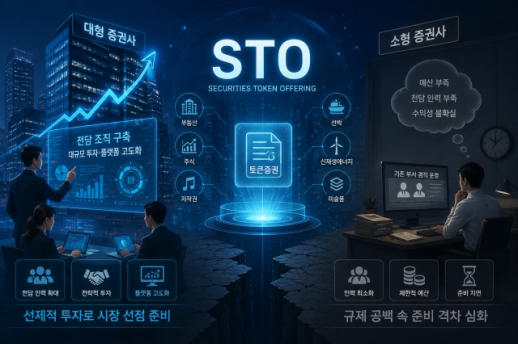 Regulatory Delays Widen Gap Among Securities Firms in Digital Asset Market As competition intensifies among securities firms to dominate the digital asset market, the delay in regulatory legislation is creating a noticeable disparity in preparations among companies. According to the financial investment industry on June 4, major domestic securities firms expect that guidelines and regulations related to Security Token Offerings (STO) will become clearer this month, prompting them to enhance their mobile trading systems and other platform infrastructures. However, discussions in the political arena regarding virtual assets and STO legislation have effectively come to a halt due to the recent local elections. Despite having completed technical preparations for market entry, firms are stuck in a 'zero hour' situation, unable to proceed without regulatory approval. A representative from the Korea Financial Investment Association stated, "All political attention is currently focused on the elections and reshaping the political landscape, leading to a complete suspension of legislative discussions in the National Assembly. Since the previously proposed bills were progressing sequentially, it will take the conclusion of the election period for legislative efforts to resume." During this regulatory vacuum, the internal organization and staffing of securities firms show extreme variations based on company size and strategy. Some mid-sized firms have made bold investments in personnel, establishing dedicated teams comparable to larger firms. Hanwha Investment & Securities, for instance, has created a new Future Strategy Office to oversee STOs, real-world asset tokenization, and global expansion initiatives. Notably, they have also set up a 'Digital Asset Research Team' within their research center, hiring specialized personnel as team leaders to build independent infrastructure. Meritz Securities has similarly established a strategic planning division to serve as a control tower for entering the virtual asset and STO markets. Rather than expanding the organization excessively, they are reportedly creating a system that organically connects traditional securities operations (investment banking and retail) with new digital asset businesses in preparation for market entry. In contrast, smaller firms with limited financial resources and personnel are finding it challenging to allocate budgets and staff for STO projects, as they do not see immediate profitability. For example, a small securities firm recently began preparations for related business but opted for a 'dual role' approach, assigning STO responsibilities to an existing department that handles retail and overseas product orders, rather than creating a dedicated team. In reality, only two staff members are overseeing this work. A representative from the small firm remarked, "Unlike larger firms that issue flashy press releases, smaller firms lack the capacity to invest specialized personnel in future projects that do not yield immediate returns. Essentially, we have just added this work under the existing team name." The securities industry is concerned that as this regulatory gap prolongs, the disparities among firms will become stark when legislation is eventually passed and the market opens. Larger firms with substantial capital can continue to invest in significant equity and enhance their platforms during the legislative pause, while smaller firms may struggle to even take the first step. An industry insider noted, "Larger firms have the luxury to proactively invest in personnel and costs for new revenue streams related to virtual assets, but smaller firms find it difficult. Ultimately, even when legislation begins, smaller firms will have no choice but to follow the path paved by larger firms, and that gap will only widen."* This article has been translated by AI. 2026-06-04 16:54:00
 -
 KOSPI slides as won weakens sharply SEOUL, June 4 (AJP) - SSouth Korea's benchmark KOSPI fell nearly 2 percent to close at 8,639.41 points on Thursday as markets reopened after Wednesday's elections, pressured by escalating tensions in the Middle East. Adding to the pressure, the Korean won also weakened sharply against the U.S. dollar. But beneath the decline, the session looked less like a broad sell-off than a wholesale rotation in market drivers, as crowded artificial intelligence stocks that had driven the recent rally gave way to new market leaders. The split told the story. While the main board fell, the junior KOSDAQ jumped more than 2 percent to around 1,050, as money rotated rather than fled. The artificial intelligence (AI) and technology names that had powered the record-breaking advance reversed hard: LG Electronics, a darling of the recent surge, crashed more than 16 percent to around 328,000 won ($214.5), the day's marquee casualty, with SK Hynix, Samsung Electronics, and Naver all lower. Foreign investors sold nearly 7 trillion won. Where the money went was the day's real news. Department store stocks led the entire market on a wealth-effect wager, as investors bet that record equity gains, reinforced by the ruling Democratic Party (DP)'s sweep in the local elections, will feed consumer spending. Shinsegae soared nearly 16 percent to around 659,000 won and Hyundai Department Store rose about 15 percent. Insurers followed, with Samsung Fire & Marine Insurance up about 14 percent to around 730,000 won. On the KOSDAQ, small-cap semiconductor-equipment and materials makers surged, with Eugene Technology and Duksan Hi-Metal both jumping roughly 30 percent, as investors hunted the next leg of the chip story beneath the megacaps. The trigger for the regional retreat was geopolitical. Oil held elevated after Iran struck Kuwait's airport and the United States launched strikes on Qeshm Island, a marked escalation around the Strait of Hormuz that sent investors out of this year's crowded winners and toward hedges and alternatives. Wall Street's overnight losses compounded the move. China's Shanghai Composite eased about 0.75 percent to around 4,051, weighed by the same risk-off mood even as oil climbed, but the surprise lay in where the oil money did not go. Despite the Hormuz escalation, China's big state-owned producers fell, with PetroChina slipping about 2 percent and CNOOC dropping more than 2 percent as investors took profits after their recent run. The oil bid narrowed instead to the speculative end, where Shanghai Petrochemical hit its 10 percent daily limit, a sign retail money chased the high-beta refiner rather than the blue-chip majors. With Beijing still awaiting direction from its Politburo meeting expected in July, the mainland remained the region's quiet laggard. Japan's Nikkei 225 fell nearly 1.5 percent to around 67,471, pulling back from Wednesday's first-ever close above 68,000 in a classic bout of profit-taking, though the retreat was not led by the chip names. Tokyo Electron, the engine of the previous day's record, extended its run, rising nearly 4 percent to around 63,200 yen. The clear winner was defense: Mitsubishi Heavy Industries climbed about 4 percent to around 3,700 yen as the intensifying Middle East conflict lifted military and heavy-industry names, the same impulse driving defense buying worldwide. Oil names were mixed, with INPEX, Japan's largest oil and gas producer, slipping nearly 2 percent to around 3,600 yen even with crude elevated, leaving Tokyo's decline a broad consolidation rather than the collapse of any single theme. Thursday was a geopolitical risk-off session that doubled as a rotation. The year's most crowded winners, Korea's AI and technology megacaps, gave back ground while money sought hedges and alternatives: defense in Japan, domestic consumer and insurance names in South Korea, and speculative oil and small-cap chip plays on the fringes. The AI trade did not break so much as step aside for a session. The questions from here are whether the Middle East escalation deepens, whether the Bank of Japan moves this month, and whether South Korea's rotation into consumer names has the staying power its sudden violence this week suggests it might. 2026-06-04 16:43:57
 -
 Minimum Wage for 9 Million Contract Workers Under Review The Minimum Wage Commission has begun serious discussions on whether to apply minimum wage standards to special employment workers, such as delivery drivers and riders. This marks the start of a significant debate over the expansion of minimum wage coverage. Labor representatives argue that the changing realities of the labor market necessitate broader protections, while business groups firmly oppose any changes, claiming they fall outside the commission's authority. On June 4, the Minimum Wage Commission convened its third plenary meeting at the Government Sejong Center to discuss the application of minimum wage standards for contract workers. This discussion was prompted by a request from Minister of Employment and Labor Kim Young-hoon, who asked the commission to consider whether it is appropriate to set a separate minimum wage for contract workers or those receiving wages in similar forms, acknowledging that traditional hourly, daily, weekly, or monthly wage structures may not apply. Many delivery riders and drivers, often contracted as individual business owners, frequently find themselves excluded from the current minimum wage system. Labor advocates argue that the existing minimum wage framework, which primarily focuses on wage employees, fails to adequately protect low-wage workers in the evolving labor market. Ryu Gi-seop, Secretary General of the Korean Confederation of Trade Unions, stated, "Currently, nearly 9 million contract workers play a crucial role in the labor market. Expanding minimum wage coverage for these workers is a necessary measure to protect them in low-wage sectors." Lee Mi-sun, Deputy Chair of the Korean Confederation of Trade Unions, emphasized, "Ensuring minimum wage for 8.7 million special employment and platform workers is an urgent task. Even when recognized as workers by the courts, they often lack proper wage calculation standards, leading to repeated instances of inadequate protection." Conversely, business representatives argue that expanding the minimum wage coverage could complicate the implementation of the system itself. Ryu Gi-jeong, Executive Director of the Korea Employers Federation, remarked, "Minimum wage is a system aimed at workers defined under the Labor Standards Act. Determining worker status is not something the Minimum Wage Commission can decide." He also highlighted the challenges in applying uniform standards to contract workers, given the variability in workload, travel distance, and contract methods. Yang Ok-seok, Head of the Human Resources Policy Department at the Korea Federation of Small and Medium Enterprises, expressed concern, stating, "There is insufficient objective verification and data on the impact of applying different minimum wage standards to various types of contract work. Overzealous application could undermine the flexibility of contract work and lead to job losses." The outcome of the Minimum Wage Commission's discussions will determine whether the minimum wage system will expand from its traditional focus on wage employees to encompass new forms of employment. However, significant differences in positions between labor and management regarding the scope of application, criteria for determining worker status, and industry-specific wage calculation methods suggest that the path to actual implementation may be fraught with challenges.* This article has been translated by AI. 2026-06-04 16:42:00
 -
 BDC Launches Amidst Market Stagnation Despite Growth Fund Potential The Business Development Company (BDC) system was officially launched on March 17, but the market remains largely inactive. Designed to provide retail investors with opportunities to invest in unlisted venture and innovative companies, the initiative has seen only one product introduced since its inception due to the absence of tax benefits. Industry experts believe that the BDC market will only begin to take shape once tax reform is determined in the second half of this year. According to the financial investment industry, the BDC system, established under amendments to the Capital Markets Act, has only seen the launch of the 'Shinhan Innovative Company Growth Investment Trust No. 1' by Shinhan Asset Management on April 22. This product is primarily targeted at institutional and professional investors, rather than general retail investors. BDC allows retail investors to invest in unlisted venture and innovative companies through a public fund structure. However, a key issue is the lack of tax support that was expected to accompany the BDC's introduction. The industry had anticipated that tax benefits similar to those for venture investment associations or new technology business investment associations would be implemented. Unfortunately, proposed amendments to the relevant tax exemption laws have not passed in the National Assembly, leaving BDCs subject to the same tax regime as general public funds. As a result, asset management firms are not rushing to launch new products. One asset management official stated, "We are considering product launches, but the speed and scope of tax reform are crucial. We are monitoring discussions as the government and the Financial Investment Association work on tax support measures." Industry consensus indicates that without tax support, the BDC will struggle to gain traction. Investments in unlisted companies tend to be long-term and carry relatively high risks, making tax incentives essential to attract retail investors. A financial investment industry representative noted, "It is rare for products investing in unlisted venture companies to lack any tax benefits. Even if it is not at the level of venture investment associations, some degree of tax support is necessary to create investment incentives." The recent focus on the National Growth Fund also poses a challenge for BDCs. The National Growth Fund is a government-backed policy fund that is discussing tax benefits such as income deductions and separate taxation. Investors are likely to gravitate towards products that offer tax benefits while also investing in innovative company growth. However, a financial investment industry representative remarked, "While the National Growth Fund is drawing market attention, which may overshadow BDCs, the National Growth Fund is temporary, whereas BDCs are designed to operate continuously like new technology business investment associations. Therefore, BDCs could eventually establish a separate market in the long run." Financial authorities also acknowledge the need for tax support. The industry views the direction of tax law amendments in the second half of this year as a critical turning point for the BDC market. If tax reforms are implemented, subsequent fund launches and capital raising could accelerate. Conversely, without such reforms, there are concerns that the newly introduced system could lose momentum right from the start.* This article has been translated by AI. 2026-06-04 16:42:00
 -
 One Login for All: South Korea's Ministry of SMEs Launches Unified Membership Service The Ministry of SMEs and Startups is establishing a streamlined system that allows users to access key policy services with a single login. Starting at 9 a.m. on June 5, the ministry will pilot the 'SME Venture 24 Unified Membership Service,' announced on June 4. This service marks the first phase of the SME Venture 24 enhancement project, enabling users to access major policy services operated by the ministry and related agencies with one account. Previously, small and medium-sized enterprises (SMEs) and small business owners had to create separate accounts for each agency's website to utilize policy funds, startup support, research and development (R&D), export assistance, and other support programs. With the new system, they will be able to access multiple policy systems with a single login. The ministry will pilot the unified membership service while ensuring that users can reliably access the new service by running the existing SME Venture 24 alongside the new offering for a period of time. Additionally, the ministry plans to continuously improve the user interface and experience (UI/UX) for frequently accessed certificate issuance and support program information, and will gradually establish a tailored service foundation for businesses. Based on this unified membership system, the ministry aims to link policy and support program data and will pilot an AI-based support program recommendation service in September 2026, focusing on user needs. Earlier, President Lee Jae-myung likened the complexity of SME policies to a “tangled mess” during a dialogue with small business owners at the Blue House in March, highlighting the need for streamlined procedures. Minister Han Seong-sook stated, "This unified membership service is the first step in making it easier for SMEs and small business owners to access various SME policies. We will gradually connect the previously fragmented policy services and improve accessibility to create a platform that genuinely supports business growth."* This article has been translated by AI. 2026-06-04 16:42:00
 -
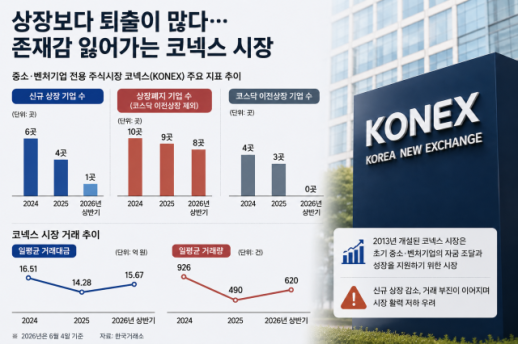 More Companies Exit KOSDAQ than Enter as KONEX Loses Relevance The KONEX market, dedicated to small and venture companies in South Korea, is entering its 14th year but has been losing vitality in recent years, with both new listings and trading activity declining. Notably, the number of companies delisted has surpassed new listings, raising concerns about its effectiveness as a growth platform for small businesses. According to the Korea Exchange, only one company, S-Tech M, has gone public on KONEX this year, having listed in April. This follows six new listings in 2024 and four in 2025, highlighting a significant drop in activity as the first half of this year concludes. In contrast, the number of delisted companies has increased, with 10 in 2024 and nine in 2025, excluding those that moved to KOSDAQ. This year, eight companies, including relatively recent listings like AMC and Pangs Sky, have exited the market. The ongoing trend of more companies leaving than entering has contributed to a decrease in the total number of listed firms. Additionally, there have been no transfers from KONEX to KOSDAQ this year, following four in 2024 and three in 2025. Trading activity has also been sluggish. The average daily trading volume in the KONEX market has steadily declined over the past three years, dropping from 1.936 billion won to 1.651 billion won and then to 1.428 billion won. Although trading volume saw a slight recovery this year to around 620 transactions per day, it remains low compared to previous years, down from an average of 926 transactions in 2024 and 490 in 2025. KONEX was established in 2013 to support funding and growth for early-stage small and venture companies, aiming to serve as a 'growth ladder' for firms transitioning to KOSDAQ. However, the expansion of direct pathways to KOSDAQ, such as technology-based and growth-based listings, has diminished the necessity for KONEX listings. Concerns have also arisen regarding the government's recent proposal to restructure the KOSDAQ market into first and second tiers, which could further limit KONEX's relevance. An industry insider noted, "If the KOSDAQ tier system is implemented, the rationale for KONEX as an intermediate market may become even less clear." In response, measures are being introduced to enhance liquidity in the KONEX market. The KONEX Association will support some listing costs, including external auditor fees and advisory fees, up to a total of 1 billion won, to incentivize new listings from this month until the end of the year. The exchange is also working on regulatory improvements. On June 2, it announced plans to increase the stock distribution obligation for KONEX-listed companies from the current 5% to a maximum of 15%. Additionally, designated advisors will be granted priority negotiation rights for facilitating transfers to KOSDAQ, as part of the proposed amendments to the KONEX market listing regulations and implementation guidelines. The exchange aims to boost market liquidity and enhance incentives for KONEX listings.* This article has been translated by AI. 2026-06-04 16:39:00
 -
 Musinsa Launches Subdued Brand Shop to Target Young Women Consumers Musinsa announced on June 4 that it will be the first domestic online retailer to launch the Italian fashion brand Subdued in South Korea. According to Musinsa, the official Subdued brand shop will be unveiled on June 5. Subdued is known for its free-spirited individuality and natural style. The brand gained attention after its first offline pop-up store opened in Seongdong-gu, Seoul, in April, where social media buzz helped spread awareness through user-generated photos. With this launch, Musinsa customers will be able to purchase Subdued's signature products and global bestsellers online. Key items include the Wings hoodie, featuring the brand's iconic sequin embellishments, low-rise denim, cropped graphic tops, and hot pants. To celebrate the official launch, Musinsa will hold a promotional event. From June 5 at 11 a.m. to June 11, all Subdued products will be offered at a 10% discount. Additionally, the first 50 customers who spend over 150,000 won during the event will receive a Subdued notebook pad. A Musinsa representative stated, "We expect that Subdued, with its trendy styles and unique aesthetics, will meet the diverse fashion preferences of our core target audience of young women aged 10 to 20." Meanwhile, Musinsa reported a record revenue of 363.6 billion won for the first quarter of this year, marking a 24.1% increase compared to the same period last year. The operating profit also rose by 8.2% to 19 billion won.* This article has been translated by AI. 2026-06-04 16:39:00
 -
Musinsa Launches Subdued Brand Shop Targeting Young Women Musinsa announced on June 4 that it will be the first domestic online retailer to introduce the Italian fashion brand Subdued. According to Musinsa, the official Subdued brand shop will be launched on June 5. Subdued is a global fashion brand known for its free-spirited individuality and natural style. The brand's first offline pop-up store, which opened in April in Seongdong-gu, Seoul, gained attention on social media as customers shared photos from the event. With this launch, Musinsa customers will be able to purchase Subdued's signature products and global bestsellers online. Featured items include the Wings hoodie adorned with the brand's signature sequin decoration, low-rise denim, cropped graphic tops, and hot pants. To celebrate the official launch, Musinsa will hold a promotional event offering a 10% discount on all Subdued products from June 5 at 11 a.m. to June 11. The first 50 customers who spend over 150,000 won during the event will receive a Subdued notepad. A Musinsa representative stated, "We expect that Subdued, with its trendy styles and unique aesthetics, will meet the diverse fashion preferences of our core target audience, young women in their teens and twenties." Meanwhile, Musinsa reported a record revenue of 363.6 billion won for the first quarter of this year, marking a 24.1% increase compared to the same period last year. Operating profit rose by 8.2% to 19 billion won.* This article has been translated by AI. 2026-06-04 16:39:00
-
 Yen Exchange Rate Hits 160 Yen per Dollar as Japan's Intervention Effects Fade The Japanese yen has risen to around 160 yen per dollar, indicating a decline in its value, as the effects of the Japanese government's large-scale yen-buying intervention at the end of April have faded within a month. Amid ongoing tensions in the Middle East, rising oil prices, and expectations of interest rate hikes in the U.S., the market is now focused on the possibility of further intervention by Japanese authorities and the pace of additional tightening by the Bank of Japan (BOJ). The Nihon Keizai Shimbun reported on June 3 that the yen's exchange rate had climbed to approximately 160.09 yen per dollar in European and U.S. foreign exchange markets. The yen's value is nearing the 160.72 yen recorded just before the Japanese government and the BOJ intervened to buy yen and sell dollars on April 30. From the end of April to the end of May, the scale of Japan's foreign exchange market intervention reached 11.7349 trillion yen (about $112.45 billion). The renewed weakness of the yen is attributed to the strength of the dollar. With no significant progress in negotiations to end hostilities between the U.S. and Iran, there has been a growing trend in the foreign exchange market to purchase the safe-haven dollar. Concerns about renewed inflation in the U.S. due to rising oil prices, combined with the resilience of the U.S. economy, have fueled speculation about interest rate hikes by the Federal Reserve, further encouraging the sale of yen and purchase of dollars. The BOJ has hinted at the possibility of interest rate hikes to counter the yen's weakness, but market reactions have been limited. BOJ Governor Kazuo Ueda stated in a speech on June 3 that if inflationary pressures increase, it would be necessary to closely discuss the possibility of a rate hike at the monetary policy meeting on June 15-16. Following his remarks, the market nearly accepted a June rate hike as a certainty, and the yen briefly rose to the low 159 yen range against the dollar. However, the buying momentum for the yen did not last long, and the exchange rate quickly returned to levels seen before the speech. Outlook for Continued Yen Weakness Market analysts believe that even if the BOJ raises interest rates at the June meeting, it will be difficult to reverse the trend of yen weakness. Mari Iwashita, a rate strategist at Nomura Securities, stated, "One rate hike will not change the trend of yen weakness," noting that market attention is shifting to the timing of the next rate increase. The current policy interest rate set by the BOJ is 0.75%. The BOJ estimates the neutral interest rate to be around 1.1% to 2.5%, and the speed at which rates are raised toward the midpoint of this range, around 1.8%, is seen as a key factor influencing the yen's trajectory. The BOJ's inability to signal a strong tightening response to market demands is also contributing to the yen's weakness. The Nikkei reported that, according to Asian hedge fund managers, Ueda's remarks reflect the cautious nature of the BOJ, suggesting that he may be mindful of the Takaiichi Sanae administration's preference for monetary easing. The perception that the BOJ has consistently lagged in responding to inflation has already spread abroad, making it difficult for mere indications of potential rate hikes to serve as a catalyst for yen appreciation. Among foreign investors, there is also a lack of enthusiasm for actively buying yen. According to the Nikkei, Bank of America (BofA) raised its medium-term outlook for the yen from "weak" to "neutral" in mid-May, projecting an exchange rate of 152 yen per dollar by the end of 2026, a decrease of 5 yen from previous estimates (indicating a stronger yen). The median forecast from about 40 securities firms compiled by LSEG in the UK also suggests that the yen will strengthen to around 154 yen per dollar by the end of 2026. However, the Nikkei noted that investors view yen purchases as a "trap of undervaluation." Alres Kutni from Vanguard Asset Management predicted that even if the BOJ raises rates this month, it will only do so once every six months, and the yen could fall to 170 yen per dollar. Ironically, the possibility of renewed intervention by Japanese authorities is also fueling yen weakness. While speculation about intervention makes it difficult for traders to openly sell yen, Japanese importers and long-term investors in overseas stocks are unable to wait for a rebound in the yen and are preemptively buying dollars. In a low volatility environment, yen carry trades, which aim to profit from interest rate differentials, are also likely to expand. The trend of borrowing low-interest yen to invest in high-interest currencies or risk assets is increasing pressure on the yen's value. According to the Commodity Futures Trading Commission (CFTC), as of May 26, the net short position in yen held by non-commercial traders classified as speculators reached 114,667 contracts. In yen terms, this amounts to approximately 1.4 trillion yen, exceeding the roughly 100,000 contracts seen before the intervention and reaching the highest level since July 2024. The yen's weakness is deepening the BOJ's concerns about inflation. The consumer price index for April, calculated by the BOJ after removing the effects of government subsidies and tax cuts, rose by 2.8% compared to the same month last year. Although the official inflation rate has slowed, this indicates that inflationary pressures are actually strengthening when excluding the effects of energy subsidies and free education policies. If the yen's weakness leads to rising import prices, the BOJ may face even stronger tightening pressures. Prime Minister Takaiichi Sanae also stated on June 3 during a meeting of the House of Councillors that the government would respond appropriately to fluctuations in the exchange rate as needed. The market is once again viewing the 160 yen per dollar level as a threshold for assessing the likelihood of renewed intervention by Japanese authorities. However, with the simultaneous pressures of a strong dollar, the U.S.-Japan interest rate differential, and rising oil prices, there is a strong belief that intervention alone will not be sufficient to change the trend. The Nikkei quoted a foreign exchange dealer as saying, "Unless the BOJ acknowledges that its policy response has lagged and shows a willingness to accelerate the pace of rate hikes, it will be difficult to expect yen appreciation." The yen's return to the 160 yen level within a month indicates that Japanese authorities are once again facing the challenge of managing exchange rates, inflation, and interest rates simultaneously.* This article has been translated by AI. 2026-06-04 16:36:00
 -
 Lee Dong-cheol Nominated as Next President of Credit Finance Association Lee Dong-cheol, the former CEO of KB Kookmin Card, has been nominated as the sole candidate for the presidency of the Credit Finance Association. He is expected to be officially appointed as the next president if he secures a majority vote from member companies at the general meeting scheduled for June 16. The industry is optimistic about having a leader with extensive experience in card, insurance, and digital businesses.On June 4, the Credit Finance Association held its second candidate recommendation committee meeting at a hotel in Seoul, where presentations and interviews were conducted for three candidates: Lee Dong-cheol, former Woori Financial Capital CEO Park Kyung-hoon, and former Chief Policy Advisor to the National Assembly Speaker Yoon Chang-hwan. Following a secret ballot, Lee was recommended as the sole candidate for the next president.Lee graduated from Korea University with a law degree and obtained his New York State bar license after attending Tulane University Law School. He has held various positions, including vice president of management planning at KB Life Insurance, senior vice president of strategy at KB Financial Group, CEO of KB Kookmin Card, and vice chairman of KB Financial Group. He is regarded as someone with a deep understanding of the card and insurance sectors, as well as experience in digital and global business.The election was highly competitive, with unpredictable outcomes until the end. Since the position became a full-time role in 2010, it has primarily been held by individuals from financial regulatory agencies. Before Lee's nomination, only Kim Deok-soo, the former president of KB Kookmin Card, was from the private sector. This led to an unusual situation where two candidates from private financial companies and one from the political sphere made it to the final candidate list.Reports indicate that the competition between Lee and former CEO Park from the capital industry was intense. Ultimately, Lee garnered support due to his strong understanding of industry issues and effective communication skills.An industry insider noted, "Lee received high praise for his presentation. There was a division of votes between the card and capital sectors, but after discussions on who could best represent the industry, a consensus formed around Lee as the right candidate."Lee is expected to be officially appointed as the next president of the association following the general meeting on June 16. If confirmed, he will become the new president nearly eight months after the term of the current president, Jeong Wan-kyu, expired in October of last year. The term lasts for three years. 2026-06-04 16:33:00