

Journalist

Kim Sang-cheol
-
 Voter Disruptions and Misconduct Reported During Local Elections On June 3, as the 9th nationwide local elections took place, numerous disruptions and false reports were reported at polling stations across the country. According to the National Police Agency, from 6 a.m. to 3 p.m., a total of 312 election-related calls were received nationwide. Of these, 53 involved disruptions or interference with voting, 3 were related to assaults, and 14 concerned traffic issues. Additionally, 242 other reports included false alarms. Incidents of varying severity occurred at polling places in different regions. At a polling station in Sejong City, a man in his 40s was stopped from showing his completed ballot to others instead of placing it in the ballot box. In Dongdaemun-gu, Seoul, a man in his 60s attempted to leave the polling station with his ballot uncast and was restrained by election officials, subsequently shouting in protest. In Yeongdeungpo-gu, Seoul, a woman in her 70s caused a disturbance, claiming that her ballot was already marked. In Gwanak-gu, a voter was reported to have shouted after being stopped from taking a photo of his ballot in the voting booth. In Busan, police received 25 election-related calls between 6 a.m. and 3 p.m. Of these, one involved disruption, while 24 were categorized as other reports. At a polling station in Bupyeong-dong, Jung-gu, a man in his 50s was reported to have disrupted voting while intoxicated, prompting police intervention. He was issued a strong warning and sent home at the request of election officials. In Seogwipo City, Jeju, an incident was reported where a voter was found to have one extra ballot than allowed. The election commission invalidated the excess ballot. Reports indicate that this voter had six ballots instead of the five they were entitled to, including two for the Seogwipo City congressional by-election. Outside polling stations, election-related incidents also occurred. In Uijeongbu City, a man in his 60s was arrested for vandalizing 20 election guidance banners. Police stated that he had removed the banners from around polling stations between the evening of May 30 and June 2, claiming he mistook them for illegal banners after early voting had concluded. The election commission has reminded voters that taking photos of ballots or intentionally revealing them is prohibited. Disruptions or actions that undermine the voting process at or near polling stations can also lead to issues. Police are investigating the reports to determine if any violations of the Public Official Election Act occurred.* This article has been translated by AI. 2026-06-03 16:12:00
 -
![[WNMC 2026] No Map in the Age of AI... Media Outlets Must Chart Their Own Course](https://image.ajunews.com//content/image/2026/06/03/20260603123832131110_518_323.jpg) [[WNMC 2026]] 'No Map in the Age of AI'... Media Outlets Must Chart Their Own Course On the second day of the World News Media Congress (WNMC) hosted by the World Association of News Publishers (WAN-IFRA) in Marseille, France, global media executives and editors confronted a shared reality: no one knows exactly where artificial intelligence (AI) will lead journalism. Ezra Eman, WAN-IFRA's AI Media Director, diagnosed the uncertainty facing the media industry in a keynote session on June 2, stating, "No media outlet has a map." In the internet era, there was a clear direction toward digital transformation, and during the mobile age, a common goal of mobile-first strategies emerged. The social media era also had relatively clear strategies for platform utilization. However, the AI era is different. The fundamental restructuring of how information is produced, distributed, and consumed means that existing formulas for success are no longer applicable. Eman remarked, "The new world cannot be explained by existing maps," emphasizing that the challenge lies not merely in adopting AI tools but in figuring out how journalism can survive and thrive in an era where AI becomes the gateway to information for people. In fact, global media companies are choosing different paths. According to a survey presented by Eman, 56% of media outlets have adopted defensive strategies to block crawling bots from AI companies, while 31% are negotiating or have signed licensing agreements with AI firms. He noted, "There is no right answer to which strategy is correct; choices may vary based on the size and circumstances of each media outlet." What is clear, however, is that media organizations must determine their own positions within the AI ecosystem. Eman stressed, "Without control, there is no market, and no way to secure value." Whereas media companies once competed for readers' attention, they are now competing to maintain their presence within AI systems. He warned that journalism must not be reduced to mere 'ingredients' within the AI ecosystem. As generative AI summarizes, explains, and recommends article content, there is a growing risk that media content will be consumed as components of AI services. Eman stated, "We must be a destination, not just an ingredient." If media outlets limit themselves to supplying content to AI, they risk losing their relationships with readers, subscription revenue, and advertising income. However, by providing differentiated services and experiences that readers actively seek, they can maintain competitiveness even as distribution methods change. He advised, "Understand AI usage patterns, avoid commoditized content, and secure scarcity. We must accumulate unique knowledge and capabilities to respond to the age of AI agents." Ultimately, as AI proliferates, the demand for exclusive information, reliability, and authenticity will become even more critical. "The market will prefer exclusive, specific, and authentic content," he predicted. During a panel discussion, global media executives shared their various approaches to navigating this 'mapless era.' Fabrice Bakhouche, CEO of the French group Ouest-France, stated, "The impact of AI on roles, workflows, and management structures is just beginning to emerge, and no one can clearly outline its influence yet." He emphasized the importance of field-based experimentation over excessive caution. "A bottom-up approach is essential; we must not be too conservative," Bakhouche said, indicating that answers should be sought through real-world experiments rather than waiting for uncertainties to resolve. Sky News in the UK is grappling with similar challenges. Jonathan Levy, CEO of Sky News, diagnosed the media industry as undergoing changes that are "simultaneously, constantly, and accelerated." He quoted former Washington Post editor Marty Baron, describing the current situation as a "rapidly changing media consumption landscape." Sky News is pursuing a strategy of transitioning to a digital and video-centric newsroom while maintaining the essence of journalism. Levy remarked, "We are providing trusted journalism while remodeling an aircraft mid-flight." He also emphasized the importance of honest leadership that does not pretend to have all the answers, stating that providing direction and trust to team members is a key role for management during the transformation process. Reuters has opted for a more systematic approach. Jane Barrett, head of AI strategy at Reuters, assessed that the key to AI implementation lies more in the organization than in technology. "10% of change is AI, 20% is technology, and 70% is about people and processes," she said. Reuters is establishing guidelines for AI use, a governance committee, and data security systems—what she referred to as 'scaffolding'—to ensure that experimentation and innovation do not compromise trust. Barrett emphasized, "Failure is learning," highlighting the importance of fostering a culture of experimentation at the organizational level. Eman concluded his presentation by reiterating, "No media outlet has a map." Instead, what is needed now is not a perfect answer but experimentation, observation, and collaboration. He urged, "We must share signals with each other and exchange experiences of failure." While media organizations are heading toward the same destination in the age of AI, they must carve their own paths to get there. The conclusion from Marseille was clear: the absence of a map is no reason to remain stagnant.* This article has been translated by AI. 2026-06-03 16:09:00
[[WNMC 2026]] 'No Map in the Age of AI'... Media Outlets Must Chart Their Own Course On the second day of the World News Media Congress (WNMC) hosted by the World Association of News Publishers (WAN-IFRA) in Marseille, France, global media executives and editors confronted a shared reality: no one knows exactly where artificial intelligence (AI) will lead journalism. Ezra Eman, WAN-IFRA's AI Media Director, diagnosed the uncertainty facing the media industry in a keynote session on June 2, stating, "No media outlet has a map." In the internet era, there was a clear direction toward digital transformation, and during the mobile age, a common goal of mobile-first strategies emerged. The social media era also had relatively clear strategies for platform utilization. However, the AI era is different. The fundamental restructuring of how information is produced, distributed, and consumed means that existing formulas for success are no longer applicable. Eman remarked, "The new world cannot be explained by existing maps," emphasizing that the challenge lies not merely in adopting AI tools but in figuring out how journalism can survive and thrive in an era where AI becomes the gateway to information for people. In fact, global media companies are choosing different paths. According to a survey presented by Eman, 56% of media outlets have adopted defensive strategies to block crawling bots from AI companies, while 31% are negotiating or have signed licensing agreements with AI firms. He noted, "There is no right answer to which strategy is correct; choices may vary based on the size and circumstances of each media outlet." What is clear, however, is that media organizations must determine their own positions within the AI ecosystem. Eman stressed, "Without control, there is no market, and no way to secure value." Whereas media companies once competed for readers' attention, they are now competing to maintain their presence within AI systems. He warned that journalism must not be reduced to mere 'ingredients' within the AI ecosystem. As generative AI summarizes, explains, and recommends article content, there is a growing risk that media content will be consumed as components of AI services. Eman stated, "We must be a destination, not just an ingredient." If media outlets limit themselves to supplying content to AI, they risk losing their relationships with readers, subscription revenue, and advertising income. However, by providing differentiated services and experiences that readers actively seek, they can maintain competitiveness even as distribution methods change. He advised, "Understand AI usage patterns, avoid commoditized content, and secure scarcity. We must accumulate unique knowledge and capabilities to respond to the age of AI agents." Ultimately, as AI proliferates, the demand for exclusive information, reliability, and authenticity will become even more critical. "The market will prefer exclusive, specific, and authentic content," he predicted. During a panel discussion, global media executives shared their various approaches to navigating this 'mapless era.' Fabrice Bakhouche, CEO of the French group Ouest-France, stated, "The impact of AI on roles, workflows, and management structures is just beginning to emerge, and no one can clearly outline its influence yet." He emphasized the importance of field-based experimentation over excessive caution. "A bottom-up approach is essential; we must not be too conservative," Bakhouche said, indicating that answers should be sought through real-world experiments rather than waiting for uncertainties to resolve. Sky News in the UK is grappling with similar challenges. Jonathan Levy, CEO of Sky News, diagnosed the media industry as undergoing changes that are "simultaneously, constantly, and accelerated." He quoted former Washington Post editor Marty Baron, describing the current situation as a "rapidly changing media consumption landscape." Sky News is pursuing a strategy of transitioning to a digital and video-centric newsroom while maintaining the essence of journalism. Levy remarked, "We are providing trusted journalism while remodeling an aircraft mid-flight." He also emphasized the importance of honest leadership that does not pretend to have all the answers, stating that providing direction and trust to team members is a key role for management during the transformation process. Reuters has opted for a more systematic approach. Jane Barrett, head of AI strategy at Reuters, assessed that the key to AI implementation lies more in the organization than in technology. "10% of change is AI, 20% is technology, and 70% is about people and processes," she said. Reuters is establishing guidelines for AI use, a governance committee, and data security systems—what she referred to as 'scaffolding'—to ensure that experimentation and innovation do not compromise trust. Barrett emphasized, "Failure is learning," highlighting the importance of fostering a culture of experimentation at the organizational level. Eman concluded his presentation by reiterating, "No media outlet has a map." Instead, what is needed now is not a perfect answer but experimentation, observation, and collaboration. He urged, "We must share signals with each other and exchange experiences of failure." While media organizations are heading toward the same destination in the age of AI, they must carve their own paths to get there. The conclusion from Marseille was clear: the absence of a map is no reason to remain stagnant.* This article has been translated by AI. 2026-06-03 16:09:00 -
![[WNMC 2026] Global News Organizations Embrace AI for Economic Growth](https://image.ajunews.com//content/image/2026/06/03/20260603124211564523_518_323.jpg) [[WNMC 2026]] Global News Organizations Embrace AI for Economic Growth "For the past 15 years, we have created content for Google. Now, we may need to design content for AI." On June 2, during the second day of the World News Media Congress (WNMC) in Marseille, discussions surrounding artificial intelligence (AI) have moved beyond threats and experimentation. News organizations worldwide are unveiling different strategies on how to utilize AI and what kind of relationship to establish with it. India's The Hindu is using AI as a tool to solve article discovery issues, while Sweden's Bonnier News is focusing on AI-driven personalization and interactive news archives. In contrast, Austria's Kleine Zeitung is redefining its news distribution strategy by viewing AI as a new audience. "There are too many articles that readers have not seen" Pundi Srirami, Chief Product Officer (CPO) and business head of The Hindu Group, identified 'discovery' as AI's most significant role. "Our site is overflowing with articles that subscribers have never seen," he said. The Hindu has approximately 35 million monthly users and around 1 million app users, but expanding its paid readership remains a challenge. Srirami diagnosed the issue as not a lack of content but rather that readers are not reaching the right articles. To address this, The Hindu is reprocessing a single article into various formats. Readers can choose from AI-generated summaries, Q&A formats, short articles of 200 words, or expanded articles of 300 words. As a result, the usage rate of AI-based content formats increased from 6% to 36%. Personalization also focused more on 'exposure space' rather than the content itself. Through AI-driven trend recommendations, customized notifications, and personalized app screens, about 15% of current app page views come from personalized areas, with some areas reaching up to 30%. Audio content was not applied indiscriminately. Srirami explained, "We only apply it where it adds value." Notably, audio content providing current affairs commentary for civil service exam candidates recorded a 24% conversion rate. He noted that about half of the increase in app engagement over the past year came from AI-based features. From Search to Conversation Sweden's Bonnier News is changing the way news is searched using AI. CPO Jan Helin explained that AI enables much more sophisticated personalization than existing recommendation algorithms. A key area of focus is the interactive archive. Instead of entering keywords to search, readers can ask questions in natural language, and AI will provide answers based on years of accumulated article data. Helin stated, "The conversion rate for users using the conversational interface is 60%." This is seen as evidence that readers are increasingly turning to conversation windows for information rather than search boxes. "AI is a new reader" The most striking claim came from Sebastian Krause, digital head of Austria's Kleine Zeitung. He assessed that for the past 15 years, media companies have focused on increasing clicks and search engine visibility. However, he noted that a new type of visitor has emerged in the AI era. That visitor is the AI bot. These bots read and summarize articles but rarely click on them. Krause interpreted this not as a threat but as a new opportunity. "AI is a new reader," he said. "Do not fight against a great product; AI is an excellent product," he added. Kleine Zeitung is even considering building separate sites for humans and AI agents. The strategy is to provide content in a format that machines can easily read and utilize, while the conditions will be determined by the media company. "Summaries can be made. But they must pay for it." Krause stated that in the AI era, distribution is no longer a bottleneck. In the internet age, how widely content is distributed was crucial, but in the future, unique content that cannot be found elsewhere will be the key competitive advantage. He emphasized, "In the AI era, the bottleneck is not distribution but originality and scarcity." In the AI Era, Competitiveness is 'Exclusive Content' Toshi Panigrahi, co-founder of Tolbit, pointed out that AI companies are currently collecting content in real-time. He argued that media companies need to understand which AIs are reading their content, what topics they are seeking, and which journalists' content holds influence in the AI environment. As AI agents evolve beyond simply reading content to performing actual actions, media companies must also establish systems to measure and monetize AI utilization. AI is no longer just a tool to enhance newsroom productivity. It is establishing itself as a new media environment that changes how news is discovered, consumed, and distributed. Global news organizations are moving beyond viewing AI as a source of fear and caution, seeking to leverage it to expand the value of journalism and create new reader touchpoints.* This article has been translated by AI. 2026-06-03 16:09:00
[[WNMC 2026]] Global News Organizations Embrace AI for Economic Growth "For the past 15 years, we have created content for Google. Now, we may need to design content for AI." On June 2, during the second day of the World News Media Congress (WNMC) in Marseille, discussions surrounding artificial intelligence (AI) have moved beyond threats and experimentation. News organizations worldwide are unveiling different strategies on how to utilize AI and what kind of relationship to establish with it. India's The Hindu is using AI as a tool to solve article discovery issues, while Sweden's Bonnier News is focusing on AI-driven personalization and interactive news archives. In contrast, Austria's Kleine Zeitung is redefining its news distribution strategy by viewing AI as a new audience. "There are too many articles that readers have not seen" Pundi Srirami, Chief Product Officer (CPO) and business head of The Hindu Group, identified 'discovery' as AI's most significant role. "Our site is overflowing with articles that subscribers have never seen," he said. The Hindu has approximately 35 million monthly users and around 1 million app users, but expanding its paid readership remains a challenge. Srirami diagnosed the issue as not a lack of content but rather that readers are not reaching the right articles. To address this, The Hindu is reprocessing a single article into various formats. Readers can choose from AI-generated summaries, Q&A formats, short articles of 200 words, or expanded articles of 300 words. As a result, the usage rate of AI-based content formats increased from 6% to 36%. Personalization also focused more on 'exposure space' rather than the content itself. Through AI-driven trend recommendations, customized notifications, and personalized app screens, about 15% of current app page views come from personalized areas, with some areas reaching up to 30%. Audio content was not applied indiscriminately. Srirami explained, "We only apply it where it adds value." Notably, audio content providing current affairs commentary for civil service exam candidates recorded a 24% conversion rate. He noted that about half of the increase in app engagement over the past year came from AI-based features. From Search to Conversation Sweden's Bonnier News is changing the way news is searched using AI. CPO Jan Helin explained that AI enables much more sophisticated personalization than existing recommendation algorithms. A key area of focus is the interactive archive. Instead of entering keywords to search, readers can ask questions in natural language, and AI will provide answers based on years of accumulated article data. Helin stated, "The conversion rate for users using the conversational interface is 60%." This is seen as evidence that readers are increasingly turning to conversation windows for information rather than search boxes. "AI is a new reader" The most striking claim came from Sebastian Krause, digital head of Austria's Kleine Zeitung. He assessed that for the past 15 years, media companies have focused on increasing clicks and search engine visibility. However, he noted that a new type of visitor has emerged in the AI era. That visitor is the AI bot. These bots read and summarize articles but rarely click on them. Krause interpreted this not as a threat but as a new opportunity. "AI is a new reader," he said. "Do not fight against a great product; AI is an excellent product," he added. Kleine Zeitung is even considering building separate sites for humans and AI agents. The strategy is to provide content in a format that machines can easily read and utilize, while the conditions will be determined by the media company. "Summaries can be made. But they must pay for it." Krause stated that in the AI era, distribution is no longer a bottleneck. In the internet age, how widely content is distributed was crucial, but in the future, unique content that cannot be found elsewhere will be the key competitive advantage. He emphasized, "In the AI era, the bottleneck is not distribution but originality and scarcity." In the AI Era, Competitiveness is 'Exclusive Content' Toshi Panigrahi, co-founder of Tolbit, pointed out that AI companies are currently collecting content in real-time. He argued that media companies need to understand which AIs are reading their content, what topics they are seeking, and which journalists' content holds influence in the AI environment. As AI agents evolve beyond simply reading content to performing actual actions, media companies must also establish systems to measure and monetize AI utilization. AI is no longer just a tool to enhance newsroom productivity. It is establishing itself as a new media environment that changes how news is discovered, consumed, and distributed. Global news organizations are moving beyond viewing AI as a source of fear and caution, seeking to leverage it to expand the value of journalism and create new reader touchpoints.* This article has been translated by AI. 2026-06-03 16:09:00 -
![[WNMC 2026] How AI is Transforming News Consumption](https://image.ajunews.com//content/image/2026/06/03/20260603153415588346_518_323.jpg) [[WNMC 2026]] How AI is Transforming News Consumption AI is not only changing how news is produced but also how readers experience it. The era of searching for keywords and clicking links is fading, giving way to a time when content is delivered based on predictions of what readers want before they even ask. On June 3, at the Palais du Pharo in Marseille, the 77th World News Media Congress (WNMC) hosted a session titled "How AI Is Transforming the News Experience." The congress, which ran from June 1 to 3, attracted around 1,000 participants representing over 450 media organizations from more than 60 countries. The session was moderated by Dmitry Shishkin, former digital development editor at BBC World Service and now an independent media consultant. Panelists included Markus Knall, content chief and editor-in-chief at Ippen Digital in Germany; Astrid Maier, deputy editor and strategy chief at dpa in Germany; Sannuta Raghu, executive producer at Scroll.in in India; and Seo Hye-seung, editor-in-chief at AJP, a media group in South Korea. The central theme of the session was "liquid content," which refers to the concept that a single piece of reporting can change its form based on the context of the reader, reaching them in the appropriate format at the right moment. This contrasts sharply with the traditional model of waiting for readers to visit the media outlet. Shishkin's "user needs" model served as the theoretical foundation for the discussion. This model starts from the premise that readers consume news not just for information but also for various intents: to know, to understand, to feel, and to act. Shishkin has emphasized, "Tell the story you want to tell, but frame it from the angle that adds value for the reader." AI takes this model further by analyzing data to determine what a reader currently wants to understand or feel, automatically generating content in the appropriate form. The session also posed the fundamental question: "What does it mean to be a news agency in the AI era?" Traditionally, news agencies have acted as wholesalers, producing articles for other media outlets. However, as AI automates translation, curation, and distribution, the boundaries of what agencies can deliver are expanding. In this context, AJP's approach, led by Seo Hye-seung, gained attention. Aju Media Group operates as a multilingual, AI-native media organization, publishing content in five languages, including Korean, English, Chinese, Japanese, and Vietnamese, through its platforms Aju Economy, AJP, and AI Business Channel (ABC). Seo identifies AJP's identity in the AI era, stating, "In the age of search, language was tied to regions, but in the AI era, that equation is flipped. All major language models are fundamentally built around English, and Asia is increasingly described by AI trained on Western data. We have discovered the role of an Asian English news agency that writes in the language AI can best understand. This is the 'Asian substance in English.'" Seo elaborates on the paradox of being a latecomer designed as an AI-native. Although AJP is a latecomer in the English news agency market, its foundation built on AI has offset the disadvantages of starting late. He shared that Aju Media Group's founder, Kwon Young-gil, 72, adopted the principles "AI or Die" and "Start now, perfect later" after attending AI lectures at KAIST during the pandemic. Seo emphasized that while AI serves as a supportive tool, the role of journalists has become even more crucial. He stated, "Our motto is clear: to become journalists that AI can learn from and keep up with," noting that at AJP, reporters with less than two years of experience are producing in-depth features, interviews, and analysis articles of 5,000 words. In practice, AJP selects a portion of the approximately 300 articles produced daily by Aju Economy through a system called "AI Pick" and automatically distributes them in four additional languages. This automation has increased the publication volume in those four languages tenfold, and English traffic has reportedly risen by 30%. This session naturally connected with the previous day's discussion on "Discovery: How to Rethink Search in the AI Era." While the June 2 session addressed the evolution of search strategies from SEO to AEO (Answer Engine Optimization) and GEO (Generative Engine Optimization), this session looked ahead to a stage where readers experience news even before they search for it. This shift suggests that the long-standing question in the media industry is changing. Whereas publishers once asked, "What is the best journalism?" the new question is, "What is the best experience?" However, both sessions emphasized a common message: the fundamentals remain more important than technology. Algorithms and platforms may change constantly, but the direct relationship with readers endures. The third key point was how AI is rapidly expanding the reporting scope of local publishers. Sannuta Raghu from Scroll.in has led experiments using AI to cover broader communities with limited resources, demonstrating that local media with significant resource constraints can greatly benefit from AI automation. AJP shares similar findings. A small AI video and essay contest conducted last year with the Indian Embassy in Korea started with a mere $220 marketing budget but garnered around one million impressions, laying the groundwork for building India-focused content. Seo cited the example of BTS, explaining how the time saved by AI translates into enhanced reader experiences. Earlier this year, a BTS concert was live-streamed 24/7 for two months in Gwanghwamun, transforming into a platform for the global fandom, known as ARMY, in five languages. He stated, "We cannot wait for readers to come to us. We must go out and understand what they want to experience." Ultimately, the session converged on a single conclusion: while AI is shaking the foundations of news production, distribution, and consumption, the reader remains at the center. Technology is merely a tool, and the goal of 'predictive journalism' is to ensure that content finds its way to readers, enhancing their experience. Seo and the other panelists shared the vision that regardless of where readers are or what format they prefer, the aim is to deliver stories at the right moment, reinforcing that the media's competitiveness in the AI era lies in creating reasons for readers to return. 2026-06-03 16:09:00
[[WNMC 2026]] How AI is Transforming News Consumption AI is not only changing how news is produced but also how readers experience it. The era of searching for keywords and clicking links is fading, giving way to a time when content is delivered based on predictions of what readers want before they even ask. On June 3, at the Palais du Pharo in Marseille, the 77th World News Media Congress (WNMC) hosted a session titled "How AI Is Transforming the News Experience." The congress, which ran from June 1 to 3, attracted around 1,000 participants representing over 450 media organizations from more than 60 countries. The session was moderated by Dmitry Shishkin, former digital development editor at BBC World Service and now an independent media consultant. Panelists included Markus Knall, content chief and editor-in-chief at Ippen Digital in Germany; Astrid Maier, deputy editor and strategy chief at dpa in Germany; Sannuta Raghu, executive producer at Scroll.in in India; and Seo Hye-seung, editor-in-chief at AJP, a media group in South Korea. The central theme of the session was "liquid content," which refers to the concept that a single piece of reporting can change its form based on the context of the reader, reaching them in the appropriate format at the right moment. This contrasts sharply with the traditional model of waiting for readers to visit the media outlet. Shishkin's "user needs" model served as the theoretical foundation for the discussion. This model starts from the premise that readers consume news not just for information but also for various intents: to know, to understand, to feel, and to act. Shishkin has emphasized, "Tell the story you want to tell, but frame it from the angle that adds value for the reader." AI takes this model further by analyzing data to determine what a reader currently wants to understand or feel, automatically generating content in the appropriate form. The session also posed the fundamental question: "What does it mean to be a news agency in the AI era?" Traditionally, news agencies have acted as wholesalers, producing articles for other media outlets. However, as AI automates translation, curation, and distribution, the boundaries of what agencies can deliver are expanding. In this context, AJP's approach, led by Seo Hye-seung, gained attention. Aju Media Group operates as a multilingual, AI-native media organization, publishing content in five languages, including Korean, English, Chinese, Japanese, and Vietnamese, through its platforms Aju Economy, AJP, and AI Business Channel (ABC). Seo identifies AJP's identity in the AI era, stating, "In the age of search, language was tied to regions, but in the AI era, that equation is flipped. All major language models are fundamentally built around English, and Asia is increasingly described by AI trained on Western data. We have discovered the role of an Asian English news agency that writes in the language AI can best understand. This is the 'Asian substance in English.'" Seo elaborates on the paradox of being a latecomer designed as an AI-native. Although AJP is a latecomer in the English news agency market, its foundation built on AI has offset the disadvantages of starting late. He shared that Aju Media Group's founder, Kwon Young-gil, 72, adopted the principles "AI or Die" and "Start now, perfect later" after attending AI lectures at KAIST during the pandemic. Seo emphasized that while AI serves as a supportive tool, the role of journalists has become even more crucial. He stated, "Our motto is clear: to become journalists that AI can learn from and keep up with," noting that at AJP, reporters with less than two years of experience are producing in-depth features, interviews, and analysis articles of 5,000 words. In practice, AJP selects a portion of the approximately 300 articles produced daily by Aju Economy through a system called "AI Pick" and automatically distributes them in four additional languages. This automation has increased the publication volume in those four languages tenfold, and English traffic has reportedly risen by 30%. This session naturally connected with the previous day's discussion on "Discovery: How to Rethink Search in the AI Era." While the June 2 session addressed the evolution of search strategies from SEO to AEO (Answer Engine Optimization) and GEO (Generative Engine Optimization), this session looked ahead to a stage where readers experience news even before they search for it. This shift suggests that the long-standing question in the media industry is changing. Whereas publishers once asked, "What is the best journalism?" the new question is, "What is the best experience?" However, both sessions emphasized a common message: the fundamentals remain more important than technology. Algorithms and platforms may change constantly, but the direct relationship with readers endures. The third key point was how AI is rapidly expanding the reporting scope of local publishers. Sannuta Raghu from Scroll.in has led experiments using AI to cover broader communities with limited resources, demonstrating that local media with significant resource constraints can greatly benefit from AI automation. AJP shares similar findings. A small AI video and essay contest conducted last year with the Indian Embassy in Korea started with a mere $220 marketing budget but garnered around one million impressions, laying the groundwork for building India-focused content. Seo cited the example of BTS, explaining how the time saved by AI translates into enhanced reader experiences. Earlier this year, a BTS concert was live-streamed 24/7 for two months in Gwanghwamun, transforming into a platform for the global fandom, known as ARMY, in five languages. He stated, "We cannot wait for readers to come to us. We must go out and understand what they want to experience." Ultimately, the session converged on a single conclusion: while AI is shaking the foundations of news production, distribution, and consumption, the reader remains at the center. Technology is merely a tool, and the goal of 'predictive journalism' is to ensure that content finds its way to readers, enhancing their experience. Seo and the other panelists shared the vision that regardless of where readers are or what format they prefer, the aim is to deliver stories at the right moment, reinforcing that the media's competitiveness in the AI era lies in creating reasons for readers to return. 2026-06-03 16:09:00 -
 SpaceX Aims for $1.75 Trillion Valuation in Upcoming IPO with Fixed Price of $135 American aerospace company SpaceX is reportedly targeting a valuation of approximately $1.75 trillion in its upcoming initial public offering (IPO). According to the Wall Street Journal on June 2, SpaceX plans to submit an amended filing to regulators soon, detailing the expected price range for its IPO scheduled for next week. Earlier this year, after acquiring Elon Musk's artificial intelligence company xAI, SpaceX was valued at about $1.25 trillion. The valuation target for this IPO is $500 billion higher. Reuters reports that SpaceX has set a fixed offering price of $135 per share and plans to sell 555.6 million shares, representing less than 5% of its total equity, to raise $75 billion. While the percentage of shares being sold is small compared to typical IPOs, the amount raised would be unprecedented. Reuters noted that fixing the offering price ahead of investor presentations and demand forecasts is highly unusual. Typically, companies propose a price range first and then finalize the offering price based on investor demand, which can lead to a price at the upper end or above the proposed range if demand is strong. This IPO is expected to be conducted entirely through new share issuance, meaning all funds raised will go directly to the company, with no existing shareholders selling their shares. The funds are anticipated to be used for expanding AI computing resources and satellite network growth. SpaceX plans to hold a corporate presentation for institutional investors in New York later this week to kick off its investor recruitment. It is also reported that preliminary interest checks, known as "testing the waters," have already been conducted with some investors. Goldman Sachs and Morgan Stanley are leading the underwriting for the IPO. Goldman Sachs will oversee the allocation of shares and the collection of funds, while Morgan Stanley will serve as the stabilization agent to support the stock price on the first day of trading. Bank of America, Citigroup, and JP Morgan are also participating as co-managers. SpaceX is expected to finalize the offering price on June 11 and begin trading on the Nasdaq under the ticker symbol "SPCX" on June 12.* This article has been translated by AI. 2026-06-03 16:06:00
 -
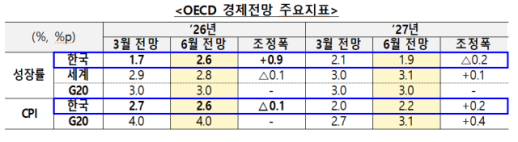 OECD Raises South Korea's Growth Forecast to 2.6% Amid Semiconductor Boom The OECD has projected that South Korea's economy will grow by 2.6% this year, driven by a surge in semiconductor exports. According to the Ministry of Finance and Economy on June 3, the OECD raised its growth forecast for South Korea by 0.9 percentage points in its World Economic Outlook report. This marks the largest increase among the G20 nations. However, the forecast for next year has been lowered by 0.2 percentage points to 1.9%. Previously, the South Korean government, the Bank of Korea, and the Korea Development Institute (KDI) had also revised their growth forecasts for this year to the mid-2% range. Reflecting the economic boom, the KOSPI index has surpassed 8,000, and the current account surplus for the first quarter reached a record $73.3 billion. The OECD noted that the expansion in exports, particularly in semiconductors, has propelled overall economic growth and private investment in South Korea. It also projected that consumer spending will gradually recover, with both prices and volumes of exports increasing since the beginning of the year. Private investment has significantly benefited from the semiconductor sector. The OECD stated, "Private investment in South Korea is increasing, particularly in semiconductors," and added that by the end of this year, investment growth is expected to spread to other sectors, maintaining a strong performance. It also forecasted a gradual recovery in consumer spending from this year into next year, influenced by supplementary budget measures. The nominal economic growth rate for this year, adjusted for the GDP deflator, is expected to be 10.4%, while the general government debt-to-GDP ratio has been revised down by 4.8 percentage points to 50.2% compared to projections made last December. Consumer prices are anticipated to average 2.6% this year, influenced by the ongoing conflict in the Middle East. However, inflation rates are expected to return to target levels starting next year. The OECD believes that measures such as the maximum price cap on oil products and reductions in fuel taxes will help alleviate inflationary pressures caused by energy supply shocks. Nonetheless, an OECD official cautioned that these measures could increase the persistence of inflationary pressures and recommended a gradual phase-out. In contrast, the global economic outlook remains bleak. The OECD has lowered its global growth forecast for this year to 2.8%, down 0.1 percentage points from its March estimate. It attributed this downgrade to soaring energy prices and trade disruptions caused by the blockade of the Strait of Hormuz. Major economies, including the United States (2.0%), the Eurozone (0.8%), and Japan (0.6%), are expected to experience slower growth due to the impact of the conflict in the Middle East. Inflation rates for G20 countries are projected at 4.0% this year and 3.1% next year. The prolonged conflict in the Middle East is identified as the biggest downside risk to global economic growth. Should the war continue, global growth could decline by as much as 0.7 percentage points, while inflation could rise by 0.4 percentage points. Conversely, an early resolution to the conflict and increased global demand for artificial intelligence (AI) are expected to positively influence global economic recovery. An OECD official emphasized the need for monetary policy to address inflationary pressures and called for measures to expand the tax base to alleviate long-term fiscal burdens. He also highlighted the necessity for structural reforms across society, including diversifying energy supply chains.* This article has been translated by AI. 2026-06-03 16:03:00
 -
 President Lee Encourages Voter Participation on Election Day President Lee Jae-myung reiterated his call for voter participation on June 3, emphasizing real estate issues. This marked his fourth post on social media on election day.In a post on X (formerly Twitter), President Lee stated, "Housing prices and real estate in South Korea are already excessively high. Although the proportion of real estate in the assets held by citizens has decreased, it remains too high."He shared statistics from Global Property Guide, which compared nominal housing price changes in major Asian countries over the past year based on data from national statistical offices and central banks. According to the report, Vietnam saw the highest increase in housing prices at 24.3%, followed by Hong Kong at 9.8%, Tokyo at 8.2%, India at 3.6%, and Singapore at 3.4%.South Korea's housing price increase was recorded at 1.8%, similar to Malaysia at 1.7%, the Philippines at 1.6%, Thailand at 1.2%, and Indonesia at 0.6%.President Lee noted, "One of the reasons the South Korean stock market remains undervalued is that we must escape from being a speculative real estate republic and transition into a startup nation, developing into an irreplaceable core country."He concluded by encouraging participation in the elections, stating, "Choosing capable and loyal representatives will create a democratic republic of Korea that we can truly be proud of to the world."* This article has been translated by AI. 2026-06-03 16:03:00
 -
 Next President of the Credit Finance Association to Be Decided The next president of the Credit Finance Association will be revealed on June 4. Following the expiration of current President Jeong Wan-kyu's term in October of last year, the selection process has been delayed for about eight months, but it is now nearing completion. Recently, Kim Ki-hwan, former CEO of KB Insurance, was nominated as a candidate for the next chair of the Fire Insurance Association, raising interest in whether candidates with industry experience from private financial firms will gain traction in the Credit Finance Association election as well. According to the credit finance industry on June 3, the association will hold its second presidential candidate recommendation committee meeting on June 4 to decide on a single candidate for the next president. The committee will interview three final candidates: Park Kyung-hoon, former CEO of Woori Financial Capital; Yoon Chang-hwan, former policy chief for the National Assembly Speaker; and Lee Dong-cheol, former CEO of KB Kookmin Card. Each candidate will undergo a 40-minute interview. Following the interviews, the 15-member committee will conduct a secret ballot, and the candidate who receives more than eight votes will be recommended as the sole candidate. This candidate will then be confirmed as the next president if they receive a majority vote at the general meeting later this month. A notable aspect of this selection process is the absence of candidates from traditional financial regulatory backgrounds among the final contenders. Historically, the presidency of the Credit Finance Association has often been held by individuals with experience in financial authorities. However, this time, the competition is between two candidates from private financial firms who have led the capital and card sectors and one candidate with a background in policy and legislative affairs. Industry sentiment appears to favor the competition between candidates with industry experience, such as Park and Lee. Park has served as CEO of Woori Financial Capital after working at Woori Bank and Woori Financial Group. He is currently an outside director at Hanwha Savings Bank. Lee has held various roles, including vice president of strategy at KB Financial Group and CEO of KB Kookmin Card, and is noted for his strong understanding of issues in the credit finance sector due to his experience in both capital and card industries. Yoon, on the other hand, has served as policy chief for the National Assembly Speaker and as head of the AI policy task force for presidential candidate Lee Jae-myung. While his direct experience in the credit finance sector is relatively limited, he is evaluated as having strong capabilities in public relations at a time when responsiveness to the National Assembly and policy matters is crucial. The credit finance industry is currently facing several challenges, including card fees, funding costs, competition with big tech payment providers, and the soundness management of capital companies. Given the differing interests among various sectors, the next president will need not only the ability to communicate with financial authorities and the National Assembly but also a practical understanding to address member companies' issues. There is a growing interpretation in the financial sector that recent selections for association leadership have highlighted the importance of industry experience and practical leadership. In the Fire Insurance Association's chair selection, a candidate from the Financial Supervisory Service was included in the final interview, but ultimately, Kim, a former representative of a non-life insurance company, was recommended as the final candidate. With industry experience being favored in this first selection of an association president under the Lee Jae-myung administration, it is anticipated that candidates from private financial firms will also gain support in the Credit Finance Association election.* This article has been translated by AI. 2026-06-03 16:03:00
 -
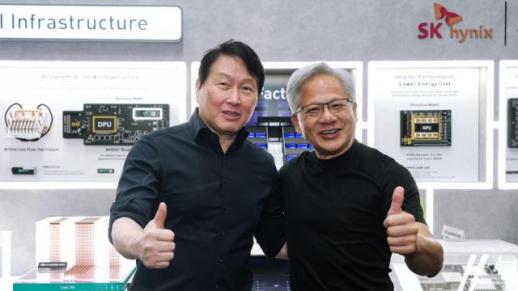 Jensen Huang and Choi Tae-won Strengthen Global AI Factory Alliance Choi Tae-won, Chairman of SK Group, and Jensen Huang, CEO of NVIDIA, reaffirmed their global artificial intelligence (AI) memory collaboration, solidifying their strategic alliance toward building an 'AI factory.' Their goal is to combine NVIDIA's AI chip design technology with SK Group's memory infrastructure to capture the next-generation AI data center market. According to industry sources on June 3, Choi and Huang met the previous day at Computex 2026 in Taiwan, where they toured the SK Hynix exhibition booth and examined key AI memory technologies and products. After the tour, Huang left a witty yet urgent message on a seventh-generation high-bandwidth memory (HBM4E) wafer, stating, "Please make more." This underscores the necessity of SK Hynix's memory infrastructure for the successful implementation of NVIDIA's next-generation AI accelerator designs. Huang also drew attention by writing "I love LPCAMM" on SK Hynix's 192GB low-power memory product. Speaking with South Korean reporters, he remarked, "Korea is the most important part of our AI semiconductor ecosystem. We have much to do together beyond just supplying chips and DRAM, including in science, robotics, and the AI factory sector." This indicates NVIDIA's intention to collaborate with Korean companies to create a next-generation AI hub that integrates AI infrastructure and software. However, Huang expressed concerns about the memory supply situation, stating, "We have secured supply chains in all areas, including HBM4, post-packaging, and silicon photonics, but we are still facing shortages." In response, Choi immediately pledged significant infrastructure investments and outlined his vision. He diagnosed that the expansion of AI infrastructure would lead to memory bottlenecks and shortages continuing until 2030. Choi declared, "We will double SK Hynix's total wafer production capacity within the next five years." Considering that building a new semiconductor fab takes at least three to five years, this proactive investment aims to fully absorb NVIDIA's explosive demand. Choi also actively embraced Huang's 'AI factory' agenda, indicating a transformation within SK Group. He emphasized, "Currently, we are merely a parts supplier producing memory chips for AI, but in the future, we want to directly challenge the production of AI factories that refine and generate intelligence." An AI factory refers to a next-generation data center that processes raw data to deliver advanced intelligence services. This reflects SK Hynix's ambition to evolve from a simple hardware supplier to a comprehensive AI infrastructure partner supporting NVIDIA's AI designs. However, Choi clearly stated that overcoming structural obstacles related to funding, power, and equipment supply over the next decade will be a challenge. To address this, SK Hynix plans to strengthen its collaboration within the AI memory ecosystem, including local supply chains such as TSMC and Foxconn.* This article has been translated by AI. 2026-06-03 16:03:00
 -
 Nikkei storms past 68,000 to record as chip-equipment makers lead AI rotation; Shanghai flat SEOUL, June 03 (AJP) - Japan's Nikkei 225 stormed past 68,000 for the first time in its history on Wednesday, closing up about 2.5 percent at around 68,400, as a fresh leg of the global AI trade reignited by record highs on Wall Street rotated decisively into the semiconductor equipment makers. With South Korea's markets closed for the national election, Tokyo carried the regional session while China's Shanghai Composite finished essentially flat at around 4,077. The detail that mattered most in Tokyo was not the size of the advance but its composition. The engine was the so-called picks and shovels of the AI buildout, the companies that make the machines that make the chips. Tokyo Electron soared about 13 percent to around 60,700 yen, the single biggest force behind the record, while Advantest, the chip-testing specialist, added about 5 percent to around 27,700 yen. The twist was that the rally's recent leaders sat it out. SoftBank Group, the AI-investment proxy that had surged to become Japan's most valuable listed company earlier in the week, fell about 3.5 percent to around 8,300 yen as investors took profits and rotated elsewhere. Even Toyota Motor, which had borne the brunt of the week's selling, bounced nearly 2 percent to around 2,900 yen. Wednesday's record was not the familiar SoftBank-led charge but a rotation within the AI trade, out of the high-flying proxy and into the equipment names that supply the industry. The move carried a currency tailwind, with the dollar pushing briefly above 160 yen, a weak-yen boost for Japan's exporters. With the yen near 160, the pressure on the Bank of Japan to raise rates at its June meeting only builds, a tension that has shadowed the Tokyo rally for weeks. Crude, meanwhile, rose more than a dollar a barrel after the week's de-escalation narrative sharply reversed. Secretary of State Marco Rubio told a Senate committee that Iran has mined large segments of the Strait of Hormuz, a concrete escalation that undercut the draft framework to reopen the waterway that markets had been pricing since late May. The reversal restores precisely the imported-inflation risk that has driven central-bank caution across the region, and it will greet Korean markets when they reopen Thursday. China's Shanghai Composite finished essentially unchanged at around 4,077, once again failing to join the records being set in Tokyo, but the flat headline concealed a movement that echoed Japan's theme: the chip names led. Cambricon, the domestic AI-chip champion often likened to Nvidia, jumped about 5.5 percent to around 1,370 yuan, the standout of the session. NAURA Technology, China's own semiconductor-equipment maker, rose about 1 percent to around 609 yuan, a more modest move than Tokyo Electron's but the same picks-and-shovels logic taking hold, while SMIC, the country's largest foundry, was little changed near 133 yuan. CNOOC, the state oil producer, climbed about 2.5 percent to around 36 yuan as crude firmed on the Hormuz escalation. Gains in chips and oil were enough to keep Shanghai green, but only just, as old-economy names continued to weigh. Across both of the day's open markets, the same signal stood out: the AI rally is maturing and rotating toward the equipment makers, even as crowd favorites like SoftBank pause for breath. That is what a broadening rather than a breaking rally looks like. The questions from here are whether the Bank of Japan moves in June, whether Shanghai can finally join a regional advance it has watched from the sidelines, and how Korean markets, reopening Thursday into a fresh oil shock, absorb a Hormuz reversal that lands just as the Bank of Korea was beginning to see currency relief. 2026-06-03 15:49:35