
Journalist

Lim, Kwu Jin
-
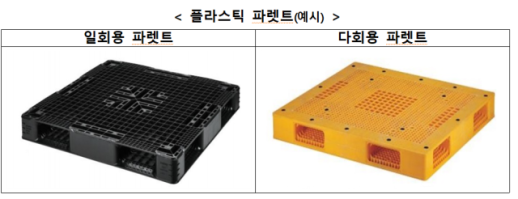 South Korea fines 18 plastic pallet firms 11.7 billion won for bid-rigging Eighteen manufacturers and sellers of plastic pallets that allegedly coordinated bid winners and prices have been fined by South Korea’s antitrust watchdog. The Fair Trade Commission said May 7 it will impose a combined 11.737 billion won ($11.7 billion won) in penalties and issue corrective orders against the 18 companies for avoiding competition and fixing prices. Pallets are platforms used in logistics to bundle and move multiple items as a single load. The companies took part in 165 bids run by 23 businesses and, through phone calls, in-person meetings and mobile messaging, agreed in advance on the expected winner, “cover” bidders and bid prices for each tender, the commission said. The cover bidders submitted bids at the agreed price level, and the designated winner shared part of the collusive profits with other firms. In particular, five of the firms also agreed on which company would supply pallets in transactions with NongHyup Economic Holdings and then split the profits, the commission said. When local NongHyup cooperatives asked to buy pallets, four other firms quoted prices higher than the NongHyup supply price to steer purchases through Economic Holdings. The collusion lasted 6 years and 8 months and involved 369.2 billion won in related sales, the commission said. It said 23 companies, including Lotte Chemical, DL Chemical and Seoul Milk Cooperative, were harmed. An FTC official said the agency will respond strictly to cartels that impose unnecessary costs on businesses and weaken industrial competitiveness. * This article has been translated by AI. 2026-05-07 12:04:39
 -
 Bank of Korea: Stock Wealth Effect Lags Advanced Economies, Could Grow as KOSPI Hits 7,000 South Korea’s stock market generates a much smaller “wealth effect” on household spending than major advanced economies, the Bank of Korea said, though the impact could grow as the KOSPI enters the 7,000 era and stock ownership broadens. In a report released Wednesday titled “BOK Issue Note: An Assessment of Korea’s Stock Wealth Effect,” the central bank estimated that when rising share prices increase household wealth, consumption rises by about 1.3% of capital gains. That implies that a 10,000-won increase in stock prices translates into roughly 130 won available for consumption. In the United States and Europe, about 3% to 4% of capital gains typically feeds into consumption, the report said. The BOK attributed the gap largely to structural factors, including a relatively narrow investor base. As of 2024, stock assets equaled 77% of disposable income, far below the U.S. level of 256% and 184% in major European countries. Stock holdings are also concentrated among high-income, high-asset households, which tend to have a lower propensity to consume, limiting spillover to spending. Market performance has also weighed on the effect. From 2011 to 2024, the S&P 500’s average expected monthly return was 0.53%, compared with 0.09% for the KOSPI, while volatility was 3.43% for the S&P 500 versus 3.77% for the KOSPI, about 10% higher. The probability that gains persist was 67% in the U.S. and 56% in South Korea, and the average duration of gains was 3.1 months in the U.S. versus 2.3 months in South Korea. Investment behavior also constrains consumption, the report said, as stock profits tend to flow first into real estate rather than spending. For households without a home, about 70% of stock capital gains are estimated to move into property. Kim Min-su, deputy head of the BOK’s macro analysis team, said capital gains have tended to shift into real estate because in the past the property market had lower volatility and higher returns, raising the opportunity cost of consumption. Still, the BOK said the wealth effect could strengthen as share prices rise rapidly on factors including expanding global demand for artificial intelligence, increasing household stock holdings and drawing more young and middle- and lower-income investors into the market. Household stock capital gains totaled 429 trillion won last year, about 22 times the average for 2011-2024, the report said. Because new investors tend to show a relatively larger wealth effect, the BOK said the gains could translate into stronger consumption. The central bank also warned that a sharp market correction could produce a larger negative wealth effect. With leveraged investing such as margin loans increasing, a drop in asset prices alongside heavier debt burdens could add to downside pressure on the economy, it said. Kim said it is important over the medium to long term to create a stable investment environment so the stock market can serve as a foundation for household wealth formation. He said policy efforts should curb the concentration of stock gains into real estate and strengthen incentives for long-term stock holding so that companies’ economic performance can translate into household asset accumulation and greater capacity to spend.* This article has been translated by AI. 2026-05-07 12:03:17
 -
 Appeals Court Cuts Han Duck-soo Sentence to 15 Years for Role in Martial Law Case Han Duck-soo, who was indicted on charges tied to former President Yoon Suk Yeol’s Dec. 3 emergency martial law, received a reduced sentence on appeal. On the 7th, the Seoul High Court’s Criminal Division 12-1 sentenced Han to 15 years in prison for charges including performing key duties in an insurrection. The term was eight years less than the 23-year sentence handed down at the first trial. The panel said, as the lower court did, that Han played a central role in the process of declaring martial law and shook the constitutional order. It found him guilty of carrying out key tasks in the insurrection, including proposing that a Cabinet meeting be convened to make the declaration appear to have undergone normal deliberation, and trying to obtain after-the-fact signatures from Cabinet members after the declaration. The court also treated as participation in the insurrection Han’s actions on the day martial law was declared, when he discussed with former Interior and Safety Minister Lee Sang-min at the presidential office specific plans to carry out repression, including blocking major state institutions and cutting electricity and water to media outlets. As in the first trial, the court also convicted Han over allegations that, after martial law was lifted, he conspired with Yoon and former Defense Minister Kim Yong-hyun to sign and then discard a backdated proclamation drafted by former aide Kang Eui-gu to conceal legal flaws in the original declaration. The court found him guilty of making a false official document and violating the Presidential Records Act. However, unlike the first trial, the appeals court acquitted Han of perjury. The court said Han’s testimony at the Constitutional Court in February last year, when he appeared as a witness in the president’s impeachment trial and said he had not seen the martial law proclamation, was false. But it ruled that his answer to the effect that he did not see Kim hand the document to Lee was difficult to treat as perjury. The court, as the lower court did, did not view as key insurrection duties Han’s act of asking then-ruling People Power Party floor leader Choo Kyung-ho about the situation at the National Assembly after the declaration, or his attendance at an outside event as a stand-in at Yoon’s direction. It also maintained not-guilty rulings on allegations that Han delayed Cabinet deliberation after martial law was lifted and on a charge of using a false official document. Han’s lawyers said after the ruling that they could not accept the findings of fact or legal reasoning and indicated they would immediately appeal to the Supreme Court. The special counsel team told reporters that while the sentence fell short of the first-trial term, it viewed the decision as meaningful. The team said it would decide whether to appeal after reviewing the written judgment. 2026-05-07 11:32:11
 -
 KB Kookmin Card Creates Board-Level Consumer Protection Committee KB Kookmin Card said Thursday it has created a Consumer Protection Committee within its board of directors to strengthen its financial consumer protection function. The company said the move is intended to proactively implement the Financial Supervisory Service’s “best practices for financial consumer protection governance” announced in September last year and to make consumer protection a core management value. The new committee will set basic policies for building and operating an internal control system for financial consumer protection, deliberate and vote on the company’s consumer protection strategy and detailed action plans, and oversee the results of related in-house committees. The committee will meet regularly at least once every half-year and may convene additional meetings as needed to discuss key agenda items. KB Kookmin Card said it aims to embed consumer protection in the board, the company’s top decision-making body, and strengthen management and oversight. The company also established a VOC (Voice of Customer) executive council last year to more actively reflect customer feedback in its decision-making process. A KB Kookmin Card official said the new committee “clearly institutionalizes our commitment to make consumer protection the top value and a principle we must comply with proactively,” adding that the company will work to enhance consumer rights and trust through a companywide, prevention-focused consumer protection system. 2026-05-07 11:31:24
 -
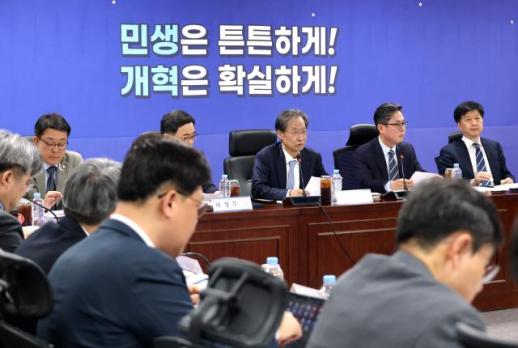 Ruling Party, Government Say 80% of High Oil Price Aid Paid Out; Price Cap Helped Curb Inflation The ruling party and the government said May 7 that relief payments aimed at easing household strain from high oil prices triggered by the Middle East war have been carried out at about the 80% level. They also said a price cap helped offset a significant share of inflation pressures. The Democratic Party’s special committee on economic responses to the Middle East war held its fifth meeting with the government at the National Assembly on May 7 to review measures including the high oil price relief program and the price cap. Rep. Ahn Do-geol, the committee’s secretary, told reporters after the meeting that about 3.8 trillion won of the 4.8 trillion won budget had been executed through the Ministry of the Interior and Safety, or roughly 80%. He said the key issue is whether the money is reaching eligible recipients, and by that measure 1.4 trillion won has been paid out, adding that the rollout appears to be proceeding smoothly. Ahn said that as tensions in the Middle East continue to push prices higher, the price cap on petroleum products and fuel tax cuts helped keep April’s inflation rate lower. “Without the price cap and fuel tax cuts, April’s inflation rate would have been 3.8 percentage points, 1.2 points higher than the 2.6 points actually recorded,” Ahn said. He added that the measures are helping reduce about one-third of the rise in prices. He said the government’s swift response to stabilize oil prices, which affect production costs and consumer prices, is helping keep living costs steady. The party and the government also said they received a briefing from the Financial Services Commission on lowering card transaction fees for gas stations. Ahn said card companies, gas stations and the Korea Petroleum Distribution Association presented sharply different positions and no conclusion was reached. He said further talks are needed and that the Democratic Party decided to work to mediate.* This article has been translated by AI. 2026-05-07 11:27:31
 -
 Trump Signals Iran Deal Could Be Reached Within a Week Ahead of China Trip U.S. President Donald Trump suggested the United States could wrap up negotiations with Iran to end the war before his planned trip to China, as reports said the two sides are discussing a memorandum of understanding. Trump also warned he would intensify military pressure if no deal is reached. According to The Wall Street Journal and other outlets, Trump told reporters at a White House event on Tuesday local time that Iran “cannot have a nuclear weapon and will not,” adding that Iran had agreed on that point “along with many other things.” He said the two sides had “very good talks over the last 24 hours” and that “there’s a very good chance” of an agreement. CNN and Axios reported the U.S. and Iran are discussing a one-page MOU aimed at ending the war. The reports said it would include a temporary halt to Iran’s nuclear enrichment, U.S. sanctions relief, and a gradual lifting of Iran’s closure of the Strait of Hormuz and the U.S. maritime blockade of Iran. In an interview with PBS, Trump said a deal would include removing Iran’s stockpile of highly enriched uranium to the United States and shutting down Iran’s underground nuclear facilities. Trump also raised the possibility of a deal before his planned China visit on May 14-15. Asked by PBS whether it could be concluded before he leaves, he replied, “Possible.” Axios, citing officials, reported the White House hopes the talks will be finished before Trump’s China trip ends on May 15. Fox News anchor Bret Baier said Trump told him in a previous call that he expected about a week to finalize the process. Baier said Trump expressed “cautious optimism.” Even as he highlighted progress, Trump warned of renewed bombing if Iran does not agree. In a post on Truth Social, he wrote that if Iran does not consent, “the bombing will start,” and that it would be “at a much higher level and intensity than before.” U.S. keeps maritime blockade on Iran The United States has kept up pressure by maintaining its maritime blockade of Iran despite the reported diplomatic progress. U.S. Central Command said it “enforced the blockade” against the tanker Hasna as it traveled through international waters toward an Iranian port in the Gulf of Oman at about 9 a.m. Eastern time Tuesday. Central Command said the Hasna ignored repeated warnings, prompting U.S. forces to fire a 20mm machine gun and disable its rudder. It said the ship is no longer sailing to Iran and that the U.S. blockade on vessels seeking to enter or leave Iranian ports “remains fully in effect.” The United States began the maritime blockade at 10 a.m. on April 13, aiming to block ship movements through Iranian ports in what it described as a countermeasure to Iran’s closure of the Strait of Hormuz. The U.S. has said the blockade, intended to increase economic pressure, will remain until an agreement is finalized. Trump has repeatedly said the blockade will not be lifted until a signed deal to end the war is in place. Iran, meanwhile, has officially introduced new maritime rules requiring all ships passing through the Strait of Hormuz to obtain prior transit permission starting May 5, leaving unresolved friction over reopening the waterway.* This article has been translated by AI. 2026-05-07 11:24:15
 -
 Israel Strikes Lebanon Again During Ceasefire, Raising Stakes for U.S.-Iran Talks Israel carried out another large-scale airstrike on Lebanon during a ceasefire, resuming clashes that could complicate emerging U.S.-Iran talks on ending the war. On May 6 (local time), Reuters and Al Jazeera reported that Israeli Prime Minister Benjamin Netanyahu and Defense Minister Israel Katz said in a statement that Israel had struck Lebanon. The reports said Israel used fighter jets and armed drones to hit Hezbollah’s elite Radwan force in southern and eastern Lebanon, with at least 13 people reported killed. Hezbollah said it retaliated against Israeli forces using armed drones. The strike came during a ceasefire between Israel and Lebanon. Under U.S. and other mediation, the sides observed a 10-day truce from April 17 to 26 and then agreed to an additional three-week ceasefire from April 26 to May 17. Still, Israel carried out airstrikes on Lebanon on May 2 and May 5, and the violence has continued. The latest attack is also expected to affect U.S.-Iran negotiations that are now seen as within reach. Hezbollah is part of the Iran-aligned “Axis of Resistance,” and Iran’s conditions presented to the United States include an end to Israeli hostile actions against Lebanon. As clashes between Israel and Lebanon intensify, the prospects for a U.S.-Iran deal appear to diminish, and Netanyahu has voiced opposition to the talks. Reuters said, “As Iran and the United States were saying they were getting closer to end-of-war talks, the strike is threatening the ceasefire agreement that had halted Israel’s airstrikes on Lebanon.” Analysts also said the ceasefire-era speculation about a possible summit between Lebanese President Joseph Aoun and Netanyahu has become less likely. Atlantic Council researcher Nicholas Blanford told Al Jazeera, “The image of President Aoun shaking hands with Netanyahu would have a very negative impact in Lebanon.” Clashes between Israel and Lebanon began after Hezbollah resumed attacks on Israel on March 2, shortly after the outbreak of the Iran war. Lebanon’s Health Ministry says Israeli attacks have killed about 2,700 people in Lebanon and displaced 1.2 million. Israel has said 17 soldiers and two civilians have been killed.* This article has been translated by AI. 2026-05-07 11:21:07
 -
 Former PM's jail term reduced to 15 years on appeal over martial law involvement SEOUL, May 7 (AJP) - Former Prime Minister Han Duck-soo received a reduced sentence on appeal on Thursday for his involvement in disgraced former President Yoon Suk Yeol's botched martial law debacle in December 2024. In a nationally televised ruling, the Seoul High Court sentenced Han to 15 years in prison on insurrection charges related to Yoon's Dec. 3 declaration of martial law, which led to his ouster from office. Han was found guilty on most of the main charges including aiding or conspiring with Yoon in the short-lived, late-night martial law bid, as well as concealing or fabricating documents to make the move appear lawful. But Han's sentence was significantly reduced from the 23 years handed down by the lower court in January this year, as the appellate court, in a partial reversal, cleared him of some charges including perjury over his testimony at Yoon's impeachment trial in February last year. Even with the lighter sentence, Han's lawyers immediately vowed to appeal following the ruling. 2026-05-07 11:20:56
 -
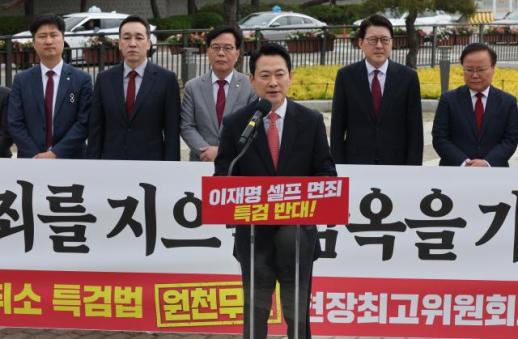 People Power Party slams special counsel bill allowing indictment cancellations in Lee Jae-myung cases The People Power Party held an on-site meeting of its 최고위원회 in front of Cheong Wa Dae on May 7 and criticized a special counsel bill that would allow the cancellation of indictments in cases involving President Lee Jae-myung. The party said indictment cancellations would go beyond “erasing Lee Jae-myung’s crimes” and amount to “the last tollgate on the road to dictatorship.” It also urged that five trials involving Lee be resumed. Party leaders, including Jang Dong-hyeok, spoke at the meeting held in front of the fountain at the Sarangchae near Cheong Wa Dae in Seoul. Jang said, “In Lee Jae-myung’s eyes inside Cheong Wa Dae, he can’t see the economy, people’s livelihoods, diplomacy or security — anything. Right now, Lee is thinking only about not going to prison.” Jang cited allegations including illegal remittances to North Korea, the Daejang-dong scandal, perjury, misuse of corporate card funds and election law violations, calling them “clear and shameless crimes” that he said Lee could not avoid facing. He claimed Lee was trying to “erase his crimes altogether by appointing a special counsel himself.” “In short, he wants to use a special counsel to take the indictment from the judge and have Lee Jae-myung tear it up with his own hands,” Jang said, adding, “He seems afraid of going to jail, but not afraid of the public at all.” Jang said, “The moment criminal Lee Jae-myung tears up the indictment with his own hands, an all-powerful dictatorship will begin in earnest,” and warned of harsher pressure on the opposition and the media. He also called the upcoming local elections a vote to stop what he described as “Lee Jae-myung’s dictatorship.” Jang also said he opposed a constitutional amendment proposal scheduled for a vote at the National Assembly plenary session that day, calling it a political maneuver to extend Lee’s rule. He said that if Lee wants a constitutional revision, Lee should first declare he will not seek another term. Jang urged the immediate withdrawal of the special counsel bill tied to indictment cancellations and called for the repeal of laws he described as unconstitutional. “They drafted a constitutional amendment to suit their tastes, introduced it first, and now say they want discussions — that itself is a dictatorial idea,” he said. Floor leader Song Eon-seok also criticized the special counsel measure, calling it an unprecedented “self-pardon bill” that would mobilize state power to erase Lee’s alleged criminal suspicions. “If he is truly confident, as he says, there is no reason to avoid trial,” Song said. Song added that five trials involving Lee — including cases tied to Daejang-dong, Baekhyeon-dong, Ssangbangwool-related remittances to North Korea, and violations of the Public Official Election Act — “should be resumed immediately.”* This article has been translated by AI. 2026-05-07 11:20:05
 -
 China Probes Hefei Party Chief Fei Gaoyun for Serious Discipline Violations A Chinese official born in the 1970s and once discussed as a potential next-generation leader has come under investigation, the latest in a string of falls among so-called “post-70s” cadres. The official is Fei Gaoyun, the Communist Party secretary of Hefei, the capital of Anhui province, which has recently emerged as a high-tech hub. China’s Central Commission for Discipline Inspection said on its website on the 6th that Fei is being investigated on suspicion of “serious discipline violations.” Fei has not appeared in public since April 19, when he presided over a Hefei party committee meeting. After the announcement, the Anhui provincial party committee and the Hefei party committee each held meetings to express support for the party center’s decision. The Hefei party committee said it would “strengthen management of family members, close associates and staff” and build “a clean and healthy relationship between government and businesses.” Fei, born in August 1971 and a native of Huai’an in Jiangsu province, spent about 30 years in public service in Jiangsu. He served as head of the organization department in Nantong, mayor and party secretary of Changzhou, and executive vice governor of Jiangsu. He moved to Anhui in 2023, served as executive vice governor there, and became Hefei party secretary in April last year. The article said Fei was known to have built ties in Jiangsu with senior leaders including Premier Li Qiang, United Front Work Department head Shi Taifeng and State Councilor Wu Zhenglong. It said Fei was promoted to Changzhou party secretary in 2017 when Li and Shi were serving as Jiangsu party secretary and governor, respectively, and later worked as a vice governor during Wu’s tenure as Jiangsu governor. Fei drew attention after being elected an alternate member of the Central Committee at the Communist Party’s 20th National Congress. Expectations had been high that he would enter the Central Committee and be tapped for a key central post at next year’s 21st Party Congress, joining a group of rising “post-70s” officials. He ultimately did not avoid the party’s disciplinary crackdown. On April 30, another “post-70s” official seen as a future leadership contender, Li Yunze, head of the National Financial Regulatory Administration at ministerial rank, was demoted over discipline violations, the report said. With the 21st Party Congress and a leadership reshuffle ahead next year, China’s anti-graft drive appears to be intensifying. The discipline commission said that, in addition to Fei, two other senior officials were also being investigated on suspicion of discipline violations: Zhandui, a vice mayor of Lhasa in the Tibet Autonomous Region, and Hu Chaowen, party secretary of Enshi Tujia and Miao Autonomous Prefecture in Hubei province.* This article has been translated by AI. 2026-05-07 11:19:04