
Journalist

Lim, Kwu Jin
-
 South Korea to Expand Community Solar, Aiming for 700 'Sunlight Income Villages' This Year The South Korean government is moving to expand resident-led solar power projects, gathering on-the-ground feedback as it pushes to build more than 700 “Sunlight Income Villages” this year through regulatory tweaks and stronger administrative support. The Ministry of Climate, Energy and Environment said it held a policy forum on Thursday morning at the Han River Flood Control Office in Seoul’s Seocho district. Climate Minister Kim Seong-hwan attended along with members of the Sunlight Income Village task force, energy-related agencies, ReSCO companies, experts, industry representatives and financial institutions. Participants discussed hurdles in implementation, hands-on support and post-completion management. Sunlight Income Villages are community-participation projects in which residents join solar generation through cooperatives and return profits to the local community. The government views the program as a model that can expand renewable energy while boosting local economies, and expects wider solar deployment to raise energy self-sufficiency at the community level. Key topics included financing, grid connection, securing sites and permitting procedures. Based on the forum, the ministry said it will review ways to streamline administrative steps that developers have sought to improve, including facility confirmation under the Renewable Portfolio Standard, technical reviews and pre-use inspections. It also said it will use a public-private field support team and ReSCO partners to assist projects from cooperative formation through operations, and will strengthen checks on profit distribution after completion. Kim said the initiative is “the most practical energy transition model” in which residents participate and share benefits, pledging to create more than 700 villages this year and quickly lay the groundwork for nationwide expansion. He also vowed to tighten oversight from planning through operations so projects proceed “more transparently and stably.”* This article has been translated by AI. 2026-05-07 10:04:08
 -
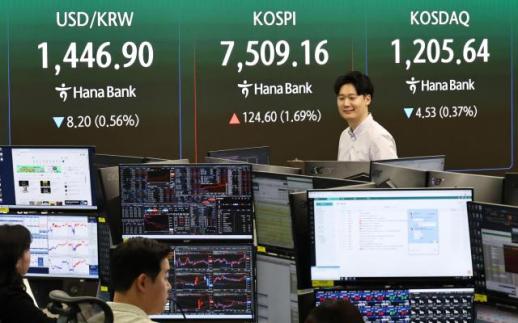 KOSPI briefly tops 7,500 for first time as AI chip rally powers Seoul stocks SEOUL, May 07 (AJP) - South Korean stocks surged to another record Thursday, with the benchmark KOSPI briefly topping the 7,500 mark for the first time as easing oil prices, renewed optimism over a potential U.S.-Iran agreement and another global surge in AI-linked chip shares fueled heavy buying in Seoul’s largest technology stocks. The main index climbed as high as 7,531.88, breaking above the 7,500 mark after Wall Street’s three major indexes closed sharply higher overnight. The KOSDAQ also edged up 0.36 percent to 1,214.50 in early trading. The rally was again led by semiconductor heavyweights, which continued to dominate market momentum. Samsung Electronics rose 2.07 percent to trade at 271,500 won and SK hynix gained 1.12 percent to 1,619,000 won. The advance followed another record-setting day in the United States, where the Dow Jones Industrial Average rose 1.24 percent while the S&P 500 and Nasdaq Composite climbed 1.46 percent and 2.02 percent, respectively, both setting fresh all-time highs. Investor sentiment improved after U.S. President Donald Trump said Iran appeared willing to abandon its nuclear ambitions and pursue a deal, raising hopes that tensions in the Middle East could ease despite lingering geopolitical uncertainty. Oil prices tumbled on expectations that a broader regional conflict could be avoided, easing inflation concerns that had weighed on global equities in recent weeks. Brent crude fell 7.83 percent to settle at $101.27 a barrel, while West Texas Intermediate crude dropped 7.03 percent to $95.08. The global chip rally accelerated after U.S. chipmaker AMD posted surprisingly strong earnings, sending its shares up 18 percent overnight and lifting broader AI-related stocks. NVIDIA climbed 5.77 percent after announcing plans to expand optical manufacturing facilities in the United States with Corning, while Intel gained 4.49 percent and Micron Technology advanced 4.12 percent. The momentum spilled into Seoul, with semiconductor, auto and heavy industry shares remaining resilient despite heavy foreign selling, as retail investors stepped in to support the market after its recent record-breaking surge. Auto stocks traded higher, with Hyundai Motor jumping 5.45 percent to 580,000 won and Kia advancing 2.91 percent to 159,100 won. Among defense and heavy industry names, HD Hyundai Heavy Industries climbed 3.55 percent to 671,000 won, and Doosan Enerbility surged 6.85 percent to 135,700 won. In the financial sector, Samsung Life Insurance edged up 0.34 percent to 299,000 won, while KB Financial Group slipped 0.38 percent to 158,300 won. Battery-related shares underperformed the broader market, with LG Energy Solution falling 1.66 percent to 474,000 won. Hanwha Aerospace also dropped 3.21 percent to 1,387,000 won despite continued strength in defense-related plays overall. Market concentration has intensified rapidly as Korea’s equity rally becomes increasingly dependent on semiconductor heavyweights. As of Wednesday’s close, the combined market capitalization of Samsung Electronics common shares, Samsung Electronics preferred shares and SK hynix reached about 2,848 trillion won, accounting for roughly 47 percent of the KOSPI’s total market value of 6,058 trillion won and responsible for nearly 80 percent behind KOSPI rally. Including related affiliates such as SK Square, Samsung C&T and Samsung Life Insurance pushes that figure above 50 percent, underscoring growing concerns that the market’s gains are becoming narrowly concentrated around a small group of conglomerate-linked AI beneficiaries. The divergence between large and small stocks has widened sharply in recent weeks. Over the past month, the KOSPI large-cap index rose 38 percent, compared with gains of 21 percent for mid-cap shares and 11 percent for small-cap stocks. Since the start of the year, when the KOSPI began its explosive climb on AI-driven optimism, large-cap stocks have surged 82 percent, more than four times the gain posted by small-cap shares. Even during Wednesday’s historic surge into the 7,000 milestone, large-cap stocks climbed 7.22 percent, while mid-cap shares were nearly flat and small-cap stocks declined. The growing divide reflects continued investor demand for large-cap stocks with stronger earnings outlooks amid ongoing geopolitical and energy market uncertainty. Foreign investors bought a net 7.23 trillion won worth of KOSPI shares over the past month, with most inflows concentrated in Samsung Electronics, SK hynix and Doosan Enerbility. Brokerages expect momentum in semiconductor, power equipment, defense, brokerage and renewable-energy shares to continue through the first half, as global AI infrastructure spending and liquidity-driven foreign inflows continue to dominate market direction. 2026-05-07 10:04:03
 -
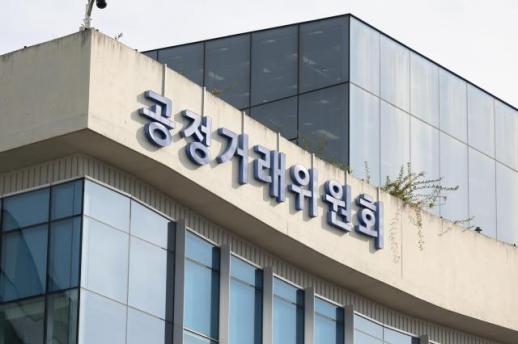 Korea Fair Trade Commission to Brief Big Conglomerates on Disclosure Rules South Korea’s antitrust regulator will hold tailored briefings online and in person for disclosure officers at major conglomerates, aiming to prevent repeat violations. The Korea Fair Trade Commission said May 7 it will host the sessions with the Korea Chamber of Commerce and Industry from May 11 to 13 for companies designated as disclosure-target business groups, commonly known as large conglomerates. The commission holds quarterly briefings each year to improve understanding of disclosure requirements and curb recurring violations. Groups that breach the disclosure system can face corrective orders and administrative fines of up to 100 million won. Last month, the commission newly designated 11 groups as large conglomerates: Line, the Korea Teachers’ Credit Union, Woongjin, Shielders, Daemyung Chemical, Toss, Kolmar Korea, Heesung, Orion, QCP Group and Iljin Global. Including the newly designated groups, the total number of large conglomerates in South Korea is 102. At the briefings, the commission will also explain obligations related to status disclosures, disclosures of large internal transactions, and disclosures of key matters for unlisted companies, reflecting cases in which the controlling person of some groups has changed to a natural person. It will provide additional guidance tied to this year’s group designations and set aside time for questions and answers, offering company-specific assistance. The commission said it will continue outreach online. In the first half of the year, it plans to produce explanatory videos on large internal transactions, key matters for unlisted companies and group status disclosures, and release them on its official YouTube channel. In the second half, it plans to hold “on-site disclosure briefings” for conglomerates based outside the capital region. * This article has been translated by AI. 2026-05-07 10:03:21
 -
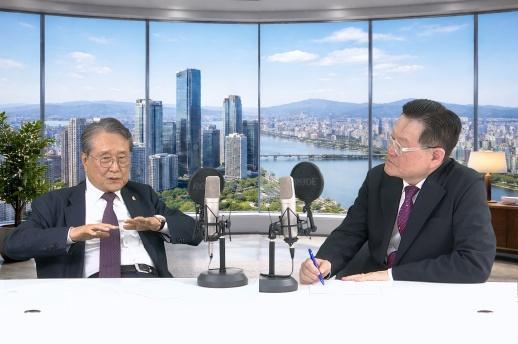 Yu Jang-hee Warns of Global Economic Reset, Urges Korea to Diversify Export Markets The global economic order is being reshaped at speed, with war, tariffs and technology rivalry colliding and undermining the free-trade system that long underpinned growth. Yu Jang-hee, head of the National Council of Elders’ Wonjiwon, described the moment not as a routine downturn but as a “transition of order,” citing the Russia-Ukraine war, conflict in the Middle East, U.S. tariff policy and U.S.-China tensions. Yu said higher energy prices and unstable supply chains could drive inflation while slowing growth. He argued South Korea’s heavy reliance on external demand leaves it among the first to feel global shocks, despite its top-10 economy and competitiveness in manufacturing, semiconductors and cultural industries. As a response, Yu called for “market diversification,” urging South Korea to reduce dependence on exports centered on the United States and China and expand into India, Africa, Latin America and other regions. He also said Korean companies’ strength lies in their ability to adapt quickly and adopt new technologies such as artificial intelligence, adding that outcomes will depend on strategy. “Korea is still a competitive country, and if it sets the direction correctly, it can create opportunities,” he said. - How do you view the global economy now. “Today’s global economy is hard to describe as a simple slowdown or recession. It is closer to a structural transition in which the international order itself is being shaken. In the past, economic and security issues were partly separated. That is no longer the case. The Russia-Ukraine war, Middle East conflict and U.S. tariff policy are binding the economy and security into a single structure. At the same time, technological innovation such as AI is changing the business environment fundamentally. In this situation, conventional countercyclical policy is not enough. Geopolitical risk and competition for technological dominance are working at the same time. This is not a ‘business cycle’ crisis but a ‘change in order.’ And it will not end quickly; it could last more than 10 years.” - What is the root cause of the free-trade order weakening. “The free-trade system provided a stable growth environment for about 20 years after the WTO launched in 1995. But the decisive turning point was U.S.-China conflict. China expanded its global market share on price competitiveness while using state-led industrial policy to foster specific industries. That undermined market fairness, and the United States came to see it as a threat. Tariff policy took hold under the Trump administration, and the conflict became structural. This is not a simple trade dispute. It is a ‘hegemony competition’ linking technology, security and industrial policy, so it is difficult to resolve and likely to be prolonged.” - How will the recent Middle East situation affect the economy. “The Middle East has always had a major impact on the global economy because of energy. When conflict breaks out, oil supply becomes unstable and prices rise. Higher energy prices raise production costs and increase inflation pressure. The biggest concern is stagflation — rising prices with slowing growth. Policy responses are difficult: raising rates deepens a downturn, while cutting rates can push prices higher. Another key point is that the conflict is unlikely to end quickly. Ending a war is harder than starting one, and if energy infrastructure is damaged, restoration can take years. So this is not just a short-term shock; it could affect the global economy over the medium to long term.” - How do you assess South Korea’s current position. “Objectively, South Korea has reached a very high level. It has a top-10 economy and global competitiveness in semiconductors, manufacturing, bio and cultural content. But it also has clear structural vulnerabilities. The biggest is high external dependence — a large export share and heavy reliance on specific countries. In that structure, external shocks show up quickly. If global demand falls, exports drop and growth is affected immediately. In short, Korea has strengths and weaknesses at the same time: it is competitive, but highly exposed to the external environment.” - What is the solution to overcome these limits. “The most important thing is market diversification. Korea has relied heavily on two pillars, the United States and China. They remain important, but dependence on them alone is risky. Korea should actively expand into India, Africa, Latin America and Southeast Asia. These regions have growing populations and strong potential for economic growth, making them important long-term markets. Diversification is not just about increasing exports. It is about stabilizing the national economy by changing a structure in which the whole economy can be shaken by conditions in a single country.” - How do you assess the competitiveness of Korean companies. “Korean companies’ biggest strength is adaptability. They respond quickly when conditions change and actively adopt new technologies. That matters in global competition. That strength is likely to continue in the AI era. Korea has strong digital infrastructure and IT capabilities, giving it an advantage in applying AI to industry. There may be gaps in foundational technology, but in practical use and application, Korea can be competitive. That is why Korean companies can find opportunities even in a crisis.” - How important is South Korea-U.S. economic cooperation. “Cooperation remains very important. The United States has top competitiveness across advanced technology, finance and manufacturing, and it basically maintains a free-market system, which provides a stable basis for cooperation. There may be short-term friction over tariffs or industrial policy, but over the long term the relationship is likely to hold. In technology, cooperation is essential. In semiconductors, AI and bio, cooperation with the United States is a major help to Korea’s economy.” - What is your outlook for shipbuilding and defense industries. “Shipbuilding is facing a very interesting opportunity. U.S. shipbuilding competitiveness has weakened significantly. If Korean companies enter, they can secure market leadership. Defense is similar. As the global security environment becomes more unstable, demand is rising. Korea has technology and production capacity, so it can be competitive. These two industries are likely to become important growth pillars for Korea’s economy.” - What is the future of the semiconductor industry. “Semiconductors are a core industry for Korea. There are risks, but it is also the biggest opportunity. Korea is very strong in advanced semiconductors. The key is to sustain innovation. Korea must move beyond production-centered growth and secure high value-added technology. With intensifying global competition, continued investment and R&D are needed.” - Where does Korea stand in the AI era. “AI is a technology that will change every industry. Korea may lag in foundational technology, but it can be competitive in applications. AI use is spreading quickly, especially in manufacturing and content industries. Speed is critical. Because change is so fast, a slow response can widen gaps. The government and companies should invest aggressively together.” - What is the biggest long-term risk. “Population cliff, talent cliff and labor cliff. The talent issue is the most serious. In the AI era, talent is competitiveness. Korea lacks talent and also faces outflows abroad. If it cannot solve this, long-term growth will be difficult.” - Even so, are you optimistic about Korea’s economy. “Yes. Korea has proven competitiveness in many areas — manufacturing, technology, culture and defense, among others. Another important factor is trust: global trust in Korean products and companies is high. With those strengths, if Korea sets the direction well, it can grow.” :Yu Jang-hee, Wonjiwon chief: Yu is a leading South Korean expert in international economics and trade. He graduated from Seoul National University’s economics department and earned a doctorate in economics in the United States, then worked across academia and policy. He led multiple economic and trade-related institutions, including the Korea Institute for International Economic Policy (KIEP), and was deeply involved in shaping South Korea’s external economic policy. He has played an important role in South Korea-U.S. economic cooperation, working with major U.S. think tanks and corporate networks to help broaden the foundation for Korean companies’ global expansion. He has continued research on changes in the international economic order and trade policy, and has spoken consistently on issues including U.S.-China tensions, expanding protectionism and global supply-chain restructuring. Yu is seen as combining academic analysis with a policymaker’s practical perspective, offering solutions that can be applied to economic policy and corporate strategy. He continues to study global economic trends and South Korea’s response strategies, advising both companies and government. He has emphasized “market diversification” and “corporate competitiveness” as key themes for South Korea’s economic survival amid rapid change in the global order. 2026-05-07 09:59:45
 -
 SK Telecom Posts 5.376 Trillion Won Q1 Operating Profit as AI Data Center Sales Surge SK Telecom (SKT) said it showed signs of recovery in the first quarter after the fallout from a hacking incident last year. Revenue and operating profit edged down from a year earlier, but sales from its AI data center business nearly doubled, and the company maintained net additions in 5G subscribers, keeping a 45.7% market share. SKT said Thursday that on a consolidated basis it posted first-quarter 2026 revenue of 4.3923 trillion won and operating profit of 537.6 billion won. Revenue fell 1.4% from a year earlier and operating profit slipped 5.3%, but the company returned to operating profit in the 500 billion won range, boosting expectations for the second half. Wireless revenue declined 3% to 2.5813 trillion won. Still, 5G continued to expand as a share of handset subscribers, reaching 81%. Net additions of 5G subscribers continued, and SKT’s 5G market share held steady at 45.7%. Marketing expenses rose 7.1% from a year earlier to 740.8 billion won, but fell 3.0% from the previous quarter. In the wireline business, revenue from fixed-line communications rose 2.2% to 295.4 billion won, supported by net additions in high-speed internet subscribers and a higher share of gigabit internet users. High-speed internet subscribers increased to 7.311 million. Pay-TV revenue fell 1.3% to 471.9 billion won, and enterprise revenue slipped 1.7% to 274.7 billion won. IPTV subscribers totaled 6.75 million. Against softer telecom results, the AI business helped drive the recovery. AIDC revenue rose 89.3% from a year earlier to 131.4 billion won, helped by higher utilization at new data centers and expanding sales of graphics processing unit as a service, or GPUaaS. AI business-to-business and business-to-consumer revenue fell 10.3% to 45.0 billion won, reflecting weaker cloud revenue. SKT said it expects demand for AI infrastructure to surge, led by global big tech companies, and plans to strengthen competitiveness across the AI data center value chain while continuing to expand its infrastructure footprint. The company also said it will step up shareholder returns and has resumed dividends that had been suspended. The first-quarter dividend is 830 won per share. Chief Financial Officer Park Jong-seok said the first quarter was “a meaningful period” in which the company delivered results aligned with its goals for the year, including strengthening core competitiveness around customer value and restoring profitability through a streamlined AI business. “We will continue focusing on improving performance through sustained results,” he said. 2026-05-07 09:53:15
 -
 Finance Minister Koo to Announce Fifth Oil Price Cap at 7 p.m.; Anti-Hoarding Ban Extended to July Deputy Prime Minister and Finance and Economy Minister Koo Yun-cheol said the government will announce the fifth round of a cap on petroleum product prices at 7 p.m. on May 7, ahead of its application starting May 8. He also said the ban on hoarding petroleum products will be extended by two months, through July, and that the government will move to strengthen the system, including introducing administrative fines. Koo made the remarks while chairing the eighth meeting of the interagency task force on special management of consumer prices at the Government Complex in Sejong on May 7. He said the fifth price cap, to take effect from 12 a.m. on May 8, will be set after considering international oil price trends, petroleum consumption, and the fiscal and household burden. “To block misconduct such as refusing to sell under the pretext of the price cap, we will extend the notice banning hoarding of petroleum products through July,” Koo said. He added, “We will also prepare improvement measures, including creating administrative fines and using reward programs, to increase the effectiveness of price-stabilization steps.” On recent price conditions, Koo said that despite the fallout from the Middle East war, the April consumer price inflation rate held at about 2.6% due to the price cap and expanded shipments of agricultural products. He said the price cap, along with steps such as fuel tax cuts, helped reduce the rise in prices by about 1.2 percentage points. Koo also said South Korea’s inflation has been relatively stable compared with other countries. With consumer prices in major economies such as the United States and the United Kingdom running above 3%, he said, South Korea has maintained inflation in the low-to-mid 2% range. The government said it will intensify efforts to manage consumer prices. It will conduct daily checks on key items closely tied to household spending, including petroleum products, agricultural goods, processed foods and daily necessities, and will work with the food industry to promote discount events for about 4,300 items throughout May. As follow-up steps to improve the tariff-rate quota system, the government plans to strengthen inspections across the distribution process, considering the price-stabilization effect of imported agricultural and fisheries products. It also plans to pursue legal revisions, including imposing additional taxes and creating orders to remove goods from circulation. The government will also expand customs clearance support for items affected by the Middle East war. It will strengthen screening for key imports such as petroleum products and naphtha and support diversification of import sources. It said it will simplify procedures to apply preferential tariff rates to Canadian crude oil, seeking to secure up to 33 million barrels a year. To stabilize supplies of medical products, the government said it will conduct special crackdowns on hoarding of essential medical items such as syringes and strengthen responses by prioritizing supply to essential areas such as hemodialysis. “Uncertainty is high as the Middle East war drags on, but we will build a breakwater for the people’s economy,” Koo said. “We will make every effort to stabilize prices and supplies of essential items such as energy and food.”* This article has been translated by AI. 2026-05-07 09:52:13
 -
 Gwangju stabbing suspect, 24, allegedly roamed with knives for two days before killing student A man in his 20s accused of stabbing two high school students he did not know in downtown Gwangju, killing one and injuring the other, told police he meant to take someone with him because he was going to die anyway, according to reports. Yonhap News Agency reported Thursday that the Gwangju Metropolitan Police Agency is questioning Jang, 24, who was arrested on suspicion of murder and attempted murder, about the circumstances and motive. Jang is believed to have confessed that he targeted random passersby. Investigators said he had been roaming the streets carrying two bladed weapons starting two days before the attack. One was used in the crime, and the other was found still unopened in its packaging, police said. Police said the first victim was a 17-year-old high school girl who was walking home late at night. Jang allegedly encountered her twice in the Wolgye-dong area before attacking her at 12:11 a.m. on May 5. A preliminary autopsy finding from the National Forensic Service listed the cause of death as a stab wound to the neck, the report said. The second victim was a male second-year high school student who approached after hearing a woman scream nearby, police said. He was seriously injured but is not in life-threatening condition. Investigators said Jang has not made any specific statement about whether he copied a particular incident. Instead, he has repeatedly said he decided to attack because life was not enjoyable, according to reports. Police said they have requested digital forensic analysis of Jang’s cellphone to determine the motive and plan to conduct a psychopathy assessment. A court hearing to review a warrant for Jang’s arrest is scheduled for 11 a.m. Thursday at the Gwangju District Court. Police said they will convene a panel to consider releasing his identity if he is formally detained.* This article has been translated by AI. 2026-05-07 09:51:14
 -
 Kakao posts record first-quarter operating profit as platform, content revenue rises Kakao said it posted its highest-ever quarterly revenue and operating profit in the first quarter, with broad growth across its platform and content businesses. Advertising, commerce, mobility and payments led gains in its core platform operations. On a consolidated basis, Kakao said May 7 that first-quarter revenue rose 11% from a year earlier to 1.9421 trillion won, while operating profit jumped 66% to 211.4 billion won. Platform revenue increased 16% to 1.1827 trillion won. Within that, Talk Biz revenue rose 9% to 608.6 billion won, and Talk Biz advertising revenue climbed 16% to 338.4 billion won. Kakao said demand from financial advertisers boosted overall message volume, and a wider range of messaging products expanded how advertisers used the service. Business messaging revenue rose 27% from a year earlier, while display advertising revenue increased 10%. Combined gross transaction value for Talk Biz commerce, including Gift and Talk Deal, grew 10% to 2.9 trillion won. Kakao attributed the increase to stronger product offerings in high-demand categories such as fresh food and home appliances, along with more personalized user benefits. After the March “Kakao Shopping Festa,” Talk Store transaction value rose 18% from a year earlier, and self-purchase transaction value within Gift surged 53%. First-quarter commerce revenue increased 1% to 270 billion won. Other platform revenue, which includes mobility and payments, rose 30% to 506.5 billion won. Kakao said mobility posted double-digit year-over-year revenue growth for a third straight quarter, supported by taxi, parking, last-mile logistics and advertising. Payments revenue topped 300 billion won for the first time, driven by growth across payments, financial and platform services. Content revenue rose 5% to 759.4 billion won. Music revenue increased 11% to 484.6 billion won, and media revenue climbed 23% to 92.4 billion won. Story revenue totaled 182.4 billion won. Operating expenses rose 7% to 1.7307 trillion won. Kakao’s operating margin was 11%. A company official said profitability typically is weaker in the first quarter due to seasonal factors, but improved this year as efficiency efforts focused on core businesses were reflected in results. Kakao said it plans to accelerate a shift this year to an agentic AI platform, citing growing interest as execution-focused AI that connects to real-world actions spreads quickly. The company previously launched AI services “Kanana in KakaoTalk” and “Kakao Search,” based on conversation context within KakaoTalk. Kakao said it is building a structure that links identifying user needs in chats through to reservations and payments, and aims to onboard and serve 50 million users on its AI services. Chief Executive Jeong Shin-a said, “In the first quarter, we achieved qualitative growth by strengthening our fundamental competitiveness,” adding, “Building on the structural growth momentum of our existing businesses, we will begin the transition to an agentic AI platform used by 50 million users.” 2026-05-07 09:46:52
 -
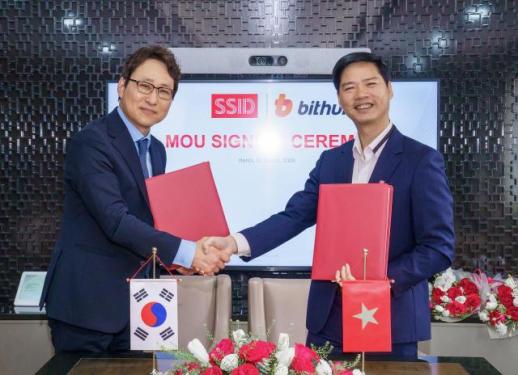 Bithumb Signs MOU With Vietnam’s SSID to Pursue Crypto Exchange Venture Bithumb is expanding cooperation with overseas financial firms as it builds a base for global business. Bithumb said May 7 it signed a broad memorandum of understanding with SSID, a subsidiary of SSI Securities, Vietnam’s largest securities firm, to pursue a virtual-asset exchange business. Attendees at the signing included Bithumb CEO Lee Jae-won, SSID CEO Nguyen Khac Hai and SSI Securities Chairman Nguyen Duy Hung, the company said. The MOU aims to build a strategic partnership to establish and operate an exchange in Vietnam. Subject to regulatory approval for virtual assets in Vietnam, the agreement also leaves open the possibility of a strategic equity investment by Bithumb in an SSID-designated entity. The companies plan to cooperate on technology architecture and development, wallet and custody systems, security and risk management, regulatory support and knowledge transfer, business and product development, and institutional business. Vietnam’s government last month put into effect a resolution allowing coin trading and the establishment of exchanges through a virtual-asset pilot program to be implemented over the next five years. The pilot limits foreign investor ownership stakes, making joint ventures with local financial firms and IT companies important for domestic exchanges. A Bithumb official said cooperation with SSI Securities and SSID reflects international recognition of Bithumb’s exchange operations and transparency. The official said Bithumb will prioritize strict compliance with Vietnam’s regulatory environment and work with its partners to build safe virtual-asset trading infrastructure.* This article has been translated by AI. 2026-05-07 09:41:28
 -
 Hantavirus-hit cruise ship heads to Spain’s Canary Islands; WHO says risk remains low A cruise ship hit by a cluster of hantavirus infections while sailing off West Africa headed for Spain’s Canary Islands after disembarking three suspected patients. AP and Reuters reported that the Dutch-flagged MV Hondius, which had been anchored for several days off the coast of Cabo Verde, began moving on May 6 (local time) with 146 passengers and crew aboard. The three suspected patients were taken off the ship and were being flown by air ambulance to the Netherlands. The Dutch Foreign Ministry said they are a 41-year-old Dutch national, a 56-year-old British national and a 65-year-old German national, and will be transferred directly to specialized hospitals in their respective European countries. Authorities have identified eight suspected cases so far, including three confirmed infections. Three people — a Dutch couple and a German — have died. One of the confirmed cases was the Dutch woman who died. Another was a British patient being treated in South Africa. South Africa’s Health Ministry said testing confirmed the Andes strain, which can spread from person to person. Swiss authorities said one of their citizens who left the ship and returned home in late April is being treated in Zurich and was also confirmed to have the Andes strain. A World Health Organization official said the same strain was identified in samples taken in Cabo Verde, South Africa and Switzerland. The ship departed Argentina on April 1 and traveled through remote areas including the Antarctic mainland, South Georgia Island and Nightingale Island. After infections were confirmed, Cabo Verde refused the ship entry, citing a public health threat. Spain decided to allow it to dock in the Canary Islands on humanitarian grounds. Cabo Verde authorities said an air ambulance arrived the previous night, but stressed that once the evacuation was completed, “the ship must resume its voyage.” Spanish Health Minister Monica Garcia told a news conference in Madrid that all remaining passengers and crew had no hantavirus symptoms and that the ship is expected to arrive in Tenerife in three days. Garcia said that if all non-Spanish passengers are healthy, they will be sent back to their home countries, while 14 Spanish passengers will be quarantined at a military hospital in Madrid. The Canary Islands’ regional government has objected to the central government’s decision. Regional leader Fernando Clavijo told Spanish broadcaster Onda Cero, “We cannot allow it to dock in the Canary Islands. This decision is not based on our criteria, and we have not received enough information.” WHO: “Not like COVID-19” The WHO said it is working with national authorities to trace the movements of 69 people who had close contact with passengers. The agency has repeatedly stressed that the situation is very different from the COVID-19 pandemic. WHO Director-General Tedros Adhanom Ghebreyesus wrote on social media platform X that “at this stage, the overall public health risk remains low.” He said the WHO is working with the operator to closely monitor the health of passengers and crew and is coordinating with national authorities to begin medical monitoring and follow-up for passengers, including those who have already disembarked. In an interview with AFP, Tedros said the risk in other parts of the world is low. Asked whether the outbreak resembled the early days of the COVID-19 pandemic, he said he did not think so. Maria Van Kerkhove, the WHO’s epidemic management director, told Reuters that “close contact” for person-to-person transmission means very close physical contact, such as sharing a cabin or providing medical care. “That is very different from COVID-19 and influenza,” she said.* This article has been translated by AI. 2026-05-07 09:40:26