

Journalist

RYU SO HYUN
-
 Nvidia Expands Influence in PC Market, Signaling New Era for AI Revolution Nvidia, the dominant force in the artificial intelligence (AI) era, is expanding its influence in the personal computer (PC) market. According to U.S. media reports, Nvidia and Microsoft are set to unveil new Windows PCs that use Nvidia chips as the primary processor during events such as Computex in Taiwan. Major PC manufacturers, including Dell, are reportedly preparing to launch related products.At first glance, this may seem like just another product announcement. However, the implications are far more significant. It signals that the stage for the AI revolution is shifting from data centers to personal desktops.For the past two years, the AI industry has been centered around data centers. Generative AIs like ChatGPT, Gemini, and Claude have operated on massive servers. Users accessed these AIs via the internet, with responses generated in data centers connected to thousands of GPUs. Nvidia's rise to become the world's most valuable company is largely due to its near-monopoly in this market.However, the next phase of the AI revolution is different.AI is no longer confined to the cloud; it is beginning to enter personal PCs and smartphones. This marks the dawn of the so-called 'on-device AI' era. In this new age, AI will handle tasks such as schedule management, document creation, email organization, translation, video production, and investment analysis in real-time, making speed and security paramount. Relying solely on external servers for processing has its limitations. Ultimately, AI must operate directly on users' devices.This is why Nvidia is venturing into the PC market.Until now, Nvidia has been the king of AI data centers, dominating the AI training and inference market through its GPUs. Now, it aims to extend its influence into the market for end-user devices where AI is actually utilized. This is not merely about selling another chip; it is a strategy to draw the entire AI ecosystem into its platform.In fact, Nvidia is also entering the CPU market beyond GPUs. Historically, Intel and AMD have led the CPU market while Nvidia focused on graphics cards. However, in the AI era, the lines between CPU and GPU are blurring. The efficiency of AI computations will determine competitive advantage.Nvidia CEO Jensen Huang has a clear vision: to connect AI chips, software, data centers, cloud services, AI models, and personal devices into a single ecosystem. In simple terms, the strategy is to create a structure where “wherever AI operates, Nvidia is present.”This is reminiscent of how Microsoft dominated the PC era with Windows, but this time the focus is on AI computing platforms rather than operating systems.The AI revolution is now entering its second act.If the first act was a competition among data centers, the second act will be a competition among personal AIs. In the future, people will use AI not just as a search tool but as a digital assistant. AI is likely to evolve into an 'AI agent' that understands users' schedules, emails, documents, financial assets, and health information, autonomously managing tasks.The challenge lies in South Korea.South Korea is a global leader in memory semiconductors. SK Hynix leads the market for high-bandwidth memory (HBM), a key component for AI semiconductors, while Samsung Electronics is also working to secure next-generation AI semiconductor competitiveness. However, in the critical areas of GPUs, AI platforms, operating systems, and large-scale AI models, U.S. companies still hold the reins.If the current structure persists, South Korea risks remaining a parts supplier rather than a core technology provider in the AI era.There is, however, hope. Domestic companies, including Naver, are venturing into sovereign AI development, and there is ample potential to create world-class AI applications in industries where South Korea excels, such as manufacturing, finance, healthcare, and education.Now, the key is to choose and focus.While the U.S. is developing AI models and China is expanding AI services based on its vast market, South Korea should concentrate on industry-specific AIs such as manufacturing AI, financial AI, healthcare AI, and defense AI. If it is a country known for making excellent automobiles, it should develop automotive AI; if it excels in shipbuilding, it should create shipbuilding AI; and if it is strong in finance, it should produce financial AI.In the AI era, all industries will be restructured as AI industries. The time when merely producing semiconductors guarantees competitiveness is fading. National competitiveness will only be realized when semiconductors, data, AI models, platforms, and services are interconnected into a single ecosystem.Nvidia's entry into the PC market is not just another product announcement; it marks the beginning of an era where AI transcends data centers and enters personal lives. This signifies that the competition for leadership in the AI industry has entered a new phase.The question we now face is this: Will South Korea remain a semiconductor supplier in the AI era, or will it leap forward as a nation designing the AI ecosystem?* This article has been translated by AI. 2026-06-01 12:18:00
 -
 Naver Enters Defense AI Market, Challenging South Korea's Security Landscape Naver Cloud has established a dedicated organization for its defense artificial intelligence (AI) business. CEO Kim Yoo-won will lead the Defense AX (AI Transformation) task force, overseeing the project aimed at developing AI models, business development, and integrating field engineering teams to make a significant entry into the defense-focused AI market. At first glance, this appears to be an expansion of a civilian IT company's business. However, the implications are much larger, signaling that South Korea's AI industry is moving beyond search, advertising, and e-commerce into the realm of national security. For a long time, we have understood defense in terms of tanks, fighter jets, and missiles. However, the wars in Ukraine and conflicts in the Middle East reveal a different reality. The outcome of modern warfare is determined not by the quantity of weapons but by the ability to gather more data, analyze it faster, and make more accurate decisions. In this context, AI is no longer just a supplementary tool; it has become the eyes and brain of the battlefield. The American AI company Palantir exemplifies this transformation. Palantir does not produce tanks or fighter jets; instead, it analyzes vast amounts of data to assist military and intelligence agencies in making strategic decisions. Today, Palantir has established itself as a key partner for the U.S. Department of Defense and intelligence agencies, recognized as a leading example of an AI security company. The market and industry are paying close attention to Naver's recent move for this reason. There is growing anticipation about the emergence of AI-based security platform companies in South Korea. Particularly in the defense sector, the nature of military information and national security data poses significant risks when there is high external dependency. In the era of generative AI, data equates to sovereignty. More critical than which AI model is used is who owns, controls, and trains the data. In this regard, Naver's initiative to advance its defense AI business based on its proprietary super-large AI model, HyperCLOVA X, along with its cloud infrastructure and data centers, is significant. The concept of 'Sovereign AI' that many countries are emphasizing aligns with this notion, advocating for nations to secure AI capabilities that they can control rather than merely importing technology. While national competitiveness during the industrial revolution was determined by steel, shipbuilding, and automobile production capabilities, in the AI era, it will be defined by semiconductors, data, and algorithms. There is a pressing need for nations to possess AI that interprets the battlefield, even if they do not manufacture weapons directly. AI is no longer merely an industrial policy issue; it is a matter of security policy and national strategy. However, Naver's challenge does not guarantee immediate success. Defense AI requires a level of reliability, security, and field applicability that far exceeds that of typical commercial services. Developing solutions tailored to actual military environments and accumulating long-term operational experience is essential. Palantir, too, did not emerge overnight; it grew through extensive collaboration with government, military, and industry over many years. Moreover, defense AI cannot be realized through the efforts of a single company alone. A vast ecosystem involving semiconductors, cloud computing, telecommunications, robotics, drones, satellites, and cybersecurity must be interconnected. For Naver's challenge to succeed, long-term cooperation among government, military, and private industry is crucial. Nonetheless, the significance of this attempt is clear. South Korea's AI industry is now expanding beyond search engines into the realm of security. This transformation is not merely a new business venture; it may represent a new pillar of national competitiveness. We are entering an era where AI will not only change the economy and industries but also become a core infrastructure of national security. Naver's foray into defense AI symbolizes this change. The question we need to ask now is not whether Naver will engage in defense business. It is a more fundamental question. In the 21st century, will the victor in war be the nation with more weapons or the one with superior AI?* This article has been translated by AI. 2026-06-01 12:18:00
 -
 Special Prosecutors Extend Detention of Kim Dae-ki and Yoon Jae-soon, Indictment Expected Next Week The second special prosecutor team, led by Kwon Chang-young, has extended the detention of former presidential chief of staff Kim Dae-ki and former chief secretary Yoon Jae-soon. They are the first individuals to be detained by the special prosecutors. According to legal sources on June 1, the special prosecutors requested the court to extend the detention period of Kim and Yoon, who were arrested on charges of abuse of authority, until June 10. Their initial detention period was set to expire on May 31. The special prosecutors are investigating allegations of illegal diversion of the Ministry of Interior budget related to the presidential residence. Kim and others are accused of illegally diverting funds from the Ministry of Interior's budget to cover excess construction costs for the relocation of the presidential residence in 2022, paying an unqualified contractor, 21 grams, more than the originally allocated contingency budget. The special prosecutors believe that Kim and others were involved in diverting 2.8 billion won from the Ministry of Interior's budget. The budget for the residence relocation was set at 1.44 billion won, but the actual construction costs ballooned to 4.116 billion won, prompting the presidential office at the time to pressure the Ministry of Interior to cover the additional expenses. Previously, on May 22, the special prosecutors successfully secured their first arrests after 86 days of operation, obtaining arrest warrants for Kim and Yoon. Kim O-jin, the former administrative secretary, who was also included in the warrant request, had his warrant denied and continues to be investigated while not in custody. The special prosecutors are expected to decide on whether to indict Kim and Yoon before the new detention period expires on June 10. They may also take legal action against Lee Sang-min, the former Minister of Interior, who is scheduled to be summoned for questioning on June 4 for similar allegations. If Kim and Yoon are indicted, the special prosecutors will need to assign at least one dispatched prosecutor to handle the prosecution, which poses a challenge. The maximum investigation period for the special prosecutors is until July 23, and they currently have 12 dispatched prosecutors. On May 22, the special prosecutors also requested the Ministry of Justice to dispatch three additional prosecutors, but this has not yet been fulfilled.* This article has been translated by AI. 2026-06-01 12:09:00
 -
 SBS Announces Next Chapter in Drama Strategy After Six Consecutive Years of 2049 Ratings Success SBS has unveiled its next chapter in drama strategy, building on six consecutive years of leading ratings among viewers aged 20 to 49. The network aims to enhance its competitive edge in season-based intellectual property while expanding weekday dramas, collaborating with global OTT platforms, and integrating artificial intelligence (AI) production technologies to adapt to the evolving media landscape.On June 1, a media day event titled 'SBS Drama Media Day: Next Episode' was held at Hotel Naru Seoul MGallery in Mapo-gu, Seoul. The event featured Hong Seong-chang, CEO of Studio S, and Kim Gi-suk, SBS Programming Director.During the event, SBS presented its achievements over the past six years since the launch of Studio S and revealed its drama lineup for the second half of 2026 through the first half of 2027. Since its inception, Studio S has established itself as a key production base for SBS dramas, delivering numerous hits such as 'Stove League,' 'Penthouse,' 'Romantic Doctor, Teacher Kim,' 'Taxi Driver,' and 'Hot Blooded Priest.'Hong highlighted the success of SBS's Friday-Saturday dramas, stating, "SBS's Friday-Saturday dramas are as solid as an impregnable fortress in the industry. The starting point was 'Hot Blooded Priest,' which was the first Friday-Saturday drama and received immense love. Since then, we have worked hard to dominate the Friday-Saturday drama slot and aimed to create a DNA of refreshing and enjoyable dramas."SBS emphasized its core strategy of 'Series Power.' The network has leveraged the success of season-based hits like 'Romantic Doctor, Teacher Kim,' 'Taxi Driver,' and 'Hot Blooded Priest' to expand characters and world-building, positioning this as a competitive advantage. Additionally, new seasons of proven hits like 'Good Partner,' 'Chaebol X Detective,' and 'Judge from Hell' are in the works.Kim noted, "The key term in programming is Series Power. The reason this is possible and strong at SBS can be attributed to three factors: a solid world-building, unique characters, and the realization of common sense and justice." He added, "Characters and worlds that viewers can follow and root for, like the revenge agency Rainbow Transport in 'Taxi Driver' and Doldam Hospital in 'Romantic Doctor, Teacher Kim,' are essential. Providing refreshing catharsis in a frustrating reality is the core of SBS's Series Power."Regarding the success of season-based dramas, Hong mentioned the trust between the creative team and actors. He stated, "It must be something the viewers want, and the world-building must be expandable. The reason we can produce many season-based dramas is due to the strong trust between the production team and the actors. There are many cases where actors, directors, and writers are tightly knit on set."SBS plans to maintain its strengths in Friday-Saturday dramas while expanding its weekday drama lineup. Kim remarked, "Starting with the success of 'Kiss for No Reason,' we have resumed weekday dramas. We need to increase the variety and challenge of dramas with the resumption of weekday programming in November." He continued, "We will implement a two-track strategy that maintains the representative identity of Friday-Saturday dramas while continuing to explore new genres like romantic comedies and sports themes."The lineup for the second half of 2026 kicks off with 'Kim Manager,' set to premiere on June 26. Based on a Naver webtoon of the same name, 'Kim Manager' tells the story of an ordinary father who becomes the most dangerous man in the world to reclaim his only daughter. So Ji-sub stars as Kim Manager, a former agent who awakens his true self for his daughter.'Chaebol X Detective' will also return for its second season, featuring the collaboration between the third-generation chaebol detective Jin Yi-soo, who returns to the violent crimes unit after completing formal training at the police academy, and the newly appointed team leader Joo Hye-ra. Ahn Bo-hyun and Jung Eun-chae star, with director Kim Jae-hong and writer Kim Ba-da reuniting from season one.In October, 'Doctor X: The Era of the White Mafia,' based on the Japanese TV Asahi series, is set to air. This medical noir follows genius surgeon Gye Soo-jung as she navigates through a corrupt medical power structure. Kim Ji-won, Lee Jung-eun, Son Hyun-joo, and Kim Woo-seok are among the cast.The highly-rated 'Good Partner' from last year is also returning for a second season. 'Good Partner 2' features the first divorce law firm representative attorney Cha Eun-kyung taking on new challenges with a new partner. Jang Na-ra reprises her role, joined by Kim Hye-yoon as the new partner.Upcoming drama 'Nine to Six' is an office romance that centers on the head of the legal team, Kang Ji-suk, who proves himself through work, and intern Han Sun-woo, who uses kindness as his weapon, alongside department head Park Hyun-tae. Park Min-young, Yook Sung-jae, and Ko Soo are confirmed to star.The 2027 lineup includes occult, legal detective, fantasy justice, and sports dramas. 'Awakening' tells the story of children who awaken strange abilities amid the hell of entrance exams and a priest who sets out to save them. Lee Joon-hyuk takes on his first leading role in the occult genre.'There is a Chance' is a cheerful legal detective drama led by former lawyer and current office manager Kwon Baek, who turns losing battles into winning ones. Lee Je-hoon plays the quirky office manager Kwon Baek, while Ha Young plays rookie attorney Yeo Shim-hee.'Nightmare' depicts a vigilante group that traps evildoers in nightmares instead of prison. Kim Nam-gil and Lee Yoo-mi star in this drama. 'Full Count' portrays the survival struggles in the sports battlefield over the position of a professional baseball coach, featuring Kim Rae-won and Park Hoon.Collaboration with global OTT platforms was also highlighted as a key strategy. Hong stated, "Global OTT can be a competitor, but it is an indispensable platform for the globalization of dramas. We are continuing our strategy to showcase not only SBS dramas but also those produced by Studio S to audiences worldwide." He added, "We have produced four dramas for global OTT and launched works on other platforms. Studio S aims to create quality dramas not only for SBS but also for global audiences."Kim also noted, "While there can be side effects from OTT collaboration, there are many positive aspects. For instance, 'Wonderful New World' was number one in ratings and also topped Netflix. It has the effect of being loved globally, which could have been limited to domestic audiences."The use of AI technology was also a topic of discussion. Hong remarked, "AI is a hot topic in the industry. Initially, directors were resistant, but after training, the paradigm shifted. AI can be utilized in a way that supports creators rather than taking away their rights."He explained, "In 'Taxi Driver,' we used AI for certain cuts, and we plan to showcase fully AI-generated footage briefly. This was created with the agreement of all production staff and creators. We intend to inform viewers about the use of AI through subtitles before the drama airs." He added, "The significance lies in being able to create scenes that were previously impossible to implement."He also mentioned the cost-saving effects of AI. Hong stated, "We created a long segment of AI footage for 'Kim Manager,' achieving over 60% savings compared to production costs without AI. As these cases accumulate, they will enhance our competitiveness."Hong identified the internal creative workforce as a key strength of Studio S. He stated, "The secret to maintaining SBS drama's competitiveness lies in the manpower of Studio S. New writers who have emerged through director and script competitions are collaborating closely in their creations. Studio S is referred to as a drama academy in the industry." Kim added, "The balance between external and internal talent is excellent."SBS is pursuing a strategy that includes strengthening season-based IP, expanding genres, increasing weekday dramas, collaborating with OTT platforms, and integrating AI production technology, all based on its six consecutive years of leading ratings among viewers aged 20 to 49. The network aims to maintain the brand competitiveness established through its Friday-Saturday dramas while broadening its platforms and formats to adapt to the changing viewing environment. Attention is focused on whether the upcoming lineup from the second half of 2026 to 2027 will validate SBS's next strategy in drama production.* This article has been translated by AI. 2026-06-01 12:06:00
 -
 Trip.com Fined $10,000 for Selling Tickets Without Proper Registration A global travel platform has been caught by regulatory authorities for selling airline tickets online without proper registration as an online sales business and for engaging in deceptive refund practices. On June 1, the Fair Trade Commission (FTC) announced it has imposed a fine of 10 million won ($10,000) on Trip.com Korea for selling airline tickets without registering as an online sales business and for refunding customers through methods different from their original payment method during the right of withdrawal. According to the FTC's investigation, Trip.com Singapore provided information on airline ticket sales to domestic consumers through its cyber mall from November 2017 to September 2025 without proper registration. Meanwhile, Trip.com Korea operated without registration from April 2020 to January 2025. The FTC determined that both Trip.com Singapore and Trip.com Korea violated Article 12, Section 1 of the Electronic Commerce Act by failing to register as online sales intermediaries. Additionally, the investigation revealed that Trip.com failed to fulfill its obligation to refund customers in accordance with the right of withdrawal and obstructed the withdrawal process. From February 2020 to July 2025, the companies refunded some customers who canceled their ticket purchases with airline vouchers instead of the original payment method. During this process, Trip.com Singapore and Trip.com Korea informed customers that "refund amounts may only be provided as airline vouchers depending on airline regulations." The FTC concluded that these actions violated Article 18, Section 3 and Article 21, Section 1 of the Electronic Commerce Act. As a result, the FTC issued corrective orders for the unregistered online sales business and the failure to refund customers, imposing fines of 5 million won each for both violations. An FTC official stated, "We plan to continuously monitor compliance with laws regarding the right of withdrawal for consumers by online travel platforms and other platform operators."* This article has been translated by AI. 2026-06-01 12:03:00
 -
 New Compensation Guidelines Established for Humidifier Disinfectant Victims Compensation standards and procedures for victims of the humidifier disinfectant disaster are being established for the first time. Affected students will receive support for up to eight semesters of college tuition, and the financial burden on raw material suppliers will significantly increase to secure compensation funds.The Ministry of Climate, Energy and Environment announced on June 1 that it will open a public comment period from June 2 to July 13 for a comprehensive revision of the enforcement decree and regulations of the 'Special Law for the Relief and Support of Humidifier Disinfectant Victims.' This revision follows the complete amendment of the special law in April and includes procedures for filing compensation claims, payment standards, and educational support.The humidifier disinfectant disaster, which began with products sold since 1994, has caused environmental and health issues, including lung damage. To date, the government has recognized 6,011 out of 8,065 applicants as victims.In December of last year, the government announced a comprehensive support plan for victims of the humidifier disinfectant disaster, indicating a shift to a state-led compensation system. The revised special law is set to take effect on October 8.The key aspect of the revision is the transition from a government-supported relief system to a compensation system based on corporate responsibility.The government will provide bereavement compensation, funeral expenses, and damages to the families of deceased victims, while those who suffered health issues will receive medical expenses, nursing costs, lost income, disability compensation, and damages. Detailed compensation standards and amounts will be determined by a compensation review committee, which will consider the extent of damage and income.The application process for compensation claims has also been clarified. Existing recognized victims need only submit certain documents, while new applicants must provide proof related to treatment, nursing, and death, as well as estimates for future medical costs and disability assessments. Future medical and nursing expenses can be paid continuously if the victim prefers, rather than as a lump sum.Support for victims will also be expanded. Student victims will have priority placement in desired middle and high schools and can receive up to eight semesters of college tuition support through national scholarships.The compensation review system will undergo a complete overhaul. The existing relief committee will be transformed into the 'Humidifier Disinfectant Compensation Review Committee' under the Prime Minister, with the establishment of a compensation support team and a specialized committee.Additionally, the Korea Environmental Industry and Technology Institute will be designated as the 'Humidifier Disinfectant Victim Management Center' to handle victim support tasks, including medical and legal consultations and assistance with compensation procedures. This aims to streamline the process from victim recognition to consultation and compensation support for greater convenience.Furthermore, the financial burden on raw material suppliers will be increased. Their contribution rate will rise from 25% to 45% of the current humidifier disinfectant business contributions. In cases of non-payment, a daily penalty of 0.1% of the overdue amount will be imposed, and companies that fail to pay may be publicly disclosed in official gazettes and information systems.Joo Hyun-soo, Director of the Environmental Health Bureau at the Ministry of Climate, stated, "We will ensure that the revision of the subordinate regulations is completed smoothly by the time the special law takes effect, so that the compensation review process for victims and their families can proceed without issues."* This article has been translated by AI. 2026-06-01 12:03:00
 -
 Climate Ministry Supports Green Companies' Expansion into China with Hydrogen and Battery Recycling Technologies South Korean green companies are set to target the Chinese market by leveraging future green technologies such as hydrogen and battery recycling. Following the establishment of the Ministry of Climate, Energy and Environment, the scope of cooperation in the energy and resource recycling sectors has expanded, enhancing Korea-China green industry collaboration.The ministry announced on June 1 that it will operate a public-private joint delegation in Beijing and Tianjin from June 2 to June 5, in collaboration with the Korea Environmental Industry Association and 14 domestic green companies.This delegation is part of a regular exchange event initiated under the 'Cheongcheon Plan,' which was signed by both countries in 2019. The Cheongcheon Plan integrates existing cooperation projects in the air quality sector and agreements from ministerial meetings to achieve tangible improvements in air quality.Notably, this year marks the first event since the ministry's launch in October 2022, expanding the focus from water and air management to encompass the entire green industry, including energy and resource recycling.The delegation will manage a Korean pavilion at the China International Environmental Protection Exhibition (CIEPEC 2026), the largest environmental exhibition in China, and will conduct one-on-one export consultations with local buyers. This initiative aims to support domestic green companies in securing export contracts and discovering new business opportunities.Participating companies this year, including Bluewin and K-PAC Korea, will showcase green technologies in high demand in China, such as integrated solutions for eco-friendly hydrogen production and storage, hydrogen purification systems, battery recycling and resource recovery technologies, and solar panel recycling technologies. With China recently strengthening its carbon neutrality and circular economy policies, opportunities for market entry are expected to grow.In addition to export consultations, the delegation will hold a Korea-China Environmental Industry Cooperation Forum to share environmental and energy policies and strategies for fostering the green industry in both countries. They will also visit Tianjin, which is promoting resource recycling and hydrogen-based green ports, to discuss cooperation in energy supply chains and resource security, as well as the potential for domestic companies to participate in demonstration projects.Industry experts anticipate that as China expands its electric vehicle and battery industries and circular economy policies, the markets for battery recycling and hydrogen will grow rapidly, creating more business opportunities for domestic green companies. The focus of Korea-China environmental cooperation, which has primarily centered on addressing fine dust, is also shifting towards a broader range of green industries.Jung Myung-kyu, head of the Green Industry Overseas Expansion Task Force at the ministry, stated, "The delegation's visit to China aims to explore comprehensive cooperation, from creating business opportunities through the exhibition to policy exchanges and building cooperation networks between Korea and China. We will actively support our green technologies to achieve tangible results in the Chinese market."* This article has been translated by AI. 2026-06-01 12:03:00
 -
 Middle East Conflict Leads to $4.2 Billion Loss in Foreign Stock Investments In the first quarter, South Korea's major institutional investors saw their foreign securities investments decrease by more than $4.2 billion. According to a report released by the Bank of Korea on June 1, the balance of foreign securities investments by institutional investors stood at $503.33 billion as of the end of March, down $4.26 billion from the previous quarter. This decline was attributed to stock market adjustments due to the ongoing conflict in the Middle East and rising U.S. Treasury yields, which resulted in greater valuation losses than net investments in foreign stocks and bonds. During the first quarter, the global financial market experienced a sharp decline in risk appetite due to the Middle East conflict. Notably, the rise in U.S. Treasury yields contributed to falling bond prices and weakened emerging market currencies, negatively impacting the value of domestic institutional investors' overseas portfolios. By investment type, asset management companies reported a decrease of $4.75 billion, securities firms saw a drop of $400 million, and insurance companies lost $40 million, while foreign exchange banks increased their balances by $930 million. In terms of products, foreign stocks saw the largest decline, with a balance reduction of $4.01 billion. Foreign bonds decreased by $450 million. Conversely, investments in Korean Paper (KP), foreign currency-denominated securities issued abroad, increased by $200 million, primarily driven by foreign exchange banks. Although foreign stocks experienced an influx of bargain-buying due to price adjustments from the Middle East conflict, the valuation losses were more significant. In the first quarter, the S&P 500 index fell by 4.6%.* This article has been translated by AI. 2026-06-01 12:03:00
 -
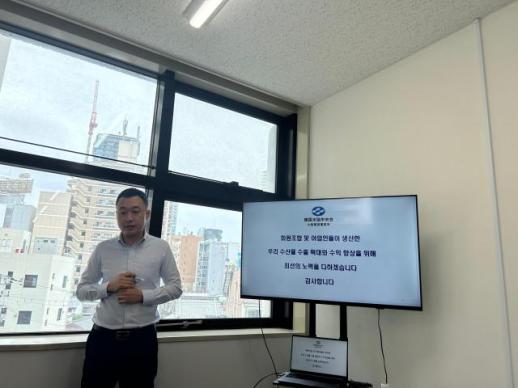 Surge in Abalone and Flounder Exports Boosts Fisheries in Japan "We aim to enhance the income of Korean fishermen by expanding the export of seafood products. Since our opening last March, we have achieved export results totaling 5.5 billion won," said Kim Dong-hee, head of the Korea Fisheries Association's Osaka office, during a meeting in Osaka on May 28. The Osaka office represents more than just a foreign branch; it serves as a 'local direct distribution platform.' Moving away from a reliance on private exporters, the association has established its own distribution network in Japan. Osaka is a major hub for seafood consumption in Japan, conveniently located near large cities like Kyoto, Kobe, and Nara, making it advantageous for securing significant consumer markets. The association has chosen Osaka as its first overseas office to develop a supply base for K-seafood in western Japan. Since its opening on March 18 of last year, the Osaka office has focused on exporting live abalone and flounder. Previously, Korean seafood had to go through intermediaries or local wholesalers before reaching the market. Now, the association manages the entire process—from production to export to local distribution—ensuring the freshness of the seafood. The office is collaborating with York Benimaru, a prominent Japanese distribution market, to supply seafood products and has confirmed exports of frozen abalone and salt. Additionally, efforts are underway to develop new products tailored to buyer demands, such as flower crabs. From March to December last year, the office exported 3.8 billion won (180 tons) of live abalone and 1.3 billion won (60 tons) of live flounder, totaling 5.5 billion won in exports, while also diversifying its key products to include frozen abalone and live octopus. These achievements were not easily attained. The Japanese market has high barriers for new entrants due to its established relationships. Kim shared, "I approached buyers as if I were hitting the ground running, making calls and visits to find potential partners." The sales efforts involved sending emails to import buyers and arranging meetings with those who responded. Kim noted, "Once we meet, I feel confident. When I introduce our organization as similar to the National Federation of Fisheries Cooperatives in Japan, trust begins to build with buyers. Once mutual understanding is established, we can start transactions." There is a growing interest among Japanese consumers in Korean abalone. Kim stated, "Farmed abalone from Korea is regarded as top quality and is a must-have in high-end restaurants for dishes like teppanyaki and butter-grilled abalone." The Korea Fisheries Association is also accelerating the process of incorporating the Osaka office as a local entity. The association believes that formal incorporation will further contribute to diversifying exports. Kim explained, "Once we are incorporated, we hope to expand our network to include small-scale businesses that want to import Korean seafood but are currently unable due to their size. This will enhance the diversification of Korean seafood exports. We are also considering storage facilities like tanks." However, the increasing competition in the abalone market poses a challenge. In 2017, Japan imported between 1,600 and 1,700 tons of abalone, but this figure surged to 2,500 tons last year. This influx has led to a decline in abalone prices. Kim remarked, "Intense internal competition within the Korean aquaculture industry has resulted in overproduction, which is driving down export prices. I understand that some regions are even beginning to reduce their aquaculture operations as a means of addressing this issue." 2026-06-01 12:03:00
 -
 Kobe Port Combines Logistics and Entertainment, Showcasing the Future of Harbors Kobe Port, located in Hyogo Prefecture, Japan, is challenging the perception of harbors as merely functional spaces for container and cargo ships. On May 29, the port was revealed as a waterfront area inviting visitors to explore. Opened in 1868, Kobe Port is one of Japan's three major trading ports, handling an average of over 2.1 million TEUs annually. The modern port began to take shape in the early 1900s, with significant developments in the new and central wharves by 1940. Kensuke Kitagawa, an official from the Kobe Port Authority, explained, "From 1965 to 2005, we expanded the port's logistics capabilities by reclaiming land from the sea." The period from the 1960s to the 1980s was marked by a focus on containerization in port logistics. Until 1963, smaller vessels were used for transportation, but the introduction of container ships transformed maritime logistics. Consequently, the existing port areas began to transition into urban spaces. Since 1970, the development of Meriken Park Harborland has added entertainment features, attracting tourists. The redevelopment of a former container terminal into Harborland has integrated dining, shopping, and recreational activities in one location. However, the port's redevelopment faced a setback due to the Great Hanshin-Awaji Earthquake in 1995. Although port facilities were restored within two years, the recovery process incurred significant debt, straining Kobe's finances and delaying redevelopment projects. The repayment of this debt was completed in 2011, allowing redevelopment efforts to accelerate. Kitagawa noted, "You are currently at the G-Lion Hours building, which houses a museum, aquarium, food court, and residential units." He added, "Across from you is the G-Lion Arena Kobe, a next-generation arena with a capacity of 10,000, operated through private investment on Kobe's land." Kobe Port Tower, established in 1964, is another key tourist attraction. Following renovations to enhance earthquake resilience in 2024, the tower opened some outdoor observation decks. Visitor numbers, which had previously plateaued at around 300,000 annually, doubled to 600,000 after the reopening. Kobe City plans to continue its port redevelopment efforts with a focus on "creating new value that connects history and the future" by 2040. Naoki Sekiguchi, an official from the Kobe Port Authority, stated, "We will operate the port primarily for logistics while enhancing tourism and entertainment features. Given that the port has a history of over 100 years, we aim to preserve as many of the historical buildings as possible during redevelopment." 2026-06-01 12:03:00