

Journalist

Salih Murat Tamer
-
 Special Prosecutor's Investigation Targets Yoon Suk Yeol Ahead of First Summons The second comprehensive special prosecutor team, led by Kwon Chang-young, is narrowing its investigation into former President Yoon Suk Yeol ahead of his first face-to-face questioning scheduled for June 6. The special prosecutor is summoning key figures involved in the emergency martial law declared on December 3 and the relocation of the presidential residence, including former Defense Minister Kim Yong-hyun, former Minister of the Interior and Safety Lee Sang-min, and former Chief of Staff Kim Dae-ki, to clarify the facts surrounding the allegations and determine what charges to apply against the former president. According to legal sources, the special prosecutor summoned both Kim and Lee as suspects for questioning on June 4. Kim faces allegations of rebellion and organizing a criminal group under military law, while Lee is accused of abuse of power. On the same day, Kim Dae-ki also underwent additional questioning. The focus of the special prosecutor's investigation is the upcoming questioning of former President Yoon, who is accused of directing the National Security Office and the National Intelligence Service to justify the martial law to allied countries, including the United States, immediately after its declaration (abuse of power). Initially, the special prosecutor considered making Yoon's appearance public but opted for a closed summons due to objections from his legal team. Legal experts believe this investigation will extend beyond merely confirming the allegations regarding the justification of martial law. The trajectory of the special prosecutor's investigation suggests a focus on reconstructing the entire command structure of the emergency martial law, with Yoon at its center. In fact, the special prosecutor is investigating Kim Yong-hyun under the charge of rebellion under military law. They believe that Yoon, Kim, and military leaders colluded to deploy armed forces to the National Assembly and the Election Commission. They are also examining evidence that suggests the formation of a so-called 'Second Investigation Division' alongside former Army Intelligence Commander Roh Sang-won to seize control of the Election Commission. The special prosecutor has also applied the same rebellion charges to former Special Warfare Command Chief Kwak Jong-geun and former Capital Defense Command Chief Lee Jin-woo, expanding the investigation to the Joint Chiefs of Staff. The special prosecutor has classified the allegations related to the Joint Chiefs of Staff as a 'first recognized case' and has charged former Chairman Kim Myung-soo and other leaders with serious offenses related to insurrection. There is speculation within and outside the legal community that the special prosecutor aims to establish a 'three-tier command structure' linking Yoon, the Joint Chiefs of Staff, and field commanders. This involves not only confirming that troops were deployed to the National Assembly and the Election Commission but also identifying who issued the orders, how they were communicated, and how they were executed. Amid allegations that some units did not follow normal command and control procedures during the martial law, the special prosecutor is also reportedly reviewing related facts. The necessity of examining whether the military command and control system (C4I) was operational during the emergency martial law and the routes of troop movements has been raised in this context. The investigation into the relocation of the presidential residence is also directed at Yoon. The special prosecutor is investigating the circumstances under which 2.8 billion won was illegally diverted from the Ministry of the Interior and Safety's budget during the 2022 relocation process, questioning whether the presidential office requested or pressured for the budget diversion and examining allegations that civil servants who opposed the diversion faced personnel disadvantages. Further questioning of Yoon is anticipated. The special prosecutor plans to summon former National Intelligence Service Deputy Director Hong Jang-won on June 11 to clarify the circumstances surrounding the delivery of the martial law justification messages. They have recently indicated that evidence suggests preparations for the emergency martial law were ongoing for an extended period. Attention is focused on how far the special prosecutor can pursue charges against Yoon. Currently, the publicized allegations involve abuse of power, but the special prosecutor is also investigating the possibility of charging Yoon with being the leader of rebellion under military law. Legal experts suggest that the scope of charges could expand depending on the testimonies and evidence obtained. Whether the rebellion charges applied to Kim Yong-hyun, Kwak, Lee, and others can be linked to Yoon will likely be a pivotal point in the ongoing investigation. Yoon's first summons is expected to mark the beginning of the comprehensive special prosecutor's investigation reaching its peak.* This article has been translated by AI. 2026-06-04 18:06:00
 -
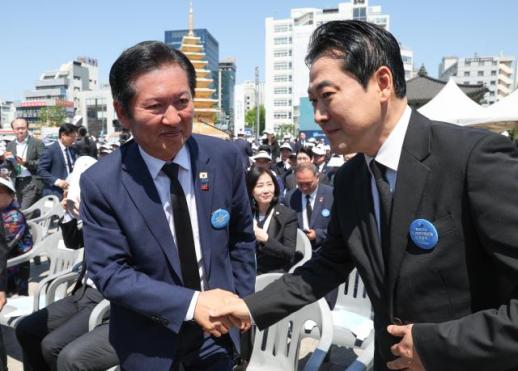 DP sweeps local elections but defeats in key races signal challenges ahead SEOUL, June 4 (AJP) - The ruling Democratic Party (DP) swept 12 of 16 metropolitan mayoral and gubernatorial races in this year's local elections on Wednesday, claiming an overall victory, but the results exposed growing vulnerabilities in Seoul and other battlegrounds that could reshape the political landscape. While the liberal party regained ground nationwide under President Lee Jae Myung, analysts said even a handful of defeats in high-profile races suggested voter dissatisfaction with the ruling camp despite its numerical advantage. The DP suffered a particularly painful loss in Seoul, widely regarded as the symbolic center of South Korean politics and a key barometer of centrist public opinion. The party also lost several closely watched parliamentary by-elections held simultaneously with the local elections including a tight race in the Buk district of the country's southern port city of Busan, where independent candidate Han Dong-hoon defeated DP candidate Ha Jung-woo in a dramatic reversal. Political observers said the mixed outcome reflected sophisticated "split-ticket voting" by the electorate, with voters backing the ruling party in many regional races while supporting conservative or independent candidates in strategically important contests. Despite losing Seoul, the DP lawmakers significantly improved their standing in the capital's district-level races. The party won 17 of Seoul's 25 district mayor posts, reversing the political map from the 2022 local elections, when conservatives held 17 districts and the Democrats controlled only eight. Still, defeats in Seoul and conservative strongholds raised concerns inside the ruling camp about waning support among moderates and voters in the capital regions. The June 3 elections also highlighted signs of changing political dynamics in the conservative stronghold of Daegu. DP candidate Kim Boo-kyum earned 45.05 percent of the vote in the Daegu mayoral race, an impressive improvement compared with the party's performance in the 2022 election. People Power Party (PPP) candidate Choo Kyung-ho won the race with 53.92 percent. In the previous local elections in 2022, PPP candidate Hong Joon-pyo won the Daegu mayoralty with 78.75 percent, while the DP candidate received only 17.97 percent. Although Kim fell short of victory, party officials viewed the result as evidence that regional political barriers in the country's southeast may be weakening. Attention is now shifting to the DP's upcoming national convention, expected as early as August, where party leader Jung Chung-rae is widely expected to seek another term. Jung is expected to argue that leading the party to victories in 12 metropolitan races justifies his reelection, while critics inside the party point to losses in Seoul and major by-elections as evidence of strategic failures. Potential challengers include Prime Minister Kim Min-seok and former party leader Song Young-gil, according to party officials. The results also intensified pressure on the PPP's leader Jang Dong-hyeok. Calls for Jang's resignation emerged within the party after conservatives failed to prevent the DP from dominating the nationwide gubernatorial races. However, Jang rejected demands to step down, saying Thursday that he would continue leading the party and seek a "new path" together with party members. Conservative lawmakers nonetheless argued that the party's overall defeat overshadowed gains in the parliamentary by-elections, where the opposition and independent conservative candidates secured several important victories. Lawmakers from the two major parties who spoke with AJP emphasized different priorities. The DP lawmaker stressed "humility," while the PPP lawmaker emphasized "unity." Rep. Kim Kyo-heung, a three-term politician from the DP, acknowledged the mixed public sentiment reflected in the election. "Even though the DP won the local elections overall, it lost the Seoul mayoral race, candidate Ha's race in Busan, the by-election in Pyeongtaek, and the mayoral elections in Ansan, Seongnam, and Yongin,” Kim said. "The DP governors, mayors, district heads, city council members, district council members and county council members elected in this election must remain humble," he added. A three-term lawmaker from the PPP said the opposition faced structural disadvantages. "In my experience, the first election held one year after a presidential election is always extremely difficult for the opposition," the lawmaker said. Yoon Sang-hyun, a five-term lawmaker from the PPP, said the local elections had been winnable for the party but that it lost because of internal divisions and a lack of vision. Yoon said the party had called for judgment against President Lee Jae Myung, but "that alone was not enough because we failed to speak about hope together." He said the only way for the PPP to win nationwide elections again was for politicians who share conservative values to unite, rather than divide into rival factions and fight each other. "If we split the party in two while fighting over who is pro-Yoon and who is anti-Yoon, we will once again forget why voters punished us yesterday," he added. 2026-06-04 18:05:54
 -
 Thermal Management Emerges as Key Factor in Electric Vehicle Market The thermal management system, which affects the driving range and charging speed of electric vehicles, is emerging as a new opportunity for the automotive parts industry. As the transition to electrification accelerates, competition to dominate the thermal management parts market is intensifying. According to industry sources, Hyundai Wia has signed a supply contract for a thermal management system for the PBV (Purpose Built Vehicle) PV7, set to be launched by Kia next year. This expands the supply of thermal management systems from the previously supplied PV5 to the new model. Hyundai Wia is positioning thermal management systems, a core component of electrification, as a future growth driver and is fostering related industries. Earlier this year at CES 2026 in Las Vegas, the company unveiled an Integrated Thermal Management System (ITMS), a cooling module, and a slim heating, ventilation, and air conditioning (HVAC) system. As the growth potential of internal combustion engine vehicles slows, Hyundai Wia is ramping up its thermal management parts business. A company representative stated, "We are increasing investments to maintain profitability in our existing internal combustion engine business while developing thermal management systems as a future growth engine. We plan to expand our supply range in line with global automakers' electrification model expansion plans." Typically, electric vehicles require more stringent temperature management than internal combustion engine vehicles, as the battery and motor must operate at optimal temperatures to maintain stable driving ranges. The electrification model is expected to gradually expand in the domestic automotive market. The Hyundai Motor Group aims to establish a lineup of 31 electric vehicles by 2030 as part of its electrification strategy. Notably, next year will see the launch of the first long-range electric vehicle (EREV) model, which will offer a driving range of over 600 miles (approximately 965 km), increasing the importance of the thermal management system. Hanon Systems, a leading player in the domestic thermal management market, is directly benefiting from the electrification of the mobility industry. The company supplies battery thermal management systems for electric vehicles (EVs), hybrid vehicles (HEVs), plug-in hybrid vehicles (PHEVs), and hydrogen fuel cell vehicles (FCEVs) to global automakers. According to financial information firm FnGuide, Hanon Systems is projected to see its operating profit consensus for the second quarter of this year reach 109.1 billion won, a 69.7% increase compared to 64.3 billion won in the same period last year. Industry experts believe that as electric vehicle technology advances, the importance of supporting thermal and energy management technologies will grow. Professor Kim Pil-soo of Daelim University’s Future Mobility Department stated, "The higher the performance of electric vehicles, the more the level of thermal management technology determines performance and efficiency. As the adoption of electrified vehicles expands, the related market growth trend will continue." 2026-06-04 18:03:00
 -
 Netmarble Sells G-Tower Headquarters for 697.7 Billion Won Netmarble is selling its headquarters, G-Tower, located in Guro-gu, Seoul, as part of efforts to secure liquidity through asset sales. On June 4, Netmarble announced that it has decided to sell the land and building of G-Tower, located at 38 Digital-ro 26-gil, Guro-gu, Seoul, for 697.67 billion won. This amount represents 8.62% of Netmarble's total assets of 8.936 trillion won as of the end of 2025. G-Tower serves as the headquarters for Netmarble and is also home to major affiliates such as Coway and Netmarble F&C. The company plans to relocate to a new headquarters in Gwacheon by the second quarter of 2028. After the sale of G-Tower, Netmarble will continue to maintain its office there until the move to the new building. The transaction will involve NH Investment & Securities, which will participate as the trustee for the JB Asset Management Real Estate Investment Trust No. 4. The sale is scheduled for June 12. Netmarble clarified that the sale price excludes taxes and fees associated with the transaction. A Netmarble official stated, "The sale of G-Tower is aimed at optimizing asset management and securing financial flexibility, and we intend to restructure our asset portfolio through this process."* This article has been translated by AI. 2026-06-04 17:54:00
 -
 From chalkboards to AI: How South Korea turns election night into must-watch TV shows SEOUL, June 4 (AJP) - With vote counting for this year's local elections underway on Wednesday, millions of viewers did not simply refresh their phones for results; they sat down and watched. The country's election night broadcasts have evolved into some of the most elaborate live television events in the country. What began as a functional exercise in relaying vote totals has become a high-stakes arena where major networks aggressively compete, blending real-time data and predictive modeling with immersive studio design and entertainment-style graphics. Wednesday's local elections offered the latest glimpse into this competition. Major terrestrial networks once again treated the ballot-counting process as their annual flagship production. MBC anchored its broadcast around a 33.7-meter LED media wall and a rotating LED cube, alongside an AI-generated countdown video. KBS focused on institutional staging and data-heavy presentation. SBS, meanwhile, expanded its partnership with OpenAI, deploying a dedicated AI situation room alongside generative video art. It was not always this way. When South Korea returned to direct presidential elections in 1987, election broadcasts were closer to public-service bulletins than prime-time entertainment. Anchors read numbers from counting centers, and simple tables and maps told viewers who was leading. The first major shift came in 1995, when MBC and Gallup Korea broadcast their own election-night predictions during local elections, correctly calling all 15 regional governor races. The move sparked legal controversy, but forced a rewrite of the rules. Exit polling was formally legalized the following year, and from that point broadcasters could frame the entire night the moment polls closed — explaining momentum and uncertainty before the first ballots were counted. Graphics and technology did the rest. In 2012, SBS introduced VIPON, its real-time graphics system, pairing live vote data with animated parodies of popular Korean dramas and films. The approach drew strong viewer responses, set the tone for the following decade and soon drew international attention — SBS won a platinum award at the 2018 Houston International Film Festival for its 2017 presidential election coverage, and outlets including the BBC and the Washington Post later covered the format extensively. Today, these broadcasts double as technology showcases. KBS brought viewers into a virtual studio via a metaverse platform during the 2022 presidential election. In 2025, MBC produced an AI-generated countdown video while SBS deployed a generative AI situation room in partnership with OpenAI Korea. SBS pushed that further in 2026, running an AI situation room analyzing election data in real time alongside a ChatGPT-powered assistant for viewers to look up candidate pledges and voting trends. The ratings battle remains fierce. During the 2025 presidential election, MBC's broadcast peaked at 14.5 percent nationwide — the only major terrestrial network to record double-digit ratings. In the 2022 presidential election, KBS led with a peak of 11.1 percent. In the 2026 local elections, MBC again topped the ratings with a peak of 8.3 percent, its third consecutive election victory. The contrast with other countries is striking. In the U.S., some 42.3 million viewers tuned in across 18 networks during the 2024 presidential election, but the format remains rooted in maps, vote totals and panel discussion. Fox News led that night with around 10.3 million viewers in primetime, while CNN drew 5.1 million — a 26 percent decline from 2020, continuing a longer trend of falling linear viewership on election night. Britain's BBC drew a peak of 4.5 million viewers for its 2024 general election coverage, with a cumulative 7.3 million tuning in across all broadcasters at the 10 p.m. exit poll announcement. The coverage was authoritative but deliberately restrained. Japan's NHK delivers results with similar formality — a presentation style that makes South Korean broadcasts look, by comparison, like a different genre of television. Some Japanese networks have begun taking note: during the 2026 general election, Fuji TV introduced Korean-style election graphics, drawing attention in both countries. Part of South Korea's distinction is structural. Broadcasters are allowed to release exit poll data as soon as voting closes, giving networks an immediate narrative to build around. Part of it is also cultural. South Korean audiences have come to treat election night as a collective ritual — a shared experience that combines politics, suspense and spectacle. Whether that approach helps citizens better understand elections or risks turning politics into entertainment is a debate media critics continue to revisit. Each election cycle now brings a contest not only among candidates, but among networks competing to define what democracy looks like on screen. 2026-06-04 17:45:47
 -
 U.S.-China Tensions Rise on 37th Anniversary of Tiananmen Square On the 37th anniversary of the Tiananmen Square incident, tensions between the United States and China have escalated. U.S. Secretary of State Marco Rubio criticized the Chinese Communist Party for attempting to erase the truth of the past through censorship, while China accused the U.S. of distorting historical facts and interfering in its internal affairs. According to reports from Reuters on June 3, Rubio issued a statement titled "37th Anniversary of the Tiananmen Square Massacre," reminding the world that it has been 37 years since the Chinese Communist Party ordered the military to attack thousands of peaceful protesters in and around Tiananmen Square on June 4. He stated, "The students, workers, and citizens who lost their lives gathered to exercise their inherent rights and demand democratic reforms and accountability for corruption. We remember their lives and honor their legacy." He emphasized that no amount of censorship can erase the past, asserting that the legitimacy of those who sacrificed to defend the inalienable rights of free expression and peaceful assembly will eventually be proven. AFP noted that Rubio's statement came less than three weeks after President Donald Trump met with Chinese President Xi Jinping in Beijing, where they agreed on an unstable trade truce, amid a slight easing of tensions compared to the previous year. China responded swiftly. Foreign Ministry spokesperson Mao Ning stated during a regular briefing on June 4 that, "The U.S. has distorted historical facts, slandered China's political system and development path, and interfered in China's internal affairs. China expresses strong dissatisfaction and resolute opposition." Mao claimed that the Chinese government has long reached a clear conclusion regarding the political turmoil of the late 1980s, asserting that the path of socialism with Chinese characteristics is a choice made by history and the people, receiving heartfelt support from the entire Chinese populace and sufficient recognition from the international community. He urged the U.S. to fulfill its promise to respect China and its people through concrete actions and to stop promoting ideological confrontation, as well as to cease interfering in China's internal affairs under the pretext of so-called "democracy and human rights." China Blocks Tiananmen Memorials Memorials and controls surrounding the Tiananmen incident continue. According to ABC News, Chinese police informed the families of Tiananmen victims that they would not be allowed to visit a cemetery in Beijing on the anniversary. Amnesty International noted that families have been reading commemorative statements at the cemetery under police surveillance for over 30 years on this date. In Hong Kong, memorial events have virtually disappeared. ABC News reported that on June 4, Hong Kong police heightened security in and around the park where large candlelight vigils were previously held, detaining performance artists attempting symbolic actions the day before the anniversary. Since 2020, Hong Kong authorities have banned candlelight vigils citing COVID-19, and large memorial events have not occurred since the implementation of the national security law, which led to the prosecution of organizers. In mainland China, any mention of the June 4 Tiananmen incident is strictly taboo. The largest memorial events, once held in Hong Kong, have been suppressed by authorities, leading to commemorations primarily taking place in cities abroad, including London, New York, Berlin, and Taipei. Meanwhile, amid the 37th anniversary of the Tiananmen incident, tensions between China and the West have extended to security and Taiwan issues. The Five Eyes intelligence alliance warned that Chinese military intelligence is attempting to recruit current and former officials, military personnel, and journalists through online job platforms to extract confidential information. China dismissed this as "entirely fabricated malicious slander." Conflicts also arose over Taiwan. China recently imposed a one-year ban on entry to mainland China, Hong Kong, and Macau for four New Zealand lawmakers who visited Taiwan, claiming they violated the "One China" principle and warning that crossing the red line on Taiwan issues would have consequences. In response, New Zealand and Taiwan asserted that parliamentary exchanges are a normal part of diplomatic relations.* This article has been translated by AI. 2026-06-04 17:39:00
 -
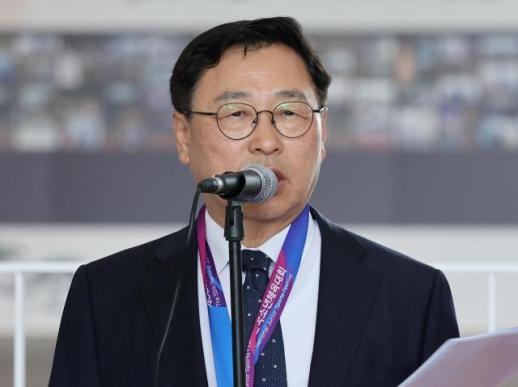 Seoul's progressive education chief wins second term SEOUL, June 4 (AJP) - Jung Keun-sik won a second term as Seoul's education chief in the June 3 local elections, extending progressive control over the capital's education office. His victory gives progressive education leaders four more years in Seoul, South Korea's education hub. It is also expected to add momentum to their key policies, including absolute grading for the college entrance exam and school records. As of 4:40 p.m. Thursday, with 99.92 percent of ballots counted, Jung had 30.32 percent of the vote, or 1,505,509 votes. Conservative candidate Cho Jeon-hyeok came second with 23.48 percent, or 1,166,086 votes. Jung led Cho by 339,423 votes, or 6.84 percentage points. Yoon Ho-sang ranked third with 14.58 percent, or 723,954 votes. Han Man-joong came fourth with 9.42 percent, or 468,177 votes. The count has not been completed because protesters blocked officials from moving a ballot box at a polling station in Jamsil 7-dong, Songpa District, after a shortage of ballot papers. Still, Jung secured victory late Wednesday night. Jung won with just over 30 percent of the vote, the lowest winning share in a Seoul education superintendent race since direct elections began. The previous record was 34.34 percent, set by former superintendent Kwak No-hyun in 2010. Eight candidates ran in this year's race, the largest number since Seoul first directly elected an education superintendent in 2008. They included three progressives, four conservatives and one centrist. Progressive candidates also won in 10 regions nationwide, including Seoul, Gyeonggi Province and Incheon. Jung, a former sociology professor at Seoul National University, first became Seoul education superintendent in an October 2014 by-election, defeating Cho. He served for one year and six months. This year, he campaigned on policy continuity. He especially stressed support for basic academic skills. His main pledges included free early childhood education for children aged 3 to 5, public transportation support for students, free school field trips, support for basic academic skills and stronger protection of teachers' rights. Jung returned to work at the Seoul Metropolitan Office of Education on Thursday morning after his suspension from duty ended. "There are many difficult tasks ahead, including students' mental health, protection of teachers' rights, AI-based future education and narrowing education gaps," Jung said. "I believe we need to strengthen cooperation among the Seoul education office, the Seoul Metropolitan Government and the central government." 2026-06-04 17:34:27
 -
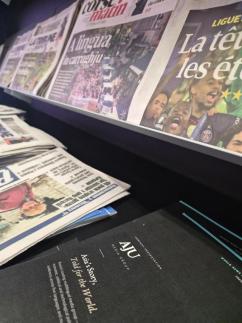 The Gap in Questions, Not Technology, at the World News Media Congress At the 77th World News Media Congress (WNMC) held in Marseille, France, the most significant realization was not a technological gap but a gap in questions. As the director of the English news agency AJP under Aju Media Group, I presented examples of artificial intelligence (AI) utilization in South Korea. The country is among the fastest in the world to adopt AI, actively integrating it into newsrooms for translation, automation, and content productivity enhancement. Aju Economy is also preparing agent-based services, liquid content, and predictive user experiences. However, the concerns faced by global media at the congress were different. While South Korean media is still asking, "What can we automate with AI?" leading global outlets are questioning, "What should journalism become in the AI era?" Throughout the three days of presentations and discussions, the focus shifted away from prompt engineering, article summarization, and translation automation. Instead, participants discussed user experience, personalization, agents, information structuring, trust, and the value of original reporting. AI remained a central topic, but the core of the discussions was not technology; it was journalism. The most impressive change was the dismantling of article-centric thinking. The Indian newspaper The Hindu was reconstructing a single article into multiple formats. Readers could view the same article as a 200-character summary, read it in a Q&A format, or listen to an audio explanation. The key was not the article itself but the format preferred by the reader. Sweden's Bonnier News was transforming its decades-old article archive into an interactive service. Instead of entering keywords into a search box, readers posed questions, and the media's articles provided the answers. Search was evolving into conversation. India's Scroll.in took it a step further. They did not view articles merely as reading material but were building a research platform using AI to provide timelines, knowledge graphs, relationship maps, event clusters, and automatically generated Q&A. Their goal was to create a workspace for scholars and researchers to delve deeply into specific issues. Germany's Ippen Digital showcased an example where over 4,000 articles were automatically produced in a single day during local elections. However, the focus was not on production volume but on personalized news tailored to regions, communities, and ultimately individuals. Global media were no longer competing in article production. They were competing in reader experience. One of the most striking examples at the congress was from the German news agency dpa. dpa's strategic director Astrid Meyer stated, "News output is not the end; it is the beginning." The dpa IQ they unveiled represented a completely different concept from traditional news services. While traditional news agencies supply articles, dpa was structuring facts, contexts, relationships, and data within articles in a way that AI could directly utilize. AI agents could access dpa IQ to request timelines of specific events and retrieve related individuals, past articles, and real-time updates. It was about facts, not articles. While many media outlets were contemplating how to produce content using AI, dpa was pondering what journalism should become in the AI era. A reliable information infrastructure. Perhaps that is the closest vision for the future of the news industry in the AI era. Austria's Kleine Zeitung took it even further. Digital director Sebastian Krause argued that AI should be viewed as a new reader. For the past 15 years, media have optimized content for Google, fixating on search engine optimization (SEO) and competing for clicks. But now, ChatGPT, Perplexity, Copilot, and Google AI mode are reading, summarizing, and reconstructing articles. AI has already become a reader. As he expressed, there may soon be separate sites for humans and agents. What they are discussing goes beyond SEO to answer engine optimization (AEO) and generative engine optimization (GEO). The goal is no longer to rank high in search results. What information AI cites and which media it trusts is becoming the new competition. Conversely, as AI advances, the essence of journalism is paradoxically emphasized. The most applauded speech at the congress was by A.G. Sulzberger, publisher of The New York Times. Sulzberger did not oppose AI; rather, he advocated for its active use. However, he reminded attendees that AI companies ultimately grow based on the reporting produced by journalists. "Most of the facts we know start from someone's original reporting," he said. Witness testimonies from people met on the ground. Documents obtained by reporters. Facts verified through on-the-ground reporting. AI can summarize that. It can rearrange it. But it cannot produce it. The repeated message throughout the congress was clear. AI is not a technology to replace journalists. It is a technology that enables journalists to conduct more reporting. As AI proliferates, facts become more important. As synthetic content increases, on-the-ground reporting becomes more crucial. As information floods in, trust becomes more valuable. Returning from Marseille, the conclusion I reached was surprisingly simple. South Korea remains one of the fastest countries to adopt technology in the world. However, rapid adoption does not equate to leadership. Global media are already discussing the next stage of automation. From articles to experiences. From search to conversation. From content to knowledge. From readers to agents. And from automation back to journalism. As Ezra Eman said, no one has a map right now. But at least the direction global media is heading is visible. That direction is not toward AI but toward people. It is about asking what readers want, how they experience news, and why journalism is still necessary. Perhaps these are the same questions South Korean media should be asking now—not what to automate with AI, but what more can we report thanks to AI.* This article has been translated by AI. 2026-06-04 17:33:00
 -
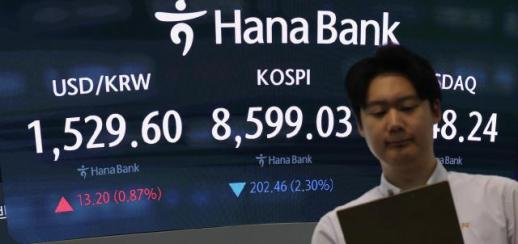 Hawkish signals fail to curb won's slide SEOUL, June 4 (AJP) - Although the Bank of Korea (BOK) has effectively pivoted back toward monetary tightening, the won-dollar exchange rate is instead plunging to its weakest level since the global financial crisis. Downward pressure on the Korean won is intensifying as investors question how much domestic monetary policy can do on its own. A stronger greenback, surging oil prices and synchronized tightening fears among major central banks are adding to the strain. In the Seoul foreign exchange market on Thursday, the exchange rate opened at 1,530.0 per dollar, down 13.6 won from the previous session's daytime closing price, marking the first time the rate opened in the 1,530 won range in 17 years and three months since March 2009, during the height of the global financial crisis. On a closing basis, the won-dollar exchange rate has already remained in the 1,500 won range for 12 consecutive sessions. Generally, an increase in the benchmark interest rate supports the won's value by boosting yields on won-denominated assets and narrowing the interest rate gap with the United States. This time, however, market dynamics are being driven more by global monetary tightening and commodity price shocks than by the BOK's rate-hiking potential. The won's recent weakness reflects heightened sensitivity to shifts in the global liquidity environment rather than South Korea's own rate path. Consequently, even a 25-basis-point rate hike by the BOK could have its stabilizing effect offset if a stronger dollar, high oil prices and foreign equity liquidation persist. Oil prices above $100 per barrel remain a persistent burden on the South Korean economy, even if the shock has been partially priced in. Given South Korea's heavy reliance on the Strait of Hormuz for most of its crude oil imports, soaring oil prices increase demand for greenbacks to settle energy import bills and raise concerns over a deteriorating trade balance. Adding to the pressure, the growing likelihood of a Bank of Japan rate hike has triggered a broader repricing of monetary policy across major Asian economies. BOJ Governor Kazuo Ueda said the previous day that there is a "clear need" to discuss the appropriateness of a rate hike, warning that delaying normalization could place a growing burden on the economy and the financial system. With the Federal Reserve, the BOK and the Bank of Japan (BOJ) all maintaining a tightening bias, a single 25-basis-point move by the local central bank may not be enough to defend the currency. Amid renewed strength in the greenback, concerns have grown that the U.S. Federal Reserve could pivot back toward a hawkish stance, while international crude prices have surged as cease-fire negotiations in the Middle East war fell back into deadlock. Shrinking foreign exchange reserves are also fueling market anxiety. South Korea's FX reserves stood at $430.66 billion at the end of last November, before the BOK was presumed to have stepped up market-stabilization measures, but fell to $426.99 billion at the end of last month, representing a decline of US$3.67 billion over six months. The latest available global ranking also points to a deterioration, with South Korea falling to 12th as of the end of April from ninth at the end of last November. Aggressive selling of domestic equities by foreign investors is further exacerbating the won's depreciation. Foreign investors offloaded a net 6.6 trillion won worth of KOSPI shares in May alone, adding to dollar demand in the local foreign exchange market. A peculiar anomaly has emerged in the market: even though the exchange rate has failed to pivot stronger, the bond market is weakening as it pre-emptively prices in an interest rate hike. The benchmark three-year government bond yield rose 8.5 basis points to 3.858 percent, its highest level since November 2023, while the 10-year yield climbed 9.4 basis points to 4.229 percent. The broader strain was already visible in May, when the average won-dollar exchange rate weakened to 1,491.39 won from 1,486.72 won in April and the average 10-year yield rose 34.7 basis points to 4.080 percent. The government and financial authorities are also heightening their vigilance. Koo Yun-cheol, Deputy Prime Minister and Minister of Economy and Finance, noted widening volatility in domestic financial and FX markets during a market monitoring meeting on Thursday, signaling that relevant agencies would respond immediately if excessive one-sided moves emerge. While the remarks were closer to a cautionary statement than a heavy-handed verbal intervention, they were interpreted as a sign that authorities could strengthen their response now that the exchange rate has entered the 1,530 won range. Experts stress that active intervention by the central bank and foreign exchange authorities is essential as the high-exchange-rate environment drags on. "There is no entity capable of blocking the exchange rate ceiling other than the foreign exchange authorities," said Lee Nak-won, an FX derivatives specialist at NH Nonghyup Bank, back in March, when the won-dollar rate skyrocketed to the 1,530 won level.l. Ultimately, the crux of the issue lies not in the BOK's rate-hike declaration itself, but in whether global dollar strength, high oil prices and foreign outflow pressure begin to subside. Unless Fed tightening fears cool and crude prices stabilize, reversing the won's downward trajectory through the BOK's baby steps alone will remain an uphill task. 2026-06-04 17:29:01
 -
 Jang Seok-bok Appointed as IBS Director, Aims to Foster Over 10 Pioneer Research Teams "At the forefront of knowledge, what matters most is 'who poses innovative questions and suggests new directions.' The Institute for Basic Science (IBS) will establish more than 10 'pioneer research teams' to strengthen its role as a hub for new discoveries and concepts," Jang Seok-bok, the newly appointed director of IBS, stated during his inauguration ceremony held at the IBS headquarters in Daejeon on June 4. The event was attended by key figures including Choi Young-ki, director of the Korea Virus Research Institute, Choi Yoon-sung, director of the National Institute for Mathematical Sciences, and Kwon Myun, acting director of the Heavy Ion Research Institute, along with IBS team leaders and members. Jang, who has been a prominent researcher since being appointed as a team leader at the inception of IBS in 2012, has led the Molecular Activation Catalysis Research Team and contributed significantly to the growth and development of IBS. His term as director will last from June 2026 to June 2031. In his inaugural address, Jang emphasized that IBS has accumulated world-class research capabilities over the past 15 years and must now focus on new discoveries and concepts as its core values, moving beyond mere excellence. He outlined a vision for IBS to evolve into a 'Discovery Hub' that explores uncharted territories and proposes new questions and research directions, rather than just accumulating results in established fields. To achieve this, he proposed several key operational directions, including the introduction of pioneer research teams, the establishment of an open research system, strengthening the competitiveness of the headquarters and research infrastructure, presenting future-oriented research directions, and fostering a healthy organizational culture based on public trust. Drawing from his experience in identifying and nurturing young researchers, Jang announced plans to support innovative researchers through the establishment of 'pioneer research teams' and enhance the system for talent discovery and development. He also mentioned expanding flexible collaborations with domestic and international universities, research institutes, and industries to build an open research ecosystem. Jang highlighted the importance of strengthening research competitiveness centered around the headquarters, stating that the newly constructed second building will create an environment that attracts outstanding researchers from both domestic and international backgrounds. He expressed commitment to expanding research infrastructure and ensuring that the heavy ion accelerator becomes a prominent research facility utilized by researchers worldwide. Additionally, he outlined plans to actively expand future research areas such as quantum science, systems biology, synthetic biology, and new materials, while proactively responding to changes in research environments driven by computing, machine learning, and artificial intelligence. "A research culture that does not fear failure, combined with stable yet bold administrative and technical support, is essential for the emergence of an outstanding research institute," Jang stated. "I will do my utmost to ensure that IBS grows into a research institution that earns the trust and support of the public and sets a new direction for global science." IBS was established in November 2011 to conduct world-class basic science research. The Ministry of Science and ICT expressed optimism about Jang's appointment, noting that his academic authority and extensive experience in research will contribute to IBS's advancement as a leading global research institution and the development of the domestic basic science research ecosystem. 2026-06-04 17:27:00