
Journalist

Seán Canney
-
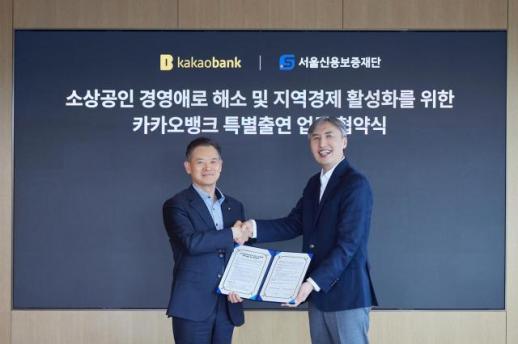 KakaoBank Provides 125 Billion Won in Guaranteed Loans to Support Small Businesses in Seoul KakaoBank is taking steps to alleviate the financial burden on small businesses in Seoul.On May 14, KakaoBank announced a special contribution of 10 billion won to the Seoul Credit Guarantee Foundation, which will facilitate a total of 125 billion won in guaranteed loans.Under this agreement, KakaoBank plans to allocate 62.5 billion won each to two initiatives: the 'Rapid Financial Support' program in collaboration with the Seoul city government and the 'District Economic Support' program working with all 25 districts in Seoul.The Rapid Financial Support program includes a 'Special Contribution Guarantee' product with a maximum limit of 100 million won and the 'Quick Dream' product, which offers up to 30 million won to small business owners with personal credit scores below 839 (according to NICE standards).The District Economic Support program aims to provide loans of up to 100 million won to small businesses located in the 25 districts of Seoul. This marks the first instance of an internet-only bank collaborating with all districts in the city.Based on KakaoBank's special contribution, the Seoul Credit Guarantee Foundation will issue the guarantees, while each district will work to expand support and promote assistance for small businesses in their areas.A KakaoBank representative stated, "We initiated this agreement to ease the financial burden and enhance convenience for small business owners in Seoul. We will continue to expand financial support for individual entrepreneurs based on innovative financial technology and practice inclusive finance."* This article has been translated by AI. 2026-05-14 10:10:04
 -
 PSG Secures Fifth Consecutive Ligue 1 Title; Lee Kang-in Misses Match Due to Injury Paris Saint-Germain (PSG), featuring national team midfielder Lee Kang-in, has secured its fifth consecutive Ligue 1 title. On May 14, PSG defeated second-place RC Lens 2-0 in an away match at the Bollaert-Delelis Stadium in Lens, thanks to goals from Khvicha Kvaratskhelia and Ibrahim Mbaye. With one league match remaining, PSG (24 wins, 4 draws, 5 losses; 76 points) has established a 9-point lead over Lens (21 wins, 4 draws, 8 losses; 67 points), ensuring their 14th overall title and fifth straight championship. Lee Kang-in, who joined PSG in July 2023, has now lifted his third Ligue 1 trophy. He has previously celebrated victories in the UEFA Champions League, UEFA Super Cup, and French Super Cup. However, Lee was unable to enjoy the victory on the field, as he missed the match due to an ankle injury sustained during a game against Brest on May 12. He is currently focusing on recovery through indoor training. PSG is now set to target a consecutive UEFA Champions League title, facing Arsenal from England on May 31 at the Puskás Aréna in Budapest.* This article has been translated by AI. 2026-05-14 10:05:12
 -
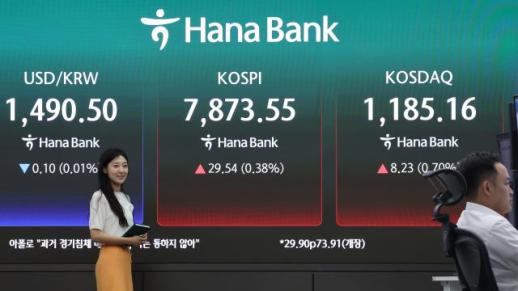 Oil Prices Hit $100 as U.S. Inflation Concerns Rise, Threatening 1490 Won Exchange Rate The exchange rate of the won against the dollar has shown volatility, surpassing the 1490 won mark during trading, influenced by rising international oil prices and inflation concerns in the United States. As of 9:20 a.m. on May 14, the exchange rate was trading at 1489.2 won per dollar. The rate opened at 1489.8 won, down 0.8 won, and briefly crossed the 1490 won threshold shortly after the market opened before retracting some gains. With ongoing geopolitical tensions in the Middle East, forecasts suggest that the blockade of the Strait of Hormuz will continue until the end of May, keeping international oil prices, particularly West Texas Intermediate (WTI), around the $100 per barrel mark. On May 13, WTI for June delivery closed at $101.02, down $1.16 (1.14%) from the previous session on the New York Mercantile Exchange. The U.S. Producer Price Index (PPI) for April surged by 1.4% month-over-month and 6.0% year-over-year, exceeding market expectations. Following the consumer price index (CPI), the PPI also surpassed forecasts, raising inflation concerns and leading to an increase in U.S. Treasury yields, particularly for long-term bonds. The dollar strengthened in tandem with rising Treasury yields. Minkyu Won, an economist at Woori Bank, noted, "The rise in bond yields is clearly contributing to a stronger dollar. Given this trend, there is a significant likelihood that the won will face downward pressure today." He added, "In addition to active buying by importers, the re-entry of demand for dollar conversions related to overseas stock investments due to a strong U.S. stock market supports the actual demand for dollars. However, the volume of export-related deferred negotiations and the authorities' caution regarding speed control may limit the upper range of the exchange rate."* This article has been translated by AI. 2026-05-14 10:03:19
 -
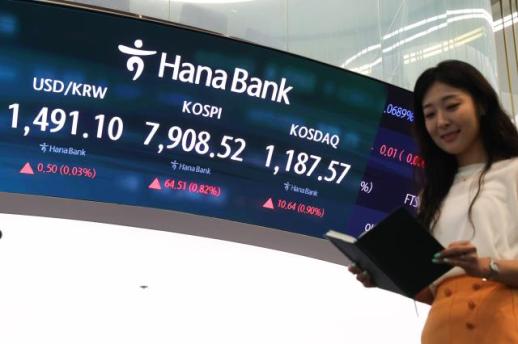 KOSPI Touches 7900 Amid Growing Hopes for 8000 KOSPI continued its strong performance early in the trading session, touching the 7900 mark. Following a record close the previous day, market attention is now focused on the possibility of KOSPI surpassing 8000. According to the Korea Exchange, as of 9:06 a.m., KOSPI was trading at 7877.59, up 33.58 points (0.43%) from the previous trading day. The index opened at 7873.91, rising by 29.90 points (0.38%), and expanded its gains, reaching as high as 7909.47 shortly after the market opened at 9:01 a.m. Seo Sang-young, a researcher at Mirae Asset Securities, stated, "The domestic stock market is expected to experience increased volatility with differentiated movements among individual stocks. Attention should be paid to changes in specific stocks following remarks from U.S. President Donald Trump during the trading session." In the securities market, individual and institutional investors purchased a net 430.8 billion won and 11 billion won, respectively, contributing to the index's rise. In contrast, foreign investors sold a net 440.1 billion won, indicating profit-taking. Among the top market capitalization stocks, mixed performances were observed. Samsung Electronics (-0.53%), HD Hyundai Heavy Industries (-2.32%), and Samsung Electro-Mechanics (-2.24%) showed declines, while SK Hynix (0.51%), SK Square (0.17%), Hyundai Motor (1.83%), LG Energy Solution (2.44%), Doosan Enerbility (1.17%), and Kia (1.23%) posted gains. The KOSDAQ index also maintained its upward trend. At the same time, KOSDAQ recorded 1186.23, up 9.30 points (0.79%). The index opened at 1187.02, rising by 10.09 points (0.86%), and continued its strong performance. In the KOSDAQ market, individual investors led the index's rise with a net purchase of 69.3 billion won, while foreign and institutional investors sold a net 42.2 billion won and 10.6 billion won, respectively. Among the top market capitalization stocks, most showed upward trends except for Lino Biotech (-3.21%). Stocks such as Alteogen (7.49%), EcoPro BM (1.98%), EcoPro (3.04%), Rainbow Robotics (1.59%), Kolon TissueGene (0.98%), Samchundang Pharm (0.75%), JUSUNG Engineering (1.25%), Rigakem Bio (5.97%), and ABL Bio (3.23%) experienced gains. Meanwhile, overnight trading on Wall Street saw semiconductor stocks continue to perform strongly, resulting in mixed outcomes for major indices. The S&P 500 and Nasdaq rose by 0.58% and 1.20%, respectively, both reaching all-time highs, while the Dow Jones Industrial Average closed down 0.14%.* This article has been translated by AI. 2026-05-14 09:59:11
 -
 Kakao Enhances AI National Assistant with Voice Feature for Public Service Reservations Kakao has enhanced its AI National Assistant service, developed in collaboration with the Ministry of the Interior and Safety, by adding a voice feature to improve the convenience of public services via KakaoTalk. On May 14, Kakao announced the integration of a voice interface into its AI National Assistant pilot service. Launched in March, this service allows users to handle public tasks through a conversational AI agent within KakaoTalk. Users can access services such as issuing electronic certificates and reserving public facilities through the KakaoTalk channel "National Assistant Gukpi." Kakao explained that the service is built on its proprietary AI model and incorporates the "Kanana Safeguard," a generative AI safety verification model, to ensure the reliability and stability necessary for public services. The Kanana Safeguard is an AI guardrail model designed to detect harmful content and risks, supporting the operation of generative AI in the public sector. The key feature of this update is the voice-based interface. Users can now utilize services simply by issuing voice commands like "issue my resident registration" or "reserve a tennis court," making the process more intuitive for tasks ranging from electronic certificate issuance to public facility reservations. The reservation process for public facilities has also been streamlined. Previously, users had to navigate to separate pages or external services during the reservation process, but now they can complete everything from searching for facilities to finalizing reservations within the KakaoTalk chat window. Kakao AI Connect's Performance Leader stated, "Since its launch, the AI National Assistant has been continuously enhanced to improve user convenience. We aim to create an environment where everyone can easily and naturally access public services by expanding the service range from text to voice and from simple guidance to actual execution."* This article has been translated by AI. 2026-05-14 09:57:00
 -
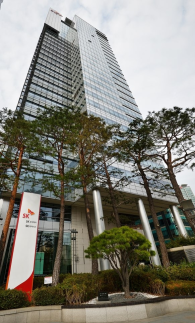 SK AX signs with OpenAI to bring ChatGPT Enterprise to Korea SEOUL, May 14 (AJP) - SK AX, the IT services arm of South Korea's SK Group, has signed a service partner agreement with OpenAI to deploy and operate ChatGPT Enterprise across Korean corporate clients, the company said on Wednesday. Under the deal, SK AX will tailor OpenAI's flagship enterprise product to each customer's workflows and security requirements, building generative artificial intelligence into back-office systems rather than bolting it on, the company said Thursday. SK AX CEO Kim Wan-jong and Anthony Russell, OpenAI's head of partnerships for Asia-Pacific, attended the signing ceremony. "We aim to help clients pursue genuine AI transformation by redesigning their internal structures, work processes and governance, not merely adopting the technology," Kim said. The agreement targets a pain point that has dogged Korean enterprises racing to embrace generative AI: the gap between pilot projects and measurable returns. SK AX flagged the rise of so-called "shadow AI," in which employees plug company data into outside chatbots without oversight, as a fresh source of security risk. SK AX will fold ChatGPT Enterprise into its existing menu of consulting, multi-agent system integration, governance design and workforce change management, drawing on AI architects, data specialists and industry domain experts. The company is positioning itself as OpenAI's preferred channel partner for the South Korean market. The tie-up adds to a string of OpenAI partnerships in South Korea, which the U.S. firm has called its largest paid-ChatGPT market outside the United States. OpenAI opened a Seoul office in September 2025 and has signed deals with Samsung SDS, SK Telecom and Kakao as it chases enterprise revenue in the country. 2026-05-14 09:56:35
 -
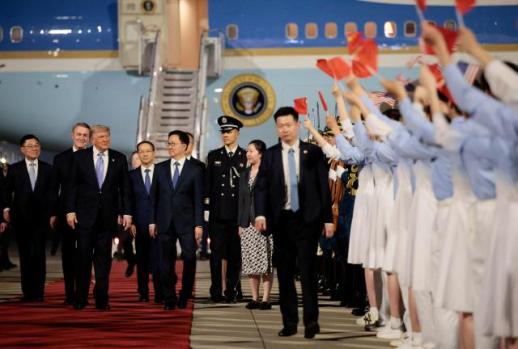 Trump-Xi summit to test fragile détente as CEOs descend on Beijing SEOUL, May 14 (AJP) -U.S. President Donald Trump and Chinese President Xi Jinping for two days from Thursday engage a high-stakes and closely-watched summit in Beijing as war in the Middle East, tariff disputes and the global artificial intelligence race reshape the balance between the world’s two largest economies. While both sides are expected to emphasize symbolism and stability in public, the summit is emerging as a transactional negotiation over tariffs, semiconductors, energy security and Taiwan, with a heavyweight U.S. business delegation underscoring how corporate America remains deeply tied to China despite escalating geopolitical rivalry. Trump on Wednesday evening arrived in Beijing seeking Chinese cooperation on multiple fronts: easing pressure on American farmers through larger agricultural purchases, stabilizing supply chains for rare earth minerals, and leveraging Beijing’s influence over Iran to reopen the Strait of Hormuz, a critical artery for global oil shipments. Xi is expected to push for tariff relief, softer export controls on advanced semiconductors and reduced U.S. military support for Taiwan. The summit comes at a delicate moment for both leaders. Trump enters Beijing amid criticism over the economic fallout from the Iran conflict and rising questions about America’s strategic overstretch. Xi faces mounting pressure from China’s slowing economy, weak domestic demand and worsening deflationary pressure. Analysts say both leaders need visible wins without appearing to concede too much strategically. Still, beneath the ceremonial choreography lies a more fundamental rivalry. Washington increasingly sees China’s industrial strategy and export-driven manufacturing dominance as a long-term threat to U.S. economic security. A report released this week by the U.S. Chamber of Commerce and Rhodium Group described China’s policy direction as an “industrial policy of everything,” warning that Beijing’s state-backed expansion into sectors ranging from AI to raw materials is narrowing the room for Western competitors. Tariffs are expected to dominate much of the negotiations. Although portions of Trump’s sweeping tariff regime have been challenged in U.S. courts, the administration is preparing additional trade actions linked to forced labor and industrial production concerns tied to China. Beijing is expected to press hard for lower tariff barriers, though Washington faces political constraints in appearing softer toward its biggest strategic competitor. Another central issue will be semiconductors and AI. Xi is reportedly seeking broader access to advanced U.S. chips after Washington partially loosened restrictions on exports of Nvidia’s H200 processors while continuing to block the company’s top-tier Blackwell systems. U.S. officials, meanwhile, remain concerned about China’s advances in AI, military-civil fusion technologies and rare earth export controls that have exposed vulnerabilities in American supply chains. Taiwan remains the summit’s most politically sensitive fault line. Chinese officials are expected to push Trump to shift Washington’s longstanding position from “not supporting” Taiwanese independence toward explicitly “opposing” it — a wording change that would signal a major diplomatic concession to Beijing. Trump has also indicated willingness to discuss a multibillion-dollar U.S. arms package for Taiwan during talks with Xi. The composition of the U.S. delegation accompanying Trump highlights the business stakes surrounding the summit. More than a dozen top executives traveled to Beijing, including Tesla and SpaceX CEO Elon Musk, Apple CEO Tim Cook, Nvidia CEO Jensen Huang, BlackRock Chairman Larry Fink, Boeing CEO Kelly Ortberg and Goldman Sachs CEO David Solomon. The lineup reflects how deeply intertwined U.S. corporations remain with the Chinese market despite years of “decoupling” rhetoric. For technology firms such as Nvidia, Qualcomm, Micron and Apple, China remains a critical manufacturing base and consumer market. Boeing is seeking to revive aircraft sales to Chinese airlines after years of trade tensions and regulatory freezes, while financial firms including BlackRock, Citi and Goldman Sachs continue to pursue long-term expansion in China’s capital markets. The presence of Elon Musk is particularly notable. Tesla’s Shanghai Gigafactory remains one of the company’s most important production hubs, while Musk has maintained unusually close ties with Chinese officials compared with many U.S. executives. His attendance signals that Beijing still views select American corporate leaders as potential stabilizers in an otherwise deteriorating bilateral relationship. The delegation also reveals Washington’s competing priorities. Alongside national security concerns over semiconductors and strategic industries, the administration is simultaneously seeking export deals, investment opportunities and supply-chain stability. Analysts say the summit illustrates the contradiction at the heart of current U.S.-China policy: intensifying strategic rivalry paired with continued economic interdependence. For Seoul and other Asian economies caught between the two powers, the outcome could have direct implications for semiconductors, energy prices, shipping routes and regional security architecture. Korea’s export-heavy economy remains particularly exposed to any changes in U.S.-China trade policy, Taiwan tensions or disruptions in the Strait of Hormuz, through which much of Asia’s imported crude oil passes. 2026-05-14 09:39:49
 -
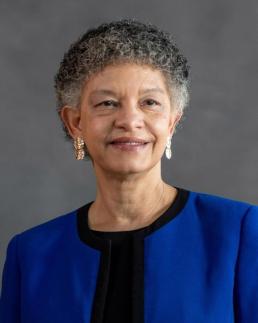 Boston Fed President Calls for Interest Rate Hold Ahead of Wash's Appointment Susan Collins, President of the Boston Federal Reserve, stated that the benchmark interest rate should be maintained at its current level for the time being. As expectations for a rate cut grow ahead of Kevin Warsh's upcoming appointment as the new chair of the Federal Reserve, there is increasing support within the Fed for keeping rates steady. Some officials have not ruled out the possibility of further rate hikes. According to a speech released before an event at the Boston Economic Club on May 13, Collins noted, "With inflation exceeding target levels for over five years, patience is wearing thin regarding temporary factors that could lead to another supply shock." Collins predicted that even if the conflict in the Middle East is resolved relatively soon, inflation is likely to decline only marginally this year. He emphasized, "It is important to maintain the current somewhat restrictive monetary policy stance for a while longer." Collins' remarks contrast with the market's growing expectations for a rate cut following Warsh's appointment. Market analysts believe that President Donald Trump’s public criticism of Jerome Powell, the current chair, has increased pressure for a rate cut, and that expectations for a shift in monetary policy may rise once Warsh takes office. However, the Fed's internal assessment differs. In a prolonged high-inflation environment, concerns are growing that if supply shocks from the Middle East conflict continue, maintaining a steady rate may be more necessary than an early cut. Internal disagreements were evident during last month’s Federal Open Market Committee (FOMC) meeting, where three voting members opposed the possibility of a rate cut as the next policy direction. Collins also expressed agreement with these dissenting views in an interview with Bloomberg last week. In his speech, Collins left the door open for the possibility of additional rate hikes. He stated, "While it is not the most likely scenario, we should consider that some policy tightening may be necessary to bring inflation back to 2% in a timely manner."* This article has been translated by AI. 2026-05-14 09:38:08
 -
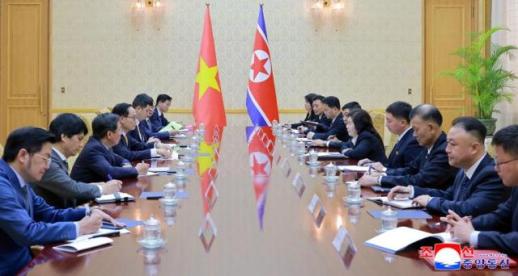 North Korean, Vietnamese FMs agree to 'deepen' bilateral ties SEOUL, May 14 (AJP) - North Korea and Viet Nam agreed to expand exchanges and strengthen cooperation across multiple sectors during talks between their foreign ministers, North Korean state media reported on Thursday. According to the state-run Korean Central News Agency (KCNA), North Korean Foreign Minister Choe Son-hui met with Vietnamese Foreign Minister Lê Hoài Trung in Pyongyang on the previous day. The visit comes as momentum has been built between the two traditional allies since Vietnamese President Tô Lâm traveled to Pyongyang in October last year for a summit with North Korean leader Kim Jong-un, the first visit by a Vietnamese top leader in some 18 years. Recalling the summit, Choe said she would work to "deepen friendly ties" with Viet Nam. Lê then responded that his country consistently values and seeks to strengthen friendly and cooperative ties with North Korea. KCNA also said the two sides vowed to expand exchanges and cooperation in multiple areas including regional and international issues. 2026-05-14 09:37:23
 -
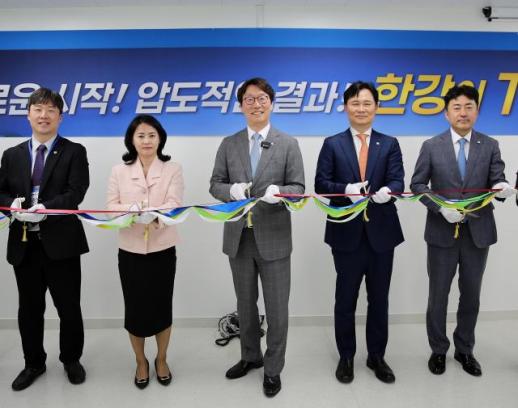 ABL Life Insurance Establishes New Sales Centers in Han River and Mapo to Enhance Competitiveness ABL Life Insurance, now part of Woori Financial Group, has added new sales centers to strengthen its competitive edge. The company aims to continue its growth by enhancing sales channels and expanding customer touchpoints. On May 13, ABL Life Insurance announced the opening of its "Han River Branch" and "Mapo Branch" in the Dohwa-dong area of Seoul. The new locations will bring the total number of ABL Life branches to 54 across the country, along with 4 training centers. The company plans to improve operational efficiency by reinforcing collaboration between headquarters and branches, enabling quicker development of sales strategies. The organization of exclusive financial consultants is also steadily expanding. The number of registered financial consultants (FCs) at ABL Life increased from 2,129 at the end of 2024 to 2,288 by the end of last year, reaching 2,638 by the end of April this year. To support the entire process from the introduction to the training of new FCs, ABL Life has established the position of training manager and introduced a professor system for FCs this year. An ABL Life representative stated, "The Han River and Mapo branches were established to enhance sales competitiveness, improve productivity, and expand services to attract new customers. We will continue to strengthen our support system to ensure that our consultants can provide the best advice to clients, contributing to the company's qualitative growth."* This article has been translated by AI. 2026-05-14 09:34:02