

Journalist

by Abraham Kwak
-
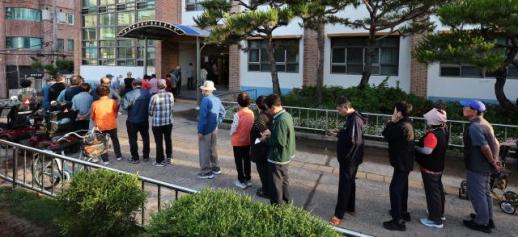
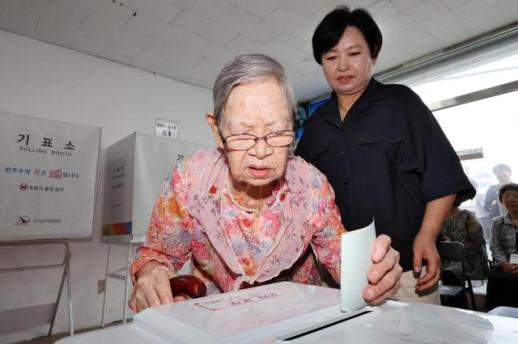 Voters from 110-Year-Old Grandmother to Island Fishermen Cast Meaningful Ballots On June 3, the main voting day for the 9th nationwide local elections, polling stations across the country were filled with stories that held more significance than just a single vote. From unique locations like a pottery shop and a gateball court transformed into polling places to island residents who traveled by boat, first-time voters, and a 110-year-old voter, a diverse group of citizens exercised their precious right to vote. One notable polling station was a pottery shop in Jangseong County, South Jeolla Province, where voters passed through aisles of ceramics and household goods to reach the voting booths. In another area, a gateball court, typically a leisure space for residents, was repurposed as a polling site, creating an unusual but engaging scene. According to Yonhap News, a 110-year-old woman participated in the elections in Gwangju's Dong-gu. She stated, "I have voted in every presidential and local election since the time of President Syngman Rhee. At 110 years old, I hope all citizens will come out to vote as well." Many young people also cast their ballots for the first time. An 18-year-old high school senior, identified as Lee, remarked, "I don’t know the names of the candidates well, but I voted for someone who I believe can address housing prices and youth employment issues." The participation of foreign nationals also drew attention. At the Daelim 2-dong Community Center, a line of permanent residents waited to vote. Foreign nationals with certain qualifications, such as those who have held permanent residency for over three years or are registered in the local foreign resident registry and are at least 18 years old, are allowed to vote in local elections. A 30-year resident of Korea, identified as Mr. Lee, who is of Korean-Chinese descent, expressed pride in participating in his first election, stating, "Even though I am not a Korean citizen, the fact that I can vote gives me a sense of pride." Voting enthusiasm was also high in the remote island regions of the West Sea. Residents of Baengnyeongdo and Yeonpyeongdo adjusted their fishing schedules or took boats to reach polling stations. Some fishermen prioritized voting over their crab-catching season, and in Ongjin County, the voter turnout exceeded 65% by 3 p.m., the highest among the 11 counties and districts in Incheon. This local election highlighted that voting is not merely a political choice but a fundamental right and a process of community engagement, as voters of all ages, professions, nationalities, and living conditions came together to cast their valuable ballots.* This article has been translated by AI. 2026-06-03 17:12:00
 -
 Special Prosecutor Summons Former Interior Minister for Budget Misappropriation Inquiry The second comprehensive special prosecutor team, led by Kwon Chang-young, has summoned Han Chang-seob, the former Vice Minister of the Interior and Safety, as part of its investigation into allegations surrounding the relocation of the presidential residence. This move comes a day before the first interrogation of Lee Sang-min, the former Interior Minister, regarding the alleged misappropriation of funds for the residence's construction. According to legal sources on June 3, the special prosecutor's team began questioning Han at 10 a.m. as a witness. Han was appointed as the first Vice Minister of the Interior and Safety shortly after the Yoon Suk Yeol administration took office in May 2022 and worked alongside Lee until his retirement in August 2023. The special prosecutor's team is investigating whether the Interior Ministry's budget was illegally diverted during the construction of the presidential residence. Lee is accused of being involved in the misappropriation of approximately 2.8 billion won to pay the construction company 21Gram for the relocation project. Additionally, the team is looking into whether Lee retaliated against Interior Ministry officials who opposed the budget diversion. Reports indicate that the special prosecutor's team has obtained statements from ministry officials suggesting that Lee instructed personnel to "send away" those who opposed the budget diversion. Some officials reportedly expressed their reluctance to accept the budget diversion orders, requesting instead to be reassigned. The special prosecutor's team appears to be confirming the decision-making process behind the budget diversion and the circumstances surrounding personnel actions at that time. The team plans to interrogate Lee as a suspect on the morning of June 4. In the afternoon of the same day, they will question Kim Dae-ki, the former Chief of Staff to the President, and on the morning of June 5, they will interrogate Yoon Jae-soon, the former Secretary for General Affairs at the Presidential Office. Both Kim and Yoon are accused of instructing the Interior Ministry to cover the construction costs for the presidential residence, which they were not obligated to do. A court issued arrest warrants for both individuals on May 22, citing concerns over potential evidence destruction. The special prosecutor's team intends to focus on whether the Presidential Office and the Interior Ministry were involved in the budget diversion to cover construction costs and whether there were any retaliatory actions against opposing officials.* This article has been translated by AI. 2026-06-03 17:12:00
 -
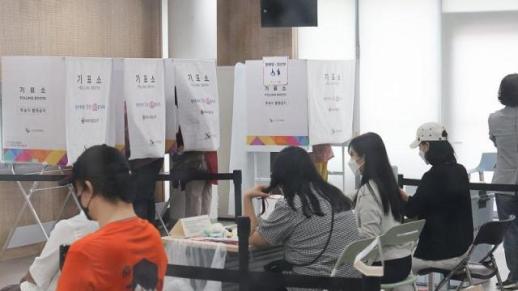 When Will the Results of the June 3 Local Elections Be Announced? The main voting for the 9th nationwide local elections concluded at 6 p.m. on June 3, drawing attention to the timing of exit poll results and the counting schedule. According to the National Election Commission and broadcasting companies, KBS, MBC, and SBS will announce the results of the exit polls at 6 p.m. However, predictions of winning candidates and estimated vote percentages can only be reported starting at 6:15 p.m., 15 minutes after polls close, in accordance with election law. Counting will begin immediately after the polls close. The National Election Commission plans to officially declare the start of counting around 6:20 p.m., followed by the opening of ballot boxes, sorting of ballots, and verification procedures. Initial counting results will vary by region but are expected to be available around 7:30 p.m. The timing for revealing winning candidates will depend on the dynamics of each region. In areas with significant vote margins, outcomes may be determined before midnight, while close races could extend counting into the early hours of the following day. The broadcasting industry and the election commission anticipate that results in some regions may be available by 3 to 4 a.m. on June 4. This local election may see a longer counting process compared to the 2022 local elections due to the introduction of verification procedures starting with the 2024 general elections. This verification involves election workers manually checking ballots that have passed through sorting machines, which enhances accuracy but may slow down the counting speed. In this election, voters will elect regional heads, local heads, education superintendents, and members of regional and local councils, with some areas also holding by-elections for the National Assembly. Voter turnout and counting progress on election day can be monitored through the National Election Commission's election statistics system.* This article has been translated by AI. 2026-06-03 17:12:00
 -
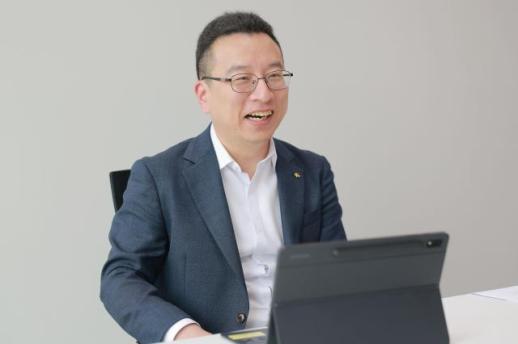 KB Kookmin Card's AI Chief Predicts Era of Clickless Payments The global payment market is experiencing a shift in competition. Traditionally, card payments involved consumers navigating apps or online stores to find products and compare benefits before selecting a card at checkout. However, with the rise of generative AI, experts predict a new model where AI will understand consumer preferences and facilitate everything from product discovery to recommendations and payments. This trend is referred to as 'Agent Pay.' Instead of customers clicking through multiple screens, an AI agent will assist users at the front end of the payment process and, if necessary, complete the transaction. In an interview with Aju Economy, Lee Cheong-jae, Chief of the AI Center at KB Kookmin Card, stated, "The card payment market is expected to see significant changes with the emergence of new payment environments such as stablecoins and Agent Pay. Companies that can quickly adopt and provide various payment protocols based on Agent Pay in the standardization process will secure a competitive edge." This indicates a shift in the payment environment from a model where customers click through multiple screens to one where AI agents facilitate the entire process from exploration to recommendation to payment. Below are excerpts from the interview with Lee: - What does it mean for payments to shift from 'clicks' to AI agents? "Currently, users find products directly on apps or websites, compare benefits, and move to the checkout page to complete their purchases. However, in the future, it may be more important for an AI agent to handle everything seamlessly rather than users clicking through multiple screens. For example, a shopping agent could search for and recommend products, then process the payment all within a chat interface. This represents the payment model of the AI era, or Agent Pay, where exploration, recommendations, and payments occur in a single flow rather than through multiple clicks." - What is your view on digital asset payments like stablecoins? "The global stablecoin market has grown to around $300 billion. For it to transition into actual services in the financial sector, legal and regulatory frameworks, as well as consumer protection measures, must be established first. Issues such as anti-money laundering, price stability, and accountability also need to be addressed. KB Kookmin Card is exploring a hybrid payment model that connects digital assets with card payment infrastructure. We have begun patent applications for hybrid payment technologies linked to digital assets and are collaborating with companies like Avalanche, OpenAsset, Solana, and AhnLab Blockchain Company to assess the applicability of payment models across various infrastructure environments. This is not about launching specific services but rather preparing for technological possibilities in response to regulatory and market changes." - In what areas will AI agents change customer experience? "Customer expectations are already set by services like ChatGPT, Claude, and Gemini. It is challenging to exceed these experiences. However, there are areas where we can improve customer experience behind the scenes. Customer service is a prime example. Utilizing AI agents in customer service can reduce response times and enhance the quality and satisfaction of answers. In digital channels like KB Pay, we can strengthen personalized recommendations. We can suggest cards and expected benefits based on consumer patterns, and in the future, we can explain the rationale behind recommendations using generative AI. In the U.S., AI agents have facilitated 176 million transactions worth a total of $730 million over the past year." - To respond to an AI agent-based payment environment, it seems card companies will need to change their internal systems. "For AI agents to connect exploration, recommendations, and payments, internal work agents must also function together. Connecting and coordinating various agents for customer service, operational manuals, data inquiries and analysis, and marketing support within a unified system ultimately creates a super agent. The key is not just to create many agents but to manage them effectively so they operate well within actual workflows and payment processes. KB Kookmin Card, as well as KB Financial Group, is considering how to connect and operate agents across its subsidiaries." - The financial sector faces strict security regulations regarding network separation and personal data protection. How can security and AI utilization coexist? "The financial sector's network separation and data usage restrictions make it difficult to use generative AI as freely as in other industries. From an external perspective, designing infrastructure that enables practical use within regulatory environments is much more challenging than model development. However, a completely closed environment that restricts everything could become a vulnerability in the long run. It is similar to how a person who remains in an overly sterile environment becomes more susceptible to infections. We need to enhance our responsiveness by finding ways to maintain security while increasing usability. Building a structure that allows for both security and usability at the enterprise AX infrastructure level and accumulating operational experience within that framework is key to financial AI innovation." - Where do you see the future competitiveness of card companies lying? "I believe it depends on how quickly we can transition to a structure that designs operations and services based on AI. The payment environment may shift to stablecoins and Agent Pay, and customer interactions may increasingly center around AI agents. To respond to these changes, it is not enough to simply create a new service. For AI agents to recommend products that suit customers and facilitate payments, customer data, product information, benefit structures, payment APIs, and internal operational systems must be interconnected. Ultimately, companies that proactively build an AX foundation that connects data, APIs, operational processes, and security systems will secure competitiveness in the evolving payment market."* This article has been translated by AI. 2026-06-03 17:03:00
 -
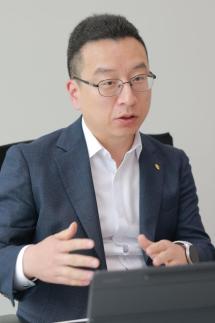 KB Kookmin Card AI Center Head: The Goal is to Make AI Centers Obsolete Lee Cheong-jae, head of the AI Center at KB Kookmin Card, believes that the completion of AI transformation (AX) will mean the AI Center will no longer need to take the lead. He explained that the role of the AI Center is to establish a foundation that allows employees to utilize AI in their respective tasks, rather than having a dedicated team develop all services directly. In an interview with Aju Economy on June 3, Lee compared generative AI to Microsoft Office, stating, "In the future, members will work in an environment where using AI is as natural as using Office tools." KB Kookmin Card established the AI Center in the second half of last year to oversee its AI strategy and infrastructure, bringing Lee on board as the head. He is an AI expert with experience as the manager of SK Telecom's initial AI model, NUGU, and as the NLP tech leader at Hyundai Motor's AIRS Company, among other roles. The AI Center is tasked with ensuring that generative AI and AI agents can be applied in real work settings by enhancing the infrastructure, which includes data, application programming interfaces (APIs), and execution environments. While the existing digital and data organization focused on data collection, model training, and service operations, the AI Center is more aligned with creating a company-wide AX execution system. Lee emphasized that the key to AI transformation in the financial sector lies in building a foundation that enables practical AI usage, rather than merely adopting the latest models. He noted, "Most companies focus on creating AI agents, but without a solid foundation, it becomes difficult to sustain in terms of cost and operations. We must first establish the AX infrastructure to apply AI reliably across more tasks." KB Kookmin Card is expanding the environment for employees to utilize AI in their work processes through the introduction of ChatGPT Enterprise, M365 Copilot, and no-code/low-code agent builders. The application scope is being broadened, starting with areas that have high practical relevance, such as internal document Q&A, consultation summaries, and marketing support.* This article has been translated by AI. 2026-06-03 17:03:00
 -
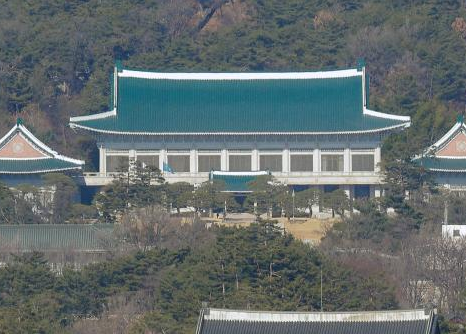 South Korea Responds to U.S. Tariff Proposal on Forced Labor Goods The Blue House stated on June 3 that it will take all necessary measures to ensure that the balance of benefits from the existing Korea-U.S. tariff agreement is not disrupted, following the U.S. Trade Representative's (USTR) announcement of high additional tariffs on South Korea and 59 other trading partners. A Blue House official said in a press release that the government will actively respond to the upcoming public comment period and hearing scheduled for July, while also considering the ongoing Section 301 investigation into overproduction. On June 2, the USTR announced the results of its investigation under Section 301, citing insufficient efforts by countries to prevent the import of goods made with forced labor, which has created an unfair competitive environment. The USTR proposed additional tariffs of 10% or 12.5% by country, with South Korea facing a 12.5% rate. This decision comes approximately three months after the USTR initiated its related investigation. Last year, South Korea committed to a total investment of $350 billion (approximately 534 trillion won) in the U.S. during tariff negotiations, successfully reducing the previously announced 25% reciprocal tariff to 15%. Currently, like other countries, South Korea is subject to a temporary 10% global tariff. The USTR plans to finalize the implementation of the proposed measures based on the findings of the forced labor investigation after gathering public input during the hearing scheduled for July 7. The Blue House official explained that since the USTR initiated the Section 301 investigation into the import ban on products made with forced labor on March 12, the government has been in close communication with the U.S. through public comments and bilateral consultations. 2026-06-03 16:36:00
 -
 Nexon's Mintrocket Unveils 'Bancho the Chef' Expanding 'Dave the Diver' IP Nexon subsidiary Mintrocket has announced a new game titled 'Bancho the Chef,' expanding the universe of 'Dave the Diver.' According to the gaming industry, Mintrocket unveiled the trailer for 'Bancho the Chef' during Sony Interactive Entertainment's online showcase, 'State of Play,' on June 2. 'Bancho the Chef' features Bancho, a sushi master from Mintrocket's marine adventure game 'Dave the Diver,' which was released in June 2023. The game explores Bancho's story before he meets the protagonist, Dave. Nexon Mintrocket is expanding its intellectual property (IP) with multiple games centered around 'Dave the Diver.' Since its release in 2023, 'Dave the Diver' has become a hit, surpassing 8 million in global sales. On June 18, the first downloadable content (DLC) for 'Dave the Diver,' titled 'In the Jungle,' will be released. While Mintrocket has provided content updates since the game's launch, this will be the first major paid expansion DLC.* This article has been translated by AI. 2026-06-03 16:33:00
 -
 Jeon Ji-hyun Returns to the Screen After 11 Years with 'Goonche' Jeon Ji-hyun, who captivated audiences with her role in the film 'Assassination,' has made her return to the screen after 11 years. Her latest film, 'Goonche,' directed by Yeon Sang-ho, has been officially invited to the Midnight Screenings section of the 79th Cannes Film Festival. Through her character, who embodies cold rationality, responsibility, and decisive action, Jeon aims to re-establish her presence that audiences have been eagerly awaiting."It's been 11 years since I last appeared on screen. The COVID-19 pandemic caused the film industry to slow down significantly, which naturally reduced opportunities to review scripts. During that time, I focused on series work, but I found the script for 'Goonche' to be intriguing. After working on longer series, I felt a bit bored, but reading Yeon Sang-ho's script reignited my desire to make a film. It was a movie I wanted to see myself. It was intense and thrilling," she said.This marks Jeon Ji-hyun's first official invitation to the Cannes Film Festival. Although she had previously visited as an ambassador, this is her first time walking the red carpet for a Korean film in which she starred. "The Cannes I visited before wasn't really Cannes," she remarked."It's a dream for every filmmaker to showcase their work at Cannes, and 'Goonche' was presented there for the first time. This is my first time attending Cannes with a Korean film. Although I've been there as an ambassador, this is my third visit, and the previous times didn't feel like Cannes. Haha. This time, I was able to take fun photos with Go Kyung-pyo, and I felt empowered as an actress. It was our own red carpet, and I was so excited. There was tension, but also moments of relaxation, and since I am comfortable with Kyung-pyo, we took playful photos together. The positive reactions and the promotional opportunities for the film were just perfect."Jeon Ji-hyun is known as a master of genre films, having excelled in works such as 'Blood,' 'The Thieves,' 'Berlin,' 'Assassination,' and dramas like 'Kingdom: Ashin of the North,' 'Jirisan,' and 'North Star.' She expressed her desire to work with leading creators in Korean genre films, stating, "I want to be an actress who is not limited to a specific genre.""I don't think being confined to one genre makes an actress a good one. Since childhood, I believed that an actress should act well, and I pondered what sets me apart from other actresses. I realized that the market needs to be broad. I thought that if I could work beyond Korea and in a wider world, it would be different. So, I took opportunities to work overseas when I could. This led me to action roles, as I believe there are enough aspects to connect with audiences through action without relying solely on dialogue. I think those elements have helped me in doing a zombie film," she added.One intriguing aspect of 'Goonche' is the dynamic between the ex-wife and current wife working towards the same goal. Jeon Ji-hyun admitted that she initially found this relationship setup unfamiliar. However, after watching the completed film, she found the structure of pursuing a common goal, despite being in different places, to be fascinating."At first, I wondered if such a setup was necessary. It can be uncomfortable for the ex-wife and current wife to drive the story together. The husband acting as a mediator might also seem strange. But after filming and seeing the finished product, I found it interesting to explore that relational dynamic. The fact that they are in different places but moving towards the same goal was compelling. Beyond the relationships, I appreciated the shared objective. I think the director's intended message about relationships comes through in this aspect," she explained.Kwon Se-jeong is a central character who guides the audience through the film. However, Jeon Ji-hyun believes that this character should be seen as someone who makes judgments and choices alongside the audience, rather than just being labeled as a strong female character."Compared to the female characters in Yeon Sang-ho's other works, I feel that 'Goonche' hasn't showcased enough yet. Kwon Se-jeong adapts to situations, but I felt there was a lack of agency in solving events. Kwon Se-jeong is the center of the film, guiding the audience and prompting them to ponder and understand her choices, so I felt a bit disappointed that I couldn't fully express myself as an actress in this character," she noted.Meeting audiences again through film after a long time, Jeon Ji-hyun expressed surprise at the changed theater culture. Unlike past stage greetings, she noted the energy created by the interaction between audiences and actors."I was surprised during the stage greetings. Nowadays, it feels more like a fan meeting. In the past, we would greet the audience in front of the screen and say, 'See you next time,' but now there's a culture of interaction that impressed me. I was truly touched by the orderliness and manners of Korean audiences. It feels like the culture has matured significantly," she said.Her return to film is also connected to changes in the film industry. The production environment has shifted since COVID-19, leading to fewer opportunities to review scripts and a natural focus on dramas and series. Jeon Ji-hyun mentioned that she considers the audience's time and money when choosing films."The film industry has changed significantly. After COVID-19, the production environment has altered, which has naturally led to a focus on dramas. With films, I feel a greater sense of responsibility. I believe I need to create works that audiences want to see, rather than just what I want to do. It's not easy for them to take the time and spend money to watch a film. I feel I have to take on that responsibility. I always want to make films that I want to see. While it may not always align, I felt that when I saw Yeon Sang-ho's work, it matched my desire. That was a significant factor for me," she explained.After meeting audiences again through film, Jeon Ji-hyun's thirst for the screen has grown. Although she hasn't been inactive during the past 11 years, reflecting on that time has left her with a sense of regret."Having made a film after a long time has made me want to work on films more frequently. I want to meet movie audiences again. I didn't think much about it being 11 years, but now that I realize it, I feel a bit regretful about the time I spent not making films, even though I wasn't completely inactive," she said.Kwon Se-jeong was a character that Jeon Ji-hyun could portray at this stage in her life. She expressed her desire to take on roles that reflect her age and emotions she can understand now."I don't think I could have played the character of Kwon Se-jeong if it weren't for this moment in my life. I wanted to portray a character that fits my age. I still feel the same way. I want to explore emotions that I can express and understand now," she concluded.'Goonche' also holds the potential for expanding the K-zombie genre. Jeon Ji-hyun believes that compared to the sci-fi genre, zombie films have already established themselves as a genre that audiences can accept and enjoy."There is a K-zombie genre. I feel that while sci-fi is still somewhat challenging for audiences to accept and realize, zombie films have already found their footing. I believe it is a genre that can resonate and be enjoyed. I think there will be opportunities to challenge it in the future," she said.* This article has been translated by AI. 2026-06-03 16:30:00
 -
 South Korea's June 3 local elections seen as key test for Lee government and party leaders SEOUL, June 03 (AJP) - South Korea’s June 3 local elections are shaping up as a crucial political test one year after the launch of President Lee Jae Myung’s government, with the outcome expected to affect the administration’s governing momentum as well as the futures of several major political figures. The elections, the first nationwide vote since the change in government, are widely viewed as more than a contest over local power. Political observers say the results could trigger broader changes across both liberal and conservative camps ahead of the next presidential race in 2030. The ruling Democratic Party of Korea said Tuesday it classified nine of the country’s 16 metropolitan mayoral and gubernatorial races, including the western port city of Incheon, Gyeonggi Province and Gangwon Province, as leaning in its favor. Party officials said they expect to win at least nine regions and as many as 15. The main opposition People Power Party said it held advantages in conservative regions, including the southern city of Daegu and North Gyeongsang Province, while describing nine regions, including Seoul and the southern port city of Busan as battlegrounds. The conservative party projected it could win between two and 11 races. A victory for the ruling party would likely strengthen the Lee administration as it enters its second year in office and give the government and the party greater justification to push ahead with reform legislation. A poor showing for the ruling bloc, however, could weaken the administration early in its second year and force the Democratic Party to slow its legislative drive in the National Assembly, where it currently holds a majority. The elections are also expected to have major implications for the political futures of ruling party leader Jung Chung-rae and main opposition leader Jang Dong-hyeok. Both leaders have faced criticism for relying heavily on hard-line supporters while seeking to maintain control of their parties, making them vulnerable to internal backlash if the election results disappoint. Regional strongholds are seen as particularly important. Jung could face a weakened position within the ruling party if it fails to hold North Jeolla Province, while Jang could suffer a major political setback if conservatives lose Daegu, long considered the heartland of South Korea’s conservative movement. The North Jeolla gubernatorial race has drawn attention after independent candidate Kim Kwan-young, who was expelled from the Democratic Party over a controversy involving chauffeur service payments, mounted a reelection bid. Some ruling party supporters have framed the race as a referendum on Jung’s leadership. Several heavyweight politicians running in local races and parliamentary by-elections are also seen as trying to position themselves for future presidential bids. Former Prime Minister Kim Boo-kyum, the Democratic Party’s candidate for Daegu mayor, could emerge as a major presidential contender if elected. Analysts say a victory in the conservative stronghold would bolster his image as a symbol of national unity. Meanwhile, Oh Se-hoon, the People Power Party’s candidate for Seoul mayor, is seeking a fifth term. A win could strengthen his standing as a leading conservative presidential hopeful capable of appealing to both hard-line conservatives and moderates following the political fallout from former President Yoon Suk Yeol’s martial law declaration and subsequent impeachment. Attention is also focused on parliamentary by-elections involving former Justice Minister Cho Kuk and former ruling party leader Han Dong-hoon. Cho, running for a National Assembly seat in Pyeongtaek, Gyeonggi Province, is viewed by liberal observers as a potential future presidential contender if he returns to parliament. His party, the Rebuilding Korea Party, currently holds 12 seats in the National Assembly. Han, running as an independent candidate in Busan’s Buk-gu after being expelled from the People Power Party, is also seen as a possible future presidential candidate if elected. Political analysts say his return to parliament could reignite tensions with Jang and reshape the conservative opposition bloc, particularly if Han pushes a reform agenda centered on his opposition to Yoon’s martial law declaration. Both Cho and Han have pledged to remain in their constituencies and prepare for the 2028 general elections if they lose Tuesday’s races. 2026-06-03 16:21:38
 -
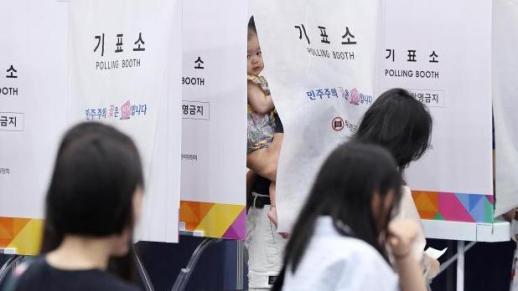 Voter Turnout Reaches 54.7% in Local Elections, Up 9.3% from 2022 As of 4 p.m. on June 3, the voter turnout for the 9th nationwide local elections has reached 54.7%. According to the National Election Commission, approximately 24.4 million of the 44.6 million eligible voters have cast their ballots. This figure includes votes from early voting, absentee voting, and maritime voting conducted from May 29 to 30. This turnout is 9.3 percentage points higher than the 45.4% recorded at the same time during the 2022 local elections. At that time, 20.1 million voters participated out of 44.3 million registered voters. The current local elections have seen a high participation rate from the early voting phase. The final early voting turnout was 23.51%, which is 2.89 percentage points higher than the 20.62% recorded in the 2022 elections. On the first day of early voting, the turnout at 4 p.m. was 9.25%, up from 8.22% at the same time four years ago. Voting began at 6 a.m. and will close at 6 p.m. Voters must present a photo ID, such as a resident registration card, driver's license, or passport, to cast their votes. The main voting for the 9th local elections runs from 6 a.m. to 6 p.m. This election will determine the heads of metropolitan and local governments, education superintendents, and members of regional councils, with some areas also holding by-elections for the National Assembly.* This article has been translated by AI. 2026-06-03 16:21:00