


Latest by
-
 LG Electronics Offers Free Repairs for Flood-Damaged Appliances in Geoje LG Electronics is providing free inspections and repairs for flood-damaged appliances in South Gyeongsang Province, regardless of the manufacturer. The company has set up a special service center at the flood site and is also offering on-site services to assist households in recovering their appliances.According to LG Electronics, the special service center in Gohyeon-dong, Geoje, has been operational since August 18. Service managers dispatched to the site are inspecting flooded appliances without regard to their brand.In Geoje and Tongyeong, LG Electronics is also conducting a 'visiting service' to directly assist affected households. Service vehicles are deployed to the area to provide cleaning, repairs, and parts replacement for damaged products.In the past, LG Electronics has expanded its disaster response services by offering free inspections and repairs for flooded appliances, regardless of the manufacturer, in areas affected by typhoons and heavy rains.Households with flood-damaged appliances can receive the same support by contacting LG Electronics customer service or visiting a service center.If the damage from heavy rains expands, LG Electronics plans to further extend its service support areas.Each summer, during the rainy season and typhoons, LG Electronics provides free inspections and repair services to affected customers.* This article has been translated by AI. 2026-08-19 14:44:00
 -
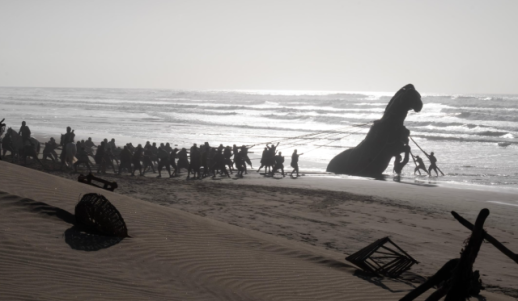 Truth-Seeker's Odyssey: From world of gods to world of man This is part 1 of a two-part column series by Aju Media Group's senior columnist Abe Kwak. A single film has summoned the world back to the seas of ancient Greece, nearly 3,000 years after Homer first sang of them. Christopher Nolan’s The Odyssey has filled theaters in major cities around the world and rekindled an extraordinary interest in Homer, Greek mythology, the Trojan War and the origins of Western philosophy. Film critics, historians, philosophers, writers and ordinary moviegoers have all entered the conversation, each finding a different meaning in the same ancient voyage. In South Korea, too, the enthusiasm has been strong enough to suggest something approaching an “Odyssey phenomenon.” A story born almost three millennia ago has returned to the center of global popular culture through the most advanced technologies of 21st-century cinema. Some groups have gone so far as to rent an entire IMAX theater to watch the film together, followed by discussions with prominent film critics. Afterward, one reads reviews and essays, each approaching the work from a different direction. Historians speak of myth and antiquity. Philosophers examine human nature and fate. Film critics analyze Nolan’s visual language and cinematic architecture. All are illuminating. Yet the more explanations one hears, and the more interpretations one reads, the clearer becomes the question that first remained after the theater went dark. Must great art yield only one answer? The moment a film leaves its director’s hands, does it not enter the life of every person who watches it? One viewer sees a family. Another remembers a war. Another thinks of youth, failure, love or waiting. Great art does not end when the screen goes black. It begins again when the audience walks out of the theater and carries it into life. The most powerful question The Odyssey left with me was, in the end, unexpectedly simple: What is a human being? How did humanity emerge from a world ruled by gods into a world in which human beings think and choose for themselves? And now, confronted by an artificial intelligence of our own making, what kind of human beings must we become? Nolan revives an ancient myth in a contemporary cinematic language. Yet the question could hardly be more modern. We send spacecraft beyond the familiar reaches of the solar system. We build machines capable of learning human language and absorbing vast stores of human knowledge. And still we stand before essentially the same questions that confronted Homer’s men and women thousands of years ago. That is why Homer’s Odyssey is great. Its greatness does not lie merely in its age. Empires have risen and vanished. Dynasties have disappeared. Religions and philosophies have been born. Humanity has passed through the Renaissance, the Scientific Revolution, the Industrial Revolution and the Information Revolution, arriving now at the threshold of artificial intelligence. Yet Odysseus is still alive. A true classic is not a relic preserved under glass. It is a work that asks a new question of every new age. That is why a classic never grows old. Homer sang of a Greek warrior crossing the Mediterranean, but within that voyage reside the permanent problems of humanity: desire and fear, love and betrayal, pride and restraint, war and peace, temptation and responsibility, death and homecoming. What Nolan ultimately finds behind the mythology is the human being. Odysseus is a hero, but never a perfect one. He is strong, yet vulnerable. Clever, yet capable of error. Brave, yet afraid. At times he becomes intoxicated by his own intelligence and success, and his pride brings new suffering upon himself and those around him. He wins a war and loses his way. The Trojan War is over, yet he cannot return home. A man who conquers the world but cannot return to himself; a civilization capable of astonishing achievement but unable to guarantee happiness; a species that accumulates immense knowledge without necessarily knowing how to live — in these respects, the Odysseus of 3,000 years ago and the humanity of the AI age are not so far apart. Nolan’s film brings this vast mythological world into modern cinematic form. Drawing upon Homer’s Odyssey, it follows the long and perilous homeward journey of Odysseus after the Trojan War. Matt Damon plays Odysseus; Tom Holland his son, Telemachus; Anne Hathaway his wife, Penelope; and Robert Pattinson Antinous, one of Penelope’s most dangerous suitors. Zendaya appears as Athena, Charlize Theron as Calypso, Samantha Morton as Circe, Jon Bernthal as Menelaus, Benny Safdie as Agamemnon, John Leguizamo as the loyal swineherd Eumaeus, Himesh Patel as Eurylochus and Elliot Page as Sinon. But behind the spectacle lies an ancient human drama. 1. The Odyssey: A Man Who Won the War but Could Not Get Home At the center stands Odysseus, played by Matt Damon. He is king of Ithaca, a small island kingdom west of mainland Greece. But Odysseus is not merely another warrior skilled with the sword. Among Homer’s heroes, what distinguishes him is not brute force but intelligence: cunning, judgment, adaptability and command of language. If Achilles represents strength, and Hector honor and duty, Odysseus represents the thinking human being. He leaves home because of the Trojan War. His wife, Penelope, and his young son, Telemachus, remain in Ithaca while he sails to battle. The war lasts 10 years. And when it ends, his suffering does not. His journey home consumes almost another decade. The simplest way to describe the architecture of The Odyssey is therefore this: a man spends 10 years fighting a war and nearly 10 more trying to return home. But those 20 years are not merely a measure of time. They are the story of a warrior slowly becoming a husband again, a father again, a human being again — after passing through temptation, terror, loss and death. For 10 years the united Greek armies cannot breach Troy. Its walls are formidable. Its defenders refuse to surrender. Then comes the stratagem that ends the war: the Trojan Horse. The Greeks construct an enormous wooden horse and hide Odysseus and other elite warriors inside it. The Greek forces then create the illusion that they have abandoned the war and sailed away. The Trojans, believing the horse to be a trophy of victory, drag it inside their city. Night falls. As Troy celebrates and sleeps, the Greek soldiers emerge from the horse, open the gates and admit the army waiting outside. The city that force could not conquer falls to deception and intelligence. Nolan’s film includes both the enormous horse and Sinon, played by Elliot Page. The figure of Sinon is elaborated less in Homer’s Odyssey than in later Greek and Roman traditions, most famously in Virgil’s Aeneid, where he helps persuade the Trojans to bring the horse within the city walls. The war ends. But that is precisely when the true Odyssey begins. Odysseus boards his ship with one destination in mind: Ithaca. There waits Penelope, who has endured years without her husband, and Telemachus, the son who scarcely remembers his father. But the sea will not release Odysseus so easily. In Homer, Poseidon, god of the sea, becomes the great divine obstacle to his return. Nolan shifts much of this divine intervention toward the realms of nature, memory, guilt and human psychology. That change makes the modern significance of the story — the movement from the world of the gods toward the world of man — all the more vivid. Polyphemus: Intelligence and Pride Among the most famous episodes is Odysseus’s encounter with Polyphemus, the Cyclops — the one-eyed giant. Odysseus and his companions enter an enormous cave stocked with sheep, goats, cheese and food. But its owner is no man. He is Polyphemus. The giant traps them inside, sealing the entrance with a massive stone, and begins devouring the sailors. No ordinary force can defeat him. Here Odysseus turns to his greatest weapon: intelligence. In Homer, he gives Polyphemus wine and tells the Cyclops that his name is “Nobody.” When the giant falls into a drunken sleep, Odysseus and his companions drive a sharpened, heated stake into his single eye. Polyphemus howls in agony. Yet when neighboring Cyclopes ask who is attacking him, he answers, in effect, “Nobody.” And so no one comes to his rescue. Odysseus survives through language and intelligence rather than strength. But what happens next is more important. Once safely away, unable to resist the temptation to boast, Odysseus reveals his true identity. He is Odysseus, king of Ithaca. It is a catastrophic act of pride. Polyphemus is the son of Poseidon. The sea god’s wrath now descends upon the hero. Odysseus’s intelligence saved him. His arrogance imperiled him again. Such is Homer’s understanding of humanity. Our greatest gift and our greatest weakness often live side by side. Circe: The Woman Who Turns Men Into Swine Odysseus and his companions eventually arrive at the island of Circe, the beautiful and dangerous enchantress. In Homer’s world, Circe possesses the power to transform human beings into animals. She casts a spell upon Odysseus’s companions and turns them into pigs. It is one of the most enduring symbols in The Odyssey. A human being who surrenders reason and self-restraint to appetite can descend into the animal within. With the aid of Hermes, Odysseus resists Circe’s magic and eventually restores his companions to human form. He nevertheless remains on her island for a significant period. And this raises a question that runs through the entire epic: Why does a man who so desperately wants to return home repeatedly stop, linger and succumb to temptation? The answer is one reason the Odyssey remains great. Homer does not portray his hero as a saint. Odysseus desires. He hesitates. He fails. And still he begins again. He is not human because he is heroic. He is a human hero because, after being shaken again and again, he keeps searching for the road that leads home. Into the Underworld: Asking the Dead for the Way Home Odysseus even descends, while still alive, into the realm of the dead. There he consults the spirit of the prophet Tiresias, asking how he can return to Ithaca. He encounters the spirit of his mother as well. He survived the battlefield, but while he fought and wandered, those he loved grew old and died. From this point on, the meaning of homecoming deepens. Home is no longer simply a place. It is the place one must reach before time itself disappears. The Sirens: Beauty Calling Human Beings Toward Destruction Then come the Sirens. Their song is irresistibly beautiful. Sailors who hear it lose reason and sail toward their deaths. Odysseus devises a solution. He orders his men to seal their ears with beeswax. But he himself wants to hear the song. So he commands them to bind him tightly to the mast — and, no matter how desperately he begs, never to release him. The song begins. Odysseus struggles violently. He commands his men to untie him. They refuse. The ship sails safely past. It is one of the most extraordinary images of desire and self-government in Western literature. Odysseus does not pretend that temptation can be abolished. He does something wiser. He acknowledges his own weakness and constructs, in advance, a mechanism that will prevent his weaker self from destroying his better judgment. Civilization itself may depend upon that insight. Scylla and Charybdis: When Every Choice Has a Cost Then comes an even crueler dilemma. On one side waits Scylla, the many-headed monster. On the other churns Charybdis, a whirlpool capable of swallowing an entire ship. There is no path without danger. This is also the tragedy of leadership. Not every decision offers a good outcome. Sometimes there is only the responsibility to choose the lesser catastrophe. Odysseus chooses the path past Scylla, sacrificing six men rather than risking the destruction of all. The hero survives. But the people beside him disappear one by one. Odysseus is therefore not a hero who marches triumphantly from victory to victory. The nearer he comes to home, the lonelier he becomes. Calypso: Choosing Mortal Love Over Immortality At last, after losing nearly everyone, Odysseus is washed ashore alone on the island of Ogygia, home of Calypso. In Homer, Calypso wishes to keep him with her. She can offer him what mortal life cannot: the possibility of escaping human finitude. Yet Odysseus does not ultimately want to become a god. He wants to return to Ithaca. He wants Penelope. He wants his son. He wants his home. Here one of the deepest themes of the Odyssey emerges: It may be better to live finitely as a human being with those one loves than to live forever without them. Another War Was Already Underway in Ithaca While Odysseus wanders, Ithaca is anything but peaceful. Its king has been gone for nearly 20 years. Many assume he is dead. Noblemen crowd into the palace and compete for Penelope’s hand, knowing that marriage to the queen could also deliver political power. Among the most dangerous is Antinous. Penelope refuses to surrender. In Homer, she uses intelligence to resist. She announces that she will choose a husband after finishing a burial shroud for her father-in-law, Laertes. By day she weaves. At night she secretly unravels what she has woven. She defeats time with patience. This is the famous weaving of Penelope. If Odysseus battles monsters across the sea, Penelope battles time within the palace. She, too, is an Odysseus. Telemachus: The Boy Who Goes in Search of His Father And another human being is growing. Telemachus. He was a child when his father sailed for Troy. Now he is a young man. Yet his palace has been occupied by suitors consuming his father’s wealth and pressuring his mother into marriage. Telemachus leaves home to discover whether Odysseus is still alive. He seeks out veterans of the Trojan War and asks what they know. Among them are Menelaus, king of Sparta, and Helen. The fact that the opening books of Homer’s Odyssey belong largely to Telemachus matters greatly. The father is trying to return home. The son must leave home in search of the father. They travel in opposite directions and finally meet. This is more than a reunion. It is the story of a boy who grows into a man in the absence of his father. Ithaca at Last: The King Returns as a Beggar After nearly 20 years, Odysseus finally reaches Ithaca. But he does not enter as a king. He disguises himself as a poor beggar and enters his own kingdom unnoticed, seeking to discover who remained loyal and who betrayed him. In Homer, one of the most heartbreaking recognitions comes not from a human being but from an animal. Argos, Odysseus’s old dog, has waited for his master through the passing years. Ancient and neglected, he recognizes Odysseus beneath the disguise. And after seeing that his master has finally returned, Argos dies. Then comes the final trial. Penelope declares that she will marry the man capable of stringing Odysseus’s bow and shooting an arrow through the aligned openings of a series of axes. One suitor after another fails. Then the ragged beggar takes the bow. He strings it. The arrow flies. The king has returned. Odysseus and Telemachus fight together against the suitors occupying the palace. For the first time, father and son stand on the same battlefield. Penelope’s Final Test: Homer’s Bed, Nolan’s Golden Pin Even then, Homer does not allow recognition to come cheaply. Penelope must know whether this man is truly her husband. Twenty years have passed. His face has changed. His body has changed. Life has changed him. So she sets one last test, referring to a secret known only to the two of them. Their marriage bed was built by Odysseus around the trunk of a living olive tree rooted in the earth. It cannot simply be moved. Only Odysseus understands what Penelope means. At that moment she knows. The man before her is her husband. Nolan does not reproduce this celebrated episode exactly. In the film, a golden Athena pin associated with Penelope becomes an important sign of recognition. The details differ. The meaning does not. The war is over. The voyage is over. The monsters have been survived. And a human being has finally returned to the person to whom he belongs. Ultimately, The Odyssey is the story of a homecoming. But homecoming does not mean merely returning to a physical house. It means the warrior becoming a husband again, the soldier becoming a father again, the figure who contended with gods becoming human again. 2. The Trojan War: The War Before the Homecoming To understand The Odyssey, one must first understand the war that precedes it. Why did Odysseus go to Troy? Why did the kings and heroes of Greece sail across the Aegean? Why did Achilles and Hector die? In mythic tradition, it begins with a wedding and a golden apple. The sea goddess Thetis is marrying the mortal Peleus. Many gods are invited. Eris, goddess of discord, is not. Enraged, she throws a golden apple into the celebration. Upon it are words meaning: “For the fairest.” Three goddesses claim it: Hera, queen of the gods; Athena, goddess of wisdom; and Aphrodite, goddess of love and beauty. Who is the most beautiful? The judgment is ultimately placed in the hands of Paris, prince of Troy. Thus comes the famous “Judgment of Paris.” Each goddess offers him a reward. Hera promises power. Athena promises wisdom and victory in war. Aphrodite promises the most beautiful woman in the world. Paris chooses Aphrodite. There is one problem. The most beautiful woman, Helen, is already married. Her husband is Menelaus, king of Sparta. Paris nevertheless brings Helen to Troy. Depending on the ancient tradition, Helen is abducted, persuaded or leaves voluntarily. But to Menelaus, the result is the same: humiliation. He appeals to his brother Agamemnon, king of Mycenae, who becomes commander of the Greek coalition. The great warriors gather. Achilles, the greatest fighter of Greece. Odysseus, king of strategy. Menelaus of Sparta. Ajax, the mighty warrior. Nestor, the veteran king. And Agamemnon, commander of them all. They cross the Aegean with a vast fleet and lay siege to Troy. On the other side stand the defenders: Priam, the aging king of Troy; Queen Hecuba; Paris; and, above all, Hector, Paris’s brother and Troy’s greatest warrior. Two names must be remembered. For Greece, Achilles. For Troy, Hector. Their collision produces the greatest tragedy of the war. Achilles: The Strongest Warrior, and Yet Entirely Human Achilles is nearly invincible. His mother is Thetis, a goddess. In a famous later tradition, Thetis immerses the infant Achilles in the River Styx, granting near invulnerability. But she holds him by the heel, leaving that one place untouched. From this story comes the expression “Achilles’ heel” — a fatal weakness. That particular version, however, is not found in Homer’s Iliad itself. It belongs to later mythological tradition. The Trojan War lasts 10 years. Yet Homer’s Iliad does not narrate all 10 years from beginning to end. It focuses primarily on a period near the war’s conclusion and on the conflict between Achilles and Agamemnon. Agamemnon takes Briseis, a woman awarded to Achilles as a prize of war. Achilles sees it as an intolerable insult. He refuses to fight. The greatest Greek warrior withdraws from battle. The war turns. Hector drives the Greeks back. Patroclus, Achilles’s closest companion, can no longer bear to watch the Greek forces suffer. He puts on Achilles’s armor and enters battle. The Trojans believe Achilles has returned and recoil in fear. But Hector kills Patroclus. When Achilles hears the news, something within him collapses. His rage is no longer directed at Agamemnon. It turns toward Hector. Achilles returns to war. Everything changes. Hector knows that he may die. He has a wife, Andromache, and a young son. Yet he cannot simply run away. He is a prince of Troy. He bears responsibility for his city. At last Achilles and Hector meet before the walls of Troy. Hector dies. But victory does not ennoble Achilles. Consumed by rage, he ties Hector’s corpse to his chariot and drags it behind him. It is the moment when triumph threatens to destroy the victor’s humanity. Then comes one of the greatest scenes in the Iliad. Priam, Hector’s elderly father, secretly enters the Greek camp at night. The king of Troy kneels before the man who killed his son. He begs for Hector’s body. Achilles looks at the old king and thinks of his own father. The two men weep. One has lost a son. The other has lost a beloved companion. For a moment they are no longer enemy king and enemy warrior. They are simply human beings joined by grief. Achilles returns Hector’s body. The Iliad moves toward this profoundly human moment. The war, however, continues. In later traditions Achilles is killed by an arrow shot by Paris, sometimes said to have been guided by Apollo. The greatest warrior in Greece is gone. Yet Troy still stands. Then the intelligence of Odysseus becomes decisive. When strength fails, thought must fight. The Greeks build the horse. Odysseus and selected warriors conceal themselves within it. Sinon helps convince the Trojans to bring it into the city. The Trojan priest Laocoön warns against trusting the Greek gift. His warning goes unheeded. The horse enters Troy. Night falls. The people celebrate what they believe to be the end of war. Then, while the city sleeps, the horse opens. Odysseus and the Greek soldiers emerge. The gates are opened. The Greek army pours in. Troy, after 10 years of resistance, falls. There is victory. But almost no one is truly happy. Troy burns. Priam is killed. The royal house collapses. Women and children are enslaved or taken captive. Hector is dead. Achilles is dead. Paris dies as well. Those who caused the war, those who tried to prevent it, and those who fought most bravely are swept away by it. Greece has won. Yet strangely, one searches in vain for the true victor. Agamemnon returns home only to be murdered in a cycle of vengeance involving his wife Clytemnestra and her lover Aegisthus. Ancient traditions and tragedies differ in detail, but the great commander’s reward is not a glorious homecoming. It is death. Menelaus and Helen endure their own difficult return. Countless soldiers never see home again. And no one pays a longer price for the journey home than Odysseus. The strategist who helped bring down Troy goes back to sea. Ahead of him wait storms, Cyclopes, Circe, Sirens, Scylla and Charybdis, Calypso, temptation and death. He no longer seeks victory. He seeks no empire. He wants no new glory. He wants one thing. Home. That is why the Iliad and the Odyssey form one continuous story while offering profoundly different visions of humanity. The Iliad is a story of war. The Odyssey is a story of return. The Iliad, through Achilles and Hector, asks how a hero dies. The Odyssey, through Odysseus, asks how a human being survives — and becomes human again. For Achilles, the central value is glory. For Hector, responsibility. For Odysseus, homecoming. For Penelope, fidelity and endurance. For Telemachus, growth. And above them all stand Zeus, Athena, Poseidon, Aphrodite and the other gods. Yet something extraordinary happens as the stories advance. At first the gods seem to determine everything. A quarrel among gods helps begin the conflict. A god raises the wind. A god blocks the sea. Gods influence victory and defeat. But what remains at the end is not the gods. It is the human being. Penelope, who waited. Telemachus, who grew to adulthood without his father. Odysseus, wounded and aged, returning after losing nearly everyone around him. Read together as a single story of civilization, Homer’s two epics reveal a remarkable movement: from the conflicts of the gods to the wars of men; from the wars of men to the homecoming of one man; and finally to the question: What is a human being? That is why humanity has remembered Odysseus for nearly 3,000 years. And it is here that Christopher Nolan’s Odyssey speaks directly to our time. Artificial intelligence can remember more than we can. It can calculate faster. It can generate human language and images. And so we must ask once again: What makes a human being human? For Odysseus, the answer was never perfection. He erred. He boasted. He succumbed to temptation. He lost almost everything. But he never completely forgot the place to which he must return. Ithaca. There was something there more important than a throne. Penelope. Telemachus. A community for which he bore responsibility. Odysseus’s greatest victory, therefore, was not the destruction of Troy. Troy was the victory of Odysseus the hero. Ithaca was the victory of Odysseus the man. And at that moment the story passes from the world of the gods into the world of humanity. From the Iliad to the Odyssey comes one of civilization’s great humanistic movements: from force to intelligence; from conquest to return; from war to ordinary life; from glory to responsibility; and, ultimately, from a world in which gods determine human destiny toward a world in which human beings begin to think, choose and bear the consequences of their choices. 3. Christopher Nolan: A Director Who Has Spent His Career Filming the Human Being Looking back across Christopher Nolan’s work, one begins to understand why he would eventually arrive at Homer. Nolan has always filmed the human being. He simply approached humanity indirectly — through memory, dreams, time, space, war and science. In Memento, he asks what happens to human identity when memory collapses. If I lose my memory, am I still myself? In Inception, he destabilizes the boundary between dream and reality and turns unconscious desire, memory and guilt into cinematic architecture. It is a world that inevitably touches the questions raised by Freudian psychoanalysis. In Interstellar, Nolan enters the worlds of relativity, black holes, time and astrophysics, yet what he refuses to abandon is the bond between a father and his daughter. In Dunkirk, he explores survival under the extremity of war. In Tenet, the direction of time itself becomes a problem of human choice. And in Oppenheimer, the triumph of human intelligence becomes the power to destroy humanity itself. What responsibility falls upon science, the scientist and civilization when knowledge becomes a weapon capable of annihilation? The forms change. The question beneath them does not. What is a human being when memory becomes unreliable? What remains of us when dream and reality collapse into one another? What does love mean when time and space themselves are distorted? What should humanity do when it acquires powers it may not be morally mature enough to wield? Now Nolan travels nearly three millennia backward and asks the same question of a man wandering among gods and monsters: Can a human being remain human to the end? In that sense, The Odyssey feels both like a new departure and like the origin point toward which Nolan’s entire career has been moving. He films time — and finds the human being. He films space — and finds the human being. He films war — and finds the human being. He films science — and finds the human being. And after filming myth, what remains is again the human being. However large Nolan’s cinema becomes, its conclusions repeatedly return to something small and intimate. Interstellar travels across the universe only to return to a father and daughter. Oppenheimer confronts the atomic bomb only to leave us with the human conscience and the burden of responsibility. And The Odyssey, after filling the screen with gods, monsters, war and oceans, leaves behind a single mortal man who wants to go home. Here one cannot help thinking of Hayao Miyazaki’s Spirited Away. Chihiro’s parents enter a strange world, encounter unattended food, surrender to appetite and are transformed into pigs. In Homer, Circe turns Odysseus’s companions into swine. There is no need to claim a direct line of influence between the works without evidence. The more fascinating truth is that, across thousands of years and across the immense geographical distance separating the Mediterranean from Japan, the same human symbol appears again: When human beings cease to govern desire and allow desire to govern them, they risk surrendering their humanity. That is the power of a classic. A classic is not copied intact. It is reborn within another culture, another era and another human life. 4. From Mythos to Logos: From the World of the Gods to the World of Man This, to me, is the most important way to read The Odyssey. In the mythic world of ancient Greece, the gods intervene directly in human life. Zeus presides over order. Poseidon shakes the sea. Athena aids mortals. Aphrodite governs love. Human beings are weaker than gods and smaller than fate. Yet as we travel through the Odyssey, the human figure becomes increasingly distinct within that divine universe. Odysseus thinks. He judges. He chooses. He makes mistakes and suffers the consequences. Then he thinks again and chooses again. Fate exists. But within fate, human beings must still act. One of the great achievements of ancient Greek civilization was not that it abolished the gods. It was that, even in a world crowded with gods, it began to discover the human right to think and the human responsibility to choose. At some point, human beings no longer looked at thunder and felt satisfied merely to call it the anger of a god. They began to ask: Why does thunder occur? What is the world made of? What is justice? What is the good life? How should human beings live? This is the movement from mythos to logos: from myth toward reason; from received explanation toward inquiry; from a world explained for us toward a world we attempt to understand for ourselves. We should not reduce history by claiming that Greek philosophy emerged directly from one literary work. But Homer’s epics, in their profound exploration of character, fate, choice and responsibility, formed part of the cultural and intellectual soil from which Greek philosophy grew. Thales and Heraclitus, Pythagoras and Socrates, Plato and Aristotle would continue the questioning. Human beings turned their gaze not only toward the cosmos but toward themselves. Who am I? Why do I exist? How should I live? Three thousand years later, those questions have not disappeared. AI has made them more urgent. Artificial intelligence learns from human language and knowledge. It writes. It draws. It composes music. It generates video. It analyzes vast quantities of data. Physical AI, joined to robotics, is moving rapidly into domains once reserved for human physical labor. The steam engine expanded human muscle. The computer expanded calculation. The internet expanded connectivity. AI now enters territories human beings long regarded as uniquely their own: language, reasoning, creativity and judgment. And so the questions change. What does it mean for a human being to write when AI can write? What is human creativity when machines make images and music? Where does responsibility lie when AI analyzes information and assists decisions? What is wisdom when a machine remembers more and calculates faster than any person? We can find part of the answer in Odysseus. AI may calculate the fastest route to Ithaca. It cannot decide why Ithaca is worth returning to. AI has no Penelope waiting. No Telemachus longing for a father. An algorithm has no homeland. To calculate a destination and to choose the purpose of a life are entirely different acts. Human beings possess that “why.” We love. We remember. We accept responsibility. We seek to make a meaningful whole from the lives we have lived. *The author is a senior columnist of AJP. 2026-08-19 14:42:46
 -
Will Trump and Kim Meet Again? Strategic Gains for North Korea Reports indicate that U.S. President Donald Trump is considering a meeting with North Korean leader Kim Jong Un during the Asia-Pacific Economic Cooperation (APEC) summit in November, raising the possibility of renewed U.S.-North Korea dialogue.However, the negotiation environment for North Korea has significantly changed since the first U.S.-North Korea summit in 2018, which focused on denuclearization. North Korea has advanced its nuclear and missile capabilities and strengthened ties with Russia and China, reducing its reliance on the U.S. for sanctions relief or economic support.Despite this, The Diplomat reported on August 18 that there are substantial strategic benefits for North Korea in meeting with the U.S., providing Kim with sufficient motivation to engage with Trump.First, there is the recognition of North Korea's status as a nuclear power. North Korea has consistently stated that it will not engage in negotiations based on denuclearization and insists that the U.S. must acknowledge its nuclear capabilities to facilitate dialogue. Trump has referred to North Korea as a 'nuclear power' on multiple occasions.While the U.S. does not officially recognize North Korea as a nuclear state, the prospect of a summit with Trump, who may negotiate based on the reality of North Korea's nuclear arsenal, could effectively grant North Korea de facto recognition of its nuclear status.Additionally, Trump has signaled a willingness to reduce the U.S.-South Korea joint military exercises, which North Korea has long criticized as 'invasion rehearsals.' The Diplomat noted that scaling back military drills holds significant strategic importance for North Korea, as adjustments to the size and role of U.S. forces in South Korea could provide Kim with considerable security benefits.Trump has emphasized his personal rapport with Kim, having met him three times in Singapore in June 2018, Hanoi in February 2019, and at the DMZ in June 2019. For Kim, restoring communication with Trump through a fourth summit could mitigate perceived military threats, particularly in light of U.S. military operations targeting North Korean leadership.Moreover, improving U.S.-North Korea relations could enhance North Korea's diplomatic autonomy in its dealings with China.However, it is anticipated that China will seek to ensure its interests and influence are adequately represented in any U.S.-North Korea summit. Observers suggest that North Korea and China may coordinate strategically to extract maximum concessions from the U.S., potentially aligning their interests regarding U.S. military activities not only on the Korean Peninsula but also in the Taiwan Strait.North Korea faces increased external pressures due to military support and troop deployments to Russia. Analysts suggest that if Kim can achieve strategic outcomes such as recognition of nuclear status, improved U.S.-North Korea relations, and a reduction of U.S. forces in South Korea through a summit with Trump, he could bolster his domestic political legitimacy and authority by portraying himself as a 'strategic genius.'Meanwhile, if Trump engages in direct negotiations with North Korea without involving South Korea, concerns about 'Korea passing' may intensify. North Korea has effectively designated South Korea as a separate adversary since 2024 and has not responded to dialogue proposals from the South, raising the possibility of a rift in U.S.-South Korea coordination on North Korea policy. 2026-08-19 14:40:00
-
KT Launches Domestic AI Semiconductor and LLM in One Server Targeting Regulated Industries KT (CEO Park Yoon-young) has introduced a corporate sovereign AI appliance that combines domestic artificial intelligence (AI) semiconductors with its own large language model (LLM).On August 19, KT announced the launch of the 'KT NPU LLM Station,' an all-in-one AI product. This appliance integrates hardware and software into a single device.The product features the 'ATOM-MAX,' a neural processing unit (NPU) developed by domestic AI semiconductor company Rebellion, along with KT's proprietary LLM 'Mideum K 2.5 Pro' and an operational application programming interface (API) platform.ATOM-MAX is a domestically produced NPU specialized for AI inference, having been validated for processing performance and power efficiency in certified tests against comparable graphics processing units (GPUs).Mideum K 2.5 Pro is KT's unique model tailored for complex inference and AI agent utilization. It is characterized by its core technologies being entirely domestically sourced, from the AI semiconductor to the LLM and operational platform.KT plans to target key sectors such as public, defense, pharmaceuticals, manufacturing, and finance, where the introduction of external generative AI has been hindered by network separation and security regulations.Additionally, KT intends to gradually integrate its self-developed AI agents, including a meeting minutes generator and coding support agent 'K-Clo' (tentative name), into the product. The company will also expand into customized deployment projects in collaboration with specialized AI agent development firms. In the long term, KT aims to apply the KT NPU LLM Station to physical AI edge data centers to establish a low-power, low-latency AI infrastructure.Lee Jin-hyung, Senior Vice President of KT's AX Business Division, stated, "The KT NPU LLM Station combines KT's full-stack AX capabilities with domestic semiconductors to enable immediate use of sovereign AI in industrial settings. It will provide a practical option for companies and institutions looking to advance their AI transformation while safeguarding data sovereignty."Meanwhile, KT has applied to lead the 'Everyone's AI' project promoted by the Ministry of Science and ICT. KT has formed a consortium with Upstage, Motif Technologies, and NC AI. Based on this, the company plans to build AI services leveraging its telecommunications and cloud infrastructure along with extensive service operation experience.* This article has been translated by AI. 2026-08-19 14:40:00
-
Park Ji-hyun and Jeon Yu-jin to Hold Concurrent Concerts at Olympic Park Singers Park Ji-hyun and Jeon Yu-jin will meet with fans at Seoul's Olympic Park during the last weekend of August. Although they will perform in different venues, both artists' fan bases will converge in the same location.According to the Olympic Park's concert schedule, Park Ji-hyun will hold her '2026 Park Ji-hyun Concert Showmanship Season 2 ENCORE' at Olympic Hall on August 29 and 30. Both performances will start at 5 p.m. and last for 120 minutes.This concert serves as an encore to her national tour, 'Showmanship Season 2,' which began in Seoul last April. Park has performed in eight cities, including Daegu, Gwangju, Incheon, Jeonju, Goyang, Busan, and Seongnam.On the same day, Jeon Yu-jin will host her second fan concert, 'TWENTY-ONE,' at the Woori Financial Art Hall within Olympic Park. The concert on the 29th will start at 6 p.m., while the performance on the 30th will begin at 5 p.m. Each concert will last for 100 minutes.'TWENTY-ONE' is Jeon Yu-jin's second solo fan concert, celebrating her 21st birthday. The event will feature live performances, talks, and interactive activities with fans.Notably, both concerts will commence at 5 p.m. on the 30th, with Park Ji-hyun performing at Olympic Hall and Jeon Yu-jin at Woori Financial Art Hall.Both venues are sizable, with Olympic Hall accommodating 2,454 seats and Woori Financial Art Hall offering 1,184 seats. However, the actual number of seats used for each concert may vary based on stage setup and seating arrangements.The simultaneous performances of these two distinct styles of trot music are expected to fill Olympic Park with excitement from fans during the last weekend of August.* This article has been translated by AI. 2026-08-19 14:40:00
-
Court Administration Chief Addresses Controversy Over Judicial Nomination Process As backlash grows from the ruling party over Chief Justice Cho Hee-dae's written nomination of Supreme Court candidates, Noh Kyung-pil, head of the Court Administration, stated, "This is not meant to provoke a fight." The Supreme Court has expressed that it could not delay the nominations further due to ongoing disagreements over candidates and the potential for additional vacancies on the court.During a session of the National Assembly's Judiciary Committee on August 19, Noh responded to a question from Democratic Party lawmaker Park Ji-won, who asked if Cho was attempting to disregard the president and the National Assembly by provoking a conflict. Noh clarified, "The Chief Justice does not intend to fight."In response to concerns that the simultaneous nominations of Cho's successor and the successor to retiring Justice Lee Heung-gu could be seen as political maneuvering, Noh stated, "I do not believe this is judicial politics."When asked if it was acceptable to disregard the president and the National Assembly, he only replied, "We were instructed to make nominations quickly until the very end." This is interpreted as a reference to the ruling party's criticism of the delays in nominating a successor to former Justice Noh Tae-ack.On the previous day, Chief Justice Cho nominated Son Bong-ki, a senior judge at the Daegu District Court, and Kim Sung-soo, a senior judge at the Seoul High Court, to President Lee Jae-myung.The controversy surrounding this nomination stems from the fact that it was made in writing, rather than the customary face-to-face process, without final agreement from the Blue House. According to the Constitution, Supreme Court justices are appointed by the president upon the recommendation of the Chief Justice, with the National Assembly's consent required. There is no separate provision mandating prior agreement on candidates with the president.Legal sources indicate that since the Supreme Court's candidate recommendation committee proposed four candidates for Noh's successor in January, there have been ongoing disagreements over the final nominee.The Blue House reportedly prioritized Kim Min-ki, a senior judge at the Seoul High Court, considering the symbolic significance of appointing the first Supreme Court justice under the Lee Jae-myung administration. In contrast, the Supreme Court initially considered Yoon Seong-sik, a senior judge at the Seoul High Court, but difficulties arose when Yoon was appointed as the presiding judge for the National Security Trial Division.Subsequently, the Supreme Court reviewed other candidates, including Park Soon-young, but failed to reach a consensus, leading to Son being proposed as a "third candidate." Son is noted for his long tenure in the Yeongnam region and is regarded as a judge without a distinct ideological bias.The Supreme Court's nomination of Son is interpreted as an attempt to find a compromise with the Blue House. However, as the retirement of Justice Lee approaches without a final agreement, it appears that Chief Justice Cho felt compelled to act on the nominations without further delay.The position left vacant by former Justice Noh has been unfilled for over five months. If Justice Lee also retires, two Supreme Court justices will be vacant simultaneously, potentially disrupting major appellate hearings.The ruling party has strongly opposed the written nomination. Some members of the Democratic Party have labeled it a "challenge to presidential appointment authority," even suggesting the possibility of impeachment against Chief Justice Cho.The response from the Blue House is expected to influence the level of conflict between the judiciary and the ruling party. Whether the Blue House accepts the nomination and submits it to the National Assembly for approval, or engages in further discussions with the Supreme Court, will determine the direction of the upcoming Supreme Court appointments.* This article has been translated by AI. 2026-08-19 14:36:00
-
President Lee Likely to Implement Sequential Cabinet Reshuffle Before National Audit President Lee Jae-myung is increasingly expected to initiate a 'sequential cabinet reshuffle' from September to October, addressing urgent personnel changes in key ministries. The resignation of Justice Minister Jeong Seong-ho and the prolonged vacancy in the Ministry of SMEs have made it difficult to delay appointments further, especially as a significant reshuffle before the October National Audit poses challenges.President Lee is anticipated to prioritize appointments in the Ministry of Justice and the Ministry of SMEs in September, followed by additional changes reflecting the outcomes of national policy initiatives and the need for political figures to return to their party roles around the time of the National Audit in October.According to sources from the Blue House and political circles on the 19th, there is no officially confirmed schedule for the reshuffle. However, the Blue House's acknowledgment of Jeong's resignation suggests that the search for his successor has become unavoidable.Blue House spokesperson Kang Yoo-jung stated the previous day that Jeong requested to step down for health reasons, urging him to fulfill his responsibilities until a successor is appointed. This marks a shift from last month when the Blue House denied rumors of his resignation.The Ministry of Justice is on the verge of launching the Serious Crimes Investigation Agency and the Prosecution Service. Jeong believes that with major legislative changes, including the abolition of the prosecution office and the separation of investigation and prosecution, his role has effectively concluded.Similarly, the appointment of a new Minister of SMEs is becoming increasingly urgent. The position has been vacant for over a month since former Minister Han Seong-sook moved to the Prime Minister's office in July. Keeping the ministry responsible for supporting small and medium-sized enterprises and venture policies in an acting capacity for an extended period contradicts the Blue House's commitment to prioritizing the economy and people's livelihoods.Thus, it is likely that President Lee will first nominate candidates for the Ministry of Justice and the Ministry of SMEs in September. Following the nomination, the National Assembly's confirmation process typically takes about 20 days, and if a confirmation report is not adopted, additional time for resubmission is required.Considering the time needed for candidate vetting, if nominations are made after mid-September, the swearing-in could extend into October.Subsequent reshuffles may focus on ministries responsible for key national tasks in the second year of governance, such as education, culture, and climate and energy. Education Minister Choi Kyo-jin and Culture and Sports Minister Choi Hwi-young, while not politicians, have been mentioned as needing replacement due to the demand for new execution capabilities in education reform and the K-content industry.The future of current lawmaker Kim Seong-hwan, Minister of Climate and Energy, is also uncertain. The Climate Ministry is tasked with implementing President Lee's new growth strategy, which includes expanding renewable energy and enhancing the power grid. While continuity in policy may necessitate his retention, the conclusion of the Democratic Party's convention raises the possibility of returning political appointees to their party roles, making him a potential candidate for replacement.Other incumbent lawmakers, including Minister of Land, Infrastructure and Transport Kim Yoon-deok, are also being considered for potential reshuffles. However, given that the Ministry recently announced and began implementing rapid housing supply measures, a swift leadership change could disrupt policy accountability and continuity. If President Lee prioritizes policy execution over political renewal, the Ministry of Land may be pushed down the list for reshuffles.There are ongoing discussions about potential changes in the Ministry of Foreign Affairs and the Ministry of Health and Welfare. However, with pressing issues such as U.S.-Korea relations and North Korea-U.S. dialogue, as well as pension and healthcare reforms, the actual scope of the reshuffle is expected to be determined by the availability of candidates and the need for continuity in operations.The October National Audit is seen as one of the biggest obstacles to a sequential reshuffle. If new ministers are not adequately briefed before the audit, they may be vulnerable to intense scrutiny from opposition parties. Conversely, if existing ministers undergo the audit for policies they have implemented before being replaced, it could ensure accountability and continuity in governance.Starting in November, the review of next year's budget will intensify, meaning that if the second reshuffle is delayed, it could extend into the end of the year.The delay in the reshuffle is largely attributed to issues surrounding candidate vetting.Strengthening the Blue House staff is expected to proceed on a separate track from the cabinet reshuffle. While ministers must be appointed through the Prime Minister's recommendation and the National Assembly's confirmation, Blue House senior secretaries can be appointed directly by the President.In particular, the position of AI Future Planning Senior Secretary, vacant since June due to former Secretary Ha Jung-woo's candidacy in a by-election, is considered urgent. With President Lee emphasizing artificial intelligence as a core component of his three mega projects and new growth strategy, the prolonged vacancy of the Blue House's 'AI Control Tower' contradicts the government's messaging.It is reported that the Blue House has re-evaluated potential candidates for the AI Senior Secretary position. With the position of the Deputy Chair of the National AI Strategy Committee also vacant, the search for someone who possesses expertise from both industry and academia while being able to mediate government interests is taking longer than expected.A ruling party official stated, “The success of the reshuffle will depend more on the qualifications of the successors and the speed of policy implementation than on the number of changes,” adding that finding candidates who meet President Lee's standards appears to be challenging.* This article has been translated by AI. 2026-08-19 14:32:10
-
NH Bank Resumes Variable Rate Mortgage Loans, Easing Borrowing Conditions NH Nonghyup Bank is set to resume offering variable rate mortgage loans. This marks the first instance of a loan regulation easing in the banking sector following the government's decision to relax household loan limits this year.According to the financial sector on August 19, NH Nonghyup Bank will restart new issuances of its 'NH Mortgage Loan' product starting August 20. The bank had restricted new issuances of this product since June 1 to manage household loan limits.The resumption of loan offerings is interpreted as a response to the stabilization of loan growth due to strengthened household loan management, which has allowed for some capacity to issue new loans.Additionally, the Financial Services Commission announced on August 13 that it would double the target increase rate for household debt this year from 1.5% to 3.0%. As a result, the entire financial sector is expected to gain approximately 30 trillion won in additional lending capacity this year.On the same day, financial authorities convened representatives from the five major banks (KB Kookmin, Shinhan, Hana, Woori, and NH Nonghyup) for a practical meeting to adjust household loan limits by bank. It is anticipated that the meeting will share first-half household loan performance and current status of balance loans while gathering industry feedback. Depending on the outcomes of this meeting, other banks may also ease existing loan regulations.* This article has been translated by AI. 2026-08-19 14:32:00
-
Hanwha Life Prepares to Establish Financial Holding Company in Indonesia As domestic financial companies in South Korea have recently received approval to establish financial holding companies in Indonesia, Hanwha Life has also begun preparations for its own transition. The company has set up a preparatory entity in the region to build a financial group structure encompassing its insurance and banking subsidiaries.According to the financial sector on August 19, Hanwha Life established 'PT HANWHA ADVISORY INDONESIA' in the first half of this year. This entity was created specifically to prepare for the establishment of a financial holding company in Indonesia.In the second quarter, Hanwha Life submitted its plan for establishing a financial holding company to the Indonesian Financial Services Authority (OJK) and is currently undergoing review. Once OJK approval is granted, the company will begin the subsequent procedures for establishing the holding company and restructuring its local financial subsidiaries.The transition to a holding company for Hanwha Life follows its acquisition of Nobu Bank, which has expanded its financial operations in the region. Having operated in the life insurance sector in Indonesia, Hanwha Life entered the banking industry through the acquisition of Nobu Bank last year. Consequently, in the first quarter of this year, local authorities notified the company to establish a financial holding company structure.OJK requires financial conglomerates of a certain size to establish a financial holding company structure. This is intended to unify capital soundness, risk management, and internal controls under a single governance structure for financial groups that operate in different sectors, such as insurance and banking.As a result, South Korean financial companies operating in Indonesia are also actively pursuing the transition to a holding company structure. Shinhan Bank received OJK approval in September last year and plans to launch its financial holding company in Indonesia next month. KB Kookmin Bank also received OJK approval on the 5th of this month, about 14 months after submitting its initial plan in June of last year.The establishment of a financial holding company and the restructuring of subsidiaries must be completed within one year of approval. If Hanwha Life receives OJK approval within this year, it is expected to finalize the establishment of its financial holding company by next year.Once the holding company structure is in place, Hanwha Life's financial operations in Indonesia are expected to be managed in a more integrated manner. This will allow for unified management of capital and risks across its local financial subsidiaries, as well as enhanced collaboration through joint marketing and linked financial products, leveraging its customer base. It will also lay the groundwork for further expansion of its financial operations in the region.Hanwha Life has been expanding its business in Indonesia, positioning the country as a key hub for its overseas financial operations. With the improved performance of Nobu Bank, expectations for synergies among subsidiaries following the transition to a financial group have also increased. Nobu Bank's net profit surged from 12 billion won in 2023 to 41.7 billion won last year, more than tripling in two years.Hanwha Life's Indonesian subsidiary also recorded a net profit of 530 million won in the first half of this year, marking a return to profitability. The company is working to improve profitability by expanding sales channels such as bancassurance and strengthening the sale of products targeted at high-net-worth individuals and universal products.A financial sector official stated, "The transition to a financial holding company structure can serve as an opportunity to establish a unified management system for local financial subsidiaries, while enhancing business synergies among subsidiaries through joint marketing and product linkages." 2026-08-19 14:28:20
-
Lotte Group Sees Profit Surge Amid Business Restructuring Lotte Group's ongoing business restructuring and focus on profitability have led to improved performance in the first half of the year. Not only did the retail and food sectors see gains, but even the chemical and construction divisions, which had faced challenging market conditions, reported increased operating profits, indicating a significant transformation across the group.According to Lotte, Lotte Shopping recorded an operating profit of 342.8 billion won in the first half of the year, an 81.5% increase compared to the same period last year. This growth is attributed to enhanced competitiveness at key stores and the restructuring of underperforming locations, along with improved profitability at major subsidiaries.In the department store sector, marketing strategies such as the 'townization' approach centered around the main store and Jamsil branch, as well as foreigner-exclusive memberships, have yielded positive results. Foreign sales reached 640 billion won in the first half, and if this trend continues, the company anticipates surpassing 1 trillion won in foreign sales by the third quarter. Internationally, Lotte Mall Westlake Hanoi has achieved record operating profits for six consecutive quarters.In the second half, Lotte plans to implement its 'Next Townization' strategy, developing the Incheon location as the third Lotte Town. The company aims to accelerate its efforts in the northeastern region of Seoul, leveraging the recently renovated Nowon store and the new Cheongnyangni branch set to open later this year.The food division has also improved profitability through global expansion and solid management. Lotte Wellfood's operating profit reached 100.5 billion won, a 98.1% increase from the previous year. Global sales grew by 22.8%, driven by significant growth in key overseas subsidiaries in India and Kazakhstan.Lotte Chilsung Beverage has revamped its product portfolio to align with changing consumer trends. After restructuring its ready-to-drink (RTD) brand 'Soonhari Jin,' the company expanded its product range, resulting in a more than twofold increase in related sales. The company now sells K-beverages like Milkis and Letsbe in over 50 countries, with global sales accounting for approximately 47% of total revenue.The chemical division is focusing on restructuring its business around specialty (high-value) products. Lotte Chemical maintained a profitable trend in both the first and second quarters, supported by its advanced materials business. The Daesan plant, which completed its split process in June, is set to launch a consolidated entity next month.Lotte Precision Chemical also saw improved profitability due to increased sales of high-value products. The operating profit for the second quarter surged more than sixfold compared to the previous year, driven by increased sales of cellulose for food and pharmaceuticals and TMAC, a key raw material for semiconductor photoresists. The company plans to expand TMAC production capacity by an additional 16% by the second quarter of 2028.Lotte Construction reported an operating profit of 172.8 billion won in the first half, more than quadrupling from the previous year. Hotel Lotte also recorded an operating profit of 135.6 billion won, returning to profitability. Lotte Innovate increased its profits by expanding its design, build, and operate (DBO) business and responding to growing demand for AI transformation within the group.A Lotte Group official stated, "We will strengthen our focus on profitability and establish a sustainable growth foundation centered on global business and specialty areas."* This article has been translated by AI. 2026-08-19 14:28:10