


Latest by
-
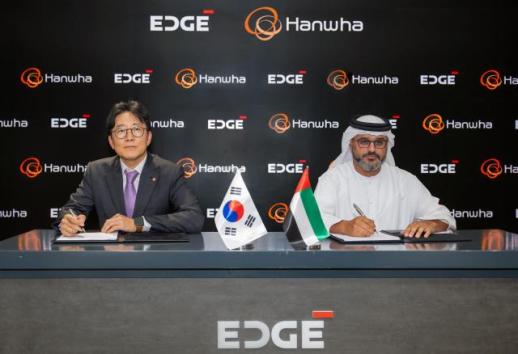 Hanwha, EDGE team up on integrated UAE air defense network SEOUL, September 17 (AJP) - Hanwha Systems and the UAE’s EDGE Group have agreed to jointly develop an integrated air defense network for the UAE. Hanwha Systems said Thursday the two sides signed a term sheet at EDGE headquarters in Abu Dhabi on Tuesday outlining the direction of the project and a phased review of weapons systems that could be introduced. Hanwha Systems has supplied multifunction radars, while Hanwha Aerospace has provided launchers, canisters and missile components for Cheongung-II exports to the UAE in 2022, Saudi Arabia in 2024 and Iraq in 2025. With EDGE, Hanwha plans to expand into a multilayered air defense network covering short-, medium- and long-range threats. “This agreement marks a turning point in the partnership between Hanwha and EDGE, moving beyond one-off weapons supplies toward sharing integrated air defense technologies and industrial capabilities,” Hanwha Systems CEO Yang Ki-won said. “We will gradually expand technology cooperation and localization to help strengthen the UAE’s defense industrial base,” Yang said. EDGE Group CEO Hamad Al Marar said the partnership is focused on expanding the UAE’s independent defense capabilities and local industrial base beyond the procurement of individual weapons systems. “EDGE will work with Hanwha to build a foundation for sustainable industrial cooperation,” Al Marar said. AJP Takeaways - Hanwha Systems and EDGE Group agreed to cooperate on an integrated air defense network for the UAE. - The partnership could include a local joint venture, production, maintenance and other localization efforts. - Hanwha plans to expand from individual weapons sales to a multilayered air defense network covering short-, medium- and long-range threats. 2026-09-17 11:02:00
 -
 KG Chemical to Build Tank Terminal in Ulsan, Expanding Energy Infrastructure KG Chemical has announced the launch of its tank terminal project in Ulsan, marking a significant step in its efforts to develop energy infrastructure as a new growth driver following its fertilizer and chemical materials business.The company began basic civil engineering work in September to utilize idle land at its Ulsan plant for the tank terminal. By the end of June next year, it plans to complete the first phase, which includes three to four tanks with a total capacity of 6,500㎘.This construction is the first step in KG Chemical's plan to establish a tank terminal with a total capacity of 200,000㎘ over the next three years. The company aims to sequentially expand storage facilities and logistics infrastructure to significantly enhance the storage and logistics capabilities for liquid cargo.The tank terminal project is part of KG Chemical's long-term strategy to diversify its business portfolio. By leveraging the geographical advantages of its Ulsan plant and the operational expertise accumulated through its fertilizer and chemical businesses, the company aims to secure a stable and sustainable revenue base.KG Chemical plans to develop the tank terminal not just as a simple storage facility rental business but as a core infrastructure supporting the KG Group's eco-friendly energy value chain.In particular, through collaboration with its affiliate KG Eco Solutions, which operates in the eco-friendly fuel sector, the company expects to minimize reliance on external storage facilities while simultaneously improving logistics stability, cost competitiveness, and operational efficiency.A KG Chemical official stated, "The fact that the tank terminal project, which has been meticulously prepared, has entered the actual construction phase is significant. We will complete this first phase without any setbacks and proceed with gradual expansions to realize a central tank terminal with a total capacity of 200,000㎘."Meanwhile, Kim Jae-ik, CEO of KG Chemical, expressed in an interview with this publication in July that the tank terminal project will not merely focus on generating revenue through storage facility rentals but will also strengthen the group's eco-friendly fuel and energy storage and logistics systems.* This article has been translated by AI. 2026-09-17 11:00:00
 -
Hanwha Systems Shares Surge Over 10% Following UAE Defense Network Announcement Hanwha Systems' stock surged in early trading after news broke that the company will participate in the construction of an integrated air defense network in the United Arab Emirates (UAE).As of 10:50 a.m. on September 17, the Korea Exchange reported that Hanwha Systems shares rose by 7,400 won (10.67%) to 76,100 won compared to the previous trading day.The sharp increase in stock price is attributed to the announcement of Hanwha Systems' involvement in the Middle East air defense project. On September 15 (local time), the company signed a key agreement with the local defense firm EDGE Group in Abu Dhabi regarding the integrated air defense network project.Under this agreement, both parties will pursue the export and joint development of long-range surface-to-air missile systems (L-SAM), counter-drone systems, and the mid-range surface-to-air missile system Cheongung-II. They will also explore the establishment of a local joint venture and production and operational plans, pending government approvals and consultations.Analysts are optimistic about the growth potential stemming from increased demand for air defense systems in the Middle East. IBK Investment & Securities projected on September 14 that revenue from existing export projects, including Cheongung-II to the UAE and Saudi Arabia, will drive performance growth, setting a new target price of 90,000 won.Additionally, Hanwha Systems reported a 218.8% increase in consolidated operating profit for the second quarter of this year, reaching 103.7 billion won compared to the same period last year. Revenue also rose by 45.5% to 1.1176 trillion won during the same timeframe. Compared to the previous quarter, operating profit increased by 202.4%, and revenue grew by 38.5%. 2026-09-17 11:00:00
-
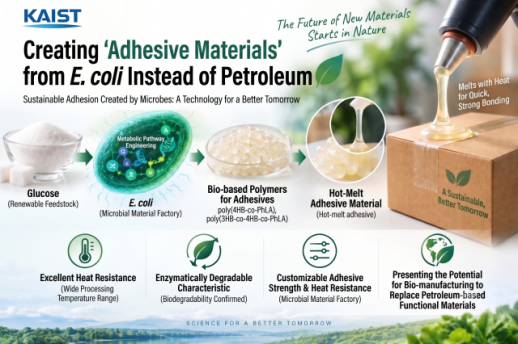 Microbes make adhesive that outgrips petroleum glue on steel SEOUL, September 17 (AJP) - Bacteria fed on sugar have produced an adhesive that held stainless steel together more strongly than the petroleum-based glue now used across industry, offering a way to make a common factory material without oil and with the ability to break down. In a shear test on stainless steel, the bio-made polymer withstood 4.58 megapascals. A commercial adhesive made from ethylene-vinyl acetate, or EVA, withstood 4.20 megapascals under the same test. That works out to about 47 kilograms of force per square centimeter, compared with 43. Shear strength measures how well two bonded surfaces resist being pushed apart sideways. The Korea Advanced Institute of Science and Technology (KAIST) said Thursday that a team led by Lee Sang-yup, a distinguished professor in its Department of Chemical and Biomolecular Engineering, engineered Escherichia coli bacteria to turn glucose into the new material. The findings were published online July 20 in the journal Nature Communications, with doctoral student Kang Min-ju and researchers Lee Young-jun and Kim Gi-bae as co-authors. The work targets hot-melt adhesives, the kind loaded into a glue gun. They melt when heated and harden as they cool, bonding surfaces quickly without chemical solvents. That makes them standard in packaging, furniture, electronics, cars and building materials. Most hot-melt adhesives are made from petroleum-derived plastics such as EVA. They bond well but do not break down easily in nature, which adds to waste and microplastic pollution. KAIST pointed to a practical consequence. A package made of biodegradable material is less green if the glue holding it together does not degrade. To build an alternative, the team turned to polyhydroxyalkanoates, or PHAs. These are biodegradable plastics that microbes can make from renewable feedstocks such as glucose. Their flexibility, strength and heat resistance change depending on which chemical building blocks go into them and in what proportion. The researchers combined two building blocks with opposite strengths. One, 4-hydroxybutyrate, makes the material soft and sticky. The other, phenyllactate, adds stiffness and helps it withstand heat. Changing the ratio between the two changed how the polymer handled heat and how well it bonded. Adhesion was strongest when 4-hydroxybutyrate made up roughly 24 to 34 percent of the building blocks, counted by number of molecules. Getting E. coli to make both building blocks and link them into one chain took several rounds of genetic redesign. Producing multiple components at once threw the cell's chemistry out of balance, so the team adjusted how strongly and when key genes switched on. The researchers also added an enzyme, CoA transferase, that prepares the building blocks for the next step of assembly inside the cell. A computer model of the thousands of chemical reactions running inside the bacterium helped the team find where raw materials ran short or production stalled. Those bottlenecks were then removed. Grown in fed-batch fermentation, a method that feeds nutrients to the microbes continuously, the engineered bacteria produced 10.2 grams of the two-part polymer per liter of culture. When the team added a third building block, 3-hydroxybutyrate, the resulting polymer reached 52.8 grams per liter. The three-part version was tested on wood, where its bonding strength was about the same as the commercial EVA adhesive. The two-part polymer that beat EVA on steel kept a substantial share of its bonding strength after being melted and reapplied several times, and the added phenyllactate improved its heat resistance. To check whether the material breaks down, the team treated it with lipase, an enzyme that digests fats. The polymer's surface was damaged, and both its molecular weight and total mass fell. Those results come from laboratory tests. KAIST did not report how the material degrades in soil, seawater or landfill conditions, and it gave no estimate of production cost or a timeline for commercial use. KAIST said the same approach of designing a microbe's metabolism could be used to tune other properties, such as flexibility and heat resistance, and to produce other functional plastics that are now made through petrochemical processes. "This study shows that by precisely designing microbial metabolism, we can go beyond simply producing polymers and directly produce functional materials," Lee said. With a wider range of unnatural building blocks and engineered microbes, he said, the approach "could expand into a biomanufacturing technology that produces not only petroleum-based adhesives but a range of functional polymers in a sustainable way." Journal/Source: Nature Communications Title: Synthesis of poly(4HB-co-PhLA) and poly(3HB-co-4HB-co-PhLA) as sustainable hot-melt adhesives using engineered Escherichia coli Link/DOI: https://researchgate.net/publication/410617396_Synthesis_of_poly4HB-co-PhLA_and_poly3HB-co-4HB-co-PhLA_as_sustainable_hot-melt_adhesives_using_engineered_Escherichia_coli 2026-09-17 10:57:34
 -
Woori Financial Exceeds Productive Finance Goal with 25.3 Trillion Won Supply Woori Financial Group has exceeded its annual goal for productive finance this year. The company plans to expand funding and investment, focusing on local and small businesses.On September 16, Woori Financial held the 'September Advanced Strategic Industry Finance Council' at its headquarters in Jung-gu, Seoul, chaired by Chairman Im Jong-ryong, to review the progress of its productive and inclusive finance initiatives.As of August, Woori Financial supplied a total of 25.3 trillion won in the productive finance sector, including 15 trillion won in investments and 23.8 trillion won in loans. This represents 116.3% of its annual target and 35.7% of its five-year goal.In the investment sector, the company is increasing its participation in the National Growth Fund and expanding venture capital supply. Woori Investment & Securities has provided 365.1 billion won in venture capital by August, exceeding its initial target by 180%.In the inclusive finance sector, Woori Financial supplied a total of 2.2 trillion won by August, including 950 billion won for low-income finance, 790 billion won for mid-interest loans, and 430 billion won for small business loans.Through Woori Bank's personal credit loan interest rate cap of 7%, approximately 75,000 individuals received a total of 3 billion won in interest relief by the end of August. The 'Woori WON Dream Living Expense Loan' provided 55.5 billion won to 7,200 individuals.The company is also expanding its debt write-off program. Woori Bank plans to write off an additional 1.2 trillion won by the end of this month, following 424 billion won in the first half of the year. Woori Card is expected to write off about 1.2 trillion won, bringing the total write-off amount for the group to approximately 2.8 trillion won.Chairman Im Jong-ryong stated, “Based on the achievements in productive finance, we need to broaden our support for local and technologically advanced small businesses. We must also expedite inclusive finance to ensure that necessary funds reach those in need on time.”* This article has been translated by AI. 2026-09-17 10:56:20
-
Finance Committee Approves Lee Hyung-il's Confirmation Report Amid Opposition Concerns The National Assembly's Finance Committee approved the confirmation report for Lee Hyung-il, the nominee for Deputy Prime Minister and Minister of Finance, on September 17. The People Power Party included a note of 'ineligibility' in the report.During a full committee meeting, the report was adopted with bipartisan agreement. However, the People Power Party expressed that many concerns raised during the confirmation hearing had not been adequately addressed, leading to their note of ineligibility. The Democratic Party reflected a 'qualified' opinion in the report.At the confirmation hearing held on September 15, criticism arose regarding Lee's ownership of an apartment in Gwacheon, where he had only lived for four months out of 17 years, contradicting the government's housing policy focused on actual residence.People Power Party lawmaker Bae Jun-young stated, "We recognize the necessity of a control tower to swiftly restore the economy and that Lee has promised to actively respond to the concerns raised. I ask Chairman Cho Seung-rae to supervise this diligently."Chairman Cho remarked, "I hope the Finance Committee can work together to help Lee effectively carry out his duties in addressing the challenging economic situation," as the confirmation report was adopted.The Finance Committee also approved plans for the National Assembly's audit of 46 institutions, including the Ministry of Finance and the Ministry of Planning and Budget, scheduled from October 6 to 23. The newly established Korea-U.S. Strategic Investment Corporation, which launched in June, has also been added to the list of institutions to be audited.* This article has been translated by AI. 2026-09-17 10:56:00
-
Choi Min-sik and Han So-hee's 'Intern' Tops Box Office on Opening Day, Surpassing 'Odyssey' The film 'Intern' debuted at the top of the box office on its opening day.According to the integrated ticket sales network on September 17, 'Intern' claimed the number one spot at the box office, surpassing the long-running 'Odyssey.' It became the first Korean film to reach the top of the box office in 50 days since 'Hope.''Intern' tells the story of Gi-ho (played by Choi Min-sik), a silver intern with 37 years of experience, who joins the company of Sun-woo (played by Han So-hee), a rising star in the fashion industry after three years. The film captures the office life of the two characters across generations and ranks.Christopher Nolan's 'Odyssey' attracted over 41,000 viewers (28.8%) on the same day, securing the second position at the box office.'Odyssey,' which had maintained the daily box office number one spot for six consecutive weeks since its release on August 5, has now ceded the top position to 'Intern.' It is the second film this year to surpass 10 million viewers, following 'The King and the Clown.'* This article has been translated by AI. 2026-09-17 10:52:00
-
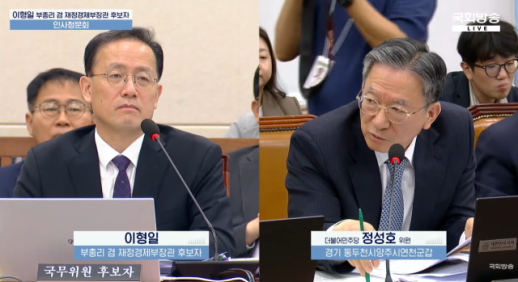 Finance nominee set to take post after clearing parliamentary hearing SEOUL, September 17 (AJP) - Lee Hyung-il, nominee for deputy prime minister and minister of finance and economy, moved a step closer to taking the post as the National Assembly's finance committee adopted his confirmation hearing report on Thursday. The move makes Lee the first of six ministerial nominees tapped by President Lee Jae Myung in his second Cabinet reshuffle on Aug. 30 to clear the parliamentary confirmation process. The committee convened at 9:30 a.m. and adopted the report after Lee underwent a roughly 12-hour confirmation hearing the previous day. During the hearing, lawmakers scrutinized him over a Gwacheon apartment he has owned for about 17 years despite living there for only about four months. Lawmakers from the ruling and opposition parties also clashed over the government’s proposed 164 trillion won ($118.8 billion) fund aimed at addressing future economic challenges. Lee, 55, is a career economic bureaucrat who passed the country's civil service exam for senior government positions in the finance and economics track in 1992 before beginning his career at the Finance Ministry. He later served in a string of senior posts including director-general of the Economic Policy Bureau, deputy minister, presidential secretary for economic policy and commissioner of Statistics Korea before becoming first vice minister of finance and economy. He earned a bachelor's degree in economics from Seoul National University and a doctorate in economics from Texas A&M University. Meanwhile, confirmation hearings for the remaining nominees for the justice, defense, gender equality and family, land and transport, and SMEs and startups ministries are still pending. AJP Takeaways - South Korea's parliament adopted Lee Hyung-il's confirmation hearing report with bipartisan support. - Lee became the first nominee from President Lee Jae Myung's second reshuffle to clear this stage. - A career economic bureaucrat, Lee passed the civil service exam's finance track in 1992. 2026-09-17 10:49:48
 -
 KOSPI climbs as market absorbs Fed hike SEOUL, September 17 (AJP) - South Korean stocks extended gains Thursday morning despite the U.S. Federal Reserve's first interest rate hike in more than three years, as easing oil prices and strength in defense and shipbuilding shares offset continued foreign selling. As of 10:30 a.m., the benchmark KOSPI stood at 6,756.11, up 0.6 percent. The index had climbed as high as 6,795.53 after opening sharply higher, before giving back part of the advance. It touched a session low of 6,710.58. Foreign investors remained firmly on the sell side, unloading 565.5 billion won ($410 million) of KOSPI shares. Institutions sold 59.6 billion won, while retail investors bought a 216.4 billion won. The continued foreign selling limited the market's upside after overseas investors had already sold Korean stocks for six consecutive sessions through Wednesday. The gains came after the Fed raised its benchmark interest rate by 25 basis points to a range of 3.75 percent to 4.00 percent overnight, its first tightening move since July 2023. Fed Chair Kevin Warsh struck a hawkish tone, saying inflation remained too high and had persisted for too long. U.S. Treasury yields remained elevated, with the benchmark 10-year yield around 5.02 percent. Wall Street finished lower following the decision. The Dow Jones Industrial Average fell 1.21 percent, while the S&P 500 lost 0.45 percent and the Nasdaq Composite edged down 0.01 percent. Technology stocks held up better than the broader market. Nvidia gained 0.82 percent and Intel jumped 4.03 percent, helping the Philadelphia Semiconductor Index rise 0.63 percent. Korea's two largest chipmakers, however, moved in opposite directions. Samsung Electronics gained 0.6 percent to 254,750 won, while SK hynix slipped 0.3 percent to 1,754,000 won. Doosan Enerbility rose 2.5 percent and Hanwha Ocean gained 3.2 percent, while Hyundai Motor fell 3.5 percent and Samsung Electro-Mechanics declined 1.4 percent. Defense, aerospace and shipbuilding stocks were leaders of the market. Aerospace and defense shares climbed 5.6 percent, while shipbuilding stocks rose 5.5 percent. SpaceX-related stocks gained 7.5 percent as a theme, while the broader aerospace theme advanced 6.6 percent. The moves followed news that SpaceX is preparing to send its Starship spacecraft into Earth orbit for the first time during an upcoming test flight. Sensorview surged 20.2 percent and Spear gained 9.8 percent. Earlier in the session, Kenkoa Aerospace, Contec and other aerospace-related names also posted sharp gains. Hyundai Pharmaceutical was another standout, rising 7.1 percent to 10,680 won after the government said it aims to introduce abortion medication in Korea by the first quarter of next year. The secondary KOSDAQ gained 0.7 percent to 821.63 after rising as high as 823.58. AJP Takeaways - KOSPI up 0.6% at 6,756.11 as the market absorbed the Fed’s 25-basis-point rate hike. - Foreign selling persists: Overseas investors sold a net 565.5 billion won of KOSPI shares, while retail investors remained net buyers. - Leadership shifts beyond chips: Samsung Electronics edged higher while SK hynix slipped, with defense, aerospace and shipbuilding stocks leading gains instead. Retail investors bought a net 32.9 billion won and institutions purchased 4.7 billion won, while foreign investors sold a net 38.6 billion won. Among actively traded KOSDAQ stocks, Seongho Electronics jumped 19.6 percent, Hana Micron gained 7.3 percent and Jusung Engineering rose 1.98 percent. Oil prices provided some relief after sharp gains earlier in the week. West Texas Intermediate crude fell 0.3 percent to around $102.20 a barrel, while Brent crude slipped 0.03 percent to $105.80. The decline followed reports that Saudi Arabia plans to restore about half the capacity of its East-West pipeline within days, easing concerns over supply routes that bypass the Strait of Hormuz. The Korean won weakened to around 1,379 per dollar as the Fed's hawkish stance supported the U.S. currency. Throughout Asia, Japan's Nikkei 225 gained 0.5 percent to 64,246.36 and China's Shanghai Composite edged up 0.13 percent to 3,896.51. Hong Kong moved in the opposite direction, with the Hang Seng Index falling 0.9 percent to 24,490.04. 2026-09-17 10:48:41
 -
Lee Kang-in Scores Second Goal of the Season in Full-Time Debut for Atletico Madrid Lee Kang-in, wearing the Atletico Madrid jersey in La Liga, scored his second goal of the season during his first full-time start since transferring to the club.On September 17, in a home match against Osasuna at the Cívitas Metropolitano Stadium in Madrid, Lee started and contributed to the team's 4-0 victory in the sixth round of the 2026-2027 La Liga season.Playing as a right midfielder in Diego Simeone's 4-4-2 formation, Lee displayed lively movement from the beginning of the match. He found the net in the 54th minute, scoring after receiving a pass from Jonathan David during a counterattack. With a calm right-footed shot inside the penalty area, he accurately placed the ball into the bottom corner of the net, showcasing his finishing ability with his non-dominant foot.This goal marked Lee's second of the season, following his debut goal in the league opener against Malaga on August 20. He now has a total of 2 goals and 1 assist in 6 league matches.Additionally, this match was Lee's first time playing the full 90 minutes since returning to Spain from Paris Saint-Germain this summer. His performance earned him the Man of the Match (MOM) title, marking his second MVP selection of the season after the league opener.Football statistics site Footmob awarded Lee the highest rating of 9.0 among all players.With Lee's impressive performance, Atletico Madrid celebrated a scoring spree. The scoring began with David's opening goal in the 24th minute, followed by Lee's goal in the 54th minute, Robain Le Normand's third goal in the 63rd minute, and Alex Baena's goal in the 82nd minute, culminating in a 4-0 victory.Atletico Madrid has now secured two consecutive league victories, bringing their record to 4 wins, 1 draw, and 1 loss (13 points), placing them third in the league, just 2 points behind second-place Real Madrid (15 points).Riding this momentum, Atletico Madrid will face their local rivals Real Madrid in the seventh round of La Liga on September 20 at 11:15 PM.* This article has been translated by AI. 2026-09-17 10:48:00