


Latest by
-
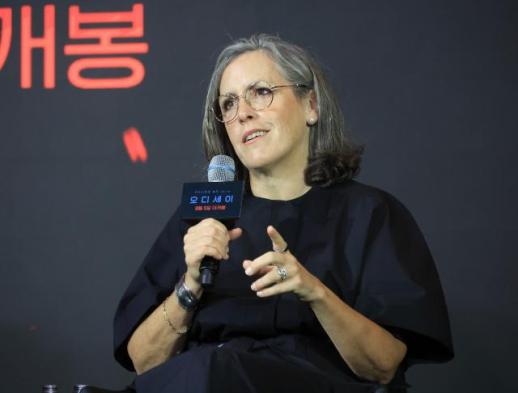 Cast and crew of 'The Odyssey' meet Korean press ahead of release Producer Emma Thomas answers questions from reporters at a press conference for the film 'The Odyssey' held at Four Seasons Hotel Seoul in Jongno-gu, Seoul, August 3, 2026. 2026-08-03 12:54:13
 -
 Cast and crew of 'The Odyssey' meet Korean press ahead of release Actress Charlize Theron answers questions from reporters at a press conference for the film 'The Odyssey' held at Four Seasons Hotel Seoul in Jongno-gu, Seoul, August 3, 2026. 2026-08-03 12:53:25
 -
 Cast and crew of 'The Odyssey' meet Korean press ahead of release Actor Matt Damon answers questions from reporters at a press conference for the film 'The Odyssey' held at Four Seasons Hotel Seoul in Jongno-gu, Seoul, August 3, 2026. 2026-08-03 12:51:53
 -
 Cast and crew of 'The Odyssey' meet Korean press ahead of release Director Christopher Nolan answers questions from reporters at a press conference for the film 'The Odyssey' held at Four Seasons Hotel Seoul in Jongno-gu, Seoul, August 3, 2026. 2026-08-03 12:49:20
 -
 Cast and crew of 'The Odyssey' meet Korean press ahead of release Director Christopher Nolan (from left), actor Matt Damon, actress Charlize Theron, and producer Emma Thomas listen to questions from reporters at a press conference for the film 'The Odyssey' held at Four Seasons Hotel Seoul in Jongno-gu, Seoul, August 3, 2026. 2026-08-03 12:48:11
 -
 Record Heat Wave and Drought Demand Urgent Government Response to Climate Disasters The Korean Peninsula has turned into a massive furnace, with temperatures in Yangsan, South Gyeongsang Province, exceeding 42 degrees Celsius, breaking the record for the highest temperature in the country’s 122-year meteorological history. The brutal heat is expected to persist for the foreseeable future.As the heat wave continues, the safety and lives of citizens are at risk, and economic losses in agriculture and industry are escalating rapidly. This situation has surpassed the level of a mere "temporary summer heat" and is now recognized as a serious social and climate disaster that threatens national functions and social foundations. It is time for a comprehensive government response.The extent of the damage has already crossed a critical threshold. The number of heat-related illnesses has surged, overwhelming emergency rooms with cases of heat stroke and exhaustion, putting vulnerable groups such as outdoor workers and the elderly in severe danger. The agricultural and fisheries sectors are also facing dire circumstances. Livestock farms across the country have reported the deaths of hundreds of thousands of chickens and pigs, while rising water temperatures have led to mass die-offs of fish in aquaculture along the southern and western coasts, undermining the primary industry. Coupled with drought, crop wilting is accelerating, threatening food prices. Electricity demand has also hit record highs, raising fears of blackouts and increasing concerns about widespread economic damage.To overcome this urgent situation, a coordinated and specific response between the central and local governments is essential. Above all, a cooperative response system at the government level is crucial. A special response team for climate disasters, involving the Ministry of the Interior and Safety, the Ministry of Health and Welfare, the Ministry of Trade, Industry and Energy, the Ministry of Agriculture, Food and Rural Affairs, and the Ministry of Oceans and Fisheries, should be activated immediately. Inter-ministerial ping-pong administration must be avoided, and if necessary, disaster safety special grants should be distributed early to enhance local governments' on-site response capabilities.Local governments must establish an emergency system focused on the field. Immediate, on-site measures such as expanding the deployment of water trucks, extending the 24-hour operation of cooling centers, and providing emergency water supply support to farms and aquaculture facilities must be implemented. In particular, protective measures for vulnerable groups most affected by the heat wave should be more detailed and specific. Social workers, community leaders, and dedicated caregivers should be matched one-on-one with at-risk households, such as elderly individuals living alone, the homeless, and people with disabilities, to provide daily health checks through a "close care service." Additionally, to assist energy-vulnerable groups who cannot even turn on air conditioning due to electricity costs, it is necessary to significantly expand the amount and eligibility for energy vouchers and to implement temporary electricity rate reductions during the heat wave period. For construction sites and outdoor workers, strict supervision must ensure that the "right to stop work during heat waves" is effectively guaranteed.The climate change we are facing is no longer a distant warning but a clear national disaster that is imminent. Weather disasters in the era of climate crisis are expected to become more frequent and intense. The government must redefine heat waves and droughts as core issues in the national disaster management system and establish a proactive and overwhelming administrative and financial support system, moving away from reactive measures. Delayed support only exacerbates disasters. There should be no hesitation in making comprehensive administrative and financial investments to protect the lives of citizens and social assets. 2026-08-03 12:44:00
 -
Marine Corps Officer Dies in Firearm Incident in Pohang A Marine Corps officer was found dead in a firearm incident at an off-base accommodation in Pohang, North Gyeongsang Province.On August 3, the Marine Corps reported that a non-commissioned officer was discovered dead from a gunshot wound at the officer's quarters in Pohang.At the time of discovery, there were no indications of foul play from external sources.A Marine Corps official stated, "We are currently investigating the exact circumstances of the incident in collaboration with military and police agencies."* This article has been translated by AI. 2026-08-03 12:40:00
-
[[ASIA BIZ]] South Korea Expands Infrastructure Cooperation with Vietnam The Ministry of Land, Infrastructure and Transport is expanding its infrastructure cooperation in line with Vietnam's national development plans. The Vietnamese leadership has requested South Korea's assistance in achieving its national development goals, leading to discussions on practical agendas such as railway modernization, urban development, and industrial infrastructure.According to recent reports from local Vietnamese media, Nguyen Phu Trong, General Secretary of the Communist Party and President of Vietnam, met with Kim Yoon-deok, Minister of Land, Infrastructure and Transport, on July 30 in Hanoi. Trong stated that Kim's visit would serve as an opportunity to enhance economic cooperation between the two countries and strengthen the comprehensive strategic partnership between Vietnam and South Korea.Ministry of Land Meets with Vietnamese Leadership to Expand Development AgendaTrong emphasized the importance of Vietnam's relationship with South Korea and expressed a desire to further strengthen cooperation in political, economic, trade, investment, science and technology, culture, and human exchanges. He also mentioned hopes to achieve a trade target of $150 billion (approximately 216 trillion won) between the two countries by 2030 in a balanced and sustainable manner.He positively assessed the collaboration between the Vietnamese Ministry of Construction and the Ministry of Land, Infrastructure and Transport, suggesting that both sides share experiences and enhance practical cooperation in infrastructure construction, renewable energy, shipbuilding technology, and advanced human resource development.During the meeting, Kim conveyed greetings from President Lee Jae-myung to Trong and other senior Vietnamese leaders. He congratulated Vietnam on its economic and social development achievements and expressed confidence that Vietnam would reach its goal of becoming a developing country with modern industry by 2030 and a high-income developed country by 2045.Kim also presented a letter from President Lee to Trong, outlining South Korea's commitment to developing the bilateral cooperation and being a reliable partner in Vietnam's national development efforts.Discussions on Practical CooperationAdditionally, the Ministry of Land, Infrastructure and Transport continued discussions on practical cooperation in the railway sector. On July 31, the Vietnamese Ministry of Construction and the Ministry of Land, Infrastructure and Transport held a Vietnam-South Korea railway technology cooperation meeting in Hanoi. The meeting was co-chaired by Tran Tien Khanh, Director of the Vietnam Railway Authority and head of the Vietnamese delegation, and Kim Tae-byeong, Director of the Railway Bureau of the Ministry of Land, Infrastructure and Transport.This meeting was the first technical meeting held under the memorandum of understanding on railway cooperation signed between Vietnam and South Korea in 2025. Khanh noted that both sides have been working on institutional capacity enhancement, technical support, railway personnel training, and infrastructure improvement projects in the Kennet Pass region using South Korea's Economic Development Cooperation Fund.He emphasized that these activities hold significant meaning in the modernization of Vietnam's railway network. The South Korean side viewed the first technical meeting as a new starting point for railway cooperation between the two countries. Kim stated that South Korea values comprehensive railway cooperation with Vietnam, including infrastructure, technology, and human resource training. He added that South Korea has experience in developing high-speed rail technology and can support Vietnam in developing a modern railway system.During the meeting, both sides discussed plans for railway projects, including high-speed rail, technology exchanges, operational system establishment, maintenance capacity enhancement, and personnel training. South Korean railway-related institutions expressed their willingness to share their experiences in project planning, management, technology transfer, operations, and maintenance, and to support Vietnam in the high-speed rail sector.From Railways to Urban Development: Collaboration in Bac Ninh Province Takes ShapeThe discussions also expanded to local government development. On July 31, in Bac Ninh Province, Nguyen Hong Tai, a member of the Central Committee of the Communist Party of Vietnam and Secretary of the Bac Ninh Provincial Party Committee, welcomed the delegation led by Minister Kim and discussed investment, urban infrastructure, and industrial development cooperation.Located near the capital Hanoi, Bac Ninh Province is home to major South Korean companies, including Samsung Electronics, and considers South Korea a key economic partner for regional development. Tai highlighted that several South Korean conglomerates continue to invest and operate in Bac Ninh, contributing to regional economic growth, job creation, and industrial restructuring. He emphasized that Bac Ninh will continue to create favorable conditions for the expansion of investment and production by South Korean companies.The province presented its expanded development space following administrative reorganization as a foundation for cooperation with South Korea. Tai explained that the adjustment of provincial administrative units has led to an increase in economic scale and population, creating conditions for new growth hubs. He also mentioned significant changes, including the approval of the comprehensive urban plan for Bac Ninh by 2050 and the recognition of meeting first-class urban standards by 2075.Urban development plans involving the Korea Land and Housing Corporation (LH) were also key topics of discussion. Tai noted that the former southeastern new city project in Bac Ninh is significant for urban space development in the province. He expressed hope that LH would develop this area into a creative city, serving as a model for urban development in Vietnam.Minister Kim praised Bac Ninh's economic and social development achievements and its competitiveness in attracting investment. He pointed out that many South Korean companies are operating in Bac Ninh, underscoring the province's important role in the global supply chain. He also stated that South Korea is ready to share its experiences in planning, technology infrastructure development, smart city construction, and modern traffic management.Meanwhile, LH specifically outlined its intention to pursue large-scale development projects in Bac Ninh. LH expressed hope that Bac Ninh would promptly approve investment policies for the southeastern new city project, covering approximately 223.5 hectares, with an estimated total investment of 19.78 trillion dong. LH also proposed the establishment of a high-tech industrial complex covering about 350 hectares. Meeting participants discussed prioritizing cooperation in sustainable solutions for industrial complex infrastructure, modern urban development, and urbanization.* This article has been translated by AI. 2026-08-03 12:32:00
-
Ulsan Elementary Schools Begin Classes Amid Ongoing Heat Wave, Parents Concerned As a prolonged heat wave continues, some elementary schools in Ulsan have already resumed classes or are set to do so soon, raising concerns among parents.While most elementary schools are scheduled to start classes in late August, some have ended their summer break early, returning to school between late July and early August. The overlap of the peak heat period with the start of classes has particularly raised worries about the safety of younger students during their commutes.An analysis of the Ulsan City Education Office's '2026 Academic Calendar' on August 3 revealed that Dongbaek Elementary School resumed classes on July 30, just a week after its summer vacation began on July 23.Sinjeong Elementary School in Nam-gu will start classes on August 4, following its vacation ceremony on July 24. Meanwhile, Yaksach Elementary and Jungnam Elementary are set to begin on August 13, Hakseong Elementary on August 18, and Yangji Elementary on August 19.The start dates for elementary schools in Ulsan vary significantly. Among the 124 schools, 32 will begin classes on August 24 and another 32 on August 25, making these the most common start dates. In total, 64 schools will start within these two days, accounting for more than half of the total. Following that, 16 schools will start on September 1, and 15 on August 26.Some schools will continue their summer break into September. The differences in summer vacation length and start dates are due to varying academic schedules, including instructional days, discretionary holidays, and winter break plans.The main concern is the safety of students returning to school during a prolonged heat wave, especially for those starting classes at the end of July or early August.While classrooms can utilize air conditioning, the situation is different for students during their commutes. Parents of younger elementary students, who may struggle with temperature regulation and coping with heat, are particularly worried about their children carrying heavy backpacks while exposed to the midday heat.A parent of a lower-grade student at Sinjeong Elementary, identified as A, expressed, "It is indeed concerning to see my child commuting with a heavy backpack under the strong sun and heat. Even if the classroom is air-conditioned, there are worries about heat-related illnesses due to outdoor exposure during commutes."Another parent, B, acknowledged the varying academic schedules among schools but noted, "The intensity of the heat wave in early August has changed compared to previous years. I hope schools can respond flexibly by adjusting commute times or implementing shortened classes based on weather conditions."The Ulsan City Education Office stated it will monitor heat advisories and weather conditions, aiming to prioritize student safety by flexibly managing academic schedules according to each school's circumstances. 2026-08-03 12:28:00
-
Busan City Allocates $100,000 to Protect Vulnerable Groups from Heatwave Busan City is allocating 100 million won (approximately $100,000) from its disaster relief fund to protect vulnerable populations, including the elderly, disabled, and homeless, in response to the highest recorded temperatures in July and the first heatwave warning in the region.On August 3, Busan officials announced that they will provide cooling costs and heat illness prevention supplies to senior centers, community welfare centers, disability support centers, and homeless shelters. The city recorded a peak temperature of 38.8 degrees Celsius (101.8 degrees Fahrenheit) on July 29, marking the highest July temperature since weather observations began in 1904. A heatwave warning was issued for the region on July 30, with heat advisories lasting for 13 days and tropical night warnings for 12 days.This support is an emergency measure added to existing heatwave response plans. The aim is to reduce the financial burden of cooling costs for social welfare facilities primarily used by vulnerable citizens and to secure supplies for preventing heat-related illnesses. The amount of support varies based on the number of facilities, operating hours, and usage patterns.For 225 senior centers, each will receive 200,000 won ($200) over two months, totaling 45 million won ($45,000). Busan City explained that this funding is intended to cover extended operating hours and the costs of running cooling equipment. Of the 55 community welfare centers, 53 will receive cooling supplies and heat illness prevention items, excluding two that do not operate as cooling centers.Among these, 12 centers that will extend their operating hours beyond the usual 9 a.m. to 6 p.m. will receive an additional 250,000 won ($250) each over two months for cooling costs, totaling 600,000 won ($600) in support.All 17 disability support centers will operate as cooling centers, but there are no plans for extended hours, so they will primarily receive heat illness prevention supplies instead of cooling cost support.Three homeless shelters will receive between 4 million and 6 million won ($4,000 to $6,000) based on their operating structure. The Hope Lighthouse Comprehensive Support Center, which operates emergency sleeping arrangements 24 hours a day, will receive 6 million won ($6,000), while the Hope Dream Center and the Dream Comprehensive Support Center will receive 4 million won ($4,000) each. The city explained that the differences in funding amounts are based on usage hours and cooling needs.A Busan City welfare policy official stated, “The Hope Lighthouse Comprehensive Support Center requires additional cooling cost support because it operates emergency sleeping arrangements around the clock.” However, the actual budget and supplies will be distributed gradually to each facility starting in early to mid-August. Each institution must determine the necessary items and quantities before proceeding with the purchasing process, and cooling costs will also be adjusted to align with the billing cycle for electricity usage.The official added, “We expect to begin distributing necessary items in early to mid-August after confirming the required supplies for each institution, and we plan to provide cooling costs around the same time.”The disaster relief fund will be administered through the Busan Community Chest of Korea. The legal basis for this support is outlined in Article 3-2, Items 9 and 12 of the Busan Disaster Relief Fund Ordinance, which allows the use of funds for cooling and heating costs for shelters and consumable supplies for vulnerable groups, as well as for projects deemed necessary by the mayor for disaster relief.If the heatwave persists, additional support will be considered. A city official noted, “The disaster relief fund has sufficient resources to allow for additional support,” adding that if any of the senior centers, welfare centers, homeless shelters, or disability support centers require extended or expanded operations, further assistance could be reviewed. The effectiveness of the support will be monitored based on reports of heat-related illnesses and the status of heatwave impacts managed by the city’s Natural Disaster Division.The welfare policy division plans to incorporate feedback from the Natural Disaster Division and facility staff to assess the effectiveness of the supply of prevention items and the expansion of cooling center operations, and will consider follow-up support if necessary. Busan City is also implementing measures to protect vulnerable groups, including checking on the well-being of elderly residents living alone, patrolling areas with high concentrations of homeless individuals, ensuring the safety of disabled persons, and inspecting cooling equipment at social welfare facilities.When a heatwave warning is issued, support staff and disability activity assistants will check on the health status of vulnerable individuals through phone calls and visits. They will provide guidance on heatwave safety measures and report any emergencies to relevant agencies, including local governments and social welfare facilities, to ensure prompt action is taken.Mayor Jeon Jae-soo stated, “The current heatwave poses a disaster situation that threatens the lives and safety of citizens,” emphasizing the need to quickly allocate necessary budgets and support to ensure that vulnerable groups, including the elderly, disabled, and homeless, can safely endure the summer.* This article has been translated by AI. 2026-08-03 12:12:00