


Latest by
-
 Student Loan Delinquencies Near 270 Billion Won, Half Held by Those Over 40 The burden of long-term delinquencies on student loans has shifted from young adults in their 20s to middle-aged individuals in their 30s and 40s. Those aged 40 and older now account for half of the total delinquent amount, with nearly 60% of the debt being classified as 'ultra-long-term delinquency' lasting over three years.According to data submitted by Rep. Han Byeong-do of the Democratic Party to the National Assembly's Education Committee, as of the end of July 2026, there were 50,101 borrowers who had been delinquent for more than six months, with a total delinquent amount of 272.3 billion won.The majority of long-term delinquents are in their 30s and 40s. The number of borrowers by age group shows that those in their 30s make up the largest share at 24,061 (48.0%), followed by those in their 40s at 18,993 (37.9%), and those in their 20s at 7,047 (14.1%). Thus, individuals over 30 represent 85.9% of all delinquents.The disparity in delinquent amounts is also pronounced. Borrowers aged 40 and older hold 134.3 billion won, nearly half (49.3%) of the total delinquent amount. Those in their 30s account for 115.4 billion won (42.4%), while those in their 20s hold 22.6 billion won (8.3%).As age increases, the average debt burden per person also rises. The average delinquent amount per person (overall average 5.435 million won) is 3.21 million won for those in their 20s, 4.8 million won for those in their 30s, and 7.07 million won for those aged 40 and older, which is 2.2 times that of those in their 20s.There are also concerns about the worsening quality of delinquencies. Among the delinquent amounts, 'ultra-long-term delinquent' loans that have not been repaid for over three years total 160.1 billion won, accounting for 58.8% of the total. Loans delinquent for 1 to 3 years amount to 84.8 billion won, while those delinquent for 6 months to 1 year total 27.4 billion won. The number of borrowers trapped in delinquency for over three years has reached 31,196.Despite this situation, recovery efforts have been declining. The annual occurrence of long-term delinquent loans rose sharply from 34.7 billion won in 2022 to 56.8 billion won in both 2024 and 2025, a 63.7% increase. In contrast, the recovery amount during the same period fell from 32.1 billion won to 29.2 billion won, a 9.0% decrease. Consequently, the net increase in long-term delinquent loans from 2022 to July 2026 is 87.1 billion won, calculated from the cumulative occurrence (224.7 billion won) minus the cumulative recovery (137.6 billion won).As concerns about student loan defaults grow, the Korea Student Aid Foundation is in discussions with the Financial Services Commission, the Ministry of Education, and the Korea Asset Management Corporation (KAMCO) to sell long-term delinquent loans to KAMCO's 'New Leap Fund' starting in July 2025. However, the planned sale will only cover about 3,800 borrowers, which is insufficient compared to the total of over 50,000 delinquents.Rep. Han Byeong-do stated, "Student loan debt is not just a problem that ends in youth. We need to prepare a debt adjustment roadmap for all 50,000 individuals, not just the 3,800 covered by the New Leap Fund sale."* This article has been translated by AI. 2026-09-15 16:00:00
 -
 Two hearts drive Kazakhstan - Almaty and Astana In 1997, when the government announced it was moving the capital, the reaction abroad was skeptical. The site chosen sat in the middle of the steppe and held fewer than 300,000 people. Countries that relocate a capital usually see one of two outcomes. The old capital loses its energy, or the new one hardens into a town of civil servants. Kazakhstan avoided both. The two cities split the work, and together they generate roughly 35 percent of national gross domestic product. Almaty took commerce and talent. It drew $8.58 billion in gross foreign direct investment last year, more than twice Astana's total, and services account for 85.9 percent of its gross regional product. South Korean manufacturers landed there too. Hyundai Motor assembles cars at a plant in Almaty with local partner Astana Motors, at an annual capacity of 80,000 vehicles. Kazakhstan is South Korea's largest trading partner in Central Asia, with two-way trade of $5.5 billion in 2023. Astana took a different route. Rather than chase what Almaty had, it built what did not exist. The Astana International Financial Centre (AIFC), which opened in 2018, carved out a zone where English common law applies instead of national law, with its own court, regulator and exchange. For a foreign investor, that settles in advance which court rules if a contract goes wrong. Registered companies reached 6,014 by midyear, 45 percent of them with foreign investors, and capital mobilized since opening stands at $26.3 billion. In the Global Financial Centres Index in March, Astana placed 65th worldwide and first across Eastern Europe and Central Asia. Almaty ranked 99th. The gap describes a division rather than a hierarchy. Astana laid a legal channel through which foreign capital can enter with confidence, and Almaty holds the market where that capital is put to work. Equity market capitalization at the Kazakhstan Stock Exchange in Almaty stood at about $76 billion at the end of last year. South Korean firms work the transport side too. SK Ecoplant and the Korea Expressway Corporation built the Almaty ring road with a Turkish contractor. Air Astana flies Incheon to Almaty daily, Asiana Airlines resumed the route in March, and Korean Air begins flying it on Dec. 17. The town on the steppe has passed 1.5 million residents. Astana added more than 110,000 people last year alone, a rise of 7 percent, and now produces about $37.6 billion in output a year. 2026-09-15 16:00:00
 -
 Aju, Kazinform in media deal amid Korea-Central Asia Summit SEOUL, September 15 (AJP) - A South Korean media company and Kazakhstan's state news agency agreed on Tuesday to share and jointly produce news content, opening a direct channel between the two countries' newsrooms hours before their leaders were to meet in Seoul. The memorandum of understanding was signed at Aju News Corporation's headquarters in central Seoul by Chairman Kwak Young-kil and Raushan Kazhibayeva, who directs the Republican State Enterprise "TV & Radio Complex of the President of the Republic of Kazakhstan." The complex owns Kazinform International News Agency, the country's official wire service, along with the Jibek Joly television channel. Aju News Corporation publishes AJP in English alongside its Korean-language news operations and is part of Aju Media Group that publishes news in other languages including Chinese, Japanese and Vietnamese. The signing came during the heaviest week of diplomatic traffic between the two countries in years. President Kassym-Jomart Tokayev is in Seoul on a state visit and was scheduled to hold bilateral talks with President Lee Jae Myung on Tuesday afternoon. On Wednesday, President Lee Jae Myung hosts the first Korea-Central Asia Summit with the leaders of Kazakhstan, Kyrgyzstan, Tajikistan, Turkmenistan and Uzbekistan, where the six governments are expected to adopt a Seoul Declaration setting out a long-term partnership framework. Under the terms of the agreement, the two organizations will exchange news content and credit each other as the source, produce material together, and open their correspondent networks to each other on request. It also covers staff training and internships, distribution of each other's output at home and abroad, and the sharing of production equipment. Costs for any of that work would be set in separate contracts, and the memorandum itself creates no financial obligation on either side. Kazhibayeva framed the deal as an opening to the wider region rather than a bilateral arrangement. "This agreement will become a gateway for Central Asian countries, opening doors to new cooperation between media companies," she said. AJP Takeaways - Kazinform Director Raushan Kazhibayeva signed a memorandum of understanding with Aju News Corporation Chairman Kwak Young-kil in Seoul on Sept. 15 under which the two organizations will exchange and co-produce news content, credit each other as the source, open their correspondent networks on request, and cooperate on staff training, distribution and production equipment, with no financial obligation created by the document itself. - Kazinform operates as part of a state enterprise supervised by Kazakhstan's presidential office that also owns the Jibek Joly television channel, is financed from the state budget, and runs correspondents in all 17 of Kazakhstan's regions plus bureaus in Russia, China, Türkiye, Europe, Azerbaijan, Uzbekistan, Kyrgyzstan and Jordan. - South Korea's foreign ministry counts 119,542 ethnic Koreans living in Kazakhstan, most of them Koryo-saram descended from those deported from the Soviet Far East in 1937, an anniversary the government plans to mark next year by expanding Korean language and culture programs in the region. AJP drew those figures and plans from foreign ministry data and government announcements rather than from the signing itself. Kazinform runs correspondents in all 17 of Kazakhstan's regions and maintains bureaus in Russia, China, Türkiye, Europe, Azerbaijan, Uzbekistan, Kyrgyzstan and Jordan. It publishes in Kazakh, Russian, English, Chinese and Uzbek from its headquarters in Astana. The agency traces its founding to August 1920, when it began as a regional branch of the Russian Telegraph Agency, and it has operated under several names and owners since. In 2022 it was folded into the presidential television and radio complex, and the following year the complex was reorganized into the state enterprise that holds it today. Its outlets are financed from the state budget. Kazhibayeva has led the complex since April 2022. She served as an adviser to Kazakhstan's prime minister and headed the public relations department at the country's Defense Ministry before taking the post. Kwak turned to the distance between the two publics rather than between the two governments. "South Korea and Kazakhstan go back a long way, but a wide gap still separates the two peoples. I hope this agreement closes that gap and brings them closer," Kwak said. Those ties predate the establishment of diplomatic relations on Jan. 28, 1992. Kazakhstan is home to 119,542 ethnic Koreans, according to South Korea's foreign ministry, most of them Koryo-saram descended from Koreans deported from the Soviet Far East to Central Asia in 1937. Next year marks the 90th anniversary of that forced resettlement, and the South Korean government has said it plans to expand Korean language and culture programs in the region to mark it. 2026-09-15 15:57:21
 -
Japan Not Invited to Xiangshan Forum as Officials Rush to China Japanese government officials have reportedly not been invited to this year's Xiangshan Forum, a major multilateral security conference hosted by China. As the Asia-Pacific Economic Cooperation (APEC) summit approaches in November, Japanese political and business leaders are making visits to China. However, relations between Japan and China remain strained following comments made by Japanese Prime Minister Sanae Takaichi regarding Taiwan.According to the Hong Kong newspaper Ming Pao, no Japanese government representatives were invited to this year's Xiangshan Forum, which runs from September 15 to 17 in Beijing. The Japanese defense attaché in China will also not attend. Last year, both the defense attaché and a researcher from the Japan Defense Research Institute participated. This year, former Prime Minister Yukio Hatoyama and other private individuals from Japan are expected to attend.Chinese Defense Minister Li Shangfu is scheduled to deliver a keynote speech at the forum. Reuters reports that he may emphasize a multipolar international order and cooperation while indirectly criticizing the United States and its allies. However, with a U.S.-China summit approaching at the end of the month, direct criticism of the U.S. is expected to be avoided, while Japan may face stronger criticism due to recent tensions.Relations between Japan and China deteriorated sharply last November after Takaichi stated that Japan's existence could be threatened in a Taiwan contingency. China has strongly opposed this statement and has demanded that Japan retract it.The cooling of relations is evident not only in security matters but also in cultural exchanges. According to Japan's Kyodo News, the 'Tokyo-China Film Week,' held annually in Tokyo every October, has been canceled this year. Additionally, Japanese film events were not held at the Beijing International Film Festival in April or the Shanghai International Film Festival in June.Amid these strained relations, Japanese political and business leaders are making efforts to improve ties with China. This is seen as a move to create a favorable atmosphere ahead of a potential meeting between Takaichi and Chinese President Xi Jinping during the APEC summit in Shenzhen in November.According to the South China Morning Post (SCMP), eight junior lawmakers from Japan's bipartisan 'Japan-China Friendship Parliamentary Alliance' began a three-day visit to China on September 13. Later this month, a delegation from the Japan International Trade Promotion Association (JAPIT), led by former Foreign Minister Takeshi Iwaya, is set to visit China from September 27 to 30 to seek a meeting with Xi. Japan's largest business groups, including Keidanren and the Kansai Economic Federation, are also planning visits to China in the coming months.Wang Guangtao, a professor of Japanese studies at Fudan University, told SCMP that these visits aim to create a favorable atmosphere for a potential Japan-China summit during the APEC meeting in November. However, he expressed skepticism about the effectiveness of these efforts, given the significance of Takaichi's comments regarding Taiwan.Takaichi is expected to attend the APEC summit in November, but it remains uncertain whether a meeting with Xi will take place. The Chinese side has indicated that Japan must demonstrate a clearer change in its stance and actions regarding the Taiwan issue. As a result, it may be challenging to find a breakthrough in bilateral relations through increased exchanges at the parliamentary or business levels alone.SCMP also noted that the weakening of Japan's diplomatic connections with China is another factor complicating efforts to improve relations. The departure of veteran politicians like former Foreign Minister Yohei Kono and former Liberal Democratic Party Secretary-General Toshihiro Nikai, who maintained close ties with China, has left a gap that younger politicians have not filled with informal high-level diplomatic channels.Furthermore, deteriorating public opinion towards China in Japan has made it politically burdensome for Japanese politicians to pursue improved relations.* This article has been translated by AI. 2026-09-15 15:56:20
-
Kakao Engages Shareholders Ahead of Upcoming Corporate Split Kakao is working to persuade minority shareholders ahead of its planned corporate split. This effort comes as opposition from labor unions and some minority shareholders has emerged regarding the absorption merger of Kakao Investment, a key step in establishing the structure for the surviving company, Kakao X, which will manage investments and subsidiaries after the split.According to industry sources, Kakao will hold a shareholder meeting on September 16 at 4 p.m. to discuss the details of the split, including its background and expected benefits.Kakao stated that the purpose of the meeting is to help minority shareholders understand key issues. The company is expected to address shareholders' concerns and questions regarding the split during a Q&A session.Kakao plans to split into a new entity, Kakao AI, and the surviving entity, Kakao X, in early 2027. Kakao AI will focus on KakaoTalk and artificial intelligence (AI) operations, while Kakao X will handle major subsidiary investments and new business development. The split ratio is set at 36.5% for Kakao AI and 63.5% for Kakao X, with existing shareholders receiving shares in both companies based on this ratio.Additionally, Kakao is working to streamline its governance structure by merging Kakao Investment into Kakao X. This small-scale merger is scheduled for January 1, 2027. The merger can proceed with a board resolution without a shareholder meeting, but if shareholders representing more than 20% of the total shares express written opposition within a specified period, the merger cannot move forward. The deadline for minority shareholders to register their opposition is September 18.There are approximately 1.6 million minority shareholders in Kakao, holding 64.83% of the total shares as of the second quarter of this year. The 20% threshold needed to block the small-scale merger corresponds to about one-third of the minority shareholders' holdings.As a result, the amount of opposition shares counted by September 18 is expected to be a critical turning point for Kakao's governance restructuring. If opposition exceeds 20%, it could delay the merger of Kakao Investment and disrupt the timeline for restructuring Kakao X.Minority shareholders are responding cautiously. According to the minority shareholder platform Act, they generally support the split as long as it includes a reassessment of shareholder value and protection of minority rights. However, they oppose any split that would harm shareholder value or infringe on minority rights.The decline in stock prices following the announcement of the split has also heightened concerns among minority shareholders. On August 21, the day Kakao announced the split, the stock price fell by 7.49% to close at 35,800 won. This uncertainty regarding the valuation of Kakao AI and Kakao X and the restructuring process has dampened investor sentiment.The Kakao labor union is also encouraging participation in expressing opposition to the small-scale merger. The Kakao branch explained that this action is separate from opposing the split itself and aims to demand that worker and shareholder opinions be reflected in the governance restructuring process. They are also considering joint responses with minority shareholders if necessary.Approval for the split itself must be obtained at a special shareholders' meeting on December 17. With minority shareholders holding over 60% of the total shares, their votes will be crucial not only for the merger of Kakao Investment but also for the approval of the split at the end of the year.During the upcoming meeting, Kakao will outline its growth strategy and shareholder return policies following the split. Key issues will include the appropriateness of the split ratio, the role of Kakao X, and strategies for enhancing corporate value post-split.* This article has been translated by AI. 2026-09-15 15:56:00
-
Do Investment Warnings on Soaring Stocks Really Work? A Month Later Analysis The Korea Exchange's investment warnings on soaring stocks have yielded mixed results in stock performance. Some stocks designated as investment warnings last month have seen a cooling off in their rapid price increases, while others have continued to rise, supported by new themes and demand.According to the Korea Exchange on September 15, several stocks, including Hyulim Robot, RF Materials, Bit & Electronics, Woori Technology, Wonik Holdings, Daehan Optical Communication, Newen AI, Samji Electronics, LK Samyang, and OIS Solutions, were designated as investment warning stocks due to their rapid price increases last month.Comparing the closing prices of these stocks on the last trading day before the investment warning designation and on September 15 reveals a significant divergence in stock performance. While some stocks have given back a substantial portion of their gains, others have continued to rise even after the warning was issued.Hyulim Robot was designated as an investment warning stock on August 14. Its closing price on August 13 was 7,720 won, but it closed at 6,140 won on the warning day, marking a 20.5% decline. This indicates that it has given back a significant portion of its gains since the warning was issued.In contrast, RF Materials has maintained its upward trajectory even after the investment warning was issued. Designated on August 5, RF Materials' price rose from 29,950 won on August 4 to 45,250 won on the warning day, a 51.1% increase.Analysts attribute the stock price increase to rising demand for optical communication driven by expanded investments in AI data centers. Kim Aram, a senior researcher at Shinhan Investment Corp., describes RF Materials as essentially the only player in the domestic lumens value chain, forecasting that sales of lumens pump laser packages will increase from 3 to 4 billion won last year to over 30 billion won this year and 70 billion won next year.Kim noted, "RF Materials has been the exclusive supplier of pump laser packages to Lumens since last year and has decided to expand its new factory at the request of clients, planning to start two-shift production from November to increase supply volume."Bit & Electronics also saw its stock price rise after being designated as an investment warning. Designated on August 10, its price increased from 3,005 won on August 7 to 4,120 won on the warning day, a 37.1% rise. This increase is attributed to heightened expectations for optical communication demand due to expanded investments in AI data centers.Investment warnings are a measure within the Korea Exchange's market alert system, one step above investment caution. Stocks designated as investment warnings require a 100% margin deposit for purchases and restrict purchases through margin trading. If a stock continues to surge after the warning, trading may be suspended or it may be designated as a high-risk investment.A securities industry official stated, "The purpose of issuing an investment warning is not to induce a stock price decline but to alert investors to overheating stocks in the short term and to limit speculative demand such as margin trading. If new policies, industry themes, or individual positive news emerge after the warning, demand may return, so it is important to consider trading volume, supply and demand, and additional factors rather than viewing the warning itself as a signal for a price drop."* This article has been translated by AI. 2026-09-15 15:52:00
-
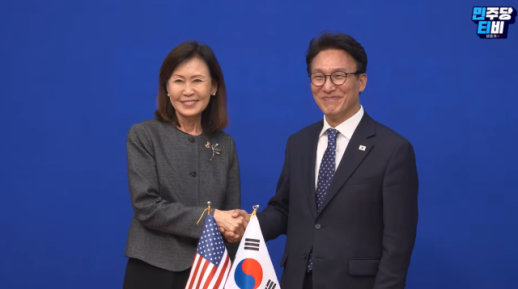 Korea's ruling party chief touts stronger US alliance in meeting with envoy SEOUL, September 15 (AJP) - Stronger self-defense capabilities do not conflict with a deeper alliance with the United States, ruling Democratic Party (DP) leader Kim Min-seok told U.S. Ambassador Michelle Steel on Tuesday. “The United States has been a reliable neighbor throughout South Korea's modernization, democratization and industrialization,” Kim told the U.S. envoy during their first meeting at the National Assembly since her arrival in late July. “I believe that the process of South Korea building its own capabilities does not contradict the deepening of its alliance with the United States.” Kim also expressed hope for progress in relations between Washington and Pyongyang, saying improved U.S.-North Korea ties could contribute to peace and progress on the Korean Peninsula. Steel said South Korea has emerged as a major player on the global stage and voiced hope for cooperation with Kim and the DP to strengthen the alliance and expand Seoul's international role. Kim's remarks came about a week after he told the National Assembly that South Korea could no longer rely solely on the United States and should strengthen its independent diplomatic and security capabilities as the regional security environment changes. Steel, a Korean-born former two-term U.S. congresswoman from California, arrived in South Korea on July 30 to take up her post. She was confirmed by the U.S. Senate in June and is the second Korean American to serve as Washington's ambassador to Seoul. AJP Takeaways - DP leader Kim Min-seok says stronger South Korean self-defense capabilities can coexist with a deeper U.S. alliance. - Kim tells U.S. Ambassador Michelle Steel that improved U.S.-North Korea ties could support peace on the Korean Peninsula. - Steel says South Korea has become a major global player and calls for closer cooperation to strengthen the alliance. 2026-09-15 15:45:34
 -
Kim Min-seok and Jang Dong-hyuk Meet with U.S. Ambassador Michelle Steel to Discuss Korea-U.S. Relations Kim Min-seok, leader of the Democratic Party, and Jang Dong-hyuk, leader of the People Power Party, met with U.S. Ambassador to South Korea Michelle Steel on September 15 at the National Assembly. During their discussions, Kim announced plans for a potential visit to the U.S. for diplomatic talks, while Jang proposed enhanced cooperation to address security threats from North Korea, emphasizing the importance of strengthening the Korea-U.S. alliance and promoting peace on the Korean Peninsula.Kim highlighted the need to further develop the alliance between the two countries, stating, "The United States has been a steadfast neighbor throughout South Korea's modernization, democratization, and industrialization processes." He stressed that South Korea's pursuit of autonomous capabilities should not conflict with deepening ties with the U.S., underscoring the significance of a strong Korea-U.S. alliance.Additionally, Kim mentioned that he is considering a diplomatic visit to the U.S., saying, "I am thinking about visiting the U.S. soon to discuss Korea-U.S. relations," and requested Steel's cooperation in this endeavor.Jang emphasized the importance of the Korea-U.S. alliance, noting, "As the U.S. has contributed to South Korea's miraculous economic growth, we are now contributing to U.S. economic development." He pointed out the increasing security threats from North Korea and human rights issues, arguing that these challenges must be addressed through cooperation among South Korea, the U.S., and Japan.Jang stated, "The two countries must strengthen security cooperation to counter North Korean threats. We can no longer ignore the dire conditions faced by our compatriots who do not enjoy basic freedoms," adding that the People Power Party will work to improve the situation regarding North Korea by collaborating with democratic nations and enhancing Korea-U.S.-Japan cooperation.Meanwhile, Ambassador Steel expressed her commitment to closely cooperate with the National Assembly on Korea-U.S. relations and North Korea strategies during her meetings with both party leaders. She conveyed her hope for close collaboration with the Democratic Party to strengthen the Korea-U.S. alliance and requested continued support for enhancing bilateral relations.* This article has been translated by AI. 2026-09-15 15:44:00
-
Number of Minors Holding Over 100 Million Won in Stocks Doubles to 5,400 The number of minors holding stocks worth over 100 million won has nearly doubled compared to last year. While the total number of minor shareholders has slightly decreased, those with high-value holdings have significantly increased.According to data received by Park Seong-hoon, a member of the National Assembly's Political Affairs Committee, from the Korea Securities Depository on September 15, the number of minors holding listed stocks worth over 100 million won reached 5,400 at the end of last year. This marks a 92.9% increase from 2,800 a year earlier. Additionally, the number of those holding between 50 million and 100 million won rose from 4,400 to 10,000, a 127.3% increase.However, during the same period, the total number of minors with stock holdings decreased slightly from 773,400 to 769,600. This follows a steady increase from 2021 to 2023, with a slight decline in growth last year.Despite the decrease in the number of holders, the total value of stocks owned by minors increased by 57.2%, rising from 4.65 trillion won in 2024 to 7.31 trillion won last year. Notably, the number of stockholders under the age of 10 decreased from 254,700 in 2024 to 232,100 last year, a drop of over 20,000, yet their total holdings increased from 1.2488 trillion won to 1.8355 trillion won, a 47.0% rise.The Korea Securities Depository's statistics on holdings are calculated based on the closing prices on the last trading day of each year. It is important to consider that the increase in the value of existing stockholders' holdings was influenced by the rise in the domestic stock market last year.Minors have shown a tendency to invest heavily in major domestic stocks such as Samsung Electronics and SK Hynix. According to data compiled by a major domestic brokerage firm on September 10, Samsung Electronics topped the list of net purchases by minor accounts, amounting to 51.5 billion won, followed by SK Hynix at 34.9 billion won and Hyundai Motor at 10.9 billion won. 2026-09-15 15:44:00
-
COFIX Rate for Variable-Rate Mortgages Stabilizes at 3.18% in August Last month, the COFIX (Cost of Funds Index), which serves as the benchmark for variable-rate mortgage loans, remained unchanged from the previous month.According to the Bankers Association on September 15, the COFIX for new transactions in August was 3.18%, the same as in July. The COFIX for new transactions had risen for four consecutive months from April to July, reaching its highest level in 1 year and 7 months at 3.22% in December 2024, but the upward trend halted in August.In contrast, the COFIX based on outstanding balances continued to rise. By the end of August, the outstanding balance COFIX increased by 0.05 percentage points to 3.05%, the highest level since June 2022 (3.07%).COFIX represents the weighted average interest rate of funds raised by eight domestic banks (NH Nonghyup, Shinhan, Woori, SC First Bank, Hana, IBK, KB Kookmin, and Citibank Korea). It reflects changes in the interest rates of deposit products and bank bonds. A decrease in COFIX indicates lower funding costs for banks, while an increase suggests the opposite.The COFIX for new transactions and outstanding balances includes regular deposits, savings accounts, mutual savings, housing savings, certificates of deposit, repurchase agreements, commercial paper, and financial bonds (excluding subordinated and convertible bonds).The new outstanding balance COFIX rose from 2.65% to 2.71%, an increase of 0.06 percentage points. This new outstanding balance COFIX also reflects the interest rates of other deposits, borrowings, and settlement funds.Major banks are expected to reflect the COFIX rate announced today in the new variable-rate mortgage loans starting as early as September 16.* This article has been translated by AI. 2026-09-15 15:40:10