


Latest by
-
 Asia's Gen Z do not wait for permission anymore SEOUL, July 24 (AJP) - A canceled exam in New Delhi. A social media ban in Kathmandu. A housing allowance in Jakarta. A job quota in Dhaka. None of these, on its own, reads like the beginning of a national crisis. Yet each one sent hundreds of thousands of young people into the streets, and in two of those countries the government did not survive. Something has shifted in how Asia's youngest adults deal with power. The region's leaders are finding out the hard way. The latest lesson is unfolding in India. For more than three weeks, students have held a protest site near Parliament in New Delhi, and smaller demonstrations have spread to Mumbai, Bengaluru, Hyderabad and dozens of other cities. The spark was the leak of a national medical school entrance exam in May, which forced millions of students to retake their tests. Prime Minister Narendra Modi, now in his 13th year in office, waited until this week to respond, posting on social media that nothing matters more than the welfare of the youth and promising fast-track tribunals for the leakers. Protesters called it late and lame. Their demands widened the next day. Why does an exam leak shake a government? Look underneath it. India's economy is growing at a healthy pace on paper. Still, nearly 40 percent of young degree holders are unemployed, according to the State of Working India 2026 report from Azim Premji University. Families pour savings and debt into an education system that routinely fails to prepare graduates for work. Then the one gateway that promised fairness, the entrance exam, turns out to be crooked too. The same sequence has been playing out across the region for four years. In Bangladesh in June, 2024, students protested a quota system that reserved a large share of government jobs for descendants of independence war veterans. In a country where a stable public sector job is one of the few reliable paths to a middle-class life, the quota felt like a rigged game. Then Prime Minister Sheikh Hasina dismissed the protesters with a slur, her security forces opened fire, and the movement stopped being about quotas at all. More than 1,000 people died, according to the interim government's health ministry. In August, Hasina fled to India by helicopter, ending 15 years in power. Nepal came next, in September 2025. The government of K.P. Sharma Oli banned 26 social media platforms, including Facebook, YouTube and X, citing registration rules. Young Nepalis read it as censorship, and the tinder was already dry. Videos contrasting the luxury vacations of politicians' children with the grinding poverty of ordinary families had gone viral under hashtags mocking the "nepo kids" of the elite. Within days, parliament was burning and at least 19 protesters were dead. Oli resigned. The ban itself was lifted almost immediately, and it changed nothing. The ban was never the story either. In Indonesia, the fuse was a report in August 2025 that all 580 members of parliament were collecting a monthly housing allowance of about $3,000, roughly 10 times the minimum wage in Jakarta. Protests turned into riots after a police armored vehicle ran over and killed Affan Kurniawan, a 21-year-old motorcycle delivery driver who was not even demonstrating. He was trying to complete a food order. In a country where the gig economy has become the holding pen for millions of young people the formal economy cannot absorb, his death needed no explanation. President Prabowo Subianto revoked the perks within days. At least eight people had died by then. Sri Lanka started it all in 2022, when an economic collapse sent young protesters into the presidential palace, some swimming in its pool, and President Gotabaya Rajapaksa fled the country. What makes this wave remarkable is where it is happening. These are societies where age confers authority, where enduring hardship quietly is treated as a virtue, where the young have long been told their turn would come if they studied and waited. Protest itself is nothing new in Asia. Students drove South Korea's democratization in 1987 and filled Indian streets long before independence. But even those movements had structure the state could recognize. Umbrella coalitions, dissident elders, opposition politicians ready to carry street demands to the negotiating table. The new thing is a generation that skips all of it, organizing itself, naming its own enemies, and bringing down governments run by men twice and three times its age. The waiting is over. Governments keep misreading these movements, and the errors follow a pattern of their own. Leaders respond to the trigger. They cancel the ban, revoke the allowance, promise tribunals for the exam leakers. Each time the concession lands as an insult, because the protesters were never asking for the small thing. They were asking why an entire generation did what it was told, studied harder than any cohort before it, and arrived at adulthood to find the jobs missing, the exams rigged, and the officials' children shopping in Paris. No tribunal answers that. The next instinct is to look for someone to arrest, buy off, or sit across a table from. There is no one. India's protests are fronted by the Cockroach Janta Party, which is not a party at all but a satirical movement named after an insult delivered by the chief justice of the Supreme Court. Nepal's protesters organized on Discord, a gaming chat app. Indonesian demonstrators flew a pirate flag from a Japanese comic. To men who came up through party machines, this all looks unserious, and that is exactly the miscalculation. A movement with no head cannot be decapitated. The old strongman playbook was written against opposition parties and union bosses. It has no page for a hashtag. What remains is force, and force is the fastest way to lose. Hasina's men fired on students, and she lost the country. Nepal's crackdown killed 19, and the government fell within five days. In India, the batons and tear gas deployed on Monday turned a protest about exam accountability into something much larger. Watching from Seoul, it is tempting to treat all this as someone else's weather. South Korea's young people do not burn parliaments. But the underlying inventory should sound familiar. Brutal exam competition. Credential inflation. Youth unemployment concentrated among the educated. Housing priced out of reach. A raw, almost forensic sensitivity to fairness. The fury that followed South Korea's own hiring scandals struck the same nerve. Korean youth have so far channeled that anger through ballots and online mobilization rather than street occupations, and they have swung elections doing it. The difference between Seoul and Dhaka is not the grievance. It is whether institutions still offer a believable way out. That is the real warning in this wave. The Gen Z across Asia are not more radical than the generations before them. It is less patient with theater, and it no longer accepts a system's promises as payment. These young people watched their parents defer, and they watched deference go unrewarded. 2026-07-24 14:02:33
-
 U.S. Intelligence: Current Airstrikes Won't Change Iran's Negotiation Stance U.S. intelligence agencies have assessed that while President Donald Trump is escalating military action against Iran, current airstrikes are unlikely to change Iran's negotiation stance. Analysts also suggest that Iran is rapidly restoring military and critical infrastructure damaged by the strikes.According to CNN on July 23, the Central Intelligence Agency (CIA) and the Defense Intelligence Agency (DIA) believe that the ongoing U.S. airstrikes are not likely to alter Iran's position in negotiations. The report cited two U.S. officials familiar with the intelligence assessment.Despite suffering significant military and economic damage from U.S. and Israeli attacks, Iran's leadership appears to believe it can endure longer than the United States. Iran continues to exert pressure on the U.S. by targeting vessels in the Strait of Hormuz and energy facilities in the Gulf region.Alex Vatanka, a researcher at the Middle East Institute, stated, "Iran is willing to endure economic and military losses under the belief that it can outlast President Trump's resolve to continue the war."CNN noted that if the airstrikes and retaliatory actions continue for an extended period, there could be additional U.S. casualties and a prolonged crisis in the Strait of Hormuz. This situation could mirror the "endless wars" in the Middle East that President Trump has criticized.Iran's rapid recovery capabilities have also been identified as a factor diminishing the effectiveness of military pressure from the U.S. and Israel.The Wall Street Journal reported, citing satellite imagery analysis from Israeli and Western officials, that Iran is quickly restoring facilities damaged in airstrikes, including missile bases, bridges, ports, and production sites.In Khangavar, western Iran, the entrances and access roads to a missile base destroyed in a March airstrike were reportedly repaired within weeks. Bridges that were damaged in the strikes were also restored in just a few days.The focus of the airstrikes on collapsing tunnel entrances rather than the underground missile facilities themselves has expedited the recovery process. Much of the weaponry and equipment stored inside remained undamaged, allowing Iran to clear debris and reopen access points for use.Former Israeli Air Defense and Missile Defense Commander Ran Kohav remarked, "Iran has replenished its missile stockpile and possesses significant weapon production and recovery capabilities."* This article has been translated by AI. 2026-07-24 14:00:00
-
Nongshim and B.I. Korea to Raise Prices on Popular Products Next Month Nongshim and B.I. Korea will raise prices on key products next month. According to industry sources on July 24, Nongshim will increase the ex-factory prices of its main cup noodles, snacks, and beverages by an average of 5.8% starting August 1.The price adjustment will affect a total of 43 brands, including 18 cup noodle varieties, 23 snacks, and 2 beverages. The average price increase by category is 6.0% for cup noodles, 5.5% for snacks, and 7.7% for beverages. As a result, the suggested retail prices for major products will also rise. The popular cup noodle 'Yukgaejang Cup Noodle' is expected to increase from 1,100 won to 1,200 won, while the beloved snack 'Shrimp Chips (90g)' will go up from 1,500 won to 1,600 won.The actual selling prices of key products such as Shin Ramyeon Cup, Honey Twist Snack, Capri Sun, and Welch's will also be adjusted across various distribution channels.This price adjustment marks the first increase for noodles in 1 year and 5 months since March 2025, and for Shrimp Chips, it comes after a price increase in September 2022, followed by reductions in 2023 and 2025. Nongshim noted that this is effectively the first increase in 3 years and 11 months. Nongshim stated that the accumulated cost burden has exceeded its capacity to absorb it.A Nongshim representative said, "Due to the impact of high exchange rates and oil prices stemming from international circumstances, the costs of packaging materials and other supplies have surged, significantly deteriorating the profitability of our domestic operations. We have endured this through management efficiency and cost-cutting, but the unavoidable increase in supplier prices has led us to make this adjustment."However, Nongshim has decided to freeze the prices of all items in the bag noodle category, which accounts for 63% of its noodle sales, in an effort to minimize the burden on consumers amid rising prices and to support the government's price stabilization efforts.Additionally, the company plans to expand discounts and promotional offers at large supermarkets, convenience stores, and e-commerce platforms to reduce the perceived impact of the price increase on consumers.Recently, the food industry has seen a series of price adjustments due to rising costs of packaging materials, raw ingredients, and logistics. Lotte Chilsung Beverage raised the ex-factory prices of 44 items, including Chilsung Cider and Pepsi Cola, by an average of 5.3% in June, and Ottogi increased prices on 29 items, including curry, noodles, ketchup, and pepper this month. B.I. Korea will raise prices on 39 varieties of Dunkin' donuts by an average of 6.5% starting August 2. Key items seeing price increases include the Famous Glazed and Cocoa Honey Dip donuts, which will rise from 1,700 won to 1,900 won, and the Crème Brûlée donut, which will go from 4,100 won to 4,200 won. Some product prices have been reduced. Dunkin' lowered the prices of three varieties of 'Dubai Style Chocolate Donuts' by 300 to 400 won starting July 22. A Dunkin' representative stated, "We have had to adjust prices due to the rise in various costs." 2026-07-24 13:56:00
-
Constitutional Court Rules Against Ban on Political Activities by University Professors' Union The South Korean government is moving to amend the Teachers' Union Law after the Constitutional Court ruled that the ban on political activities by university professors' unions is unconstitutional.Labor Minister Kim Young-hoon stated on July 24, "We respect the Constitutional Court's decision, which considers the special legal status of university professors, and we will promptly push for amendments to the Teachers' Union Law in line with the court's ruling."On July 23, the court ruled 7-2 that Article 3 of the Teachers' Union Law, which prohibits political activities by university professors' unions, infringes on the right to equality.University professors were allowed to establish unions following amendments to the Teachers' Union Law in June 2020. However, the political activity ban that applied to teachers' unions was also imposed on professors' unions, meaning that while individual professors could engage in political activities, their unions could not.The court viewed this as an unreasonable form of discrimination, noting that individual professors are broadly permitted to participate in political activities such as joining political parties, running for public office, and campaigning. The court concluded that the mere formation of a collective body by university professors, who are allowed extensive political engagement, does not necessarily pose an immediate threat to the political neutrality of education.However, the court differentiated this ruling from a previous decision that upheld the ban on political activities for primary and secondary school teachers' unions, indicating that the circumstances and subjects of the two cases are distinct.* This article has been translated by AI. 2026-07-24 13:52:00
-
Vietnam Stock Market Declines, But Korean Funds Show Resilience The Vietnamese stock market has plummeted to its lowest level in four months, yet some Korean funds have managed to maintain positive returns in the first half of the year. Amid margin calls and foreign selling pressure, strategies focusing on large-cap stocks like VIC (Vingroup) and VHM (Vinhomes) have differentiated the performance of two funds managed by Korean Investment Trust Management in Vietnam.On July 22, the VN Index of the Ho Chi Minh Stock Exchange closed down more than 62 points at 1,668, marking the largest decline since late March and falling below the psychologically significant 1,700 level.The VN Index has dropped significantly for four consecutive trading days, accumulating a 7.6% decline. Compared to its all-time high of 1,927 points recorded two months ago, the adjustment has reached 13.5%. The total trading value on the Ho Chi Minh Stock Exchange was approximately 23 trillion dong (about $1.68 billion), slightly up from the previous trading day, but buying interest remained weak.The direct cause of this sharp decline has been attributed to margin calls and the resulting 'forced selling pressure.' Tyler Nguyen Minh Dung, a senior market strategy researcher at HSC Securities, identified the increased volume of forced selling as a primary reason for the drop. He noted, "Selling pressure concentrated between 10:30 and 11:00 AM, and again from 2:00 to 2:30 PM."Forced selling has spread as declines in certain stocks prompted sales of other holdings. Dung observed that the selling affected speculative stocks, those that had already fallen significantly, and even large-cap stocks that had no apparent negative news. He suggested, "Cross-forced selling may have contributed to the widening adjustment during the trading session."Truong Quang Binh, head of the Ho Chi Minh branch of ACB Securities, also diagnosed that margin calls and forced selling rapidly exacerbated the index's decline. He explained, "By the end of the second quarter, the balance of margin loans at securities firms had surged to about 450 trillion dong (approximately $25.3 billion), causing investors to feel pressured." Consequently, some investors appeared to have reduced their positions to minimize losses or protect existing gains.In terms of supply and demand, foreign selling of large-cap stocks has added to the market's burden. On that day, foreign investors net sold approximately 5 trillion dong (about $281 million), marking the largest selling volume in the past month and a half. Stocks representing various sectors, including SSI, ACB, EIB, TPB, and VIB, were among those targeted by foreign sellers.Binh explained that after funds exited major sectors such as banking, securities, oil and gas, and steel, pressure also mounted on stocks affiliated with Vingroup. Notably, VIC and VHM, which had previously supported the index amid selling in various sectors, accounted for 32 points of the index's decline on that day.Korean Funds Show ResilienceMeanwhile, despite the rollercoaster ride of the Vietnamese stock market in the first half of the year, some Korean-managed funds have reported positive returns. As of June 30, among 15 major foreign investment funds, only three recorded positive returns when converted to Vietnamese dong. Among them, the KIM Vietnam Growth Fund achieved a return of 1.7%, while the KITMC Worldwide Vietnam RSP Balanced Fund posted a 1.5% return.Both funds are products of Korean Investment Trust Management. The KIM Vietnam Growth Fund invests in leading high-growth companies in Vietnam and maintains a significant allocation to listed stocks. The KITMC Worldwide Vietnam RSP Balanced Fund seeks long-term capital growth by investing in listed companies in Vietnam or those primarily operating in Vietnam, combining both stocks and bonds.As of mid-July, the KIM Vietnam Growth Fund had net assets of approximately $310 million (about 4.58 trillion dong), while the KITMC Worldwide Vietnam RSP Balanced Fund had net assets of $192 million (about 2.83 trillion dong).The performance difference can be attributed to their portfolios. As of the end of last month, the KIM Vietnam Growth Fund had the largest allocations in top market capitalization stocks in Vietnam, including VIC, VHM, and VCB (Vietcombank). Among these, the allocations to VIC and VHM were significant, along with holdings in MBB (Military Bank) and CTG (Vietnam Joint Stock Commercial Bank for Industry and Trade). The KITMC Worldwide Vietnam RSP Balanced Fund had a similar composition but with a larger allocation to VIC.The strength of VIC and VHM has positively impacted the two Korean funds. These stocks have shown triple-digit growth rates over the past two years, leading the VN Index's rise. However, on the day of the sharp decline, these same stocks also faced selling pressure, contributing to the index's drop.In contrast, other major foreign funds struggled to defend their returns. The JP Morgan Vietnam Opportunities Fund recorded a slight gain of 0.1%, while the Vietnam Enterprise Investment Limited and Vietnam Equity UCITS Fund managed by Dragon Capital reported returns of -3.7% and -6.6%, respectively. The Forum One-VinaCapital Vietnam Fund, part of the VinaCapital group, posted -0.3%, and the VinaCapital Vietnam Opportunities Fund recorded -2.6%, while the Finland-based PYN Elite Fund saw a return of -6.1%.In terms of long-term performance, both Korean funds have outperformed the market. From December 31, 2019, to June 30, the KITMC Worldwide Vietnam RSP Balanced Fund achieved a return of 122.7%, surpassing the VN Index's increase of 93.6% during the same period, making it the highest among 15 foreign funds. The KIM Vietnam Growth Fund also recorded a return of 101.8% during that time.* This article has been translated by AI. 2026-07-24 13:52:00
-
Presidential Security Service Launches Safety Control Team for Korea-Central Asia Summit The Presidential Security Service announced the establishment of a safety control team on July 24, in preparation for the '2026 Korea-Central Asia Summit' scheduled to take place in Seoul this September.The safety control team, led by the Security Planning and Coordination Office, consists of five divisions: the Security Operations Headquarters, Military Operations Headquarters, Police Operations Headquarters, Fire Operations Headquarters, and Terrorism Information Support Headquarters. The team will oversee the safety of delegations, including heads of state, and manage security at various event venues.Particularly for this summit, which will be held in downtown Seoul, the security service emphasized its commitment to ensuring safety while minimizing public inconvenience. Plans are in place to limit traffic disruptions and enhance traffic information dissemination.Hwang In-gwon, head of the Presidential Security Service, stated, “We will showcase world-class ‘K-security’ by integrating the expertise gained from numerous multilateral summits with advanced technology. We aim to harmonize perfect security with minimal public inconvenience through restrained control, ensuring that this summit becomes a successful national celebration.”* This article has been translated by AI. 2026-07-24 13:52:00
-
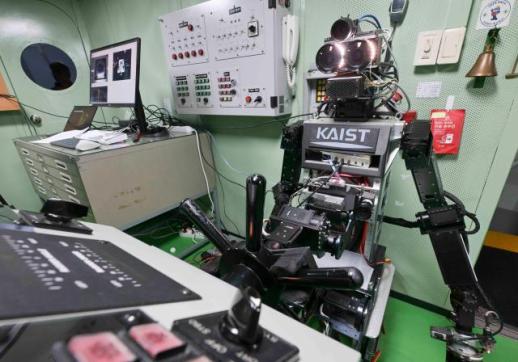 Navy tests humanoid robot at ship's wheel in first crew experiment SEOUL, July 24 (AJP) - South Korea’s Navy has tested a humanoid robot as a ship crew member for the first time, putting the machine at the wheel inside a bridge simulator as part of efforts to reduce sailors’ workload and prepare for a shrinking pool of military personnel. The Navy said Friday that the experiment was conducted Wednesday at the Naval Education and Training Command’s ship-handling training facility in Changwon, South Gyeongsang Province, in cooperation with the Korea Advanced Institute of Science and Technology. Video footage released by the Navy showed KAIST’s humanoid robot PIBOT standing at the helm inside a bridge simulator designed to replicate a naval vessel. Navy personnel stood watch at the windows and control panels, while researchers monitored the robot from nearby computer screens. In the footage, an officer of the watch gave PIBOT a helm order through a handheld microphone, just as he would to a human sailor: “Rudder left five degrees, steady on 330.” PIBOT repeated the command, moved its mechanical arm toward the wheel and turned the steering gear. After the simulated vessel’s heading stabilized, the robot reported that the course change had been completed. The repeat-back procedure is a standard part of ship handling, used to ensure that helm orders are clearly received and correctly executed. The Navy said PIBOT followed the same process used by human sailors. The test was conducted under a range of simulated conditions that naval vessels could face at sea, including narrow-channel navigation requiring frequent course changes, rough weather that repeatedly shifts a ship’s heading and nighttime navigation. The footage showed the simulator’s bridge windows switching between maritime scenarios, while PIBOT remained at the steering station and responded to orders from Navy personnel. The experiment assigned PIBOT the role of helmsman, a crew member responsible for operating the steering gear in response to orders from the captain or the officer of the watch. On a naval vessel, another sailor, known as the engine order telegraph operator, separately adjusts the ship’s speed. The Navy said the experiment was intended to examine whether robots can take over some shipboard duties now performed by sailors, beginning with steering tasks, and to explore how robotic systems could be operated aboard naval vessels. The project is linked to the Navy’s broader Navy Sea GHOST initiative, a manned-unmanned maritime combat system designed to integrate unmanned platforms and advanced technologies into future naval operations. The combat experiment will proceed in four stages: land-based ship-handling simulation, testing aboard a docked vessel, daytime sea trials and long-duration day-and-night sea trials at sea. Wednesday’s experiment was the first stage. “The Navy will use the results of this experiment to explore ways to operate robots aboard ships, reduce the workload of ship crews and actively respond to a changing defense environment, including a sharp decline in military manpower and rapid advances in high technology,” Rear Adm. Kim Hyung-jun, head of the Navy Force Analysis, Test and Evaluation Group, said. KAIST professor Shim Hyun-chul, who leads the research team, said it was meaningful to test whether a humanoid robot based on physical AI technology could perform the role of a Navy helmsman. PIBOT has been under development by KAIST since 2022 under an ADD defense technology program, with $4.1 million in funding from the Defense Acquisition Program Administration. 2026-07-24 13:48:56
-
President Lee Departs for U.S. and South America, to Announce AI Declaration in San Francisco President Lee Jae-myung and First Lady Kim Hye-kyung departed for a 7-night, 11-day tour of the United States and South America on July 24, 2026. They will visit San Francisco, Brazil, Chile, Argentina, and return via Germany.President Lee and First Lady Kim left Seoul's Seongnam Airport around 1 p.m. on July 24. They were seen off by key officials, including Chief of Staff Kang Hoon-sik, Chief Political Secretary Hong Ik-pyo, and Acting Leader of the Democratic Party Han Byeong-do.Upon arrival in San Francisco, President Lee will hold a series of meetings with Dario Amodei, CEO of Anthropic; Sam Altman, CEO of OpenAI; Jensen Huang, CEO of NVIDIA; and Hock Tan, President and CEO of Broadcom. He will also attend the upcoming 'San Francisco AI Summit.'The summit will feature over 150 participants, including prominent South Korean business leaders such as Lee Jae-yong of Samsung Electronics, Choi Tae-won of SK Group, Chung Eui-sun of Hyundai Motor Group, and Lee Hae-jin of Naver, alongside global tech CEOs, AI companies, researchers, startups, and investors.During the summit, agreements between domestic companies and big tech firms will be signed, and President Lee will announce the 'San Francisco AI Declaration' and participate in discussions.Later, President Lee will host a dinner with representatives from domestic and big tech companies. In the afternoon, he will attend a 'Silicon Valley Venture Investment Meetup,' meeting with representatives from six leading venture capital firms, including Andreessen Horowitz, General Catalyst, Sequoia Capital, Khosla Ventures, Lightspeed Venture Partners, and New Enterprise Associates.Following a signing ceremony for an MOU between the National Pension Service and these VCs, a roundtable will be held to discuss cooperation in the Korea-U.S. venture ecosystem.On July 26, President Lee will make a state visit to Brazil, arriving in Brasília for a welcome reception hosted by President Luiz Inácio Lula da Silva and his wife.The next day, an official welcome ceremony will take place, followed by a summit at the Palácio da Alvorada, an MOU signing ceremony, a joint press conference, and a state luncheon. Afterward, President Lee will travel to São Paulo for a luncheon with expatriates and a 'Korea-Brazil Business Roundtable' on July 28.On July 29, President Lee will begin his official visit to Chile with a dinner for expatriates. On July 30, he will lay a wreath at the statue of national hero O'Higgins, followed by an official welcome ceremony at the Palacio de La Moneda, a summit, an MOU signing ceremony, a joint press conference, and an official luncheon. In the afternoon, he will attend a 'Korea-Chile Business Roundtable.'That night, President Lee will arrive in Buenos Aires to commence his official visit to Argentina. On July 31, he will honor the national hero at Plaza San Martín, followed by an official welcome event at the Casa Rosada and a summit with President Javier Milei, concluding with a dinner for expatriates.On August 2, President Lee will stop in Frankfurt, Germany, for a meeting with expatriates before returning home.National Security Office Director Wi Seong-lak stated, 'Brazil, as the fifth largest country by area and seventh by population, leads the regional order in South America and demonstrates active leadership in the UN and G20. This South America tour will solidify international cooperation with these nations.' 2026-07-24 13:44:00
-
Solus Advanced Materials Reports 2nd Quarter Operating Loss of 21.3 Billion Won Solus Advanced Materials announced on July 24 that it recorded a consolidated operating loss of 21.3 billion won and sales of 101.9 billion won for the second quarter of 2026.Sales increased by about 31% compared to 77.8 billion won in the same period last year and rose approximately 16% from 88.1 billion won in the previous quarter. The operating loss slightly increased from 20.8 billion won year-on-year but decreased by 35.8% from 32.4 billion won in the previous quarter.While profitability is improving due to expanded sales and increased operating rates, ongoing losses are attributed to rising raw material prices caused by the war and the impact of the new OLED factory expansion.The battery foil segment recorded sales of 75 billion won, a 63% increase from the same period last year, driven by increased orders from existing major customers and new client acquisitions. The demand for energy storage system (ESS) products has also surged due to the expansion of AI data centers. In Europe, the recovery in demand for electric vehicles (EVs) has led to increased supply of products for EVs and ESS, contributing to overall growth.The company expects profitability to improve gradually starting in the third quarter as the effects of a product mix shift toward high-value products are reflected. It anticipates that increased supply to major North American customers and expanded production by European clients, including CATL, will drive performance.In the OLED division, sales reached 26.9 billion won, a 15% decrease compared to the previous year. This decline is attributed to seasonal off-peak effects in the first half, which led to reduced sales volumes from major customers and delays in OEM approval schedules from clients in China.The copper foil (circuit foil) segment, which has completed its sale process, is not included in this quarter's results.Gwak Geun-man, CEO of Solus Advanced Materials, stated, "The demand for battery foil from North American and European customers continues to expand. We expect that improvements in product mix and the effects of new project production will lead to increased average operating rates and a foundation for profitability in the second half of the year."Meanwhile, Solus Advanced Materials has secured the only production base in Europe through its battery foil plant in Hungary. To respond to increasing customer demand, the company decided to invest 40 billion won in its Hungarian subsidiary last month.* This article has been translated by AI. 2026-07-24 13:40:00
-
U.S. and Iran Diplomats Exchange Heated Words Over Retaliation The top diplomats of the United States and Iran engaged in a public exchange over the level of retaliation each country would pursue. Iran's assertion of a 'eye for an eye' principle was met with a stronger U.S. response, described as 'eye for a head.'On July 23, U.S. Secretary of State Marco Rubio spoke with reporters at a meeting of ASEAN foreign ministers in Manila, Philippines, stating, "I saw the Iranian foreign minister say that 'eye for an eye' is their policy. President Trump's policy is 'eye for a head.'" This indicates a willingness to respond to Iranian attacks with even greater force.Rubio warned, "Iran will pay a very heavy price for its current actions," and claimed that Iran has been seeking negotiations with the U.S. both directly and indirectly.Earlier, Iranian Foreign Minister Abbas Araghchi posted on X (formerly Twitter), stating, "Our defense principle is clear: an eye for an eye," and warned that any aggression targeting Iran, including infrastructure, would provoke a strong and decisive response.Following Rubio's comments, Araghchi took to X again to rebut, criticizing some U.S. officials for burying their heads in the sand and focusing solely on the 2028 U.S. presidential election while ignoring reality. He asserted, "The U.S. president wants to achieve results in negotiations with Iran, but due to the reckless attacks of some individuals, they will pay a greater price."This exchange of words was sparked by President Donald Trump's warning the previous day that he would bomb bridges and power plants in response to Iranian attacks on vessels in the Strait of Hormuz. Trump stated on social media platform Truth Social, "Whenever Iran attacks a ship in the Strait of Hormuz, I will destroy one of their bridges or power plants."* This article has been translated by AI. 2026-07-24 13:40:00