


Latest by
-
 Casino Regulation: Finding Balance in South Korea's Gaming Industry There is broad agreement on the need to reform South Korea's casino regulations, which have seen little change over the past 30 years. While the foreign-only casino market has expanded, the system for continuously assessing the qualifications and management status of operators has remained largely untouched. The framework for the tourism development fund, introduced in 1995, has also largely stayed the same.The 'Direction for Advancing Casino Regulations' forum held on July 22 at the National Assembly highlighted the differing perspectives on these issues. Government officials and academics argued for strengthening public accountability and management systems, while industry representatives cautioned against regulations that could threaten their survival. Key points of contention included the introduction of a five-year renewal licensing system and adjustments to the burden rate of the tourism development fund.The government's concerns are understandable. The casino industry is a sector that the state has permitted under strict conditions, unlike general tourism businesses. There is a need to establish mechanisms for regularly checking operators' financial health, compliance, and governance, especially as the industry has grown and public responsibilities need to be adjusted accordingly.There are several international examples of renewal licensing systems. However, the fact that these systems exist abroad does not mean that the market conditions are the same. Many overseas integrated resorts cater to domestic demand, while South Korea's foreign-only casinos operate under a fundamentally different market structure. Before applying the same standards, it is essential to consider these differences.What stood out during the forum was that both the government and the industry were not making incorrect arguments. The government emphasized the need for transparency and public accountability in the industry, while industry representatives voiced their ongoing concerns about survival.The reality on the ground is challenging. Although there are signs of recovery following the pandemic, large-scale integrated resorts still face significant financial burdens due to their initial investments. One resort representative noted that annual financial costs alone reach 120 billion won. Given the industry's nature, which requires a long time to recoup initial investments, there are concerns that new burdens could lead to reduced investment and job losses.Proposals to increase the tourism development fund should not be viewed solely through the lens of burden rates. The government has indicated it is considering a progressive approach that applies a maximum burden rate of 15% based on revenue size rather than uniformly. However, since each establishment has different revenue structures, investment levels, and debt sizes, the actual burden could vary significantly. Policies should be designed not just based on revenue increases but also consider operating profits, investment capacity, foreign currency acquisition effects, and contributions to employment.A more significant variable is time. With the opening of the Osaka integrated resort in Japan in 2030, the competitive landscape of the Northeast Asian casino market is likely to change dramatically. A new competitor with global operations, large hotels, international conference centers, and shopping and cultural facilities will emerge. The South Korean casino industry must prepare for more intense competition while discussing regulatory reforms.Thus, the direction of policy must be clear. While regulation is necessary, it should not weaken competitiveness. If a renewal licensing system is introduced, the criteria for evaluation and grounds for cancellation should be clearly disclosed to allow operators to invest in a predictable environment. Objective standards that minimize subjective judgments by evaluators are also needed. Additionally, it may be worth considering a sufficient grace period for new investment establishments.If the burden of the fund is adjusted, its usage must also be clear. There should be trust that the funds collected from casinos will be effectively used for expanding tourism infrastructure, training professionals, preventing problem gambling, and enhancing industry competitiveness. Reasonable incentives for operators contributing to job creation, non-casino facility investments, and local tourism revitalization should also be discussed.The industry must not ignore the need for change. Strengthening management transparency, internal controls, and responsible gambling systems are fundamental conditions for the industry to gain public trust, regardless of regulation. Demands to reduce burdens without addressing these issues are unlikely to be persuasive.This discussion is not about choosing between strengthening regulations or protecting the industry. It is a process of finding how to enhance industry trust while maintaining competitiveness. The government should not overlook industry realities by prioritizing public accountability, and the industry should not reject change solely for survival.As the 2030 opening of the Osaka integrated resort approaches, what the South Korean casino industry needs is not a policy that distinguishes winners from losers, but a system that allows both the government and the industry to enhance competitiveness together. Effective regulation should not stifle the industry but rather support its long-term, healthy growth.* This article has been translated by AI. 2026-07-24 08:36:00
 -
South Korea Responds to U.S. 12.5% Tariff on Forced Labor Goods 청와대는 미국 정부가 한국에 12.5%의 관세를 부과하겠다고 발표한 데 대해 "아직 조사가 진행 중인 공급과잉 301조 등을 포함해 최종적으로 양국 간 합의한 15%가 지켜질 수 있도록 미 측과 긴밀히 협의해나갈 예정"이라고 밝혔다. 청와대는 이날 오전 언론 공지를 통해 "한·미 양국은 관세 합의가 준수돼야 한다는 공감대가 있다"며 이 같은 입장을 전했다. 미국무역대표부(USTR)는 23일(현지시간) 지난 3월부터 실시한 '무역법 301조' 조사 결과 강제노동 상품 수입금지를 도입·강제하는 데 실패한 60개 경제주체에 10~12.5%의 관세를 부과하겠다고 밝혔다. 무역법 301조 관세는 '강제노동' 관세와 '과잉생산' 관세로 구성돼 있다. 과잉생산은 자국 내 수요를 초과한 생산을 유지하는 국가를 조사하는 것으로, 한국은 두 가지를 모두 위반한 국가로 지목된 상태다. 다만 과잉생산 관세의 부과율은 아직 발표되지 않았다. 이번에 한국에 부과된 것은 강제노동과 관련해 12.5%를 산정받았다. 다만 지난해 한·미 정상은 상호관세를 25%에서 15%로 낮추는 데 합의한 바 있다. 현재 방미 중인 김정관 산업통상부 장관과 여한구 통상교섭본부장은 미 상무부와 USTR 관계자들을 만나 무역법 301조 관세 부과 상황을 논의하고 한·미 관세 합의 이행을 요구할 것으로 전해졌다.* This article has been translated by AI. 2026-07-24 08:32:00
-
Samsung Heavy Industries Strengthens U.S. Shipbuilding Collaboration Samsung Heavy Industries is embarking on extensive collaboration with the U.S. shipbuilding industry, leveraging its advanced shipbuilding technology and operational expertise.On July 23, during the opening ceremony of the Korea-U.S. Shipbuilding Cooperation Center (KUSPC) held at the Mayflower Hotel in Washington, D.C., Samsung Heavy Industries announced the signing of agreements related to U.S. business operations and joint research.The KUSPC was established under the Ministry of Trade, Industry and Energy to support joint research between Korean and American shipbuilders and facilitate communication between governments and businesses. The ceremony was attended by key officials, including Kim Jeong-kwan, Minister of Trade, Industry and Energy, and Howard Lutnick, U.S. Secretary of Commerce, along with Samsung Heavy Industries' Vice Chairman Choi Sung-an, Vice President Kim Kyung-hee, and representatives from Korea's top three shipbuilders.Samsung Heavy Industries has actively pursued initiatives to strengthen its business collaboration in the U.S. On the same day, Samsung Heavy Industries and Conrad Shipyard received Approval in Principle (AiP) from the American Bureau of Shipping (ABS) for the basic design of a 12,000 cubic meter liquefied natural gas (LNG) bunkering vessel they are jointly developing.This achievement follows the establishment of a cooperative relationship for the joint construction of LNG bunkering vessels in December of last year, where both companies collaborated on the design of vessels to be built in the U.S.Additionally, Samsung Heavy Industries signed a strategic business cooperation agreement with Saronic Technologies, a startup specializing in the design and manufacturing of unmanned surface vehicles. The partnership will focus on researching autonomous navigation and artificial intelligence (AI) digital solutions for unmanned surface vehicles, as well as collaborating on the establishment of production infrastructure based on robotics-driven process automation.Furthermore, Samsung Heavy Industries is expanding its collaboration with U.S. MRO partner Vigor Marine Group. The two companies have signed an agreement to establish a training center in the Pacific Northwest, where Samsung Heavy Industries plans to actively share its advanced technology and expertise.Choi Sung-an, Vice Chairman of Samsung Heavy Industries, stated, "The shipbuilding cooperation project with the U.S. that we have been preparing for will mark a new milestone with today's opening ceremony. We will do our utmost to usher in a renaissance in the Korea-U.S. shipbuilding and marine industry based on our technological capabilities."This collaboration is part of Samsung Heavy Industries' ongoing efforts to penetrate the U.S. shipbuilding market. In April, the company participated in a concept design project for the next-generation logistics support vessel (NGLS) with General Dynamics NASSCO, further broadening its cooperation in the U.S. naval sector. 2026-07-24 08:32:00
-
Financial Commission Advances Leverage ETF Deposit Requirement to July 31 The Financial Services Commission (FSC) will implement stricter basic deposit requirements for single stock leverage exchange-traded funds (ETFs) and exchange-traded notes (ETNs) starting July 31, ahead of the previously scheduled date. This measure aims to stabilize investor demand early, requiring investors to hold at least 30 million won in cash to make new investments or additional purchases.On July 24, the FSC announced the early implementation of the 'Strengthening Basic Deposit Requirements for Single Stock Leverage Products' after consultations with relevant agencies and the financial investment sector. This decision follows a market situation review meeting held on July 16, where the FSC outlined supplementary measures for single stock leverage products.Under the new rules, individual investors wishing to invest in or purchase additional shares of domestic and foreign single stock leverage products must have at least 30 million won in cash. Previously, securities such as stocks, ETFs, and bonds could be counted as 70% of the market value toward the basic deposit, with a minimum deposit requirement of 10 million won.The new system excludes securities from the calculation of the basic deposit. Additionally, the previous system that allowed brokerage firms to relax basic deposit requirements based on trading experience will be abolished. While increases in deposit requirements are permitted, reductions will not be allowed.The FSC has also revised the cash deposit recognition method. Going forward, even if securities are sold, the cash will only be recognized as a basic deposit once the settlement is completed and the actual cash is deposited into the account (T+2 days). Loans taken against the proceeds from sales will also be excluded from the basic deposit. This measure aims to prevent circular trading, where investors sell stocks and immediately buy single stock leverage products.The strengthened basic deposit requirements will also apply to existing investors making additional purchases. However, if they sell their holdings, the basic deposit requirements will not apply.The FSC plans to expedite the development of brokerage firm systems. Firms that fail to complete system construction by the deadline will be advised to limit new transactions in single stock leverage products.Additionally, measures to strengthen management of price discrepancies will be implemented following amendments to exchange regulations, effective August 19. The obligations of liquidity providers (LPs) regarding price discrepancy management will be reinforced, and the procedures for designating investment caution items will be expedited.The minimum trading quantity for single stock leverage products will be increased from 1 to 20 shares, with efforts to expedite the processing procedures and system development to implement this change earlier than the originally planned November date. A temporary halt on new listings and a ban on advertising were implemented immediately following the July 16 meeting, with the price discrepancy management enhancements set to take effect on August 19.The FSC stated, 'We will continuously monitor the impact of the supplementary measures and the market situation. If the market does not stabilize, we will consider additional measures after in-depth discussions with experts and investors.' It emphasized that efforts to revitalize the KOSDAQ market, encourage long-term investment, and introduce innovative financial products will continue unwaveringly.* This article has been translated by AI. 2026-07-24 08:28:00
-
Bitcoin Falls to $65,000 Amid Escalating Middle East Conflict As the risk of U.S.-Iran conflict rises, Bitcoin prices are declining amid soaring international oil prices. According to CoinMarketCap, Bitcoin was trading at $65,141 as of 8 a.m. on July 24, down 1.3% from the previous day.This drop is attributed to heightened tensions in the Middle East and a spike in oil prices. The U.S. has conducted airstrikes on Iran for 12 consecutive days, and President Donald Trump has hinted at the possibility of a large-scale attack on Iran.In an interview with Axios on July 23, President Trump stated, "We are on the verge of making a decision (to attack), and we are fully prepared."As geopolitical crises escalate, international oil prices have surpassed $100 again. September futures for Brent crude closed at $100.69 per barrel, up 7.04% from the previous session. Meanwhile, September futures for West Texas Intermediate (WTI) crude rose 6.17% to $92.19 per barrel.Rising oil prices typically lead to inflation and interest rate hikes, which in turn dampen demand for risk assets like Bitcoin.In line with these concerns, major altcoin prices are also trending downward. Ethereum fell 0.03% to $0.99, while Solana dropped 2.37% to $0.19. XRP is trading at $1.11, down 2.66%.At the same time, on the domestic exchange Bithumb, Bitcoin was trading at 95.47 million won (approximately $64,663), up 0.44% from the previous day. The so-called 'Kimchi Premium' indicates that domestic prices are lower than international prices, currently showing a negative 0.59%.* This article has been translated by AI. 2026-07-24 08:20:00
-
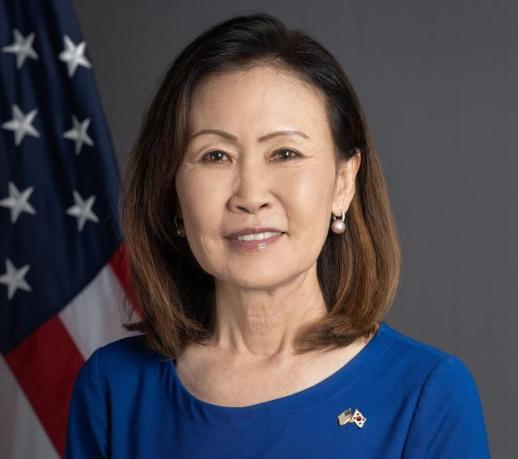 US ambassador to Korea Steel will arrive in Seoul next week SEOUL, July 24 (AJP) - The new United States ambassador to South Korea will arrive in Seoul next week, ending a vacancy of about 18 months at the top of the American mission and putting a confirmed envoy on the ground just as the two governments try to turn a sweeping trade and investment deal into actual projects. Michelle Steel gave the timing Thursday (local time) in response to a question from Yonhap News Agency at the opening of the Korea-U.S. Shipbuilding Partnership Center in Washington. "Next week," she said, referring other questions to the State Department. She called the work of strengthening the Seoul-Washington alliance her "top priority." Yonhap reported that she is widely expected to fly out around Wednesday. The post has had no confirmed occupant since Philip Goldberg left in January 2025, one of the longest gaps in the modern history of the embassy. James Heller has run the mission as chargé d'affaires ad interim, the title given to the senior diplomat who holds an embassy together when no ambassador is in place. A chargé can manage the building and pass messages. What a chargé cannot do is speak with the authority of a presidential appointee, and that distinction has mattered over the past year and a half. It has mattered because almost everything of consequence between the two countries has been decided somewhere else. The tariff and investment package that now defines the relationship was negotiated by cabinet ministers flying back and forth, instead of the embassy in Seoul. U.S. President Donald Trump on Thursday signed a memorandum directing the U.S. Trade Representative to impose tariffs of 10 percent to 12.5 percent on imports from 60 trading partners, including South Korea, following Section 301 investigations into whether they failed to prohibit or effectively enforce bans on imports made with forced labor. Rather than imposing a flat 12.5 percent tariff on Korean goods, however, the White House created a separate category for South Korea, Japan and Switzerland. Under the presidential memorandum, products from South Korea whose existing most-favored-nation (MFN) tariff is below 12.5 percent will be subject to an additional Section 301 duty sufficient to raise the total tariff to 12.5 percent. Products already facing MFN duties of 12.5 percent or higher will pay no additional Section 301 tariff. The White House said capping the total duty at 12.5 percent was "feasible, consistent with the terms of the Agreements on Reciprocal Trade or similar arrangements," and was intended to encourage Korea and the other economies to fulfill commitments on forced-labor import prohibitions. Steel arrives into that. She is 70, born in Seoul in 1955, and moved to the U.S. with her family in 1975. She speaks Korean. Her career before Congress was built on tax and local government in California, first on the California State Board of Equalization, which administers state taxes, and then on the Orange County Board of Supervisors, where she served as chair. She won a House seat in 2020, held it in 2022, and lost it narrowly to Democrat Derek Tran in 2024. Her husband, Shawn Steel, has been the Republican national committeeman for California since 2008 and led the state party from 2001 to 2003. That background points in a clear direction. Steel is a Republican operator with a business and tax orientation and a long-standing personal network in the Korean-American community, not a career Foreign Service officer. Trump nominated her in April, and the Senate confirmed her on June 17 by 55 votes to 39, close to a party-line result. During her time in the House, she pushed the Korean American Divided Families National Registry Act, which sought to help Korean Americans trace relatives separated in North Korea since the 1950~53 Korean War, and she served on Trump's advisory commission on Asian Americans and Pacific Islanders during his first term. Her confirmation hearing on May 20 before the Senate Foreign Relations Committee showed what she is likely to press on. Senator Bill Hagerty of Tennessee told her American technology firms and the e-commerce company Coupang appeared to be treated unfairly in South Korea and asked her to make sure that stopped. Senator Pete Ricketts of Nebraska raised trade barriers on American farm goods and cut quotas for American soybeans. Steel said she would take those cases to Seoul officials directly. The venue for her remarks on Thursday fit the same pattern. The Korea-U.S. Shipbuilding Partnership Center (KUSPC) is funded and staffed by Seoul and sits in Washington as the working base for the shipbuilding side of the package, known in both capitals by the slogan MASGA, or Make American Shipbuilding Great Again. It came out of a memorandum signed on May 8 between South Korea's Ministry of Trade, Industry and Resources and the U.S. Department of Commerce. Commerce Secretary Howard Lutnick attended Thursday's opening alongside Kim and executives from HD Korea Shipbuilding and Offshore Engineering, Samsung Heavy Industries and Hanwha Ocean, which bought the Philly Shipyard in Philadelphia in December 2024 and has committed $5 billion to expanding it. Steel will be the second Korean American to hold the Seoul post, after Sung Kim, who served from 2011 to 2014, and the second woman, after Kathleen Stephens, who served from 2008 to 2011. What she told the Senate in May was blunt. "American companies operating in Korea deserve the same market access that Korean companies enjoy in the U.S.," she said. 2026-07-24 08:11:25
 -
 Korea faces 12.5% tariff under new U.S. Section 301 SEOUL, July 24 (AJP) -South Korean exports to the United States will effectively face a tariff floor of 12.5 percent under President Donald Trump's new Section 301 action targeting imports linked to forced labor, but Seoul avoided being placed in the blanket tariff category after Washington cited its bilateral trade agreement with Korea. Trump on Thursday signed a memorandum directing the U.S. Trade Representative to impose tariffs of 10 percent to 12.5 percent on imports from 60 trading partners following Section 301 investigations into whether they failed to prohibit or effectively enforce bans on imports made with forced labor. The measures took effect at 12:01 a.m. Friday, immediately replacing the temporary 10 percent global tariff imposed under Section 122 of the Trade Act after the Supreme Court struck down Trump's reciprocal tariffs earlier this year. Rather than imposing a flat 12.5 percent tariff on Korean goods, however, the White House created a separate category for South Korea, Japan and Switzerland. Under the presidential memorandum, products from South Korea whose existing most-favored-nation (MFN) tariff is below 12.5 percent will be subject to an additional Section 301 duty sufficient to raise the total tariff to 12.5 percent. Products already facing MFN duties of 12.5 percent or higher will pay no additional Section 301 tariff. The White House said capping the total duty at 12.5 percent was "feasible, consistent with the terms of the Agreements on Reciprocal Trade or similar arrangements," and was intended to encourage Korea and the other economies to fulfill commitments on forced-labor import prohibitions. That treatment differs from the majority of economies investigated under Section 301, which were assigned either a flat 10 percent or flat 12.5 percent tariff. South Korea therefore avoided being classified among countries that failed outright to adopt forced-labor import prohibitions, while also avoiding an across-the-board additional tariff. Seoul dispatched Trade, Industry and Energy Minister Kim Jung-kwan to Washington ahead of the announcement, coinciding with the launch of the Korea-U.S. Shipbuilding Partnership Center, to advance the "Make American Shipbuilding Great Again" (MASGA) initiative — the centerpiece of South Korea's proposed $350 billion investment package under the bilateral trade and tariff agreement. The White House memorandum followed USTR's final determination that the acts, policies and practices of all 60 investigated economies were unreasonable and burdened U.S. commerce. The investigations concluded that the economies had either failed to prohibit or failed to effectively enforce bans on imports produced with forced labor. The USTR fact sheet described the action as applying to the top 60 U.S. trading partners accounting for 99.4 percent of U.S. imports, calling it the "most sweeping international labor rights action" ever undertaken by the United States. "The United States is the only country in the world to adopt, and effectively enforce, a ban on imports made with forced labor," USTR said, urging trading partners to adopt comparable restrictions. The memorandum also provides broad product exemptions. Products already subject to Section 232 national security tariffs, including steel and aluminum, are excluded from the new duties, as are informational materials, donations and accompanied baggage. Additional exemptions cover raw materials that could create domestic supply shortages, products whose tariffs could disrupt the U.S. economy, goods unavailable from alternative suppliers, and products whose exemption would better encourage trading partners to adopt forced-labor import bans. The accompanying 55-page Annex modifies the Harmonized Tariff Schedule of the United States by creating country-specific tariff headings. For South Korea, it establishes two separate tariff codes: one for products already subject to MFN tariffs of at least 12.5 percent, which receive no additional duty, and another for products with MFN tariffs below 12.5 percent, which are subject to a Section 301 duty bringing the total tariff to 12.5 percent. The Annex makes the changes effective for goods entering the United States from 12:01 a.m. Eastern Time on July 24. The White House said the structure preserves reciprocal trade arrangements while maintaining pressure on trading partners to strengthen enforcement against forced-labor imports. For South Korea, it means many exports will continue to face an overall tariff burden capped at 12.5 percent rather than a blanket additional duty, although Seoul still faces the prospect of further U.S. tariffs from a separate Section 301 investigation into structural excess capacity later this year. 2026-07-24 08:09:14
 -
Hanwha Ocean Advances Joint Development of U.S. Naval Vessels Hanwha Ocean is solidifying its position as a leader in promoting joint growth in the Korea-U.S. shipbuilding industry by establishing collaborative relationships with key partners in the United States, encompassing vessel design and development, workforce training, and supply chain development.On July 23, during the opening ceremony of the 'Korea-U.S. Shipbuilding Cooperation Center' in Washington, D.C., Hanwha Ocean announced the signing of contracts for the design and development of a Global Fast Sealift vessel, along with two memorandums of understanding (MOUs) aimed at workforce training and supply chain development in the shipbuilding sector.Hanwha Ocean has entered into a 'professional services contract' with Leidos Gibbs & Cox, a renowned name in vessel design, for the joint design of the Global Fast Sealift. This agreement marks a significant step forward from the MOU signed in April, which focused on enhancing naval shipbuilding capabilities for the U.S. and allied nations.Through this contract, the two companies will commence joint design efforts for the Global Fast Sealift, promoting collaborative technology development and establishing a cooperative framework to ensure design quality. This partnership aims to combine Hanwha Ocean's shipbuilding capabilities with the design and engineering expertise of Leidos Gibbs & Cox, which has designed over 70% of U.S. Navy surface vessels since World War II, to present a reliable and validated platform to the U.S. and global markets.Additionally, Hanwha Ocean signed an MOU with Hanwha Philadelphia Shipyard and Delaware County Community College to collaborate on shipbuilding technology education and development. This initiative aims to respond to the demand for skilled labor in the U.S. shipbuilding industry by developing instructor training programs.Delaware County Community College, located in eastern Pennsylvania, is a two-year institution that provides workforce training and technical education programs to the local community. It participates as a technical training institution linked to the apprenticeship program operated by Hanwha Philadelphia Shipyard, offering job-related theoretical education to apprentices.Furthermore, Hanwha Ocean has signed an MOU with Hanwha Philadelphia Shipyard, the Philadelphia Chamber of Commerce, and the Philadelphia Growth Partnership to enhance supply chain cooperation in the shipbuilding industry. This collaboration aims to identify local shipbuilding supply chains and build a regional shipbuilding ecosystem, seeking to strengthen the supply chain in the U.S. and expand the production capacity of Hanwha Philadelphia Shipyard.Jung In-seop, head of Hanwha Ocean's management support division, stated, "Hanwha Ocean is fully prepared to contribute to the revitalization of the U.S. shipbuilding industry and the advancement of the Korean shipbuilding sector. We will expand collaboration in areas where the U.S. has the greatest need, becoming a key driver of the MASGA project."MASGA is a Korea-U.S. shipbuilding cooperation initiative inspired by former President Donald Trump's 'MAGA' slogan, representing a $150 billion project for the revitalization and investment in the U.S. shipbuilding industry.* This article has been translated by AI. 2026-07-24 08:04:00
-
Turkish Airlines and Malta Tourism Board Strengthen Focus on Korean Market Turkish Airlines, the airline serving the most countries worldwide, and the Malta Tourism Board are enhancing their focus on the Korean market by increasing engagement with domestic travelers.On July 23, Turkish Airlines and the Malta Tourism Board jointly hosted a 'Media Day' for major domestic media at the Courtyard Marriott Seoul Myeongdong.The event aimed to promote the Incheon-Istanbul-Malta route and the convenience of transfers at Istanbul Airport, while also showcasing Malta's cultural, natural, and culinary tourism resources.Attendees included Endo Shingo, the head of the Malta Tourism Board's Japan-Korea office, and Ilker Basaran, the country manager for Turkish Airlines in Korea, who delivered welcoming remarks.Malta's 7,000-Year History Meets Demand for Individual and Experiential TravelThe Malta Tourism Board presented its tourism resources, including UNESCO World Heritage sites such as megalithic temples with a history of approximately 7,000 years, Mediterranean landscapes, gourmet experiences, luxury travel, and marine activities. The board also introduced tourism content tailored to the growing demand among Korean travelers for individual and experiential travel.Following this, Turkish Airlines explained its flight route from Incheon to Malta via Istanbul and highlighted the transfer system at Istanbul Airport, emphasizing connectivity to Malta and major European cities based on its global network. During a networking session that followed, participants discussed the outlook for the Maltese tourism market, European travel trends, and potential collaboration between the two organizations.Daily Flights to Malta via IstanbulTurkish Airlines operates as a global airline connecting Europe, the Middle East, and Africa, with Istanbul as its hub. Currently, it offers two daily flights to Malta via Istanbul, providing convenient connections for passengers traveling from Korea to Malta and other major European cities.Recently, the airline was recognized for having the 'World's Best In-Flight Meal' by AirlineRatings and won the 'Best In-Flight Meal in Europe' at the 2026 APEX Best Airline Awards.Founded in 1933 with five aircraft, Turkish Airlines is now a member of the Star Alliance and operates a fleet of 556 passenger and cargo aircraft. It serves 358 destinations in 133 countries worldwide, including 305 international and 53 domestic routes.* This article has been translated by AI. 2026-07-24 07:52:00
-
 Washington keeps Seoul on FX watchlist, backs KRW stabilization actions SEOUL, July 24 (AJP) -The United States kept South Korea on its currency monitoring list on Thursday, saying the country continued to run large external surpluses while acknowledging Seoul's intervention to curb excessive volatility in the won and its efforts to further liberalize the foreign exchange market. The U.S. Treasury again designated South Korea as a currency monitoring country in its semiannual report to Congress on the macroeconomic and foreign exchange policies of major trading partners, alongside China, Japan, Taiwan, Singapore, Vietnam, Germany, Ireland, Switzerland and Thailand. All 10 economies were also included in the previous report released in January. The Treasury did not designate any major U.S. trading partner as a currency manipulator. South Korea remained on the monitoring list because it continued to meet two of the Treasury's three criteria for enhanced analysis: a current account surplus exceeding 3 percent of gross domestic product and a goods and services trade surplus with the United States of more than $15 billion. It did not meet the third criterion of persistent, one-sided foreign exchange purchases, as authorities were net sellers of dollars during the review period. The Treasury generally keeps economies that meet two of the three criteria on the monitoring list for at least two consecutive reports to ensure that improvements are sustained. According to the report, South Korea's current account surplus widened to 6.6 percent of GDP, or $123 billion, in 2025 from 5.3 percent a year earlier, reflecting strong exports led by semiconductors and other technology products. Its goods and services surplus with the United States narrowed to $45 billion from $54 billion in 2024 as U.S. imports of Korean products, particularly automobiles, declined, but remained well above the Treasury's monitoring threshold. The Treasury said Korean authorities sold a net $28 billion in foreign exchange, equivalent to 1.5 percent of GDP, during 2025 to slow the won's depreciation, with about $22.5 billion of the intervention taking place in the fourth quarter. It assessed the intervention as aimed at smoothing excessive volatility amid depreciation pressure on the won rather than securing a competitive trade advantage. The report said the won's appreciation against the dollar was concentrated in the final trading sessions of 2025, strengthening 2.6 percent from 1,481 won per dollar on Dec. 23 to 1,445 won on Dec. 31 amid heavy reported intervention by Korean authorities. Depreciation deepened this year. After floating above 1,500 won in June, the dollar has come down to 1,476.5 won Friday. Referring to its Jan. 14 statement, the Treasury reiterated that the recent depreciation pressure on the won was not consistent with South Korea's strong economic fundamentals and stressed that excessive volatility in the foreign exchange market was undesirable. The Treasury also gave a positive assessment of Seoul's foreign exchange market reforms. "Authorities are making progress in reducing restrictions on foreign investor participation in onshore foreign exchange markets," the report said, adding that the measures "should help liquidity and price discovery in local markets over the medium term." It also noted a bilateral understanding under which South Korea has begun sharing monthly information on foreign exchange intervention with the United States and publishing additional reserve data in line with International Monetary Fund standards. The Treasury's monitoring framework is based on three criteria: a bilateral goods and services surplus with the United States of at least $15 billion, a current account surplus of at least 3 percent of GDP and persistent, one-sided net foreign currency purchases totaling at least 2 percent of GDP over a 12-month period. No major U.S. trading partner met all three criteria during the latest review period, the Treasury said, concluding that none manipulated its currency to gain an unfair competitive advantage. 2026-07-24 07:45:19