


Latest by
-
 Korea Railroad Corporation Develops AI-Based Simulator for Track Workers, Aiming for 2027 Launch The Korea Railroad Corporation (KORAIL) has begun developing an AI-based training simulator for track workers. KORAIL announced on July 23 that it is working on an 'AI-based track work training simulator' that allows workers to learn safe working methods without entering the tracks. This development project has been selected as a key initiative in the 'AI Application Product Rapid Commercialization Support Project,' which is jointly promoted by 11 government agencies aiming to elevate South Korea to a leading position in AI. KORAIL plans to commercialize the simulator by 2027. The total project cost is 4.07 billion won, with 2.85 billion won funded by the government. The project will run from this month until December 2027, spanning a total of 18 months. KORAIL is collaborating with Hannam University and YMX on this initiative. The simulator will utilize AI, virtual reality, and digital twin technology to recreate actual track environments in a virtual space. Workers will be able to repeatedly practice the procedures for track work from preparation to completion in a risk-free environment. KORAIL expects that this training will enhance the adaptability and risk response capabilities of workers entering the tracks, and plans to expand the training to include not only new employees but also personnel from partner companies. The simulator will feature virtual representations of tracks, facilities, and surrounding terrain. An AI physics engine will visualize risk factors at the site, such as wind pressure from train operations and the risk of electric shock from overhead lines, allowing workers to train for various scenarios tailored to their roles and specific sections. An interactive coaching system will be introduced, with an AI agent acting as a 'virtual instructor.' This system will analyze workers' actions and detect risky behaviors in real-time, suggesting correct working methods. Given the importance of preventing safety accidents during track work, the approach of using an AI agent in a virtual environment to repeatedly train for real risks is expected to enhance the effectiveness of training before workers are deployed on-site. KORAIL plans to secure highly realistic training content through the simulator's development and validation process, gradually applying it across railway sites nationwide. Yang Tae-hoon, head of KORAIL's Railway Research Institute, stated, 'The core of this development is to safely and repeatedly experience the risk factors of the field in a digital space and learn how to respond. We will enhance the safety capabilities of track workers through practical training utilizing AI and digital twin technology.'* This article has been translated by AI. 2026-07-23 16:04:00
 -
Kang Hyun-sook, Former KBL Referee Chair, Passes Away at 71 Kang Hyun-sook, the former chair of the Korean Basketball League (KBL) referees, passed away on July 22 due to illness. She was 71 years old.A graduate of Muhak High School, Kang joined the Woori Bank team in 1973 and played for the national team until her retirement in 1980. Standing at 172 cm, she was recognized for her skills as a point guard, excelling in both game management and scoring.From 1978, she served as the captain of the national team, leading them to a gold medal at the Bangkok Asian Games that year. In 1979, she contributed to Korea's runner-up finish at the World Women's Basketball Championship and was named to the tournament's All-Star Five.She concluded her national team career with a victory, as Korea defeated China 101-68 in the finals of the 1980 Hong Kong Asian Women's Basketball Championship. Following this tournament, she retired from the court.After retirement, Kang held various positions, including game supervisor and financial chair for the Women's Korean Basketball League (WKBL), as well as technical director for the Korean Basketball Association. She also served as the team leader for the women's national team at the 2010 World Championship and the 2011 Asian Championship.In September 2011, she was appointed as the KBL referee chair, becoming the first woman to hold this position in men's professional basketball. At the time, KBL President Han Sun-kyo noted that Kang was selected for her reputation as a "upright and principled person" amid challenges in appointing referees due to club interests.She is survived by her husband, Kim Jong-wan, and daughters Kim Ui-jeong, Kim Ui-jin, and Kim Ui-min. Her funeral is being held at Seoul St. Mary's Hospital, with the burial scheduled for 5 a.m. on July 24.* This article has been translated by AI. 2026-07-23 16:04:00
-
Hyundai Card Reports 11.9% Increase in First-Half Net Profit Hyundai Card reported double-digit growth in both operating profit and net profit for the first half of the year, marking four consecutive years of growth. The company attributed its solid performance to an increase in membership and growth in credit sales.On July 23, Hyundai Card announced that its net profit for the first half of the year reached 185.2 billion won, up 11.9% from 165.5 billion won during the same period last year. Operating revenue increased by 10% to 2.3372 trillion won, while operating profit rose 16.3% to 249.5 billion won.The growth in membership and credit sales volume contributed to the improved results. The number of members increased by 280,000 to 12.78 million compared to the same period last year.The credit sales volume for the first half of the year was 90.6894 trillion won, a 4.6% increase from 86.6873 trillion won in the previous year. In the second quarter alone, the figure reached 45.9 trillion won, reflecting a 3.3% increase year-on-year.Hyundai Card maintained its industry-leading position in overseas credit sales, which totaled 22.0128 trillion won, bolstered by enhanced payment convenience through services like Apple Pay and specialized offerings for international travel.Funding costs remained stable, with interest expenses decreasing by 0.5% to 370.7 billion won compared to the same period last year.The company's financial health indicators also showed improvement. The actual delinquency rate fell to 1.05%, down 0.14 percentage points from the previous year. The general delinquency rate, excluding refinancing loans, decreased from 0.84% to 0.74%, a drop of 0.10 percentage points.A Hyundai Card representative stated, "We are experiencing balanced growth across all business areas, continuing our profit increase for four consecutive years. Our proactive risk management also ensures we maintain the highest level of financial stability in the industry."* This article has been translated by AI. 2026-07-23 16:04:00
-
Gmarket Launches 'Gmarket Must-Have Hyundai Card' with Up to 12% Rewards Gmarket announced on July 23 that it is launching the 'Gmarket Must-Have Hyundai Card' in collaboration with Hyundai Card.The 'Must-Have Hyundai Card' is the fourth private label credit card (PLCC) introduced by Gmarket and Hyundai Card. The two companies previously launched the industry's first PLCC, the Smile Card, in 2018, followed by the Smile Card Edition 2 and Edition 3.This new card enhances reward benefits in conjunction with Gmarket's paid membership program, 'Must-Have Membership.' Users will earn 7% in Smile Cash on purchases made on Gmarket and Auction, with a monthly cap of 14,000 won. If users meet the previous month's spending requirements, they can earn 0.7% on all purchases at domestic and international merchants without a cap.Members of the Must-Have Membership can combine the 7% card rewards with an additional 5% membership reward, allowing for a total of up to 12% in rewards. The maximum monthly reward amount, combining both membership and card benefits, is 84,000 won.To celebrate the launch, Gmarket is offering a promotion. Customers who apply for the card and set up regular payments for the Must-Have Membership subscription by July 31 will receive a monthly refund of 2,900 won in Smile Cash for six months.Additionally, Gmarket and Auction will provide a 20% discount on card payments, with a maximum discount of 30,000 won on Gmarket and 20,000 won on Auction, limited to one use per account. A special event is also being held where a 5,000 won Mega MGC Coffee gift card is available for just 100 won.A Gmarket representative stated, "We designed this card to maximize benefits for our customers, considering their spending trends, thereby enhancing the perceived value for membership members."Meanwhile, Gmarket has opened a permanent exhibition hall called 'Incheon Marketplace' in collaboration with Incheon Metropolitan City and the Incheon Tourism Organization to showcase local specialties and tourism content, supporting small businesses in expanding their online sales. A discount event will run until July 31.* This article has been translated by AI. 2026-07-23 16:04:00
-
 S. Korea cracks down on 26 firms over false diet food ads SEOUL, July 23 (AJP) - South Korea's Ministry of Food and Drug Safety said it had referred 26 companies for administrative penalties and filed criminal complaints against them for marketing diet products with false or exaggerated claims, in a scheme that moved about 600,000 units worth 11.5 billion won. The companies promoted 30 products, only eight of which were licensed as health functional foods, the ministry said at a briefing on Thursday. The remaining 22 were ordinary foods. Penalties may include business suspensions or corrective orders under the country's food labelling and advertising law. The products rode a wave of online weight-loss fads, among them the so-called "Olé-shot," a mixture of olive oil and lemon juice, and a so-called "natural Wegovy" combining olive oil with boiled eggs. Some were pitched as an "edible Wegovy" or invoked GLP-1, the class of blockbuster obesity drugs. Kim Ji-yeon, a professor of food science and biotechnology at Seoul National University of Science & Technology, dismissed the claims at the briefing. "There are no research findings that olive oil has anti-ageing effects," she said, adding that olive oil benefits the body only when it displaces saturated fat within a normal diet, not when taken as a supplement. She said there was no evidence lemon juice aids the liver in detoxification. Several firms produced short-form videos in which celebrities and pharmacists appeared to endorse the products, using AI-generated imagery and depictions of body tissue to suggest drug-grade effects such as appetite suppression and blocked fat absorption. The videos circulated repeatedly on Facebook and YouTube and funneled viewers to the sellers' own online storefronts. Phrases such as "rapid short-term weight loss" and "fat expulsion" appeared in the clips but were scrubbed from the linked sales pages, a tactic the ministry said exploited the difficulty of tracing advertisers behind clips that vanish after posting. Markups ran from 1.8 to 27.5 times the purchase price. In one case, a product bought for 2,000 won was sold for 60,000 won, generating 2.09 billion won in revenue. 2026-07-23 16:03:20
 -
President Lee Calls for Faster Construction of New Towns Amid Housing Concerns President Lee Jae-myung has labeled the delays in construction for existing public housing sites, including the third new town project, as a "serious problem" and has called for expedited administrative procedures. He expressed caution regarding demands to ease regulations on private redevelopment and reconstruction projects, citing concerns that such measures could stimulate housing prices. Instead, he emphasized a focus on accelerating the pace of public land development and enhancing public-led supply.During the 'National Forum on Real Estate Policy' held on July 23 in Yeouido, Seoul, President Lee remarked on the delays in construction for previously announced areas, stating, "This is indeed a serious issue." He added, "The administrative speed is too slow," and suggested that if necessary, regulations could be changed or procedures could be conducted in parallel to reduce time.He questioned, "Can we really afford to take over 60 months?" and noted that efforts are underway to reduce this timeframe by more than half. The aim is to accelerate the connection between announced public land supply plans and actual construction and occupancy.Conversely, President Lee adopted a cautious stance on calls to ease regulations to stimulate redevelopment and reconstruction. He pointed out that increasing the floor area ratio in reconstruction does not significantly increase the number of housing units, and in some cases, redevelopment can lead to a decrease in the total number of units post-project. He emphasized the need for careful consideration of whether easing regulations would stabilize the housing market or contribute to soaring prices.This statement appears to distance itself from market demands for increased urban housing supply through relaxed redevelopment and reconstruction regulations. Previously, voices from the Seoul city government and the construction industry have called for expanded floor area incentives, flexible zoning, and expedited project procedures to boost urban supply.President Lee also expressed a commitment to enhancing public-led supply. He mentioned plans to move away from the past focus on small public rental units of 8 to 12 pyeong (approximately 264 to 396 square feet) for low-income households, proposing instead to supply high-quality public rentals of 25 to 30 pyeong (approximately 825 to 990 square feet) in transit-oriented areas. This initiative aims to provide housing that the middle class can occupy long-term, creating a housing ladder for those seeking to own homes.He indicated that he would also consider ways to utilize underused and vacant land in urban areas. Addressing concerns about the contraction of private rentals, he noted, "With high demand and prices for sales, why would we want to rent out new construction sites?" He identified the lack of available land for new construction as a fundamental issue. When expert panelists raised the need to convert non-residential and vacant land for residential use, he expressed willingness to explore this option.Meanwhile, Jin Mi-yun, a professor of real estate at Myongji University, who spoke at the forum, stated, "Since 2022, high interest rates and soaring construction costs have led to a significant decline in permits and construction starts, disrupting the supply pipeline." She recommended selective financial and tax support for feasible construction projects and urged the prompt reorganization of overlapping regulatory frameworks, such as land transaction permission zones.* This article has been translated by AI. 2026-07-23 16:00:00
-
Hyundai Engineering Selects 12 Startups for AI and Future Housing Collaboration Hyundai Engineering has selected 12 startups to collaborate on construction AI transformation and future housing, in partnership with the Seoul Economic Promotion Agency.On July 23, Hyundai Engineering announced that it has finalized the selection of 12 promising startups through the '2026 Hyundai Engineering x Seoul Startup Open Innovation' competition, co-hosted with the Seoul Economic Promotion Agency.This year's competition, now in its fifth iteration, received applications from a total of 156 startups. Hyundai Engineering selected 12 companies across five sectors: three in construction AX, three in future housing, two in lifestyle, three in digital healthcare, and one in smart construction technology.Construction AX refers to the transformation of work processes using AI. Hyundai Engineering plans to enhance its business competitiveness by integrating startup technologies across various areas, including construction sites, housing services, healthcare, and smart construction technology.The selected startups will collaborate with Hyundai Engineering's operational departments to conduct technology and service demonstrations over the next four months, from this month until October. Hyundai Engineering will provide commercialization support funds and opportunities for practical testing.Depending on the results of these demonstrations, the company will consider expanding the application of successful technologies. Hyundai Engineering aims to broaden its support for subsequent collaborations, including joint development of new technologies and products, purchasing contracts, and investment reviews.As the construction industry looks to AI and smart housing services as future growth drivers, collaboration between large construction firms and startups is becoming a key avenue for validating the practical application of new technologies.A representative from Hyundai Engineering stated, “We will continue to expand collaboration opportunities to ensure that innovative technologies lead to tangible business results through close cooperation with startups.”* This article has been translated by AI. 2026-07-23 16:00:00
-
K-Beauty Leaders Join President Yoon's South America Tour to Expand Market Reach During President Yoon Suk Yeol's visit to three South American countries, leaders from major domestic cosmetics companies are joining the trip. This move is seen as an effort to secure distribution channels in the early growth stage of the K-Beauty market in Latin America and to lay the groundwork for expanding local operations.According to the Blue House, President Yoon will visit San Francisco, Brazil, Chile, and Argentina for 11 days starting on July 24. He will meet with global artificial intelligence companies and venture capital representatives in San Francisco on July 24-25, before making a state visit to Brazil at the invitation of President Luiz Inácio Lula da Silva from July 26-29.On July 28, a Korea-Brazil business roundtable hosted by President Yoon in São Paulo will include representatives from leading K-Beauty companies, such as Lee Sang-mok of Amorepacific Holdings, Kim Byung-hoon of APR, Cheon Joo-hyuk of Gudai Global, and Kim Sung-woon of Silicon Two. They are expected to discuss strategies for entering the Brazilian market and expanding cooperation with local businesses and distributors.The participation of K-Beauty executives in the Brazil visit is interpreted as a strategic move targeting the Latin American market. While the cosmetics market in Latin America is smaller than in North America and Europe, the export and local sales of Korean products have been rapidly increasing. Notably, Brazil, the largest cosmetics market in Latin America, has shown significant growth. According to the Korea Trade-Investment Promotion Agency, Korea's cosmetics exports to Brazil rose from $9 million in 2022 to $32 million in 2024, reaching $54 million last year. This represents a 69% increase from the previous year and a sixfold growth over three years.Individual company performances are also becoming evident. Skin1004, a skincare brand owned by Gudai Global, saw its sales in South America increase by 187% last year, with approximately 74% of its total South American sales coming from Argentina and Chile, the countries included in this trip.Global K-Beauty distribution platform Silicon Two is also accelerating its efforts in Latin America. The company began full-scale operations in Mexico last month and is currently working on establishing a subsidiary in Brazil by the end of the year. The goal is to use the Mexico and Brazil subsidiaries as strategic hubs connecting North and South America to expand its distribution network throughout Latin America.Amorepacific has entered the Brazilian market with its hair care brands Mise en Scène and Ryo, while APR, which derives 89% of its revenue from overseas, has identified South America as a new growth market and plans to expand its international business. APR is currently present in local offline channels in Brazil, including Soneda and Pague Menos, as well as Pharmacity in Argentina.This visit is expected to accelerate the efforts of domestic cosmetics companies to penetrate the Latin American market. An industry insider stated, "The South American region is a market where K-Beauty exports are steadily increasing, and future demand expansion is anticipated. We expect K-Beauty companies to become more active in their market entry efforts." 2026-07-23 16:00:00
-
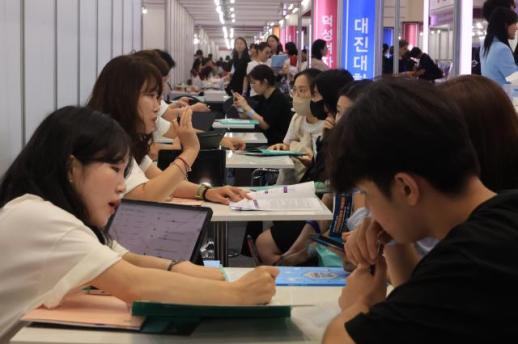 College admissions season kicks off for class 2027 SEOUL, July 23 (AJP)-South Korea's 2027 college admissions season officially got underway Wednesday as the country's largest university admissions counseling fair opened at COEX in southern Seoul, drawing nearly every four-year university ahead of this year's early application period. The three-day 2027 Early Admissions Fair opened at 10 a.m. at COEX Hall 1 in Gangnam-gu and runs through Friday, about six weeks before universities begin accepting early admission applications for the 2027 academic year. This year's early admissions application period is scheduled for Sept. 7-11, when current high school seniors will submit their applications. Anxiety is palpable among this year's applicants and their parents, as this marks the final college entrance exam under the current system. Starting with the 2028 academic year, a five-tier grading system for school records will be implemented, along with an integrated college entrance exam that no longer separates humanities and sciences tracks. According to KCUE, 16,764 people had pre-registered online as of July 20, with organizers expecting roughly 5,000 additional walk-in visitors. Booths for Seoul's top universities, which are especially popular among students, filled their daily counseling slots within 30 minutes of opening. Organized by the Korean Council for University Education (KCUE), which represents about 150 four-year universities nationwide, the fair features all 150 member institutions, including 32 national and public universities and 118 private universities. Admissions officers are providing one-on-one counseling on admission strategies, application procedures and university-specific selection criteria, making the event one of the largest annual gatherings for prospective students and their parents before the start of the admissions season. 2026-07-23 15:59:39
 -
 Foreign buying lifts KOSPI more than 4% SEOUL, July 23 (AJP) - Foreign investors bought a net 2.14 trillion won (US$1.46 billion) worth of shares on the KOSPI on Thursday, helping lift the index more than 4 percent as individual investors sold throughout the rally. The KOSPI closed at 7,096.89, up 299.19 points or 4.4 percent, while the tech-heavy KOSDOAQ rose 5.2 percent to 790.28, led by gains in biotechnology stocks. Other major Asian markets moved in the same direction but with far less force, with Japan's Nikkei 225 rising 0.5 percent and China's Shanghai Composite barely changed. SK hynix did the heavy lifting, closing at 1,919,000 won ($1,307.67), up 4.9 percent. Samsung Electronics rose 3.7 percent to 270,000 won ($183.99). The gap between the two widened over the session. Traders read the split as positioning around high-bandwidth memory rather than a broad semiconductor rerating. Samsung Electro-Mechanics outpaced both, gaining 7.7 percent to 1,448,000 won ($986.71). Institutions added a net 101.1 billion won ($68.9 million). Individuals sold 2.21 trillion won ($1.51 billion). Market breadth was strong, with 831 stocks rising while 74 fell. Energy equipment and electrical gear led the sector tables, with construction close behind, a rotation that puts the buying well beyond memory. The KOSPI 200 added 4.3 percent to 1,126.33. In Tokyo, Advantest rose 4.1 percent and SoftBank Group 3.8 percent, while Fast Retailing fell 1.9 percent. The won traded at 1,467.50 per dollar, stronger by 11.50 won from the previous session. The risk is that foreign buying of this scale may be driven more by index flows than by fundamentals, with such inflows into Seoul often proving short-lived. 2026-07-23 15:58:59