


Latest by
-
 K-Beauty Leaders Join President Yoon's South America Tour to Expand Market Reach During President Yoon Suk Yeol's visit to three South American countries, leaders from major domestic cosmetics companies are joining the trip. This move is seen as an effort to secure distribution channels in the early growth stage of the K-Beauty market in Latin America and to lay the groundwork for expanding local operations.According to the Blue House, President Yoon will visit San Francisco, Brazil, Chile, and Argentina for 11 days starting on July 24. He will meet with global artificial intelligence companies and venture capital representatives in San Francisco on July 24-25, before making a state visit to Brazil at the invitation of President Luiz Inácio Lula da Silva from July 26-29.On July 28, a Korea-Brazil business roundtable hosted by President Yoon in São Paulo will include representatives from leading K-Beauty companies, such as Lee Sang-mok of Amorepacific Holdings, Kim Byung-hoon of APR, Cheon Joo-hyuk of Gudai Global, and Kim Sung-woon of Silicon Two. They are expected to discuss strategies for entering the Brazilian market and expanding cooperation with local businesses and distributors.The participation of K-Beauty executives in the Brazil visit is interpreted as a strategic move targeting the Latin American market. While the cosmetics market in Latin America is smaller than in North America and Europe, the export and local sales of Korean products have been rapidly increasing. Notably, Brazil, the largest cosmetics market in Latin America, has shown significant growth. According to the Korea Trade-Investment Promotion Agency, Korea's cosmetics exports to Brazil rose from $9 million in 2022 to $32 million in 2024, reaching $54 million last year. This represents a 69% increase from the previous year and a sixfold growth over three years.Individual company performances are also becoming evident. Skin1004, a skincare brand owned by Gudai Global, saw its sales in South America increase by 187% last year, with approximately 74% of its total South American sales coming from Argentina and Chile, the countries included in this trip.Global K-Beauty distribution platform Silicon Two is also accelerating its efforts in Latin America. The company began full-scale operations in Mexico last month and is currently working on establishing a subsidiary in Brazil by the end of the year. The goal is to use the Mexico and Brazil subsidiaries as strategic hubs connecting North and South America to expand its distribution network throughout Latin America.Amorepacific has entered the Brazilian market with its hair care brands Mise en Scène and Ryo, while APR, which derives 89% of its revenue from overseas, has identified South America as a new growth market and plans to expand its international business. APR is currently present in local offline channels in Brazil, including Soneda and Pague Menos, as well as Pharmacity in Argentina.This visit is expected to accelerate the efforts of domestic cosmetics companies to penetrate the Latin American market. An industry insider stated, "The South American region is a market where K-Beauty exports are steadily increasing, and future demand expansion is anticipated. We expect K-Beauty companies to become more active in their market entry efforts." 2026-07-23 16:00:00
-
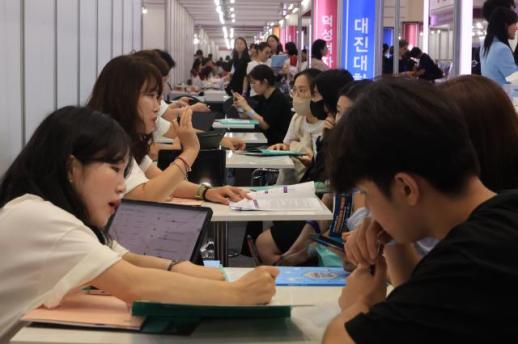 College admissions season kicks off for class 2027 SEOUL, July 23 (AJP)-South Korea's 2027 college admissions season officially got underway Wednesday as the country's largest university admissions counseling fair opened at COEX in southern Seoul, drawing nearly every four-year university ahead of this year's early application period. The three-day 2027 Early Admissions Fair opened at 10 a.m. at COEX Hall 1 in Gangnam-gu and runs through Friday, about six weeks before universities begin accepting early admission applications for the 2027 academic year. This year's early admissions application period is scheduled for Sept. 7-11, when current high school seniors will submit their applications. Anxiety is palpable among this year's applicants and their parents, as this marks the final college entrance exam under the current system. Starting with the 2028 academic year, a five-tier grading system for school records will be implemented, along with an integrated college entrance exam that no longer separates humanities and sciences tracks. According to KCUE, 16,764 people had pre-registered online as of July 20, with organizers expecting roughly 5,000 additional walk-in visitors. Booths for Seoul's top universities, which are especially popular among students, filled their daily counseling slots within 30 minutes of opening. Organized by the Korean Council for University Education (KCUE), which represents about 150 four-year universities nationwide, the fair features all 150 member institutions, including 32 national and public universities and 118 private universities. Admissions officers are providing one-on-one counseling on admission strategies, application procedures and university-specific selection criteria, making the event one of the largest annual gatherings for prospective students and their parents before the start of the admissions season. 2026-07-23 15:59:39
-
 Foreign buying lifts KOSPI more than 4% SEOUL, July 23 (AJP) - Foreign investors bought a net 2.14 trillion won (US$1.46 billion) worth of shares on the KOSPI on Thursday, helping lift the index more than 4 percent as individual investors sold throughout the rally. The KOSPI closed at 7,096.89, up 299.19 points or 4.4 percent, while the tech-heavy KOSDOAQ rose 5.2 percent to 790.28, led by gains in biotechnology stocks. Other major Asian markets moved in the same direction but with far less force, with Japan's Nikkei 225 rising 0.5 percent and China's Shanghai Composite barely changed. SK hynix did the heavy lifting, closing at 1,919,000 won ($1,307.67), up 4.9 percent. Samsung Electronics rose 3.7 percent to 270,000 won ($183.99). The gap between the two widened over the session. Traders read the split as positioning around high-bandwidth memory rather than a broad semiconductor rerating. Samsung Electro-Mechanics outpaced both, gaining 7.7 percent to 1,448,000 won ($986.71). Institutions added a net 101.1 billion won ($68.9 million). Individuals sold 2.21 trillion won ($1.51 billion). Market breadth was strong, with 831 stocks rising while 74 fell. Energy equipment and electrical gear led the sector tables, with construction close behind, a rotation that puts the buying well beyond memory. The KOSPI 200 added 4.3 percent to 1,126.33. In Tokyo, Advantest rose 4.1 percent and SoftBank Group 3.8 percent, while Fast Retailing fell 1.9 percent. The won traded at 1,467.50 per dollar, stronger by 11.50 won from the previous session. The risk is that foreign buying of this scale may be driven more by index flows than by fundamentals, with such inflows into Seoul often proving short-lived. 2026-07-23 15:58:59
-
 Nearly half of jobless young Korean graduates out of work for over a year SEOUL, July 23 (AJP) -Nearly half of South Koreans aged 15 to 29 who had completed their education but were not working had remained without employment for at least a year as of May, the highest share since the global financial crisis. Nearly two in 10 — a record high — had gone at least three years without work, pointing to a widening pool of young adults left on the sidelines. The proportion of graduates unemployed for at least one year rose 2.0 percentage points from a year earlier to 48.6 percent, equivalent to 605,000 people, according to a supplementary youth survey released Thursday by the Ministry of Data and Statistics. It was the highest level since the 51.7 percent recorded in 2009 during the global financial crisis, while the share without work for at least three years rose to a record 19.4 percent, or 241,000 people. The survey’s non-employed category covers people who have graduated, withdrawn from or completed their final level of education but are not currently working, including both officially unemployed people and those outside the labor force. The number of young people who had completed their education fell by 171,000 to 4.003 million, with employment declining by 202,000 to 2.76 million and the non-employed population rising by 31,000 to 1.243 million. Job training and preparations for employment examinations were the most common activities among non-employed graduates at 39.3 percent, followed by simply passing the time at 25.3 percent and preparing for further education at 12.5 percent. The average time required to graduate from college increased by 1.3 months to four years and 5.7 months, the longest since the series began in 2007, while the share who had taken a leave of absence rose 2.5 percentage points to 48.9 percent. Kim Rak-hyun, director of the ministry’s Employment Statistics Division, attributed the increase to the growing proportion of four-year college graduates and more students taking leave to prepare for jobs or qualification examinations. The proportion of graduates who had held at least one job after completing their education fell 1.6 percentage points to 84.8 percent, the lowest since the related series began in 2004. Among young people outside the labor force, 600,000 had prepared for an employment examination during the previous week, up by 15,000 from a year earlier, although their share remained unchanged at 14.5 percent. The proportion preparing for private-sector jobs fell 2.0 percentage points to 34.0 percent, while the share studying for general civil service examinations climbed 3.9 percentage points to 22.1 percent, its first increase in five years. Kim said improved conditions for lower-ranking civil servants and companies’ growing preference for experienced workers and rolling recruitment had made private-sector entry more difficult for young applicants. For graduates whose first job was a paid position, the average time required to find work shortened by 0.1 month to 11.2 months, while average tenure at their first workplace increased by 0.4 month to one year and 6.8 months. Monthly pay of between 2 million won and less than 3 million won was the most common starting income bracket at 42.1 percent, followed by 1.5 million won to less than 2 million won at 23.3 percent and 500,000 won to less than 1 million won at 11.8 percent. Dissatisfaction with pay, working hours and other employment conditions was the leading reason for leaving a first job at 44.4 percent, followed by the completion of temporary or seasonal work at 18.0 percent and personal or family reasons at 14.5 percent. The overall number of employed people aged 15 to 29 fell by 255,000 from a year earlier to 3.427 million, lowering the youth employment rate by 2.4 percentage points to 43.8 percent. The number of unemployed young people increased by 5,000 to 266,000, pushing the unemployment rate up by 0.6 percentage point to 7.2 percent. 2026-07-23 15:57:15
-
Hite Jinro Launches First Global Jinro Campaign with BTS's V to Target Overseas Soju Market Hite Jinro is accelerating its efforts to penetrate the global soju market by partnering with BTS member V. The company has launched its first global campaign featuring V and plans to expand its flavored soju product line to cater to international consumers' tastes. On July 23, Hite Jinro unveiled the main advertisement for its global campaign, 'My Favorite Jinro.' The campaign aims to familiarize overseas consumers with Jinro and convey the image of a brand enjoyed with friends in everyday settings. The advertisement depicts V mistakenly entering the wrong room at a party. It showcases scenes of people from different gatherings enjoying Jinro with V, delivering the brand message of connecting people and creating special moments. The room numbers in the video also reflect the company's global business strategy. Room '306' represents the three regular soju varieties and six flavored soju varieties currently sold overseas, while '307' symbolizes plans to increase the flavored soju offerings to more than seven. Following the main advertisement, Hite Jinro will sequentially roll out digital content, consumer engagement events, and offline promotions both domestically and internationally. The advertisement will be available on Jinro's official global YouTube, Instagram, and Facebook channels. The new global tagline, 'Feel the Moment,' was also introduced, signifying the warmth and joy that Jinro brings to moments shared with loved ones. On July 3, Hite Jinro appointed V as the global ambassador for its soju export brand Jinro. The company described this move as part of its strategy to popularize Jinro among consumers worldwide. Hwang Jeong-ho, Executive Director of Hite Jinro's Overseas Business Division, stated, "We will continue to expand our influence in the mainstream alcoholic beverage market abroad and broaden our connections with consumers, further enhancing our competitiveness as a global representative soju brand."* This article has been translated by AI. 2026-07-23 15:56:00
-
KB Financial Reports Record Earnings of Nearly 4 Trillion Won in First Half of 2026 KB Financial Group reported record earnings nearing 4 trillion won for the first half of 2026. The contribution of its securities subsidiary to the group's performance rose to 21%, with the non-banking sector's share expanding to 44%, driving overall growth.On July 23, KB Financial announced a net profit of 3.8846 trillion won for the first half of 2026, marking a 13.1% increase compared to the same period last year, the highest level ever recorded.In the second quarter, net profit reached 1.9922 trillion won, a 5.3% increase from the first quarter, also the largest quarterly profit to date. Notably, the non-banking sector accounted for 44% of the group's earnings, reflecting balanced growth across subsidiaries.KB Financial stated, "Despite increased volatility in financial markets due to rising exchange rates, interest rates, and geopolitical risks, substantial growth in fee income, supported by a stable interest income base, drove our performance."The surge in performance was largely attributed to net fee income from securities brokerage. The stock market saw heightened activity, with the KOSPI index surpassing 9,000 points in the first half.Net fee income for the first half totaled 2.9612 trillion won, a 50.6% increase from the previous year. In the second quarter alone, net fee income reached 1.6019 trillion won, up 17.8% year-on-year, setting a new quarterly record.Interest income also remained robust, with net interest income for the first half at 6.4783 trillion won, a 1.7% increase from the same period last year. However, net interest income for the second quarter fell to 2.7440 trillion won, a 5.7% decrease from the previous quarter due to a narrowing net interest margin (NIM).As of the end of June, the group's non-performing loan (NPL) ratio stood at a stable 0.67%. The common equity tier 1 (CET1) ratio and BIS capital adequacy ratio were maintained at industry-leading levels of 13.74% and 15.91%, respectively.By subsidiary, KB Kookmin Bank reported a net profit of 2.2254 trillion won for the first half, a 1.7% increase from the previous year. This growth occurred as the impact of one-time large provisions from the previous year faded, and interest income was managed stably while asset management fee income expanded.KB Securities recorded a net profit of 796.3 billion won for the first half, a 135% increase year-on-year, driven by broad revenue growth in key sectors such as wealth management amid a capital market boom. During the same period, KB Insurance reported a net profit of 478.8 billion won, while KB Kookmin Card posted 218.9 billion won. KB Life's net profit decreased by 20.4% year-on-year to 150.4 billion won.On the same day, KB Financial's board of directors approved a quarterly cash dividend of 1,155 won per share and a share buyback and cancellation plan worth 700 billion won. This brings the total shareholder return for the year to an estimated 3.7 trillion won.* This article has been translated by AI. 2026-07-23 15:52:00
-
Vietnam's New Cryptocurrency Regulations Spark Confusion Among Investors Vietnam has introduced regulations to control both trading methods and capital flows in its cryptocurrency market, which is set to begin pilot operations. Domestic investors who trade cryptocurrencies without going through licensed service providers approved by the Ministry of Finance may face fines. Additionally, splitting transactions into multiple parts or using anonymity tools could be classified as suspicious money laundering activities, leading to increased confusion among investors.According to local reports from VnExpress and others on July 23, the Vietnamese government established administrative penalties for violations related to cryptocurrencies in Decree 284/2026, announced on July 16. This decree applies during the pilot operation period outlined in Resolution 05/2025. It allows for fines of up to 20 million dong (approximately $840) for institutions and up to 10 million dong (about $420) for individuals. If an individual violates the regulations in the same manner as an institution, they will be liable for half the amount imposed on the institution.The most significant change is the limitation on trading channels available to investors. Domestic investors who trade cryptocurrencies without going through a Ministry of Finance-approved service provider may face fines ranging from 30 million to 50 million dong (approximately $1,260 to $2,100).For transactions involving cryptocurrencies that are only permitted for foreign investors, the penalties are even steeper, ranging from 70 million to 100 million dong. The obligations for service providers have also been strengthened. If a service provider fails to verify the identity of investors when opening accounts, they could face fines of 50 million to 70 million dong. Collecting, storing, exchanging, selling, gifting, or disclosing cryptocurrency-related data and account information without permission could result in fines of 150 million to 200 million dong.Unlicensed operations and advertising will also face strict penalties. Institutions providing or promoting cryptocurrency services without authorization could be fined between 180 million and 200 million dong. Selling cryptocurrencies to individuals who are not investors or issuing them before meeting conditions, as well as failing to properly disclose investment prospectuses, could also incur fines of 150 million to 200 million dong.If an issuing entity provides inaccurate or incomplete information to regulatory authorities, service providers, or investors, they will also face penalties, with fines set between 100 million and 150 million dong. Decree 284 will take effect on September 1 and will be enforced during the pilot operation period established by Resolution 05/2025.Shift Toward Licensed Exchanges and Expanded Money Laundering CriteriaThe cryptocurrency regulations are expanding beyond administrative penalties to include anti-money laundering frameworks. On July 14, the Standing Committee of the National Assembly of Vietnam reviewed proposed amendments to the Law on the State Bank of Vietnam, the Anti-Money Laundering Law, and the Law on Credit Institutions. Pham Thi Kim Chi, Governor of the State Bank of Vietnam, reported that the amendments to the Anti-Money Laundering Law will include 'cryptocurrency services' as mandatory reporting subjects and will redefine indicators of suspicious transactions in this sector. The amendments propose 15 indicators to identify suspicious transactions in cryptocurrency trading.Key indicators include splitting transactions to avoid customer verification or reporting requirements. Repeated deposits and withdrawals shortly after account creation, or transferring assets to countries or regions with high risks of money laundering or terrorist financing without reasonable justification, are also included. Transactions involving frequent conversions of cryptocurrencies to fiat currency under unfavorable price conditions may also be considered suspicious. Transactions where multiple accounts or wallets send assets to the same address or where a single account rapidly distributes assets to multiple wallets are also subject to reporting.Using cryptocurrencies with enhanced anonymity or mixing services to conceal the source of funds is classified as a suspicious indicator. Transactions linked to wallets or cryptocurrency service providers associated with past fraud, online gambling, extortion, or stolen assets may also be reported. Additionally, using anonymous tools when accessing platforms or delaying or refusing to provide customer identification information will be regulated. Transactions with unregistered or unlicensed cryptocurrency service providers without being able to explain the source of assets are also flagged as suspicious.The agency responsible for drafting the legislation stated that the amendments aim to align the anti-money laundering system with international standards and reduce legal gaps. The revisions also seek to prepare for evaluations by the Financial Action Task Force. However, during the legislative review process, concerns were raised about the overly broad criteria. Phan Van Mai, Chairman of the Economic and Financial Committee, emphasized the need to clarify the concept of 'cryptocurrency services' and the scope of services subject to reporting obligations. He also called for more specific criteria for identifying suspicious transactions to ensure practical application.Vietnam's cryptocurrency market has been in a pilot operation since September last year and will continue for five years. Cryptocurrencies refer to digital assets that are authenticated through cryptographic or digital technology during their creation, issuance, storage, and transfer processes. In the pilot market, the sale, issuance, trading, and payment of cryptocurrencies will be conducted in Vietnamese dong. Until a separate tax system is established, transactions involving cryptocurrencies will be taxed similarly to securities. The government will initially allow the establishment of exchanges for a maximum of five companies to control risks and assess impacts before expanding the market.Investor ConcernsInvestors are questioning how the new regulations will be applied in practice. One reader asked whether a Vietnamese worker in the U.S. using the licensed Coinbase platform would be considered as trading on an unlicensed platform under Vietnamese standards.There were also inquiries about where to find the list of licensed exchanges. Another reader questioned, “How can I know if an exchange has received regulatory approval?” Confusion also arose regarding the range of tradable assets and products. One reader asked, “If a Vietnamese exchange does not support a specific coin, can I trade it on an international exchange?” Another expressed concern about how to proceed if their cryptocurrency is not listed on a licensed exchange.Additionally, there were criticisms regarding the ambiguity of the transaction-splitting criteria. One reader questioned, “In cryptocurrency trading, it is common to buy a little when prices drop, sell some when they rise, and buy again if prices increase further. Would this also be considered transaction splitting?” 2026-07-23 15:52:00
-
Samsung Biologics Reports Strong Q2 Revenue and Operating Profit Amid Union Strike Concerns Samsung Biologics continued its solid growth in the second quarter, meeting market expectations with strong performance. The company attributed its revenue and profit increases to full operation of its production facilities and favorable exchange rates. However, union-related risks are expected to pose challenges in the second half of the year.On July 23, Samsung Biologics announced that it recorded a revenue of 1.32 trillion won and an operating profit of 586.4 billion won for the second quarter. This represents a 30% increase in revenue and a 23% increase in operating profit compared to the same period last year. The operating profit margin remained above 40%.The results reflect the full operation of its first to fourth plants and the positive impact of favorable exchange rates. Although there were some production delays, the contribution from new facilities offset these issues, allowing the company to maintain double-digit growth. Notably, the company demonstrated a stable profit generation structure, maintaining high profitability even before the full revenue recognition from its fifth plant and the production facility in Rockville, USA.Looking ahead, additional growth is anticipated in the second half of the year. As revenue contributions from the Rockville facility and the fifth plant in Songdo ramp up, there is potential to achieve the upper end of the annual revenue growth guidance of 15-20%. Market analysts suggest that the annual performance may exceed previous forecasts due to increased operating rates at the Rockville plant.The company’s financial structure remains stable, with total assets of 12.65 trillion won, equity of 8.36 trillion won, and liabilities of 4.29 trillion won as of the end of the second quarter. The debt ratio stood at 51.3%, and the borrowing ratio was 11.5%.Samsung Biologics is also accelerating its global business expansion and securing new modalities. The company is establishing a sales office in Europe, aiming to build a sales network that covers the three major global biotech markets, including the United States and Japan. Recently, it diversified its business portfolio by acquiring the global peptide CDMO company Polypeptide Group for approximately 2.7 trillion won.However, union risks are expected to impact performance in the second half of the year. Starting in the third quarter, costs related to union strikes and wage negotiations are anticipated to affect profitability.Analysts view one-time costs resulting from labor negotiations as a key variable. If an agreement is reached that includes wage increases and bonuses, related labor costs could be reflected all at once. Some analysts warn that if wage increases exceed expectations, it could impact operating profit margins in the following year.Lee Ji-soo, a researcher at Daol Investment & Securities, noted, "The production disruptions and some batch disposal costs from the union strike in May are expected to be reflected in the third quarter." Jeong Yi-soo, a researcher at IBK Investment & Securities, explained, "The partial strike by the union from May 1 to May 5 caused some production delays, but the estimated revenue loss of about 150 billion won is expected to be recognized in the third quarter."Labor-management conflicts remain unresolved. Since the union initiated a full strike in May, it has been unable to narrow its differences with management. The company estimates that the strike has resulted in a revenue loss of approximately 150 billion won.The union is demanding an average base salary increase of over 14%, a bonus of 30 million won per person, and the distribution of 20% of operating profit as performance bonuses, along with the elimination of upper limits. In contrast, management has proposed a 6.2% increase in base salary and a one-time payment of 6 million won, indicating significant differences in their positions. Samsung Biologics stated that it is committed to resolving the labor-management conflict through dialogue. 2026-07-23 15:52:00
-
KOSPI Approaches 7,100 Mark Amid 2 Trillion Won Foreign Investment; KOSDAQ Rises 5% The KOSPI surged over 4% to near the 7,100 mark, bolstered by 2 trillion won in net purchases from foreign investors. Expectations for Alphabet's expansion in artificial intelligence (AI) investments fueled gains in semiconductor stocks, with buying interest also spreading to power equipment, secondary batteries, and biotechnology sectors.On July 23, the KOSPI closed at 7,096.89, up 299.19 points (4.40%) from the previous trading day. At one point during the session, it rose to 7,137.20, surpassing the 7,100 level.In the securities market, foreign investors led the index's rise with net purchases of 2.1351 trillion won, while institutions also bought 101.1 billion won. In contrast, individual investors sold a net 2.2107 trillion won.Most of the top market capitalization stocks saw gains. Samsung Electronics closed up 3.65% at 270,000 won, while SK Hynix rose 4.86% to 1,919,000 won. Other strong performers included LG Energy Solution (up 8.41%), Samsung Electro-Mechanics (up 7.66%), and Hyundai Motor (up 3.35%).Analysts attribute the positive sentiment to Alphabet's strong performance and increased capital expenditures (CAPEX), which have bolstered investor confidence in AI-related investments. Alphabet reported an 82% year-on-year increase in cloud revenue for the second quarter and confirmed its commitment to expanding data center investments.Lee Kyung-min, a researcher at Daishin Securities, stated, "Alphabet's robust cloud performance and CAPEX expansion reaffirmed strong demand for AI infrastructure and data center investments, supporting AI investment sentiment." He added, "Despite external uncertainties, foreign investors have continued net buying for four consecutive trading days, driving the index higher."The expectation of increased data center investments also boosted stocks related to power infrastructure. The need for enhanced power infrastructure has become apparent due to supply disruptions in power grids in areas densely populated with data centers in the U.S., leading to significant gains for companies like LS ELECTRIC and HD Hyundai Electric.The KOSDAQ index closed at 790.28, up 39.19 points (5.22%) from the previous trading day. Foreign and institutional investors net bought 133 billion won and 60.3 billion won, respectively, while individuals sold a net 198.5 billion won.Among the top KOSDAQ stocks, Alteogen surged 14.37%, while EcoProBM (up 9.95%), EcoPro (up 9.34%), ABL Bio (up 7.06%), and Rainbow Robotics (up 6.17%) also saw significant increases.Despite external uncertainties, including rising international oil prices, the market's gains were fueled by substantial foreign capital inflows and expectations for AI investments. With the KOSPI briefly surpassing the 7,100 mark, the sustainability of foreign buying and the performance of major domestic and international companies will likely determine future market movements.* This article has been translated by AI. 2026-07-23 15:48:00
-
Doosan Bobcat Reports 42.9% Increase in Q2 Operating Profit Doosan Bobcat announced on July 23 that it recorded provisional results of 2.4479 trillion won in sales and 291.7 billion won in operating profit for the second quarter of 2026.Compared to the same period last year, sales increased by 11.2%, operating profit rose by 42.9%, and net profit grew by 63.9%. The company stated, "Sales increased due to price hikes despite some volume delays from system checks, and operating profit benefited from U.S. tariff refunds." They added, "Net profit was influenced by the rise in operating profit and a reduction in financial costs."In U.S. dollar terms, sales grew by 4% year-on-year to $1.63 billion, while operating profit surged by 34% to $195 million.By product category, sales in the compact equipment and industrial vehicle segments rose by 4% and 2%, respectively, while portable power sales returned to last year's levels. Doosan Mottrol, which produces hydraulic components, reported a 40% growth compared to the previous year.Regionally, sales in North America increased by 3% year-on-year, driven by effective pricing strategies and higher forklift sales. Europe, the Middle East, and Africa saw a 10% growth due to recovering demand for compact equipment and favorable exchange rates. However, sales in Asia, Latin America, and Oceania fell by 8% due to weak forklift sales, despite strong performance in South America, Oceania, and India.On the same day, Doosan Bobcat's board of directors decided to set the second-quarter dividend at 400 won per share. The company is implementing a plan to enhance corporate value, which includes a minimum annual dividend of 1,600 won and quarterly dividends.Additionally, Doosan Bobcat announced last month that it signed a memorandum of understanding with AI solution company Maum AI to develop autonomous operation technology for construction equipment.* This article has been translated by AI. 2026-07-23 15:44:00