


Latest by
-
 Seoul Mayor Oh Se-hoon Faces Political Crisis After Court Ruling Seoul Mayor Oh Se-hoon has encountered a significant political challenge after being sentenced to a fine of 10 million won (approximately $8,500) and an additional 21 million won (about $17,800) in restitution for violating political funding laws. The Seoul Central District Court's Criminal Division 22, led by Judge Cho Hyung-woo, delivered the ruling on July 22. Oh was charged with illegally receiving funds for a public opinion poll from Myung Tae-kyun, who was also implicated in the case. Former Deputy Mayor Kang Cheol-won received a fine of 3 million won, while the sponsor who covered the costs, Kim Han-jeong, was fined 5 million won. Oh's defense argued that he did not directly commission the poll or request funding, maintaining his innocence. However, the court emphasized the seriousness of the illegal receipt of political funds, leading to a ruling that could disqualify him from office. This verdict is expected to have significant political repercussions, affecting not only Oh's future but also the governance of Seoul. The court's key considerations included the legitimacy of the poll request and whether there was collusion in the funding through a third party. The court rejected all motions to dismiss the charges presented by Oh's legal team and found him guilty of the 21 million won funding violation. The court determined that Oh had sufficient motive to commission the poll during the 2021 Seoul mayoral by-election to counter his opponents and establish political connections. It also noted that Oh appeared to have led the illegal activities while attempting to evade responsibility in court. Despite the ruling, the court acknowledged that there was no evidence of active manipulation of public opinion, as the poll results were unfavorable to Oh. Some charges related to other polls, amounting to 12 million won, were deemed not guilty due to the possibility of third-party involvement. Oh's legal team has announced plans to appeal the first-instance ruling, which will extend the judicial battle to the High Court and Supreme Court. Under current law, a fine exceeding 1 million won for political funding violations results in the loss of public office. Although Oh can remain in his position until a final ruling is made, the acknowledgment of collusion in illegal donations complicates his defense in higher courts. Throughout the appeals process, Oh will face the burden of proving his legal innocence while navigating the political fallout from the case. The ruling has cast uncertainty over the future of Seoul's administration. The city government has stated its commitment to continue major projects without interruption, but the leadership's stability is likely to be challenged. The outcomes of key initiatives and large development projects will depend on the results of the appeals, putting the administration's momentum at risk. Ensuring continuity and preventing organizational disruption are urgent tasks for Mayor Oh. Oh's political future has also suffered a severe blow. As a prominent candidate for the presidency within the conservative camp, this guilty verdict is expected to significantly impact his moral standing and credibility. His presidential ambitions have been abruptly halted, and his position within the party and the political landscape is likely to diminish rapidly. It remains to be seen how Oh will navigate the dual challenges of the legal appeals process and the instability of his administration. * This article has been translated by AI. 2026-07-22 17:56:00
-
President Yoon Suk Yeol to Visit U.S. and Three South American Countries President Yoon Suk Yeol will embark on an 11-day trip to the United States and three South American countries from July 24 to August 3.National Security Office Director Wi Seong-rak announced on July 22 during a briefing at the Blue House that President Yoon will visit San Francisco, Brazil, Chile, and Argentina before returning via Frankfurt, Germany.On the first day of his trip, July 24 (local time), President Yoon will begin his official schedule in San Francisco with meetings with global artificial intelligence (AI) leaders and Silicon Valley venture capitalists.On the morning of the first day, he will meet sequentially with Dario Amodei, CEO of Anthropic; Sam Altman, CEO of OpenAI; Jensen Huang, CEO of NVIDIA; and Hock Tan, President and CEO of Broadcom.The 'San Francisco AI Summit' will follow, featuring over 150 participants, including domestic business leaders such as Lee Jae-yong, Chairman of Samsung Electronics; Choi Tae-won, Chairman of SK Group; Chung Eui-sun, Chairman of Hyundai Motor Group; and Lee Hae-jin, Chairman of Naver, along with CEOs from global tech companies, AI firms, researchers, startups, and investors.During this event, memorandums of understanding (MOUs) will be signed between domestic companies and big tech firms, and President Yoon will announce the 'San Francisco AI Declaration' and participate in discussions.Later, President Yoon will host a dinner with representatives from domestic and big tech companies.On July 25, the second day of his trip, he will attend a 'Silicon Valley Venture Investment Meetup' in the afternoon, meeting with representatives from six top venture capital firms, including Andreessen Horowitz, General Catalyst, Sequoia Capital, Khosla Ventures, Lightspeed Venture Partners, and New Enterprise Associates.Following the signing of an MOU between the National Pension Service and these VCs, a roundtable discussion will focus on cooperation in the Korea-U.S. venture ecosystem.Policy Chief Kim Yong-beom stated during the briefing that the meetings with global big tech CEOs aim to emphasize South Korea's commitment to substantial AI investment and global collaboration, seeking tangible outcomes in investment and cooperation from key companies in the global AI supply chain.Regarding the AI summit, he noted, "This event signifies the beginning of expanding and concretizing the vision of South Korea's three mega projects for a great leap forward, bringing together domestic conglomerates leading AI innovation and global big tech companies." He added that these efforts will highlight South Korea's irreplaceable status in the global AI ecosystem and express the intent for AI cooperation between South Korea and big tech firms.Kim also mentioned that the Silicon Valley venture investment meetup aims to establish a long-term partnership for strategic collaboration between the Korea-U.S. innovation ecosystems through the MOU with top global venture capital firms, enhancing connections between the two countries' venture ecosystems and expanding opportunities for attracting overseas investment in promising K-startups.On July 26, President Yoon will make a state visit to Brazil, starting with a welcome reception hosted by President Luiz Inácio Lula da Silva in Brasília.On July 27, following an official welcome ceremony, he will hold a summit at the Palácio da Alvorada, sign MOUs, hold a joint press conference, and enjoy a state luncheon. He will then travel to São Paulo for a luncheon with expatriates and a 'Korea-Brazil Business Roundtable' on July 28.President Yoon will begin his official visit to Chile on the evening of July 29 with a dinner for expatriates. On July 30, he will lay a wreath at the statue of founding hero O'Higgins, followed by an official welcome ceremony at the Palacio de La Moneda, a summit, MOU signing, joint press conference, and official luncheon, concluding with a 'Korea-Chile Business Roundtable' in the afternoon.That night, he will arrive in Buenos Aires to start his official visit to Argentina. On July 31, he will lay a wreath at Plaza San Martín to honor independence heroes, followed by an official welcome event at the Casa Rosada and a summit with President Javier Milei, concluding with a dinner for expatriates to wrap up his South American tour.Director Wi highlighted the economic significance of the South American visit, stating, "Brazil, Chile, and Argentina represent a massive market with a combined population of 280 million and a GDP of $3.7 trillion, ranking fourth in the world." He noted that discussions will focus on resuming negotiations for the Korea-Mercosur trade agreement with Brazil and Argentina, and modernizing the FTA with Chile, South Korea's first FTA partner.He added, "With Brazil as the largest defense market in Latin America, Argentina ranking third in global media coverage of the Korean Wave, and Chile as a promising infrastructure market, we will enhance practical cooperation between governments to realize market development potential across various sectors."Wi concluded, "Brazil, as the fifth-largest country by area and seventh by population, plays a leading role in regional order and demonstrates active leadership in international organizations such as the UN and G20. This South American tour will solidify international cooperation with these countries."He also noted that Brazil has the second-largest rare earth reserves, is the top exporter of coffee, sugar, and chicken, while Chile leads in copper and lithium reserves, and Argentina ranks second in shale gas reserves and first in soybean oil exports. He stated that the visit aims to strengthen strategic partnerships related to key mineral supply chains and deepen discussions on diversifying food and energy import sources. 2026-07-22 17:52:00
-
People Power Party Announces Candidates for Committee Chair Positions The People Power Party has failed to reach an internal agreement on the appointment of the National Land Committee chair. As a result, lawmakers Yu Ui-dong and Kim Jeong-ja will compete in a party primary on the 23rd for the position. Lawmaker Ahn Cheol-soo, who sought the Foreign Affairs and Unification Committee chair, has decided not to run for the position.On July 22, the People Power Party announced the results of candidate registrations for committee chairs, which included the Education Committee, Foreign Affairs and Unification Committee, Industry, Trade, and Small and Medium Enterprises Committee, Welfare Committee, National Land Committee, Intelligence Committee, and Gender Equality and Family Committee.Except for the National Land and Foreign Affairs committees, the remaining committee chairs will be filled by single candidates: Kim Hee-jung (Education Committee), Kim Sung-won (Industry Committee), Lee Man-hee (Welfare Committee), Lee Yang-soo (Intelligence Committee), and Lim Yi-ja (Gender Equality Committee). However, Yu Ui-dong and Kim Jeong-ja will face off for the National Land Committee chair. Previously, Song Seok-jun, who had agreed to alternate the National Land and Foreign Affairs committee chairs with Kim Jeong-ja for one year each, has now registered as a candidate for the Foreign Affairs Committee chair.The candidates registered will be voted on during the People Power Party's meeting scheduled for the 23rd. Single candidates will undergo a yes-or-no vote. The selected candidates will then be finalized through a vote by lawmakers from both parties in the National Assembly on the same day.Meanwhile, Ahn, who initially wanted the Foreign Affairs Committee chair, ultimately did not register as a candidate. It appears that party leader Jeong Jeom-sik communicated directly with Ahn to facilitate this decision.* This article has been translated by AI. 2026-07-22 17:44:00
-
Maeil Dairy Expands into U.S. Market with Olive Young Partnership Maeil Dairy is expanding its presence in the North American market by introducing soy milk, beverages, and inner beauty products through Olive Young in the United States.On July 22, Maeil Dairy announced that eight of its flagship products are now available at the Olive Young store in Pasadena and on the U.S. online mall.The products include three types of Maeil Soy Milk (99.9% Plain, High-Protein Plain, and Black Soybean), two Picnic flavors (Apple and Peach), and three types of Selex Milsera Collagen (beverage, stick powder, and gummies).In response to the growing interest in K-beauty expanding into food and health care in the U.S., Maeil Dairy has focused its product lineup on plant-based protein and inner beauty products. The company aims to broaden its engagement with local consumers by promoting strategic products that encompass K-food and inner beauty.Maeil Soy Milk, celebrating its 10th anniversary, is being introduced to the U.S. market with a focus on low-sugar and high-protein options. The lineup includes a sugar-free 99.9% soy milk product, high-protein plain, and black soybean varieties, reflecting the rising trend of clean-label consumption that emphasizes ingredients and quality.Launched in 1984, Picnic targets a younger consumer base familiar with K-culture, focusing on promoting this popular Korean beverage brand. Selex Milsera Collagen, containing milk ceramide, collagen, and hyaluronic acid, diversifies its offerings with beverages, powders, and gummies to expand consumer choices.The eight products are available at the Olive Young Pasadena store and online, with Selex Milsera Collagen gummies also available at the Century City location.A Maeil Dairy representative stated, "U.S. consumers' interest is expanding to encompass Korean dietary habits and health management. We will continue to enhance our product competitiveness in the global market and expand our overseas sales channels."Meanwhile, Maeil Dairy exports infant formula, adult nutrition products, juices, plant-based beverages, and coffee drinks to over ten countries, including the United States, China, Japan, and Southeast Asia.* This article has been translated by AI. 2026-07-22 17:44:00
-
 North Korea's new DMZ roads seen as border-control project, not invasion route SEOUL, July 22 (AJP) - North Korea's expanding network of tactical roads, fences and bridges along the Demilitarized Zone is aimed at turning the armistice line into a de facto state border and tightening domestic control rather than preparing for an invasion, North Korea experts said Wednesday. The construction reflects Pyongyang's shift away from decades of pursuing peaceful reunification toward treating South Korea as a permanently separate hostile state, they said. Satellite imagery has revealed extensive vegetation clearing and newly built roads along the North Korean side of the Military Demarcation Line (MDL), which runs through the center of the DMZ. Koh Yu-hwan, a professor of North Korean studies at Dongguk University, said the project should be understood as the physical implementation of North Korean leader Kim Jong Un's declaration that the two Koreas are separate states. "This is a project to turn the line into a state border," Koh said. "Alongside the constitutional measures it has taken, North Korea is now taking physical steps to divide the South and North into two states." "The roads should be viewed as military roads for managing that border." Kim abandoned the North's longstanding goal of peaceful reunification at the end of 2023, redefining inter-Korean relations as those between "two hostile states." Since then, Pyongyang has referred to the MDL area as its "southern border" while steadily fortifying the frontier. Satellite imagery shows that an almost 18-kilometer road has appeared along the North Korean side of the MDL near Cheorwon, Gangwon Province, since July last year. Across the border region, imagery has identified more than 100 kilometers of newly visible roads and cleared corridors. Separately, South Korea's military estimates North Korea has completed roughly 70 kilometers of tactical roads and about 90 kilometers of fencing near the MDL. The figures refer to the combined length of roads extending along the border rather than roads running deep into North Korean territory. Images also show a new road and bridge under construction near the upper reaches of the Bukhan River immediately north of the MDL. The road, about 10 meters wide, is capable of accommodating military vehicles. The roads form part of a broader network of fences, minefields, barriers and cleared strips being established along the northern side of the DMZ. They are likely intended to transport workers and construction materials, patrol newly installed barriers and rapidly move personnel between different sections of the border. Koh, however, questioned the roads' military value as invasion routes. "If North Korea were preparing for an invasion, there would be little reason to move forces through a place that is fully exposed to the South," he said. "A road along the border could itself become an easy target." The DMZ remains a buffer zone established under the 1953 Armistice Agreement, extending roughly two kilometers on either side of the MDL. Deploying armed combat units or heavy weapons into the zone could constitute an armistice violation. Another defense expert agreed that the roads are better suited to maintaining border infrastructure than supporting offensive operations. "Ultimately, I believe the greater purpose is to prevent North Korean residents from moving south," he said. By erecting physical barriers along the frontier, Pyongyang can also reinforce its domestic narrative that South Korea is a separate enemy state posing a constant threat, he added. He also noted that roads immediately adjacent to the MDL have limited military significance in modern warfare because North Korea already possesses artillery, missiles and other long-range weapons capable of striking targets far beyond the border. That assessment broadly aligns with the United Nations Command's own evaluation. In a fact sheet released on June 23, the UNC said fencing, road construction and vegetation clearing do not violate the Armistice Agreement as long as the activities remain north of the MDL and do not introduce heavy weapons, combat units or offensive military technologies into the DMZ. The command said roads and fences could serve legitimate defensive purposes, including preventing infiltration and unauthorized crossings, and added that it had found no evidence North Korea had deployed heavy weapons or drone capabilities inside the DMZ. Most construction remains about 100 meters north of the MDL, although the UNC is investigating South Korean allegations that some fences or land mines may have crossed the line in several locations. The UNC also said the Korean People's Army notified it in the summer of 2025 of plans to begin fence construction and road repairs. North Korean personnel operating close to the MDL later withdrew after receiving UNC warnings, reducing the risk of an accidental confrontation. The border construction has also drawn attention as advanced U.S. surveillance aircraft have conducted repeated reconnaissance flights over and around the Korean Peninsula in recent weeks. Publicly available flight-tracking data showed a U.S. Army Aerial Reconnaissance and Electronic Warfare System (ARES) aircraft conducting multiple missions after taking off from Camp Humphreys in Pyeongtaek on July 18. The aircraft also flew over waters off North Korea's South Hwanghae Province, where missile-related facilities are located. ARES had separately operated near China's eastern coastline on July 11, flying close to Qingdao, Shanghai and Wenzhou while China and Russia were conducting joint naval exercises. A U.S. Navy MQ-4C Triton high-altitude surveillance drone was also detected over central South Korea on July 14 and again on July 17. There is no public evidence directly linking those reconnaissance flights to North Korea's border construction. South Korea's Defense Ministry, however, maintains that the project constitutes a clear violation of the Armistice Agreement. "North Korea has approached to within 10 meters of the Military Demarcation Line to install barbed-wire fences and build tactical roads as part of its efforts to fortify the border," the ministry said. "We strongly condemn these actions as clear violations of the Armistice Agreement and are maintaining close surveillance and readiness in coordination with the United Nations Command." While Seoul continues to characterize the construction as an Armistice violation, many North Korea specialists see the project not as preparation for war but as another step in Kim's effort to transform the armistice line into a permanent national border—physically, politically and psychologically. 2026-07-22 17:43:03
-
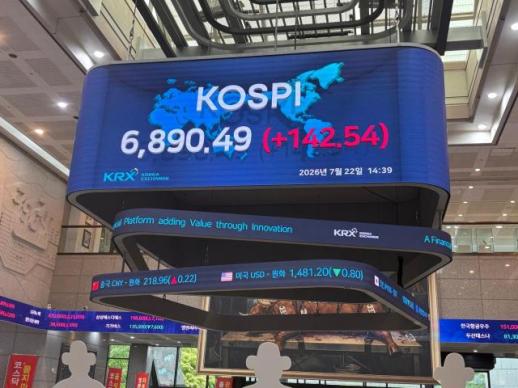 Foreign investors' return lifts KOSPI ahead of key big tech earnings SEOUL, July 22 (AJP) - Foreign investors extended their buying streak to a third consecutive session on Wednesday, helping lift the benchmark KOSPI higher despite caution among investors ahead of U.S. big tech earnings, which could determine whether the recent rally in artificial intelligence (AI)-related stocks can be sustained. The KOSPI rose 0.74 percent to close at 6,797.70 points after surging as much as 6 percent during the session, but gave up most of its gains in late trading. The junior KOSDAQ, meanwhile, fell 0.30 percent to 751.09. Foreign investors purchased 2.61 trillion won (US$1.9 billion) worth of KOSPI shares, bringing their net buying over the past three sessions to 3.46 trillion won, according to the Korea Exchange. The latest inflows mark a sharp turnaround in foreign investors’ stance after weeks of heavy selling. They dumped 19.8 trillion won during the week spanning late June and early July before trimming their net selling to 4.1 trillion won the following week. They then returned as net buyers last week and have further accelerated their purchases this week. The buying spree was concentrated in semiconductor and technology shares, with foreign investors purchasing a net 3.18 trillion won worth of electrical and electronics stocks over the past three trading sessions. Samsung Electronics, the key beneficiary of the inflows, rose 0.58 percent to close at 260,500 won, while SK hynix edged down 0.33 percent to 1,830,000 won as investors locked in profits following recent gains. Among other large-cap technology shares, Samsung Electro-Mechanics climbed 2.67 percent to 1,345,000 won and Samsung Electronics preferred shares gained 2.27 percent to 185,100 won, while Samsung Biologics fell 1.65 percent to 1,372,000 won. Automakers outperformed, with Hyundai Motor advancing 4.76 percent to 418,000 won and Hyundai Mobis jumping 6.99 percent to 513,000 won. Shipbuilder HD Hyundai Heavy Industries also gained 2.88 percent to 464,500 won, while Samsung C&T rose 3.06 percent to 354,000 won. On the junior KOSDAQ, robotics shares remained a bright spot despite the broader index's decline, as Samsung Electronics' newly established robotics division continued to fuel expectations for physical AI. Robotics software developer NRobotics jumped 29.89 percent to 2,390 won and service robot maker Hyulim Robot gained 9.70 percent to 6,900 won, while Lightron Fiber-Optic Devices rose 6.67 percent. The broader index, however, gave up its early gains as profit-taking spread across technology shares. The recent sell-off, which sent the KOSPI down about 20 percent this month, has made valuations more attractive, encouraging foreign investors to return to the market. Wall Street investment banks Morgan Stanley and JPMorgan have also struck a more optimistic tone on South Korean stocks. Morgan Stanley maintained its 9,000-point KOSPI target this week, saying the recent selloff has brought the market close to a bottom. JPMorgan also reaffirmed its 12-month target of 12,500, citing resilient corporate fundamentals and continued earnings momentum led by semiconductors. The positive outlook has also been driven by expectations that the AI-driven memory-chip upcycle will last longer than previously anticipated. Morgan Stanley said concerns over tighter memory supply in 2027 and 2028 have increased, describing the recent pullback in semiconductor shares a buying opportunity. A stabilizing South Korean won has also improved sentiment toward local assets by easing concerns over foreign capital outflows. The currency weakened slightly on Wednesday, however, with the dollar-won exchange rate rising to 1,479.50 in afternoon trading from 1,473.40 in the previous session. Still, analysts cautioned that whether foreign buying develops into a sustained trend will largely depend on earnings from U.S. technology giants, beginning with Alphabet after the U.S. market closes Wednesday. Alphabet, one of the world's four largest hyperscale cloud operators, previously projected capital spending of $180 billion to $190 billion this year, roughly double last year's level, as it expands AI infrastructure. If the company maintains or raises its spending outlook for next year, expectations for memory demand could strengthen further, providing another catalyst for Korean chip stocks. The cautious mood was reflected across Asia. Japan's Nikkei 225 erased an intraday gain of more than 2 percent to end 0.18 percent lower, while Taiwan's benchmark index rose 1.34 percent even as chipmaker TSMC slipped 0.41 percent. 2026-07-22 17:42:34
-
Average Price of New Apartments in Japan's Capital Region Surpasses 100 Million Yen Japan's capital region has seen the average price of new apartments exceed 100 million yen (approximately $980,000) for the first time in the first half of this year. Prices have surged not only in Tokyo's 23 wards but also in Chiba and Kanagawa. The combination of rising material and labor costs, along with a decrease in supply, has led developers to focus on areas where they can command higher prices, suggesting that the upward trend in new apartment prices will continue for the foreseeable future.According to the Asahi Shimbun, citing data released by the Japan Real Estate Economic Institute, the average price of newly built apartments in the capital region rose 13.1% year-on-year to 101.35 million yen in the first half of this year. This marks the first time the average price in the capital region has surpassed 100 million yen.In Tokyo's 23 wards, the average price of new apartments reached a record high of 142.49 million yen, up 9.1% from the previous year. In Chiba, prices skyrocketed by 56.8% to 89.97 million yen, while Kanagawa saw a 20% increase to 83.46 million yen. Conversely, Saitama experienced a slight decline of 1.3%, with an average price of 64.69 million yen. While Tokyo's 23 wards had the highest average price, Chiba and Kanagawa recorded greater percentage increases. Notably, tower apartments in Chiba, particularly in Kaihinmakuhari and Funabashi, have gained popularity, driving up the average price.The primary reasons for the rising prices of new apartments include increased material and labor costs. According to the Japan Federation of Construction Contractors, construction costs have risen by approximately 30% over the past five years. The growing demand for data center construction has also led to a shortage of skilled workers for electrical and HVAC installations, further increasing construction costs. As costs rise, developers are concentrating their efforts on urban and popular areas where they can charge higher prices. Tadashi Matsuda, a senior researcher at the Japan Real Estate Economic Institute, explained that competition among companies for land in desirable locations has driven up land prices even further.The supply of new apartments has also significantly decreased. The number of new apartments in the capital region fell from 95,635 units in 2000 to just 21,962 last year. In the first half of this year, the supply dropped by 64 units year-on-year to 7,989 units. This marks the third consecutive year that the supply has fallen below 10,000 units, and it is the second-lowest level since the first half of 2020, when only 7,489 units were supplied due to the COVID-19 pandemic.Developers are also taking a cautious approach to new projects. Sumitomo Realty & Development announced during its May financial briefing that it would not rush to sell 6,000 unsold apartments built when construction costs were lower and would selectively pursue new projects.In response to rising prices, some apartments are now offering differentiated services. Tokyo Tatemono plans to introduce a paid taxi service for children at an apartment set to be completed in Arakawa, Tokyo, in July next year. The service will notify the apartment intercom when a taxi arrives, even if the child does not have a mobile phone. The starting price for a three-bedroom unit with a floor area of 70 square meters is around 79 million yen.Tokyu Land Corporation's new apartment in Sagamihara, Kanagawa, features a lounge on the 28th floor with a bookshelf containing about 400 books and a café bar offering meals. Instead of lowering prices, the strategy focuses on enhancing communal facilities and services to increase market appeal.The Japan Real Estate Economic Institute forecasts that high prices will persist. If geopolitical tensions in the Middle East continue to keep material costs elevated, this could further drive up apartment prices beyond 2027. Matsuda stated, "In the long term, the likelihood of new apartment prices declining is very low."* This article has been translated by AI. 2026-07-22 17:40:00
-
Korea Development Bank Discusses Financial Support for Yeosu No. 1 Petrochemical Restructuring The Korea Development Bank announced on July 22 that it held a meeting with bond financing institutions to support the restructuring of the Yeosu No. 1 project under the 'Structural Innovation Support Agreement.'The Yeosu No. 1 restructuring plan is a collaborative effort by Yeochun NCC, Lotte Chemical, Hanwha Solutions, and DL Chemical to reorganize the petrochemical industry. The Ministry of Trade, Industry and Energy approved the final restructuring plan on July 20, and the government announced a tailored support package that includes financial, tax, cost reduction, and research and development (R&D) assistance, as well as support for local economies and job stability.During the meeting, the Korea Development Bank and bond financing institutions discussed financial support measures necessary for the restructuring, in conjunction with the government’s support initiatives. Key agenda items included deferring repayment of existing bonds and providing new investment funding for the restructuring.According to the restructuring plan, Hanwha Solutions and DL Chemical's downstream facilities, along with Lotte Chemical's basic chemical operations at the Yeosu plant, will be integrated into Yeochun NCC. The newly formed entity will aim to rationalize naphtha cracking facilities (NCC), enhance vertical integration, shift towards a high-value product-focused business structure, and improve its financial structure.Lotte Chemical, DL Chemical, and Hanwha Solutions plan to transfer their basic chemical operations to the new entity while concentrating their capabilities on core businesses, aiming to advance their operations towards high-value, eco-friendly advanced chemicals.Amid increasing uncertainty in naphtha supply due to geopolitical instability in the Middle East, bond financing institutions previously provided Yeochun NCC with a $300 million emergency import letter of credit (L/C) and $350 million to Lotte Chemical during the ongoing restructuring due diligence.* This article has been translated by AI. 2026-07-22 17:36:00
-
Guryong Village to Transform into 2,120-Unit Public Housing Complex Guryong Village in Gangnam District, Seoul, will see the construction of a public housing complex with 2,120 units. Once known as Seoul's 'last shantytown,' Guryong Village is set to be redeveloped into a large residential area that harmonizes with the natural environment of Daemosan and Guryongsan.The Seoul Metropolitan Government announced on July 22 that the plan for the 'Guryong Village Public Housing Construction Project M Block and B2 Block' was conditionally approved during the third meeting of the Public Housing Integrated Review Committee held on July 21.This approval confirms the housing supply plan for the core areas of Guryong Village, specifically M Block and B2 Block, which will provide a total of 2,120 units.M Block will consist of 300 units, built over two basement levels and 15 floors. It will include 115 integrated public rental units, 165 long-term lease homes (Mirilnae House), and 20 public sale units.B2 Block will be a high-rise complex with 2 to 28 floors, offering a total of 1,820 units, including 643 integrated public rental units and 1,177 Mirilnae House units.The city plans to preserve the natural features of Guryong Village by integrating the nearby Daemosan and Guryongsan environments into the design. The project will also incorporate renewable energy sources and eco-friendly design techniques.Improvements to pedestrian environments are also planned. The project aims to create a pedestrian-friendly street environment by connecting neighborhood parks and community facilities, as well as establishing a walking network that links surrounding green spaces and living areas. This is intended to provide a comfortable and safe residential environment.Given the scarcity of large public housing projects in the Gangnam area, the Guryong Village redevelopment project addresses both the improvement of living conditions in vulnerable areas and the supply of public housing in urban centers.The Seoul Metropolitan Government aims to obtain construction project approval by the end of this year, with plans to begin construction next year. The target completion date is set for 2031.Myung No-jun, head of the Seoul Housing Office, stated, "We expect this project to significantly contribute to housing stability for citizens by providing quality housing in the high-demand Gangnam area."* This article has been translated by AI. 2026-07-22 17:36:00
-
U.S., South Korea, and Japan Foreign Ministers Meet in Manila to Discuss Regional Security U.S., South Korean, and Japanese foreign ministers held a meeting on July 22 in Manila, Philippines, to discuss global and regional security issues. Cho Hyun, South Korea's Foreign Minister, U.S. Secretary of State Mark Rubio, and Japan's Foreign Minister Toshimitsu Motegi convened at the Philippine International Convention Center (PICC) to address regional and global dynamics, economic security, and the situation on the Korean Peninsula. This meeting comes about two weeks after their previous discussions during the NATO summit on July 7. The ministers are in Manila to participate in ASEAN-related foreign ministers' meetings, including the ASEAN Regional Forum (ARF) and the East Asia Summit (EAS). According to the South Korean Foreign Ministry, the three ministers shared assessments of the current situation on the Korean Peninsula and reaffirmed their commitment to maintaining a strong deterrent posture against North Korea while upholding the principles of denuclearization. They agreed to continue close coordination on North Korea policy and to maintain communication and cooperation to ensure peace and stability on the Korean Peninsula through dialogue and diplomacy. The ministers also discussed recent developments in Northeast Asia and the Middle East, agreeing on the need to strengthen communication and policy coordination among the U.S., South Korea, and Japan amid increasing uncertainties in the international landscape. They exchanged views on regional dynamics, including attempts to unilaterally change the status quo, and reaffirmed their commitment to upholding international law as reflected in the United Nations Convention on the Law of the Sea, particularly regarding freedom of navigation and lawful use of the seas in the Indo-Pacific region, including Southeast Asia. The three ministers reviewed key trends in economic security and exchanged views on major risk factors and policy coordination directions. They emphasized the importance of cooperation among reliable allies in light of ongoing volatility in the global economy and agreed to deepen practical collaboration based on the achievements and strengths of the U.S., South Korea, and Japan in areas such as nuclear energy, critical minerals, and emerging technologies. In particular, they committed to expanding cooperation in protecting advanced technologies, enhancing nuclear energy, diversifying and strengthening supply chains, responding to economic coercion, and Arctic security, while continuing follow-up discussions.* This article has been translated by AI. 2026-07-22 17:32:00