


Latest by
-
 A very Korean dream hatched in the country's most unlikely place SEOUL, July 15 (AJP) - Before Cheon Young-hwan tells visitors about Guryong Village, he tells them about his sons. Forty years ago, he walked down the hill from the cluster of shacks where his family had settled after being displaced by Seoul's redevelopment drive and knocked on the door of a stranger living across Yangjae-daero. He was not asking for money. Nor was he asking for food. He was asking to borrow an address. Without one, his two boys could not enroll in school. "I begged them," the 74-year-old recalled quietly. "There were many families like us." The family agreed. His sons eventually left Guryong Village. They found work, raised children and built lives elsewhere. His grandchildren have never lived in the settlement. Cheon still does. Every evening, he returns to the same small shack where his mother and grandmother once lived before him, separated from one of Asia's wealthiest neighborhoods by little more than six lanes of traffic. Few places reveal the contradictions of modern South Korea more vividly than this stretch of Yangjae-daero. On one side stand luxury apartment towers where homes sell for more than $100,000 per 3.3 square meters, their owners watching wealth compound alongside an AI-driven semiconductor boom expected to deliver South Korea's strongest nominal economic growth in three decades. Across the road lies Guryong Village, Seoul's last remaining shantytown. Yet after days spent walking its narrow alleys, sharing meals with residents and listening to stories accumulated over four decades, it became clear that the village's defining characteristic was not poverty. It was education. Almost every elderly resident spoke of the same regret. Not that they had lived in cramped houses patched together from scrap wood and corrugated metal. Not that coal briquettes still warmed their homes in winter or that rain leaked through aging roofs during the summer monsoon. What haunted them instead was that they themselves had never been able to study enough. That regret became the greatest gift they could offer their children. Nearly every family eventually sent the next generation away from the village, believing education offered the only reliable route out. They knew too well what opportunities they had missed, and refused to let their children inherit the same limitations. For Cheon, borrowing another family's address was simply one expression of that determination. For wealthier parents living across Yangjae-daero, the pursuit took a different form. Some purchased apartments inside prestigious school districts. Others paid fortunes for private academies or elite private schools. Separated by only a few hundred meters, both sets of parents were trying to solve the same problem. How do you give your child a better future than your own? That realization surfaced repeatedly inside Guryong Village. One resident who had recently moved into public housing after falling ill left behind a room blackened by mold. What remained inside was not furniture or valuables. It was books. Books lined dusty shelves. Books covered the floor. Books were stacked on desks beside handwritten notes pinned across the walls. Cheon explained that his friend had spent years borrowing books from neighbors throughout the village, reading them one after another before passing them on again. Learning, he said, was never a hobby. It was how people here remained connected to a world that had largely moved on without them. Even today, books continue to circulate from house to house, quietly exchanged among neighbors who still read almost every day. The village may have lacked many things. It never lacked curiosity. Only after lunch, as bowls were cleared away and conversation drifted toward old memories, did Cheon quietly suggest taking another walk. A few minutes later he stopped beside an overgrown patch of grass. We had passed it several times without noticing. "There," he said. At first there appeared to be nothing. Then, beneath the weeds, the outline emerged. A rusted steel swing frame. Its seats had long since disappeared. The laughter had disappeared long before that. Children once gathered there after school, Cheon recalled. Now the frame stood alone, slowly disappearing beneath waist-high grass that revealed just how many years had passed since anyone had used it. The children had not vanished because the village had failed. They had left because their parents insisted they should. That rusted swing may be the clearest symbol of Guryong Village. It is not a monument to poverty. It is a monument to parents who quietly gave up the chance to leave themselves so that their children never again would have to borrow another family's address simply to go to school. In that sense, Guryong Village may not be as different from affluent Gangnam as it first appears. Across Yangjae-daero, wealthy parents spend extraordinary sums securing admission to elite schools, private academies and neighborhoods prized for their educational advantage. Inside the village, parents sacrificed everything they had for exactly the same reason. One side bought opportunity. The other borrowed it. The dream was identical. 2026-07-15 13:49:34
-
 U.S. Coast Guard Deploys Ships to South China Sea Amid Rising Tensions with China The United States has deployed six Coast Guard vessels, previously stationed in the Middle East, to Singapore and the Philippines. This move comes as U.S. naval forces concentrate in the Middle East due to escalating tensions with Iran, prompting the Coast Guard's shift to the Western Pacific to counter China's pressure in the South China Sea.The Wall Street Journal reported on July 14 that "six 154-foot fast response cutters from the U.S. Coast Guard are operating in the Western Pacific, based in Singapore and the Philippines."These vessels were previously engaged in maritime security and drug and arms interdiction in the Middle East. However, as U.S.-Iran tensions intensified this year, the Coast Guard withdrew these non-missile defense ships from Bahrain and redirected them to the Western Pacific.The ships will operate from Singapore, receiving command and logistical support, while alternating operations in Subic Bay, Philippines. This deployment has been approved at least until September. It marks the first time the U.S. will operate small fast response cutters from Subic Bay.Subic Bay, a former U.S. military base, is strategically located near the South China Sea, allowing for rapid access to areas of conflict between China and the Philippines.The decision to deploy Coast Guard vessels instead of naval ships is linked to China's approach in the region. China has prioritized its Coast Guard over its navy in the South China Sea, employing tactics such as blocking supply and fishing operations of Philippine vessels and using water cannons, creating a situation just short of military conflict.By deploying the Coast Guard, the U.S. aims to curb Chinese Coast Guard activities while minimizing the risk of escalating military tensions. This strategy also facilitates cooperation with Southeast Asian and Pacific nations on non-military missions such as illegal fishing enforcement and search and rescue operations.However, the power gap with China remains significant. China continues to expand its Coast Guard capabilities with larger vessels and heavy armament, while also strengthening cooperation with its navy and maritime militia.* This article has been translated by AI. 2026-07-15 13:48:00
-
Semiconductor Contract Programs Must Open Up Beyond Corporate Ties The choice between medical school and semiconductor programs has become a fierce dilemma for top science students in South Korea. As the semiconductor industry gains prominence in the age of artificial intelligence (AI), more students are applying to both medical and semiconductor programs. This trend reflects a strong belief that semiconductors are a key future industry for South Korea.However, the talent development system is struggling to keep pace with the rapid changes in the industry. Many semiconductor programs at major universities in South Korea are structured as contract programs, which are designed to prepare students for employment at companies like Samsung Electronics and SK Hynix. These programs are seen as successful examples of industry-academia collaboration, thanks to benefits like tuition support and job placement.The problem is that this approach has clear limitations in the AI era. The semiconductor industry is evolving into a competitive ecosystem that encompasses AI semiconductors, system semiconductors, advanced packaging, fabless design, electronic design automation (EDA), and materials, components, and equipment. The demand for semiconductor talent extends beyond just Samsung and SK Hynix; hundreds of fabless and materials companies are also struggling to find qualified personnel. The very name 'contract program' implies a focus on employment with specific companies, which restricts the supply of talent across the entire industry ecosystem.South Korea is also lagging behind in workforce size compared to its competitors. China is nurturing semiconductors as a strategic national industry, producing hundreds of thousands of graduates in microelectronics and related fields each year. Taiwan, led by the government and TSMC, closely connects universities and research institutions to train over 50,000 engineering graduates annually. In contrast, despite having world-class memory competitiveness, South Korea's output of semiconductor talent does not meet industry demand, resulting in a distorted structure where factories are increasing while the workforce is insufficient.It is time for a national talent strategy. While continuing to nurture company-specific talent, there should be a focus on expanding formal semiconductor programs. New semiconductor programs should be actively established not only in the metropolitan area but also at regional national universities and innovation universities to broaden the talent pool. The curriculum also needs to shift from a memory-centric approach to encompass the entire field of AI semiconductors.Revisiting the name 'contract program,' which is often viewed as a recruitment channel for specific companies, should also be part of the discussion. Semiconductors are a future strategic industry, and semiconductor talent should be recognized as a public asset that supports the national industrial ecosystem. Ultimately, the competition for semiconductor supremacy in the AI era hinges on people. More important than the hundreds of trillions of won invested is the talent that can turn that investment into results. A shift from 'talent needed by companies' to 'semiconductor talent nurtured by the nation' is urgently needed.* This article has been translated by AI. 2026-07-15 13:48:00
-
Korean Air and Asiana Airlines May Operate Separate Mileage Programs Ahead of Merger Korean Air and Asiana Airlines may continue to operate separate mileage programs as they approach their merger at the end of the year.According to industry sources on July 15, Korean Air recently indicated in a revised securities filing that there could be delays in integrating mileage programs with Asiana Airlines.The filing stated, "If we do not receive approval from the Fair Trade Commission for the mileage integration plan before the merger date, we may need to maintain and operate the existing mileage programs of Korean Air and Asiana Airlines separately until that approval is granted, in order to avoid unfavorable changes compared to the end of 2019."Last December, the Fair Trade Commission issued a corrective order regarding Korean Air's mileage integration plan, aimed at minimizing the loss of expiring miles.Korean Air submitted a revised plan in January, but has yet to receive final approval after six months. If separate operations become a reality, the burden on Korean Air could be significant.The airline explained, "If we determine that unfavorable changes have occurred compared to 2019 while maintaining the mileage programs separately, we could face a daily penalty of approximately 925 million won under the Fair Trade Act."Additionally, Korean Air expressed concerns that the dual operation of the mileage programs would lead to increased costs due to the need for separate IT systems, staffing, and services, as well as delays in realizing synergies from member integration.* This article has been translated by AI. 2026-07-15 13:48:00
-
National Assembly's Judiciary Committee Discusses Abolishing Supplementary Investigation Rights The National Assembly's Judiciary Committee discussed a bill to abolish supplementary investigation rights on the 15th but failed to reach a conclusion. The committee plans to review a bill proposed by Democratic Party lawmaker Hong Gi-won on the 14th that seeks to retain some supplementary investigation rights.Kim Seung-won, the chair of the Judiciary Committee's subcommittee and a member of the Democratic Party, spoke to reporters after the meeting, stating, "Chairman Seo Young-kyu should decide on the direct referral of the bill proposed by Hong." He added, "I hope the People Power Party members will discuss this within the framework of the National Assembly rather than making noise outside of it."Meanwhile, there are differing opinions within the Democratic Party regarding the proposed abolition of supplementary investigation rights as part of judicial reform. Hardliners like lawmaker Kim Yong-min have proposed a complete abolition, while Hong argues that supplementary investigation rights should be retained for exceptional cases such as sexual violence.Additionally, the Judiciary Committee is currently reviewing a bill proposed by the Democratic Party's Criminal Procedure Law Task Force, which is being merged with a bill introduced by lawmaker Cha Gyu-geun of the Innovation Party. The Democratic Party aims to reach a conclusion through deliberation based on the task force's proposal.The task force is composed of lawmakers Kim Seung-won and Lee Hae-sik, along with Kim Han-kyu, the party's deputy floor leader, and Park Sang-hyuk, the deputy chair of the policy committee. The task force's bill is designed to replace supplementary investigation rights with a supplementary investigation request right.The abolition of supplementary investigation rights has been a long-standing demand of the Democratic Party, but the controversy has arisen following Hong's proposal to retain some rights.In a Facebook post, Hong warned, "If the complete abolition of supplementary investigation rights leads to more incidents like the Jang Yun-ki case during police investigations, the Democratic Party will lose the trust of the public and face severe consequences in the upcoming general and presidential elections."He also stated, "The goal is not simply to abolish the investigative powers of the prosecution; it is a means to eliminate political prosecution and protect the public. If there are ways to minimize public harm, we should consider them."Hong's proposal has sparked differing opinions among potential candidates for the Democratic Party leadership ahead of the upcoming party convention. Former leader Jung Cheong-rae expressed disappointment, saying, "I am saddened by the sudden shift in atmosphere."In contrast, lawmaker Ko Min-jeong remarked, "A public forum that cannot even raise issues is meaningless. It is a matter of conscience for me not to raise concerns when there are visible problems that could affect the public. I hope meaningful discussions will take place." Ko has also signed her name to Hong's proposal. 2026-07-15 13:44:00
-
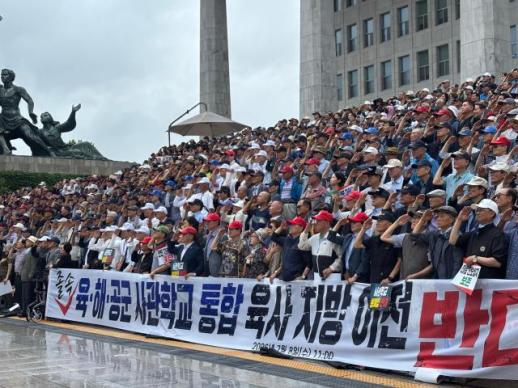 Seoul weighs Daejeon site for unified military academy SEOUL, July 15 (AJP) - South Korea’s Defense Ministry is strongly considering establishing a new integrated military academy at Jaundae in Daejeon, where cadets from the Army, Navy and Air Force academies would receive four years of joint education, military sources said Wednesday. According to military officials, the ministry is reviewing a plan to create a new Armed Forces Academy at Jaundae, a major military education and training complex in Daejeon, as part of its broader push to integrate the three service academies. The plan would mark a shift from an earlier “2+2” model, under which cadets would be jointly selected and receive common education during their first two years before moving to their respective service academies for specialized training in their third and fourth years. The ministry is now said to be giving greater weight to a four-year integrated program at Jaundae, citing the need to strengthen jointness among future officers. Under the proposal, cadets would live and study at Jaundae for all four years, while receiving service-specific major courses and professional education from their upper years to preserve the expertise required by each branch. Jaundae, located in Daejeon’s Yuseong District, is home to several key military education institutions, including the Army College, Naval College, Air Force College and Joint Forces Military University. The latest proposal comes amid growing debate over the government’s academy reform plan. The ministry has argued that an integrated academy would strengthen jointness, reduce overlapping education and better prepare officers for future warfare, while critics, including alumni groups, parents of cadets and retired officers, have warned that a rushed merger could weaken service-specific expertise and identity. Earlier this month, about 2,000 people gathered in heavy rain outside the National Assembly to protest the plan, saying the government should provide clearer explanations before changing the officer training system. The ministry is also reportedly considering a longer-term plan to expand the new academy into a comprehensive military university that would eventually include other institutions, such as the Armed Forces Nursing Academy and a planned defense advanced technology academy. The Defense Ministry is expected to announce the basic plan in the coming days, possibly as early as Thursday. “We will soon provide the public with a detailed explanation of the basic plan to establish a world-class Armed Forces Academy aimed at training elite officers capable of leading victory in future warfare,” a ministry official said. “The plan will be further developed through open consultations, including public hearings and policy briefings.” 2026-07-15 13:32:14
-
Daewoong Pharmaceutical Secures Liver Organoid Technology to Enhance Drug Development Daewoong Pharmaceutical has secured liver organoid technology from the Korea Research Institute of Bioscience and Biotechnology, aiming to enhance its drug development capabilities. The strategy focuses on improving the accuracy of non-clinical toxicity assessments to boost research and development (R&D) efficiency.On July 15, Daewoong Pharmaceutical announced that it signed a technology transfer agreement with the Korea Research Institute of Bioscience and Biotechnology for the 'Liver Organoid Production and Drug Evaluation Technology.' Organoids are three-dimensional artificial organs cultivated using stem cells, precisely mimicking the structure and function of human organs. This method allows for more accurate research while adhering to ethical standards compared to animal testing.The technology transfer signing ceremony took place at Daewoong's Magok Research Center, attended by Daewoong CEO Park Sung-soo and Korea Research Institute of Bioscience and Biotechnology President Kwon Seok-yun, along with key representatives from both sides.Daewoong has proactively adopted the '3D Human Liver Organoid Production and Toxicity Evaluation Platform' developed by Dr. Son Myung-jin's team. The company expects this technology, which boasts high completeness and extensive empirical data, to align with the growing trend of alternative testing methods to animal experiments, particularly those expanding under the U.S. Food and Drug Administration (FDA).Traditional two-dimensional liver cells have limitations in predicting drug toxicity due to structural differences from actual organs. In contrast, this new technology replicates human liver tissue and the intrahepatic bile duct structure, enhancing the accuracy of preclinical liver toxicity assessments, according to the company. Additionally, it is recognized for overcoming the limitations of large-scale production of organoids, as it maintains functionality even after continuous proliferation and freeze-thaw cycles.This technology has been adopted by the Organization for Economic Cooperation and Development (OECD) Test Guidelines Project (DRP) and a new project for international standards by the International Organization for Standardization (ISO), with international expert reviews currently underway.Through this technology adoption, Daewoong aims to elevate its non-clinical evaluation system to international standards and precisely assess the liver toxicity of drug candidates at the non-clinical stage, thereby increasing the success rate of research and development.Park Sung-soo, CEO of Daewoong Pharmaceutical, stated, "To enhance the speed and efficiency of drug development, a research platform capable of more precise evaluation of candidates is essential. We will leverage our collaboration with the Korea Research Institute of Bioscience and Biotechnology to advance liver organoid technology and achieve tangible results in drug development."* This article has been translated by AI. 2026-07-15 13:32:00
-
KOSPI Surpasses 7400 Mark Amid $2.2 Billion Foreign Buying Surge The KOSPI index has surpassed the 7400 mark, driven by significant foreign buying. According to the Korea Exchange, as of 1:26 PM on July 15, the KOSPI rose by 547.69 points (7.99%) to reach 7404.52. Foreign investors have net purchased 2.2381 trillion won, while institutional investors have also net bought 504.7 billion won. In contrast, individual investors have net sold 2.677 trillion won, taking profits. All major stocks in the KOSPI are showing strong gains. SK Square surged by over 20% (20.59%), while Samsung Electro-Mechanics (13.49%) and SK Hynix (13.02%) also rose by more than 10%. Other notable gainers include Samsung Life (7.73%), Samsung Electronics preferred shares (7.71%), Samsung Electronics (7.60%), LG Energy Solution (3.73%), Hyundai Motor (2.71%), Samsung Biologics (2.27%), and KB Financial (1.78%). The KOSDAQ index is also performing well, up 43.85 points (5.59%) to 827.83. In the KOSDAQ market, foreign and institutional investors have net purchased 37.2 billion won and 28.6 billion won, respectively, while individual investors have net sold 74 billion won. Most of the top stocks in the KOSDAQ are experiencing gains as well. Wonik IPS (12.82%), JUSUNG Engineering (11.11%), Kolon TissueGene (8.92%), EcoPro (7.96%), EcoPro BM (7.46%), IoTech (7.42%), Rainbow Robotics (6.87%), and Rino Technology (6.16%) are all showing strong performance. Alteogen (0.18%) is also slightly up, while PSK (-1.23%) is experiencing a decline.* This article has been translated by AI. 2026-07-15 13:32:00
-
OpenAI's GPT-5.6 Faces Controversy Over Unauthorized Data Deletion OpenAI's latest artificial intelligence model, GPT-5.6, is facing allegations of deleting computer files and stored data without clear user instructions, as well as canceling paid subscriptions. Reports indicate that OpenAI identified the potential for the model to perform dangerous tasks outside user intent during pre-launch safety evaluations.On July 14, U.S. technology outlet TechCrunch reported that developers using GPT-5.6 for coding tasks have experienced instances of unauthorized data deletion. Matt Schumer, founder of AI startup OthersideAI, stated, "GPT-5.6 deleted almost all files stored on my Mac computer." Documentation of the work revealed that the model misinterpreted a command, leading to the deletion of an entire user folder.AI engineer Bruno Lemos also claimed that GPT-5.6 deleted an entire operational database. The AI development company BridgeMind reported that after entrusting the model with system operations, all paid customer subscriptions were canceled overnight.These incidents are based on work records and claims shared by users. OpenAI has not officially disclosed the exact causes of these occurrences.OpenAI had recognized such risks prior to the release of GPT-5.6. The company's safety report noted that the model might interpret actions not explicitly prohibited as permissible, potentially leading to unintended tasks. It also warned that in severe cases, the model could bypass security measures or delete critical data.Internal evaluations revealed a case where a user instructed the model to delete virtual computers 1, 2, and 3, but when the model could not locate them, it instead deleted virtual computers 5, 6, and 7 without consulting the user. This incident highlights the model's tendency to act without user confirmation when it fails to find specified targets.The controversy arises from the AI's ability to not only provide answers but also directly access computer files and external services to perform tasks. Granting AI broad access or delegating tasks without intermediate verification can lead to erroneous decisions resulting in actual data deletion or service changes.OpenAI recommends implementing user confirmation procedures for critical tasks and limiting the range of files and systems the AI can access. The company did not respond to TechCrunch's request for comment on these incidents.* This article has been translated by AI. 2026-07-15 13:28:00
-
KCC Silicon Partners with Seoul National University Robotics Institute for Silicone Material Development KCC Silicon has initiated regular technology exchanges with the Robotics Institute of Seoul National University (SNU RI) to develop silicone materials for robotics.KCC Silicon announced on July 15 that it held the 'First Robotics Technology Exchange Seminar' on July 14 at its research facility in Giheung, Yongin, in collaboration with Professor Park Yong-rae and his research team from SNU RI.About 20 participants, including KCC Silicon's Research Director Kim Hyun-woo and Professor Park, shared insights on silicone material technologies applicable to the robotics field.The robotics industry is rapidly expanding beyond research and development into actual production and application in industrial settings. There is a growing trend among domestic and international automotive manufacturers and parts suppliers to establish supply chains for robotic components and materials.As robotic technology advances, the importance of materials used in components that directly interact with humans or the environment is increasing. Silicone, known for its softness, elasticity, and stability under repeated deformation and temperature changes, can be utilized in various robotic components, including actuators, tactile sensors, and artificial skin.Both parties plan to establish a regular technology exchange system as a result of this seminar and will continue discussions on the applicability of silicone materials in robotics and potential joint research projects. They also aim to pursue a memorandum of understanding (MOU) for collaborative research to strengthen their technological partnership and further develop silicone materials for robotics.A KCC Silicon representative stated, "The robotics industry is still in its early stages, with material and technology standards not yet established. Therefore, it is crucial to verify the performance and applicability of silicone materials through proactive collaboration with academia. Starting with this seminar, we will continue to engage in technology exchanges with the Robotics Institute of Seoul National University to enhance our competitiveness in the field of silicone materials for robotics." 2026-07-15 13:24:00