


Latest by
-
 Export-Import Bank to Automate Loan Reviews and Document Checks with AI The Export-Import Bank of Korea is set to enhance operational efficiency by utilizing generative artificial intelligence (AI) for loan reviews and document checks. The initiative aims to reduce bureaucratic formalities and unnecessary administrative tasks, allowing employees to focus on core activities such as business development, customer consultations, and credit assessments. On July 9, the Export-Import Bank announced that it has completed the selection of a final contractor for the establishment of an 'AI-Based Intelligent Workspace' and will begin system design this month. This project is part of a broader push for operational innovation emphasized by Bank President Kihyun Hwang. The bank plans to apply AI technology across its operations to eliminate unproductive procedures and concentrate its capabilities on its primary responsibilities as a policy bank. Initially, AI will be used to improve the loan review process. The bank intends to develop an 'AI Credit Review System' that analyzes vast customer data and accumulated information to streamline the complex loan assessment process. By automating repetitive data verification tasks, employees will be able to focus on specialized duties such as credit assessments and evaluations. The bank also aims to enhance convenience for corporate clients. It plans to introduce 'Corporate Finance AI Document Review' to automate the document review and verification process, thereby reducing waiting times for assessments. Additionally, a 'Smart One-Stop Reporting System' will be implemented for overseas investment reporting, utilizing conversational AI to handle document submissions in a single step. Work practices will also evolve. The bank plans to utilize five key functions across its operations, including a collaborative workspace for inter-departmental projects, an AI assistant for analyzing work patterns, natural language-based conversational search, automated meeting minutes, and document draft generation. A bank official stated, "Through a new AI-centered work environment, we aim to establish an innovative corporate culture where creative ideas can be freely shared without being constrained by unnecessary formalities. The capabilities gained from this initiative will enhance our credit assessment abilities and improve the convenience of our external financial services."* This article has been translated by AI. 2026-07-09 08:52:00
-
SK Hynix Sees Strong Demand Ahead of U.S. IPO with 7x Subscription for ADRs SK Hynix's American Depositary Receipt (ADR) offering has reportedly attracted more than seven times the subscription demand for the available shares.Bloomberg News reported on July 8, citing sources, that global long-term investment funds, technology-focused funds, sovereign wealth funds, and Asia-specialized global investors participated in the offering.According to the report, the offering price is expected to be finalized on July 9. SK Hynix's filing with the U.S. Securities and Exchange Commission (SEC) indicates that one ADR represents one-tenth of a common share.Bloomberg calculated that based on the Seoul stock market's closing price of 2,076,000 won per share on July 8, the offering could raise approximately $24.5 billion (about 37.14 trillion won). If this holds, SK Hynix's U.S. listing would be the second largest for a foreign company on the U.S. stock market, following Alibaba Group's $25 billion IPO in 2014.However, sources noted that specific terms are still under discussion and may change.The offering is being managed by Bank of America, Citigroup, Goldman Sachs, and JPMorgan Chase, with nine additional financial institutions participating. Previously, SK Hynix secured interest for up to $7 billion in ADR purchases from firms including Baillie Gifford, Coatue Management, and Situational Awareness Partners.SK Hynix's ADRs will begin pre-trading on the Nasdaq Global Select Market under the ticker symbol 'SKHYV' on July 10, and will change to 'SKHY' when regular trading starts on July 13.* This article has been translated by AI. 2026-07-09 08:52:00
-
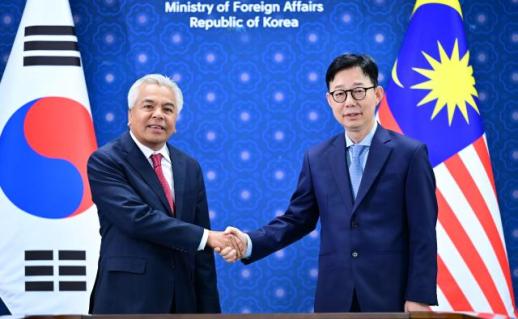 S. Korea, Malaysia deepen energy cooperation after Hormuz shock SEOUL, July 09 (AJP) - South Korea and Malaysia agreed to strengthen energy security cooperation, from stable liquefied natural gas supplies to potential nuclear power collaboration, as Seoul works to shore up supply lines battered by this year's war in Iran and the closure of the Strait of Hormuz. The stakes for South Korea are hard to overstate. The country routes about 70 percent of its crude oil imports through the strait, and the effective blockade that began in late February left 26 South Korean-flagged vessels stranded in the Persian Gulf, sent the KOSPI to its worst single session on record and pushed the won to a 17-year low. Even after Iran and the United States announced a ceasefire on April 8, traffic through the strait has remained far below prewar levels. Malaysia, South Korea's second-largest LNG supplier, ships its gas across sea lanes that bypass the chokepoint entirely, which has turned a longstanding trade relationship into a strategic asset. That backdrop framed the 10th South Korea-Malaysia Policy Consultation, held Wednesday in Seoul between First Vice Foreign Minister Park Yoon-joo and Amran Mohamed Zin, secretary general of Malaysia's Ministry of Foreign Affairs. Agreeing that disruptions to global energy supply chains have made reliable partners more important than ever, the two sides committed to keeping LNG and petroleum product trade stable and to pursuing strategic cooperation, including on nuclear power, according to South Korea's Ministry of Foreign Affairs. The relationship runs both ways: South Korea is the second-largest buyer of Malaysia's refined petroleum products. Trade was the other forward-looking item. The two vice ministers said they are working closely toward signing a bilateral free trade agreement within the year, expecting the pact to expand trade and lay the institutional groundwork for cooperation in new industries, including artificial intelligence and digital technology, halal products, green industry and biotechnology. Defense cooperation, meanwhile, keeps producing concrete results. Park pointed to Malaysia's adoption of the FA-50 light combat aircraft in 2023 and its purchase of the Haegung ship-based interceptor missile in April, and the two sides noted that a joint defense industry committee is being pursued this year on the foundation of an existing defense cooperation memorandum. Both deals carry weight beyond their price tags. The FA-50 contract, signed in February 2023 between Malaysia's Ministry of Defence and Korea Aerospace Industries, covers 18 aircraft for about $920 million and ranks among the largest defense acquisitions in Malaysian history. The Korean jet beat out India's Tejas, Pakistan's JF-17, Russia's MiG-35 and Türkiye's Hurjet in the tender, marking the fourth Southeast Asian aircraft sale for Korea Aerospace Industries (KAI) after Indonesia, the Philippines and Thailand. First deliveries are due this year, with the Royal Malaysian Air Force expecting six aircraft by the end of 2026 instead of the four originally planned, and KAI has said a follow-on order for 18 more is likely. The Haegung deal, though smaller at $94 million, was a milestone for South Korea's missile industry. Signed at the Defence Services Asia exhibition in Kuala Lumpur on April 22, it marked the first overseas export of the ship-to-air interceptor, developed from 2011 under the state-run Agency for Defense Development and mass-produced by LIG Nex1, now LIG Defense & Aerospace, since 2019. Designed to shoot down incoming anti-ship missiles and aircraft, Haegung will arm the Royal Malaysian Navy's new littoral mission ships being built by Turkish shipbuilder STM. Park described Malaysia as a longtime friend and strategic partner, and called for cooperation that ordinary citizens in both countries can feel. Amran stressed people-to-people exchange through tourism and education, saying he hopes more South Koreans will visit during Visit Malaysia Year 2026. Travel between the two countries has been growing: about 330,000 Malaysians visited South Korea last year, up from 240,000 in 2023, while about 460,000 South Koreans traveled to Malaysia, according to the Korea Tourism Organization. Park asked for Malaysia's support in concluding a mutual driver's license recognition agreement within the year to make visits easier. The two sides also exchanged views on the Korean Peninsula and regional affairs. Park thanked Malaysia for its cooperation as ASEAN chair last year and asked for continued support in implementing Seoul's vision for a comprehensive strategic partnership with the bloc. Amran expressed support for the South Korean government's policy and efforts for peaceful coexistence on the Korean Peninsula, and the two agreed to maintain close communication for regional peace and stability. 2026-07-09 08:50:11
-
Lee Dong-cheol, Head of the Credit Finance Association, Calls for Enhanced Support for New Technology Financing The Credit Finance Association is set to strengthen support for expanding venture capital supply to new technology finance companies through improvements in investment-related systems and professional training. The association aims to enhance the investment environment based on feedback from member companies and to expand educational functions and domestic and international networks to boost the competitiveness of the new technology finance sector.Lee Dong-cheol, the head of the Credit Finance Association, stated at a meeting with representatives of new technology finance companies hosted by the Financial Supervisory Service on July 9 at The Plaza Hotel in Seoul, "New technology finance companies have invested 1.7 trillion won in small and venture businesses in just the first quarter of this year, playing a crucial role in supporting the growth of startups and innovative enterprises."He emphasized, "The association will continue to strengthen support for the sector through system improvements, professional training, and the enhancement of domestic and international networks to expand investment."This meeting marked the first official gathering of top executives in the sector since Lee's appointment, where representatives from the Financial Supervisory Service and new technology finance companies discussed the healthy development direction and system improvement measures for the new technology finance industry.Lee Jin, Deputy Director of the Financial Supervisory Service's Small Finance Division, remarked, "It is essential to improve investment-related systems and investor protection measures that align with recent changes in the industrial environment. We will spare no institutional support to ensure that the new technology finance sector, which plays a significant role in the domestic venture investment market, can expand its venture capital supply."* This article has been translated by AI. 2026-07-09 08:48:00
-
Fire in Eunpyeong District Villa Claims Lives of Two Elementary School Students A fire broke out overnight in a villa in Eunpyeong District, Seoul, resulting in the tragic deaths of two elementary school students.According to Yonhap News, the fire occurred at 10:57 p.m. on July 8 in a three-story villa with one basement level located in Galhyeon-dong, Eunpyeong District. Two elementary school students, a boy and a girl, were found inside the burning unit and were transported to a hospital, but unfortunately, they did not survive. The two are believed to be siblings, and it has been reported that other family members were not home at the time of the incident.Two other residents of the building received treatment for smoke inhalation, while nine additional residents managed to evacuate on their own. Neighbors reported being startled by the fire, which erupted late at night in a residential area.Fire authorities responded to reports from nearby residents who heard an explosion followed by flames. A total of 82 firefighters and 23 vehicles were deployed to the scene, and the fire was completely extinguished by 11:47 p.m., approximately 50 minutes after it started.Fire officials are currently investigating the exact cause of the fire and assessing the extent of the damage.* This article has been translated by AI. 2026-07-09 08:44:00
-
Shinhan Securities Raises Kia's Target Price by 9% Amid Robotics and SDV Valuation Reassessment Shinhan Investment Corp. announced on July 9 that it has raised its target price for Kia from 220,000 won to 240,000 won, a 9% increase, citing that the value of robotics and software-defined vehicles (SDV) has not been fully reflected in the stock price. The firm maintained its 'buy' rating.Park Kwang-rae, a researcher at Shinhan Investment, stated, "Like Hyundai Motor, Kia has connections to robotics and SDV through its indirect stake in Boston Dynamics via HMG Global, the introduction of Atlas at its Georgia plant, and the planned SDV launch in 2028." He added, "As simple narratives gradually materialize, the discount rate compared to Hyundai is expected to narrow over time."He also projected that Kia's second-quarter earnings would exceed market expectations. Park estimated an operating profit of 2.9 trillion won for the second quarter, a 5% increase from the same period last year, attributing this growth to increased sales volume, improved product mix, and rising average selling prices (ASP).Park identified the expansion of hybrid electric vehicle (HEV) sales in the U.S. as a key growth driver. He noted, "The biggest upside factor for the second-quarter results is the strong sales of HEVs in the U.S. The Telluride has an HEV share exceeding 55%, and in the second half of the year, the addition of Sportage HEV sales, which began mass production at HMGMA, is expected to raise the HEV share in the U.S. to around 30% this year."While he pointed out that increased incentives in Korea and Europe, rising raw material and research and development (R&D) costs, and the expanding impact of U.S. tariffs are negative factors, he still anticipates that positive factors will outweigh the negatives in the second quarter.* This article has been translated by AI. 2026-07-09 08:36:00
-
Bitcoin Falls to $62,000 Amid Trump’s Warning of Strong Attack on Iran Concerns over a military conflict between the United States and Iran have led to a decline in Bitcoin's value. As of 8 a.m. on July 9, Bitcoin was trading at $62,262, down 1.98% from the previous day, according to global cryptocurrency market site CoinMarketCap. Analysts attribute the drop in Bitcoin's price to increasing geopolitical risks. On July 8, U.S. President Donald Trump stated, "It seems the memorandum of understanding has ended," and announced, "We will strongly attack Iran again tonight." This follows a series of events including attacks on commercial vessels in the Strait of Hormuz on July 6-7, U.S. airstrikes in response on July 7, and subsequent attacks on U.S. military bases in the Middle East by Iran on July 8. Concerns about inflation are also rising, with Federal Reserve officials anticipating an increase in interest rates. Major altcoins also experienced declines. Ethereum fell 2.01% to $1,741, while Solana dropped 4.25% to $77, and XRP decreased by 2.17% to $1.09. Meanwhile, at the same time on the domestic exchange Bithumb, Bitcoin was trading at 93.11 million won (approximately $61,790), reflecting a 0.64% increase from the previous day. The so-called "Kimchi premium"—the difference between domestic and international prices—was at a negative 0.66%. * This article has been translated by AI. 2026-07-09 08:36:00
-
Kang Byeong-jung Donates 10 Billion Won in Stocks to Pusan National University Kang Byeong-jung, chairman of Nexen Group, is donating 10 billion won to Pusan National University.According to industry sources on July 9, Nexen Tire announced on July 7 that Kang would donate 1,445,087 shares of Nexen Tire, valued at approximately 10 billion won, to the Pusan National University Development Foundation.Kang stated, "I am pleased to be able to support Pusan National University at a time when universities play a crucial role in the balanced development of the nation alongside local communities and businesses. I hope that more opportunities are created for young people to dream and challenge themselves in their local areas."Since the mid-1970s, when he became the chairman of his alma mater Jinju Ibanseong Middle School, Kang has been involved in educational and scholarship initiatives, contributing to the development of talent and supporting underprivileged groups for over 50 years. To date, he has donated approximately 50 billion won through personal contributions and three cultural scholarship foundations, including KNN Cultural Foundation, Nexen Wolsuk Cultural Foundation, and Wolsuk Seondojang Scholarship Foundation, benefiting around 10,000 students.Previously, he made headlines by donating 15 billion won to his alma mater Dong-A University as a development fund and contributed 3 billion won during the bid for the 2030 Busan World Expo. His late wife, Kim Yang-ja, who passed away three years ago, also donated 10 billion won in stocks and bonds to a public foundation.* This article has been translated by AI. 2026-07-09 08:36:00
-
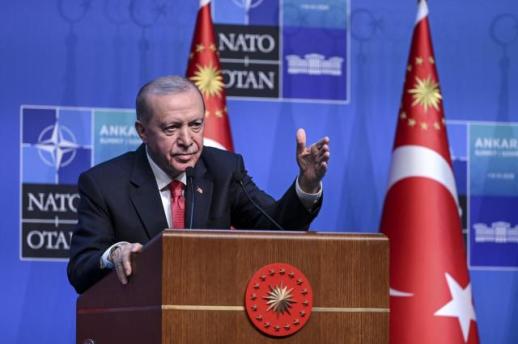 Türkiye emerges stronger from Ankara NATO summit SEOUL, July 09 (AJP) - Türkiye closed out the first North Atlantic Treaty Organization summit ever held in its capital on Wednesday with its standing in the alliance visibly enhanced, as President Recep Tayyip Erdogan pointed to progress on F-35 fighter jets, a thaw in relations with Washington and a defense industry that he said now outpaces many allies. "We have successfully concluded our NATO summit, which we hosted in our country for the second time in 22 years and for the first time in our capital, Ankara," Erdogan said at a news conference after the two-day gathering at the Beştepe Presidential Complex. "This historic summit, which we hosted at a time when Euro-Atlantic security is being tested, has been conducted in a manner that will shape our common future." The summit itself produced substantial commitments. Allies pledged 70 billion euros, about $80 billion, in military equipment, assistance and training for Ukraine in 2026, and announced more than $50 billion in new procurements at the North Atlantic Treaty Organization (NATO) Summit Defence Industry Forum, according to the alliance. Members also agreed to a 27 billion euro investment to modernize fuel storage and pipeline infrastructure extending to the eastern flank, while European allies and Canada reported raising core defense spending by more than $139 billion since last year's summit in The Hague, a jump of nearly 20 percent. For the host, however, the most consequential developments came on the sidelines. Erdogan said US President Donald Trump has taken a "positive approach" toward delivering F-35 fighter jets to Türkiye, more than six years after Washington suspended the country from the program over its purchase of the Russian S-400 air defense system. Ankara has long argued that the two systems do not conflict and that its suspension violated the program's rules. "Mr. Trump actually has a positive approach toward Türkiye on the F-35 issue. Hopefully, when the F-35s are delivered to Türkiye, the whole world will say, 'America kept its promise,'" Erdogan said. Asked whether Washington had linked a possible F-35 sale to the S-400 issue, Erdogan declined to elaborate. "Keep watching us," he replied. The Turkish president also said US sanctions against Ankara are no longer being enforced. "At the moment, the United States is not applying any sanctions against us. To a large extent, they have been lifted," he said, adding that senior Turkish officials including the defense minister, foreign minister and chief of the general staff had confirmed this firsthand. Momentum extended to Türkiye's flagship domestic aircraft program. Erdogan said Trump expressed support for the sale of F110 jet engines, manufactured by General Electric, to power the KAAN fighter jet, an indigenous program launched in 2016 to reduce reliance on foreign military equipment. The Trump administration has reportedly notified Congress of a proposed engine sale valued at more than $700 million. The two leaders also discussed joint naval construction, including frigates, corvettes and submarines, which Erdogan said Turkish shipyards are fully capable of building. "It was a very, very productive meeting," Erdogan said of his talks with Trump, noting that the US president "left the press conference very happy." He added that Trump responds within 24 hours whenever Ankara reaches out. Erdogan framed the warming ties as recognition of the capabilities Türkiye built largely on its own. He said the country never enjoyed the post-Cold War peace dividend that many European states did, instead contending with regional crises and terrorism for decades. "There were times when we were left alone and treated unfairly. Therefore, we often had to rely on our own capabilities," he said. "Today, in terms of defense spending, military capabilities and the defense industry that underpins them, we are well ahead of many allies." The numbers back up an expanding role. Türkiye commands NATO's second-largest land army and has anchored the alliance's southeastern flank for decades. Turkish F-16s will deploy to Estonia in August as part of NATO's Air Policing mission, Ankara will lead the Kosovo Force until September 2026 and the country is scheduled to command the NATO Response Force in 2028 and 2029. Addressing alliance leaders, Erdogan said Türkiye has taken steps to raise defense spending to 3.5 percent of gross domestic product before 2030 and ranks among the world's top 10 countries in defense production and export capacity, according to the Embassy of Türkiye in Seoul. He singled out drone maker Baykar as proof of that rise. "They are receiving very serious orders from around the world and continue to do so. This shows that our unmanned aerial vehicles and armed drones have found acceptance globally," Erdogan said. He also promoted the Steel Dome, Türkiye's integrated air defense project, saying it strengthens both national and alliance defenses. "If others have different domes, we also have the Steel Dome," he said. Erdogan pressed allies to remove what he called lingering barriers to defense trade within the alliance. "Although some obstacles to defense industry trade among allies have decreased, they still exist. These restrictions must be removed as soon as possible, without conditions," he said. In his address to alliance leaders, he warned that excluding non-European Union allies from European defense cooperation would create an artificial division within Europe, and at his press conference, he repeated that EU defense initiatives must complement NATO rather than duplicate it. He brushed aside criticism of a potential F-35 sale from Israeli Prime Minister Benjamin Netanyahu and Greek Prime Minister Kyriakos Mitsotakis. "A country can buy and sell defense equipment. Türkiye is already producing these systems, and alongside producing them, it also has the right to buy them," he said. On Greece, however, he struck a conciliatory note, welcoming Mitsotakis' expressed desire to resolve maritime disputes in the Aegean Sea. "Let us sit down, talk and resolve the issue," he said. On Ukraine, Erdogan said the war has become one of attrition, "claiming tens of thousands of casualties every month," and renewed Türkiye's offer to host negotiations, having brokered earlier rounds of talks between Moscow and Kyiv in Istanbul. "There are no losers in a just peace. I would like to reiterate that we are ready to bring the parties together once again in Türkiye," he said. He also expressed support for Trump's vision for peace in Ukraine, according to the embassy. He said he repeatedly pushed Gaza onto the summit agenda, citing more than 73,000 Palestinian deaths, and pointed to nearly 5,000 deaths in Lebanon since March 2 from continuing Israeli attacks. "Our region can tolerate neither new tensions nor new conflicts. On the contrary, like air and water, humanity needs peace, tranquility and stability," he said. Türkiye stands ready to contribute to clearing mines in the Strait of Hormuz, he told alliance leaders. Erdogan met Trump as well as the leaders of Canada, Finland, France, Germany, Italy and the United Kingdom on the summit's sidelines, and Syrian President Ahmed al-Sharaa was also in Ankara. He said he would keep pressing European leaders on Türkiye's EU accession, telling German Chancellor Friedrich Merz that "making Türkiye wait for 53 years is an injustice." Türkiye will host two more major international gatherings this year: the 13th Summit of the Organization of Turkic States in Ankara on Oct. 29 and 30, and the COP31 United Nations climate summit in Antalya from Nov. 9 to 20. 2026-07-09 08:24:58
-
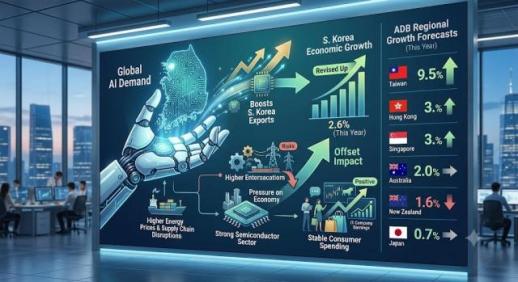 IMF and ADB up South Korea's growth forecast to 2.6% for this year SEOUL, July 9 (AJP) -South Korea's economy is expected to survive global-wide setback from the prolonged Gulf crisis and run above its growth potential through next year as it benefits from feverish chip demand amid artificial intelligence investment boom, drawing one of the steepest outlook upgrades from the International Monetary Fund and the Asian Development Bank. The IMF on Wednesday raised its 2026 growth forecast for South Korea to 2.6 percent, up 0.7 percentage point from its April projection — the largest upward revision among the 30 economies covered in its July World Economic Outlook Update. It also lifted next year's forecast by 0.4 percentage point to 2.5 percent. The ADB in its latest revised outlook released on Thursday also upgraded this year's growth forecast for Korea to 2.6 percent from 1.9 percent projected in April and nudging next year's estimate to 2.0 percent from 1.9 percent, likewise citing robust AI-led semiconductor exports. The IMF said South Korea's strong overseas demand for semiconductors and AI hardware had more than offset the drag from the Middle East conflict, identifying Korea as one of the world's four largest net exporters of AI hardware alongside Taiwan, Thailand and Malaysia. It noted the Korean economy expanded at an annualized 7.5 percent in the first quarter, far exceeding its earlier estimate of 1.8 percent. The ADB similarly said resilient exports driven by global AI demand would continue supporting growth into next year, while stronger corporate earnings, buoyant equity markets and government support should underpin domestic consumption. Both institutions nevertheless warned that the outlook remains vulnerable to rising energy prices and geopolitical uncertainty. The IMF trimmed its 2026 global growth forecast to 3.0 percent from 3.1 percent, saying the world economy is caught between supply disruptions caused by the Middle East conflict and an AI-driven technology cycle. It warned that geopolitical tensions, trade fragmentation and elevated energy costs remain major downside risks, although it expects energy markets to normalize gradually next year. The ADB likewise cautioned that higher production costs stemming from energy prices and supply-chain disruptions could weigh on Korea's economy. It also pointed to the potential return of U.S. tariffs and a correction in equity markets as additional risks, even as the country's semiconductor industry is expected to cushion those headwinds. It projected South Korea's inflation at 2.7 percent this year and 2.2 percent next year, citing the impact of higher international energy prices on consumer prices. The figures are 0.4 and 0.2 percentage points higher, respectively, than its April forecasts. Meanwhile, the ADB revised up its growth forecast for Taiwan to 9.5 percent, while projecting Hong Kong and Singapore to grow in the 3 percent range. But forecasts for Japan and Australia were unchanged from earlier projections, at 0.7 percent and 2.0 percent, respectively, while New Zealand's growth forecast was lowered by 0.3 percentage point from April to 1.6 percent. 2026-07-09 08:21:25