


Latest by
-
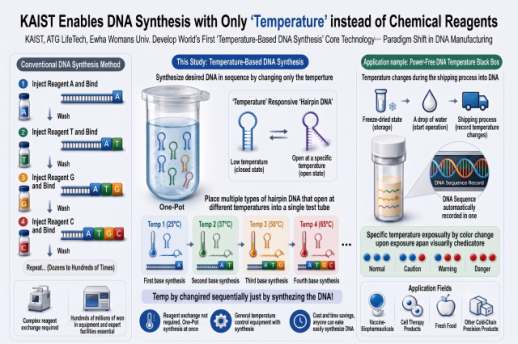 KAIST turns temperature into DNA synthesis tool SEOUL, July 06 (AJP) - Korean researchers have developed a way to build custom DNA strands using only changes in temperature, removing the chemical reagents and costly equipment that DNA synthesis has long required and potentially lowering the cost of work across drug development, diagnostics and synthetic biology. According to the Korea Advanced Institute of Science and Technology (KAIST) on Tuesday, the research team, led by the institute's Choi Yeong-jae, used the chemical reagent-free method to build a battery-free device called a "DNA temperature black box," which records the temperature history of a shipment without any power source. The work was carried out with ATG Lifetech and a team led by Ewha Womans University's Choi Han-sol. Conventional DNA synthesis builds a strand one base at a time, adding and then washing away chemical reagents at every step to link the four building blocks known as A, T, G and C. The process depends on automated synthesizers that can cost hundreds of millions of won and on dedicated laboratory facilities, a barrier that has kept custom DNA out of reach for many smaller labs and devices. The new approach, which the researchers named the Temperature Mediated Primer Exchange Reaction, or TEMPER, replaces that reagent swapping with heat. The team engineered hairpin DNA, folded molecules that spring open only within a set temperature range. By placing several types of hairpin, each tuned to a different temperature, into a single tube and then shifting the temperature in sequence, the researchers assembled a target DNA strand step by step without exchanging any solution. The significance, the team says, is that it changes the method of DNA synthesis itself, handing the control that chemical reagents once exercised over to temperature, a variable that is simple to adjust with standard equipment. The researchers describe it as the world's first platform to synthesize arbitrary DNA sequences through temperature alone. To show the technology could be put to use, the team demonstrated three applications in the paper: a writer for storing digital data in DNA, a color-changing temperature indicator, and the battery-free temperature logger. The DNA temperature black box is stored freeze-dried and begins working when a single drop of water is added. From that point it records when, by how much and in what order the temperature changed, writing that history directly into a DNA sequence. It also changes color once it crosses a set threshold, allowing a spoiled shipment to be spotted by eye. The team expects such a device to help monitor vaccines, biologic drugs, cell therapies and fresh food, where cold-chain handling determines quality. "This study is a world-first foundational technology that presents a new principle, that DNA can be synthesized using temperature alone rather than chemical reagents," Choi said in the announcement, in remarks translated from Korean. He said he expected the method to make DNA synthesis easier and cheaper, lowering the barrier to basic bioscience research and opening new industrial uses such as the battery-free black box. The study was published in Nature Communications on July 2. KAIST's Choi Jang-ho and GIST doctoral student Kim Jin-ho were co-first authors, with Choi Yeong-jae and Choi Han-sol as corresponding authors. (Reference Information) Journal/Source: Nature Communications Title: Programmable one-pot polymerase-mediated DNA synthesis via temperature control Link/DOI: https://bit.ly/4aAr8zY 2026-07-07 10:08:23
-
 Korean Wave Generates $18.9 Billion and Creates 240,000 Jobs The Korean Wave has established itself as a leading industry in the South Korean economy, according to a report released on July 7 by the Ministry of Culture, Sports and Tourism and the Korea International Cultural Exchange Agency.This year, the export revenue generated by the Korean Wave reached $18.975 billion, marking a 15.9% increase from the previous year.Exports of content, including music and dramas, accounted for $10.188 billion, while consumer goods and tourism exports reached $8.788 billion, reflecting increases of 14.2% and 18%, respectively. Notably, the success of the Netflix animated series 'K-Pop Demon Hunters' contributed to an 84% surge in music exports and a 37.8% rise in tourism exports.The economic impact of the Korean Wave was also at an all-time high, with production-induced effects estimated at 48.28 trillion won, value-added effects at 20.79 trillion won, and employment effects generating 240,370 jobs. Over the past decade, exports related to the Korean Wave have increased by 2.68 times, nearly double the overall growth rate of South Korea's total goods and services exports, which was 1.36 times.However, the growth of the Korean Wave is not uniform across all regions. While interest and favorability towards the Korean Wave have increased in the United States, the United Kingdom, and the United Arab Emirates, both metrics have declined in key Southeast Asian markets such as Thailand, Vietnam, and Malaysia. Researchers noted that while the Korean Wave is growing quantitatively, there is a sense of fatigue in core markets.In the Middle East, the acceptance of the Korean Wave varies by country. According to the report 'The Acceptance of the Korean Wave in the Transitional Islamic World: Where is the Korean Wave in the Middle East?', the phenomenon has expanded to male and parent generations since the release of 'Squid Game'. However, the researchers critically addressed cultural tensions and performance-oriented limitations, suggesting the need for risk management strategies, including consultations with Muslim advisory groups and tailored approaches for different countries.In Japan, the relationship between political conflict and cultural consumption does not necessarily align. The report 'Evolution of Localization Strategies for Korean Wave Content in Japan and Changes in Acceptance Patterns: Focused on K-Pop and Korean Dramas' found that even among those with limited affinity for Korea, many continue to consume K-Pop and Korean dramas, often preferring to enjoy K-Pop in its original Korean and dramas with Korean audio and subtitles.Park Chang-sik, the director, stated, “We will continue to deepen our analysis of the economic ripple effects and local studies in key markets to develop a practical foundation for Korean Wave policies.”The '2025 Korean Wave Ecosystem Study' can be downloaded from the Korea International Cultural Exchange Agency's Korean Wave Research Archive.* This article has been translated by AI. 2026-07-07 10:04:00
-
Justice Ministry Extends Public Proposal Submission Period by Two Weeks The Future Committee for Respecting Prosecutorial Human Rights, under the Justice Ministry, has decided to extend the submission period for cases of prosecutorial abuse and human rights violations by two weeks.On July 7, the Justice Ministry announced that the submission period for the 'public proposal case' will be extended until July 18. The committee aims to gather sufficient public input on cases involving alleged human rights violations or prosecutorial abuse.This extension is intended to provide more opportunities for ordinary citizens, who may have found it difficult to voice their concerns due to legal barriers. The committee expects that the extended period will allow for a more comprehensive collection of public voices regarding cases of unjust human rights violations or prosecutorial abuse.Previously, the committee held its fourth meeting on July 3, where members met with officials from the fact-finding team. During the meeting, the committee received detailed reports on the team's organizational structure and operational status to date.Both the committee and the fact-finding team expressed a shared understanding that swift and thorough fact-finding is the top priority to address the grievances of citizens harmed by past prosecutorial overreach. They agreed to work closely together moving forward.In particular, the committee engaged in in-depth discussions regarding the selection of 'additional cases for investigation.' This indicates an intention to uncover human rights violations that have either remained controversial or been concealed, beyond those already in the public eye. The committee plans to examine various aspects to determine if there have been instances where the prosecution has infringed upon citizens' fundamental rights through excessive investigations or prosecutions.Earlier, on June 10, the Justice Ministry established the Future Committee to investigate allegations of human rights violations and prosecutorial abuse, with the aim of clarifying the facts and recommending improvements to related systems.The fact-finding team tasked with investigating the allegations of human rights violations and prosecutorial abuse began its work on June 24 at the Seoul Eastern District Prosecutors' Office.The committee plans to scrutinize various cases suspected of improper investigations and prosecutions by the prosecution, including the Ssangyong Group's North Korean remittance case, the Daejang-dong case, the case involving former Democratic Research Institute Deputy Director Kim Yong, and the shooting of a public official in the West Sea.* This article has been translated by AI. 2026-07-07 10:04:00
-
Samsung Electronics Shares Drop Over 5% Despite Strong Q2 Earnings Samsung Electronics reported preliminary second-quarter results that exceeded market expectations, yet its shares fell more than 5% in early trading, dropping below 300,000 won. The decline is attributed to profit-taking following a recent surge in stock prices, shifting market focus to the future semiconductor industry outlook and sustainability of profit momentum.As of 9:29 a.m. on July 7, Samsung's stock was trading at 299,500 won, down 18,500 won (5.82%) from the previous trading day.On this day, Samsung announced that its consolidated revenue for the second quarter reached 171 trillion won, with an operating profit of 89.4 trillion won. Compared to the previous quarter, revenue increased by 27.74%, and operating profit rose by 56.21%. Year-over-year, revenue surged by 129.31%, and operating profit skyrocketed by 1,810.26%.For the first half of the year, Samsung reported cumulative revenue of 304.87 trillion won and operating profit of 146.63 trillion won, marking increases of 98.34% and 1,190.76%, respectively, compared to the same period last year.Despite these record results, the stock's weakness is seen as a result of the recent sharp rise in share prices, which had already priced in much of the earnings expectations, along with profit-taking triggered by the earnings announcement.Market analysts believe that the direction of the stock price will be determined more by future semiconductor industry trends and potential upward revisions of profit estimates than by the current results.Han Ji-young, an analyst at Kiwoom Securities, stated, "The key factor will be changes in annual profit estimates for 2026 centered around semiconductors after today. Currently, the consensus for operating profit estimates for Samsung and SK Hynix has only increased by 6-7% since June." He noted that this is limited compared to the 73% and 48% upward adjustments seen during the first quarter earnings season for Samsung and SK Hynix, respectively. He added that upcoming events, such as SK Hynix's American Depositary Receipt (ADR) event scheduled for this week, could influence the recovery momentum of the KOSPI index centered on semiconductors.There are also forecasts for continued improvement in performance. Son In-jun, an analyst at Eugene Investment & Securities, remarked, "The memory business is driving overall performance due to competition among clients for inventory and increased pricing power. The shipment of High Bandwidth Memory 4 (HBM4) and the expansion of long-term supply contracts (LTA) are expected to positively impact performance." He anticipates that the average selling prices (ASP) of DRAM and NAND flash will continue to rise in the third quarter, leaving room for further upward revisions of performance estimates, and added that the recent stock price adjustment is merely a temporary correction within a bullish market.* This article has been translated by AI. 2026-07-07 09:52:00
-
Dreame Launches T16 Pro Steam Vacuum Cleaner with Multi-Functionality Dreame Technology announced the launch of its next-generation vacuum mop cleaner, the T16 Pro Steam, which combines high-temperature steam, hot water mopping, and foam cleaning functions.The product is designed to address various cleaning needs, from floor sterilization to managing grease stains and pet odors, all in one device.The new model features a "SaunaClean™" steam sterilization technology, a 90°C hot water mopping system, and a "triple water cleaning system" that integrates these functions. The high-temperature steam generated by a 200°C boiler eliminates bacteria and dust mites, while the hot water effectively washes away sticky grease and everyday dirt.It also includes features tailored for pet owners. The foam wash function sprays a bio-enzyme-based mousse cleaning foam directly onto soiled areas to help eliminate floor stains and pet odors. The company claims that using steam, hot water, and cleaning foam according to the type of contamination allows for more hygienic floor maintenance compared to traditional mopping.The T16 Pro Steam enhances cleaning performance and space efficiency, boasting a suction power of up to 30,000 Pa and a slim design of just 9.85 cm, with a maximum 180-degree reclining structure. This allows it to clean under low furniture such as beds and sofas, while automatically adjusting suction power and water usage based on floor contamination levels.To reduce maintenance burdens, it incorporates a "dual heating self-cleaning system" that automatically cleans the brush at up to 95°C after high-temperature steam cleaning, facilitating quick drying and minimizing post-cleaning brush care. An LED blue light helps users easily identify fine dust and contaminants that are difficult to see with the naked eye.When connected to a dedicated application, users can monitor and manage cleaning modes and product status via their smartphones. The device can operate continuously for up to 72 minutes on a single charge, allowing for extensive cleaning in larger spaces.A Dreame representative stated, "The T16 Pro Steam combines steam, hot water, and foam cleaning technologies into one product, providing a more hygienic and convenient floor management experience. We plan to continue expanding our premium smart home experience based on innovative technologies unique to Dreame."* This article has been translated by AI. 2026-07-07 09:52:00
-
Hanwha Ocean Shares Plunge Over 22% After Losing Canadian Submarine Contract Hanwha Ocean's shares have dropped more than 22% following news that the company failed to secure a contract for Canada's next-generation submarine program (CPSP).As of 9:38 a.m. on July 7, Hanwha Ocean's stock was trading at 90,100 won, down 26,000 won (22.39%) from the previous trading day. The stock experienced a sharp decline early in the session, triggering a volatility interruption mechanism.The drop in stock price is attributed to the Canadian government's selection of ThyssenKrupp Marine Systems (TKMS) as the preferred bidder for the next-generation submarine program. Hanwha Ocean had partnered with HD Hyundai Heavy Industries in the bidding process but was ultimately unsuccessful in being selected as the preferred bidder, leading to a deterioration in investor sentiment.On July 6, Canadian Prime Minister Mark Carney announced that TKMS had been chosen as the preferred bidder for the construction of 12 submarines, which includes maintenance and operation over the next 30 years. However, he noted that if negotiations with TKMS fail, Hanwha Ocean would retain the right to negotiate as the next in line.Kang Kyung-tae, a researcher at Korea Investment & Securities, stated, "A temporary stock shock is inevitable following the news of the failed bid, but considering the upcoming second-quarter earnings report scheduled for the end of this month and expectations for shipbuilding investments in the U.S., the decline may gradually recover."* This article has been translated by AI. 2026-07-07 09:52:00
-
Death Toll from Venezuela Earthquake Rises to 3,535; Nearly 18,000 Displaced Venezuela's death toll from two powerful earthquakes that struck on June 24 has risen to 3,535, according to reports on July 6.Jorge Rodriguez, the President of the Venezuelan National Assembly, confirmed the updated figures, stating that the number of fatalities has reached 3,535.The number of injured remains at 16,740, while the number of displaced individuals has reached 17,854.The earthquakes impacted the capital city of Caracas and the coastal region of La Guaira. Rodriguez noted that 856 buildings were damaged, with 190 of them completely collapsed.The Venezuelan government has deployed 29,567 army and security personnel for rescue and recovery operations, alongside 27,930 volunteers who have joined the efforts.Despite the large-scale rescue operations involving thousands, the chances of finding survivors have significantly diminished more than ten days after the earthquakes.Health risks are increasing in the shelters for the displaced. The Pan American Health Organization (PAHO) has warned that overcrowding, lack of ventilation, limited access to clean water, and sanitation issues could heighten the risk of infectious disease outbreaks. Authorities are considering targeted vaccination campaigns based on the health risks and vaccine availability in the shelters.* This article has been translated by AI. 2026-07-07 09:48:00
-
KakaoBank's Yoon Ho-young Envisions AI Native Banking Revolution Internet-only banks began with the digitization of banking, but in the age of AI, they are moving towards a complete redesign of banking itself. Yoon Ho-young, CEO of KakaoBank, is one of the first financial leaders to declare this transformation. He presents KakaoBank's future vision as an 'AI Native Bank,' defining AI not just as a service but as a core infrastructure that will change the bank's operations, products, organization, and customer experience.KakaoBank is implementing a strategy to integrate AI throughout the bank, including AI financial calculators, AI search, hyper-personalized services, explainable AI (XAI), and the establishment of AI governance. Additionally, the bank is evolving into a comprehensive financial platform based on AI by combining its global digital banking strategy focused on Thailand and Indonesia with digital assets and platform finance.Yoon views AI not merely as a tool to assist banks but as a new operating system that redesigns banking.AI Native Bank as the Future of BankingYoon Ho-young sees AI as an operating system that drives the entire bank, not just a part of its functions. He has declared 'AI Native Bank' as KakaoBank's new vision, stating that all services, operations, management strategies, and organizational structures will be redesigned around AI. The goal is to innovate customer experiences and enhance operational efficiency while redefining financial services."Having a platform and data optimized for AI is not a choice but a condition for survival," he emphasized, adding that KakaoBank will fully commit to building an AI-based user experience and environment. He believes that AI is now a key factor determining how banks exist, rather than just a competitive edge for internet banks.A Bank Where AI Interacts with CustomersOne of the most symbolic changes under Yoon's leadership is the introduction of generative AI services. KakaoBank has launched an AI financial calculator that allows customers to ask questions in natural language, such as, "If I borrow 50 million won, how much do I need to repay each month?" The AI autonomously infers the interest rate, duration, and repayment method to provide answers.The bank has also introduced an AI search service that instantly retrieves necessary information when customers ask about products or services in everyday language. This shift aims to transform financial services from a menu-driven approach to a conversation-based one, preparing for an era where AI takes on the role of bank tellers.Entering the Era of Hyper-Personalized FinanceYoon believes that AI's greatest strength lies in hyper-personalized finance. During the app overhaul, KakaoBank introduced AI-based personalized recommendation features, analyzing customers' financial usage patterns to suggest necessary services proactively. Explainable AI (XAI) is applied in fraud detection systems (FDS) to allow both customers and employees to verify the basis of AI's judgments.This reflects the philosophy that AI should provide reliable judgments, not just quick decisions. Yoon sees this capability as a core competitive advantage in creating a bank that understands its customers best.In-House AI Research and DevelopmentYoon does not rely on external sources for AI technology. KakaoBank conducts its own AI research and development through an in-house organization, focusing on finance-specialized LLMs and generative AI technologies, and has presented its findings at international academic conferences. The bank is also researching services where AI writes consumer diaries based on transaction histories and developing finance-specialized AI models.In line with the implementation of the AI Basic Act, KakaoBank is advancing its AI Governance 2.0 project, establishing a system to manage the entire lifecycle of AI from development to verification and operation. Yoon believes that AI competitiveness arises not only from technology but also from responsible operations.AI and Platform GrowthYoon is positioning KakaoBank as a financial platform rather than just a bank. The bank has built a comprehensive platform that offers fund sales, investment services, public offering subscriptions, dollar boxes, financing for individual businesses, mobile commerce, and authentication services all within a single app. AI plays a crucial role in connecting these services in the most suitable form for customers.He is creating a virtuous cycle where the larger the platform grows, the more data AI can learn, and as AI advances, the platform's competitiveness increases. This strategy is laying the foundation for KakaoBank to evolve from a simple internet bank into a financial platform integrated into daily life.Expanding into Global AI FinanceYoon does not limit the AI strategy to South Korea. KakaoBank has invested in Indonesia's Super Bank and has been selected as a virtual bank operator in Thailand, marking a significant step into the Southeast Asian market. He stated, "We will build a global digital bank network to create a successful model for future banking." In Thailand, KakaoBank will lead product planning and mobile system development, aiming to transplant AI-based digital financial experiences into international markets. AI is becoming a key competitive factor in ushering in the era of global digital banking.Preparing for AI and Digital AssetsYoon is also preparing for the era of digital assets alongside AI. KakaoBank is expanding its virtual asset services in collaboration with Coinone and has proactively filed trademarks related to won-based stablecoins. He believes that the combination of AI, digital assets, and platform finance will accelerate the dismantling of boundaries in finance.His long-term strategy is to connect traditional banking services like deposits and loans with investments, payments, and digital assets into a single AI platform.The Essence of Financial EntrepreneurshipYoon Ho-young's vision of financial entrepreneurship is to 'redesign the operating system of banking with AI.' He aims to leverage AI not just for customer service or task automation but as a driving force to change the bank's structure, platform, and global strategy. The concepts of AI Native Bank, hyper-personalized finance, global digital banking, AI governance, and digital asset strategies all point in the same direction.Yoon envisions a bank that is no longer just a space for selling financial products but a platform where AI understands customers and acts proactively. He is working to create a new banking model that leads the global AI finance era, going beyond South Korea's internet banking landscape.SWOT Analysis:StrengthsYoon is a financial and ICT convergence expert who has led KakaoBank since its inception and was the first to propose the AI Native Bank strategy. He excels at simultaneously advancing AI financial calculators, AI search, explainable AI, AI governance, and global digital banking strategies, effectively combining technology and platforms.WeaknessesDespite expanding its platform business, KakaoBank still relies heavily on interest income, and the ongoing costs associated with AI investments remain a burden. As an internet bank, it faces higher demands for regulatory changes and system stability than traditional banks.OpportunitiesThe expansion of generative AI, digital assets, stablecoins, and the global digital banking market presents opportunities for KakaoBank to grow into an AI-based comprehensive financial platform. Its entry into Thailand and Indonesia enhances the potential for global expansion in AI finance.ThreatsThe competition is intensifying as traditional banks increase their AI investments and as big tech companies like Toss and Naver enter the platform space. Ongoing risks include stricter AI regulations, data privacy concerns, and changes in digital asset regulations.* This article has been translated by AI. 2026-07-07 09:48:00
-
K-Bank Launches Pilot for Stablecoin Settlements in Korean Won K-Bank is initiating a pilot program to verify an off-ramp system that settles payments based on stablecoins in Korean won. This comes as discussions around the institutionalization of digital assets gain momentum, prompting the bank to explore the feasibility of implementing stablecoin settlement infrastructure in a real financial environment.On July 7, K-Bank announced that it has begun a proof of concept (PoC) in collaboration with Lambda256 and KSNET to validate the off-ramp operational framework for banks in a digital asset-based settlement environment.The core of this project is to assess whether an off-ramp operational model that converts settlement funds from digital asset payments into Korean won can be effectively implemented in a financial institution. An off-ramp refers to the process or service that converts virtual assets into fiat currencies like Korean won or U.S. dollars, linking them to the existing financial system.The pilot will specifically test an operational model that settles payments based on the stablecoin USDC in Korean won.K-Bank will serve as the key settlement institution, handling foreign exchange (FX) applications, Korean won disbursements, as well as anti-money laundering (AML) and suspicious transaction reporting (STR) related to the overall off-ramp operations.KSNET will utilize its existing payment infrastructure to provide the stablecoin payment framework and manage the conversion for merchants into Korean won. Lambda256 will support the on-chain settlement execution system through its orchestration platform, SCOPE, and on-chain compliance platform, CLAIR.A K-Bank official stated, "This project is a significant attempt to demonstrate the off-ramp operational capabilities that banks need to prepare for the institutionalization of digital assets. We will continue to build a safe and reliable digital financial infrastructure to proactively respond to regulatory changes in the future."* This article has been translated by AI. 2026-07-07 09:48:00
-
Samsung Electronics Reports Record Earnings, Yet Shares Plunge 5% Samsung Electronics announced its preliminary earnings for the second quarter of this year, reporting a record operating profit, but its stock price fell nearly 5% during trading.On July 7, Samsung disclosed that it achieved sales of 171 trillion won and an operating profit of 89.4 trillion won for the second quarter. The operating profit exceeded market expectations and was hailed as the largest quarterly operating profit ever, surpassing major global tech firms like Nvidia, thanks to increased demand for AI semiconductors.However, the market's reaction was contrary to expectations. Despite the 'record earnings' news, Samsung's stock price dropped more than 5% immediately after the earnings announcement.Analysts attribute the decline primarily to 'profit-taking' following the anticipated earnings. They noted that improvements in Samsung's performance had been expected for several months, and the stock had already risen significantly, reflecting much of that optimism. Consequently, the earnings announcement triggered a wave of short-term profit-taking.This phenomenon is often described as 'buy the rumor, sell the news,' where expectations drive the stock price up before the announcement, only for selling to occur afterward.Another factor contributing to the decline is that market expectations had become excessively high.While the earnings are indeed at an all-time high, investors are more focused on how long the boom in AI memory semiconductors will last. Key variables that could influence future stock prices include the expansion of HBM (high-bandwidth memory) supply in the second half of the year, the sustainability of AI investments, and the pace of recovery in the foundry business, which remains a concern for profitability.Concerns about the AI investment cycle have also had some impact.Recently, the global semiconductor sector has experienced increased volatility amid debates over potential overheating in AI investments. Analysts suggest that the possibility of a slowdown in AI infrastructure investments or a moderation in spending by major U.S. tech firms has contributed to heightened volatility across semiconductor stocks.However, many analysts believe it is premature to conclude that this adjustment marks a long-term trend change.The rise in prices and demand for memory used in AI servers continues, and Samsung remains a key beneficiary of the AI semiconductor boom. The upcoming release of confirmed earnings and the outlook presented during the earnings conference call will likely play a significant role in determining the stock's next direction.Market participants interpret this adjustment not merely as a reaction to poor earnings but rather as a reflection of investors applying higher standards for future growth, given that even record earnings had already been largely factored into the stock price.* This article has been translated by AI. 2026-07-07 09:36:00