SEOUL, July 06 (AJP) - Korean researchers have developed a way to build custom DNA strands using only changes in temperature, removing the chemical reagents and costly equipment that DNA synthesis has long required and potentially lowering the cost of work across drug development, diagnostics and synthetic biology.
According to the Korea Advanced Institute of Science and Technology (KAIST) on Tuesday, the research team, led by the institute's Choi Yeong-jae, used the chemical reagent-free method to build a battery-free device called a "DNA temperature black box," which records the temperature history of a shipment without any power source. The work was carried out with ATG Lifetech and a team led by Ewha Womans University's Choi Han-sol.
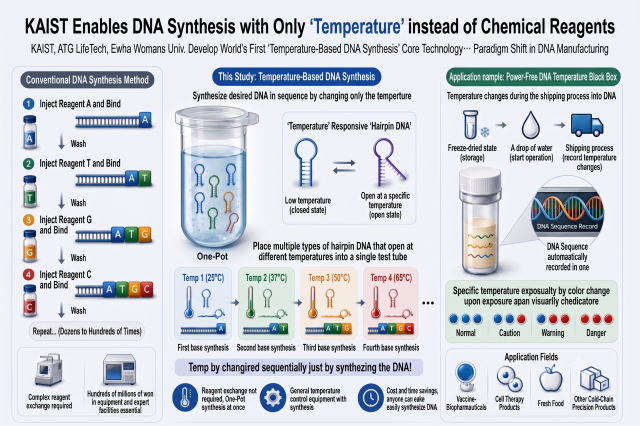
Conventional DNA synthesis builds a strand one base at a time, adding and then washing away chemical reagents at every step to link the four building blocks known as A, T, G and C. The process depends on automated synthesizers that can cost hundreds of millions of won and on dedicated laboratory facilities, a barrier that has kept custom DNA out of reach for many smaller labs and devices.
The new approach, which the researchers named the Temperature Mediated Primer Exchange Reaction, or TEMPER, replaces that reagent swapping with heat. The team engineered hairpin DNA, folded molecules that spring open only within a set temperature range. By placing several types of hairpin, each tuned to a different temperature, into a single tube and then shifting the temperature in sequence, the researchers assembled a target DNA strand step by step without exchanging any solution.
The significance, the team says, is that it changes the method of DNA synthesis itself, handing the control that chemical reagents once exercised over to temperature, a variable that is simple to adjust with standard equipment. The researchers describe it as the world's first platform to synthesize arbitrary DNA sequences through temperature alone.
To show the technology could be put to use, the team demonstrated three applications in the paper: a writer for storing digital data in DNA, a color-changing temperature indicator, and the battery-free temperature logger. The DNA temperature black box is stored freeze-dried and begins working when a single drop of water is added. From that point it records when, by how much and in what order the temperature changed, writing that history directly into a DNA sequence. It also changes color once it crosses a set threshold, allowing a spoiled shipment to be spotted by eye. The team expects such a device to help monitor vaccines, biologic drugs, cell therapies and fresh food, where cold-chain handling determines quality.
"This study is a world-first foundational technology that presents a new principle, that DNA can be synthesized using temperature alone rather than chemical reagents," Choi said in the announcement, in remarks translated from Korean. He said he expected the method to make DNA synthesis easier and cheaper, lowering the barrier to basic bioscience research and opening new industrial uses such as the battery-free black box.
The study was published in Nature Communications on July 2. KAIST's Choi Jang-ho and GIST doctoral student Kim Jin-ho were co-first authors, with Choi Yeong-jae and Choi Han-sol as corresponding authors.
(Reference Information)
Journal/Source: Nature Communications
Title: Programmable one-pot polymerase-mediated DNA synthesis via temperature control
Link/DOI: https://bit.ly/4aAr8zY

Copyright ⓒ Aju Press All rights reserved.