
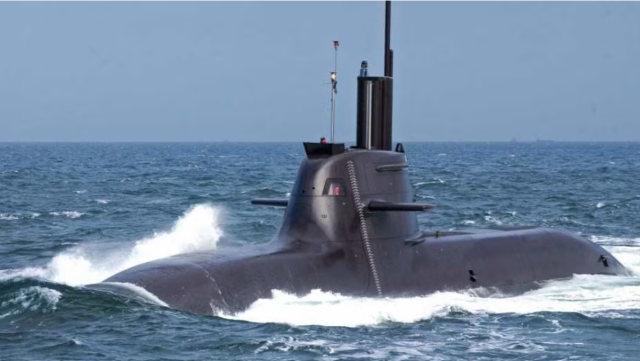
The reported decision would see TKMS’s Type 212CD chosen over South Korea’s KSS-III Batch-II, dealing a setback to Hanwha Ocean after an intense, nearly yearlong competition for one of Canada’s largest-ever military procurement programs.
Canadian Prime Minister Mark Carney is expected to formally announce the preferred bidder in Halifax, Nova Scotia, later Monday before departing for a NATO summit in Türkiye. His office had not publicly confirmed the reported selection as of publication.
The selection, if confirmed, would open exclusive negotiations with TKMS rather than immediately result in a final contract. Canada has said it aims to sign a contract for the new fleet by 2028 and receive the first submarine by 2035.
The Canadian Patrol Submarine Project is aimed at replacing the Royal Canadian Navy’s aging Victoria-class fleet with up to 12 conventionally powered submarines capable of operating across the Arctic, Atlantic and Pacific.
Canada identified TKMS and Hanwha Ocean as the project’s two qualified suppliers in August 2025 after assessing their capabilities, construction capacity and delivery schedules.
TKMS offered the Type 212CD, which is being developed for the German and Norwegian naval forces. Germany and Norway promoted the proposal as an opportunity for Canada to join a common submarine program with two NATO allies and Arctic partners.
The outcome marks a setback for Hanwha Ocean, which had mounted an extensive campaign highlighting the KSS-III Batch-II’s long-range capabilities, delivery schedule and proposed investments in Canadian industry.

Kim Hee-su
Kim Hee-su is a bilingual reporter at AJU Press, covering defense and foreign affairs. Before joining AJP in 2025, she worked at The Korea Times, where she wrote interview stories, including a profile of North Korean defector Kim Gum-hyok, and produced digital content. She also previously worked as a researcher for KBS News 9’s International News Department, supporting correspondents in 10 countries around the world. She graduated from the University of Toronto in Canada with a double major in Book and Media Studies and East Asian Studies.
Copyright ⓒ Aju Press All rights reserved.
Related News
-
 Canada's Submarine Bid: A Learning Experience, Not a Failure
The outcome of the $60 billion Canadian submarine bid is disappointing. Given the all-out efforts from both the government and companies, there is a sense of frustration. Hanwha Ocean and HD Hyundai Heavy Industries challenged the Canadian Patrol Submarine Project (CPSP) with their world-class submarine technology, but the preferred bidder was ultimately decided to be Germany's TKMS. The fierce competition that lasted for several months did not yield the desired results.However, this result should not be viewed solely as a failure. Just over 30 years ago, South Korea was a country that could not properly construct submarines. With the commissioning of the Changbogo-class submarine in 1993, it became the 43rd nation to operate submarines, and now it is recognized for its competitiveness, having competed closely with Germany, a global submarine powerhouse. The transformation demonstrated through this process is more significant than the outcome itself.President Yoon Suk Yeol also commented on Facebook on July 7, stating, "Challenges come with both successes and disappointments," adding that "today's experience will serve as a valuable foundation for further enhancing our technology and competitiveness." His message emphasized the essence of accumulating industrial competitiveness over emotional disappointment.President Yoon stressed that South Korea will continue to boldly take on challenges. However, the lessons from this bidding process are worth reflecting on. Notably, the formula for defense exports has changed. In the past, weapon performance and price were the decisive factors. Recently, defense exports have shifted from business-to-business (B2B) transactions to strategic competition between governments (B2G). Factors such as diplomatic relations, security cooperation, supply chains, industrial investment, financial support, maintenance and repair systems, and technology transfer are all evaluated as part of a single package.In the Canadian submarine bid, the government dispatched Strategic Economic Cooperation Special Envoy Kang Hoon-sik multiple times, and companies also provided comprehensive support. Even Hyundai Motor Group, which is not directly related to defense, proposed collaboration plans with Canada, demonstrating that defense exports reflect the totality of national capabilities.What comes next is crucial. The global defense market is likely to undergo significant restructuring over the next several decades. Europe is rearming, security demands are increasing in the Indo-Pacific region, and military enhancements are occurring in the Middle East simultaneously. New markets are opening not only for submarines but also for surface ships, unmanned systems, and AI-based command systems.Our strategy must evolve as well. Simply excelling in weapon manufacturing is not enough. There is a need to meticulously establish a national-level export model that combines diplomacy, finance, industrial cooperation, energy, and supply chains. We should be able to propose long-term partnerships that encompass maintenance and repair (MRO), crew training, and local production collaboration after exports. This will be the new competitive edge for K-defense.At the same time, we must be wary of excessive 'export omnipotence.' Demanding excessive burdens or sacrifices from companies unrelated to the project under the guise of national strategic projects is not sustainable. Public-private cooperation is most effective when based on voluntary participation and mutual benefits.The Canadian submarine bid confirmed that K-defense can compete at the highest levels in the global market. The key takeaway is not a single result but the accumulated experiences. Using failures as a stepping stone to promote changes in technology and strategy, and having the courage to challenge again in the next opportunity, is the true strength.* This article has been translated by AI.
-
 Canada's submarine award in Korea's favor, but final shape uncertain
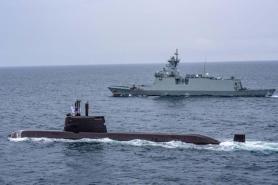
The South Korean Navy submarine Dosan Ahn Chang-ho (foreground), and frigate Daejeon conduct tactical maneuvers in waters off western Canada during a joint exercise held June 4-5, 2026. Courtesy of ROK Navy SEOUL, July 03 (AJP) - Canada is moving closer to selecting South Korea as the preferred supplier for its multibillion-dollar submarine program, although the final structure of the award remains uncertain, with Ottawa still weighing whether to place the entire order with one bidder or split it with Germany, according to multiple sources familiar with the matter. "The mood is leaning toward South Korea. The last sticking point is whether the full package goes to Korea or is shared with the German team," one source told AJP. "Even if the order is divided, I understand South Korea could receive the larger share," a German submarine expert familiar with the discussions separately told AJP, adding that the announcement had been delayed as the parties continued to coordinate details. Ottawa had initially been expected to name a preferred bidder around the end of June, but the decision has slipped into early July amid continued speculation over whether all 12 submarines under the Canadian Patrol Submarine Project (CPSP) will go to a single supplier or be divided between South Korea's Hanwha Ocean and Germany's Thyssenkrupp Marine Systems (TKMS). A South Korean industry ministry official declined to comment directly on the negotiations but suggested the government was awaiting "positive news." Canada plans to acquire up to 12 conventionally powered submarines under the CPSP. The competition has narrowed to Hanwha Ocean's KSS-III Batch-II and TKMS's Type 212CD. The German submarine expert said the principal difference between the two submarines lies in their size and operational philosophy. Both are diesel-electric submarines equipped with air-independent propulsion systems. The Type 212CD is smaller, requires a significantly smaller crew and is optimized for prolonged submerged and covert operations, giving it advantages in stealth and low detectability. The KSS-III, by contrast, offers a substantially longer operational range and carries a larger and more diverse weapons load, making it better suited for long-range patrols and strike missions. The expert added that the Type 212CD was designed primarily for NATO interoperability, while the two platforms also differ in maintenance requirements and operational management. Canada has repeatedly stressed that the selection extends beyond submarine performance to include jobs, industrial investment and broader economic cooperation, effectively turning the competition into a contest between two government-backed industrial packages. Canada’s Secretary of State for Defence Procurement Stephen Fuhr (fifth from left), tours the Jang Yeong-sil, the lead KSS-III Batch-II submarine proposed for Canada’s CPSP, at Hanwha Ocean’s Geoje shipyard, alongside Vice Defense Minister Lee Doo-hee (seventh from left), and Hanwha Ocean CEO Kim Hee-cheul (sixth from left). Courtesy of Hanwha Ocean During a February visit to Hanwha Ocean's Geoje shipyard, Canada's Secretary of State for Defence Procurement Stephen Fuhr highlighted the automotive sector as an area where bidders could strengthen their proposals, later saying that "auto would be a good place to start." South Korea's package centers on rapid submarine delivery, domestic production in Canada and broader cooperation in steel, artificial intelligence, and mobility. Its flagship proposal includes a C$3.1 billion hydrogen truck project based on Hyundai Motor's fuel-cell technology, featuring a hydrogen vehicle plant in Ontario, a liquefied hydrogen facility in British Columbia and refueling stations across western Canada. Seoul estimates the package could create about 9,000 jobs. Germany's proposal, meanwhile, emphasizes NATO interoperability and Canada's participation in the existing German-Norwegian Type 212CD production program. Earlier in the competition, Canadian officials pointed to Volkswagen's planned Ontario battery plant when encouraging Seoul to present a comparable automotive investment. Volkswagen later distanced itself from the submarine competition, saying the battery investment was independent of the defense procurement process and denying any cooperation with TKMS. The timing also coincides with President Lee Jae Myung's participation in his first NATO summit since taking office. Lee is expected to use the gathering in Ankara on July 7-8 to promote South Korea's growing role in global defense supply chains and its ability to deliver advanced weapons systems quickly and at scale. The industry ministry official cautioned against linking Lee's attendance directly to Canada's submarine decision. "There are many reasons for attending the NATO summit, and it would be too early to say the president is going because the submarine project is likely to go South Korea's way," the official said. He added, however, that South Korea's defense manufacturing capacity has become increasingly valuable as NATO members seek to rebuild depleted inventories while reducing supply-chain vulnerabilities. "NATO urgently needs to strengthen its own defense, but defense supply chains cannot be restored in a matter of months or even one or two years," he said. South Korea has emerged as an increasingly attractive alternative because it offers relatively fast delivery, competitive pricing and active production lines, earning a growing reputation as an "arsenal of the free world," he added. Another factor reshaping the competition is Canada's proposal to establish a multilateral Defence, Security and Resilience Bank (DSRB), which could reduce the political advantage Germany appeared to gain from Ottawa's expanding defense relationship with Europe. Canada recently became the first non-European participant in the European Union's €150 billion Security Action for Europe (SAFE) program, giving Canadian companies greater access to European defense projects. While the agreement does not require Ottawa to purchase a European submarine, it strengthened Germany's argument that the Type 212CD fits Canada's expanding defense integration with Europe. Canadian flag outside the Maritime Museum of the Atlantic on September 4th, 2004, by photograph taken by Jared Grove. At the same time, Canada is leading efforts to establish the DSRB, which aims to mobilize up to £100 billion ($134 billion) in low-cost financing for defense production, resilient supply chains and security-related industries. Ottawa hopes to announce about 10 founding members during the NATO summit. Canada's lead negotiator has described discussions with Seoul as productive and estimated South Korea's chances of joining as a founding member at roughly "50-50." Germany, by contrast, has participated only as an observer. If South Korea ultimately secures the submarine contract, it would position itself not only as a supplier of naval platforms but also as a long-term partner in a broader Canada-led defense manufacturing and financing network spanning shipbuilding, maintenance, supply chains and advanced industrial cooperation. The final decision will therefore determine far more than which submarine Canada purchases. It will shape the industrial and defense partnership underpinning the operation and maintenance of Canada's future submarine fleet for decades. Canadian Defence Minister David McGuinty has also warned that operating two submarine classes would increase costs and complexity by requiring separate maintenance, logistics and training systems, although he has stopped short of ruling out a split order. For now, the central question is no longer whether South Korea remains in contention, but whether Ottawa awards the full contract to Seoul or opts for a politically balanced compromise by dividing the order.
-
 Canada's Submarine Procurement Narrows to Two Finalists: Hanwha Ocean and TKMS
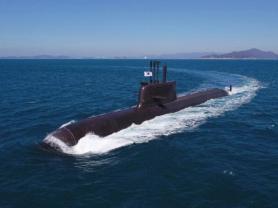
Hanwha Ocean's 3,000-ton 'Jangbogo-III Batch-II (KSS-III)' submarine proposed to Canada Canada's next-generation submarine procurement has narrowed to a two-horse race between South Korea's Hanwha Ocean and the German-Norwegian consortium ThyssenKrupp Marine Systems (TKMS). The announcement of the winning bidder, originally expected by the end of June, is now anticipated to be delayed by a few days. However, there are expectations that a decision could be made before Prime Minister Mark Carney attends the NATO summit in Ankara, Turkey, on July 7. Maintenance and Support Critical; Caution on Split Orders According to CTV News Canada on June 29, this procurement aims to replace the aging Victoria-class submarines of the Royal Canadian Navy. Canada plans to acquire up to 12 submarines, which will include maintenance and support contracts spanning 30 to 50 years. The total value of the project is estimated to exceed $100 billion (approximately 154 trillion won). Currently, only one of the four Victoria-class submarines is operational. The Canadian government is linking this procurement to the NATO defense spending increase trend. NATO member countries are discussing a plan to allocate 5% of their GDP to defense spending by 2035. The submarine project could serve as a prime example of Canada's commitment to enhancing naval capabilities and increasing defense expenditures. The evaluation criteria place significant emphasis on maintenance and support capabilities. The Canadian Defense Investment Agency is assessing bids based on four criteria: submarine performance (20%), maintenance and support (50%), financial conditions (15%), and security and economic cooperation (15%). The ability to maintain and operate the submarines reliably over decades is crucial. The likelihood of split orders is decreasing. Canadian Defense Minister David McGuinty recently stated during a visit to Japan, "Dividing any fleet increases cost burdens." He added, "Maintaining and operating two different fleets is a complex task for any country," suggesting a preference for selecting a single contractor over splitting the order between Hanwha Ocean and TKMS. Hanwha Promises Early Delivery; TKMS Highlights NATO Interoperability Hanwha Ocean is emphasizing a rapid delivery schedule and industrial cooperation. The company has stated it can deliver the first submarine to Canada by 2032, with a total of four submarines by 2035. The estimated construction cost per submarine is about $2 billion (approximately 3.1 trillion won). By replacing the aging Victoria-class submarines early, Hanwha claims it can reduce maintenance costs by about $1 billion (approximately 1.5 trillion won). Hanwha has also proposed operational support measures, including training 200 Canadian submarine crew members at its base in Jinhae. The company has established over 80 partnerships with Canadian firms. According to KPMG analysis, these collaborations could generate over $70 billion (approximately 107 trillion won) in economic impact in Canada from 2026 to 2044. The job creation effect in Canada is estimated at 430,000, with a projected increase in GDP of $96.3 billion (approximately 148 trillion won) during the same period. TKMS is promoting its operational interoperability with NATO as a key advantage. The argument is that if Canada operates submarines similar to those of its NATO allies, joint operations will be easier. TKMS has indicated it can expedite the delivery schedule for Canadian orders, aiming to supply four submarines by 2036. The company has also proposed that Canada utilize its facilities in Europe, India, and Singapore. TKMS is also emphasizing economic benefits, having disclosed 19 memorandums of understanding (MOUs). The company promises an economic ripple effect of $160 billion (approximately 246 trillion won) over the contract period, with an estimated GDP increase of $86 billion (approximately 132 trillion won) and job creation of over 650,000, although the timeframe for these figures has not been clearly specified. The final decision is closely tied to security strategy. Choosing TKMS would enhance Canada's operational interoperability within NATO and strengthen Arctic defense strategies. Opting for Hanwha Ocean could expand security cooperation in the Indo-Pacific region based on large-scale defense collaboration with South Korea. Canada's choice is expected to signal the direction of future security cooperation beyond merely purchasing submarines.* This article has been translated by AI.