
SEOUL, July 07 (AJP) - Samsung Electronics on Tuesday estimated second-quarter operating profit at 89.4 trillion won ($58.4 billion) beating consensus of around 84.60 trillion won, as hot chip selling prices more than offset the cost of record performance bonuses for semiconductor employees.
The preliminary figure compares with operating profit of 57.2 trillion won in the previous quarter and 4.7 trillion won a year earlier and fueled a red-hot earning streak for the third quarter. It also suggests income could have nearly doubled from the January-March period when excluding bonus outlay.
Second-quarter revenue came to 171 trillion won, slightly short of the FnGuide consensus of 172.68 trillion won, but much higher than 133.9 trillion won in the previous quarter and 74.6 trillion won a year earlier,
The world's top DRAM maker's second-quarter earnings were highly anticipated, given the red-hot demand for memory chips powering AI, which also spilled over into mass-market memory due to supply constraints.
Citi Research estimated that average selling prices for DRAM and NAND rose 44 percent and 53 percent, respectively, from the first quarter.
The latecomer in the high-bandwidth memory race was also expected to benefit from long-term strategic supply contracts with major technology companies seeking to lock in memory supplies.
Industry sources also said provisions for employee performance bonuses were at least partially reflected in the quarter, while stronger seasonal demand for air conditioners and other premium home appliances during an early summer heatwave likely supported the consumer electronics business.
Samsung will release detailed earnings, including business division results, later this month.

Candice Kim
Candice Kim is a dedicated business and technology reporter specializing in the intersection of high-tech innovation and fast-paced consumer trends. Her core beats span the semiconductor, IT, cosmetics, and retail sectors, where she provides in-depth coverage of industry titans including Samsung Electronics, SK hynix, and LG Electronics, alongside leading consumer brands like Olive Young and Musinsa. Whether analyzing complex silicon supply chains or tracking the latest shifts in beauty and fashion retail, Candice is committed to delivering sharp, accurate reporting that keeps readers informed on the forces shaping today's most dynamic markets.
Copyright ⓒ Aju Press All rights reserved.
Related News
-
 Hyundai takes Asia's humanoid race beyond the dance floor
Atlas, Hyundai Motor Group's humanoid robot, recreates Son Heung-min's signature goal celebration during halftime of the 2026 FIFA World Cup Round of 16 match at MetLife Stadium in East Rutherford, New Jersey, on July 5, 2026. Photo courtesy of Hyundai Motor Group. SEOUL, July 06 (AJP) - Hyundai Motor reclaimed the 500,000-won threshold Monday, rising 2 percent even as the broader market retreated, after its growing robotics portfolio quietly stole attention from investors otherwise fixated on Samsung Electronics' earnings guidance due the following day. Boston Dynamics' Atlas humanoid robot, owned by Hyundai Motor Group, showcased a series of football-inspired celebrations during halftime of the Brazil-Norway World Cup round-of-16 match at MetLife Stadium in New Jersey on Sunday. Before nearly 80,000 spectators, Atlas recreated signature goal celebrations associated with global stars including Harry Kane, Erling Haaland, Matheus Cunha and Son Heung-min before delivering the match ball to the referees. Hyundai said the performance demonstrated the same reinforcement-learning and whole-body control technologies it is developing for industrial applications. Atlas, Hyundai Motor Group's humanoid robot, during halftime of the 2026 FIFA World Cup Round of 16 match at MetLife Stadium in East Rutherford, New Jersey, on July 5, 2026. Photo courtesy of Hyundai Motor Group. The appearance formed part of Hyundai's "Next Starts Now" campaign. Brand marketing chief Ji Seong-won said the roughly five-year project was intended to bring advanced robotics into public view rather than simply advertise the company. Unlike many Chinese humanoid demonstrations that have gone viral for choreographed dances and acrobatic performances, Hyundai emphasized practical mobility and industrial capability over spectacle, underscoring its strategy of building robots designed to work alongside humans rather than merely entertain them. The industrial focus extends beyond humanoids. This photo provided by Hyundai Motor group show, members of Team Genesis wearing 'X-ble Shoulder wearable robot' at Le Mans 24. Hyundai's 1.9-kilogram battery-free wearable exosuit was deployed by Genesis Magma Racing's pit crew during June's 24 Hours of Le Mans, helping reduce shoulder strain during rapid tire changes. The device has since been introduced to a young peach farmer in Eumseong through a NongHyup support program. A state-backed study found it reduced shoulder muscle activity by an average of 33 percent during fruit-harvesting work. The demonstrations come as Hyundai targets annual humanoid production capacity of 30,000 units by 2028. Atlas is expected to begin parts-sequencing work at Hyundai Motor Group Metaplant America in Georgia that year before expanding into more complex assembly tasks by 2030. The robotics initiative forms part of Hyundai's broader 125.2 trillion won domestic investment plan through 2030, including a robotics and AI data-center cluster in Saemangeum. Investors appeared to welcome Hyundai's progress in what is increasingly described as "physical AI." While the KOSPI fell 0.46 percent, automobile stocks led the market, climbing 3.45 percent. Kia surged 5.72 percent, while Hyundai Motor rose 2.03 percent to 502,000 won. Hyundai Motor 2Woo B gained 4.44 percent and Hyundai Motor Woo advanced 3.97 percent. Auto-parts manufacturers were the market's third-best-performing sector, rising 3.27 percent. Kumho Tire soared 29.96 percent to hit the daily trading limit, although no company-specific announcement appeared to explain the move. Insurance shares also outperformed, led by Samsung Fire & Marine Insurance, which climbed 5.64 percent. Brokerages are increasingly trying to identify the long-term winners in humanoid robotics. Hyundai Motor Group and Boston Dynamics present "School of Football," a robotics campaign showing the humanoid robot Atlas training with a football. Photo courtesy of Hyundai Motor Group. In a June report, CLSA analyst Brian Lee projected annual global humanoid production would exceed 1 million units by 2030, with the market reaching $320 billion by 2035. CLSA ranked Tesla and Boston Dynamics well ahead of rival developers, arguing both benefit from large-scale manufacturing expertise and captive demand from their automotive businesses. Figure AI ranked a distant third. The brokerage estimated Boston Dynamics' value at roughly 161 trillion won under its base-case scenario, well above the average 86 trillion won valuation assigned by other brokerages it surveyed. Whether Hyundai's early positioning ultimately translates into a durable competitive advantage remains uncertain. South Korea boasts the world's highest manufacturing robot density, with 1,220 robots for every 10,000 workers as of 2024, according to the International Federation of Robotics. Scale, however, belongs to China. The country operates by far the world's largest industrial robot fleet, with more than 2 million units, and its collective humanoid robot output is expected to surpass Hyundai's 2028 production target as early as next year, according to industry estimates.
-
 Durability of Seoul's bull questioned as leverage exceeds retail trade
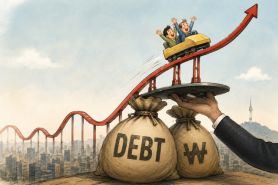
A debt-powered ride to record highs. Image generated by AI SEOUL, July 06 (AJP) — As the KOSPI correction enters a third week, retail investors remain the primary buffer against relentless foreign selling, but much of their firepower is borrowed, raising questions about the durability of Seoul's record-setting bull market. Outstanding margin loans and stock-backed lending averaged a record 61.98 trillion won ($39.8 billion) per trading day during the April-June quarter, exceeding the combined average daily trading value of 52.5 trillion won on the KOSPI and KOSDAQ over the same period, according to Korea Exchange (KRX) data. A comparison of South Korea's average outstanding retail leverage and the average daily trading value on the KOSPI and KOSDAQ during the Q2 of 2026. Source: Korea Exchange (KRX). Graphics generated by AI Outstanding margin loans climbed 15.9 percent from the first quarter to a record 35.94 trillion won, while stock-backed loans — borrowing secured against shares investors already owned — remained virtually unchanged at 25.97 trillion won. The divergence suggests investors were increasingly borrowing to finance new stock purchases rather than tapping existing holdings for liquidity. Average outstanding margin loans, stock-backed loans and total retail borrowing during the Q1 and Q2 of 2026. Source: Korea Financial Investment Association (KOFIA). Graphics generated by AI The surge in leverage coincided with one of the most extraordinary rallies in the history of South Korea's equity market. The benchmark KOSPI surged past the 5,000 level for the first time in January, broke above 6,000 in February, raced through both 7,000 and 8,000 in May and surpassed 9,000 for the first time in June. The KOSPI has since retreated to just above the 8,000 mark as of Monday after weeks of record foreign selling. The first-half rally was fueled by optimism surrounding artificial intelligence and South Korea's memory-chip industry, led by Samsung Electronics and SK hynix. As prices climbed rapidly, fear of missing out drew more money into the market while early investors locked in profits, producing increasingly sharp swings in share prices. The Korea Exchange said volatility interruption mechanisms, or VIs — temporary two-minute auctions triggered when individual stocks move too sharply — were activated 29,357 times during the first half of the year, the highest number ever recorded for a six-month period. The previous record of 24,401 came during the first half of 2020, when markets were rattled by the COVID-19 pandemic. The KOSPI's average intraday volatility reached 3.30 percent during the first half, the second-highest level on record after 3.51 percent in the first half of 1998. Critics argue that retail trading has become increasingly speculative and selective since the launch of single-stock leveraged exchange-traded funds linked to Samsung Electronics and SK hynix, with the products' daily rebalancing amplifying market swings. In a written response to Park Sung-hoon of the main opposition People Power Party, the Bank of Korea said additional investment in single-stock leveraged ETFs could deepen market concentration because Samsung Electronics and SK hynix already account for more than half of the KOSPI's market capitalization. The central bank also warned that the daily rebalancing and arbitrage activities required by leveraged ETFs could intensify one-way trading and amplify price swings when investor sentiment shifts. The warning marked a notable shift from the Bank of Korea's June 24 Financial Stability Report, which had concluded that single-stock leveraged ETFs would likely have only a limited impact on overall market stability. Less than two weeks later, however, the central bank warned that the products could deepen market concentration and amplify volatility. Signs of overheating also appeared in regulatory data. The Korea Exchange designated 43 stocks as "investment risk" issues during the first half, compared with just two a year earlier. Investment warning designations rose to 379 from 35, while investment caution notices jumped to 2,944 from 271. The issue has also spilled into politics. Ahn Cheol-soo of the main opposition People Power Party on Sunday criticized single-stock leveraged ETFs linked to Samsung Electronics and SK hynix, saying their daily rebalancing had amplified market volatility and turned the KOSPI into a "casino." He called on regulators to consider delisting the products, noting that all 14 leveraged ETFs tied to the two chipmakers had posted negative returns over the past month, with losses reaching as much as 35.9 percent. He also urged President Lee Jae Myung to dismiss the country's top financial regulators over their approval of the products. For brokerages, however, the leverage boom has proved highly lucrative. Applying an assumed annual interest rate of 9 percent to average margin loans and 8.5 percent to stock-backed loans, securities firms are estimated to have generated about 1.36 trillion won in interest income from stock-related lending during the second quarter alone, up 8.7 percent from an estimated 1.25 trillion won in the first quarter. Nearly 60 percent of that increase came from the expansion of margin lending, underscoring that brokerages benefited primarily from investors taking on new debt. Outstanding margin balances have recently hovered around 38 trillion won as brokerages approach regulatory limits on total lending relative to their equity capital. Several major firms, including NH Investment & Securities and KB Securities, have recently raised capital to expand their lending capacity, suggesting margin financing could continue to grow if retail demand remains resilient. The figures point to a fundamental shift in Korea's bull market. It is no longer being driven solely by optimism over artificial intelligence or booming semiconductor earnings. Increasingly, it is being financed by borrowed money.
-
 Samsung Electronics awards up to 100% bonus to chip division for first half
Samsung Electronics Seocho headquarters/ AJP Yoo Na-hyun SEOUL, July 06 (AJP) - Samsung Electronics said on Monday it will pay performance bonuses of up to 100 percent of monthly base salary to employees in its semiconductor division for the first half of the year, ahead of its second-quarter earnings announcement. The company said its Memory Business will receive the maximum Target Achievement Incentive (TAI) payout of 100 percent of monthly base salary for a second consecutive half, reflecting improved earnings driven by higher high bandwidth memory (HBM) shipments and rising conventional DRAM prices. Within the Device Solutions (DS) division, employees in the System LSI Business and Foundry Business will receive bonuses equivalent to 75 percent of monthly base salary, while the Semiconductor Research Center, Samsung Advanced Institute of Technology (SAIT) and other shared organizations will receive 100 percent. Under Samsung's TAI program, employees receive performance-based bonuses twice a year based on the performance of their business division and individual business unit, with payouts capped at 100 percent of monthly base salary. In the Device eXperience (DX) division, employees in the Mobile eXperience (MX) Business will receive bonuses equivalent to 50 percent of monthly base salary, down from 75 percent in the previous half despite solid sales of the Galaxy S26 series. Employees in the Visual Display (VD) Business and Digital Appliances (DA) Business will receive bonuses of 50 percent and 25 percent, respectively. The Medical Device Business and Korea Sales and Marketing Office will receive 75 percent, while the Networks Business, Corporate Management Office and other organizations will receive 50 percent. Samsung Electronics is scheduled to announce its preliminary second-quarter earnings on Tuesday. Separately, Samsung Display said employees in its small- and medium-sized display business will receive bonuses equivalent to 100 percent of monthly base salary, while those in its large-display business will receive 75 percent. Samsung Electro-Mechanics will award bonuses of 100 percent across all business divisions, while Samsung SDI set its first-half payout at 75 percent of monthly base salary.