


Latest by
-
 New Guidelines Halt Asymmetric Dual Listings, Protecting Parent Company Shareholders The government has effectively put a stop to asymmetric dual listings that infringe on the rights of common shareholders in parent companies. To list a subsidiary, companies must now follow stringent procedures to protect the interests of parent company shareholders. Notably, subsidiaries formed through physical division will be required to obtain shareholder approval under the '3% rule,' which limits voting rights for major shareholders. As a result, the threshold for initial public offerings (IPOs) for large corporate affiliates is expected to rise significantly.On July 6, the Financial Services Commission and the Korea Exchange released detailed guidelines on the 'principled prohibition of dual listings and exceptional allowances.' This follows the government's announcement in March of measures to advance the capital market. The guidelines aim to prevent dual listings and spin-offs, which have been cited as factors contributing to the Korea discount.According to the guidelines, the board of directors of a parent company seeking to pursue a dual listing must fulfill five key obligations: assess the impact on shareholders, establish protection measures for shareholders, communicate with shareholders and confirm their consent, conduct a vote on the listing proposal, and disclose relevant information. Additionally, to ensure compliance, an 'independent special committee' consisting of at least three directors or external experts must be formed to conduct prior reviews and decisions.The criteria for shareholder approval, which garnered significant attention for investor protection, will not follow the minority shareholder majority (MoM) model but will instead apply the '3% rule.' This means that the voting rights of the largest shareholder and related parties will be limited to 3%, and a majority of attending shareholders (at least one-quarter of voting rights) must agree for a dual listing to proceed.The criteria for shareholder approval will vary by type of subsidiary. Subsidiaries formed through physical division must obtain approval from parent company shareholders. For general subsidiaries (acquired or newly established), obtaining shareholder approval will be considered sufficient for investor protection, but those that do not receive approval will face strict scrutiny. However, 'low-weight subsidiaries,' which account for less than 10% of the parent company's revenue, operating profit, or assets, will not require shareholder approval.Market participants expect that the implementation of these guidelines will improve practices where parent company shareholders suffer due to spin-off listings. As of the end of last year, the dual listing rate in South Korea was 11.2%, significantly higher than in major countries like the United States (0.05%) and Japan (4.0%). However, there are concerns that the increased difficulty of dual listings through physical division may dampen the IPO market. Voices from the venture capital (VC) and private equity (PE) sectors suggest that recovering investment funds through IPOs may become more challenging.* This article has been translated by AI. 2026-07-06 17:52:00
-
Duksan Meets Guidelines for Dual Listing; Which Companies Will Follow? On July 6, the government released guidelines for dual listing reviews, raising questions about the efforts required to pass the assessment. During a briefing, the Financial Services Commission highlighted Duksan Nepcores as a model example of compliance with these guidelines.Duksan Nepcores, a subsidiary of Duksan High Metal, aimed for a public listing in the first half of this year. In May, the company held a separate shareholders' meeting for common shareholders of its parent company to obtain approval for the listing. The major shareholders did not push the decision unilaterally. Approximately 80% of the investors, including common shareholders, participated, resulting in over 90% approval for the dual listing proposal. During this process, the company also proposed measures for shareholder protection, such as stock dividends and increased dividends. A representative from the Financial Services Commission stated, "The disclosure documents indicate that Duksan High Metal followed the board approval process, and the voting results from common shareholders met the minority shareholder majority (MoM) standard, effectively fulfilling the dual listing criteria required by the new guidelines."In the market, DTS, a subsidiary of Dasan Networks, is also cited as a leading example. This company has followed procedures mindful of the new regulations, including obtaining common shareholder consent after applying for preliminary listing review and proposing shareholder return plans.Many companies are planning to pursue dual listings after July. Major corporate affiliates such as Hanwha Energy, HD Hyundai Robotics, and LS E-Six Solutions are expected to undergo dual listing reviews in the future. Among these, HD Hyundai Robotics is anticipated to require shareholder approval, as it was established through a physical division of HD Hyundai. LS E-Six Solutions, which withdrew its domestic listing plans in January, is expected to face stringent individual reviews if it seeks to relist, although it may not need to obtain shareholder consent.Go Young-ho, a capital markets division chief at the Financial Services Commission, commented on the applicability of the guidelines to companies like CJ Olive Young and HD Hyundai Robotics, stating, "We will need to comprehensively review governance and business structures after they actually apply for preliminary listing reviews to make a determination." 2026-07-06 17:52:00
-
Weather Forecast: Rain Expected Nationwide with Highs Reaching 35 Degrees On July 7, which marks the beginning of the summer season, the weather across the country is expected to be mostly cloudy.Rain will fall in the central region until night, while Jeju Island will see rain in the morning. The southern regions may experience rain from early dawn through the afternoon.The expected precipitation for July 7 and 8 is between 30 to 80 mm in Seoul, Incheon, Gyeonggi Province, and the five islands of the West Sea. Northern Gyeonggi Province is forecasted to receive over 100 mm, and the five islands of the West Sea may see more than 150 mm.In the inland and mountainous areas of Gangwon Province, 30 to 80 mm of rain is expected, with over 100 mm in northern inland Gangwon and 5 to 30 mm along the eastern coast.Daejeon, Sejong, Chungnam, and Chungbuk are expected to receive 30 to 80 mm, while Jeonbuk is also forecasted for 30 to 80 mm. Gwangju and Jeonnam may see 20 to 60 mm, and the northwestern inland areas of Gyeongbuk are expected to receive 20 to 60 mm. Busan, Ulsan, Gyeongnam, Daegu, and Gyeongbuk (excluding the northwestern inland) are forecasted for 5 to 20 mm, with Jeju Island receiving less than 5 mm.In areas experiencing rain, heavy downpours of 20 to 30 mm per hour, along with gusts, thunder, and lightning, are anticipated, necessitating caution.The heatwave will continue, with daytime highs reaching 35 degrees Celsius. Morning lows are expected to range from 21 to 24 degrees, while daytime highs will be between 28 and 35 degrees.The expected morning lows in major cities are as follows: △Seoul 24 degrees △Incheon 24 degrees △Chuncheon 22 degrees △Gangneung 24 degrees △Daejeon 23 degrees △Daegu 23 degrees △Jeonju 24 degrees △Gwangju 24 degrees △Busan 23 degrees △Jeju 25 degrees.Daytime highs are forecasted to be: △Seoul 30 degrees △Incheon 29 degrees △Chuncheon 29 degrees △Gangneung 32 degrees △Daejeon 31 degrees △Daegu 33 degrees △Jeonju 32 degrees △Gwangju 32 degrees △Busan 29 degrees △Jeju 31 degrees.Wave heights are expected to be between 0.5 to 1.5 meters in the East Sea, 0.5 to 2.0 meters in the West Sea, and 0.5 to 1.0 meters in the South Sea.In the offshore waters (approximately 200 km from the coastline), wave heights are forecasted to be 0.5 to 1.5 meters in the East Sea, 0.5 to 3.0 meters in the West Sea, and 0.5 to 2.0 meters in the South Sea.* This article has been translated by AI. 2026-07-06 17:52:00
-
 Even government bonds can bite, South Korea's regulator warns SEOUL, July 06 (AJP) — South Korea's financial regulator on Monday warned that even government bonds, long regarded by many retail investors as one of the safest investments, can generate significant losses if interest rates rise. The Financial Supervisory Service (FSS) issued the warning as part of its latest investor education campaign on common investment disputes after complaints increased from investors who suffered unexpected losses after buying low-risk bonds, including Korean government bonds, on brokerage recommendations. The FSS said that while government bonds carry little default risk, their market value can fall when interest rates rise, meaning investors who sell before maturity may incur losses. A 30-year government bond with a face value of 10,000 won that pays a 3 percent annual interest rate could lose about 17 percent of its market value if market interest rates rise by one percentage point, it said. The FSS also urged investors to be cautious about buying long-term bonds, saying they should consider whether they may need access to their money before the bonds mature. Investors who want to preserve their principal or who may need cash for unexpected expenses should be particularly careful. "The longer a bond's maturity, the more its price will fluctuate as market interest rates change," it said. The regulator further cautioned investors against relying solely on sales representatives' interest-rate forecasts when making investment decisions. It noted that market interest rates do not always move in line with the central bank's policy rate, meaning bond prices can still fall even when the central bank cuts rates. The FSS also urged investors to compare prices before buying bonds directly from brokerages, as transaction costs and dealer spreads can make those bonds more expensive than similar ones traded on the Korea Exchange. Exchange-traded bonds may offer lower prices, although they can be harder to buy because of limited liquidity. "We will continue to provide timely guidance on investment risks and strengthen investor protection where necessary," the FSS said. 2026-07-06 17:41:56
-
 Seoul's 24-hour FX market tests local banks' staffing capacity SEOUL, July 06 (AJP) - South Korea began round-the-clock foreign exchange trading on Monday, but while the country's largest lenders are relying on overseas dealing desks to cover the new hours, smaller regional banks say they are scrambling to find enough people to stay awake. "We need more staff, but there are limits to how quickly we can hire people for this," one foreign-exchange official at a regional bank told AJP on condition of anonymity. "We will probably introduce rotating shifts internally." Another regional-bank official said recruitment was not a near-term solution. "For now, we are looking at two options: rotating shifts and new hiring," the official said. "Because recruitment takes a lot of time, we are thinking of responding first through rotating shifts." The new framework, launched Monday, allows dollar-won spot trading to run from 6 a.m. Monday to 6 a.m. Saturday during U.S. daylight-saving time. The opening and closing times will shift to 7 a.m. during U.S. winter time. The launch marks the final step in South Korea's transition to a near 24-hour onshore foreign-exchange market. Trading hours had already been extended in July last year from the previous 9 a.m.-3:30 p.m. schedule to 9 a.m.-2 a.m. the following day. The immediate challenge for banks is covering the four-hour gap between the previous 2 a.m. market close and the start of the regular Seoul business day. Korea's five major lenders—KB Kookmin, Shinhan, Hana, Woori and NH NongHyup—have spent the past year preparing by expanding staffing, reorganizing overseas operations and strengthening London dealing desks, according to multiple industry sources. Some are expected to use capital-markets teams in Singapore, London and New York, while others will rely primarily on London because Korea's early morning overlaps with London's trading day. Regional banks, however, face a different reality. Unlike the country's largest lenders, their foreign-exchange business is centered on customer transactions, trade finance and liquidity management for local exporters and importers. Most lack extensive overseas dealing operations in financial centers such as London and New York. "Even if we automate the process, it is ultimately people who have to look at it and make judgments," the first official said. "We need people to conduct the final checks, but that is not easy at this point." "It is true that we are stretched compared with other banks that have branches in places such as London and New York," the official added. Trading volumes have so far remained subdued as foreign banks appear to be observing how the new system settles in. "So far, foreign banks are closely watching market moves after the opening, and we do not see trading volume exploding," the second official said. "But if trading volume increases later, we will have to expand the number of rotating staff or hire new employees." The staffing challenge extends beyond banks' existing non-deliverable forward (NDF) operations. While NDF desks can monitor offshore won movements, the new 24-hour onshore dollar-won market requires banks to support deliverable spot transactions, settlement, price-making, risk management and operational supervision throughout the trading session. Some lenders are expected to redeploy FX derivatives dealers or rely more heavily on automated hedging systems, but bankers say additional manpower remains unavoidable. Foreign-exchange brokers have also adjusted staffing plans, introducing overnight shifts and rotating schedules ahead of the launch. The Ministry of Economy and Finance and the Bank of Korea said banks, securities firms, brokers and exporters had prepared for the new framework through changes to internal rules, staffing, systems and test trading. The 24-hour regime applies to the interbank dollar-won market rather than all retail foreign-exchange services. Customer remittances, currency exchange and corporate FX transactions during overnight hours will continue to depend on each institution's staffing, systems and risk-management policies. Market participants say the longer trading window could strengthen South Korea's case for inclusion in MSCI's developed-market index, although success will ultimately depend on offshore liquidity, tighter bid-ask spreads and sustained foreign participation rather than trading hours alone. 2026-07-06 17:40:02
-
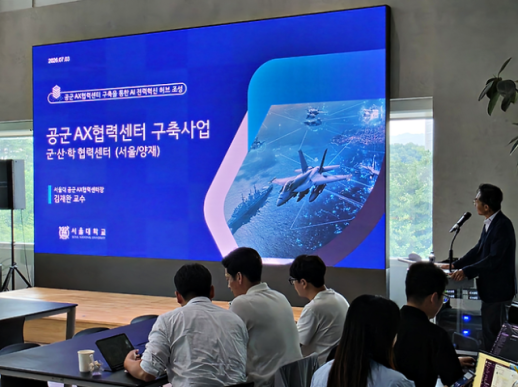 Korea's Air Force, SNU launch AI initiative to reshape aerospace warfare SEOUL, July 06 (AJP) - Seeking to accelerate its digital frontline transformation, the South Korean Air Force has partnered with Seoul National University (SNU) to develop three key AI technologies that can be directly deployed in military operations. The projects will focus on tracking mobile missile launchers, automatically identifying targets and generating combat plans for aerospace operations. Each project will be carried out by a joint team consisting of SNU researchers and a participating private company. The initiative is part of efforts to establish the Air Force AX Cooperation Center, a joint military-academic-industry hub designed to accelerate the Air Force’s adoption of artificial intelligence. AX refers to AI transformation. The Air Force plans to establish an AX base at the Industrial AX Innovation Center within the Seoul AI Hub in August, with support from the Ministry of National Defense. SNU will oversee the cooperation center, while Air Force personnel will be stationed there to identify operational requirements, conduct security reviews and help connect research results to military acquisition and deployment programs. The Artificial Intelligence Research Institute has also been commissioned to provide specialized AI education and support the operation of the SNU-Air Force AX Cooperation Center. “The Air Force AX center is not simply a research space,” said Zhang Byong-tak, head of SNU’s defense AI talent development program. “It is a hub for practical civil-military cooperation where technologies the Air Force actually needs are developed with companies and then directly applied and fielded in military operations.” A project led by Zhang will focus on tracking mobile missile launchers. His team is developing an AI system that combines various data sources with maps to predict where these launcher vehicles will go after firing a missile. By showing these paths on a digital map in real time, the system will help analysts find moving targets much faster. To identify targets automatically, Kwak No-jun’s team is building a system that analyzes both military photos and written text together. It will compare new images with older data to spot similar activities, while also checking past reports and records. This will help analysts pinpoint targets with greater speed and accuracy. Another project, led by Yu Young-jae, applies AI to planning air and space combat. The team is creating a tool that helps assign troops, select targets, and recommend the best weapons based on official guidelines. This system aims to cut down planning time and help commanders make smarter, more accurate decisions. Companies with AI capabilities, including startups, small and medium-sized enterprises and defense contractors, may apply to participate from July 6 to 17. Applicants will first undergo a document review, with a shortlist of up to three candidates for each project. A committee led by SNU will then select the participating companies. The selection and partnership agreements are expected to be completed in late July, with research scheduled to begin in early August. 2026-07-06 17:39:19
-
Korean Appraisers Association Opposes Patent Attorney Law Amendment The Korean Appraisers Association has expressed strong opposition to a proposed amendment to the Patent Attorney Act currently pending in the National Assembly, calling it a "toxic provision that legally permits conflicts of interest." The association stated on July 6 that it has continuously communicated its objections and suggestions for amendments to the Intellectual Property Office since discussions began in March, but has only received generic responses. The primary concern raised by the association is Article 7-5, Section 1, Subsection 1 of the amendment, which allows patent attorneys to conduct appraisals of patents, utility models, designs, and trademarks for which they have directly represented clients. The association criticized this provision as permitting "self-appraisal," where a patent attorney evaluates their own represented patents, undermining the objectivity and fairness that are vital to the appraisal market. They warned that this could send a dangerous signal that encourages fraudulent patent applications and inadequate evaluations, ultimately causing significant harm to the national economy. In fact, major professional qualification systems in South Korea, including those for appraisers (Article 25 of the Appraisal Act), lawyers (Article 51 of the Attorney Act), and certified public accountants (Article 21 of the Certified Public Accountant Act), strictly prohibit any work that poses a conflict of interest or raises concerns about unfair practices. The association argues that the proposed amendment is regressive, allowing typical conflict-of-interest situations that other professions are prohibited from engaging in. The association has consistently proposed amendments and collaborative solutions to the Intellectual Property Office to resolve the conflict, but claims the office has maintained a "no amendments" policy and has only engaged in a superficial consultation process. They also dismissed claims made by the head of the Intellectual Property Office in March that sufficient consultations with relevant organizations had taken place as inaccurate. Furthermore, the association emphasized the need for a strict national oversight system to be explicitly stated in the law, including significantly strengthening the disciplinary provisions for patent attorneys to prevent a recurrence of past cases of inadequate patent value assessments. Yang Gil-soo, president of the Appraisers Association, cautioned against viewing the issue as merely a turf battle among professional qualifications, stating, "The valuation of intellectual property rights requires collaboration between the expertise of appraisers and the technical expertise of patent attorneys, and the amendment should not become a source of conflict." An industry insider remarked, "Valuations must be determined objectively and independently from clients, but this amendment effectively legitimizes conflicts of interest by allowing patent attorneys to appraise their own represented items, creating a structure that encourages evaluations tailored to client preferences and risks promoting illegal activities."* This article has been translated by AI. 2026-07-06 17:36:00
-
Baejae High School Baseball Team Apologizes Amid Political Debate The Baejae High School baseball team has apologized to Gwangju Ilgo High School following a controversy that erupted during a high school baseball game. The incident has sparked a political debate over the severity of the punishment and the nature of the actions involved.On the afternoon of July 6, all 36 members of the Baejae baseball team, along with some parents and staff, visited Gwangju Ilgo to read an apology letter. This visit came a week after the controversy arose during a match on June 29 at the Cheongryonggi National High School Baseball Championship.The Baejae baseball team stated, "We sincerely apologize to the players, parents, and citizens of Gwangju who were deeply hurt by our inappropriate remarks and actions." The team's coach acknowledged the responsibility, saying, "There is no excuse for regional derogatory cheers."The controversy began during the match between Baejae and Gwangju Ilgo when some Baejae students shouted phrases like "Let's go to Starbucks" and "Tank Day." These cheers were criticized for evoking recent controversies surrounding a Starbucks Korea event that was seen as trivializing the May 18 Gwangju Democratization Movement and the torture and death of activist Park Jong-cheol.Given that the remarks were directed at Gwangju Ilgo, a school in the Gwangju area, the situation escalated into accusations of mocking the May 18 movement and regional discrimination. In response, the Korea Baseball Softball Association imposed a six-month suspension on the Baejae baseball team from national competitions.Political reactions have been mixed. The Democratic Party views the incident as a matter of hate speech and historical distortion. Acting party leader Han Byeong-do expressed dismay, stating, "Regardless of political affiliation, no one should make jokes or belittle such matters." Senior spokesperson Kang Jun-hyuk criticized claims from some members of the People Power Party that the punishment was excessive, arguing that such mockery and hate should not be defended as free expression.Democratic Party lawmaker Kim Jun-hyuk called for stronger accountability from the school, asserting that while appropriate punishment for the players and coaching staff is necessary, the larger failure lies with the school's administration for allowing such behavior to occur. He criticized the incident as not merely a spontaneous act by students but a result of neglect in character education by the school and its governing body.Conversely, some members of the People Power Party and conservative figures argue that the punishment is too harsh. Yang Hyang-ja, a senior member of the People Power Party, acknowledged that extreme and hateful expressions are wrong and contrary to sportsmanship but called for a reconsideration of the severity of the punishment. Kim Jae-won, another senior member, described the players' actions as "immature" but deemed the six-month suspension for all student-athletes as "clearly excessive and violent."Independent lawmaker Han Dong-hoon and Lee Jun-seok, leader of the Reformist Party, also raised concerns about the punishment's severity. Han stated that while using the May 18 Gwangju Democratization Movement as a target for jeering is wrong, a six-month suspension for young students is excessive. Lee similarly urged the Korea Baseball Softball Association to revoke the six-month suspension.The debate has also touched on issues of free expression. Lee Byeong-tae, vice-chairman of the Presidential Regulatory Reform Committee, posted that the May 18 movement has become a taboo subject, emphasizing that the core of the argument remains centered on free expression. In response, the Blue House issued a warning regarding inappropriate conduct from individuals in responsible positions within government-affiliated organizations and subsequently recommended resignation.The Baejae incident has evolved into a complex discussion involving inappropriate cheering by school sports teams, hate speech, gaps in historical education, the severity of punishments for minors, and political interference. While the Baejae baseball team has apologized in Gwangju, the debate over how to address this issue and prevent future occurrences is likely to continue for some time. 2026-07-06 17:32:00
-
Over 10,000 First-Year High School Dropouts Amid Educational Reforms First-year high school classrooms are facing significant turmoil. Amid major changes in the college entrance system, including the full implementation of the high school credit system and the new grading system, the number of first-year dropouts has surpassed 10,000. The Ministry of Education has denied a direct link between the new grading system and the increase in dropouts, but educators and academic experts point to the contradictions of the complex credit system and college entrance policies, along with the 'anxiety marketing' of private education, as contributing factors to the crisis in public education. According to data released by the Ministry of Education on July 6, the number of first-year dropouts in general high schools has steadily increased: 6,112 in 2021, 7,880 in 2022, and 9,373 in 2023. In the 2025 academic year, following the introduction of the new grading system, the number of dropouts reached 10,016.Education Ministry: "Dropout increase not solely due to new grading system... more dropouts from lower ranks"However, the Ministry has drawn a line, stating that it is difficult to attribute the dropout crisis solely to the new grading system. The average rank of first-year dropouts in 2025 is 3.7 (on a 5-point scale), which translates to a 6.7 under the previous 9-point system, indicating that a larger proportion of dropouts are from lower-ranking students. In response to concerns about top students opting for 'resetting their grades' (dropping out and re-enrolling), the Ministry noted that the dropout rate among first-grade students (6.72%) has actually decreased from two years ago (7.07%), and the number of students re-enrolling the following year remains similar to the previous year. Additionally, addressing fears that the new grading system would weaken the differentiation among top students, the Ministry reported that the number of students maintaining straight A's across all subjects in the first and second semesters has decreased by 38% to 4,659, suggesting that the number of students who can maintain straight A's through to their third year is likely to be less than the medical school admission quota of 3,671, indicating sufficient grading differentiation."Career pressure from credit system and mismatch with college entrance exam leads to dropouts"Despite the Ministry's quantitative explanations, the sense of crisis felt by educators and experts is severe. Some in the education sector analyze that the pressure stemming from the full implementation of the high school credit system is a significant underlying factor in the surge of first-year dropouts. Under the credit system, students must choose complex subjects aligned with their career paths from their first year. A professor of education noted in a conversation with Aju Economy that "forcing first-year students, who may not have a clear career path, to select subjects directly tied to college admissions creates extreme stress." Moreover, while the grading system operates under the credit system and the new 5-point scale, the college entrance exam, a major component of admissions, still adheres to the old system, creating a significant contradiction. Among students facing this double burden, there is a growing perception that "it is better to drop out early, take the high school equivalency exam, and focus solely on the college entrance exam rather than being tied down by complicated school life and grade management." Private education institutions are also exploiting these gaps in the system and the anxiety of students to encourage dropouts.Admissions experts: "Rushing to drop out for college entrance exam is a dangerous gamble"However, education authorities and admissions experts warn that hastily dropping out of high school with the hope of relying solely on college entrance exam scores is a very risky choice in terms of college admissions strategy. The landscape of college admissions is gradually shifting away from a 100% reliance on entrance exam scores. In fact, according to the reform intentions for the 2028 college admissions process, nine out of 16 major universities that are subject to regulations on entrance exam-based admissions have either established or strengthened the inclusion of school records in their admissions criteria. Consequently, a total of 11 major universities will now utilize school records as a component of their admissions process. Colleges are transitioning to a more qualitative evaluation of students who have demonstrated diligence and responsibility within the school community, rather than simply selecting those with high quantitative entrance exam scores. Min Byung-gon, head of admissions at Seoul National University, expressed in a commentary that "it is unfortunate that many students are considering dropping out due to concerns about their grades." He criticized the notion that "one must achieve straight A's to gain admission to their desired university" as a form of fear-based marketing. He emphasized that schools are not just places for receiving grades but are environments where students learn to collaborate and take responsibility, growing as democratic citizens. He added that the type of talent universities seek are students who possess the potential to grow proactively within their given environment.* This article has been translated by AI. 2026-07-06 17:28:00
-
Financial Authorities to Provide 300 Billion Won Special Guarantees for Homeplus-Affected SMEs The financial authorities will provide special guarantees worth up to 300 billion won to small and medium-sized enterprises (SMEs) affected by Homeplus.The Financial Services Commission announced on July 6 that it held a 'Homeplus Financial Sector Response Meeting.' The meeting discussed the current status of financial support for partner companies following the decision to terminate Homeplus's rehabilitation process on July 3, as well as future response directions.The Korea Credit Guarantee Fund will apply 'Crisis Response Special Guarantees' to provide emergency liquidity support of up to 300 billion won for SMEs affected by Homeplus. The guarantee limit will be set at a maximum of 50 million won, with the guarantee fee rate reduced by 0.5 percentage points.Cha Byeong-ho, head of the Credit Guarantee Fund's Credit Business Division, stated, "Immediately after the announcement of the decision to terminate the rehabilitation process, we quickly revised our internal guidelines related to special guarantees and completed the relevant procedures, allowing support applications to begin today. We have also communicated this support information to branches nationwide to minimize the time required for fund supply on the ground."Since the initiation of Homeplus's rehabilitation process in March of last year, the banking sector has extended support to partner companies, including the maturity extension of accounts receivable-backed loans totaling 4.8944 trillion won (4,454 cases), repayment deferrals of 122.3 billion won (2,999 cases), and new funding of 15.8 billion won (93 cases).Shin Jin-chang, secretary general of the Financial Services Commission, urged the banking sector to continue to carefully monitor and facilitate additional maturity extensions and repayment deferrals to alleviate financial difficulties faced by small partner companies.The Financial Supervisory Service will continue to operate a financial consultation center for Homeplus suppliers and partner companies, enhancing one-stop support by linking with consultation channels of related agencies.The financial authorities plan to continue discussions on additional support measures in conjunction with a government-wide task force.* This article has been translated by AI. 2026-07-06 17:28:00