


Latest by
-
 KFTC Initiates Settlement Process for Unicity Korea Over Allegations of Bypassing Commission Limits The Korea Fair Trade Commission (KFTC) has initiated a settlement process for Unicity Korea, which is accused of bypassing commission limits for multi-level marketing agents. This decision follows the company's proposal for self-correction measures, including improvements to its commission payment system and an extension of the consumer return period. This marks the first time the KFTC has decided to commence such a procedure since the introduction of the settlement system under the Direct Selling Act.On October 21, the KFTC announced that it accepted Unicity Korea's application for a settlement regarding alleged violations of the Direct Selling Act. The settlement process allows businesses accused of legal violations to voluntarily propose corrective measures aimed at remedying harm and improving transaction order, enabling the KFTC to conclude the case without determining the legality of the actions.The core issue in this case is whether Unicity Korea's payment of commissions to domestic multi-level marketing agents through its U.S. headquarters constitutes a bypass of the legal payment limits. According to Article 20, Section 3 of the Direct Selling Act, the total amount of commissions that a multi-level marketing business can pay to agents cannot exceed 35% of the sales revenue from goods supplied to those agents.The KFTC has been investigating Unicity Korea's actions after the company changed the affiliation of its top agents to Unicity International, its U.S. headquarters, which then paid commissions to those agents. If the commissions paid by the U.S. headquarters are included in Unicity Korea's total commission payments, it would exceed the legal limit from 2021 to 2024.However, a civil court in the second instance handling a related case ruled that the commissions paid by the U.S. headquarters could not be viewed as a circumvention of regulations by Unicity Korea. The prosecution also decided not to pursue charges on the grounds that it did not constitute a bypass.In light of this, Unicity Korea opted to apply for a settlement rather than continue to contest the legal judgment, stating its intention to improve its commission payment system and enhance cooperation with agents and consumers. The proposed corrective measures include registering agents affiliated with the U.S. headquarters under Unicity Korea.The company also plans to adjust the point value (PV) of major products and their prices to comply with the commission payment limit and establish a monitoring committee to oversee payment statuses.Additionally, Unicity Korea has proposed consumer protection measures, including extending the return period for consumers from the current 20 days to three months. The company will conduct compliance training for agents and local customer support centers and enhance the functions of its agent consultation center. It will also provide information on preventing illegal multi-level marketing through its website for three days each month and improve its IT systems for agent convenience.The KFTC has determined that these proposals meet the initial requirements for commencing the settlement process.The settlement system under the Direct Selling Act was introduced following a legal amendment in January 2022 and has been in effect since July of that year. This is the first case to initiate such a procedure since the system's introduction. According to relevant laws, the KFTC must prepare a provisional settlement plan and provide stakeholders with an opportunity to submit opinions for a period of at least 30 days. The final plan will be confirmed after review and approval by the commission, and failure to implement the approved corrective measures without justifiable reasons may result in penalties.The KFTC stated, "We will work with Unicity Korea to prepare a specific provisional settlement plan and conduct stakeholder consultations and discussions with relevant agencies. The final plan will be presented to the commission for a decision on whether to confirm the settlement."* This article has been translated by AI. 2026-10-21 10:32:00
 -
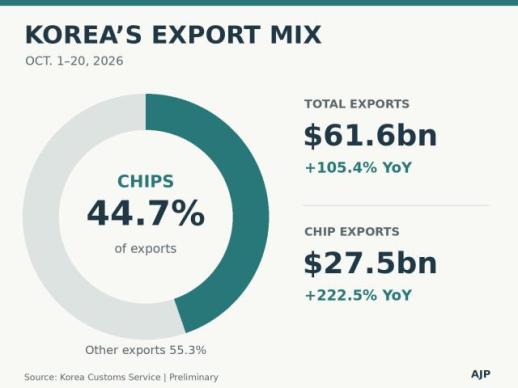 AJP Factbox: Korea keeps up red-hot export streak Oct 2026-10-21 10:28:21
 -
President Lee Refutes Controversy Over Prosecutor's Attendance at Cabinet Meetings 이재명 대통령은 21일 공소청장과 중대범죄수사청장의 국무회의 배석을 둘러싼 위헌 논란에 대해 생성형 인공지능(AI) 제미나이의 답변을 인용하며 반박했다. 법적으로 배석이 가능하다는 정부 입장과 수사·기소기관의 정치적 중립성이 훼손될 수 있다는 우려가 맞서면서 논란이 이어지고 있다. 특히 다른 헌법적 해석이 아니라 대통령이 AI의 법률 분석을 통해 기존 방침을 재확인했다는 점에서 또다른 논란이 불거질 것으로 예상된다. 이 대통령은 이날 엑스(X·옛 트위터)에 ‘제미나이에게 물어봤습니다’라는 제목의 글을 올리고 “정부조직법 제11조를 부정하는 공소청장·중수청장의 국무회의 배석 불가론은 위헌적 억지”라는 제미나이의 답변을 공유했다. 제미나이는 헌법상 행정권이 대통령을 수반으로 하는 정부에 속하고, 정부조직법에 따라 대통령이 중앙행정기관장을 지휘·감독할 수 있다는 점을 근거로 들었다. 제미나이는 “공소청장과 중수청장의 국무회의 참석을 배제하라는 주장은 대통령의 행정감독권과 정부 통솔 구조를 정면으로 부정하는 궤변”이라고 답했다. 이어 “대통령이 지휘·감독하더라도 공식 회의인 국무회의에는 참석시키지 말라는 주장은 명백한 모순”이라고 했다. 또한 공소청장과 중수청장이 국무회의에 배석해 소관 업무를 논의하는 것이 책임정치에 부합한다며, 이들을 배제하는 것은 오히려 대통령의 민주적 통제에서 벗어난 ‘밀실 속 치외법권 성역’을 만드는 결과로 이어질 수 있다고 주장했다. 다만 제미나이의 답변은 법원이나 헌법재판소의 판단 또는 정부의 공식 유권해석은 아니다. 질문에 입력된 전제와 표현에 따라 답변이 달라질 수 있는 생성형 AI의 분석을 이 대통령이 직접 헌법 논쟁의 반박 근거로 제시한 셈이다. 이 대통령은 지난 13일 국무회의에서도 사정기관장 배석 논란을 직접 반박했다. 당시 이 대통령은 “정부조직법상, 헌법에 의해 당연한 일”이라며 “우리가 세부 사건 처리에 관여하지는 않는다. 그러나 국가의 일반적인 정책 방향을 공유하는 것은 중요하다”고 주장했다. 논란은 전날 김지용 신임 중수청장이 국무회의에 참석하면서 다시 불거졌다. 이 대통령은 김 청장에게 “네 편, 내 편 가리지 말고 일체의 성역 없이 수사력을 총동원해 중대범죄를 엄단함으로써 중수청의 존재 의의와 필요성을 국민께 증명해 달라”고 주문했다. 김 청장은 “중수청을 성공적으로 정착시켜 검찰개혁을 완수하고 국민 권익 보호에 최선을 다하겠다”고 답했다. 현행 국무회의 규정상 공소청장과 중수청장은 당연직 참석자는 아니다. 다만 국무회의 의장은 필요하다고 인정할 경우, 중앙행정기관장과 중요 공무원을 배석시켜 발언하게 할 수 있다. 정부는 이에 따라 공소청장과 중수청장의 배석에 법적 문제가 없으며, 국무회의에서 개별 사건을 논의하지 않는다고 설명하고 있다. 반면 법조계 일각에서는 개별 국무회의 배석이 법적으로 가능하더라도 이를 정례화하는 것은 별개의 문제라는 지적이 나온다. 현직 대통령과 가족, 청와대 참모 등 살아 있는 권력을 수사하거나 기소할 수 있는 기관장이 대통령 주재 회의에 반복적으로 참석하면 명시적인 지시가 없어도 무언의 압박으로 작용할 수 있다는 것이다.* This article has been translated by AI. 2026-10-21 10:28:00
-
Vietnam Signs Free Trade Agreement with EFTA After 10 Years of Negotiations Vietnam has signed a free trade agreement (FTA) with the European Free Trade Association (EFTA), which includes Switzerland, Norway, Iceland, and Liechtenstein, after more than a decade of negotiations. The agreement will gradually reduce tariffs on most traded goods, while both sides have committed to expanding investments in advanced technology and industrial cooperation. However, meeting stringent technical and environmental standards poses a significant challenge for Vietnamese exporters.According to Vietnamese economic media VnEconomy, the FTA was finalized on October 21, concluding 21 rounds of negotiations that spanned over ten years. The EFTA is an economic cooperation group comprising Switzerland, Norway, Iceland, and Liechtenstein, and the agreement includes provisions for tariff reductions as well as cooperation on technological innovation and sustainable development.Both parties discussed practical implementation strategies for the agreement during the '2026 Vietnam-Switzerland Economic Forum' held on October 19. This event was organized to mark the 55th anniversary of diplomatic relations between Vietnam and Switzerland, focusing on expanding trade and investment cooperation following the FTA.The core of the agreement is the gradual reduction of tariffs on most items. Both sides aim to establish a legal framework that allows businesses to trade securely and promotes investment in patents, advanced technologies, and high-value products.Unlike previous agreements centered on market opening, this one also addresses climate change, green transition, and quality labor standards. The goal is to expand tariff benefits while establishing responsible production and trade systems in environmental and labor sectors.Helene Budliger Artieda, the Swiss State Secretary for Economic Affairs (SECO), emphasized during the forum's opening that this agreement, finalized after 21 rounds of negotiations, marks the beginning of enhanced practical cooperation between the two sides. She explained that the agreement's value extends beyond mere market access improvements to support technological innovation and sustainable development.Switzerland's approach to supporting Vietnam is also evolving. Since 1991, Switzerland has participated as a development cooperation partner, providing over $800 million in official development assistance (ODA). Recently, the focus has shifted from direct financial aid to strengthening technical capacities and improving institutional frameworks to support the self-reliance of Vietnamese private enterprises.Philipp Rösler, former Vice Chancellor of Germany and chair of the Vietnam-Switzerland Economic Forum, highlighted that free trade and fair competition are key drivers of economic prosperity. He noted that despite advancements in technology and online services, direct interactions between businesses and individuals remain crucial, as these relationships can foster future trade and direct investments.Vietnamese Companies Need to Enhance Technical and Environmental Capabilities Beyond TariffsThe Vietnamese government believes that the success of the FTA should be assessed based on actual business activities rather than just the scale of tariff reductions. Ngo Trung Khanh, Deputy Director of the Ministry of Industry and Trade's Department of Multilateral Trade, stated that the agreement's success should be evaluated through actual export contracts, technology transfer volumes, and improvements in worker incomes.To achieve this, the Vietnamese government has identified three key challenges for businesses. First, even with tariff elimination, substantial export growth will be difficult if companies fail to meet technical regulations, food safety standards, and sustainability requirements. The EFTA market, while possessing high purchasing power, also imposes strict product standards. Vietnamese companies must verify origin regulations and carefully assess costs related to digital tracking systems and various certifications before exporting.Attracting investment in advanced industries is also a major priority. Vietnam aims to move beyond simple machinery imports and contract processing to attract Swiss investments in precision machinery, pharmaceuticals, green energy, logistics, and digital technology to strengthen domestic production capabilities.Additionally, the government plans to enhance administrative support to help companies effectively utilize tariff benefits. The Ministry of Industry and Trade is establishing an integrated management and implementation system centered around three frameworks: an 'FTA portal' providing relevant information and services, an 'FTA index' assessing local governments' implementation levels, and an 'FTA ecosystem' connecting businesses with relevant agencies.While the agreement improves access for Vietnamese companies to the markets of the four European countries, tariff reductions alone do not guarantee increased exports. Strict technical and safety standards, as well as origin regulations, must be met for actual trade to occur. The support system being developed by the Vietnamese government is also focused on overcoming these barriers, meaning the effectiveness of the agreement will depend on companies' compliance capabilities and technology transfer outcomes.* This article has been translated by AI. 2026-10-21 10:28:00
-
Kim Min-seok Prioritizes Super Wide Area Special Zone Law in Regular National Assembly Kim Min-seok, leader of the Democratic Party, emphasized on the 21st that he will prioritize the "Super Wide Area Special Zone Law" as a key legislative agenda in the regular National Assembly.During a Supreme Council meeting held at the National Assembly, he stated, "We will support local areas to become leaders in future industries through infrastructure supply, substantial financial and tax support, and bold regulatory rationalization."Regarding contentious issues such as the so-called "white-collar exemption," which would exclude certain professional sectors from labor regulations like the 52-hour workweek, he said, "We will create rational alternatives that do not undermine the value of labor while maintaining competitiveness through swift discussions."In this context, the Democratic Party plans to jointly propose two versions of the Super Wide Area Special Zone Law—one applying labor regulation exemptions and one not—before deliberating on them in consultation with business and labor sectors.On the same day, in recognition of Police Day, Kim expressed gratitude to the police. He also urged efforts to enhance investigative capabilities needed for responding to intelligent crimes and to develop effective measures against violent and sexual crimes.He added, "The Democratic Party will also play a role in police reform to enhance professionalism and accountability in cooperation with the government’s Police Reform Committee, centered around our internal police reform promotion team."Meanwhile, Han Byeong-do, the floor leader, commented on the early return of wartime operational control, stating, "This signifies that South Korea will take responsibility for its own security and play a leading role within the South Korea-U.S. alliance," emphasizing that the U.S.-South Korea Combined Forces Command will remain in place even after the transfer of operational control. He noted that both self-defense and the South Korea-U.S. alliance will be strengthened together.He further remarked, "If we understand the long and arduous history of the return of operational control, we cannot dismiss it as a 'remnant of outdated ideology,'" urging the People Power Party to cease its outdated color-coded rhetoric.Additionally, the Democratic Party appointed former prosecutor Seo Ji-hyun as co-chair of the special committee on measures to eradicate domestic violence and stalking, following the earlier appointment of lawmaker Song Ok-joo as chair.* This article has been translated by AI. 2026-10-21 10:24:10
-
China Maintains Stable Prices Amid Global Energy and Food Crises As global energy supply chains are disrupted by conflicts in the Middle East and rising oil prices in Europe and the United States, China is reportedly maintaining relatively stable prices and energy and food supplies, according to the state-run Global Times. The publication analyzed that energy reserves, a diversified industrial network, and proactive government responses serve as a buffer against external shocks affecting people's livelihoods.China's Consumer Price Index (CPI) rose only 0.9% in September compared to the same month last year, while food prices actually fell by 1.7%. During the seven-day National Day holiday, interregional travel across China reached 2.144 billion trips, bringing the total for the combined Mid-Autumn Festival and National Day holiday to nearly 2.8 billion trips.Energy reserves have been identified as a key factor in mitigating the impact of soaring international oil prices. China's crude oil imports, the largest in the world, averaged about 8.1 million barrels per day in the second quarter, a 32% decrease from the previous quarter. In May and June, imports fell below 8 million barrels per day, marking the lowest levels since 2016; however, there was no domestic shortage of petroleum products. Strategic reserves and refined oil stocks played a buffering role.Food security is also being supported. This year, China's summer grain production exceeded 300 billion jin (15 million tons) for the first time. The daily processing and supply capacity for grains and cooking oil also surpassed 1.8 million tons.Diversification of industrial networks and energy sources also plays a role in absorbing shocks. In September, industrial production among large-scale industrial enterprises in China increased by 5.5% compared to the same month last year. Manufacturing rose by 6.0%, automotive manufacturing by 6.7%, and electronics by 16.4%. From January to September this year, coal production reached 3.45 billion tons, crude oil 164.6 million tons, and natural gas 196.7 billion cubic meters.The transfer of rising raw material costs to consumers has also been limited. In September, China's industrial producer purchase prices rose by 6.9%, with coal mining and oil and gas extraction prices surging by 35.3% and 24.5%, respectively. However, through margin adjustments in the refining and petrochemical industries and domestic oil price regulation systems, the retail price increase for refined oil was restrained to 16.6%, according to Global Times.The government's proactive supply management was also emphasized. China's peak electricity demand during the summer set three records, reaching 1.553 billion kilowatts, but coal stocks at government-managed power plants maintained over 30 days' worth of consumption. There were no power restrictions or outages. Global Times stated, "It is not that the world's storms have bypassed China, but rather that China has prevented those shocks from disrupting daily life," emphasizing that energy and food security, along with the government's adjustment capabilities, are sources of confidence for the Chinese economy.* This article has been translated by AI. 2026-10-21 10:24:00
-
Despite High Demand, Some Seoul Apartments Fail to Sell Out Some apartments in Seoul are experiencing repeated recruitment efforts despite recording double-digit subscription competition rates. Smaller units are priced between 700 million and 800 million won, with some requiring a 40% payment of the purchase price within a month of winning the lottery. While many applicants show interest during the subscription phase, actual contracts are influenced by the price, financing conditions, and product appeal, leading to a disconnect between competition rates and sales.According to the Korea Real Estate Agency's subscription home page, the Cheonggye Norway Forest in Hwanghak-dong, Jung-gu, conducted its 13th round of unsold unit subscriptions on October 20, targeting 10 units with a dedicated area of 39 square meters.This complex had previously attracted a significant number of applicants. In the 12th round, 149 people applied for 13 units, resulting in an average competition rate of 11.46 to 1. In the 11th round, 446 applicants vied for 13 units, pushing the competition rate to 34.3 to 1. However, leftover units led to the continuation of recruitment into the 13th round.The price and payment schedule for Cheonggye Norway Forest may also pose challenges. The highest price for the 39-square-meter units is set at 761.12 million won. According to the 13th recruitment announcement, winners must pay a 10% deposit and 30% of the price in one to three installments within 30 days of the contract date, requiring 40% of the purchase price to be secured within a month.Based on the highest price, this amounts to approximately 304.45 million won. If the mid-term loan is not executed within the specified period or if the loan limit is lower than expected, the buyer must secure additional funds.Harrington Place Nowon in Nowon-gu is experiencing a similar trend. In its second round of voluntary supply, 203 applications were received for 15 units, resulting in an average competition rate of 13.53 to 1. However, 13 units are being offered again in the third round. The highest price for the 59-square-meter units is around 865 million won.In Gangbuk-gu, The Richmond Mia also offered 16 units in its second round of voluntary supply this month, with the highest price for the 49-square-meter units set at 802 million won. All three complexes have relatively small areas, but their highest prices range from 700 million to 800 million won, placing a significant financial burden on actual buyers.Ham Young-jin, head of the real estate research lab at Woori Bank, analyzed, "As the total purchase price burden increases, actual buyers are likely to abandon 'national standard' subscriptions in favor of smaller units, while asset holders will gravitate toward larger units with high scarcity, indicating a polarization trend that is expected to continue for the time being."However, as recruitment efforts continue, the remaining supply is decreasing. Harrington Place Nowon saw its re-supply peak at 58 units, which has since dropped to 17, then 15, and now 13. The Richmond Mia also saw its supply decrease from 98 units in June to 31 in September and 16 this month.The reduction in remaining supply does not indicate a halt in contracts. However, the ongoing re-supply following double-digit competition rates makes it difficult to gauge sales solely based on competition rates. The re-supply may include contract cancellations, disqualified winners, or contract terminations.Product appeal is also a variable. If less desirable units remain after repeated recruitment or if the price competitiveness compared to existing nearby apartments is insufficient, winners may hesitate to finalize contracts.A real estate agent near Harrington Place Nowon stated, "While being a newly built property in a prime location is advantageous, considering the product appeal, it should be approached primarily for actual residence. It may not be suitable for investment purposes aimed at future profits or value appreciation."* This article has been translated by AI. 2026-10-21 10:24:00
-
Shinhan Life Launches AI Agent System to Prevent Customer Complaints Shinhan Life announced the launch of its 'Customer Complaint Prevention AI Agent' system on October 21. This system converts call center consultation content into text and analyzes it in conjunction with customer information, contract details, and service history. It identifies issues and areas requiring additional action that arise during consultations. The system also categorizes these issues to assist staff in responding quickly to customer situations.Unlike traditional Voice of Customer (VOC) handling methods, this system allows for proactive management even before formal complaints are filed. The AI analyzes consultation content and automatically registers relevant issues, which are then reviewed by staff to provide necessary actions to customers. The results are monitored, and the data is used for AI learning to prevent recurrence.Shinhan Life plans to enhance the system through data learning by the end of this month and will begin full-scale customer service in November. Staff will reach out to customers to confirm requests or connect them with relevant departments for additional guidance and actions.Recurring issues will also be reflected in service and policy improvements. The company aims to analyze the causes of delays or insufficient guidance identified during consultations and service processes to enhance operational procedures and reduce similar complaints in the future.A Shinhan Life representative stated, "We are committed to using the AI-powered consumer protection agent to ensure that customer complaints are not repeated. We will actively monitor customer feedback and improve our services. Our goal is to identify even minor inconveniences proactively and strengthen our consumer protection system through prompt resolutions and fundamental policy improvements." 2026-10-21 10:24:00
-
Kiyoshi Kurosawa and Takashi Shimizu Collaborate on Disney+ Horror Series Renowned Japanese horror directors Kiyoshi Kurosawa and Takashi Shimizu are joining forces for a new project. The two masters, who led the J-Horror boom in the early 2000s, will collaborate on an original series for the global streaming platform Disney+. According to reports on October 21, Kurosawa and Shimizu will direct key episodes of the six-part Japanese supernatural horror anthology series titled 'Night Tales Club,' produced by Walt Disney Company. The series is set to premiere globally on Disney+ and Hulu in January 2027. Kurosawa is celebrated for films such as 'Cure,' 'Pulse,' and the Venice Film Festival award-winning 'Wife of a Spy,' establishing his unique position in global cinema. Shimizu is known for the 'Ju-on' franchise and its Hollywood remake, 'The Grudge,' which sparked a worldwide interest in J-Horror. The collaboration between these two iconic figures has garnered significant attention from global film and genre enthusiasts. This project is based on a collection of short horror stories by prominent Japanese horror novelist Ichirō Sawamura, who also wrote the original novel for the film 'Onda.' Sawamura is directly involved in the adaptation, ensuring that the original's chilling psychological elements are preserved. The narrative centers around a successful businessman named Hōjō, who becomes obsessed with supernatural phenomena. Japanese actor Takayuki Yamada plays Hōjō, serving as the guide and central figure of the story. In the series, Hōjō believes that ghosts, curses, and bizarre paranormal events represent a 'system bug' revealing hidden conspiracies in the world. He offers a reward of 20 million yen (approximately $180,000) to anyone who brings actual ghost stories and physical evidence to his group, the 'Night Tales Club.' In addition to Kurosawa and Shimizu, the series features a total of seven top Japanese directors. Shinzō Katayama, known for the Disney+ hit 'Carnival,' along with Yukiko Sode, Yūichirō Sakashita, and Yōsuke Nakamura, will each direct one episode. The main sequence featuring Yamada is directed by Kenji Nakajima, known for Netflix's 'Tokyo Scammers,' with Teruhisa Yamamoto, producer of the Academy Award-winning 'Drive My Car,' also involved in the production. Original author Sawamura expressed his excitement, stating, "As the original creator, I feel immense surprise and joy that the stories I wrote will be adapted into a visual format to terrify audiences worldwide."* This article has been translated by AI. 2026-10-21 10:16:20
-
Hyundai Card's Alphabet Card Surpasses 150,000 Issued in Three Months 현대카드는 독자브랜드 '알파벳카드'가 출범 3개월 만에 발급 15만장을 넘어섰다고 21일 밝혔다. 업종별로 혜택을 특화하고 브랜드 디자인을 차별화한 전략이 주효했다. 알파벳카드는 뷰티와 간편결제, 정기결제, 다이닝, 여행 등 특정 업종에 혜택을 집중한 카드 상품이다. 상품별로 해당 업종에서 10% 할인 등 단순한 혜택 구조를 적용해 소비자가 주요 혜택을 쉽게 파악할 수 있도록 했다. 현대카드는 알파벳카드에 독자브랜드 전략을 적용했다. 전용 서체와 카드 패키지를 새롭게 제작했으며 카드 플레이트 전면에서 현대카드 기업이미지(CI)도 없앴다. 개별 카드 상품을 넘어 알파벳카드 자체를 하나의 브랜드로 각인시키려는 시도다. 상품명에도 업종별 혜택을 직관적으로 드러냈다. '알파벳카드 B'는 뷰티(Beauty), '알파벳카드 T'는 여행(Travel) 등으로 구분해 소비자가 상품별 특성을 쉽게 이해할 수 있도록 했다. 현대카드 관계자는 "여행, 다이닝 등 개인의 취향과 생활 방식에 따라 소비 분야가 세분화되면서 자신이 자주 이용하는 업종에 혜택을 집중한 카드 수요를 겨냥했다"고 말했다. 2026-10-21 10:16:20