


Latest by
-
 Gwangju Education Office Enforces Zero Tolerance on Misuse of School Property The Gwangju Education Office is applying a 'zero tolerance' policy to the misuse or unauthorized disposal of school property, while strengthening management and oversight. Following an investigation into incidents of staff misusing school property and unauthorized sales through second-hand transactions in June, the education office confirmed misconduct and has taken disciplinary action against those involved. In light of this situation, the education office plans to reassess the management of public property and enhance preventive measures and audit functions to avoid similar cases in the future. Special training will be conducted across all institutions to prevent the personal misuse of public property and to avoid conflicts of interest. Future audits will also include assessments of the appropriateness of public property management as a mandatory item. If any individual is found to be using public property for personal purposes or gaining private benefits from it, they will be held strictly accountable under the zero tolerance policy. The education office aims to strengthen the management and oversight system, not just by identifying and penalizing misconduct, but also by examining potential gaps in the management process from acquisition to storage, use, and disposal of property. Since public property is not privately owned, the education office expects that these measures will enhance the sense of responsibility among members of schools and educational institutions regarding the management of public property. Kim Dae-jung, the superintendent, stated, "The integrity and public nature of the education field are values that cannot be compromised for any reason. We will thoroughly address the weaknesses in the public property management system and strengthen on-site inspections to fundamentally improve our practices and prevent similar incidents from occurring again." Meanwhile, the Gwangju Education Office plans to continuously monitor the management of public property in schools and institutions, conducting audits and preventive training to enhance transparency and accountability in the management of public assets.* This article has been translated by AI. 2026-09-04 14:04:00
 -
Hanmi Pharmaceutical Presents Phase 2 Results for Rare Disease Treatment in Europe Hanmi Pharmaceutical will present the results of its Phase 2 clinical trial for a treatment of congenital hyperinsulinism at a European conference. The company announced on September 4 that it will share findings on its treatment, 'Epegaglutide' (HM15136), for congenital hyperinsulinism (CHI) at the 64th European Society for Pediatric Endocrinology (ESPE 2026) conference, taking place from September 8 to 10 in Marseille, France. Congenital hyperinsulinism is a rare condition characterized by excessive insulin secretion, leading to hypoglycemia. Currently, there are no FDA-approved treatments specifically for this condition. Existing approved treatments for hypoglycemia due to hyperinsulinism have limited efficacy based on specific genotypes and are associated with side effects such as hirsutism, fluid retention, and heart failure. As a result, many patients rely on unapproved medications or undergo pancreatic surgery despite the risks of side effects. Hanmi Pharmaceutical is developing Epegaglutide as a weekly injectable treatment, the first of its kind aimed at overcoming the limitations of existing therapies. According to the company, Epegaglutide demonstrated excellent safety and tolerability in patients with congenital hyperinsulinism during the Phase 2 trial presented at last year's ESPE. It also showed effectiveness in reducing both hypoglycemia and severe hypoglycemia incidents. Earlier this year, the treatment received Breakthrough Therapy Designation (BTD) from the FDA. This designation provides various benefits to drugs that show significant clinical improvement potential over existing therapies for serious conditions based on preliminary clinical evidence. Drugs designated as BTD receive intensive guidance and support from the FDA throughout the development process, including the option for a Rolling Review, which allows for partial submission of data during the approval process. Additionally, Epegaglutide has been designated as an orphan drug (ODD) by the FDA, the European Medicines Agency (EMA), and the Korean Ministry of Food and Drug Safety (MFDS). In the U.S., it has also been classified as a treatment for pediatric rare diseases (RPD). The EMA has also designated Epegaglutide as an orphan drug for the treatment of autoimmune insulin syndrome. Lee Moon-hee, head of Hanmi Pharmaceutical's clinical team, stated, "In this presentation, we will discuss the demographic and clinical characteristics of patients who participated in the Phase 2 trial." Meanwhile, Hanmi Pharmaceutical is also gaining attention in the obesity drug sector. Shinhan Investment Corp. has projected that the value of Hanmi's entire obesity treatment pipeline will be reassessed following the technology transfer of a candidate drug aimed at reducing muscle loss to the global pharmaceutical company Genentech (a subsidiary of Roche). As a result, the firm maintained a buy rating on the stock and raised its target price from approximately 510,000 won to 650,000 won, an increase of 27.5%. This target price adjustment is primarily based on the technology transfer agreement for HM17321 signed on August 24. Hanmi Pharmaceutical transferred global rights, excluding Korea, for the muscle-preserving obesity treatment candidate HM17321 to Roche's subsidiary Genentech. The total contract value is $2.35 billion (approximately 3.2 trillion won), with an upfront payment of $190 million (approximately 2.7 trillion won).* This article has been translated by AI. 2026-09-04 14:00:10
-
Supreme Court Fined for Failing to Encrypt Personal Identification Numbers The Supreme Court's Court Administration Office has been fined by the Personal Information Protection Commission for failing to encrypt the resident registration numbers of some court personnel.According to legal sources on September 4, the Court Administration Office announced the previous day that it had stored 598 resident registration numbers in its internal email database without encryption from December 2013 to January 2025, leading to a violation of the Personal Information Protection Act. The commission imposed a fine, recommended corrective measures, and ordered public disclosure of the incident.However, it has been reported that there was no data breach involving the resident registration numbers.A representative from the Court Administration Office stated, "There was information that had been stored unencrypted in the past on the court's internal email system, and we have taken immediate action to delete the problematic data."* This article has been translated by AI. 2026-09-04 14:00:00
-
Yuhan-Kimberly Joins 'On: Youth Project' to Support Young Adults Preparing for Independence Yuhan-Kimberly is supporting young adults preparing for independence in areas experiencing population decline.On September 4, Yuhan-Kimberly announced that it participated in a memorandum of understanding for the 'On: Youth Project' on September 3 at the Seoul Olympic Parktel in Songpa-gu, Seoul. The company aims to establish a collaborative framework for supporting young adults preparing for independence alongside the Ministry of Health and Welfare, public institutions, and NGOs.The 'On: Youth Project' is designed to help young adults preparing for independence who reside in areas with declining populations to settle into their communities. A total of seven organizations, including the Ministry of Health and Welfare, public institutions, businesses, and NGOs, are involved in the initiative.Participating organizations plan to provide essential items for daily living, enhance access to information, build peer networks, and connect with local communities to establish a foundation for the independence of these young adults.According to the Ministry of Health and Welfare's '2023 Independence Support Survey,' the debt rate among young adults preparing for independence is 33.4%, significantly higher than the 11.9% rate for all young people. The primary causes of debt include living expenses and housing costs.The survey also found that 10.6% of young adults preparing for independence have experienced social withdrawal, compared to just 1.7% of all young people.As part of this project, Yuhan-Kimberly will provide 'care boxes' containing essential items for daily living. This initiative aims to alleviate the financial burden during the early stages of independence while also promoting programs that foster consumer experiences and encourage responsible spending habits through collaboration with various companies.Jeon Yang-sook, head of Yuhan-Kimberly's Sustainable Management Center, stated, "To ensure that young adults preparing for independence can settle healthily in society, the efforts of a single organization are insufficient. I hope this collaborative project will provide practical support for their journey toward independence."Meanwhile, Yuhan-Kimberly continues its social contribution activities for vulnerable groups based on a three-year memorandum of understanding signed with LH. Last year, the company launched the 'On: Family Campaign' to raise social awareness for children born out of wedlock and their families.* This article has been translated by AI. 2026-09-04 13:56:00
-
Kangjin County Urges Quick Passage of Rural Basic Income Bill Kangjin County has actively requested support from the National Assembly to establish a legal foundation for the stable implementation of rural basic income and to be selected for a pilot project in 2027. On September 2, Deputy County Mayor Kim Jun-cheol and Population Policy Director Kim Jin-gwan visited the office of Rep. Moon Geum-joo to explain the necessity of the swift passage of the 'Rural Basic Income Bill' and the selection of Kangjin County for the pilot project. The county conveyed its position that political attention and cooperation are needed for the rural basic income bill, currently pending in the National Assembly's Legislation and Judiciary Committee, to pass the plenary session and allow the program to be fully implemented starting in 2028. In particular, they emphasized the need for increased national financial support, considering the poor financial conditions of rural local governments included in the population decline areas. Deputy County Mayor Kim Jun-cheol stated, "The 69 counties in population decline have low financial independence, making it difficult to participate in projects without reducing existing county budgets. If the bill passes and the national subsidy rate increases from the current 40% to over 50%, it would significantly alleviate the burden on financially struggling local governments." He also raised concerns that limiting the selection of pilot project areas could lead to adverse effects from population movement between regions and a sense of relative deprivation in unselected areas. Deputy Mayor Kim emphasized, "It is necessary to quickly establish a legal and institutional foundation for rural basic income to ensure stable expansion beyond limited projects in certain areas." In response, Rep. Moon Geum-joo remarked, "Rural basic income is a project aimed at revitalizing rural areas facing population extinction, and I am very interested in it. I will work hard for the passage of the bill and will actively support Kangjin County if it applies for the 2027 pilot project." Kangjin County has highlighted its experience in implementing resident support policies using its own resources, such as agricultural and childcare allowances, as well as its initiatives like the 'Half-Price Travel' program to attract tourists as strengths for securing the pilot project. The county plans to closely monitor future additional application schedules and government policies while detailing the financial plans and implementation systems necessary for project applications. Kang Jin-won, the county mayor, stated, "Kangjin County has already implemented policies using county funds, such as agricultural and childcare allowances, and is pursuing various policies to respond to the rural extinction crisis, including the Half-Price Travel program. We will concentrate our administrative efforts to ensure Kangjin County is selected in the upcoming pilot project application." Meanwhile, the government has proposed expanding the number of rural basic income target areas from 17 this year to 35 next year in the 2027 budget plan. Kangjin County is preparing for the possibility of additional pilot project applications in line with the government's expansion policy while continuously explaining the necessity of the project and local conditions to the National Assembly and relevant ministries.* This article has been translated by AI. 2026-09-04 13:48:00
-
Toss Bank Faces Regulatory Action and $2.4 Million Fine from Financial Supervisory Service Toss Bank has received an institutional warning and a fine of over 240 million won following its first regular inspection by the Financial Supervisory Service (FSS).On September 4, the FSS announced the results of the inspection conducted from November 4 to December 6, 2024. The sanctions were imposed on August 25.The FSS identified legal violations due to inadequate internal controls at Toss Bank, resulting in an institutional warning and a fine of 245.2 million won.Three executives received a 'warning,' while two others faced sanctions for 'violations and unfair practices related to former employees.' Additionally, one employee was subject to a salary reduction, another was sanctioned for violations related to a former employee, and four cases were flagged for self-management.Key violations identified by the FSS included: failure to notify customers of financial transaction information, failure to initiate procedures for the expiration of claims on fraudulently used accounts, violations of reporting obligations when establishing or changing financial transaction-related terms, delays in building a customer inquiry system for credit information use and provision, violations of disclosure obligations regarding credit extensions to major shareholders, failure to protect customer service staff, violations of electronic financial transaction safety measures, and failure to notify customers of corrections to electronic financial transaction errors.Furthermore, the FSS has advised Toss Bank to strengthen its capital ratio management system, enhance its credit evaluation system for low- to mid-credit borrowers, and expand loan supply, among 22 management recommendations. It also suggested improvements to performance evaluation systems and the strengthening of board capabilities, totaling 35 recommendations.In addition to the sanctions disclosed, further announcements regarding ongoing separate matters will be made in the future.* This article has been translated by AI. 2026-09-04 13:44:00
-
Nepal Rescues Two Survivors from Hydropower Plant Tunnel After Major Floods Two employees were rescued from a hydropower plant tunnel in Nepal nine days after severe flooding struck the region.On September 4, local time, Nepalese authorities reported that "two living Nepali employees were rescued during search operations at the Trishuli 3A hydropower plant tunnel and were transported to a hospital." Meanwhile, the Ministry of Foreign Affairs announced that the Overseas Emergency Relief Team (KDRT) plans to conduct aerial searches using two helicopters supported by the Nepalese military, weather permitting.The helicopters will also carry thermal imaging drones for the search, and two firefighters remaining in Dunchi will continue ground searches.On the same day, KDRT was in discussions with Nepalese officials regarding joint search areas and methods.The areas of focus for the South Korean rescue team include the lower Yellow Bridge and the mountainous region behind the main camp east of the Trishuli River.These locations are believed to be where missing persons may have sought refuge, and families of the missing have expressed hope for additional searches in these areas.The lower Yellow Bridge has not yet been thoroughly searched, so KDRT plans to prioritize this area if helicopter operations are conducted.* This article has been translated by AI. 2026-09-04 13:36:00
-
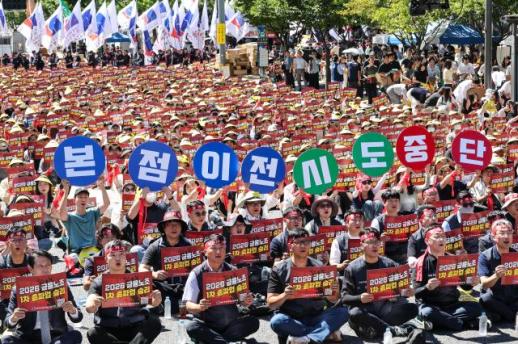 Korea's state bank workers join union strike opposing to relocation SEOUL, September 04 (AJP) -Whether South Korea's financial regulators and state-run policy banks will be swept into a second round of public-sector relocations starting next year remains undecided, but the possibility has become a major flashpoint for financial workers, drawing about 15,000 union members to central Seoul on Friday. The Korean Financial Industry Union staged a sit-in along Sejong-daero in Gwanghwamun, its first such action in about a year, with workers from the state lenders Korea Development Bank, Export-Import Bank of Korea and Industrial Bank of Korea forming the core of the turnout. Many wore red headbands emblazoned with "general strike," while placards called for blocking regional relocation, introducing a 4.5-day workweek and securing real wage increases. The strike came a day after the government unveiled plans to review about 350 public institutions in the Seoul metropolitan area for relocation under a "minimum retention" principle, with a detailed list due in the fourth quarter and moves beginning in 2027. KDB, IBK and Eximbank have not yet been formally designated for relocation. The uncertainty has nevertheless alarmed their unions, which argue that dispersing policy lenders, financial regulators, commercial institutions and specialist personnel could weaken the clustering that underpins Seoul's financial industry. "Financial companies, policy and supervisory institutions and specialized personnel need to be gathered in one place to exchange information and make quick decisions," union Chairman Yoon Seok-gu said. He called for the government first to assess how much the first round of public-institution relocations eased concentration in the Seoul area or contributed to regional economies before embarking on another round. The union is demanding that any headquarters relocation be subject to prior notice and agreement with employees. It is also seeking a 6 percent wage increase, a 4.5-day workweek, expanded youth hiring, an extension of the retirement age and other institutional changes. Senior Vice Chairman Yang Min-ho said the six demands formed the core of the union's bargaining agenda. Yoon said shorter working hours were necessary because financial workers faced heavy performance pressure and demanding schedules that left little time for family life. The rally also drew lawmakers from both the ruling Democratic Party and the opposition People Power Party. Democratic Party lawmaker Lee Yong-woo voiced support for the union's call for a 4.5-day workweek, while People Power Party lawmaker Kim Hyung-dong said relocation of public financial institutions should require National Assembly consent. Union members occupied all lanes of a roughly 450-meter stretch of Sejong-daero between Dongwha Duty Free and the direction of Seoul City Hall during the rally. Average traffic speed across central Seoul slowed to 11.7 kilometers per hour around noon, according to the Seoul Transport Operation and Information Service. The union said further strikes could follow depending on the outcome of negotiations. Members voted last month to authorize industrial action with 96.05 percent support and held a mass rally on Aug. 28 to signal preparations for Friday's walkout. The dispute adds a potentially difficult financial-sector dimension to the government's broader decentralization drive. The government says it intends to minimize the number of public institutions allowed to remain in the capital region and use relocations to create stronger regional economic clusters. Financial unions argue that applying the same logic to policy banks and regulators could instead fragment an industry that depends heavily on proximity among institutions, regulators and specialist talent. AJP Takeaways - About 15,000 financial workers rallied in central Seoul against the possible relocation of state-run policy banks under the government's second public-institution relocation drive. - KDB, IBK and the Export-Import Bank of Korea have not yet been formally designated for relocation, with the government set to announce its detailed list in the fourth quarter. - The Korean Financial Industry Union also demanded a 4.5-day workweek, a 6 percent pay increase, expanded youth hiring and prior agreement on any headquarters move. 2026-09-04 13:32:51
 -
Prosecutors Charge Judge Ji Gwi-yeon with Violation of Anti-Corruption Law Judge Ji Gwi-yeon of the Seoul Northern District Court has been charged with violating the Anti-Corruption Law in connection with allegations of room salon entertainment. During the investigation, he reportedly denied most of the charges.A spokesperson for the Corruption Investigation Office for High-Ranking Officials (CIO) stated on September 4 that Judge Ji denied the allegations during questioning. The spokesperson added, "He said, 'I don't remember well' or 'I might have fallen asleep due to alcohol,' and claimed, 'I don't think I drank for an extended period with the lawyers at the bar.'"When asked if he denied the amount charged, the spokesperson said, "He stated that it was 'not within his area' regarding the amount, which contradicts his previous claim of having 'had one or two drinks and left.'"The CIO also investigated whether Judge Ji had a history of being reported as intoxicated in the vicinity of the bar, but found no significant circumstances.Regarding the decision not to charge the accompanying lawyers, the spokesperson explained, "The unique structure of the CIO law means we have no investigative authority over those lawyers, who are private citizens and not public officials."The spokesperson added, "We need to receive a complaint or have a special reason to initiate an investigation, but we lack the authority to do so, and we are reviewing the direction of the case."Additionally, the spokesperson noted, "The lawyers were also uncooperative during the investigation, with some refusing to testify."On the same day, the CIO charged Judge Ji without detention for violating the Anti-Corruption Law.Judge Ji is accused of visiting a reservation-only bar in Cheongdam-dong, Gangnam, with two lawyer acquaintances in August 2013, where he allegedly had drinks and had them pay a total of 4.09 million won. The CIO determined that Judge Ji's share of the bill amounted to 1.36 million won when divided among the three.The Anti-Corruption Law stipulates that public officials who receive goods or entertainment worth more than 1 million won from the same individual in a single instance are subject to punishment, regardless of job-relatedness or reciprocity.Previously, Judge Ji presided over the first trial of former President Yoon Suk-yeol in a rebellion case while working at the Seoul Central District Court last year. However, during the review of the former president's release from custody, he calculated the detention period in hours rather than days, leading to the release of the former president. The then-opposition Democratic Party criticized Judge Ji harshly, and in May of the same year, allegations of his involvement in room salon entertainment were raised, along with the release of related photographs. Subsequently, civic groups filed a complaint against Judge Ji with the CIO for violating the Anti-Corruption Law.The CIO began its investigation and confirmed that the payment records from the bar matched the taxi usage records of Judge Ji. They also secured financial transaction records of related individuals and conducted summons investigations before charging Judge Ji without detention.The CIO investigated the potential for quid pro quo arrangements between Judge Ji and the lawyers but concluded that there was no evidence of such relationships based solely on vague assumptions, leading to a decision not to charge for violations related to receiving entertainment.Following the indictment, Judge Ji's legal representative issued a statement strongly criticizing the CIO. Attorney Kim Hyung-seok of SP Law Firm stated, "Judge Ji briefly attended a gathering with his juniors and left immediately. The relationship with his juniors and the circumstances of the gathering are particularly important, as none of the juniors have worked on cases related to clients' duties in the past ten years."He continued, "Even if we assume, as the CIO claims, that my client stayed for the entire gathering, the total value of the gifts received from the same individual does not exceed 1 million won, and thus the legal criteria for violating the Anti-Corruption Law are not met."He expressed regret over the CIO's unreasonable factual recognition and legal application, stating, "We will engage sincerely in the upcoming trial process."* This article has been translated by AI. 2026-09-04 13:32:00
-
South Korea to Reintegrate Power Companies into 'Korea Power' After 25 Years The South Korean government plans to reintegrate its five power generation companies, which were split in 2001 to introduce competition in the electricity sector. The new entity, named 'Korea Power,' is set to be established as a wholly-owned subsidiary of Korea Electric Power Corporation (KEPCO) and aims to officially launch in October 2027. On September 4, the Ministry of Climate, Energy and Environment held a meeting at KEPCO's Southern Seoul headquarters to announce the plan for the consolidation of the five companies and the roadmap for implementation. Since February, the government has been conducting research and gathering opinions from experts, labor unions, and stakeholders from the five companies. The research recommended that merging into a single entity would be the most suitable structure to enhance the effectiveness of energy transition and ensure a just transition while improving management efficiency. According to the ministry, the combined power generation capacity of the five companies is approximately 53 gigawatts (GW), which would position the new company as the eighth largest power producer globally, and the fourteenth largest when including Chinese firms. The government aims to consolidate the capital and workforce currently spread across the five companies to expand renewable energy initiatives and systematically pursue a just transition following the phase-out of coal power. By centralizing fuel procurement and investment in power generation facilities, the government plans to reduce costs and develop renewable energy and energy storage systems (ESS) on a large scale to achieve economies of scale. The organizational structure will also undergo significant changes. The headquarters of Korea Power will consist of four divisions: the Renewable Energy Division, the Just Transition Division, the Safety Technology Division, and the Planning and Management Division. The current structure of five CEOs, five auditors, and ten executive directors will be streamlined to one CEO, one auditor, and four executive directors. The workforce at the headquarters will decrease from over 2,400 to about 1,800. The remaining 600 employees will be assigned to three to four newly established regional renewable energy divisions, focusing on local renewable energy projects such as solar and onshore wind. The existing regional thermal power divisions will maintain their current structure to ensure stable operations and safety at power plants. As coal plants are phased out or converted, the government will consider reallocating personnel in accordance with the principles of a just transition and may establish additional regional renewable energy divisions if necessary. The location of the new headquarters has not yet been determined. The current headquarters of the five companies, located in Jinju, Boryeong, Taean, Busan, and Ulsan, each accommodate about 500 employees, making it challenging to house the consolidated workforce of 1,800 in one location. The government plans to decide on the headquarters location later, taking into account the current positions of the power companies, the impact of the just transition, and living and working conditions, in conjunction with the second public institution relocation policy. The government will also initiate the drafting of a special law to facilitate the merger of the five companies. This law will include provisions for the establishment of Korea Power, the delegation of permits and approvals related to power generation, the succession of rights and obligations of existing companies, the simplification of merger procedures, and the alleviation of tax burdens. The government is also considering provisions to exempt the merger from antitrust reviews. The goal is to enact this special law during the regular session of the National Assembly this year. Later this month, the ministry will form a 'Power Generation Company Integration Preparation Committee' chaired by the second vice minister. This committee will include representatives from the five companies, KEPCO, and sector experts to discuss the organizational structure, personnel allocation, operational systems, integration procedures, and overseas business opportunities for the new company. Following the enactment of the special law, the Integration Promotion Committee will begin the formal integration process. The government aims to complete the registration of the new entity and the appointment of executives by September 2027, with the official launch of 'Korea Power' scheduled for October 1 of the same year. * This article has been translated by AI. 2026-09-04 13:32:00