

Indian Prime Minister Modi visits Cheonggyecheon [Aju Business Daily photo ]
Copyright ⓒ Aju Press All rights reserved.
Related News
-
 Indian Youth Protest Forces Modi Government to Yield, Resulting in Minister's Resignation
In India, a youth protest that began as an online satire movement has forced the resignation of a key minister in Prime Minister Narendra Modi's government, creating a political stir.After 12 years of long-standing rule, the Modi administration, which has rarely backed down under pressure from civil society, has made an unusual concession in the face of collective action from Generation Z.On July 27, CNN reported that the newly formed "Cockroach People's Party (CJP)" led large-scale protests against the leak of university entrance exam questions, resulting in the resignation of Education Minister Dharmendra Pradhan.Thousands of protesters occupied central New Delhi for several days, demanding accountability for the exam leak and Pradhan's resignation. They argued that the leak deprived millions of students of a fair opportunity.Following Pradhan's resignation on July 25, celebrations erupted late into the night at Jantar Mantar, the protest site in New Delhi. Participants waved flags, danced, and sang, viewing the resignation as a victory for collective action.Pradhan, a close ally of Prime Minister Modi, had maintained his position despite various civil society protests since the Bharatiya Janata Party (BJP) came to power in 2014. His resignation is seen as an unusual concession from the BJP, which has built a strong image under Modi's leadership.The protests are rooted in the accumulated economic grievances of the youth. India, with a population of over 360 million aged 15 to 29, has seen about 40% of college graduates under 25 unemployed, according to recent reports.Despite being one of the fastest-growing major economies in the world, many young people feel that national growth has not translated into job opportunities or upward mobility for individuals.The CJP originated from a satirical online movement created by Boston University graduate Abhijit Deepke. It quickly evolved into a platform representing the anxieties of youth regarding employment, governance, and social mobility.Protesters notably utilized Instagram Reels, videos, and memes to share real-time updates from the ground, rather than relying on traditional media. The scale of participation grew after police used tear gas and batons against protesters marching toward Parliament on July 20, with some calling for Modi's resignation.After the government promised to consider additional demands, including compensation for families of students who took their own lives due to the exam leak, the protest leadership decided to suspend demonstrations on July 25. However, Deepke remarked as he left the protest site, "This is not the end. We will meet again soon."CNN noted that Modi and the BJP still enjoy high approval ratings and strong electoral organization, with the next general election scheduled for 2029. However, analysts are watching to see if this incident could catalyze long-term political mobilization among the youth.* This article has been translated by AI.
-
Xi Jinping and Narendra Modi to Discuss Key Issues During Upcoming Meeting
Chinese President Xi Jinping will visit India on September 12-13. The Chinese Foreign Ministry announced on the 10th that Xi will attend the 18th BRICS summit in New Delhi at the invitation of Indian Prime Minister Narendra Modi. This marks Xi's first visit to India in seven years, and it is particularly significant as it is his first trip since the clash between Chinese and Indian troops in the Galwan Valley in 2020, raising questions about a potential turning point in bilateral relations.During the visit, Xi is expected to hold talks with Modi. The main topics of discussion will focus on four key areas. The first is the border issue. Relations between the two countries deteriorated sharply after the 2020 clash, but there have been efforts to reduce military tensions since last year. India and China have been negotiating to prevent troop clashes along the Line of Actual Control (LAC). Indian media anticipate that the summit will address recent developments in border negotiations, troop deployments, and border management systems.The second area of focus is the restoration of economic cooperation. While trade between the two nations is recovering, there remains significant distrust regarding investments and business operations due to India's security reviews of Chinese companies, delays in visa issuance, and regulatory issues. India may push for expanded market access for Chinese products and a reduction in trade deficits. Conversely, China is likely to request that India ease investment restrictions on Chinese firms and improve visa and customs processes. Indian media have suggested the possibility of launching a 'strategic economic dialogue' platform between the two countries.The third topic is enhancing cooperation as members of the Global South. Chinese state media highlighted Xi's visit as an opportunity to promote BRICS as a platform for joint development and reform of international governance. This includes discussions on IMF shareholding and World Bank governance reform, issues linked to global multipolarity. If the two leaders present a united front on these matters, it could signal a coordinated effort to counterbalance the United States. For Xi, who is set to visit the U.S. on the 24th, this could represent a significant political maneuver.The fourth area of discussion will be cooperation within BRICS, particularly regarding direct payment methods that exclude the dollar. India is expected to advocate for connecting central bank digital currencies (CBDCs) among member countries to facilitate cross-border payments during the summit. For China, which is promoting the expansion of the digital yuan, there is little reason to oppose this initiative. However, India remains cautious about a China-centric financial order and is believed to prefer cooperation at the level of payment system integration rather than a joint currency to replace the dollar.On the 10th, the second BRICS finance ministers and central bank governors meeting took place in Mumbai, where participants discussed various topics, including the global economic situation, international financial governance, the BRICS contingency reserve fund, cross-border payment systems, fintech, and sustainable finance.Additionally, global issues such as the situation in the Middle East and the war in Ukraine are expected to be on the agenda for the Xi-Modi summit. If the two leaders can reach concrete agreements on border stability, normalization of visas and flights, Chinese investment, and trade expansion, it could signal the most significant improvement in China-India relations since the 2020 Galwan clash. Furthermore, if they present a unified stance on direct currency payments and global multipolarity, it could enhance the significance of their cooperation.* This article has been translated by AI.
-
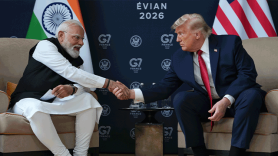 Trump and Modi Meet at G7 to Discuss Trade Agreement and Maritime Security
Indian Prime Minister Modi (left) and U.S. President Trump hold a bilateral meeting Donald Trump, the President of the United States, and Narendra Modi, the Prime Minister of India, met during the G7 summit to discuss a trade agreement and the safety of sailors in the Hormuz Strait. This was their first face-to-face meeting since their talks at the White House in February of last year. On June 17, local time, Reuters and AP reported that Trump and Modi held a separate meeting while attending the G7 summit in Évian-les-Bains, France. Trump stated that negotiations with India have been ongoing for quite some time and are “almost at the final stage.” He referred to Modi as “a long-time friend” but also described him as “a very tough negotiator.” The two countries are in the final stages of discussions regarding tariffs and conditions for U.S. companies entering the Indian market as they work toward a phase one trade agreement. In February, they reached a tentative agreement on some issues, but finalization has been delayed due to disagreements over U.S. trade law Section 301 investigations and tariffs. Section 301 allows the U.S. to impose retaliatory tariffs on what it deems unfair trade practices. Modi requested assurances for the safety of Indian sailors operating in the Gulf region, including the Hormuz Strait. He emphasized that “hundreds of thousands of Indian sailors are engaged in global maritime trade,” and their protection is crucial during the implementation of the U.S.-Iran memorandum of understanding. Earlier, on June 9, U.S. forces attacked a Palauan-flagged oil tanker, claiming it violated a maritime blockade against Iran, resulting in the deaths of three Indian sailors. Following this incident, the Indian government summoned the U.S. chargé d'affaires to express its concerns. Trump commented on the sailors' deaths, stating, “We are working together on this issue,” and added, “They are great people.” He also noted, “If India is attacked, we will be there to help them.” This meeting is seen as an opportunity to recalibrate the relationship between the two nations, which has cooled due to tariff disputes and maritime security issues. Trump expressed his willingness to visit India in the future, although he did not provide a specific timeline.* This article has been translated by AI.